

CONSUMERS’ AWARENESS
LEVEL ON THEIR CONSUMER
RIGHTS AND
RESPONSIBILITIES
DOSCST IN-HOUSE REVIEW
June 25-26, 2014
AVR, DOSCST
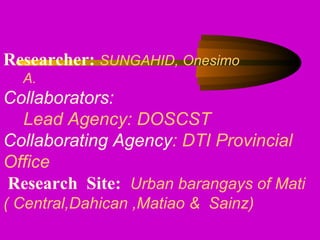
Researcher: SUNGAHID, Onesimo
A.
Collaborators:
Lead Agency: DOSCST
Collaborating Agency: DTI Provincial
Office
Research Site: Urban barangays of Mati
( Central,Dahican ,Matiao & Sainz)
Duration:
Date Started: February 25, 2013
Date Ended: : May 26, 2014
Development Zone: Education
Summary of Financial Report:
Total budget: P 5,000.00
Actual Expenditure: P 5,000.00
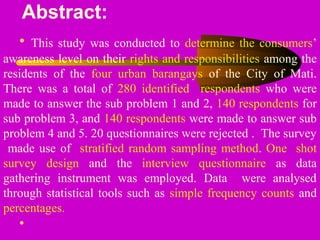
Abstract:
• This study was conducted to determine the consumers’
awareness level on their rights and responsibilities among the
residents of the four urban barangays of the City of Mati.
There was a total of 280 identified respondents who were
made to answer the sub problem 1 and 2, 140 respondents for
sub problem 3, and 140 respondents were made to answer sub
problem 4 and 5. 20 questionnaires were rejected . The survey
made use of stratified random sampling method. One shot
survey design and the interview questionnaire as data
gathering instrument was employed. Data were analysed
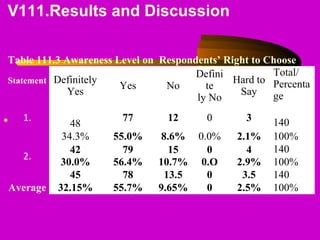
through statistical tools such as simple frequency counts and
percentages.
•
Abstract:
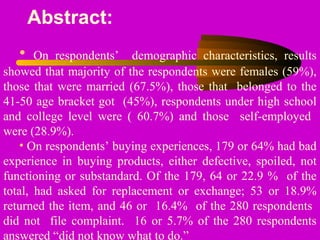
• On respondents’ demographic characteristics, results
showed that majority of the respondents were females (59%),
those that were married (67.5%), those that belonged to the
41-50 age bracket got (45%), respondents under high school
and college level were ( 60.7%) and those self-employed
were (28.9%).
• On respondents’ buying experiences, 179 or 64% had bad
experience in buying products, either defective, spoiled, not
functioning or substandard. Of the 179, 64 or 22.9 % of the
total, had asked for replacement or exchange; 53 or 18.9%
returned the item, and 46 or 16.4% of the 280 respondents
did not file complaint. 16 or 5.7% of the 280 respondents
answered “did not know what to do.”
Abstract:
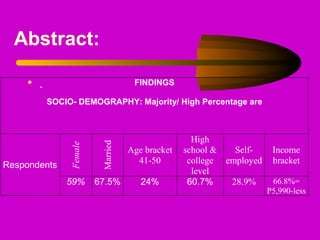
• . FINDINGS
SOCIO- DEMOGRAPHY: Majority/ High Percentage are
Respondents
Female
Married
Age bracket
41-50
High
school &
college
level
Self-
employed
Income
bracket
59% 67.5% 24% 60.7% 28.9% 66.8%=
P5,990-less
Abstract:
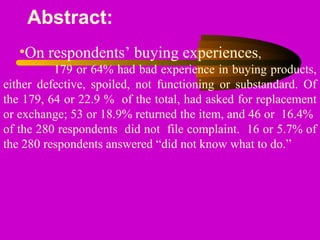
•On respondents’ buying experiences,
179 or 64% had bad experience in buying products,
either defective, spoiled, not functioning or substandard. Of
the 179, 64 or 22.9 % of the total, had asked for replacement
or exchange; 53 or 18.9% returned the item, and 46 or 16.4%
of the 280 respondents did not file complaint. 16 or 5.7% of
the 280 respondents answered “did not know what to do.”
Abstract:
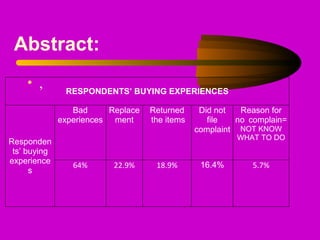
• , RESPONDENTS’ BUYING EXPERIENCES
Responden
ts’ buying
experience
s
Bad
experiences
Replace
ment
Returned
the items
Did not
file
complaint
Reason for
no complain=
NOT KNOW
WHAT TO DO
64% 22.9% 18.9% 16.4% 5.7%
Abstract:
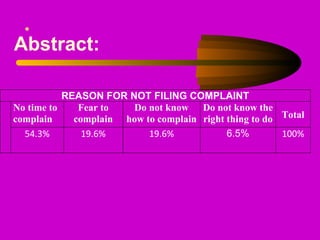
• Of the 46 respondents who did not file complaint,
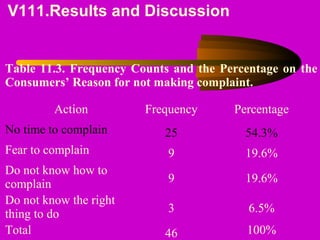
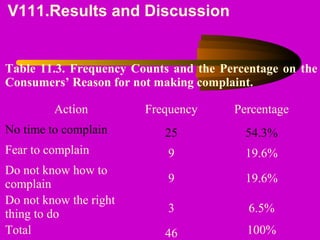
25 or 54.3% had reasoned, ‘ no time to complain”.
while 39. 2% either they fear to complain ( 19.6%) and did
not know how to complain( 19. 6 % ).
Abstract:
• .
REASON FOR NOT FILING COMPLAINT
No time to
complain
Fear to
complain
Do not know
how to complain
Do not know the
right thing to do Total
54.3% 19.6% 19.6% 6.5% 100%
Abstract:
•
•With regards to their rights, respondents had
–A) high level of consumer awareness with their right to
information, safety and right to basic needs.
– B) low level of awareness on their right to choose,
right to redress, to representation, to healthy environment
and to consumer education.
–C) Over all, respondents had low awareness level on
their consumer rights.
Introduction:
•With impact of industrialization and
manufacturing companies, more and more goods and
services are made available to the consumers. Along
with this rapid social changes, consumers are more
vulnerable to substandard products and false services
due to malpractices of traders and manufacturing
entities who are motivated alone by material gains.
Introduction:
•So consumer laws were promulgated to safeguard
consumers against these practices
•With the legal basis, consumers’ rights and responsibilities
are defined.
•To what extent do consumers are aware of their rights and
responsibilities?
• Results of this study will assist the Trade and Industry
Department in plotting its direction of emphasis towards a
better consumer education strategy.
Objectives :
General Objective: to determine the
consumers’ level of awareness on their
consumer rights and responsibilities.
Specific objectives: TO FIND OUT
1.their socio-demographic characteristics.
2.the respondents’ buying experiences.
3.their awareness level on their consumers’ rights.
4.their awareness level on their consumers’ buying
responsibilities.
5.their awareness level on agencies responsible for
the implementation of consumers’ rights.
Methodology:
Research Locale of the Study
The study was conducted in four (4)
barangays of Mati, City, Davao Oriental. These
barangays are: Barangay Sainz, Central, Matiao
and Dahican.
•Respondents of the Study
The respondents of the study were obtained
from the four barangays of Mati City: Baranagy
Sainz, Barangay Central, Barangay Matiao, and
Baranagy Dahican respectively.
Methodology:
• The Sampling Method
• Stratified sampling methods with proportionate
allocation of the respondents per barangay
done using random selection sampling.
Methodology:
Research Design Instrument
One-shot survey design using interview
guide to gather data.
•Methods of Analysis
•Data were computed, analyzed and interpreted using
percentages and frequency counts.
Methodology:
• .
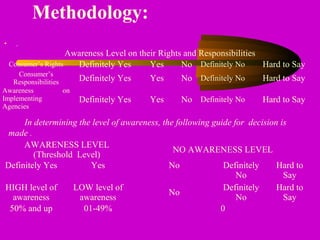
Awareness Level on their Rights and Responsibilities
Consumer’s Rights Definitely Yes Yes No Definitely No Hard to Say
Consumer’s
Responsibilities Definitely Yes Yes No Definitely No Hard to Say
Awareness on
Implementing
Agencies
Definitely Yes Yes No Definitely No Hard to Say
AWARENESS LEVEL
(Threshold Level)
NO AWARENESS LEVEL
Definitely Yes Yes No Definitely
No
Hard to
Say
HIGH level of
awareness
LOW level of
awareness
No
Definitely
No
Hard to
Say
50% and up 01-49% 0
In determining the level of awareness, the following guide for decision is
made .
Methodology:
Research Design Instrument
One-shot survey design using interview
guide to gather data.
•Methods of Analysis
•Data were computed, analyzed and interpreted using
percentages and frequency counts.
V111.Results and Discussion
.
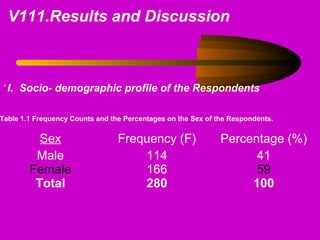
Table 1.1 Frequency Counts and the Percentages on the Sex of the Respondents.
Sex Frequency (F) Percentage (%)
Male
Female
Total
114
166
280
41
59
100
I. Socio- demographic profile of the Respondents
V111.Results and Discussion
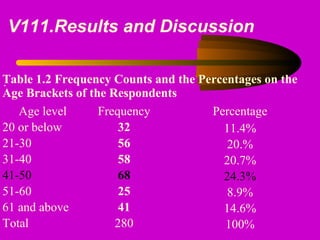
.Table 1.2 Frequency Counts and the Percentages on the
Age Brackets of the Respondents
Age level Frequency Percentage
20 or below 32 11.4%
21-30 56 20.%
31-40 58 20.7%
41-50 68 24.3%
51-60 25 8.9%
61 and above 41 14.6%
Total 280 100%
V111.Results and Discussion
.
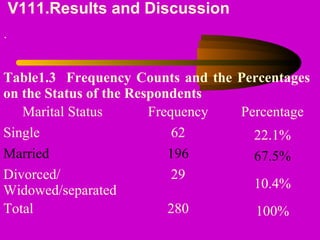
Table1.3 Frequency Counts and the Percentages
on the Status of the Respondents
Marital Status Frequency Percentage
Single 62 22.1%
Married 196 67.5%
Divorced/
Widowed/separated
29
10.4%
Total 280 100%
V111.Results and Discussion
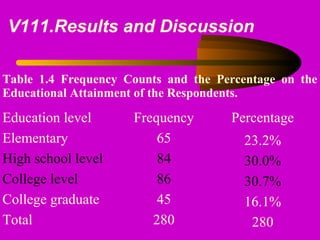
Table 1.4 Frequency Counts and the Percentage on the
Educational Attainment of the Respondents.
Education level Frequency Percentage
Elementary 65 23.2%
High school level 84 30.0%
College level 86 30.7%
College graduate 45 16.1%
Total 280 280
V111.Results and Discussion
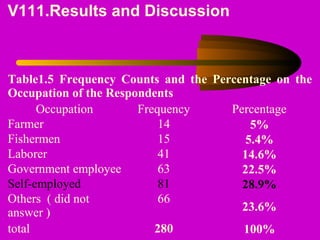
Table1.5 Frequency Counts and the Percentage on the
Occupation of the Respondents
Occupation Frequency Percentage
Farmer 14 5%
Fishermen 15 5.4%
Laborer 41 14.6%
Government employee 63 22.5%
Self-employed 81 28.9%
Others ( did not
answer )
66
23.6%
total 280 100%
V111.Results and Discussion
.
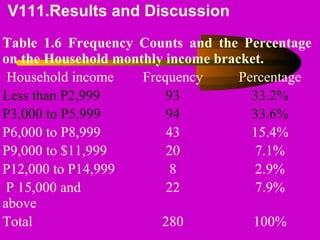
Table 1.6 Frequency Counts and the Percentage
on the Household monthly income bracket.
Household income Frequency Percentage
Less than P2,999 93 33.2%
P3,000 to P5,999 94 33.6%
P6,000 to P8,999 43 15.4%
P9,000 to $11,999 20 7.1%
P12,000 to P14,999 8 2.9%
P 15,000 and
above
22 7.9%
Total 280 100%
V111.Results and Discussion
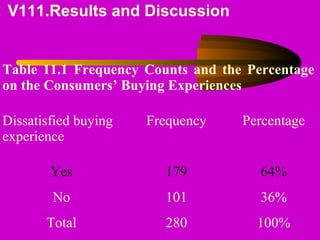
Table 11.1 Frequency Counts and the Percentage
on the Consumers’ Buying Experiences
Dissatisfied buying
experience
Frequency Percentage
Yes 179 64%
No 101 36%
Total 280 100%
• .
V111.Results and Discussion
.
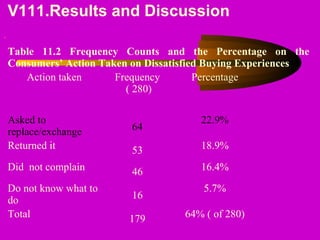
Table 11.2 Frequency Counts and the Percentage on the
Consumers’ Action Taken on Dissatisfied Buying Experiences
Action taken Frequency
( 280)
Percentage
Asked to
replace/exchange 64
22.9%
Returned it 53 18.9%
Did not complain 46 16.4%
Do not know what to
do 16
5.7%
Total 179 64% ( of 280)
V111.Results and Discussion
Table 11.3. Frequency Counts and the Percentage on the
Consumers’ Reason for not making complaint.
Action Frequency Percentage
No time to complain 25 54.3%
Fear to complain 9 19.6%
Do not know how to
complain 9 19.6%
Do not know the right
thing to do 3 6.5%
Total 46 100%
V111.Results and Discussion
Table 11.3. Frequency Counts and the Percentage on the
Consumers’ Reason for not making complaint.
Action Frequency Percentage
No time to complain 25 54.3%
Fear to complain 9 19.6%
Do not know how to
complain 9 19.6%
Do not know the right
thing to do 3 6.5%
Total 46 100%
V111.Results and Discussion
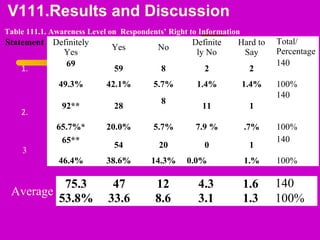
Table 111.1. Awareness Level on Respondents’ Right to Information
Statement Definitely
Yes
Yes No
Definite
ly No
Hard to
Say
Total/
Percentage
1.
 
69
59 8 2 2
140
49.3% 42.1% 5.7% 1.4% 1.4% 100%
2.
92** 28
8
11 1
140
65.7%* 20.0% 5.7% 7.9 % .7% 100%
3
65**
54 20 0 1
140
46.4% 38.6% 14.3% 0.0% 1.% 100%
Average
75.3 47 12 4.3 1.6 140
53.8% 33.6 8.6 3.1 1.3 100%
V111.Results and Discussion
.
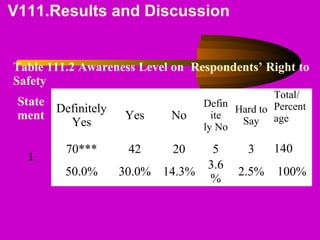
Table 111.2 Awareness Level on Respondents’ Right to
Safety
State
ment
Definitely
Yes
Yes No
Defin
ite
ly No
Hard to
Say
Total/
Percent
age
1
 
70*** 42 20 5 3 140
50.0% 30.0% 14.3%
3.6
%
2.5% 100%
V111.Results and Discussion
Table 111.3 Awareness Level on Respondents’ Right to Choose
Statement Definitely
Yes
Yes No
Defini
te
ly No
Hard to
Say
Total/
Percenta
ge
1.
 
48
77 12 0 3 140
34.3% 55.0% 8.6% 0.0% 2.1% 100%
2.
42 79 15 0 4 140
30.0% 56.4% 10.7% 0.O 2.9% 100%
Average
45 78 13.5 0 3.5 140
32.15% 55.7% 9.65% 0 2.5% 100%
• .
V111.Results and Discussion
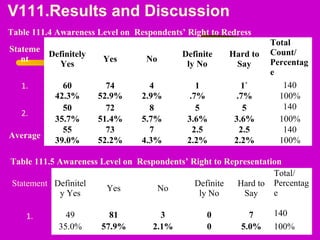
.Table 111.4 Awareness Level on Respondents’ Right to Redress
Stateme
nt
Definitely
Yes
Yes No
Definite
ly No
Hard to
Say
Total
Count/
Percentag
e
1.
 
60 74 4 1 1` 140
42.3% 52.9% 2.9% .7% .7% 100%
2.
50 72 8 5 5 140
35.7% 51.4% 5.7% 3.6% 3.6% 100%
Average
55 73 7 2.5 2.5 140
39.0% 52.2% 4.3% 2.2% 2.2% 100%
Table 111.5 Awareness Level on Respondents’ Right to Representation
Statement
 
Definitel
y Yes
Yes No
Definite
ly No
Hard to 
Say
Total/ 
Percentag
e
1.
 
49 81 3 0 7 140
35.0% 57.9% 2.1% 0 5.0% 100%
V111.Results and Discussion
.
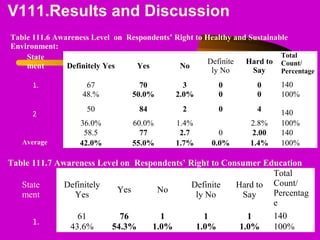
Table 111.6 Awareness Level on Respondents’ Right to Healthy and Sustainable
Environment:
State
ment Definitely Yes Yes No
Definite
ly No
Hard to
Say
Total
Count/
Percentage
1.
 
67 70 3 0 0 140
48.% 50.0% 2.0% 0 0 100%
2.
50 84 2 0 4
 
140
36.0% 60.0% 1.4%   2.8% 100%
Average
58.5 77 2.7 0 2.00 140
42.0% 55.0% 1.7% 0.0% 1.4% 100%
Table 111.7 Awareness Level on Respondents’ Right to Consumer Education
State
ment
Definitely 
Yes
Yes No
Definite
ly No
Hard to 
Say
Total 
Count/ 
Percentag
e
1.
61 76 1 1 1 140
43.6% 54.3% 1.0% 1.0% 1.0% 100%
V111.Results and Discussion
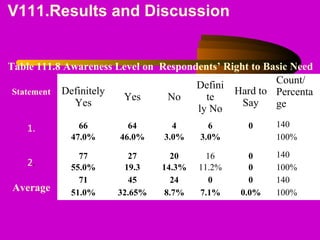
Table 111.8 Awareness Level on Respondents’ Right to Basic Need
Statement Definitely 
Yes
Yes No
Defini
te
ly No
Hard to 
Say
Count/ 
Percenta
ge
1.
 
66 64 4 6 0 140
47.0% 46.0% 3.0% 3.0% 100%
2.
77 27 20 16 0 140
55.0% 19.3 14.3% 11.2% 0 100%
Average
71 45 24 0 0 140
51.0% 32.65% 8.7% 7.1% 0.0% 100%
V111.Results and Discussion
.
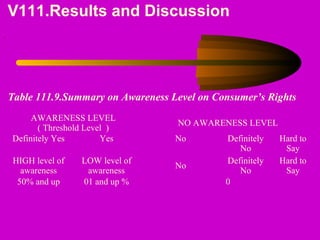
AWARENESS LEVEL
( Threshold Level  )
NO AWARENESS LEVEL
Definitely Yes Yes No Definitely
No
Hard to 
Say
HIGH level of 
awareness
LOW level of 
awareness
No
Definitely 
No
Hard to 
Say
50% and up 01 and up % 0
Table 111.9.Summary on Awareness Level on Consumer’s Rights
V111.Results and Discussion
.
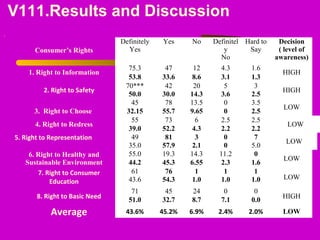
Consumer’s Rights
Definitely 
Yes
Yes No Definitel
y
No
Hard to 
Say
Decision
( level of
awareness)
 
1. Right to Information
75.3 47 12 4.3 1.6
HIGH
 
53.8 33.6 8.6 3.1 1.3  
2. Right to Safety
70*** 42 20 5 3
HIGH
 
50.0 30.0 14.3 3.6 2.5  
 
3. Right to Choose 
45 78 13.5 0 3.5
LOW
 
32.15 55.7 9.65 0 2.5  
4. Right to Redress
55 73 6 2.5 2.5
LOW
39.0 52.2 4.3 2.2 2.2
 5. Right to Representation
 
49 81 3 0 7
LOW
 
35.0 57.9 2.1 0 5.0  
6. Right to Healthy and
Sustainable Environment
55.0 19.3 14.3 11.2 0
LOW
 
44.2 45.3 6.55 2.3 1.6  
7. Right to Consumer 
Education
61 76 1 1 1
LOW
 
43.6 54.3 1.0 1.0 1.0  
8. Right to Basic Need
71 45 24 0 0
HIGH
 
51.0 32.7 8.7 7.1 0.0  
Average 43.6% 45.2% 6.9% 2.4% 2.0% LOW  
V111.Results and Discussion
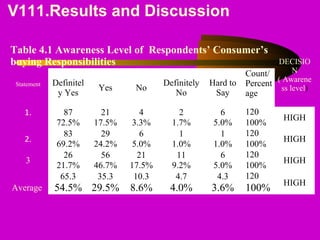
Table 4.1 Awareness Level of Respondents’ Consumer’s
buying Responsibilities DECISIO
N
( Awarene
ss level)
Statement
 
Definitel
y Yes
Yes No
Definitely 
No
Hard to 
Say
Count/ 
Percent
age
1.
 
87 21 4 2 6 120
HIGH
72.5% 17.5% 3.3% 1.7% 5.0% 100%
2.
83 29 6 1 1 120
HIGH
69.2% 24.2% 5.0% 1.0% 1.0% 100%
3
26 56 21 11 6 120
HIGH
21.7% 46.7% 17.5% 9.2% 5.0% 100%
 
Average 
65.3 35.3 10.3 4.7 4.3 120
HIGH
54.5% 29.5% 8.6% 4.0% 3.6% 100%
V111.Results and Discussion
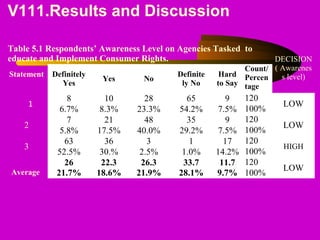
Table 5.1 Respondents’ Awareness Level on Agencies Tasked to
educate and Implement Consumer Rights. DECISION
( Awarenes
s level)Statement Definitely
Yes
Yes No
Definite
ly No
Hard
to Say
Count/
Percen
tage
1
8 10 28 65 9 120
LOW
6.7% 8.3% 23.3% 54.2% 7.5% 100%
2
7 21 48 35 9 120
LOW
5.8% 17.5% 40.0% 29.2% 7.5% 100%
3
63 36 3 1 17 120
HIGH
52.5% 30.% 2.5% 1.0% 14.2% 100%
Average
26 22.3 26.3 33.7 11.7 120
LOW
21.7% 18.6% 21.9% 28.1% 9.7% 100%
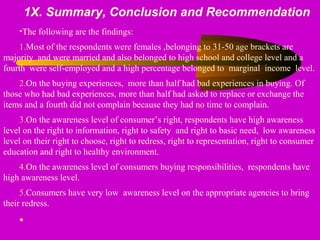
1X. Summary, Conclusion and Recommendation
•The following are the findings:
1.Most of the respondents were females ,belonging to 31-50 age brackets are 
majority  and were married and also belonged to high school and college level and a 
fourth  were self-employed and a high percentage belonged to  marginal  income  level.
2.On the buying experiences,  more than half had bad experiences in buying. Of 
those who had bad experiences, more than half had asked to replace or exchange the 
items and a fourth did not complain because they had no time to complain.
3.On the awareness level of consumer’s right, respondents have high awareness 
level on the right to information, right to safety  and right to basic need,  low awareness 
level on their right to choose, right to redress, right to representation, right to consumer 
education and right to healthy environment.
4.On the awareness level of consumers buying responsibilities,  respondents have 
high awareness level.
5.Consumers have very low  awareness level on the appropriate agencies to bring 
their redress. 
•
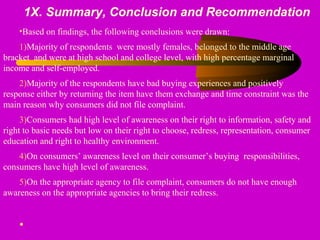
1X. Summary, Conclusion and Recommendation
•Based on findings, the following conclusions were drawn:
1)Majority of respondents  were mostly females, belonged to the middle age 
bracket  and were at high school and college level, with high percentage marginal 
income and self-employed. 
2)Majority of the respondents have bad buying experiences and positively 
response either by returning the item have them exchange and time constraint was the 
main reason why consumers did not file complaint.
3)Consumers had high level of awareness on their right to information, safety and 
right to basic needs but low on their right to choose, redress, representation, consumer 
education and right to healthy environment.
4)On consumers’ awareness level on their consumer’s buying  responsibilities, 
consumers have high level of awareness.
5)On the appropriate agency to file complaint, consumers do not have enough 
awareness on the appropriate agencies to bring their redress.
•
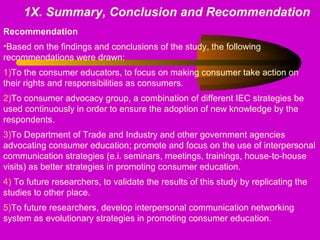
1X. Summary, Conclusion and Recommendation
Recommendation
•Based on the findings and conclusions of the study, the following
recommendations were drawn:
1)To the consumer educators, to focus on making consumer take action on
their rights and responsibilities as consumers.
2)To consumer advocacy group, a combination of different IEC strategies be
used continuously in order to ensure the adoption of new knowledge by the
respondents.
3)To Department of Trade and Industry and other government agencies
advocating consumer education; promote and focus on the use of interpersonal
communication strategies (e.i. seminars, meetings, trainings, house-to-house
visits) as better strategies in promoting consumer education.
4) To future researchers, to validate the results of this study by replicating the
studies to other place.
5)To future researchers, develop interpersonal communication networking
system as evolutionary strategies in promoting consumer education.
THE END
THANK YOU VERY MUCH
• Researcher: Onie Sun

Consumer awareness level

  • 1.
    CONSUMERS’ AWARENESS LEVEL ONTHEIR CONSUMER RIGHTS AND RESPONSIBILITIES DOSCST IN-HOUSE REVIEW June 25-26, 2014 AVR, DOSCST
  • 2.
    Researcher: SUNGAHID, Onesimo A. Collaborators: LeadAgency: DOSCST Collaborating Agency: DTI Provincial Office Research Site: Urban barangays of Mati ( Central,Dahican ,Matiao & Sainz)
  • 3.
    Duration: Date Started: February25, 2013 Date Ended: : May 26, 2014 Development Zone: Education Summary of Financial Report: Total budget: P 5,000.00 Actual Expenditure: P 5,000.00
  • 4.
    Abstract: • This studywas conducted to determine the consumers’ awareness level on their rights and responsibilities among the residents of the four urban barangays of the City of Mati. There was a total of 280 identified respondents who were made to answer the sub problem 1 and 2, 140 respondents for sub problem 3, and 140 respondents were made to answer sub problem 4 and 5. 20 questionnaires were rejected . The survey made use of stratified random sampling method. One shot survey design and the interview questionnaire as data gathering instrument was employed. Data were analysed through statistical tools such as simple frequency counts and percentages. •
  • 5.
    Abstract: • On respondents’demographic characteristics, results showed that majority of the respondents were females (59%), those that were married (67.5%), those that belonged to the 41-50 age bracket got (45%), respondents under high school and college level were ( 60.7%) and those self-employed were (28.9%). • On respondents’ buying experiences, 179 or 64% had bad experience in buying products, either defective, spoiled, not functioning or substandard. Of the 179, 64 or 22.9 % of the total, had asked for replacement or exchange; 53 or 18.9% returned the item, and 46 or 16.4% of the 280 respondents did not file complaint. 16 or 5.7% of the 280 respondents answered “did not know what to do.”
  • 6.
    Abstract: • . FINDINGS SOCIO-DEMOGRAPHY: Majority/ High Percentage are Respondents Female Married Age bracket 41-50 High school & college level Self- employed Income bracket 59% 67.5% 24% 60.7% 28.9% 66.8%= P5,990-less
  • 7.
    Abstract: •On respondents’ buyingexperiences, 179 or 64% had bad experience in buying products, either defective, spoiled, not functioning or substandard. Of the 179, 64 or 22.9 % of the total, had asked for replacement or exchange; 53 or 18.9% returned the item, and 46 or 16.4% of the 280 respondents did not file complaint. 16 or 5.7% of the 280 respondents answered “did not know what to do.”
  • 8.
    Abstract: • , RESPONDENTS’BUYING EXPERIENCES Responden ts’ buying experience s Bad experiences Replace ment Returned the items Did not file complaint Reason for no complain= NOT KNOW WHAT TO DO 64% 22.9% 18.9% 16.4% 5.7%
  • 9.
    Abstract: • Of the46 respondents who did not file complaint, 25 or 54.3% had reasoned, ‘ no time to complain”. while 39. 2% either they fear to complain ( 19.6%) and did not know how to complain( 19. 6 % ).
  • 10.
    Abstract: • . REASON FORNOT FILING COMPLAINT No time to complain Fear to complain Do not know how to complain Do not know the right thing to do Total 54.3% 19.6% 19.6% 6.5% 100%
  • 11.
    Abstract: • •With regards totheir rights, respondents had –A) high level of consumer awareness with their right to information, safety and right to basic needs. – B) low level of awareness on their right to choose, right to redress, to representation, to healthy environment and to consumer education. –C) Over all, respondents had low awareness level on their consumer rights.
  • 12.
    Introduction: •With impact ofindustrialization and manufacturing companies, more and more goods and services are made available to the consumers. Along with this rapid social changes, consumers are more vulnerable to substandard products and false services due to malpractices of traders and manufacturing entities who are motivated alone by material gains.
  • 13.
    Introduction: •So consumer lawswere promulgated to safeguard consumers against these practices •With the legal basis, consumers’ rights and responsibilities are defined. •To what extent do consumers are aware of their rights and responsibilities? • Results of this study will assist the Trade and Industry Department in plotting its direction of emphasis towards a better consumer education strategy.
  • 14.
    Objectives : General Objective:to determine the consumers’ level of awareness on their consumer rights and responsibilities.
  • 15.
    Specific objectives: TOFIND OUT 1.their socio-demographic characteristics. 2.the respondents’ buying experiences. 3.their awareness level on their consumers’ rights. 4.their awareness level on their consumers’ buying responsibilities. 5.their awareness level on agencies responsible for the implementation of consumers’ rights.
  • 16.
    Methodology: Research Locale ofthe Study The study was conducted in four (4) barangays of Mati, City, Davao Oriental. These barangays are: Barangay Sainz, Central, Matiao and Dahican. •Respondents of the Study The respondents of the study were obtained from the four barangays of Mati City: Baranagy Sainz, Barangay Central, Barangay Matiao, and Baranagy Dahican respectively.
  • 17.
    Methodology: • The SamplingMethod • Stratified sampling methods with proportionate allocation of the respondents per barangay done using random selection sampling.
  • 18.
    Methodology: Research Design Instrument One-shotsurvey design using interview guide to gather data. •Methods of Analysis •Data were computed, analyzed and interpreted using percentages and frequency counts.
  • 19.
    Methodology: • . Awareness Levelon their Rights and Responsibilities Consumer’s Rights Definitely Yes Yes No Definitely No Hard to Say Consumer’s Responsibilities Definitely Yes Yes No Definitely No Hard to Say Awareness on Implementing Agencies Definitely Yes Yes No Definitely No Hard to Say AWARENESS LEVEL (Threshold Level) NO AWARENESS LEVEL Definitely Yes Yes No Definitely No Hard to Say HIGH level of awareness LOW level of awareness No Definitely No Hard to Say 50% and up 01-49% 0 In determining the level of awareness, the following guide for decision is made .
  • 20.
    Methodology: Research Design Instrument One-shotsurvey design using interview guide to gather data. •Methods of Analysis •Data were computed, analyzed and interpreted using percentages and frequency counts.
  • 21.
    V111.Results and Discussion . Table1.1 Frequency Counts and the Percentages on the Sex of the Respondents. Sex Frequency (F) Percentage (%) Male Female Total 114 166 280 41 59 100 I. Socio- demographic profile of the Respondents
  • 22.
    V111.Results and Discussion .Table1.2 Frequency Counts and the Percentages on the Age Brackets of the Respondents Age level Frequency Percentage 20 or below 32 11.4% 21-30 56 20.% 31-40 58 20.7% 41-50 68 24.3% 51-60 25 8.9% 61 and above 41 14.6% Total 280 100%
  • 23.
    V111.Results and Discussion . Table1.3Frequency Counts and the Percentages on the Status of the Respondents Marital Status Frequency Percentage Single 62 22.1% Married 196 67.5% Divorced/ Widowed/separated 29 10.4% Total 280 100%
  • 24.
    V111.Results and Discussion Table1.4 Frequency Counts and the Percentage on the Educational Attainment of the Respondents. Education level Frequency Percentage Elementary 65 23.2% High school level 84 30.0% College level 86 30.7% College graduate 45 16.1% Total 280 280
  • 25.
    V111.Results and Discussion Table1.5Frequency Counts and the Percentage on the Occupation of the Respondents Occupation Frequency Percentage Farmer 14 5% Fishermen 15 5.4% Laborer 41 14.6% Government employee 63 22.5% Self-employed 81 28.9% Others ( did not answer ) 66 23.6% total 280 100%
  • 26.
    V111.Results and Discussion . Table1.6 Frequency Counts and the Percentage on the Household monthly income bracket. Household income Frequency Percentage Less than P2,999 93 33.2% P3,000 to P5,999 94 33.6% P6,000 to P8,999 43 15.4% P9,000 to $11,999 20 7.1% P12,000 to P14,999 8 2.9% P 15,000 and above 22 7.9% Total 280 100%
  • 27.
    V111.Results and Discussion Table11.1 Frequency Counts and the Percentage on the Consumers’ Buying Experiences Dissatisfied buying experience Frequency Percentage Yes 179 64% No 101 36% Total 280 100% • .
  • 28.
    V111.Results and Discussion . Table11.2 Frequency Counts and the Percentage on the Consumers’ Action Taken on Dissatisfied Buying Experiences Action taken Frequency ( 280) Percentage Asked to replace/exchange 64 22.9% Returned it 53 18.9% Did not complain 46 16.4% Do not know what to do 16 5.7% Total 179 64% ( of 280)
  • 29.
    V111.Results and Discussion Table11.3. Frequency Counts and the Percentage on the Consumers’ Reason for not making complaint. Action Frequency Percentage No time to complain 25 54.3% Fear to complain 9 19.6% Do not know how to complain 9 19.6% Do not know the right thing to do 3 6.5% Total 46 100%
  • 30.
    V111.Results and Discussion Table11.3. Frequency Counts and the Percentage on the Consumers’ Reason for not making complaint. Action Frequency Percentage No time to complain 25 54.3% Fear to complain 9 19.6% Do not know how to complain 9 19.6% Do not know the right thing to do 3 6.5% Total 46 100%
  • 31.
    V111.Results and Discussion Table111.1. Awareness Level on Respondents’ Right to Information Statement Definitely Yes Yes No Definite ly No Hard to Say Total/ Percentage 1.   69 59 8 2 2 140 49.3% 42.1% 5.7% 1.4% 1.4% 100% 2. 92** 28 8 11 1 140 65.7%* 20.0% 5.7% 7.9 % .7% 100% 3 65** 54 20 0 1 140 46.4% 38.6% 14.3% 0.0% 1.% 100% Average 75.3 47 12 4.3 1.6 140 53.8% 33.6 8.6 3.1 1.3 100%
  • 32.
    V111.Results and Discussion . Table111.2 Awareness Level on Respondents’ Right to Safety State ment Definitely Yes Yes No Defin ite ly No Hard to Say Total/ Percent age 1   70*** 42 20 5 3 140 50.0% 30.0% 14.3% 3.6 % 2.5% 100%
  • 33.
    V111.Results and Discussion Table111.3 Awareness Level on Respondents’ Right to Choose Statement Definitely Yes Yes No Defini te ly No Hard to Say Total/ Percenta ge 1.   48 77 12 0 3 140 34.3% 55.0% 8.6% 0.0% 2.1% 100% 2. 42 79 15 0 4 140 30.0% 56.4% 10.7% 0.O 2.9% 100% Average 45 78 13.5 0 3.5 140 32.15% 55.7% 9.65% 0 2.5% 100% • .
  • 34.
    V111.Results and Discussion .Table111.4 Awareness Level on Respondents’ Right to Redress Stateme nt Definitely Yes Yes No Definite ly No Hard to Say Total Count/ Percentag e 1.   60 74 4 1 1` 140 42.3% 52.9% 2.9% .7% .7% 100% 2. 50 72 8 5 5 140 35.7% 51.4% 5.7% 3.6% 3.6% 100% Average 55 73 7 2.5 2.5 140 39.0% 52.2% 4.3% 2.2% 2.2% 100% Table 111.5 Awareness Level on Respondents’ Right to Representation Statement   Definitel y Yes Yes No Definite ly No Hard to  Say Total/  Percentag e 1.   49 81 3 0 7 140 35.0% 57.9% 2.1% 0 5.0% 100%
  • 35.
    V111.Results and Discussion . Table111.6 Awareness Level on Respondents’ Right to Healthy and Sustainable Environment: State ment Definitely Yes Yes No Definite ly No Hard to Say Total Count/ Percentage 1.   67 70 3 0 0 140 48.% 50.0% 2.0% 0 0 100% 2. 50 84 2 0 4   140 36.0% 60.0% 1.4%   2.8% 100% Average 58.5 77 2.7 0 2.00 140 42.0% 55.0% 1.7% 0.0% 1.4% 100% Table 111.7 Awareness Level on Respondents’ Right to Consumer Education State ment Definitely  Yes Yes No Definite ly No Hard to  Say Total  Count/  Percentag e 1. 61 76 1 1 1 140 43.6% 54.3% 1.0% 1.0% 1.0% 100%
  • 36.
    V111.Results and Discussion Table111.8 Awareness Level on Respondents’ Right to Basic Need Statement Definitely  Yes Yes No Defini te ly No Hard to  Say Count/  Percenta ge 1.   66 64 4 6 0 140 47.0% 46.0% 3.0% 3.0% 100% 2. 77 27 20 16 0 140 55.0% 19.3 14.3% 11.2% 0 100% Average 71 45 24 0 0 140 51.0% 32.65% 8.7% 7.1% 0.0% 100%
  • 37.
    V111.Results and Discussion . AWARENESS LEVEL ( Threshold Level  ) NO AWARENESS LEVEL Definitely YesYes No Definitely No Hard to  Say HIGH level of  awareness LOW level of  awareness No Definitely  No Hard to  Say 50% and up 01 and up % 0 Table 111.9.Summary on Awareness Level on Consumer’s Rights
  • 38.
    V111.Results and Discussion . Consumer’sRights Definitely  Yes Yes No Definitel y No Hard to  Say Decision ( level of awareness)   1. Right to Information 75.3 47 12 4.3 1.6 HIGH   53.8 33.6 8.6 3.1 1.3   2. Right to Safety 70*** 42 20 5 3 HIGH   50.0 30.0 14.3 3.6 2.5     3. Right to Choose  45 78 13.5 0 3.5 LOW   32.15 55.7 9.65 0 2.5   4. Right to Redress 55 73 6 2.5 2.5 LOW 39.0 52.2 4.3 2.2 2.2  5. Right to Representation   49 81 3 0 7 LOW   35.0 57.9 2.1 0 5.0   6. Right to Healthy and Sustainable Environment 55.0 19.3 14.3 11.2 0 LOW   44.2 45.3 6.55 2.3 1.6   7. Right to Consumer  Education 61 76 1 1 1 LOW   43.6 54.3 1.0 1.0 1.0   8. Right to Basic Need 71 45 24 0 0 HIGH   51.0 32.7 8.7 7.1 0.0   Average 43.6% 45.2% 6.9% 2.4% 2.0% LOW  
  • 39.
    V111.Results and Discussion Table4.1 Awareness Level of Respondents’ Consumer’s buying Responsibilities DECISIO N ( Awarene ss level) Statement   Definitel y Yes Yes No Definitely  No Hard to  Say Count/  Percent age 1.   87 21 4 2 6 120 HIGH 72.5% 17.5% 3.3% 1.7% 5.0% 100% 2. 83 29 6 1 1 120 HIGH 69.2% 24.2% 5.0% 1.0% 1.0% 100% 3 26 56 21 11 6 120 HIGH 21.7% 46.7% 17.5% 9.2% 5.0% 100%   Average  65.3 35.3 10.3 4.7 4.3 120 HIGH 54.5% 29.5% 8.6% 4.0% 3.6% 100%
  • 40.
    V111.Results and Discussion Table5.1 Respondents’ Awareness Level on Agencies Tasked to educate and Implement Consumer Rights. DECISION ( Awarenes s level)Statement Definitely Yes Yes No Definite ly No Hard to Say Count/ Percen tage 1 8 10 28 65 9 120 LOW 6.7% 8.3% 23.3% 54.2% 7.5% 100% 2 7 21 48 35 9 120 LOW 5.8% 17.5% 40.0% 29.2% 7.5% 100% 3 63 36 3 1 17 120 HIGH 52.5% 30.% 2.5% 1.0% 14.2% 100% Average 26 22.3 26.3 33.7 11.7 120 LOW 21.7% 18.6% 21.9% 28.1% 9.7% 100%
  • 41.
    1X. Summary, Conclusionand Recommendation •The following are the findings: 1.Most of the respondents were females ,belonging to 31-50 age brackets are  majority  and were married and also belonged to high school and college level and a  fourth  were self-employed and a high percentage belonged to  marginal  income  level. 2.On the buying experiences,  more than half had bad experiences in buying. Of  those who had bad experiences, more than half had asked to replace or exchange the  items and a fourth did not complain because they had no time to complain. 3.On the awareness level of consumer’s right, respondents have high awareness  level on the right to information, right to safety  and right to basic need,  low awareness  level on their right to choose, right to redress, right to representation, right to consumer  education and right to healthy environment. 4.On the awareness level of consumers buying responsibilities,  respondents have  high awareness level. 5.Consumers have very low  awareness level on the appropriate agencies to bring  their redress.  •
  • 42.
    1X. Summary, Conclusionand Recommendation •Based on findings, the following conclusions were drawn: 1)Majority of respondents  were mostly females, belonged to the middle age  bracket  and were at high school and college level, with high percentage marginal  income and self-employed.  2)Majority of the respondents have bad buying experiences and positively  response either by returning the item have them exchange and time constraint was the  main reason why consumers did not file complaint. 3)Consumers had high level of awareness on their right to information, safety and  right to basic needs but low on their right to choose, redress, representation, consumer  education and right to healthy environment. 4)On consumers’ awareness level on their consumer’s buying  responsibilities,  consumers have high level of awareness. 5)On the appropriate agency to file complaint, consumers do not have enough  awareness on the appropriate agencies to bring their redress. •
  • 43.
    1X. Summary, Conclusionand Recommendation Recommendation •Based on the findings and conclusions of the study, the following recommendations were drawn: 1)To the consumer educators, to focus on making consumer take action on their rights and responsibilities as consumers. 2)To consumer advocacy group, a combination of different IEC strategies be used continuously in order to ensure the adoption of new knowledge by the respondents. 3)To Department of Trade and Industry and other government agencies advocating consumer education; promote and focus on the use of interpersonal communication strategies (e.i. seminars, meetings, trainings, house-to-house visits) as better strategies in promoting consumer education. 4) To future researchers, to validate the results of this study by replicating the studies to other place. 5)To future researchers, develop interpersonal communication networking system as evolutionary strategies in promoting consumer education.
  • 44.
    THE END THANK YOUVERY MUCH • Researcher: Onie Sun