Assessment Strategies for
Mathematics in the Elementary
Grades
ASSESSING LEARNING
Assessment is the process of tracking learners’ progress
based on learning standards, including the development of
21st-century skills, part of the K to 12 framework. It must be
aligned with curriculum standards and lesson objectives to
ensurestudentsaretestedonwhattheyneedtolearn.
ZONE OF PROXIMAL
DEVELOPMENT (ZPD):
The process of assessment is anchored in Vygotsky's ZPD
framework, recognizing that learners have diverse abilities and
requiring multiple assessment methods. It supports students in
moving from guided to independent learning, with tasks that are
challengingbutachievable.
ASSESSMENT IN THE K
TO 12 PROGRAM:
Thereisunitybetweeninstructionandassessment—both
shouldalignwithreal-lifeapplications.Assessmentispart
ofeverydaylessons,notjustwrittenexams.Kto12’s
enhancedcurriculumisstandards-based,andassessment
mustmeasurewhetherlearnersmeetthosestandards.
PRINCIPLES OF ASSESSMENT:
Assessmentshouldbeconsistentwiththecurriculumstandards.
1.
Formative assessment helps prepare students for summative
assessments.
2.
Assessmentresultsshouldimprovestudentlearning.
3.
Assessmentisnotusedtothreatenorintimidatelearners.
4.
TYPES OF ASSESSMENTS:
Therearetwomaintypes:
1. Formative Assessment: This is an ongoing process used to monitor
students’ progress. It serves two purposes: “assessment for learning” for
teachers and “assessment as learning” for students. It’s informal and can
be done before, during, or after lessons, even outside the classroom.
Feedback helps both teachers and students understand areas of
improvement.
2. Summative Assessment: This is the “assessment
of learning” and is usually given at the end of a
unit or term to measure students’ knowledge and
skills. Results are recorded, used for grades, and
reportedtoparentsandteachers.
SUMMATIVE ASSESSMENT
COMPONENTS
Summative assessments include three components: Written Work,
Performance Test, and Quarterly Assessment. Each learning area has
specific weightings for these components, which contribute to the
students’ final grades. These tests are spaced out over the quarter and
aimtomeasureifstudentshavemetthecurriculumstandards.
Traditional learning refers to the
conventional method of
education, typically centered
around a teacher delivering
instruction in a classroom setting.
Traditional Learning
Key characteristics of
traditional learning
include:

1. Teacher-Centered: The teacher is the primary source of
knowledge and directs the learning process.
2. Classroom-Based: Learning is a traditional form of
education where students gather in a physical room with a
teacher to learn.
3. Standardized Curriculum: The curriculum is
generally uniform and based on educational
standards or requirements.
4. Assessment: is a method used to evaluate
learning, primarily through exams, quizzes, and
assignments.
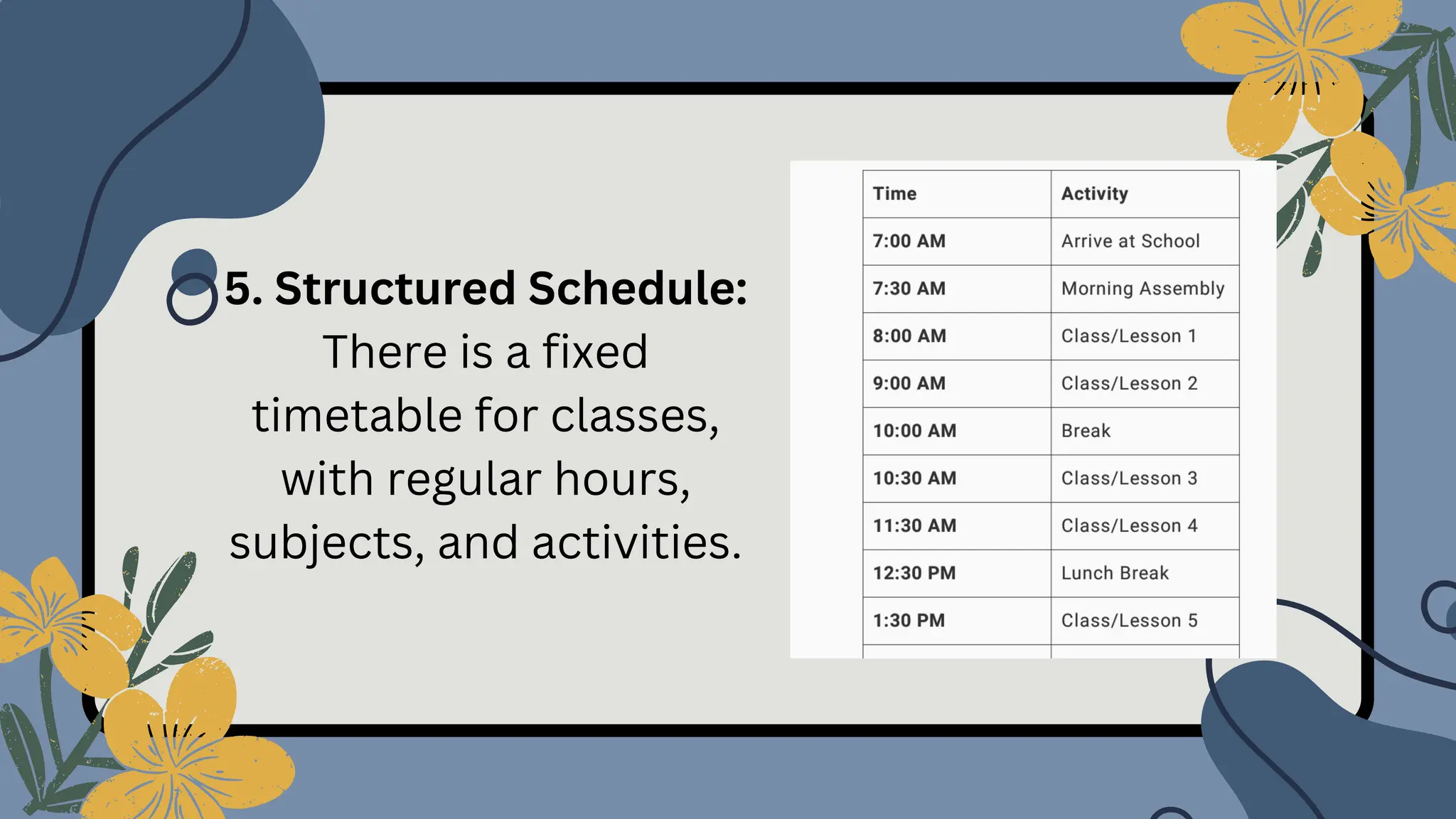
5. Structured Schedule:
There is a fixed
timetable for classes,
with regular hours,
subjects, and activities.
6. Limited Use of Technology: In its most
conventional form, traditional learning relies
more on textbooks, lectures, and face-to-face
interaction rather than digital tools.
Authentic Assessment
form of assessment in which students are asked
to perform real-world tasks that demonstrate
meaningful application of essential knowledge
and skills.
- Jon Mueller
Authentic Assessment
Performance assessments call upon the
examinee to demonstrate specific skills and
competencies, that is, to apply the skills and
knowledge they have mastered.
- Richard J. Stiggins
What does Authentic Assessment look like?
An authentic assessment usually includes a
task for students to perform and a rubric by
which their performance on the task will be
evaluated.
Traditional Assessment vs. Authentic Assessment
• Multiple choice
• Gap fill
• True-false
• Inventories
• Peer rating / Self rating
• Journals
• Portfolios
• Discussions
• Interviews
Traditional Assessment Authentic Assessment
• To develop productive
citizens
Must be capable of performing
real tasks.
• Schools must help students
become proficient at
performing tasks.
• Have the students perform
meaningful tasks.
Authentic
• To develop productive
citizens
• Must possess a body of
knowledge and skills
• Schools must teach this
body of knowledge and skills
• Test the students if they
acquired the knowledge and
skills
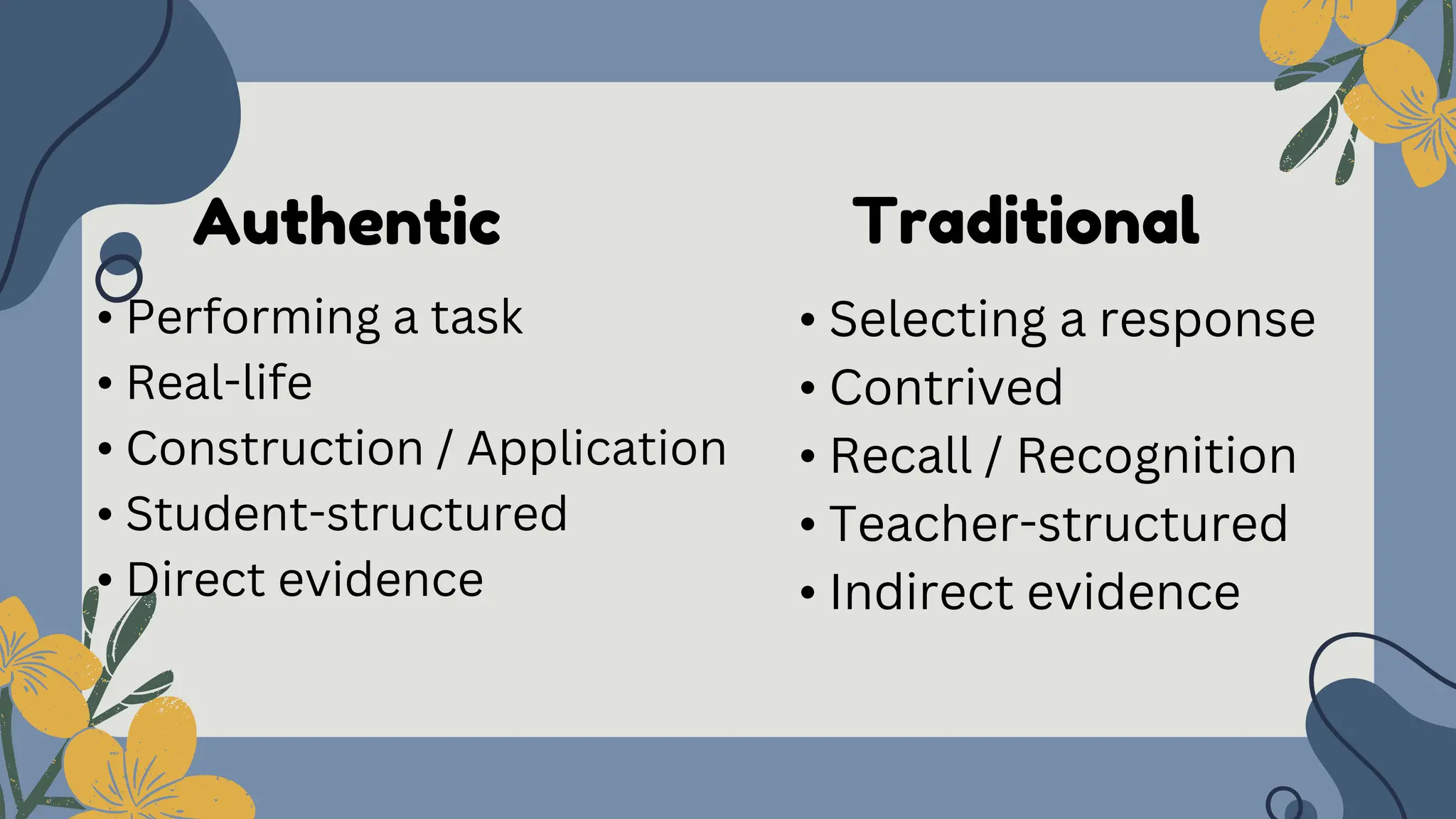
Traditional
• Performing a task
• Real-life
• Construction / Application
• Student-structured
• Direct evidence
Authentic
• Selecting a response
• Contrived
• Recall / Recognition
• Teacher-structured
• Indirect evidence
Traditional
Alternative Names for Authentic
Assessment
• Performance Assessment
• Alternative Assessment
• Direct Assessment
Why Use Authentic Assessment
Authentic Assessments are Direct Measures
• We do not just want students to know the content of the
disciplines when they graduate. We, of course, want them
to be able to use the acquired knowledge and skills in the
real world. So, our assessments have to also tell us if
students can apply what they have learned in authentic
situations.
Why Use Authentic Assessment
Authentic Assessments Capture Constructive
Nature of Learning
• We cannot simply be fed knowledge. We need to
construct our own meaning of the world, using
information we have gathered and were taught and our
own experiences with the world (Bransford & Vye,
1989)
Why Use Authentic Assessment
Authentic Assessments Integrate Teaching,
Learning and Assessment
• In the authentic assessment model, the same
authentic task used to measure the students'
ability to apply the knowledge or skills is used as a
vehicle for student learning.
Why Use Authentic Assessment
Authentic Assessments Integrate Teaching,
Learning and Assessment
• When presented with a real-world problem to solve,
students are learning in the process of developing a
solution, teachers are facilitating the process, and the
students' solutions to the problem becomes an assessment
of how well the students can meaningfully apply the
concepts.
• Step 1: Identify the standards
• Step 2: Select an authentic task
• Step 3: Identify the criteria for the task
• Step 4: Create the rubric
How to Create Authentic Assessments
• Standards, like goals, are statements of what students
should know and be able to do. However, standards are
typically more narrow in scope and more amenable to
assessment than goals.
• Students will be able to add two-digit numbers correctly.
STEP 1: Identify the Standards
STEP 2: Select an Authentic Task
• Find a way students can demonstrate that they are
fully capable of meeting the standard. The language
of a well-written standard can spell out what a task
should ask students to do to demonstrate their
mastery of it.
STEP 3: Identify the Criteria for the Task
• Ask "What does good performance on this task look
like?" or "How will I know they have done a good job
on this task?"
• Criteria: Indicators of good performance on a task
• Once you have identified the criteria you
want to look for as indicators of good
performance, you next decide whether to
consider the criteria analytically or
holistically.
STEP 4: Create the Rubric
DESIGNING LEARNING
PORTFOLIO
INTRODUCTION
Portfolio assessment is a detailed, unique, and
personalized evaluation of what the learners know
and can do. A portfolio is a collection of pieces of
evidence of efforts, learnings, development,
growth, and achievement.
THE PORTFOLIO ASSESSMENT
is an example of authentic and non-traditional
assessment of learning. The use of portfolio assessmen
is an answer to the need for continuous assessment in
course of day- to-day instruction that traditional
assessment like standardized testing cannot address
Purposes of Learning Portfolio
• The portfolio guides the learner and teachers to set and
establish goals aligned in the learning objectives.
• The process of making portfolio ensures the active
participation of the learners and helps learners examine
growth and development over time.
• The portfolio processes provide chances for self-evaluation
and reflection.
•The portfolio enhances the student's learning and current
achievement and showcases and documents the developme
and growth in a more contextualized manner
• The portfolio can evaluate teaching effectiveness. The
portfolio provides flexibility in curriculum and instruction
planning because it considers the developmental domains of
the learners and content of the subject matter.
• The portfolio can help evaluate and improve the curriculum.
• The portfolio reinforces hands-on and concrete experiences.
•The portfolio can motivate parents and other stakeholders
to become involved in the learner's
• evaluation plan
TYPES OF LEARNING PORTFOLIO
• Documentary Portfolio -Involves a collection of work
overtime showing the growth and improvement reflecting
students learning of identified outcomes. It is also called
growth portfolio
• Process Portfolio -Demonstrates all facets or phases of
the learning process, hence the arrangement is based on
the learner's stages of metacognitive processing
• Showcase Portfolio -Is the kind that shows only the best of
the student's outputs and products
• Evaluation Portfolio -Includes some work that had not
previously been submitted
• Class Portfolio -Contains a student grade and
evaluative assessment of the student by the teacher
• Ideal Portfolio -Contains all the work a student has
completed
ESSENTIAL CHARACTERISTICS OF
PORTFOLIO ASSESSMENT
• Portfolio is an assessment that is done
together by the learners and the teacher. The
teacher guides the learner from planning,
execution, and evaluation of contents of
learning portfolios, hence the interaction and
discourse are important elements of the
process.
Portfolio is an assessment that is done together
by the learners and the teacher. The teacher
guides the learner from planning, execution, and
evaluation of contents of learning portfolios,
hence the interaction and discourse are
important elements of the process.
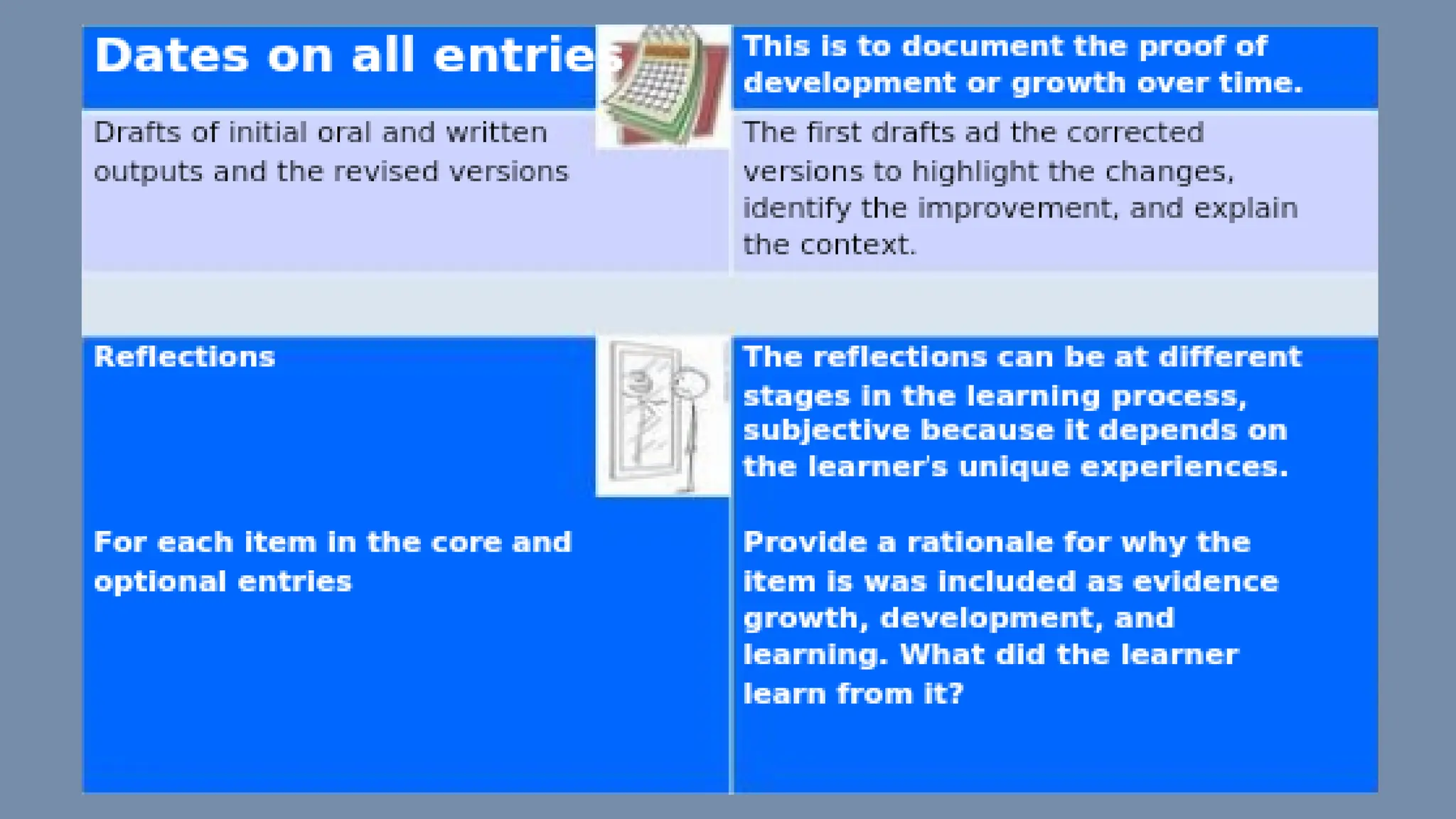
The Basic Elements of a Learning Portfolio
Assessment  Strategies for  Mathematics in the  Elementary Grades_20241204_215408_0000.pdf

Assessment Strategies for Mathematics in the Elementary Grades_20241204_215408_0000.pdf

  • 1.
    Assessment Strategies for Mathematicsin the Elementary Grades
  • 2.
    ASSESSING LEARNING Assessment isthe process of tracking learners’ progress based on learning standards, including the development of 21st-century skills, part of the K to 12 framework. It must be aligned with curriculum standards and lesson objectives to ensurestudentsaretestedonwhattheyneedtolearn.
  • 3.
    ZONE OF PROXIMAL DEVELOPMENT(ZPD): The process of assessment is anchored in Vygotsky's ZPD framework, recognizing that learners have diverse abilities and requiring multiple assessment methods. It supports students in moving from guided to independent learning, with tasks that are challengingbutachievable.
  • 4.
    ASSESSMENT IN THEK TO 12 PROGRAM: Thereisunitybetweeninstructionandassessment—both shouldalignwithreal-lifeapplications.Assessmentispart ofeverydaylessons,notjustwrittenexams.Kto12’s enhancedcurriculumisstandards-based,andassessment mustmeasurewhetherlearnersmeetthosestandards.
  • 5.
    PRINCIPLES OF ASSESSMENT: Assessmentshouldbeconsistentwiththecurriculumstandards. 1. Formativeassessment helps prepare students for summative assessments. 2. Assessmentresultsshouldimprovestudentlearning. 3. Assessmentisnotusedtothreatenorintimidatelearners. 4.
  • 6.
    TYPES OF ASSESSMENTS: Therearetwomaintypes: 1.Formative Assessment: This is an ongoing process used to monitor students’ progress. It serves two purposes: “assessment for learning” for teachers and “assessment as learning” for students. It’s informal and can be done before, during, or after lessons, even outside the classroom. Feedback helps both teachers and students understand areas of improvement.
  • 7.
    2. Summative Assessment:This is the “assessment of learning” and is usually given at the end of a unit or term to measure students’ knowledge and skills. Results are recorded, used for grades, and reportedtoparentsandteachers.
  • 8.
    SUMMATIVE ASSESSMENT COMPONENTS Summative assessmentsinclude three components: Written Work, Performance Test, and Quarterly Assessment. Each learning area has specific weightings for these components, which contribute to the students’ final grades. These tests are spaced out over the quarter and aimtomeasureifstudentshavemetthecurriculumstandards.
  • 9.
    Traditional learning refersto the conventional method of education, typically centered around a teacher delivering instruction in a classroom setting. Traditional Learning
  • 10.
    Key characteristics of traditionallearning include:  1. Teacher-Centered: The teacher is the primary source of knowledge and directs the learning process. 2. Classroom-Based: Learning is a traditional form of education where students gather in a physical room with a teacher to learn.
  • 11.
    3. Standardized Curriculum:The curriculum is generally uniform and based on educational standards or requirements. 4. Assessment: is a method used to evaluate learning, primarily through exams, quizzes, and assignments.
  • 12.
    5. Structured Schedule: Thereis a fixed timetable for classes, with regular hours, subjects, and activities.
  • 13.
    6. Limited Useof Technology: In its most conventional form, traditional learning relies more on textbooks, lectures, and face-to-face interaction rather than digital tools.
  • 14.
    Authentic Assessment form ofassessment in which students are asked to perform real-world tasks that demonstrate meaningful application of essential knowledge and skills. - Jon Mueller
  • 15.
    Authentic Assessment Performance assessmentscall upon the examinee to demonstrate specific skills and competencies, that is, to apply the skills and knowledge they have mastered. - Richard J. Stiggins
  • 16.
    What does AuthenticAssessment look like? An authentic assessment usually includes a task for students to perform and a rubric by which their performance on the task will be evaluated.
  • 17.
    Traditional Assessment vs.Authentic Assessment • Multiple choice • Gap fill • True-false • Inventories • Peer rating / Self rating • Journals • Portfolios • Discussions • Interviews Traditional Assessment Authentic Assessment
  • 18.
    • To developproductive citizens Must be capable of performing real tasks. • Schools must help students become proficient at performing tasks. • Have the students perform meaningful tasks. Authentic • To develop productive citizens • Must possess a body of knowledge and skills • Schools must teach this body of knowledge and skills • Test the students if they acquired the knowledge and skills Traditional
  • 19.
    • Performing atask • Real-life • Construction / Application • Student-structured • Direct evidence Authentic • Selecting a response • Contrived • Recall / Recognition • Teacher-structured • Indirect evidence Traditional
  • 20.
    Alternative Names forAuthentic Assessment • Performance Assessment • Alternative Assessment • Direct Assessment
  • 21.
    Why Use AuthenticAssessment Authentic Assessments are Direct Measures • We do not just want students to know the content of the disciplines when they graduate. We, of course, want them to be able to use the acquired knowledge and skills in the real world. So, our assessments have to also tell us if students can apply what they have learned in authentic situations.
  • 22.
    Why Use AuthenticAssessment Authentic Assessments Capture Constructive Nature of Learning • We cannot simply be fed knowledge. We need to construct our own meaning of the world, using information we have gathered and were taught and our own experiences with the world (Bransford & Vye, 1989)
  • 23.
    Why Use AuthenticAssessment Authentic Assessments Integrate Teaching, Learning and Assessment • In the authentic assessment model, the same authentic task used to measure the students' ability to apply the knowledge or skills is used as a vehicle for student learning.
  • 24.
    Why Use AuthenticAssessment Authentic Assessments Integrate Teaching, Learning and Assessment • When presented with a real-world problem to solve, students are learning in the process of developing a solution, teachers are facilitating the process, and the students' solutions to the problem becomes an assessment of how well the students can meaningfully apply the concepts.
  • 25.
    • Step 1:Identify the standards • Step 2: Select an authentic task • Step 3: Identify the criteria for the task • Step 4: Create the rubric How to Create Authentic Assessments
  • 26.
    • Standards, likegoals, are statements of what students should know and be able to do. However, standards are typically more narrow in scope and more amenable to assessment than goals. • Students will be able to add two-digit numbers correctly. STEP 1: Identify the Standards
  • 27.
    STEP 2: Selectan Authentic Task • Find a way students can demonstrate that they are fully capable of meeting the standard. The language of a well-written standard can spell out what a task should ask students to do to demonstrate their mastery of it.
  • 28.
    STEP 3: Identifythe Criteria for the Task • Ask "What does good performance on this task look like?" or "How will I know they have done a good job on this task?" • Criteria: Indicators of good performance on a task
  • 29.
    • Once youhave identified the criteria you want to look for as indicators of good performance, you next decide whether to consider the criteria analytically or holistically. STEP 4: Create the Rubric
  • 30.
  • 31.
    INTRODUCTION Portfolio assessment isa detailed, unique, and personalized evaluation of what the learners know and can do. A portfolio is a collection of pieces of evidence of efforts, learnings, development, growth, and achievement.
  • 32.
    THE PORTFOLIO ASSESSMENT isan example of authentic and non-traditional assessment of learning. The use of portfolio assessmen is an answer to the need for continuous assessment in course of day- to-day instruction that traditional assessment like standardized testing cannot address
  • 33.
    Purposes of LearningPortfolio • The portfolio guides the learner and teachers to set and establish goals aligned in the learning objectives. • The process of making portfolio ensures the active participation of the learners and helps learners examine growth and development over time. • The portfolio processes provide chances for self-evaluation and reflection. •The portfolio enhances the student's learning and current achievement and showcases and documents the developme and growth in a more contextualized manner
  • 34.
    • The portfoliocan evaluate teaching effectiveness. The portfolio provides flexibility in curriculum and instruction planning because it considers the developmental domains of the learners and content of the subject matter. • The portfolio can help evaluate and improve the curriculum. • The portfolio reinforces hands-on and concrete experiences. •The portfolio can motivate parents and other stakeholders to become involved in the learner's • evaluation plan
  • 35.
    TYPES OF LEARNINGPORTFOLIO • Documentary Portfolio -Involves a collection of work overtime showing the growth and improvement reflecting students learning of identified outcomes. It is also called growth portfolio • Process Portfolio -Demonstrates all facets or phases of the learning process, hence the arrangement is based on the learner's stages of metacognitive processing • Showcase Portfolio -Is the kind that shows only the best of the student's outputs and products
  • 36.
    • Evaluation Portfolio-Includes some work that had not previously been submitted • Class Portfolio -Contains a student grade and evaluative assessment of the student by the teacher • Ideal Portfolio -Contains all the work a student has completed
  • 37.
    ESSENTIAL CHARACTERISTICS OF PORTFOLIOASSESSMENT • Portfolio is an assessment that is done together by the learners and the teacher. The teacher guides the learner from planning, execution, and evaluation of contents of learning portfolios, hence the interaction and discourse are important elements of the process.
  • 38.
    Portfolio is anassessment that is done together by the learners and the teacher. The teacher guides the learner from planning, execution, and evaluation of contents of learning portfolios, hence the interaction and discourse are important elements of the process.
  • 39.
    The Basic Elementsof a Learning Portfolio