Development of
Administrative
Law
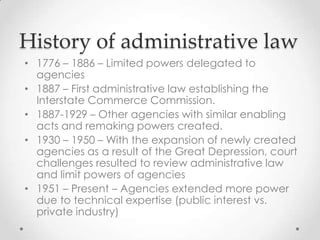
History of administrative law
• 1776 – 1886 – Limited powers delegated to
agencies
• 1887 – First administrative law establishing the
Interstate Commerce Commission.
• 1887-1929 – Other agencies with similar enabling
acts and remaking powers created.
• 1930 – 1950 – With the expansion of newly created
agencies as a result of the Great Depression, court
challenges resulted to review administrative law
and limit powers of agencies
• 1951 – Present – Agencies extended more power
due to technical expertise (public interest vs.
private industry)
Delegation Doctrine
• Legal theory that proposes that the legislature may
make laws and may convey the power of law-
making to others.
• The delegation of power to an administrative
agency occurs when the agency receives
legislative powers or rule-making and judicial
powers of hearing cases and making decisions.
Application of the Delegation
Doctrine
• Powers are delegated to agencies because
legislatures and courts are unable to handle the
volume of work and neither has the expertise in
area of specialty.
• Legislatures direct agencies in enacting laws by
establishing guidelines that must be followed, thus
limiting power.
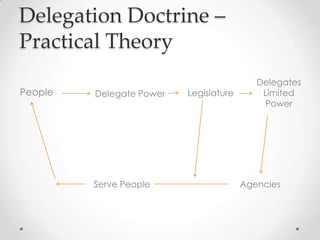
Delegation Doctrine –
Practical Theory
Delegate Power LegislaturePeople
Delegates
Limited
Power
AgenciesServe People
Application of the Delegation
Doctrine
• Agencies develop standards through rules
and regulations based on legislative
guidelines.
• United States v. Grimaud, 220 U.S. 506 (1911)
o Case involving the saving of land for the nation’s forests.
Defendants were accused of violating Regulation 45 by
grazing sheep without a permit.
o Secretary of Agriculture was charged with the authority to
make rules and regulations to preserve the forests from
destruction. Required individuals to secure permits before
grazing any stock in a forest reserve.
o The Court upheld agency’s right to make rules and
regulations.
Disputed Delegation
• Occurs when delegation by Congress (legislature)
does not accompany sufficient standards
• According to S. Ct in Eastlake v. Forest City
Enters., 426 US 668 (1976), “a Congressional
delegation of power…must be accompanied by
discernible standards, so that the delegate’s
actions may be measured by fidelity to the
legislative will.”
• Cases, in which struck down delegation:
o Panama Refining (1935)
o Schechter (1935)
o Carter (1936)
Panama Refining Co. v.
Ryan, 293 US 388 (1935)
• Also known as the Hot Oil case. The S. Ct. ruling that
overturned key elements of the New Deal legislative
program under the National Industrial Recovery Act
of 1933.
• Section 9c of the NIRA provided the President with
the power to prohibit the interstate and foreign
trade of petroleum goods produced in excess of
state quotas.
• Court found that Congress violated the delegation
doctrine by vesting the President with legislative
powers without clear guidelines.
A.L.A. Schechter Poultry Corp. v.
United States, 295 US 495 (1935)
• S. Ct declared unconstitutional the Live Poultry
Code, Section 3 of the NIRA, which gave the
president the authority to approve “codes of unfair
competition” that were drafted by the businesses
themselves
• Schechter was charged with violating the code by
selling unfit chickens, illegally selling chickens on an
individual basis, avoiding inspections, falsifying
records, and selling poultry to unlicensed
purchasers.
• Court held that the president lack the power to
write the code, as all legislative power is to be
vested in Congress.
Carter v. Carter Coal Co., 298
US 238 (1936)
• Court found the Bituminous Coal Conservation Act
of 1935 unconstitutional because Congress went
beyond its powers.
• The Act regulated prices, minimum
wages, maximum hours and “fair practices” of the
coal industry. Tax refunds were established as
incentives to abide by the regulations.
• Congress did not have the right to regulate
manufacturing under the guise of regulating
commerce.
Separation of Powers
• Theory of government, in which powers are
separated into three branches
(executive, legislative, and judicial) to prevent the
usurpation of power by one group or one person.
• The Constitution provides:
o Legislative branch creates the laws
o Judicial branch settles disputes concerning the
laws
o Executive branch manages the staff and
programs necessary in carrying out the laws
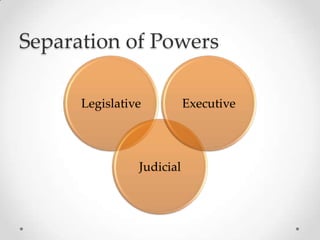
Separation of Powers
Legislative
Judicial
Executive
Federalism
• In addition to requiring the powers of government
to be split into three branches, the Constitution
requires two distinct forms of government that will
be equal:
o National (federal) and state government system.
• Federalism is the system in which the power to
govern is shared between the national (federal)
and state governments.
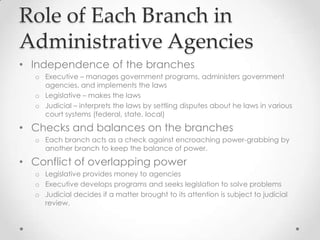
Role of Each Branch in
Administrative Agencies
• Independence of the branches
o Executive – manages government programs, administers government
agencies, and implements the laws
o Legislative – makes the laws
o Judicial – interprets the laws by settling disputes about he laws in various
court systems (federal, state, local)
• Checks and balances on the branches
o Each branch acts as a check against encroaching power-grabbing by
another branch to keep the balance of power.
• Conflict of overlapping power
o Legislative provides money to agencies
o Executive develops programs and seeks legislation to solve problems
o Judicial decides if a matter brought to its attention is subject to judicial
review.
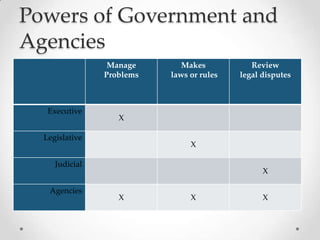
Powers of Government and
Agencies
Manage
Problems
Makes
laws or rules
Review
legal disputes
Executive
X
Legislative
X
Judicial
X
Agencies
X X X
Intelligible Principle
• Principle that provides that the legislature give an
agency guidelines from which to make specific
laws and criteria to set standards.
• Mistretta v. United States, 488 US 361 (1989)
o Questioned the delegation of authority to the U.S. Sentencing Commission
to research prison sentences and to draft prison sentencing guidelines for
federal judges.
o Court upheld the delegation on three major grounds:
• Congress had created a starting point of current sentencing
averages;
• Congress determined the sentencing goals; and
• Congress ordered statutory minimums and maximums to be followed
as guidelines.
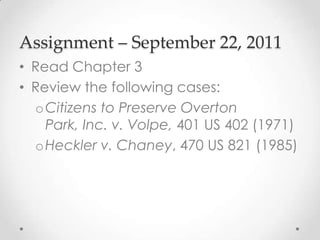
Assignment – September 22, 2011
• Read Chapter 3
• Review the following cases:
oCitizens to Preserve Overton
Park, Inc. v. Volpe, 401 US 402 (1971)
oHeckler v. Chaney, 470 US 821 (1985)
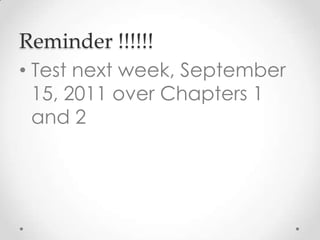
Reminder !!!!!!
• Test next week, September
15, 2011 over Chapters 1
and 2

Chapter2.development of administrative law

  • 1.
  • 2.
    History of administrativelaw • 1776 – 1886 – Limited powers delegated to agencies • 1887 – First administrative law establishing the Interstate Commerce Commission. • 1887-1929 – Other agencies with similar enabling acts and remaking powers created. • 1930 – 1950 – With the expansion of newly created agencies as a result of the Great Depression, court challenges resulted to review administrative law and limit powers of agencies • 1951 – Present – Agencies extended more power due to technical expertise (public interest vs. private industry)
  • 3.
    Delegation Doctrine • Legaltheory that proposes that the legislature may make laws and may convey the power of law- making to others. • The delegation of power to an administrative agency occurs when the agency receives legislative powers or rule-making and judicial powers of hearing cases and making decisions.
  • 4.
    Application of theDelegation Doctrine • Powers are delegated to agencies because legislatures and courts are unable to handle the volume of work and neither has the expertise in area of specialty. • Legislatures direct agencies in enacting laws by establishing guidelines that must be followed, thus limiting power.
  • 5.
    Delegation Doctrine – PracticalTheory Delegate Power LegislaturePeople Delegates Limited Power AgenciesServe People
  • 6.
    Application of theDelegation Doctrine • Agencies develop standards through rules and regulations based on legislative guidelines. • United States v. Grimaud, 220 U.S. 506 (1911) o Case involving the saving of land for the nation’s forests. Defendants were accused of violating Regulation 45 by grazing sheep without a permit. o Secretary of Agriculture was charged with the authority to make rules and regulations to preserve the forests from destruction. Required individuals to secure permits before grazing any stock in a forest reserve. o The Court upheld agency’s right to make rules and regulations.
  • 7.
    Disputed Delegation • Occurswhen delegation by Congress (legislature) does not accompany sufficient standards • According to S. Ct in Eastlake v. Forest City Enters., 426 US 668 (1976), “a Congressional delegation of power…must be accompanied by discernible standards, so that the delegate’s actions may be measured by fidelity to the legislative will.” • Cases, in which struck down delegation: o Panama Refining (1935) o Schechter (1935) o Carter (1936)
  • 8.
    Panama Refining Co.v. Ryan, 293 US 388 (1935) • Also known as the Hot Oil case. The S. Ct. ruling that overturned key elements of the New Deal legislative program under the National Industrial Recovery Act of 1933. • Section 9c of the NIRA provided the President with the power to prohibit the interstate and foreign trade of petroleum goods produced in excess of state quotas. • Court found that Congress violated the delegation doctrine by vesting the President with legislative powers without clear guidelines.
  • 9.
    A.L.A. Schechter PoultryCorp. v. United States, 295 US 495 (1935) • S. Ct declared unconstitutional the Live Poultry Code, Section 3 of the NIRA, which gave the president the authority to approve “codes of unfair competition” that were drafted by the businesses themselves • Schechter was charged with violating the code by selling unfit chickens, illegally selling chickens on an individual basis, avoiding inspections, falsifying records, and selling poultry to unlicensed purchasers. • Court held that the president lack the power to write the code, as all legislative power is to be vested in Congress.
  • 10.
    Carter v. CarterCoal Co., 298 US 238 (1936) • Court found the Bituminous Coal Conservation Act of 1935 unconstitutional because Congress went beyond its powers. • The Act regulated prices, minimum wages, maximum hours and “fair practices” of the coal industry. Tax refunds were established as incentives to abide by the regulations. • Congress did not have the right to regulate manufacturing under the guise of regulating commerce.
  • 11.
    Separation of Powers •Theory of government, in which powers are separated into three branches (executive, legislative, and judicial) to prevent the usurpation of power by one group or one person. • The Constitution provides: o Legislative branch creates the laws o Judicial branch settles disputes concerning the laws o Executive branch manages the staff and programs necessary in carrying out the laws
  • 12.
  • 13.
    Federalism • In additionto requiring the powers of government to be split into three branches, the Constitution requires two distinct forms of government that will be equal: o National (federal) and state government system. • Federalism is the system in which the power to govern is shared between the national (federal) and state governments.
  • 14.
    Role of EachBranch in Administrative Agencies • Independence of the branches o Executive – manages government programs, administers government agencies, and implements the laws o Legislative – makes the laws o Judicial – interprets the laws by settling disputes about he laws in various court systems (federal, state, local) • Checks and balances on the branches o Each branch acts as a check against encroaching power-grabbing by another branch to keep the balance of power. • Conflict of overlapping power o Legislative provides money to agencies o Executive develops programs and seeks legislation to solve problems o Judicial decides if a matter brought to its attention is subject to judicial review.
  • 15.
    Powers of Governmentand Agencies Manage Problems Makes laws or rules Review legal disputes Executive X Legislative X Judicial X Agencies X X X
  • 16.
    Intelligible Principle • Principlethat provides that the legislature give an agency guidelines from which to make specific laws and criteria to set standards. • Mistretta v. United States, 488 US 361 (1989) o Questioned the delegation of authority to the U.S. Sentencing Commission to research prison sentences and to draft prison sentencing guidelines for federal judges. o Court upheld the delegation on three major grounds: • Congress had created a starting point of current sentencing averages; • Congress determined the sentencing goals; and • Congress ordered statutory minimums and maximums to be followed as guidelines.
  • 17.
    Assignment – September22, 2011 • Read Chapter 3 • Review the following cases: oCitizens to Preserve Overton Park, Inc. v. Volpe, 401 US 402 (1971) oHeckler v. Chaney, 470 US 821 (1985)
  • 18.
    Reminder !!!!!! • Testnext week, September 15, 2011 over Chapters 1 and 2