S
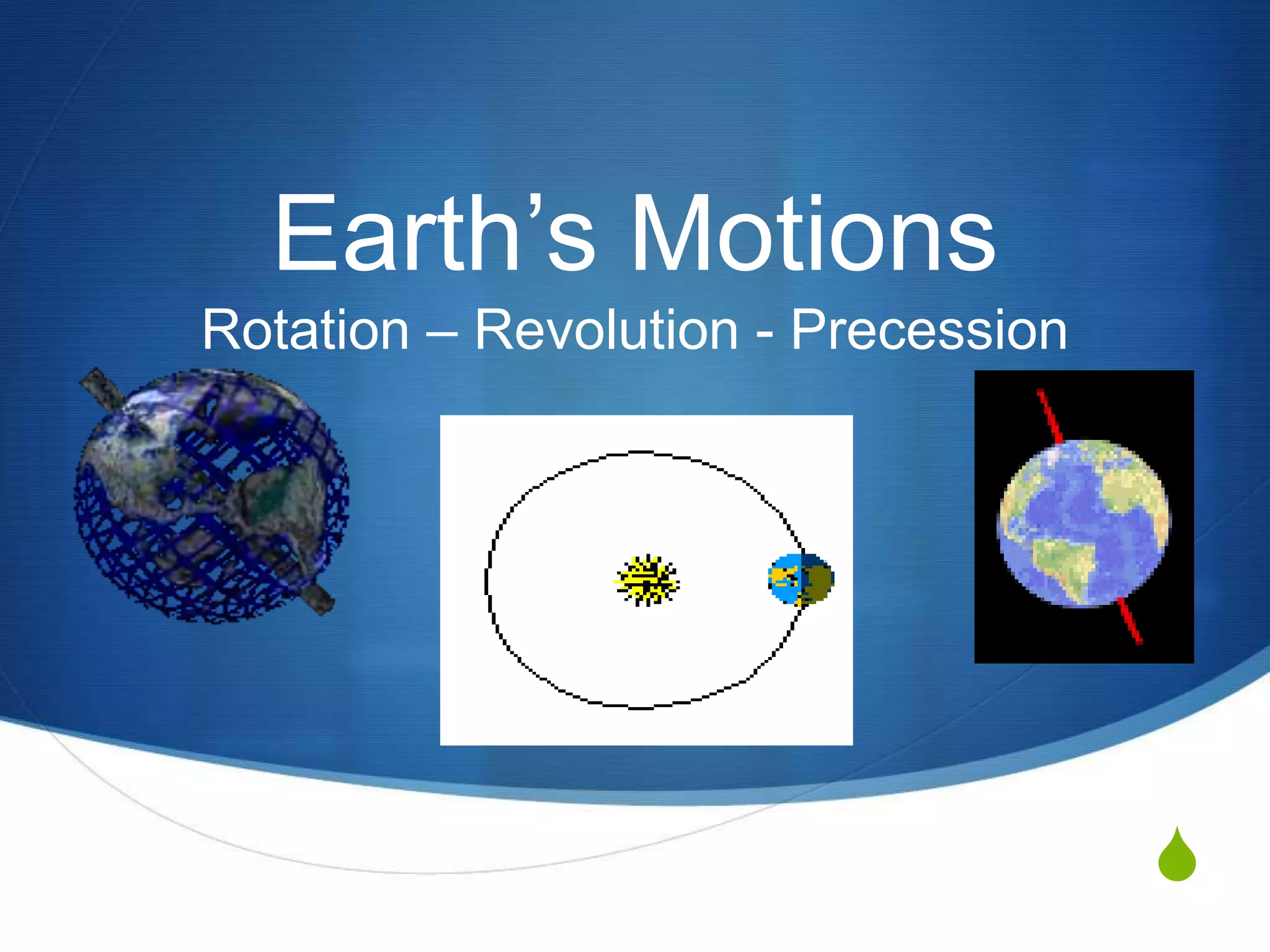
Earth’s Motions
Rotation – Revolution - Precession
• At all times, half of Earth is illuminated
by the sun and half is in the dark.
• Daytime and nighttime are the result of
Earth’s rotation on its axis.
• Earth’s axis tilts at an angle of 23.5°
and points toward the North Star.
2
LEARNING TARGETS
Earth’s Rotation
• The spinning of Earth on its axis is called rotation.
• The “AXIS” is an imaginary line passing through
Earth’s center through the N. and S. Poles.
• The Sun will illuminate only half the Earth at a time.
3
Obliquity Flash
Earth’s Rotation
• Rotates Eastward (From West – East)
• Counter-clockwise in Northern Hemisphere.
• Clockwise in Southern Hemisphere
• Sun appears to rise in the East and set in the West.
4
Sun in Sky Flash
Earth’s Rotation Causes…
1. Earth to stay upright in orbit.
2. Bulge at the equator – oblate spheroid shape
3. Day and Night
5
Earth’s Rotation Causes…
1. Earth to stay upright in orbit.
• The Earth is tilted 23.5°
• The N. Pole points toward the star Polaris
6
Spinning Earth – Click
Here
Non Spinning Earth –
Click Here
Earth’s Rotation Causes…
2. Earth to bulge at the equator
7
• Poles – rotation is almost 0 mph
• US-Latitudes – rotation is between 700 – 900 mph
• Equator – rotation is 1000 mph
Earth’s Rotation Causes…
3. Day and Night
8
• DAYTIME: When we are on the side of Earth facing the
sun.
• NIGHTTIME: When we are on the side of Earth opposite
the sun.
• 1 rotation = 24 hours
(1 day)
Earth’s Rotation Causes…
3. Day and Night
9
• It is Earth that is
moving (rotating).
• The Sun is stationary
(almost)
• The Sun just appears
to move.
Earth’s Rotation
• Check your understanding…
10
DAY NIGHT THINK QUESTIONS
Earth’s Rotation Causes…
1. Earth to stay upright in orbit.
2. Bulge at the equator – oblate spheroid shape
3. Day and Night
12
Pendulum at the Franklin Institute
June 27, 2013 14
DRAW A
DIAGRAM OF
WHAT YOU SEE
How does the pendulum support the idea that Earth rotates – Provide
evidence to support your claim.
DRAW A
DIAGRAM OF
WHAT YOU SEE
Describe what
you see
Describe what
you see
Evidence of Rotation
• Foucault Pendulum
• A pendulum is suspended above Earth’s surface.
• Once a pendulum is set in motion it will continue to move in the
same direction.
• The Earth spins underneath the pendulum.
• The Pendulum seems to change directions because Earths
rotation.
16
Earth’s Precession
18
 A slow movement/changing of direction around
a point or axis of a spinning body.
 The top does not fall over as long as it stays
spinning.
Earth’s Precession
19
 The Earth “wobbles” on its axis once every
26,000 years.
 Earth’s precession moves opposite to its
rotation.
 Earth’s axis will not straighten due to this
constant rotation. Spinning Earth – Click
Here
Non Spinning Earth –
Click Here
Moving toward Vega
20
 The movement of one object around another object is called
revolution.
 While Earth spins, it also moves around the sun.
 Earth revolves counterclockwise (N. Pole) around the sun at
66,000mph .
 1 Revolution takes 365.25 rotations (days).
 A day is added to the calendar every 4 years in February to account
for the extra 0.25 day rotation.
21
EARTH’S REVOLUTION
01_earthsun_Flash
 The movement of one object around another object is called
revolution.
 While Earth spins, it also moves around the sun.
 Earth revolves counterclockwise (N. Pole) around the sun at 66mph .
 1 Revolution takes 365.25 rotations (days).
 A day is added to the calendar every 4 years in February to account
for the extra 0.25 day rotation.
22
EARTH’S REVOLUTION
01_earthsun_Flash
 The path Earth takes around the sun is called an
orbit.
 Earth’s orbit is in the shape of an ellipse (flat oval)
23
EARTH’S REVOLUTION
 The path Earth takes around the sun is called an
orbit.
 Earth’s orbit is in the shape of an ellipse (flat oval)
24
EARTH’S REVOLUTION
0408_rotatingearth_Flash
 The sun is closer to one side of the ellipse than the other.
 Perihelion – point along Earth’s orbit when Earth is
closest to the sun. (JANUARY)
 Aphelion – Point along Earth’s orbit when Earth is farthest
from the sun (July)
25
EARTH’S REVOLUTION
DRAWING OF EARTH IN ITS ORBIT
June 27, 2013 27
 Ships sailing over the horizon will appear to sink as they sail
from port, as they sail over the horizon they follow the
curvature of Earth and move below the horizon.
 Photographs and models taken from space show a round
Earth.
 A lunar eclipse casts Earth’s shadow on the moon and the
curvature of Earth can be seen.
 The changing positions of the certain stars such as Polaris
can be viewed at different angles from different latitudes.
 Shadows at local noon at different latitudes will have
different lengths at different latitudes. The closer to the
equator the more direct the light and the shorter the shadow.
28
DESCRIBE 2 PIECES OF EVIDENCE THAT
SUPPORT EARTH’S SHAPE.
1. Earth stays upright at 23.5 degrees and will not topple over
in it’s orbit because of Earth’s rotation.
2. Earth takes on an oblate spheroid shape and gets wider at
the equator and flatter at the poles as a result its fast
rotation.
3. The Earth will rotate in and out of the sunlight causing an
observer on Earth to experience a certain amount of daylight
and darkness.
29
DESCRIBE TWO FACTORS THAT RESULT
FROM EARTH’S ROTATION.
Once a pendulum is set in motion it will continue to move in the same
direction. The Earth rotates underneath the pendulum. The Pendulum
seems to change directions because Earth is rotating underneath.
From the perspective of an observer on Earth it appears that the
pendulum changes direction, but when seen from above Earth (space),
the pendulum stays swinging in the same direction and the Earth
rotates under giving the appearance that it changed direction.
30
HOW DOES A PENDULUM PROVIDE
EVIDENCE OF EARTH’S ROTATION?
 1 day is 1 complete rotation in and out of the sun’s light.
 1 year is 1 complete revolution around the sun.
31
HOW IS THE LENGTH OF DAY AND YEAR RELATED TO
EARTH’S MOVEMENT THROUGH SPACE?
GYROSCOPE LAB Earth’s
Motions
ROTATION
REVOLUTION
PRECESSION
The spinning motion of a
planet on its axis.
The movement of an object
around another object.
The movement of the rotational axis
(wobbling) of an object.
June 27, 2013 33
Write out the
steps that your
group will
follow in detail
here.
• Diagrams of gyroscope
• Labels on Diagram
• Arrows representing direction
• Statements describing the
motion observed
• Inferences
Identify how the gyroscope resembles the rotation,
revolution, and precession of Earth
35
ROTATION VS. REVOLUTION REVIEW
The spinning motion of a
planet on its axis.
The movement of 1 object
around another object.
Counter Clockwise – North
Hemisphere
Counter Clockwise
Night and Day Year
1 Rotation = 24 Hours
1 Revolution = 1 Year =
365.25 Days
Poles – 0 mph
Equator – 1000 mph
66,000 mph
1. Earth to stay at 23.5 tilt
2. Oblate Spheroid
Seasons are caused by Earth’s tilt
and Revolution around the sun.
36
EARTH
Axis Orbit
24 hours
1 Year or 365.25
rotations
Night and Day Year
rotates on its
completing 1 trip in
causes
completing 1 trip in
causes
revolves on its
What is Earth’s Shape?
Oblate Spheroid
What is the axis?
Imaginary line that runs through geographic N. and S.
poles at 23.5 degrees.
What causes night and day?
Day and night is caused by Earth’s rotation in and out
of the sun’s light.
37
REVIEW QUESTIONS
 If seen from the North Pole perspective, which
direction does Earth rotate?
 Earth rotates counter clockwise
 What does the sun appear to do during a typical day?
 The sun appears to move across the sky from east to west
 What shape is the Earth’s orbit for revolution around
the sun?
 Earth’s orbit is in the shape of an ellipse.
38
REVIEW QUESTIONS
 When is the Earth closest to the sun?
 January
 What is this point called?
 Perihelion
 When is the Earth farthest from the sun?
 July
 What is this point called?
 Aphelion
 What’s wrong with this sentence: Earth revolves on its axis.
 Earth rotates on its axis
 Earth revolves on its orbit
39
REVIEW QUESTIONS
 What would you tell someone if, when asked why it is warmer
in the summer and colder in the winter, they said that it is
because we are closer to the sun in the summer and farther
away in the winter?
 When the Earth is closest to the sun the time of year is January, when
the Earth is farthest from the sun the time of year is July.
 In January, the Northern hemisphere is experiencing Winter
 In July, the Northern hemisphere is experiencing Summer.
 Therefore how close or far the Earth is from the sun does not
determine whether it is summer or winter.
40
REVIEW QUESTIONS
 Draw a diagram, clearly (with detail), showing the Earth in its
motion around the sun. Label when it is closest and farthest
away from the sun. Use appropriate terms and dates.
41
REVIEW QUESTIONS
 In the space below, draw and explain how and why you think
we have seasons. Show the position of Earth with respect to
the sun at each season. Offer an explanation for why that
season is occurring where you have it drawn it.
42
REVIEW QUESTIONS
43
EARTH’S REVOLUTION

Earths motions 2016_website

  • 1.
    S Earth’s Motions Rotation –Revolution - Precession
  • 2.
    • At alltimes, half of Earth is illuminated by the sun and half is in the dark. • Daytime and nighttime are the result of Earth’s rotation on its axis. • Earth’s axis tilts at an angle of 23.5° and points toward the North Star. 2 LEARNING TARGETS
  • 3.
    Earth’s Rotation • Thespinning of Earth on its axis is called rotation. • The “AXIS” is an imaginary line passing through Earth’s center through the N. and S. Poles. • The Sun will illuminate only half the Earth at a time. 3 Obliquity Flash
  • 4.
    Earth’s Rotation • RotatesEastward (From West – East) • Counter-clockwise in Northern Hemisphere. • Clockwise in Southern Hemisphere • Sun appears to rise in the East and set in the West. 4 Sun in Sky Flash
  • 5.
    Earth’s Rotation Causes… 1.Earth to stay upright in orbit. 2. Bulge at the equator – oblate spheroid shape 3. Day and Night 5
  • 6.
    Earth’s Rotation Causes… 1.Earth to stay upright in orbit. • The Earth is tilted 23.5° • The N. Pole points toward the star Polaris 6 Spinning Earth – Click Here Non Spinning Earth – Click Here
  • 7.
    Earth’s Rotation Causes… 2.Earth to bulge at the equator 7 • Poles – rotation is almost 0 mph • US-Latitudes – rotation is between 700 – 900 mph • Equator – rotation is 1000 mph
  • 8.
    Earth’s Rotation Causes… 3.Day and Night 8 • DAYTIME: When we are on the side of Earth facing the sun. • NIGHTTIME: When we are on the side of Earth opposite the sun. • 1 rotation = 24 hours (1 day)
  • 9.
    Earth’s Rotation Causes… 3.Day and Night 9 • It is Earth that is moving (rotating). • The Sun is stationary (almost) • The Sun just appears to move.
  • 10.
    Earth’s Rotation • Checkyour understanding… 10
  • 11.
    DAY NIGHT THINKQUESTIONS
  • 12.
    Earth’s Rotation Causes… 1.Earth to stay upright in orbit. 2. Bulge at the equator – oblate spheroid shape 3. Day and Night 12
  • 13.
    Pendulum at theFranklin Institute
  • 14.
  • 15.
    DRAW A DIAGRAM OF WHATYOU SEE How does the pendulum support the idea that Earth rotates – Provide evidence to support your claim. DRAW A DIAGRAM OF WHAT YOU SEE Describe what you see Describe what you see
  • 16.
    Evidence of Rotation •Foucault Pendulum • A pendulum is suspended above Earth’s surface. • Once a pendulum is set in motion it will continue to move in the same direction. • The Earth spins underneath the pendulum. • The Pendulum seems to change directions because Earths rotation. 16
  • 18.
    Earth’s Precession 18  Aslow movement/changing of direction around a point or axis of a spinning body.  The top does not fall over as long as it stays spinning.
  • 19.
    Earth’s Precession 19  TheEarth “wobbles” on its axis once every 26,000 years.  Earth’s precession moves opposite to its rotation.  Earth’s axis will not straighten due to this constant rotation. Spinning Earth – Click Here Non Spinning Earth – Click Here
  • 20.
  • 21.
     The movementof one object around another object is called revolution.  While Earth spins, it also moves around the sun.  Earth revolves counterclockwise (N. Pole) around the sun at 66,000mph .  1 Revolution takes 365.25 rotations (days).  A day is added to the calendar every 4 years in February to account for the extra 0.25 day rotation. 21 EARTH’S REVOLUTION 01_earthsun_Flash
  • 22.
     The movementof one object around another object is called revolution.  While Earth spins, it also moves around the sun.  Earth revolves counterclockwise (N. Pole) around the sun at 66mph .  1 Revolution takes 365.25 rotations (days).  A day is added to the calendar every 4 years in February to account for the extra 0.25 day rotation. 22 EARTH’S REVOLUTION 01_earthsun_Flash
  • 23.
     The pathEarth takes around the sun is called an orbit.  Earth’s orbit is in the shape of an ellipse (flat oval) 23 EARTH’S REVOLUTION
  • 24.
     The pathEarth takes around the sun is called an orbit.  Earth’s orbit is in the shape of an ellipse (flat oval) 24 EARTH’S REVOLUTION 0408_rotatingearth_Flash
  • 25.
     The sunis closer to one side of the ellipse than the other.  Perihelion – point along Earth’s orbit when Earth is closest to the sun. (JANUARY)  Aphelion – Point along Earth’s orbit when Earth is farthest from the sun (July) 25 EARTH’S REVOLUTION
  • 26.
    DRAWING OF EARTHIN ITS ORBIT
  • 27.
  • 28.
     Ships sailingover the horizon will appear to sink as they sail from port, as they sail over the horizon they follow the curvature of Earth and move below the horizon.  Photographs and models taken from space show a round Earth.  A lunar eclipse casts Earth’s shadow on the moon and the curvature of Earth can be seen.  The changing positions of the certain stars such as Polaris can be viewed at different angles from different latitudes.  Shadows at local noon at different latitudes will have different lengths at different latitudes. The closer to the equator the more direct the light and the shorter the shadow. 28 DESCRIBE 2 PIECES OF EVIDENCE THAT SUPPORT EARTH’S SHAPE.
  • 29.
    1. Earth staysupright at 23.5 degrees and will not topple over in it’s orbit because of Earth’s rotation. 2. Earth takes on an oblate spheroid shape and gets wider at the equator and flatter at the poles as a result its fast rotation. 3. The Earth will rotate in and out of the sunlight causing an observer on Earth to experience a certain amount of daylight and darkness. 29 DESCRIBE TWO FACTORS THAT RESULT FROM EARTH’S ROTATION.
  • 30.
    Once a pendulumis set in motion it will continue to move in the same direction. The Earth rotates underneath the pendulum. The Pendulum seems to change directions because Earth is rotating underneath. From the perspective of an observer on Earth it appears that the pendulum changes direction, but when seen from above Earth (space), the pendulum stays swinging in the same direction and the Earth rotates under giving the appearance that it changed direction. 30 HOW DOES A PENDULUM PROVIDE EVIDENCE OF EARTH’S ROTATION?
  • 31.
     1 dayis 1 complete rotation in and out of the sun’s light.  1 year is 1 complete revolution around the sun. 31 HOW IS THE LENGTH OF DAY AND YEAR RELATED TO EARTH’S MOVEMENT THROUGH SPACE?
  • 32.
    GYROSCOPE LAB Earth’s Motions ROTATION REVOLUTION PRECESSION Thespinning motion of a planet on its axis. The movement of an object around another object. The movement of the rotational axis (wobbling) of an object.
  • 33.
  • 34.
    Write out the stepsthat your group will follow in detail here. • Diagrams of gyroscope • Labels on Diagram • Arrows representing direction • Statements describing the motion observed • Inferences Identify how the gyroscope resembles the rotation, revolution, and precession of Earth
  • 35.
    35 ROTATION VS. REVOLUTIONREVIEW The spinning motion of a planet on its axis. The movement of 1 object around another object. Counter Clockwise – North Hemisphere Counter Clockwise Night and Day Year 1 Rotation = 24 Hours 1 Revolution = 1 Year = 365.25 Days Poles – 0 mph Equator – 1000 mph 66,000 mph 1. Earth to stay at 23.5 tilt 2. Oblate Spheroid Seasons are caused by Earth’s tilt and Revolution around the sun.
  • 36.
    36 EARTH Axis Orbit 24 hours 1Year or 365.25 rotations Night and Day Year rotates on its completing 1 trip in causes completing 1 trip in causes revolves on its
  • 37.
    What is Earth’sShape? Oblate Spheroid What is the axis? Imaginary line that runs through geographic N. and S. poles at 23.5 degrees. What causes night and day? Day and night is caused by Earth’s rotation in and out of the sun’s light. 37 REVIEW QUESTIONS
  • 38.
     If seenfrom the North Pole perspective, which direction does Earth rotate?  Earth rotates counter clockwise  What does the sun appear to do during a typical day?  The sun appears to move across the sky from east to west  What shape is the Earth’s orbit for revolution around the sun?  Earth’s orbit is in the shape of an ellipse. 38 REVIEW QUESTIONS
  • 39.
     When isthe Earth closest to the sun?  January  What is this point called?  Perihelion  When is the Earth farthest from the sun?  July  What is this point called?  Aphelion  What’s wrong with this sentence: Earth revolves on its axis.  Earth rotates on its axis  Earth revolves on its orbit 39 REVIEW QUESTIONS
  • 40.
     What wouldyou tell someone if, when asked why it is warmer in the summer and colder in the winter, they said that it is because we are closer to the sun in the summer and farther away in the winter?  When the Earth is closest to the sun the time of year is January, when the Earth is farthest from the sun the time of year is July.  In January, the Northern hemisphere is experiencing Winter  In July, the Northern hemisphere is experiencing Summer.  Therefore how close or far the Earth is from the sun does not determine whether it is summer or winter. 40 REVIEW QUESTIONS
  • 41.
     Draw adiagram, clearly (with detail), showing the Earth in its motion around the sun. Label when it is closest and farthest away from the sun. Use appropriate terms and dates. 41 REVIEW QUESTIONS
  • 42.
     In thespace below, draw and explain how and why you think we have seasons. Show the position of Earth with respect to the sun at each season. Offer an explanation for why that season is occurring where you have it drawn it. 42 REVIEW QUESTIONS
  • 43.