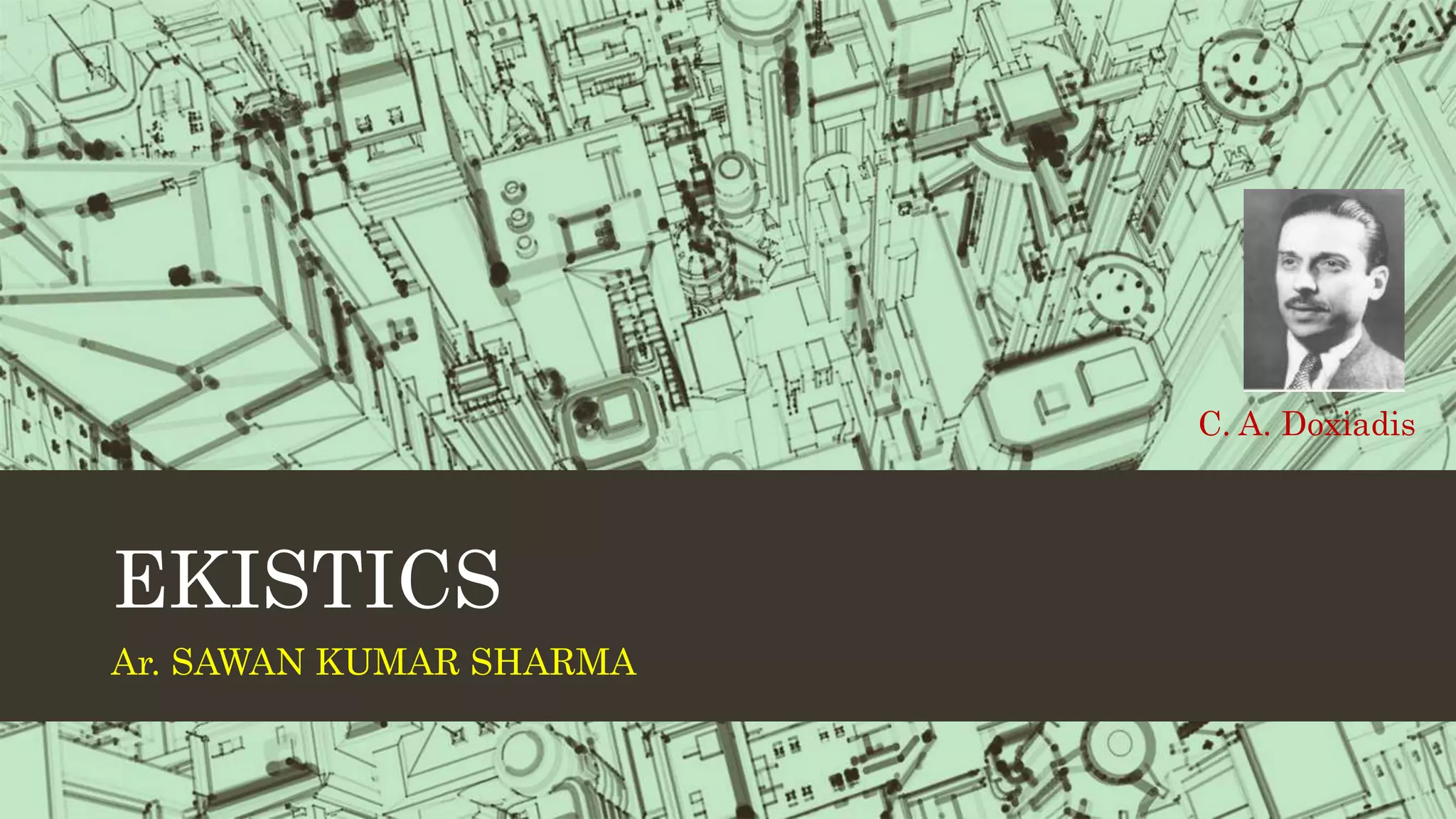
EKISTICS
Ar. SAWAN KUMAR SHARMA
C. A. Doxiadis
INTRODUCTION
In order to create the cities of the future, we need to systematically develop a science of
human settlements. This science termed as Ekistics. Coined by Constantinos A. Doxiadis
"Ekistics starts with the premise that human settlements are susceptible of systematic
investigation".
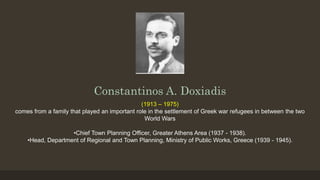
Constantinos A. Doxiadis
(1913 – 1975)
comes from a family that played an important role in the settlement of Greek war refugees in between the two
World Wars
•Chief Town Planning Officer, Greater Athens Area (1937 - 1938).
•Head, Department of Regional and Town Planning, Ministry of Public Works, Greece (1939 - 1945).
FOCUS
• Ekistics, will take into consideration the principles, man takes into account when
building his settlements, as well as the evolution of human settlements through
history in terms of size and quality.
• The target is to build the city of optimum size, that is, a city which respects human
dimensions. Since there is no point in resisting development, we should try to
accommodate technological evolution and the needs of man within the same
settlement.
• Ekistics examines not only built forms, but also the interface of time , movements and
systems in the built environment.
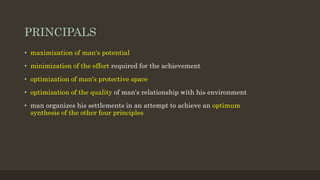
PRINCIPALS
• maximization of man's potential
• minimization of the effort required for the achievement
• optimization of man's protective space
• optimization of the quality of man's relationship with his environment
• man organizes his settlements in an attempt to achieve an optimum
synthesis of the other four principles
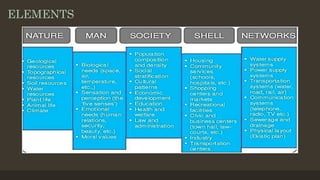
ELEMENTS
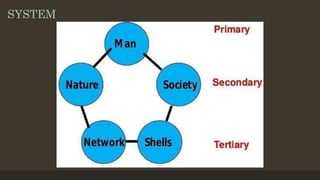
SYSTEM
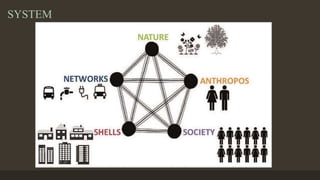
SYSTEM
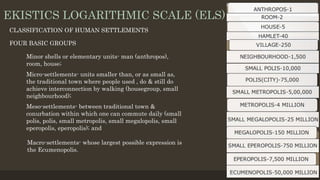
EKISTICS LOGARITHMIC SCALE (ELS)
CLASSIFICATION OF HUMAN SETTLEMENTS
FOUR BASIC GROUPS
Minor shells or elementary units- man (anthropos),
room, house;
Micro-settlements- units smaller than, or as small as,
the traditional town where people used , do & still do
achieve interconnection by walking (housegroup, small
neighbourhood);
Meso-settlements- between traditional town &
conurbation within which one can commute daily (small
polis, polis, small metropolis, small megalopolis, small
eperopolis, eperopolis); and
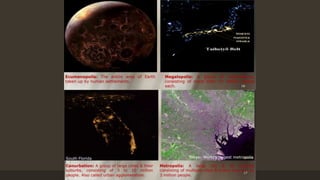
Macro-settlements- whose largest possible expression is
the Ecumenopolis.
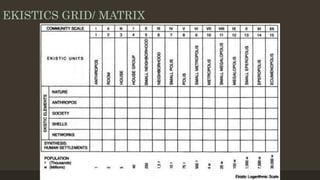
EKISTICS GRID/ MATRIX
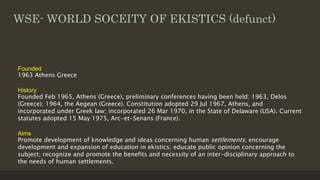
WSE- WORLD SOCEITY OF EKISTICS (defunct)
Founded
1963 Athens Greece
History
Founded Feb 1965, Athens (Greece), preliminary conferences having been held: 1963, Delos
(Greece); 1964, the Aegean (Greece). Constitution adopted 29 Jul 1967, Athens, and
incorporated under Greek law; incorporated 26 Mar 1970, in the State of Delaware (USA). Current
statutes adopted 15 May 1975, Arc-et-Senans (France).
Aims
Promote development of knowledge and ideas concerning human settlements; encourage
development and expansion of education in ekistics; educate public opinion concerning the
subject; recognize and promote the benefits and necessity of an inter-disciplinary approach to
the needs of human settlements.
IE- INSTITUTE OF EKISTICS
Founded
2017 New Delhi
History
Founded Nov 2017, New Delhi (INDIA)
preliminary conferences having been held: 2017, 2018, 2019, 2021 New Delhi
Constitution adopted Mar 2018, New Delhi, and incorporated under SOCEITEIS REGITRATION ACT
1860; incorporated 17 NOV 2017, in New Delhi (INDIA)
Aims
To promote and foster education and research in the subjects related with the system of human
settlements with special emphasis on the development of Ekistics and to assist its teachings in various
aspects.
http://www.instituteofekistics.com/
MASTERS PROGRAMME IN EKISTICS
M. Arch. (Ekistics)
While the country is developing at a very fast pace, the condition of
human settlements especially the Urban agglomerate is deteriorating.
The environmental hazards, depletion of natural resources, the ever
growing population and its various needs, stressful working conditions,
congested cities, migration, deteriorating social fabric, cracking socio-
economic dynamism are issues of concern.
Jamia Millia Islamia being the pioneer in taking the lead on the issues of
Social Concern and as Centre of Innovation has realized the need of the
time. It has taken initiative via multidisciplinary Masters Degree program
in Ekistics with a holistic approach, so that growth and management of
Human Settlements, rural and Urban both, can be shaped up to the
needs, aspiration and expectations of the people.
FACULTY OF ARCHITECTURE & EKISTICS, JAMIA
MILLIA ISLAMIA, NEW DELHI
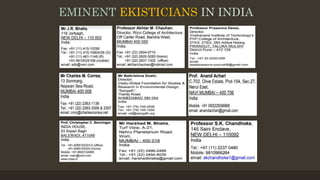
EMINENT EKISTICIANS IN INDIA

EKISTICS

  • 1.
    EKISTICS Ar. SAWAN KUMARSHARMA C. A. Doxiadis
  • 2.
    INTRODUCTION In order tocreate the cities of the future, we need to systematically develop a science of human settlements. This science termed as Ekistics. Coined by Constantinos A. Doxiadis "Ekistics starts with the premise that human settlements are susceptible of systematic investigation".
  • 3.
    Constantinos A. Doxiadis (1913– 1975) comes from a family that played an important role in the settlement of Greek war refugees in between the two World Wars •Chief Town Planning Officer, Greater Athens Area (1937 - 1938). •Head, Department of Regional and Town Planning, Ministry of Public Works, Greece (1939 - 1945).
  • 4.
    FOCUS • Ekistics, willtake into consideration the principles, man takes into account when building his settlements, as well as the evolution of human settlements through history in terms of size and quality. • The target is to build the city of optimum size, that is, a city which respects human dimensions. Since there is no point in resisting development, we should try to accommodate technological evolution and the needs of man within the same settlement. • Ekistics examines not only built forms, but also the interface of time , movements and systems in the built environment.
  • 5.
    PRINCIPALS • maximization ofman's potential • minimization of the effort required for the achievement • optimization of man's protective space • optimization of the quality of man's relationship with his environment • man organizes his settlements in an attempt to achieve an optimum synthesis of the other four principles
  • 6.
  • 7.
  • 8.
  • 9.
    EKISTICS LOGARITHMIC SCALE(ELS) CLASSIFICATION OF HUMAN SETTLEMENTS FOUR BASIC GROUPS Minor shells or elementary units- man (anthropos), room, house; Micro-settlements- units smaller than, or as small as, the traditional town where people used , do & still do achieve interconnection by walking (housegroup, small neighbourhood); Meso-settlements- between traditional town & conurbation within which one can commute daily (small polis, polis, small metropolis, small megalopolis, small eperopolis, eperopolis); and Macro-settlements- whose largest possible expression is the Ecumenopolis.
  • 11.
  • 12.
    WSE- WORLD SOCEITYOF EKISTICS (defunct) Founded 1963 Athens Greece History Founded Feb 1965, Athens (Greece), preliminary conferences having been held: 1963, Delos (Greece); 1964, the Aegean (Greece). Constitution adopted 29 Jul 1967, Athens, and incorporated under Greek law; incorporated 26 Mar 1970, in the State of Delaware (USA). Current statutes adopted 15 May 1975, Arc-et-Senans (France). Aims Promote development of knowledge and ideas concerning human settlements; encourage development and expansion of education in ekistics; educate public opinion concerning the subject; recognize and promote the benefits and necessity of an inter-disciplinary approach to the needs of human settlements.
  • 13.
    IE- INSTITUTE OFEKISTICS Founded 2017 New Delhi History Founded Nov 2017, New Delhi (INDIA) preliminary conferences having been held: 2017, 2018, 2019, 2021 New Delhi Constitution adopted Mar 2018, New Delhi, and incorporated under SOCEITEIS REGITRATION ACT 1860; incorporated 17 NOV 2017, in New Delhi (INDIA) Aims To promote and foster education and research in the subjects related with the system of human settlements with special emphasis on the development of Ekistics and to assist its teachings in various aspects. http://www.instituteofekistics.com/
  • 14.
    MASTERS PROGRAMME INEKISTICS M. Arch. (Ekistics) While the country is developing at a very fast pace, the condition of human settlements especially the Urban agglomerate is deteriorating. The environmental hazards, depletion of natural resources, the ever growing population and its various needs, stressful working conditions, congested cities, migration, deteriorating social fabric, cracking socio- economic dynamism are issues of concern. Jamia Millia Islamia being the pioneer in taking the lead on the issues of Social Concern and as Centre of Innovation has realized the need of the time. It has taken initiative via multidisciplinary Masters Degree program in Ekistics with a holistic approach, so that growth and management of Human Settlements, rural and Urban both, can be shaped up to the needs, aspiration and expectations of the people. FACULTY OF ARCHITECTURE & EKISTICS, JAMIA MILLIA ISLAMIA, NEW DELHI
  • 15.