Political Theory
Ideologies
Conservatism
Starter - Left or Right wing policy
1. Introducing a National Living Wage
2. Oppose same sex marriage
3. Lower Taxes on businesses
4. Support Private Schools
5. Nationalisation of Industries
6. Free School Meals for all P1-3 pupils
Starter – Left or Right wing policy
1. Introducing a National Living Wage
2. Oppose same sex marriage
3. Lower Taxes on businesses
4. Support Private Schools
5. Nationalisation of Industries
6. Free School Meals for all P1-3 pupils
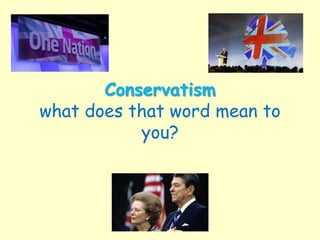
Conservatism
what does that word mean to
you?
Conservatism
Conservatism: An ideology characterised by
support for tradition, duty, authority and
property. (Heywood, 2002)
Note:
• It is important at this stage to make a
distinction between ‘big C’ Conservative and
‘small c’ conservative.
• The ‘big C’ refers to the Conservative political
party, whereas, the small c refers to the
political ideology.
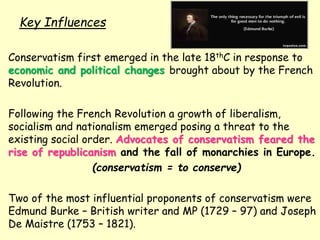
Key Influences
Conservatism first emerged in the late 18thC in response to
economic and political changes brought about by the French
Revolution.
Following the French Revolution a growth of liberalism,
socialism and nationalism emerged posing a threat to the
existing social order. Advocates of conservatism feared the
rise of republicanism and the fall of monarchies in Europe.
(conservatism = to conserve)
Two of the most influential proponents of conservatism were
Edmund Burke – British writer and MP (1729 – 97) and Joseph
De Maistre (1753 – 1821).
Edmund Burke
• Burke was actually a Whig (Liberal) MP from 1766-94 and was lauded by both the
Liberals and the Conservatives during the 19th Century. During the 20th Century
however, he came to be seen as the father of modern Conservatism. ​
• All quotes come from his work ‘Reflections on the Revolution in France’ (1790).
This was written after the French Revolution began in 1789, but before the ‘Terror’
that it descended into. ​
• It can be seen as forecasting a lot of the troubles that did face the Revolution in
the years that followed.​
• In order to best understand Burke’s work, a bit of background to the French
Revolution is important.
Watch the clip and take notes:​
https://www.youtube.com/watch?v=zBTKGf1nFlA
Key Influences
Conservatives blamed the
bloodbath of the French
Revolution on the
Enlightenment idea that
human beings could
consciously create
political society.
The major political
conflicts in 20th century
democracies have been
between conservatives
and socialists
What is conservatism?
Difficult to give an accurate definition and must be careful to
associate it too much with the Conservatives of today, but there
are a number of personal traits that a conservative is likely to
have:
• Conservatives tend to want less control over the individual,
doesn’t like fixed political doctrines.
• Like the status quo to be maintained rather than any radical
change.
• Although the nature of conservative thinking may change
dependent on the time they usually want to maintain tradition,
the present and they look to the past as a guide rather than
fixed principles for the future.
• Want the individual to work hard and flourish in terms of
pursuing goals and achieving fulfilment.
• Conservative also want good social order and security even if
that is at the expense of freedom, rights and equality
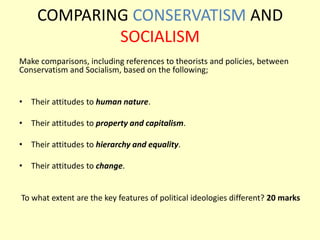
COMPARING CONSERVATISM AND
SOCIALISM
Make comparisons, including references to theorists and policies, between
Conservatism and Socialism, based on the following;
• Their attitudes to human nature.
• Their attitudes to property and capitalism.
• Their attitudes to hierarchy and equality.
• Their attitudes to change.
To what extent are the key features of political ideologies different? 20 marks
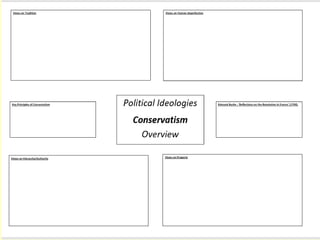
So, Conservatism encompasses the following
views:
 Tradition (keeping things the way they’ve always been)
 Human imperfection (humans will do bad things given the
chance)
 Authority (following rules)
 Property (owning your own property is good)
 Hierarchy (there are people below us and above us)
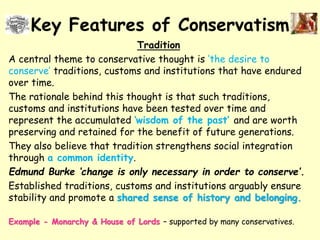
Key Features of Conservatism
Tradition
A central theme to conservative thought is ‘the desire to
conserve’ traditions, customs and institutions that have endured
over time.
The rationale behind this thought is that such traditions,
customs and institutions have been tested over time and
represent the accumulated ‘wisdom of the past’ and are worth
preserving and retained for the benefit of future generations.
They also believe that tradition strengthens social integration
through a common identity.
Edmund Burke ‘change is only necessary in order to conserve’.
Established traditions, customs and institutions arguably ensure
stability and promote a shared sense of history and belonging.
Example - Monarchy & House of Lords – supported by many conservatives.
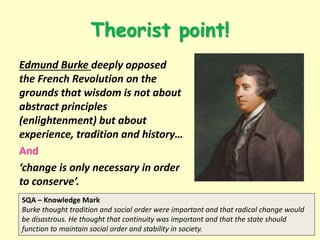
Theorist point!
Edmund Burke deeply opposed
the French Revolution on the
grounds that wisdom is not about
abstract principles
(enlightenment) but about
experience, tradition and history…
And
‘change is only necessary in order
to conserve’.
SQA – Knowledge Mark
Burke thought tradition and social order were important and that radical change would
be disastrous. He thought that continuity was important and that the state should
function to maintain social order and stability in society.
Human Imperfection
Another core part of conservatism is the idea that humans are
not perfect. Indeed, conservatives are actually quite pessimistic
about the nature of human beings – humans are flawed.
Accordingly, conservatism believed that humans have the
capacity for reason but are fundamentally security-seeking
creatures, dependent and morally corruptible.
They view individuals to be inherently greedy, selfish and thirsty
for power therefore human beings need a firm ‘moral compass’.
Proponents of conservatism view crime as an exemplification of
this. Conservatives suggest criminality is a result of individual
greed rather than the failings of society and that a strong
system of law enforcement and punishment is required to
combat it.
Example – conservatives may support harsher punishments, longer prison
sentences. They are less in favour of rehabilitation of criminals.
Theorist point!
Edmund Burke argued that human
beings were intellectually imperfect
especially when they are confronted
with the complexity of social life.
Do you agree with this
statement?
Burke argued – ‘We are flawed creatures and we must simply recognise that. Any
ideology that works against the grain of human nature in order to establish a utopia
will inevitably end in dystopia. By recognising the limitations of human beings, one
can avoid the unnecessary destruction and death that arises from attempts to perfect
humanity.’
Hierarchy
Linked to the idea of an organically developed society they view
hierarchy within society as natural and inevitable as it reflects
the different roles people have within society i.e. employer and
worker or teacher and pupil.
Meritocracy: the holding of power based on merit. In the eyes
of conservatism there exists ‘natural’ inequality (e.g. poverty) –
very little society can do – down to individual
Conservatism suggests that individuals have an obligation to
respect this hierarchy in order for society to function.
Example – conservatism would argue that young people should do
as teachers and parents say without question out of duty.
It also acknowledges that a person’s status in life is determined
by chance and therefore suggests that the fortunate have a
moral obligation to care for the less fortunate.
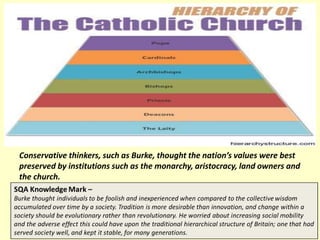
Conservative thinkers, such as Burke, thought the nation’s values were best
preserved by institutions such as the monarchy, aristocracy, land owners and
the church.
Authority
Allied to the natural hierarchy of society conservatives
believe that authority should be top down in nature.
Conservatives believe that those with the higher social
status will inevitably have the necessary experience or
education to provide leadership and guidance to those on a
lower social position i.e. a parent’s authority over their
children.
Again conservatives view acceptance of authority as a
necessary obligation to ensure the proper functioning of
society.
Authority is embedded through a hierarchical series of
social and political institutions: state, armed forces, legal
system, education, religion, the family. (Link Hierarchy
and Authority)
Example – conservatives would respect and uphold
institutions such as the police, armed forces and courts.
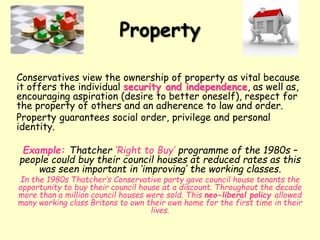
Conservatives view the ownership of property as vital because
it offers the individual security and independence, as well as,
encouraging aspiration (desire to better oneself), respect for
the property of others and an adherence to law and order.
Property guarantees social order, privilege and personal
identity.
Example: Thatcher ‘Right to Buy’ programme of the 1980s –
people could buy their council houses at reduced rates as this
was seen important in ‘improving’ the working classes.
In the 1980s Thatcher’s Conservative party gave council house tenants the
opportunity to buy their council house at a discount. Throughout the decade
more than a million council houses were sold. This neo-liberal policy allowed
many working class Britons to own their own home for the first time in their
lives.
Property
‘Burke believed that private property is the foundation of a just
social order and the spur to personal industry and national
prosperity. He argued passionately against intrusive government
monopolies and in favor of widespread access to acquiring property,
which he thought serves as a powerful check on encroachments by
the state.’
Property holds a special, almost mystical, significant for
Conservatives. Property ownership gives people a sense of
confidence and assurance in an uncertain and unpredictable world.
Likewise, those who possess and enjoy their own property are more
likely to respect the property of others. Property owners therefore
have a stake in society and an interest in maintaining law and order.
This, in turn, supports the other Conservative values of authority
and tradition.
Property
Summary: Conservatism is…
• The ‘desire to conserve’ – no need for
radical _______.
• _________ for established customs and
institutions (church/family/monarchy)
• _________ in its view of human nature –
humans are limited, dependent and need
stability – individuals may be corrupt,
selfish or greedy.
• Need for strong system of _____ and
_____
• A belief in the importance of private
______
Summary: Conservatism is…
• The ‘desire to conserve’ – no need for
radical change.
• Respect for established customs and
institutions (church/family/monarchy)
• Pessimistic in its view of human nature –
humans are limited, dependent and need
stability – individuals may be corrupt,
selfish or greedy.
• Need for strong system of law and order
• A belief in the importance of private
property
Summarise Conservatism in 5
words!!
Starter – 2020 US election
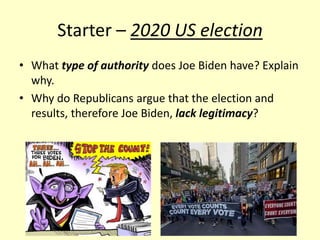
• What type of authority does Joe Biden have? Explain
why.
• Why do Republicans argue that the election and
results, therefore Joe Biden, lack legitimacy?
Conservatism in the Modern
Context
We will now consider three prominent
branches of conservatism to have emerged
in the UK:
1. One Nation conservatism - Disraeli
2. Neo-liberal conservatism - Thatcher
3. New Right (Neoconservatism) – David Cameron
Research Task –
• Who is the leader?
• When were they in power?
• What was the basics of their belief?
Traditional ‘old fashioned’
conservatism
• Importance of patriotism and authority.
• Opposes significant social and political changes.
• Opposes Britain's closer connections with Europe
(traditional Euro scepticism)
• Racist tendencies
• Supporters of social discipline and strong law and order –
stress importance of punishment (favour of capital
punishment).
• Oppose constitutional reform (e.g. devolution)
• Strong attachment to monarchy and House of Lords
‘One Nation’ conservatism
One Nation Conservatism is unity between the
classes.
• It promotes the idea that the privileged elite should
care for the poor and less fortunate
• It’s adoption in Britain was done more in fear of social
revolution rather than of genuine care for the poor
• During the late 19th Century Conservative Prime
Minister Benjamin Disraeli introduced a number of
electoral reforms aimed at politically integrating
poorer people in the UK stating that ‘reform from
above’ was preferable to ‘revolution from below’.
• Therefore, it is important to note that conservative
social reforms are not done through some ideological
desire for equality, but through a desire for a stable
hierarchy.
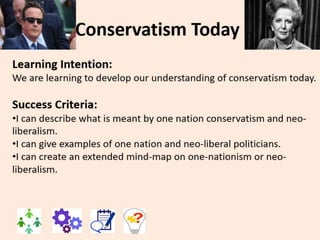
Disraeli
1871 Trade Union
Act – legalised
Trade Unions
1872 Secret Ballot
Act – removed
bribery and
corruption from
elections
1875 Public Health
Act – clean running
water, drainage
systems etc.
These reforms benefited poorer
Brits – an example of ‘One
Nation Conservatism’
Provided more stability and
reduced fear of revolution.
Questions
• What was Disraeli's view on the rich and
poor?
• According to Boris Johnson – what is a ‘one
nation Tory?’
• Explain, in your own words, why leaders like
Disraeli and Johnson want to be seen as ‘One
Nation Conservatives’.

Conservatism

  • 1.
  • 2.
    Starter - Leftor Right wing policy 1. Introducing a National Living Wage 2. Oppose same sex marriage 3. Lower Taxes on businesses 4. Support Private Schools 5. Nationalisation of Industries 6. Free School Meals for all P1-3 pupils
  • 3.
    Starter – Leftor Right wing policy 1. Introducing a National Living Wage 2. Oppose same sex marriage 3. Lower Taxes on businesses 4. Support Private Schools 5. Nationalisation of Industries 6. Free School Meals for all P1-3 pupils
  • 4.
    Conservatism what does thatword mean to you?
  • 5.
    Conservatism Conservatism: An ideologycharacterised by support for tradition, duty, authority and property. (Heywood, 2002) Note: • It is important at this stage to make a distinction between ‘big C’ Conservative and ‘small c’ conservative. • The ‘big C’ refers to the Conservative political party, whereas, the small c refers to the political ideology.
  • 6.
    Key Influences Conservatism firstemerged in the late 18thC in response to economic and political changes brought about by the French Revolution. Following the French Revolution a growth of liberalism, socialism and nationalism emerged posing a threat to the existing social order. Advocates of conservatism feared the rise of republicanism and the fall of monarchies in Europe. (conservatism = to conserve) Two of the most influential proponents of conservatism were Edmund Burke – British writer and MP (1729 – 97) and Joseph De Maistre (1753 – 1821).
  • 7.
    Edmund Burke • Burkewas actually a Whig (Liberal) MP from 1766-94 and was lauded by both the Liberals and the Conservatives during the 19th Century. During the 20th Century however, he came to be seen as the father of modern Conservatism. ​ • All quotes come from his work ‘Reflections on the Revolution in France’ (1790). This was written after the French Revolution began in 1789, but before the ‘Terror’ that it descended into. ​ • It can be seen as forecasting a lot of the troubles that did face the Revolution in the years that followed.​ • In order to best understand Burke’s work, a bit of background to the French Revolution is important. Watch the clip and take notes:​ https://www.youtube.com/watch?v=zBTKGf1nFlA
  • 8.
    Key Influences Conservatives blamedthe bloodbath of the French Revolution on the Enlightenment idea that human beings could consciously create political society. The major political conflicts in 20th century democracies have been between conservatives and socialists
  • 9.
    What is conservatism? Difficultto give an accurate definition and must be careful to associate it too much with the Conservatives of today, but there are a number of personal traits that a conservative is likely to have: • Conservatives tend to want less control over the individual, doesn’t like fixed political doctrines. • Like the status quo to be maintained rather than any radical change. • Although the nature of conservative thinking may change dependent on the time they usually want to maintain tradition, the present and they look to the past as a guide rather than fixed principles for the future. • Want the individual to work hard and flourish in terms of pursuing goals and achieving fulfilment. • Conservative also want good social order and security even if that is at the expense of freedom, rights and equality
  • 11.
    COMPARING CONSERVATISM AND SOCIALISM Makecomparisons, including references to theorists and policies, between Conservatism and Socialism, based on the following; • Their attitudes to human nature. • Their attitudes to property and capitalism. • Their attitudes to hierarchy and equality. • Their attitudes to change. To what extent are the key features of political ideologies different? 20 marks
  • 13.
    So, Conservatism encompassesthe following views:  Tradition (keeping things the way they’ve always been)  Human imperfection (humans will do bad things given the chance)  Authority (following rules)  Property (owning your own property is good)  Hierarchy (there are people below us and above us)
  • 14.
    Key Features ofConservatism Tradition A central theme to conservative thought is ‘the desire to conserve’ traditions, customs and institutions that have endured over time. The rationale behind this thought is that such traditions, customs and institutions have been tested over time and represent the accumulated ‘wisdom of the past’ and are worth preserving and retained for the benefit of future generations. They also believe that tradition strengthens social integration through a common identity. Edmund Burke ‘change is only necessary in order to conserve’. Established traditions, customs and institutions arguably ensure stability and promote a shared sense of history and belonging. Example - Monarchy & House of Lords – supported by many conservatives.
  • 15.
    Theorist point! Edmund Burkedeeply opposed the French Revolution on the grounds that wisdom is not about abstract principles (enlightenment) but about experience, tradition and history… And ‘change is only necessary in order to conserve’. SQA – Knowledge Mark Burke thought tradition and social order were important and that radical change would be disastrous. He thought that continuity was important and that the state should function to maintain social order and stability in society.
  • 17.
    Human Imperfection Another corepart of conservatism is the idea that humans are not perfect. Indeed, conservatives are actually quite pessimistic about the nature of human beings – humans are flawed. Accordingly, conservatism believed that humans have the capacity for reason but are fundamentally security-seeking creatures, dependent and morally corruptible. They view individuals to be inherently greedy, selfish and thirsty for power therefore human beings need a firm ‘moral compass’. Proponents of conservatism view crime as an exemplification of this. Conservatives suggest criminality is a result of individual greed rather than the failings of society and that a strong system of law enforcement and punishment is required to combat it. Example – conservatives may support harsher punishments, longer prison sentences. They are less in favour of rehabilitation of criminals.
  • 18.
    Theorist point! Edmund Burkeargued that human beings were intellectually imperfect especially when they are confronted with the complexity of social life. Do you agree with this statement? Burke argued – ‘We are flawed creatures and we must simply recognise that. Any ideology that works against the grain of human nature in order to establish a utopia will inevitably end in dystopia. By recognising the limitations of human beings, one can avoid the unnecessary destruction and death that arises from attempts to perfect humanity.’
  • 19.
    Hierarchy Linked to theidea of an organically developed society they view hierarchy within society as natural and inevitable as it reflects the different roles people have within society i.e. employer and worker or teacher and pupil. Meritocracy: the holding of power based on merit. In the eyes of conservatism there exists ‘natural’ inequality (e.g. poverty) – very little society can do – down to individual Conservatism suggests that individuals have an obligation to respect this hierarchy in order for society to function. Example – conservatism would argue that young people should do as teachers and parents say without question out of duty. It also acknowledges that a person’s status in life is determined by chance and therefore suggests that the fortunate have a moral obligation to care for the less fortunate.
  • 20.
    Conservative thinkers, suchas Burke, thought the nation’s values were best preserved by institutions such as the monarchy, aristocracy, land owners and the church.
  • 21.
    Authority Allied to thenatural hierarchy of society conservatives believe that authority should be top down in nature. Conservatives believe that those with the higher social status will inevitably have the necessary experience or education to provide leadership and guidance to those on a lower social position i.e. a parent’s authority over their children. Again conservatives view acceptance of authority as a necessary obligation to ensure the proper functioning of society. Authority is embedded through a hierarchical series of social and political institutions: state, armed forces, legal system, education, religion, the family. (Link Hierarchy and Authority) Example – conservatives would respect and uphold institutions such as the police, armed forces and courts.
  • 22.
    Conservatives view theownership of property as vital because it offers the individual security and independence, as well as, encouraging aspiration (desire to better oneself), respect for the property of others and an adherence to law and order. Property guarantees social order, privilege and personal identity. Example: Thatcher ‘Right to Buy’ programme of the 1980s – people could buy their council houses at reduced rates as this was seen important in ‘improving’ the working classes. In the 1980s Thatcher’s Conservative party gave council house tenants the opportunity to buy their council house at a discount. Throughout the decade more than a million council houses were sold. This neo-liberal policy allowed many working class Britons to own their own home for the first time in their lives. Property
  • 23.
    ‘Burke believed thatprivate property is the foundation of a just social order and the spur to personal industry and national prosperity. He argued passionately against intrusive government monopolies and in favor of widespread access to acquiring property, which he thought serves as a powerful check on encroachments by the state.’ Property holds a special, almost mystical, significant for Conservatives. Property ownership gives people a sense of confidence and assurance in an uncertain and unpredictable world. Likewise, those who possess and enjoy their own property are more likely to respect the property of others. Property owners therefore have a stake in society and an interest in maintaining law and order. This, in turn, supports the other Conservative values of authority and tradition. Property
  • 25.
    Summary: Conservatism is… •The ‘desire to conserve’ – no need for radical _______. • _________ for established customs and institutions (church/family/monarchy) • _________ in its view of human nature – humans are limited, dependent and need stability – individuals may be corrupt, selfish or greedy. • Need for strong system of _____ and _____ • A belief in the importance of private ______
  • 26.
    Summary: Conservatism is… •The ‘desire to conserve’ – no need for radical change. • Respect for established customs and institutions (church/family/monarchy) • Pessimistic in its view of human nature – humans are limited, dependent and need stability – individuals may be corrupt, selfish or greedy. • Need for strong system of law and order • A belief in the importance of private property
  • 27.
  • 28.
    Starter – 2020US election • What type of authority does Joe Biden have? Explain why. • Why do Republicans argue that the election and results, therefore Joe Biden, lack legitimacy?
  • 30.
    Conservatism in theModern Context We will now consider three prominent branches of conservatism to have emerged in the UK: 1. One Nation conservatism - Disraeli 2. Neo-liberal conservatism - Thatcher 3. New Right (Neoconservatism) – David Cameron Research Task – • Who is the leader? • When were they in power? • What was the basics of their belief?
  • 31.
    Traditional ‘old fashioned’ conservatism •Importance of patriotism and authority. • Opposes significant social and political changes. • Opposes Britain's closer connections with Europe (traditional Euro scepticism) • Racist tendencies • Supporters of social discipline and strong law and order – stress importance of punishment (favour of capital punishment). • Oppose constitutional reform (e.g. devolution) • Strong attachment to monarchy and House of Lords
  • 32.
    ‘One Nation’ conservatism OneNation Conservatism is unity between the classes. • It promotes the idea that the privileged elite should care for the poor and less fortunate • It’s adoption in Britain was done more in fear of social revolution rather than of genuine care for the poor • During the late 19th Century Conservative Prime Minister Benjamin Disraeli introduced a number of electoral reforms aimed at politically integrating poorer people in the UK stating that ‘reform from above’ was preferable to ‘revolution from below’. • Therefore, it is important to note that conservative social reforms are not done through some ideological desire for equality, but through a desire for a stable hierarchy.
  • 33.
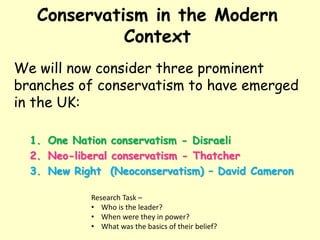
    Disraeli 1871 Trade Union Act– legalised Trade Unions 1872 Secret Ballot Act – removed bribery and corruption from elections 1875 Public Health Act – clean running water, drainage systems etc. These reforms benefited poorer Brits – an example of ‘One Nation Conservatism’ Provided more stability and reduced fear of revolution.
  • 34.
    Questions • What wasDisraeli's view on the rich and poor? • According to Boris Johnson – what is a ‘one nation Tory?’ • Explain, in your own words, why leaders like Disraeli and Johnson want to be seen as ‘One Nation Conservatives’.

Editor's Notes

  • #34 https://www.youtube.com/watch?v=vOV7KeZANXw