Migration and Empire
Section C: Scottish Emigration, 1830’s - 1939
WHAT WILL BE COVERED IN THIS SECTION
Reasons for Emigration, including:
● Poverty
● The Highland Clearances
● Missionary Work
● The Effectiveness of Emigration Societies and Government Schemes
● The Attraction of New Lands (e.g. economic opportunity and cheap
land)
PUSH VS PULL FACTORS
Push Factor -
something which
forces a person out of
the country they
currently live in.
Pull Factor -
something which
attracts a person to
the country they are
moving to.
Push Factors:
What Forced
Scots to Leave?
Highlands vs Lowlands
Lowlands
Emigration
Reasons for Emigration
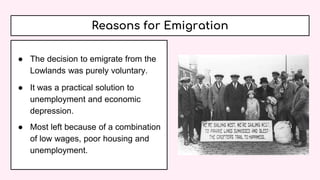
● The decision to emigrate from the
Lowlands was purely voluntary.
● It was a practical solution to
unemployment and economic
depression.
● Most left because of a combination
of low wages, poor housing and
unemployment.
1. Poverty
● Tenement buildings roughly 4 stories high, with
families often sharing 1 or 2 rooms.
● There were dark closes and courtyards full of ash
heaps, rubbish piles and dry toilets.
● Poor ventilation and overcrowding led to the
spread of tuberculosis and other diseases.
● Scottish people chose to leave in the hopes of
better living conditions and better housing.
1. Poverty
2. Lack of Jobs/Employment
● With the introduction of factories, goods could be made very quickly and
cheaper than craftsmen had made them previously.
● As a result craftsmen could not compete and were forced to emigrate to
places like Canada and Australia, where their skills were appreciated and in
demand.
● The skilled worker was the highest number of those emigrating.
● 1912 and 1913 – 47% of adult male emigrants from Scotland described
themselves as skilled, compared with 36 per cent of those from England and
Wales.
● The worst periods of emigration were the late 1840s and early 1850s, the
mid-1880s, and the period 1906–13.
Where Did Workers Emigrate to?
● Unskilled labourers tended to
opt for Canada and Australia
where there was many job
opportunities
● Skilled workers preferred
South Africa and the USA.
3. Decline in Heavy Industry
● During the Interwar years the there was less
demand for heavy industry goods such as steel
and shipbuilding, which were the industries that
were a huge employer in Scotland.
● Scotland struggled to get foreign orders as a result
of competition from other countries.
● When these industries went in to decline, many
from Scotland moved to other areas of Britain, like
the south of England to find employment or abroad.
● Many Scots who left were young and well educated
(brain drain).
4. Service in the Army
● Many simply joined the army and left to fight for the
Empire all over the world.
● Highland regiments were a very good way for people
within Scotland to leave and gain a living elsewhere.
Many, including lowlanders joined the Highland
Regiments in the 19th Century.
● This was a period when the Highlanders were seen
as the best the army could produce and this image
was spread around the country, which encouraged
others to join.
5. Changing Technology
● Many emigrated from the farming areas in Scotland because of new
scientific inventions which changed the role of humans in production.
● New machines were being used to produce more food (increase in
population).
● Less farm workers were needed.
● Houses were tied to their jobs - if they lost their jobs then they would
also lose their house.
Examples of Changing Technology
Bell’s reaper was
used to cut corn.
Horses replaced
manpower.
A seed drill was
used instead of
sowing.
(Tull’s Drill)
Tractors replaced
horses for pulling
carts and
equipment.
Railways
transported
fertilisers,
machinery and
produce to towns.
Highlands
Emigration
1. Highland Clearances
● The policy of the landlord was to clear the
poorest Highlanders from the land and maintain
those crofters (renters) who were capable of
paying rent.
● The Dukes of Argyll and Sutherland and other
large landowners financed emigration schemes.
● Offers of funding were linked to eviction, which
left little choice to the crofter.
1. Highland Clearances
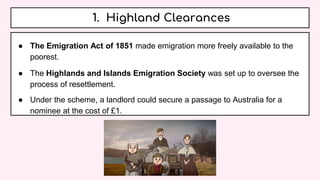
● The Emigration Act of 1851 made emigration more freely available to the
poorest.
● The Highlands and Islands Emigration Society was set up to oversee the
process of resettlement.
● Under the scheme, a landlord could secure a passage to Australia for a
nominee at the cost of £1.
1. Highland Clearances
● Between 1846 and 1857 around 16,533
people of the poorest types, comprising
of mainly young men, were assisted to
emigrate.
● The greatest loss occurred in the
Islands, particularly Skye, Mull, the Long
Island and the mainland parishes of the
Inner Sound.
2. Failure of the Potato Crop
● The crofting population relied on a potato
diet.
● The crop failed in the late 1830s and
again in the late 1840s.
● Emigration seemed the only alternative to
avoid mass starvation.
Push Reasons For Emigration From Scotland
Lowlands Emigration Highlands Emigration
1. Poverty
2. Lack of Jobs
3. Heavy Industry Decline
4. Roles in the Army
5. Changes to Technology
1. Highland Clearances
2. Failure of Potato Crop
Pull Factors:
What Attracted
Scots to Move
Elsewhere?
1. Improvements in Transport
● It became much easier to travel
overseas. It also became cheaper.
● The invention of the steamship
reduced the time it took to travel and
lowered the risk of sailing such a
distance.
● In 1850 it could take up to 6 weeks to
cross the Atlantic. By 1914, this had
been reduced to just 1 week.
1. Improvements in Transport
● Building of the railways also improved travel links across Scotland and the
rest of the UK.
● This meant that the Scots could easily get to major sailing ports much
quicker.
2. Help to Move Abroad
● Emigration was expensive.
● Scots needed money to travel and build new homes once they arrived in
the new countries.
● Many Scots needed financial help to move.
● There were several public and private schemes available to help Scots
make the move.
2. Help to Move Abroad (Landlords)
● Landlords wanted to reduce the number of people living on their lands so that
it could be used for other purposes.
● Some landlords also helped negotiate for land on behalf of their tenants with
the government of countries like Canada.
● Landowners like Lord Selkirk and the Duke of Hamilton gave their tenants a
lot of help.
● Not all landlords were helpful – Colonel Gordon evicted 1770 people from his
estates in South Uist, Barra and Benbecula.
2. Help to Move Abroad (Government)
● Before WWI, the Government did very little to support its people.
● After the war they did help a little as they saw emigration to be helping with
the unemployment problem.
● The Empire Settlement Act (1922) gave £3 million a year to help with travel
expenses.
2. Help to Move Abroad (Government)
● Governments which ruled the different parts of
the British Empire put a lot of effort into
attracting certain people.
● Some places had offices in Scotland who were
able to hand out leaflets and hold public talks
to encourage people to move elsewhere.
● Canada – wanted well qualified farmers and
workers.
2. Help to Move Abroad (Charities)
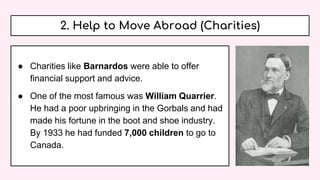
● Charities like Barnardos were able to offer
financial support and advice.
● One of the most famous was William Quarrier.
He had a poor upbringing in the Gorbals and had
made his fortune in the boot and shoe industry.
By 1933 he had funded 7,000 children to go to
Canada.
3. Missionary Work
● The British Empire contained people with different religions.
● Some men and women believed it was their duty to convert people to
Christianity. They became known as Missionaries.
● Alexander Duff established the Madras College in India.
● Dr Jane Waterson set up a girls school in South Africa.
● The best known missionary was Dr David Livingstone who went to Africa
where he taught his faith and his medical skills.
4. Opportunities Abroad
● Many were promised a better quality of
life where they would be free from
poverty and would have secure
employment.
● Others were promised they could own
and support their own land.
● USA and New Zealand offered cheap
and fertile land to farmers, whilst Canada
said crofters could buy land at fair prices.
5. Family Connections
● Relatives provided money and paid for tickets so that others could join them.
● Many moved to be with relatives after they had heard stories of a better life
and others having settled well in a new country.
6. To Make Money
● New Zealand’s South Island to farm sheep – Scottish farmers were respected
for their experience and skills.
● North America – Andrew Little from Moffat emigrated in 1894 and became
known as the ‘sheep king of Idaho’.
● Andrew Carnegie made a huge fortune from providing steel for railways in
North America.
● Two Scottish cousins for Dufftown and Forres build the Canadian Pacific
Railway.
● Examples of experienced Scots making a name for themselves and a fortune
was encouraging.
7. Opportunities for Skilled Workers
● Skilled workers had the education and training that was in demand abroad.
● Textiles industry abroad brought Scots over especially in New England
(USA).
● By 1870, 46% of all Scots who emigrated to the USA worked in factories,
engineering and mining jobs.
8. Encouragement From Other Scots
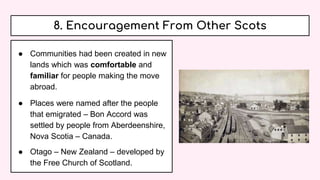
● Communities had been created in new
lands which was comfortable and
familiar for people making the move
abroad.
● Places were named after the people
that emigrated – Bon Accord was
settled by people from Aberdeenshire,
Nova Scotia – Canada.
● Otago – New Zealand – developed by
the Free Church of Scotland.
Pull Reasons For Emigration From Scotland
Pull Reasons
1. Better Transport
2. Help to Move Abroad (Government, Charities etc.)
3. Family Connections
4. Encouragement From Other Scots
5. Missionary Work
6. Employment for Skilled Workers
7. Better Life Opportunities
8. To Make a Fortune

C

  • 1.
    Migration and Empire SectionC: Scottish Emigration, 1830’s - 1939
  • 2.
    WHAT WILL BECOVERED IN THIS SECTION Reasons for Emigration, including: ● Poverty ● The Highland Clearances ● Missionary Work ● The Effectiveness of Emigration Societies and Government Schemes ● The Attraction of New Lands (e.g. economic opportunity and cheap land)
  • 3.
    PUSH VS PULLFACTORS Push Factor - something which forces a person out of the country they currently live in. Pull Factor - something which attracts a person to the country they are moving to.
  • 4.
  • 5.
  • 6.
  • 7.
    Reasons for Emigration ●The decision to emigrate from the Lowlands was purely voluntary. ● It was a practical solution to unemployment and economic depression. ● Most left because of a combination of low wages, poor housing and unemployment.
  • 8.
    1. Poverty ● Tenementbuildings roughly 4 stories high, with families often sharing 1 or 2 rooms. ● There were dark closes and courtyards full of ash heaps, rubbish piles and dry toilets. ● Poor ventilation and overcrowding led to the spread of tuberculosis and other diseases. ● Scottish people chose to leave in the hopes of better living conditions and better housing.
  • 9.
  • 10.
    2. Lack ofJobs/Employment ● With the introduction of factories, goods could be made very quickly and cheaper than craftsmen had made them previously. ● As a result craftsmen could not compete and were forced to emigrate to places like Canada and Australia, where their skills were appreciated and in demand. ● The skilled worker was the highest number of those emigrating. ● 1912 and 1913 – 47% of adult male emigrants from Scotland described themselves as skilled, compared with 36 per cent of those from England and Wales. ● The worst periods of emigration were the late 1840s and early 1850s, the mid-1880s, and the period 1906–13.
  • 11.
    Where Did WorkersEmigrate to? ● Unskilled labourers tended to opt for Canada and Australia where there was many job opportunities ● Skilled workers preferred South Africa and the USA.
  • 12.
    3. Decline inHeavy Industry ● During the Interwar years the there was less demand for heavy industry goods such as steel and shipbuilding, which were the industries that were a huge employer in Scotland. ● Scotland struggled to get foreign orders as a result of competition from other countries. ● When these industries went in to decline, many from Scotland moved to other areas of Britain, like the south of England to find employment or abroad. ● Many Scots who left were young and well educated (brain drain).
  • 13.
    4. Service inthe Army ● Many simply joined the army and left to fight for the Empire all over the world. ● Highland regiments were a very good way for people within Scotland to leave and gain a living elsewhere. Many, including lowlanders joined the Highland Regiments in the 19th Century. ● This was a period when the Highlanders were seen as the best the army could produce and this image was spread around the country, which encouraged others to join.
  • 14.
    5. Changing Technology ●Many emigrated from the farming areas in Scotland because of new scientific inventions which changed the role of humans in production. ● New machines were being used to produce more food (increase in population). ● Less farm workers were needed. ● Houses were tied to their jobs - if they lost their jobs then they would also lose their house.
  • 15.
    Examples of ChangingTechnology Bell’s reaper was used to cut corn. Horses replaced manpower. A seed drill was used instead of sowing. (Tull’s Drill) Tractors replaced horses for pulling carts and equipment. Railways transported fertilisers, machinery and produce to towns.
  • 16.
  • 17.
    1. Highland Clearances ●The policy of the landlord was to clear the poorest Highlanders from the land and maintain those crofters (renters) who were capable of paying rent. ● The Dukes of Argyll and Sutherland and other large landowners financed emigration schemes. ● Offers of funding were linked to eviction, which left little choice to the crofter.
  • 18.
    1. Highland Clearances ●The Emigration Act of 1851 made emigration more freely available to the poorest. ● The Highlands and Islands Emigration Society was set up to oversee the process of resettlement. ● Under the scheme, a landlord could secure a passage to Australia for a nominee at the cost of £1.
  • 19.
    1. Highland Clearances ●Between 1846 and 1857 around 16,533 people of the poorest types, comprising of mainly young men, were assisted to emigrate. ● The greatest loss occurred in the Islands, particularly Skye, Mull, the Long Island and the mainland parishes of the Inner Sound.
  • 20.
    2. Failure ofthe Potato Crop ● The crofting population relied on a potato diet. ● The crop failed in the late 1830s and again in the late 1840s. ● Emigration seemed the only alternative to avoid mass starvation.
  • 21.
    Push Reasons ForEmigration From Scotland Lowlands Emigration Highlands Emigration 1. Poverty 2. Lack of Jobs 3. Heavy Industry Decline 4. Roles in the Army 5. Changes to Technology 1. Highland Clearances 2. Failure of Potato Crop
  • 22.
  • 23.
    1. Improvements inTransport ● It became much easier to travel overseas. It also became cheaper. ● The invention of the steamship reduced the time it took to travel and lowered the risk of sailing such a distance. ● In 1850 it could take up to 6 weeks to cross the Atlantic. By 1914, this had been reduced to just 1 week.
  • 24.
    1. Improvements inTransport ● Building of the railways also improved travel links across Scotland and the rest of the UK. ● This meant that the Scots could easily get to major sailing ports much quicker.
  • 25.
    2. Help toMove Abroad ● Emigration was expensive. ● Scots needed money to travel and build new homes once they arrived in the new countries. ● Many Scots needed financial help to move. ● There were several public and private schemes available to help Scots make the move.
  • 26.
    2. Help toMove Abroad (Landlords) ● Landlords wanted to reduce the number of people living on their lands so that it could be used for other purposes. ● Some landlords also helped negotiate for land on behalf of their tenants with the government of countries like Canada. ● Landowners like Lord Selkirk and the Duke of Hamilton gave their tenants a lot of help. ● Not all landlords were helpful – Colonel Gordon evicted 1770 people from his estates in South Uist, Barra and Benbecula.
  • 27.
    2. Help toMove Abroad (Government) ● Before WWI, the Government did very little to support its people. ● After the war they did help a little as they saw emigration to be helping with the unemployment problem. ● The Empire Settlement Act (1922) gave £3 million a year to help with travel expenses.
  • 28.
    2. Help toMove Abroad (Government) ● Governments which ruled the different parts of the British Empire put a lot of effort into attracting certain people. ● Some places had offices in Scotland who were able to hand out leaflets and hold public talks to encourage people to move elsewhere. ● Canada – wanted well qualified farmers and workers.
  • 29.
    2. Help toMove Abroad (Charities) ● Charities like Barnardos were able to offer financial support and advice. ● One of the most famous was William Quarrier. He had a poor upbringing in the Gorbals and had made his fortune in the boot and shoe industry. By 1933 he had funded 7,000 children to go to Canada.
  • 30.
    3. Missionary Work ●The British Empire contained people with different religions. ● Some men and women believed it was their duty to convert people to Christianity. They became known as Missionaries. ● Alexander Duff established the Madras College in India. ● Dr Jane Waterson set up a girls school in South Africa. ● The best known missionary was Dr David Livingstone who went to Africa where he taught his faith and his medical skills.
  • 31.
    4. Opportunities Abroad ●Many were promised a better quality of life where they would be free from poverty and would have secure employment. ● Others were promised they could own and support their own land. ● USA and New Zealand offered cheap and fertile land to farmers, whilst Canada said crofters could buy land at fair prices.
  • 32.
    5. Family Connections ●Relatives provided money and paid for tickets so that others could join them. ● Many moved to be with relatives after they had heard stories of a better life and others having settled well in a new country.
  • 33.
    6. To MakeMoney ● New Zealand’s South Island to farm sheep – Scottish farmers were respected for their experience and skills. ● North America – Andrew Little from Moffat emigrated in 1894 and became known as the ‘sheep king of Idaho’. ● Andrew Carnegie made a huge fortune from providing steel for railways in North America. ● Two Scottish cousins for Dufftown and Forres build the Canadian Pacific Railway. ● Examples of experienced Scots making a name for themselves and a fortune was encouraging.
  • 34.
    7. Opportunities forSkilled Workers ● Skilled workers had the education and training that was in demand abroad. ● Textiles industry abroad brought Scots over especially in New England (USA). ● By 1870, 46% of all Scots who emigrated to the USA worked in factories, engineering and mining jobs.
  • 35.
    8. Encouragement FromOther Scots ● Communities had been created in new lands which was comfortable and familiar for people making the move abroad. ● Places were named after the people that emigrated – Bon Accord was settled by people from Aberdeenshire, Nova Scotia – Canada. ● Otago – New Zealand – developed by the Free Church of Scotland.
  • 36.
    Pull Reasons ForEmigration From Scotland Pull Reasons 1. Better Transport 2. Help to Move Abroad (Government, Charities etc.) 3. Family Connections 4. Encouragement From Other Scots 5. Missionary Work 6. Employment for Skilled Workers 7. Better Life Opportunities 8. To Make a Fortune