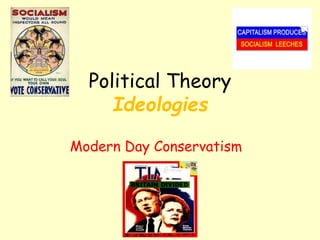
Political Theory
Ideologies
Modern Day Conservatism
Neoliberalism
Neo-liberalism
• Classical liberalism (freedom) within a conservative
framework.
• Economic liberty – minimal Government intervention.
• ‘Laissez Faire’ economics (letting things take its own
course without interference).
• Support free market economics - state intervention
is unnecessary.
• Strong state is still required to maintain public
order and ensure traditional values are upheld.
• Welfare state undermines self-reliance – promotes
idleness (laziness) – blaming individual for their
situation.
• Cut taxes and deregulate business.
• Views are very ‘right wing’
Liberalism is a political and economic doctrine that
emphasizes individual autonomy, equality of opportunity,
and the protection of individual rights (primarily to life,
liberty, and property), against both the state and private
economic actors, including businesses.
The ‘Iron Lady’
https://www.youtube.com/watch?v=jUfIzRYvBT4
New York Times: What did Thatcherism do for Britain
(3:06)
https://www.youtube.com/watch?v=F0-ZZZPjE2g
Life and Legacy of the ‘Iron Lady’
(3:40)
Prime Minister from 1979- 1990. Falkland's war victory in 1982
and the recovering economy led to her successful re-election.
Her support for the community charge (Poll tax) was her
demise. She resigned as PM and party leader in Nov 1990 after
Michael Heseltine challenged her leadership. She was then
given peerage in the House of Lords.
Margaret Thatcher was a major proponent of this individualist ideal,
famously saying that ‘there is no such thing as society, only individuals
and their families’.
As Prime Minister, Thatcher carried out a neoliberal legislative
programme selling off state owned businesses such as British Telecom,
British Airways and Rolls Royce; as well as, introducing new laws restricting
trade unions and closing nationalised heavy industries, such as coal
mines.
Thatcher believed state intervention bred a culture of dependence and
inhibited the conservative traditions of individual responsibility and
entrepreneurship.
She believed an unrestricted free-market would find a way to resolve
issues such as unemployment and poverty without the need for government
intervention.
However, Thatcher’s ‘right to buy’ scheme allowing people to buy their
council houses at discounted rates is an indication that she still adhered
to traditional conservative values such as the importance of owning
property.
Questions
1. ‘There is no such thing as society, only
individuals and their families’. What does this
mean?
2. What did Margaret Thatcher think the
responsibility of the state was? Control the economy or
control law and order?
3. How did Thatcher think unemployment and
poverty should be solved?
4. Summarise, in your words, what Neo-Liberalism
is?
New Right
Neoconservatism (New Right) aims to reassert
traditional 19th Century conservatism with a
primary focus on restoring hierarchal authority and
a return to traditional societal values such as
family, religion and nationalism in order to ensure
stability.
Similar to neoliberalism the New Right advocate
minimal government involvement in people’s lives
and encourage individual responsibility and
entrepreneurship.
In Focus: David Cameron
Since becoming PM in 2010 David Cameron arguably
pursued a New Right legislative agenda (albeit
restricted by his coalition partners 2010-2015),
reducing public spending, introducing welfare reform
and allowing greater involvement of the free-market
in the NHS and education (privatisation).
Furthermore, his call for a ‘Big Society’ approach to
social issues requiring charities and volunteers to
take action rather than government fits neatly with
the type of top down benevolence characteristic of
traditional conservative values.
Organic Society
Conservatism rejects the idea that society is man-made but
rather it forms organically as a result of shared
experiences, traditions and values.
‘The total is greater than the sum of its parts’ -
Conservatives believe in a more communitarian approach to
development e.g. everyone plays a role to improve society
Accordingly, conservatives place a great deal of importance
on traditional social institutions like organised religion and
social structures like the nuclear family as these are
considered to be the ‘fabric’ holding society together
which allow it develop organically.
Example – David Cameron’s ‘Big Society’ of 2010 placed an
emphasis on individual goodwill, volunteering and charity work
to improve society as a whole
• Because obedience to those in authority is necessary, Conservatives
believe that the natural structure of society is hierarchical and unequally.
Gradations of social position and status, e.g. a class system, are inevitable
because they reflect the different roles and responsibilities that people
have within a society.
• There are mutual obligations between the different levels in the hierarchy
and these obligations promote social cohesion. For example, the rich have
a responsibility to the poor, in the form of charity. If they fail to meet that
obligation, then the results will be crime and, ultimately, a violent
revolution. David Cameron’s ‘Big Society’, which has continued into May
and Johnson’s premierships and in which voluntary groups take on a
significant share of social welfare provision, is an example of responsibility
in practice. The food banks that have grown up in the ‘Big Society’
exemplify the rich (those with surplus food and time) supporting the poor.
Therefore, a Conservative would not see them as a source of shame, but as
a source of pride.
"To have charitable support given by people voluntarily to support their fellow
citizens I think is rather uplifting and shows what a good, compassionate
country we are. Inevitably, the state can't do everything, so I think that there is
good within food banks.”
Jacob Rees-Mogg MP, Conservative
(Source: BBC News 14 Sept 2017 https://www.bbc.co.uk/news/uk-politics-41264965)
https://www.youtube.com/watch?v=YZDA0UpNrQA
Big Society Qs
• What does David Cameron mean when he
says ‘Big Society answers rather than Big State
answers’?
• Should we proud of foodbanks as a society?
What are the viewpoints of Conservatives?
What do you think the view point of Socialists would be?
Task – Branches of Conservatism
• How do each of the following link to the main characteristics
of Conservatism;
One Nation conservatism - Disraeli
Neo-liberal conservatism - Thatcher
New Right (Neoconservatism) – David Cameron
Hierarchy/Equality Property
Human Nature Change
Success of UK Conservatives
Very successful at winning elections in the
UK (in power for over two thirds of 20th
Century)
Good at getting ideas across (gaining
working class support in the 80s)
Still tends to defend a specific group, the
middle classes.
Issues facing UK Conservatives
 Blamed for recession in 1990s
 Major issues with support in Scotland due to
legacy of ‘Thatcherism’
 Split over Europe (some want complete exit
while others want economic union)
 Linked to Political Sleaze (notions of privilege
lead to corruption)
 Centrality of tradition incompatible with
modern multicultural society
 Conservatives labelled the ‘nasty party’ due to
their views on individual responsibility and
market driven solutions to social problems.
What aspects of conservatism do you agree with?
Explain why for each…..
• Human Imperfection – are humans naturally imperfect,
impulsive beings?
• Property – does it benefit society if people own property?
Provide incentive and security
• Class/Authority – does society need an upper and lower class to
function? Do people need authority to not fall into chaos?
• Change – is radical change in society necessary? If it isn’t
broke do we drastically need to fix it?

MDC

  • 1.
  • 2.
  • 3.
    Neo-liberalism • Classical liberalism(freedom) within a conservative framework. • Economic liberty – minimal Government intervention. • ‘Laissez Faire’ economics (letting things take its own course without interference). • Support free market economics - state intervention is unnecessary. • Strong state is still required to maintain public order and ensure traditional values are upheld. • Welfare state undermines self-reliance – promotes idleness (laziness) – blaming individual for their situation. • Cut taxes and deregulate business. • Views are very ‘right wing’ Liberalism is a political and economic doctrine that emphasizes individual autonomy, equality of opportunity, and the protection of individual rights (primarily to life, liberty, and property), against both the state and private economic actors, including businesses.
  • 4.
    The ‘Iron Lady’ https://www.youtube.com/watch?v=jUfIzRYvBT4 NewYork Times: What did Thatcherism do for Britain (3:06) https://www.youtube.com/watch?v=F0-ZZZPjE2g Life and Legacy of the ‘Iron Lady’ (3:40) Prime Minister from 1979- 1990. Falkland's war victory in 1982 and the recovering economy led to her successful re-election. Her support for the community charge (Poll tax) was her demise. She resigned as PM and party leader in Nov 1990 after Michael Heseltine challenged her leadership. She was then given peerage in the House of Lords.
  • 5.
    Margaret Thatcher wasa major proponent of this individualist ideal, famously saying that ‘there is no such thing as society, only individuals and their families’. As Prime Minister, Thatcher carried out a neoliberal legislative programme selling off state owned businesses such as British Telecom, British Airways and Rolls Royce; as well as, introducing new laws restricting trade unions and closing nationalised heavy industries, such as coal mines. Thatcher believed state intervention bred a culture of dependence and inhibited the conservative traditions of individual responsibility and entrepreneurship. She believed an unrestricted free-market would find a way to resolve issues such as unemployment and poverty without the need for government intervention. However, Thatcher’s ‘right to buy’ scheme allowing people to buy their council houses at discounted rates is an indication that she still adhered to traditional conservative values such as the importance of owning property.
  • 6.
    Questions 1. ‘There isno such thing as society, only individuals and their families’. What does this mean? 2. What did Margaret Thatcher think the responsibility of the state was? Control the economy or control law and order? 3. How did Thatcher think unemployment and poverty should be solved? 4. Summarise, in your words, what Neo-Liberalism is?
  • 7.
    New Right Neoconservatism (NewRight) aims to reassert traditional 19th Century conservatism with a primary focus on restoring hierarchal authority and a return to traditional societal values such as family, religion and nationalism in order to ensure stability. Similar to neoliberalism the New Right advocate minimal government involvement in people’s lives and encourage individual responsibility and entrepreneurship.
  • 8.
    In Focus: DavidCameron Since becoming PM in 2010 David Cameron arguably pursued a New Right legislative agenda (albeit restricted by his coalition partners 2010-2015), reducing public spending, introducing welfare reform and allowing greater involvement of the free-market in the NHS and education (privatisation). Furthermore, his call for a ‘Big Society’ approach to social issues requiring charities and volunteers to take action rather than government fits neatly with the type of top down benevolence characteristic of traditional conservative values.
  • 9.
    Organic Society Conservatism rejectsthe idea that society is man-made but rather it forms organically as a result of shared experiences, traditions and values. ‘The total is greater than the sum of its parts’ - Conservatives believe in a more communitarian approach to development e.g. everyone plays a role to improve society Accordingly, conservatives place a great deal of importance on traditional social institutions like organised religion and social structures like the nuclear family as these are considered to be the ‘fabric’ holding society together which allow it develop organically. Example – David Cameron’s ‘Big Society’ of 2010 placed an emphasis on individual goodwill, volunteering and charity work to improve society as a whole
  • 10.
    • Because obedienceto those in authority is necessary, Conservatives believe that the natural structure of society is hierarchical and unequally. Gradations of social position and status, e.g. a class system, are inevitable because they reflect the different roles and responsibilities that people have within a society. • There are mutual obligations between the different levels in the hierarchy and these obligations promote social cohesion. For example, the rich have a responsibility to the poor, in the form of charity. If they fail to meet that obligation, then the results will be crime and, ultimately, a violent revolution. David Cameron’s ‘Big Society’, which has continued into May and Johnson’s premierships and in which voluntary groups take on a significant share of social welfare provision, is an example of responsibility in practice. The food banks that have grown up in the ‘Big Society’ exemplify the rich (those with surplus food and time) supporting the poor. Therefore, a Conservative would not see them as a source of shame, but as a source of pride. "To have charitable support given by people voluntarily to support their fellow citizens I think is rather uplifting and shows what a good, compassionate country we are. Inevitably, the state can't do everything, so I think that there is good within food banks.” Jacob Rees-Mogg MP, Conservative (Source: BBC News 14 Sept 2017 https://www.bbc.co.uk/news/uk-politics-41264965)
  • 11.
  • 13.
    Big Society Qs •What does David Cameron mean when he says ‘Big Society answers rather than Big State answers’? • Should we proud of foodbanks as a society? What are the viewpoints of Conservatives? What do you think the view point of Socialists would be?
  • 14.
    Task – Branchesof Conservatism • How do each of the following link to the main characteristics of Conservatism; One Nation conservatism - Disraeli Neo-liberal conservatism - Thatcher New Right (Neoconservatism) – David Cameron Hierarchy/Equality Property Human Nature Change
  • 15.
    Success of UKConservatives Very successful at winning elections in the UK (in power for over two thirds of 20th Century) Good at getting ideas across (gaining working class support in the 80s) Still tends to defend a specific group, the middle classes.
  • 16.
    Issues facing UKConservatives  Blamed for recession in 1990s  Major issues with support in Scotland due to legacy of ‘Thatcherism’  Split over Europe (some want complete exit while others want economic union)  Linked to Political Sleaze (notions of privilege lead to corruption)  Centrality of tradition incompatible with modern multicultural society  Conservatives labelled the ‘nasty party’ due to their views on individual responsibility and market driven solutions to social problems.
  • 18.
    What aspects ofconservatism do you agree with? Explain why for each….. • Human Imperfection – are humans naturally imperfect, impulsive beings? • Property – does it benefit society if people own property? Provide incentive and security • Class/Authority – does society need an upper and lower class to function? Do people need authority to not fall into chaos? • Change – is radical change in society necessary? If it isn’t broke do we drastically need to fix it?