





LINEAR
MOMENTUM
CONCEPT OF LINEAR
MOMENTUM
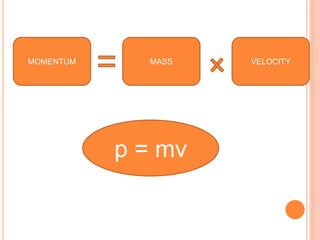
MOMENTUM VELOCITYMASS
p = mv
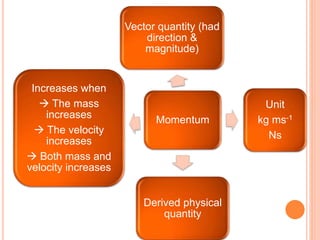
Momentum
Vector quantity (had
direction &
magnitude)
Unit
kg ms-1
Ns
Derived physical
quantity
Increases when
 The mass
increases
 The velocity
increases
 Both mass and
velocity increases
CONSERVATION OF
MOMENTUM
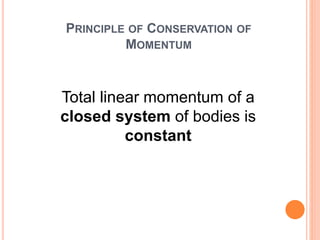
PRINCIPLE OF CONSERVATION OF
MOMENTUM
Total linear momentum of a
closed system of bodies is
constant
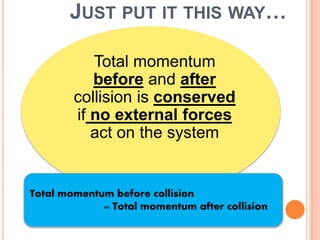
JUST PUT IT THIS WAY…
Total momentum
before and after
collision is conserved
if no external forces
act on the system
Total momentum before collision
= Total momentum after collision
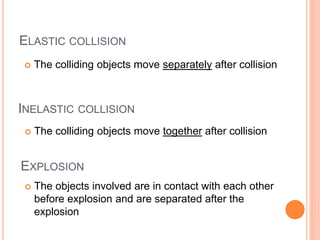
ELASTIC COLLISION
 The colliding objects move separately after collision
INELASTIC COLLISION
EXPLOSION
 The colliding objects move together after collision
 The objects involved are in contact with each other
before explosion and are separated after the
explosion
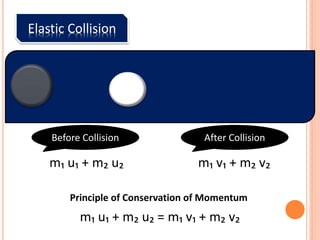
Elastic Collision
Before Collision After Collision
m₁ u₁ + m₂ u₂ m₁ v₁ + m₂ v₂
Principle of Conservation of Momentum
m₁ u₁ + m₂ u₂ = m₁ v₁ + m₂ v₂
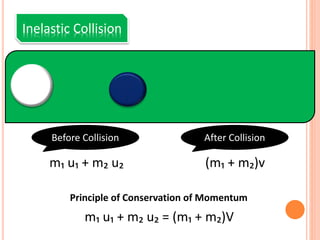
Inelastic Collision
Before Collision After Collision
m₁ u₁ + m₂ u₂ (m₁ + m₂)v
m₁ u₁ + m₂ u₂ = (m₁ + m₂)V
Principle of Conservation of Momentum
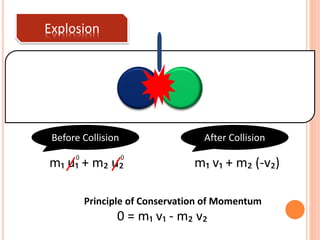
Explosion
Before Collision After Collision
m₁ u₁ + m₂ u₂ m₁ v₁ + m₂ (-v₂)
Principle of Conservation of Momentum
0 = m₁ v₁ - m₂ v₂
0 0
Elastic Inelastic Explosion
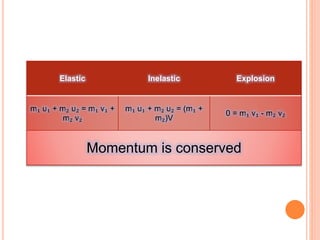
m₁ u₁ + m₂ u₂ = m₁ v₁ +
m₂ v₂
m₁ u₁ + m₂ u₂ = (m₁ +
m₂)V
0 = m₁ v₁ - m₂ v₂
Momentum is conserved
APPLICATION: THE PRINCIPLE OF
CONSERVATION OF MOMENTUM
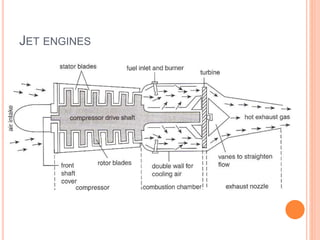
JET ENGINES
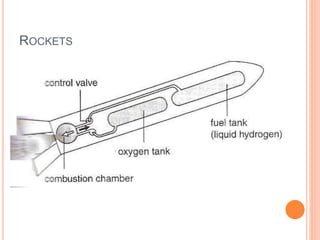
ROCKETS
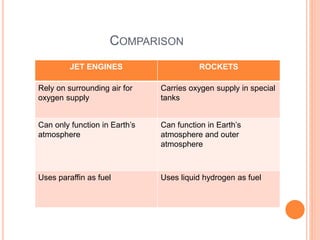
COMPARISON
JET ENGINES ROCKETS
Rely on surrounding air for
oxygen supply
Carries oxygen supply in special
tanks
Can only function in Earth’s
atmosphere
Can function in Earth’s
atmosphere and outer
atmosphere
Uses paraffin as fuel Uses liquid hydrogen as fuel
APPLICATION OF IDEA
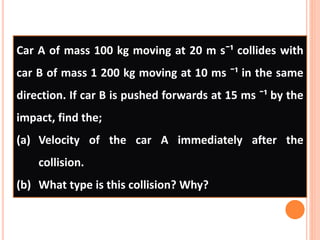
Car A of mass 100 kg moving at 20 m sˉ¹ collides with
car B of mass 1 200 kg moving at 10 ms ˉ¹ in the same
direction. If car B is pushed forwards at 15 ms ˉ¹ by the
impact, find the;
(a) Velocity of the car A immediately after the
collision.
(b) What type is this collision? Why?
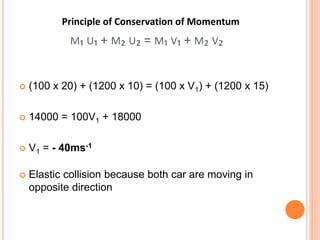
 (100 x 20) + (1200 x 10) = (100 x V1) + (1200 x 15)
 14000 = 100V1 + 18000
 V1 = - 40ms-1
 Elastic collision because both car are moving in
opposite direction
M₁ U₁ + M₂ U₂ = M₁ V₁ + M₂ V₂
Principle of Conservation of Momentum
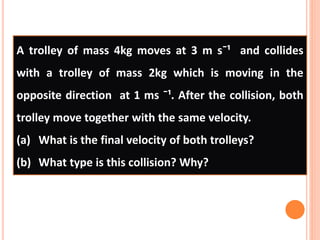
A trolley of mass 4kg moves at 3 m sˉ¹ and collides
with a trolley of mass 2kg which is moving in the
opposite direction at 1 ms ˉ¹. After the collision, both
trolley move together with the same velocity.
(a) What is the final velocity of both trolleys?
(b) What type is this collision? Why?
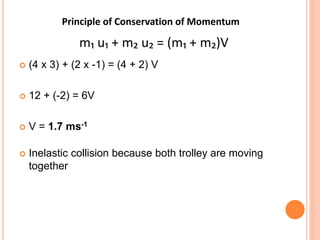
 (4 x 3) + (2 x -1) = (4 + 2) V
 12 + (-2) = 6V
 V = 1.7 ms-1
 Inelastic collision because both trolley are moving
together
Principle of Conservation of Momentum
m₁ u₁ + m₂ u₂ = (m₁ + m₂)V
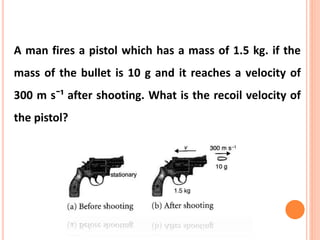
A man fires a pistol which has a mass of 1.5 kg. if the
mass of the bullet is 10 g and it reaches a velocity of
300 m sˉ¹ after shooting. What is the recoil velocity of
the pistol?
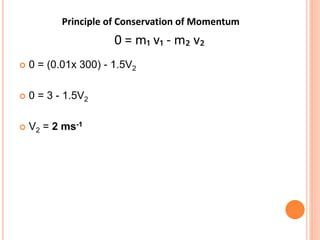
 0 = (0.01x 300) - 1.5V2
 0 = 3 - 1.5V2
 V2 = 2 ms-1
Principle of Conservation of Momentum
0 = m₁ v₁ - m₂ v₂
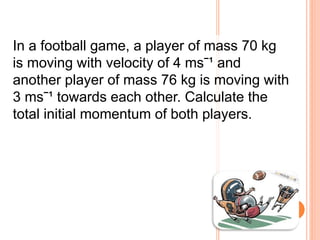
In a football game, a player of mass 70 kg
is moving with velocity of 4 msˉ¹ and
another player of mass 76 kg is moving with
3 msˉ¹ towards each other. Calculate the
total initial momentum of both players.
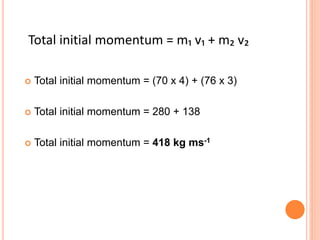
 Total initial momentum = (70 x 4) + (76 x 3)
 Total initial momentum = 280 + 138
 Total initial momentum = 418 kg ms-1
Total initial momentum = m₁ v₁ + m₂ v₂
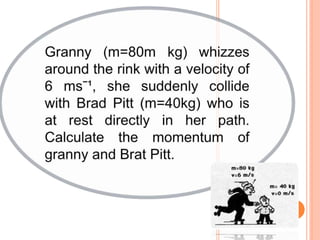
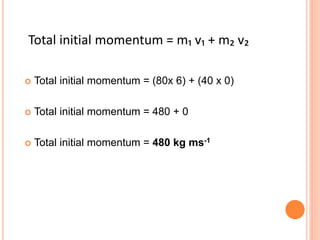
 Total initial momentum = (80x 6) + (40 x 0)
 Total initial momentum = 480 + 0
 Total initial momentum = 480 kg ms-1
Total initial momentum = m₁ v₁ + m₂ v₂
SUMMARY
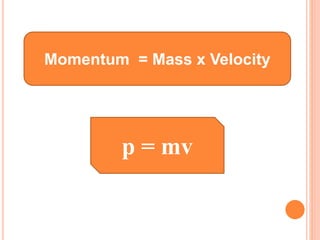
Momentum = Mass x Velocity
p = mv
PRINCIPLE OF CONSERVATION OF
MOMENTUM
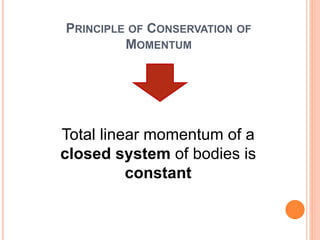
Total linear momentum of a
closed system of bodies is
constant
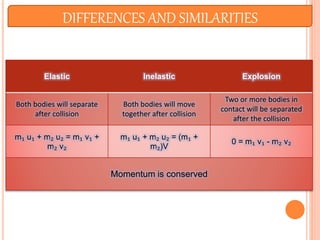
Elastic Inelastic Explosion
Both bodies will separate
after collision
Both bodies will move
together after collision
Two or more bodies in
contact will be separated
after the collision
m₁ u₁ + m₂ u₂ = m₁ v₁ +
m₂ v₂
m₁ u₁ + m₂ u₂ = (m₁ +
m₂)V
0 = m₁ v₁ - m₂ v₂
Momentum is conserved
DIFFERENCES AND SIMILARITIES

2.4 analysing momentum

  • 1.
  • 2.
  • 3.
  • 4.
    Momentum Vector quantity (had direction& magnitude) Unit kg ms-1 Ns Derived physical quantity Increases when  The mass increases  The velocity increases  Both mass and velocity increases
  • 5.
  • 6.
    PRINCIPLE OF CONSERVATIONOF MOMENTUM Total linear momentum of a closed system of bodies is constant
  • 7.
    JUST PUT ITTHIS WAY… Total momentum before and after collision is conserved if no external forces act on the system Total momentum before collision = Total momentum after collision
  • 8.
    ELASTIC COLLISION  Thecolliding objects move separately after collision INELASTIC COLLISION EXPLOSION  The colliding objects move together after collision  The objects involved are in contact with each other before explosion and are separated after the explosion
  • 9.
    Elastic Collision Before CollisionAfter Collision m₁ u₁ + m₂ u₂ m₁ v₁ + m₂ v₂ Principle of Conservation of Momentum m₁ u₁ + m₂ u₂ = m₁ v₁ + m₂ v₂
  • 10.
    Inelastic Collision Before CollisionAfter Collision m₁ u₁ + m₂ u₂ (m₁ + m₂)v m₁ u₁ + m₂ u₂ = (m₁ + m₂)V Principle of Conservation of Momentum
  • 11.
    Explosion Before Collision AfterCollision m₁ u₁ + m₂ u₂ m₁ v₁ + m₂ (-v₂) Principle of Conservation of Momentum 0 = m₁ v₁ - m₂ v₂ 0 0
  • 12.
    Elastic Inelastic Explosion m₁u₁ + m₂ u₂ = m₁ v₁ + m₂ v₂ m₁ u₁ + m₂ u₂ = (m₁ + m₂)V 0 = m₁ v₁ - m₂ v₂ Momentum is conserved
  • 13.
    APPLICATION: THE PRINCIPLEOF CONSERVATION OF MOMENTUM
  • 14.
  • 15.
  • 16.
    COMPARISON JET ENGINES ROCKETS Relyon surrounding air for oxygen supply Carries oxygen supply in special tanks Can only function in Earth’s atmosphere Can function in Earth’s atmosphere and outer atmosphere Uses paraffin as fuel Uses liquid hydrogen as fuel
  • 17.
  • 18.
    Car A ofmass 100 kg moving at 20 m sˉ¹ collides with car B of mass 1 200 kg moving at 10 ms ˉ¹ in the same direction. If car B is pushed forwards at 15 ms ˉ¹ by the impact, find the; (a) Velocity of the car A immediately after the collision. (b) What type is this collision? Why?
  • 19.
     (100 x20) + (1200 x 10) = (100 x V1) + (1200 x 15)  14000 = 100V1 + 18000  V1 = - 40ms-1  Elastic collision because both car are moving in opposite direction M₁ U₁ + M₂ U₂ = M₁ V₁ + M₂ V₂ Principle of Conservation of Momentum
  • 20.
    A trolley ofmass 4kg moves at 3 m sˉ¹ and collides with a trolley of mass 2kg which is moving in the opposite direction at 1 ms ˉ¹. After the collision, both trolley move together with the same velocity. (a) What is the final velocity of both trolleys? (b) What type is this collision? Why?
  • 21.
     (4 x3) + (2 x -1) = (4 + 2) V  12 + (-2) = 6V  V = 1.7 ms-1  Inelastic collision because both trolley are moving together Principle of Conservation of Momentum m₁ u₁ + m₂ u₂ = (m₁ + m₂)V
  • 22.
    A man firesa pistol which has a mass of 1.5 kg. if the mass of the bullet is 10 g and it reaches a velocity of 300 m sˉ¹ after shooting. What is the recoil velocity of the pistol?
  • 23.
     0 =(0.01x 300) - 1.5V2  0 = 3 - 1.5V2  V2 = 2 ms-1 Principle of Conservation of Momentum 0 = m₁ v₁ - m₂ v₂
  • 24.
    In a footballgame, a player of mass 70 kg is moving with velocity of 4 msˉ¹ and another player of mass 76 kg is moving with 3 msˉ¹ towards each other. Calculate the total initial momentum of both players.
  • 25.
     Total initialmomentum = (70 x 4) + (76 x 3)  Total initial momentum = 280 + 138  Total initial momentum = 418 kg ms-1 Total initial momentum = m₁ v₁ + m₂ v₂
  • 27.
     Total initialmomentum = (80x 6) + (40 x 0)  Total initial momentum = 480 + 0  Total initial momentum = 480 kg ms-1 Total initial momentum = m₁ v₁ + m₂ v₂
  • 28.
  • 29.
    Momentum = Massx Velocity p = mv
  • 30.
    PRINCIPLE OF CONSERVATIONOF MOMENTUM Total linear momentum of a closed system of bodies is constant
  • 31.
    Elastic Inelastic Explosion Bothbodies will separate after collision Both bodies will move together after collision Two or more bodies in contact will be separated after the collision m₁ u₁ + m₂ u₂ = m₁ v₁ + m₂ v₂ m₁ u₁ + m₂ u₂ = (m₁ + m₂)V 0 = m₁ v₁ - m₂ v₂ Momentum is conserved DIFFERENCES AND SIMILARITIES