API Governance and
Monetization
Sanjeewa Malalgoda
Director - Engineering
WSO2
● I’m the technical product manager for WSO2 API Manager and API
Platform for Kubernetes, with 14 years of experience in software design
and development.
● Technology areas
⦿ API management and integration
⦿ Docker, Kubernetes
⦿ API gateways, high performance gateways
● Connect with me
⦿ LinkedIn - https://au.linkedin.com/in/sanjeewa-malalgoda
⦿ X - https://twitter.com/sanjeewa190?lang=en
About Me
2
● Evolution of API management
● APIs as digital products
● API governance and practical usages
● API governance best practices and sample framework
● API revenue models and monetization
● Implementation of effective API monetization strategy
Agenda
3
Evolution of API Management
5
● Some questions we posed in the early days
⦿ How do you change the authentication mode for a given API?
⦿ How do you manage access control for different roles and permissions for the same
API?
⦿ What steps are taken to help consumers easily use APIs? Do you provide
documentation?
⦿ Are auto-generated SDKs and documents provided? Is there a user-friendly portal for
developers to browse and use APIs?
Evolution of API Management
6
● Web services evolved to meet specific requirements, allowing backend
developers more freedom.
● API management facilitated coordination among different teams and
simplified service integration.
● APIs increasingly served as the primary external interfaces for services.
● Governance became increasingly prominent as the importance of APIs
grew.
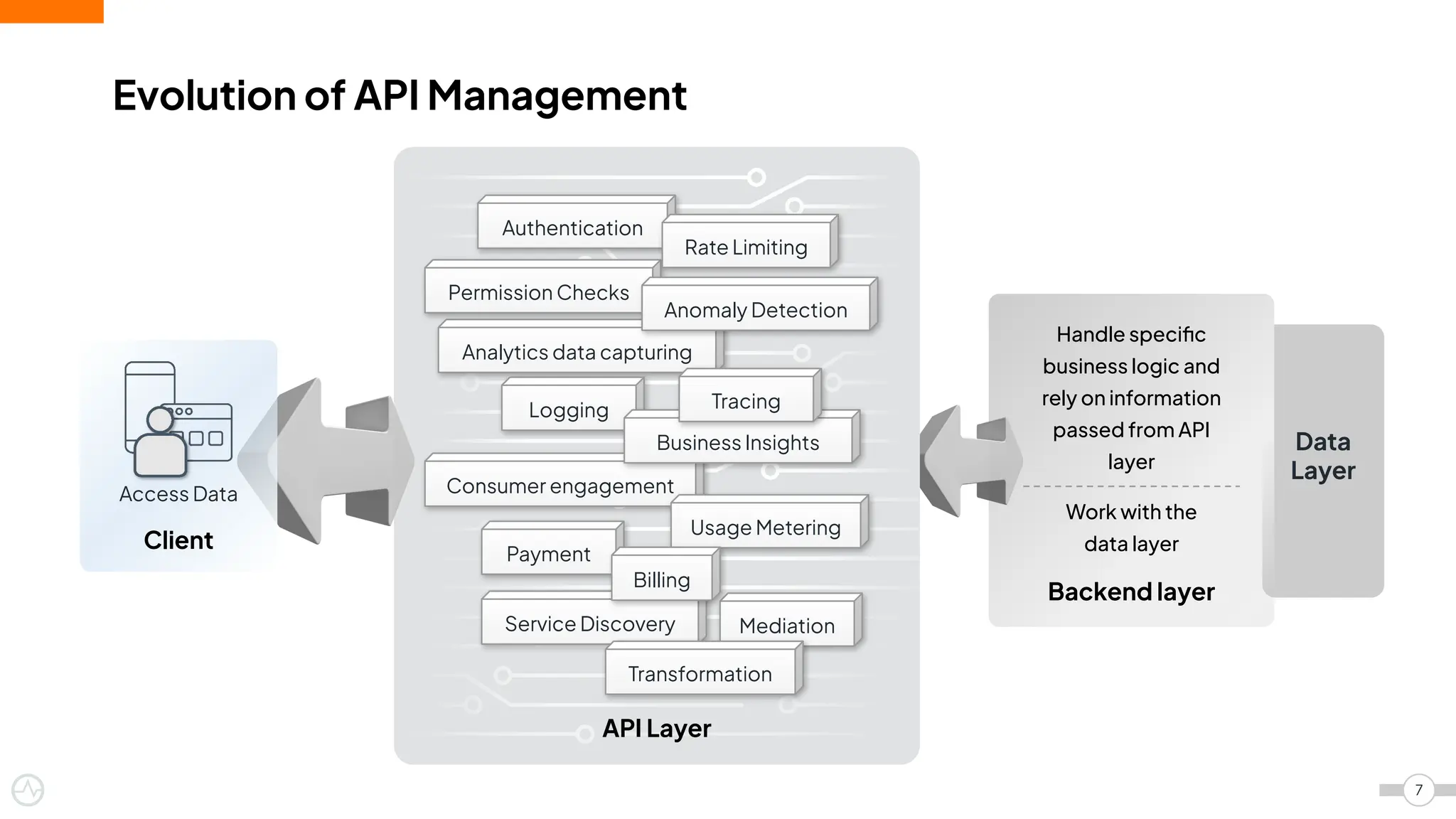
API Layer
Consumer engagement
Evolution of API Management
7
Analytics data capturing
Logging
Business Insights
Usage Metering
Payment
Service Discovery Mediation
Transformation
Permission Checks
Authentication
Anomaly Detection
Rate Limiting
Tracing
Billing
Client
Access Data
Backend layer
Handle specific
business logic and
rely on information
passed from API
layer
Work with the
data layer
Data
Layer
APIs as Digital Products
Transformation of APIs into Marketable Products
9
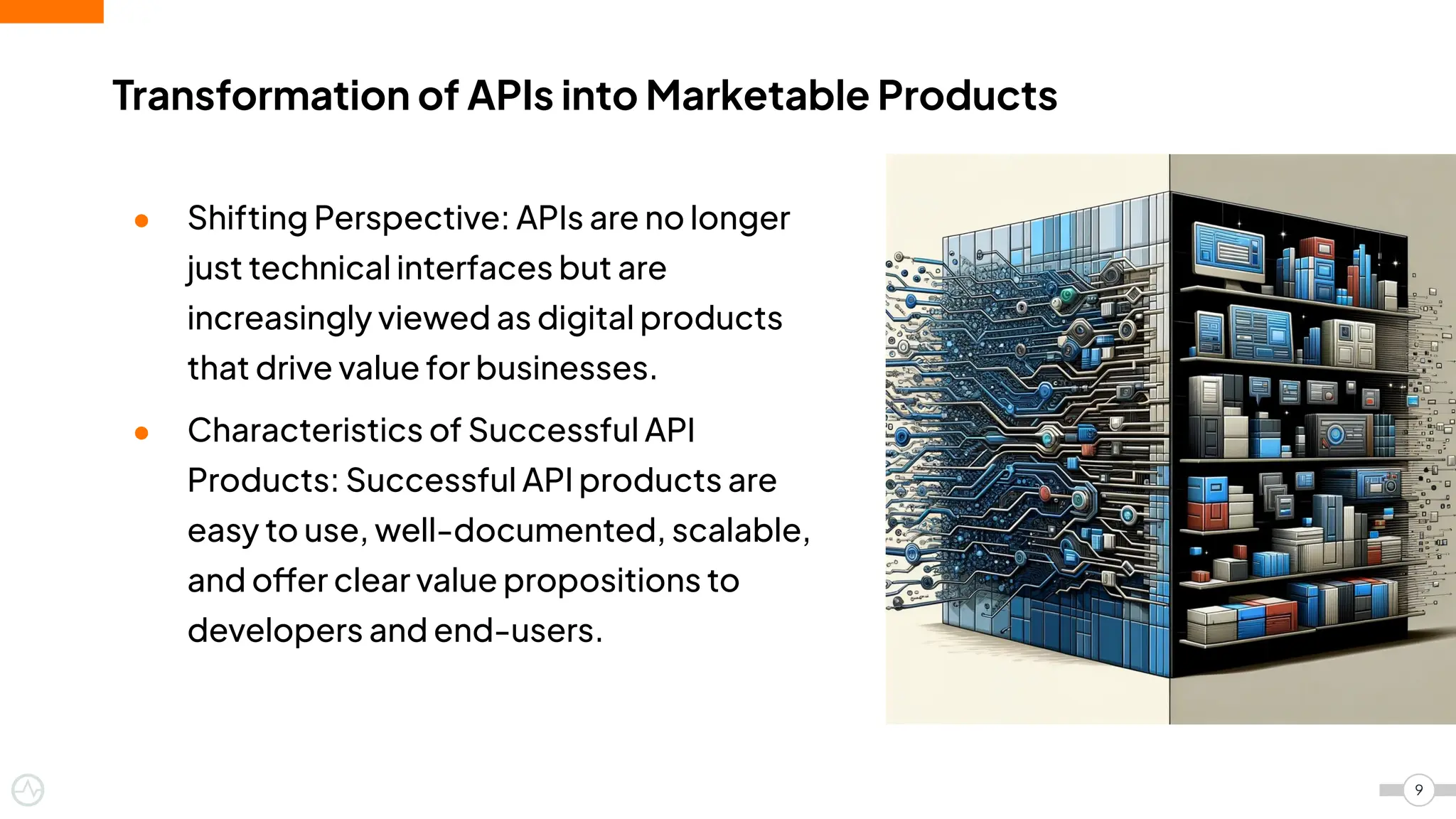
● Shifting Perspective: APIs are no longer
just technical interfaces but are
increasingly viewed as digital products
that drive value for businesses.
● Characteristics of Successful API
Products: Successful API products are
easy to use, well-documented, scalable,
and offer clear value propositions to
developers and end-users.
Transformation of APIs into Marketable Products
10
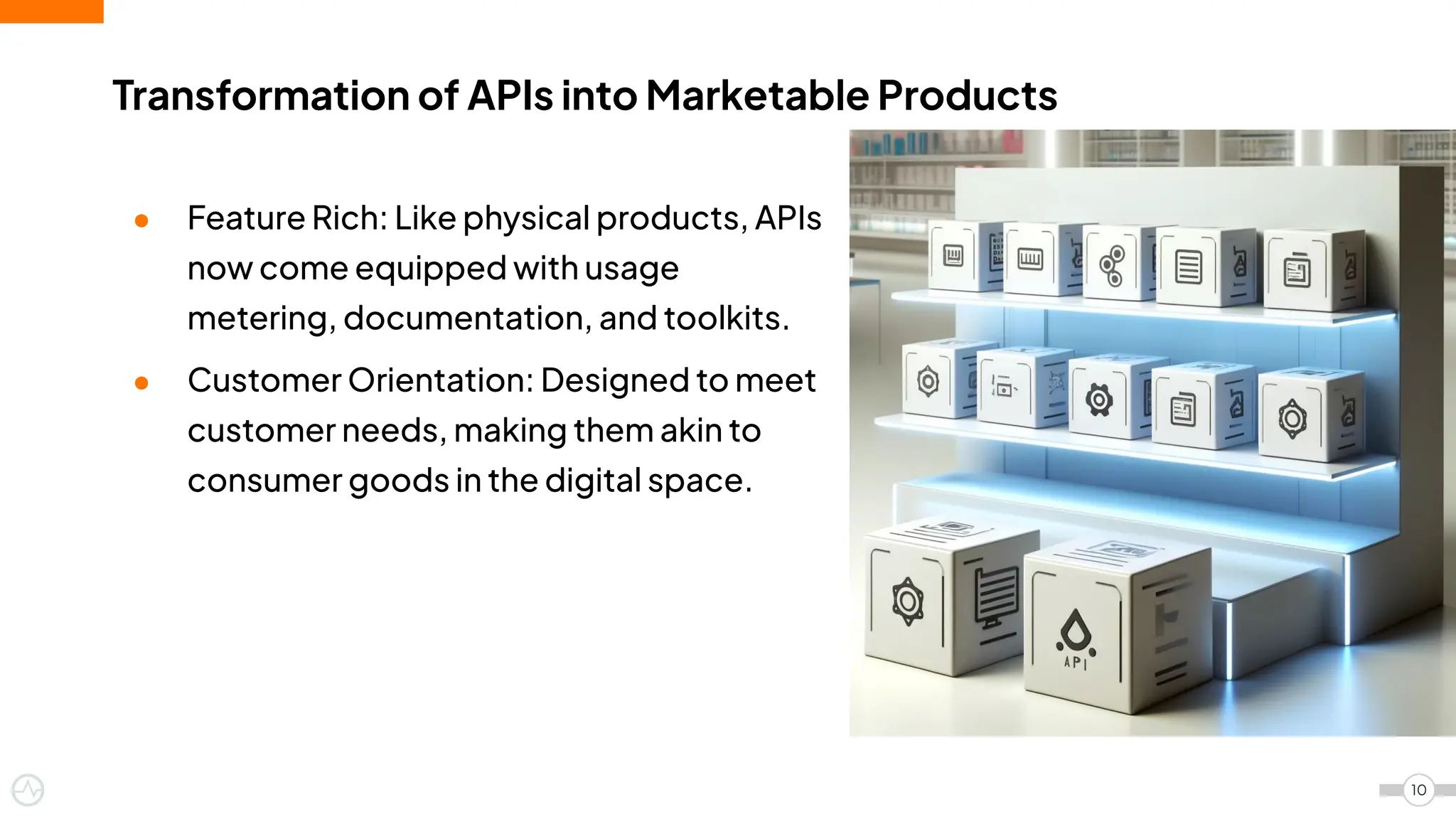
● Feature Rich: Like physical products, APIs
now come equipped with usage
metering, documentation, and toolkits.
● Customer Orientation: Designed to meet
customer needs, making them akin to
consumer goods in the digital space.
Implementing Governance for API as Digital Products
11
● Introduction of Governance: With APIs becoming a key customer-facing
element, governance has become crucial to maintain quality and security.
● Establishing Guidelines: Organizations are now setting up specific
processes and guidelines to manage these APIs effectively.
● Enforcement of Best Practices: Focus on enforcing best practices to
ensure APIs are reliable, secure, and user-friendly for clients.
Why API Governance Matters
12
● Security: Protects sensitive data and prevents unauthorized access.
● Consistency: Maintains a consistent experience for developers using your
APIs.
● Reliability: Guarantees APIs are available and function as expected.
● Visibility: Provides insights into API usage and performance.
● Reduced Costs: Efficient API development and management saves
resources.
Practical Applications and Governance
of APIs
Some Experiences
14
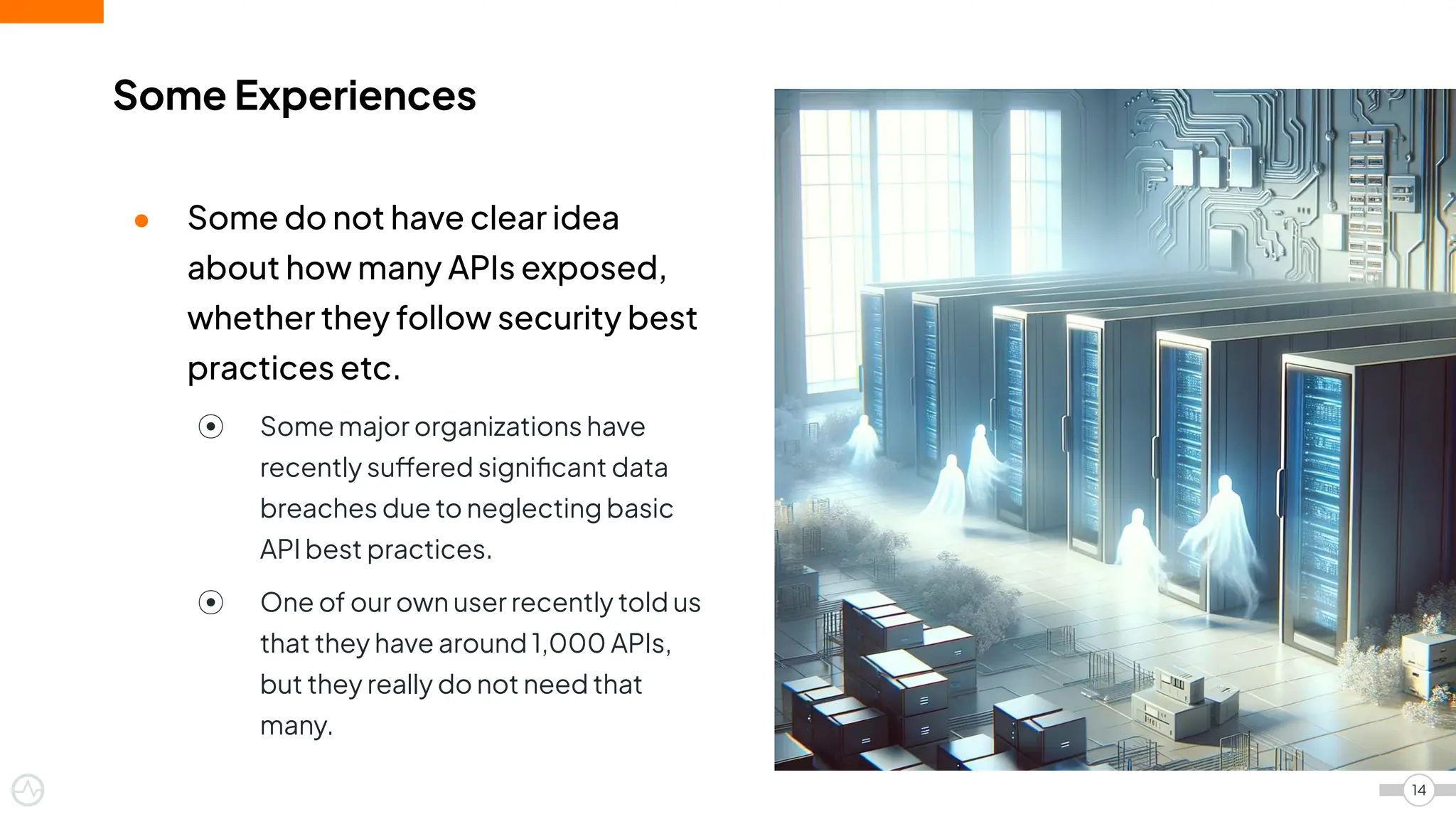
● Some do not have clear idea
about how many APIs exposed,
whether they follow security best
practices etc.
⦿ Some major organizations have
recently suffered significant data
breaches due to neglecting basic
API best practices.
⦿ One of our own user recently told us
that they have around 1,000 APIs,
but they really do not need that
many.
The Importance of API Governance in the Present Era
15
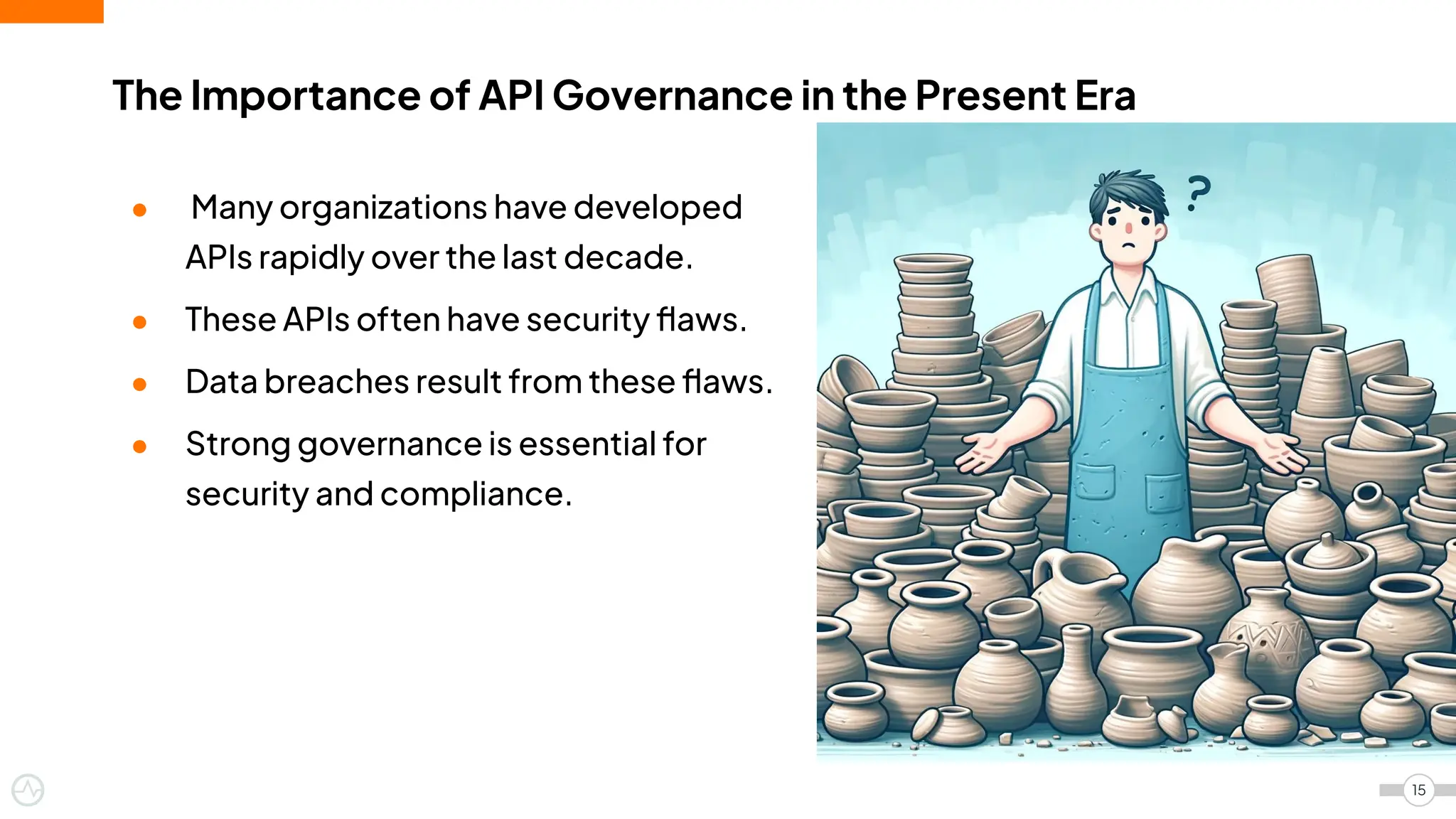
● Many organizations have developed
APIs rapidly over the last decade.
● These APIs often have security flaws.
● Data breaches result from these flaws.
● Strong governance is essential for
security and compliance.
Best Practices and Frameworks for API
Governance
API Governance
17
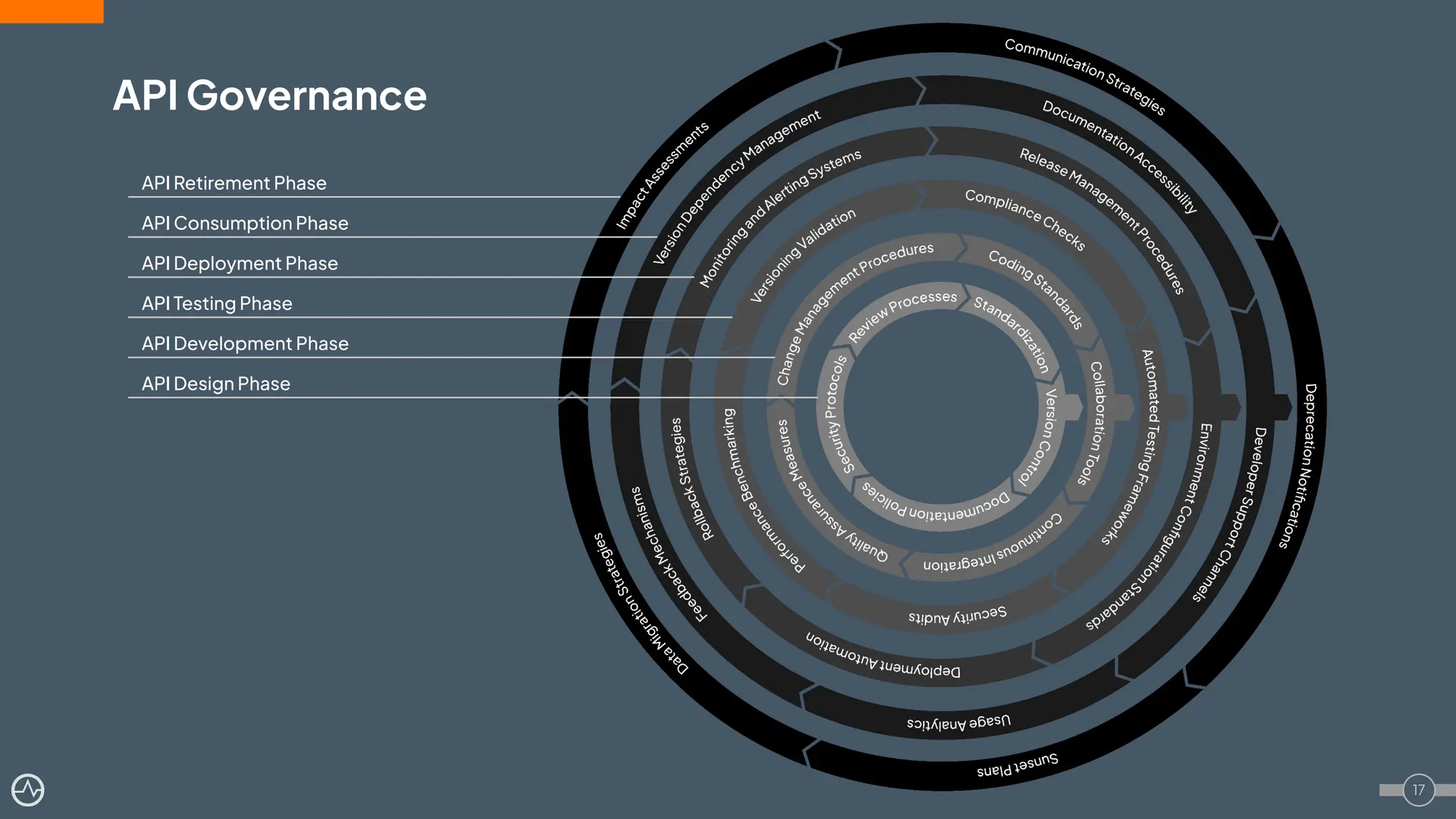
API Design Phase
API Development Phase
API Testing Phase
API Deployment Phase
API Consumption Phase
API Retirement Phase
Future Directions for API Governance
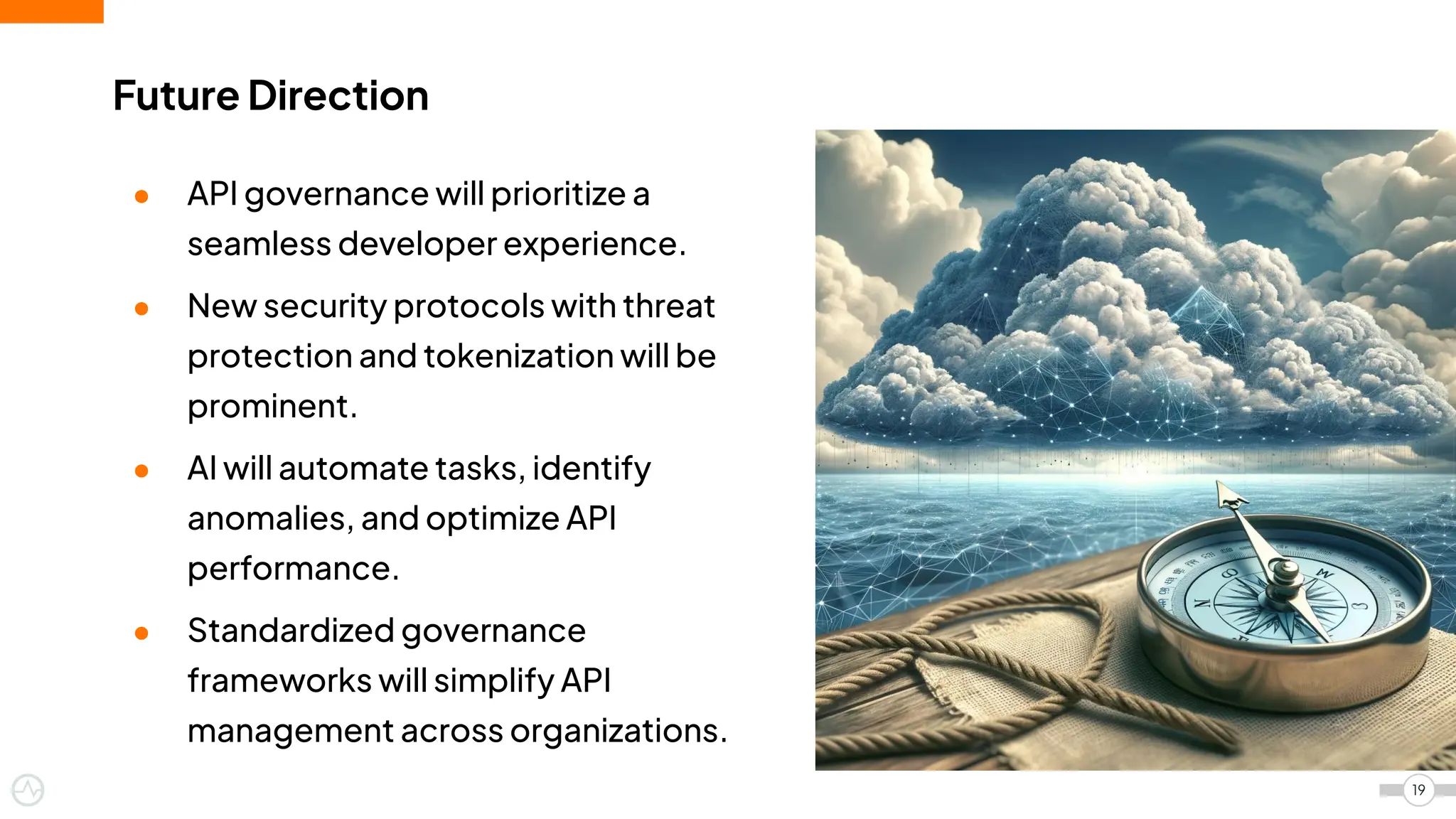
Future Direction
19
● API governance will prioritize a
seamless developer experience.
● New security protocols with threat
protection and tokenization will be
prominent.
● AI will automate tasks, identify
anomalies, and optimize API
performance.
● Standardized governance
frameworks will simplify API
management across organizations.
API Revenue Models and Monetization
Strategies
API Governance and Monetization
21
API revenue models and governance are linked because:
● Access Control: Defines user tiers and pricing.
● Quality Assurance: Supports premium pricing with reliable services.
● Compliance: Ensures the API is secure and meets legal standards, attracting
paying users.
● Usage Limits: Enables tiered pricing models based on user consumption.
● Monitoring: Helps refine pricing by analyzing user behavior and API
performance.
API Revenue Models
22
Direct API Revenue Models
Users are charged for each API call.
Users pay a recurring fee for API access, often with tiered options.
Multiple plans offer different levels of access and features.
Indirect API Revenue Models
Basic services are free; advanced features cost extra.
Revenue is generated by selling data or insights.
APIs promote other products or services.
The API is free but includes advertisements.
Implementing an Effective API
Monetization Strategy
Role of API Management Platform in Effective API Monetization
24
Usage Tracking: Log API calls for analytics and billing.
Billing Integration: Automate billing based on usage.
Rate Limiting: Set usage limits to prevent abuse.
Subscription Management: Handle sign-ups and plan changes.
API Gateway: Manage API traffic and enforce policies.
SLA Management: Track and manage service level agreements.
Scalability: Automatically adjust to increased usage.
Developer Portal: Provide easy to use platform for API consumption.
Question Time!
25
Thank You!

API Governance and Monetization - The evolution of API governance

  • 1.
    API Governance and Monetization SanjeewaMalalgoda Director - Engineering WSO2
  • 2.
    ● I’m thetechnical product manager for WSO2 API Manager and API Platform for Kubernetes, with 14 years of experience in software design and development. ● Technology areas ⦿ API management and integration ⦿ Docker, Kubernetes ⦿ API gateways, high performance gateways ● Connect with me ⦿ LinkedIn - https://au.linkedin.com/in/sanjeewa-malalgoda ⦿ X - https://twitter.com/sanjeewa190?lang=en About Me 2
  • 3.
    ● Evolution ofAPI management ● APIs as digital products ● API governance and practical usages ● API governance best practices and sample framework ● API revenue models and monetization ● Implementation of effective API monetization strategy Agenda 3
  • 4.
    Evolution of APIManagement
  • 5.
    Evolution of APIManagement 5 ● Some questions we posed in the early days ⦿ How do you change the authentication mode for a given API? ⦿ How do you manage access control for different roles and permissions for the same API? ⦿ What steps are taken to help consumers easily use APIs? Do you provide documentation? ⦿ Are auto-generated SDKs and documents provided? Is there a user-friendly portal for developers to browse and use APIs?
  • 6.
    Evolution of APIManagement 6 ● Web services evolved to meet specific requirements, allowing backend developers more freedom. ● API management facilitated coordination among different teams and simplified service integration. ● APIs increasingly served as the primary external interfaces for services. ● Governance became increasingly prominent as the importance of APIs grew.
  • 7.
    API Layer Consumer engagement Evolutionof API Management 7 Analytics data capturing Logging Business Insights Usage Metering Payment Service Discovery Mediation Transformation Permission Checks Authentication Anomaly Detection Rate Limiting Tracing Billing Client Access Data Backend layer Handle specific business logic and rely on information passed from API layer Work with the data layer Data Layer
  • 8.
  • 9.
    Transformation of APIsinto Marketable Products 9 ● Shifting Perspective: APIs are no longer just technical interfaces but are increasingly viewed as digital products that drive value for businesses. ● Characteristics of Successful API Products: Successful API products are easy to use, well-documented, scalable, and offer clear value propositions to developers and end-users.
  • 10.
    Transformation of APIsinto Marketable Products 10 ● Feature Rich: Like physical products, APIs now come equipped with usage metering, documentation, and toolkits. ● Customer Orientation: Designed to meet customer needs, making them akin to consumer goods in the digital space.
  • 11.
    Implementing Governance forAPI as Digital Products 11 ● Introduction of Governance: With APIs becoming a key customer-facing element, governance has become crucial to maintain quality and security. ● Establishing Guidelines: Organizations are now setting up specific processes and guidelines to manage these APIs effectively. ● Enforcement of Best Practices: Focus on enforcing best practices to ensure APIs are reliable, secure, and user-friendly for clients.
  • 12.
    Why API GovernanceMatters 12 ● Security: Protects sensitive data and prevents unauthorized access. ● Consistency: Maintains a consistent experience for developers using your APIs. ● Reliability: Guarantees APIs are available and function as expected. ● Visibility: Provides insights into API usage and performance. ● Reduced Costs: Efficient API development and management saves resources.
  • 13.
    Practical Applications andGovernance of APIs
  • 14.
    Some Experiences 14 ● Somedo not have clear idea about how many APIs exposed, whether they follow security best practices etc. ⦿ Some major organizations have recently suffered significant data breaches due to neglecting basic API best practices. ⦿ One of our own user recently told us that they have around 1,000 APIs, but they really do not need that many.
  • 15.
    The Importance ofAPI Governance in the Present Era 15 ● Many organizations have developed APIs rapidly over the last decade. ● These APIs often have security flaws. ● Data breaches result from these flaws. ● Strong governance is essential for security and compliance.
  • 16.
    Best Practices andFrameworks for API Governance
  • 17.
    API Governance 17 API DesignPhase API Development Phase API Testing Phase API Deployment Phase API Consumption Phase API Retirement Phase
  • 18.
    Future Directions forAPI Governance
  • 19.
    Future Direction 19 ● APIgovernance will prioritize a seamless developer experience. ● New security protocols with threat protection and tokenization will be prominent. ● AI will automate tasks, identify anomalies, and optimize API performance. ● Standardized governance frameworks will simplify API management across organizations.
  • 20.
    API Revenue Modelsand Monetization Strategies
  • 21.
    API Governance andMonetization 21 API revenue models and governance are linked because: ● Access Control: Defines user tiers and pricing. ● Quality Assurance: Supports premium pricing with reliable services. ● Compliance: Ensures the API is secure and meets legal standards, attracting paying users. ● Usage Limits: Enables tiered pricing models based on user consumption. ● Monitoring: Helps refine pricing by analyzing user behavior and API performance.
  • 22.
    API Revenue Models 22 DirectAPI Revenue Models Users are charged for each API call. Users pay a recurring fee for API access, often with tiered options. Multiple plans offer different levels of access and features. Indirect API Revenue Models Basic services are free; advanced features cost extra. Revenue is generated by selling data or insights. APIs promote other products or services. The API is free but includes advertisements.
  • 23.
    Implementing an EffectiveAPI Monetization Strategy
  • 24.
    Role of APIManagement Platform in Effective API Monetization 24 Usage Tracking: Log API calls for analytics and billing. Billing Integration: Automate billing based on usage. Rate Limiting: Set usage limits to prevent abuse. Subscription Management: Handle sign-ups and plan changes. API Gateway: Manage API traffic and enforce policies. SLA Management: Track and manage service level agreements. Scalability: Automatically adjust to increased usage. Developer Portal: Provide easy to use platform for API consumption.
  • 25.
  • 26.