CONSEQUENCES
PSY 3570: Practicum with Special Populations
The Law of Effect
 The effects of our actions determine whether we
will repeat them
This is the foundation of behavioral psychology
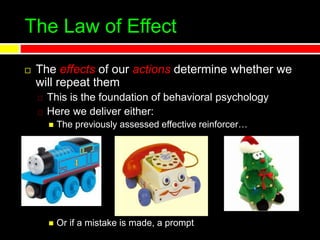
Here we deliver either:
 The previously assessed effective reinforcer…
 Or if a mistake is made, a prompt
The Prompt Hierarchy
1. Verbal (i.e. repeat SD)
2. Gestural (i.e. point to the correct
stimulus)
3. Partial Physical (i.e. a light nudge on
the elbow)
4. Full Physical (hand over hand)
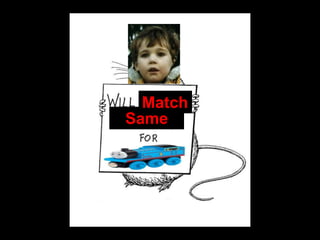
Same
Match
Monitoring Criteria
 Two forms of tutor response
1. Reinforcer delivery
2. Correction
 Let’s get a better understanding of what
this means…
Monitoring Criteria (Reinforcer)
 Was the reinforcer delivered immediately?
We aim for < 1 second!
 Is the reinforcer effective?
Does the child’s world light up or do they cast it
aside?
 Engages with the item for 10-15 seconds
Remember preference can change rapidly, assess
often
This will be discussed in greater detail during MO
lecture
 Was the intonation appropriate?
Instead of the neutral SD tone, we want jubilation
We should “throw a party” for independent correct
responses
Monitoring Criteria (Reinforcer)
 Was social reinforcement paired with
tangible?
Play with your child!
Do not simply hand them their reinforcer, interact
We want to establish ourselves as a learned
reinforcer
 Did you use tangible for last trial?
Always end on a correct response
 Even if it means more trials
 Even if it means relying on a mastered skill
It is important to use tangibles for the last trial
 This gives you time to finish data collection
 This gives you time to transition into next procedure
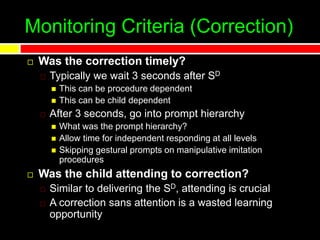
Monitoring Criteria (Correction)
 Was the correction timely?
Typically we wait 3 seconds after SD
 This can be procedure dependent
 This can be child dependent
After 3 seconds, go into prompt hierarchy
 What was the prompt hierarchy?
 Allow time for independent responding at all levels
 Skipping gestural prompts on manipulative imitation
procedures
 Was the child attending to correction?
Similar to delivering the SD, attending is crucial
A correction sans attention is a wasted learning
opportunity
Monitoring Criteria (Correction)
 Is the correction implemented as written?
Follow the prompt hierarchy
Read procedures carefully, there may be
unique instructions
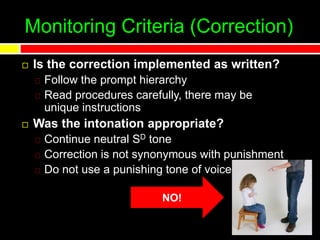
 Was the intonation appropriate?
Continue neutral SD tone
Correction is not synonymous with punishment
Do not use a punishing tone of voice
NO!
Monitoring Score Recap
 Correction
Timely
Attending
As written
Intonation
 Reinforcer
Immediate
Effective
Intonation
Pair social with tangible
Use tangible for last trial

Consequences

  • 1.
    CONSEQUENCES PSY 3570: Practicumwith Special Populations
  • 2.
    The Law ofEffect  The effects of our actions determine whether we will repeat them This is the foundation of behavioral psychology Here we deliver either:  The previously assessed effective reinforcer…  Or if a mistake is made, a prompt
  • 3.
    The Prompt Hierarchy 1.Verbal (i.e. repeat SD) 2. Gestural (i.e. point to the correct stimulus) 3. Partial Physical (i.e. a light nudge on the elbow) 4. Full Physical (hand over hand)
  • 4.
  • 5.
    Monitoring Criteria  Twoforms of tutor response 1. Reinforcer delivery 2. Correction  Let’s get a better understanding of what this means…
  • 6.
    Monitoring Criteria (Reinforcer) Was the reinforcer delivered immediately? We aim for < 1 second!  Is the reinforcer effective? Does the child’s world light up or do they cast it aside?  Engages with the item for 10-15 seconds Remember preference can change rapidly, assess often This will be discussed in greater detail during MO lecture  Was the intonation appropriate? Instead of the neutral SD tone, we want jubilation We should “throw a party” for independent correct responses
  • 7.
    Monitoring Criteria (Reinforcer) Was social reinforcement paired with tangible? Play with your child! Do not simply hand them their reinforcer, interact We want to establish ourselves as a learned reinforcer  Did you use tangible for last trial? Always end on a correct response  Even if it means more trials  Even if it means relying on a mastered skill It is important to use tangibles for the last trial  This gives you time to finish data collection  This gives you time to transition into next procedure
  • 8.
    Monitoring Criteria (Correction) Was the correction timely? Typically we wait 3 seconds after SD  This can be procedure dependent  This can be child dependent After 3 seconds, go into prompt hierarchy  What was the prompt hierarchy?  Allow time for independent responding at all levels  Skipping gestural prompts on manipulative imitation procedures  Was the child attending to correction? Similar to delivering the SD, attending is crucial A correction sans attention is a wasted learning opportunity
  • 9.
    Monitoring Criteria (Correction) Is the correction implemented as written? Follow the prompt hierarchy Read procedures carefully, there may be unique instructions  Was the intonation appropriate? Continue neutral SD tone Correction is not synonymous with punishment Do not use a punishing tone of voice NO!
  • 10.
    Monitoring Score Recap Correction Timely Attending As written Intonation  Reinforcer Immediate Effective Intonation Pair social with tangible Use tangible for last trial

Editor's Notes

  • #5 Again, this slide is to make the parallel to rat lab and our autism practicum. Then I threw the other stuff in there so as to not say children with autism are rats. 
  • #7 Case coordinators should discuss protocol on prompted responses
  • #8 Elaborate on what tangible is (during presentation)
  • #9 I didn’t go into detail about attending because Joe did in his presentation Attending to stimulus & gestures= important!
  • #10 It would be good to have examples/video of a “punishing tone” Maybe Joe can demonstrate it in class?