STRUCTURED PLAY
PSY 3570: Practicum with Special Populations
Incidental Teaching
 Primarily used to increase verbal and nonverbal
communication and spontaneous speech
 What are some methods for promoting
generalization?
 New environments
 Different context
 Looser stimulus control
Incidental Teaching Contd.
 Procedure in which stimuli and events are
arranged within ongoing, typical, activities to
motivate children to interact with people or
practice a skill
 Must be child-initiated to be considered
incidental teaching
So, What is Structured Play
Then?
 Structured play is WoodsEdge’s version of
incidental teaching
 This is a time to provide extra learning
opportunities outside of discrete trials in the
student’s natural or play environments
 It is also a time to
 Promote generalization and maintenance
of skills
 To challenge the student to engage in
elaborations of responses
Structured Play
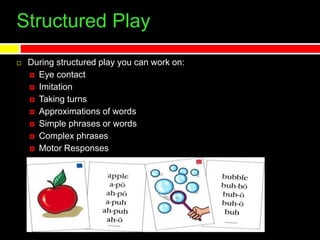
 During structured play you can work on:
 Eye contact
 Imitation
 Taking turns
 Approximations of words
 Simple phrases or words
 Complex phrases
 Motor Responses
Structured Play
 This should NOT be break time in the child’s
schedule
 Just like any other procedure in your child’s
schedule, it should take about 5-7 minutes
 Should be a time where you work on:
 Generalization and maintenance of previously learned skills
 Current acquisition skills
 Increasing language
 Play skills
 Building
 Pretend play
 Games
What You Will Be Monitored On
7
 Length of time spent on structured play
 2 points taken off of score when:
 Tutor begins structured play 5 minutes early
 Tutor begins structured play more than 5 minutes late
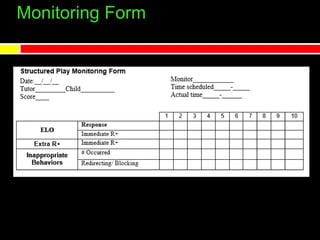
 At LEAST 10 ELO’s based on the skills in your
child’s repertoire
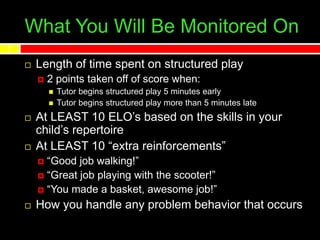
 At LEAST 10 “extra reinforcements”
 “Good job walking!”
 “Great job playing with the scooter!”
 “You made a basket, awesome job!”
 How you handle any problem behavior that occurs
Monitoring Form
Structured Play Guidelines
 Child-initiated
 Child should show interest in the activity or reinforcer
instead of the tutor choosing activity or reinforcer
 If child has MO issues and does not initiate, you may
need to contrive environment to increase MO
 What are some ways to contrive the
environment?
 Putting items out of reach
 Pair neutral items with known reinforcers
 Use known reinforcers to increase initiations
Structured Play Guidelines Contd.
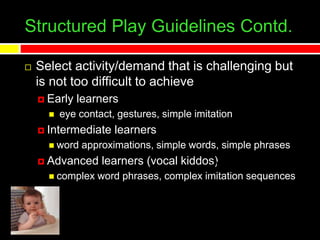
 Select activity/demand that is challenging but
is not too difficult to achieve
 Early learners
 eye contact, gestures, simple imitation
 Intermediate learners
 word approximations, simple words, simple phrases
 Advanced learners (vocal kiddos)
 complex word phrases, complex imitation sequences
Structured Play Guidelines Contd.
 Attempt elaboration of response
 Once child makes a response (ex:
approximation of word) prompt them to
expand that response
 Example:
Child:“Buh”
Tutor: Say “buh, buh”
 Example:
Child: “bubbles”
Tutor: Say “bubbles please”
Structured Play Guidelines
Contd.
 Use appropriate prompts to evoke elaboration
 Following prompt hierarchy for physical responses
 Repeating SD up to 3 times for vocal responses
 Encourage independence
 Make sure that you are allowing the child time to
response without additional prompting
 Allow child to remain engaged in activity of choice instead of
redirecting
 If child is really engaged in their activity/toy, don’t redirect
them to new activities or toys, this may result in problem
behavior.
 Remember this is supposed to be child-initiated!
 Instead just get creative with ELOs!
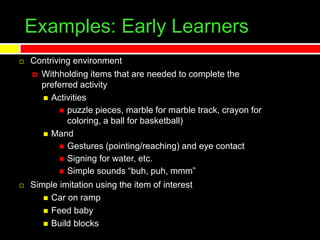
Examples: Early Learners
 Contriving environment
 Withholding items that are needed to complete the
preferred activity
 Activities
 puzzle pieces, marble for marble track, crayon for
coloring, a ball for basketball)
 Mand
 Gestures (pointing/reaching) and eye contact
 Signing for water, etc.
 Simple sounds “buh, puh, mmm”
 Simple imitation using the item of interest
 Car on ramp
 Feed baby
 Build blocks
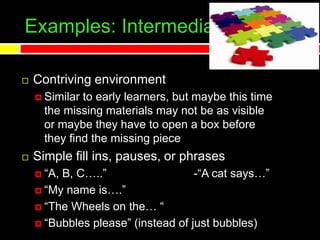
Examples: Intermediate
 Contriving environment
 Similar to early learners, but maybe this time
the missing materials may not be as visible
or maybe they have to open a box before
they find the missing piece
 Simple fill ins, pauses, or phrases
 “A, B, C…..” -“A cat says…”
 “My name is….”
 “The Wheels on the… “
 “Bubbles please” (instead of just bubbles)
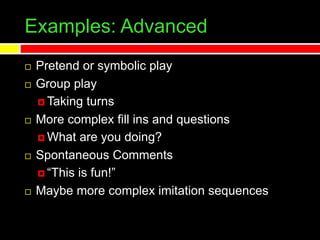
Examples: Advanced
 Pretend or symbolic play
 Group play
 Taking turns
 More complex fill ins and questions
 What are you doing?
 Spontaneous Comments
 “This is fun!”
 Maybe more complex imitation sequences
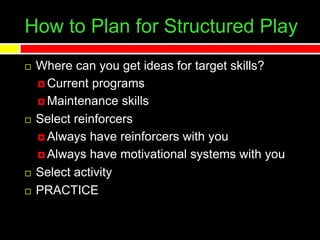
How to Plan for Structured Play
 Where can you get ideas for target skills?
 Current programs
 Maintenance skills
 Select reinforcers
 Always have reinforcers with you
 Always have motivational systems with you
 Select activity
 PRACTICE
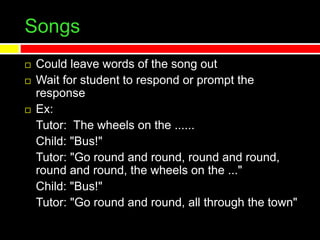
Songs
 Could leave words of the song out
 Wait for student to respond or prompt the
response
 Ex:
Tutor: The wheels on the ......
Child: "Bus!"
Tutor: "Go round and round, round and round,
round and round, the wheels on the ..."
Child: "Bus!"
Tutor: "Go round and round, all through the town"
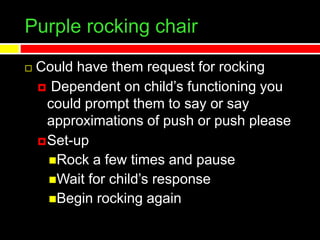
Purple rocking chair
 Could have them request for rocking
 Dependent on child’s functioning you
could prompt them to say or say
approximations of push or push please
Set-up
Rock a few times and pause
Wait for child’s response
Begin rocking again
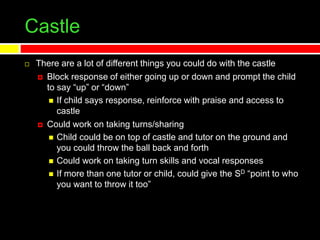
Castle
 There are a lot of different things you could do with the castle
 Block response of either going up or down and prompt the child
to say “up” or “down”
 If child says response, reinforce with praise and access to
castle
 Could work on taking turns/sharing
 Child could be on top of castle and tutor on the ground and
you could throw the ball back and forth
 Could work on taking turn skills and vocal responses
 If more than one tutor or child, could give the SD “point to who
you want to throw it too”
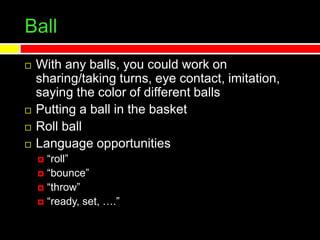
Ball
 With any balls, you could work on
sharing/taking turns, eye contact, imitation,
saying the color of different balls
 Putting a ball in the basket
 Roll ball
 Language opportunities
 “roll”
 “bounce”
 “throw”
 “ready, set, ….”
Bikes
 Good reinforcer for imitation or motor skills
 Tutor could be on bike and say “do this” to work
on pedaling
 If appropriate for your kiddo:
 If child mands for bike, you could prompt them
to “find it”
 SD: “find a bike”
 Could have them answer colors of bike
 May not be appropriate for a lot of our kiddos
but really good for those kids who have a
colors procedure in their schedule
 SD: “find a red bike”
Things to Remember
 Keep it child-initiated and FUN!
 Spend approximately 5-7 minutes maximum
 Encourage elaborations of responses
 Select appropriately challenging activity and get
as many ELO’s in as possible
 This may require you to talk to the support
coordinator
 Always end the trial with
success/reinforcement

Structured Play

  • 1.
    STRUCTURED PLAY PSY 3570:Practicum with Special Populations
  • 2.
    Incidental Teaching  Primarilyused to increase verbal and nonverbal communication and spontaneous speech  What are some methods for promoting generalization?  New environments  Different context  Looser stimulus control
  • 3.
    Incidental Teaching Contd. Procedure in which stimuli and events are arranged within ongoing, typical, activities to motivate children to interact with people or practice a skill  Must be child-initiated to be considered incidental teaching
  • 4.
    So, What isStructured Play Then?  Structured play is WoodsEdge’s version of incidental teaching  This is a time to provide extra learning opportunities outside of discrete trials in the student’s natural or play environments  It is also a time to  Promote generalization and maintenance of skills  To challenge the student to engage in elaborations of responses
  • 5.
    Structured Play  Duringstructured play you can work on:  Eye contact  Imitation  Taking turns  Approximations of words  Simple phrases or words  Complex phrases  Motor Responses
  • 6.
    Structured Play  Thisshould NOT be break time in the child’s schedule  Just like any other procedure in your child’s schedule, it should take about 5-7 minutes  Should be a time where you work on:  Generalization and maintenance of previously learned skills  Current acquisition skills  Increasing language  Play skills  Building  Pretend play  Games
  • 7.
    What You WillBe Monitored On 7  Length of time spent on structured play  2 points taken off of score when:  Tutor begins structured play 5 minutes early  Tutor begins structured play more than 5 minutes late  At LEAST 10 ELO’s based on the skills in your child’s repertoire  At LEAST 10 “extra reinforcements”  “Good job walking!”  “Great job playing with the scooter!”  “You made a basket, awesome job!”  How you handle any problem behavior that occurs
  • 8.
  • 9.
    Structured Play Guidelines Child-initiated  Child should show interest in the activity or reinforcer instead of the tutor choosing activity or reinforcer  If child has MO issues and does not initiate, you may need to contrive environment to increase MO  What are some ways to contrive the environment?  Putting items out of reach  Pair neutral items with known reinforcers  Use known reinforcers to increase initiations
  • 10.
    Structured Play GuidelinesContd.  Select activity/demand that is challenging but is not too difficult to achieve  Early learners  eye contact, gestures, simple imitation  Intermediate learners  word approximations, simple words, simple phrases  Advanced learners (vocal kiddos)  complex word phrases, complex imitation sequences
  • 11.
    Structured Play GuidelinesContd.  Attempt elaboration of response  Once child makes a response (ex: approximation of word) prompt them to expand that response  Example: Child:“Buh” Tutor: Say “buh, buh”  Example: Child: “bubbles” Tutor: Say “bubbles please”
  • 12.
    Structured Play Guidelines Contd. Use appropriate prompts to evoke elaboration  Following prompt hierarchy for physical responses  Repeating SD up to 3 times for vocal responses  Encourage independence  Make sure that you are allowing the child time to response without additional prompting  Allow child to remain engaged in activity of choice instead of redirecting  If child is really engaged in their activity/toy, don’t redirect them to new activities or toys, this may result in problem behavior.  Remember this is supposed to be child-initiated!  Instead just get creative with ELOs!
  • 13.
    Examples: Early Learners Contriving environment  Withholding items that are needed to complete the preferred activity  Activities  puzzle pieces, marble for marble track, crayon for coloring, a ball for basketball)  Mand  Gestures (pointing/reaching) and eye contact  Signing for water, etc.  Simple sounds “buh, puh, mmm”  Simple imitation using the item of interest  Car on ramp  Feed baby  Build blocks
  • 14.
    Examples: Intermediate  Contrivingenvironment  Similar to early learners, but maybe this time the missing materials may not be as visible or maybe they have to open a box before they find the missing piece  Simple fill ins, pauses, or phrases  “A, B, C…..” -“A cat says…”  “My name is….”  “The Wheels on the… “  “Bubbles please” (instead of just bubbles)
  • 15.
    Examples: Advanced  Pretendor symbolic play  Group play  Taking turns  More complex fill ins and questions  What are you doing?  Spontaneous Comments  “This is fun!”  Maybe more complex imitation sequences
  • 16.
    How to Planfor Structured Play  Where can you get ideas for target skills?  Current programs  Maintenance skills  Select reinforcers  Always have reinforcers with you  Always have motivational systems with you  Select activity  PRACTICE
  • 17.
    Songs  Could leavewords of the song out  Wait for student to respond or prompt the response  Ex: Tutor: The wheels on the ...... Child: "Bus!" Tutor: "Go round and round, round and round, round and round, the wheels on the ..." Child: "Bus!" Tutor: "Go round and round, all through the town"
  • 18.
    Purple rocking chair Could have them request for rocking  Dependent on child’s functioning you could prompt them to say or say approximations of push or push please Set-up Rock a few times and pause Wait for child’s response Begin rocking again
  • 19.
    Castle  There area lot of different things you could do with the castle  Block response of either going up or down and prompt the child to say “up” or “down”  If child says response, reinforce with praise and access to castle  Could work on taking turns/sharing  Child could be on top of castle and tutor on the ground and you could throw the ball back and forth  Could work on taking turn skills and vocal responses  If more than one tutor or child, could give the SD “point to who you want to throw it too”
  • 20.
    Ball  With anyballs, you could work on sharing/taking turns, eye contact, imitation, saying the color of different balls  Putting a ball in the basket  Roll ball  Language opportunities  “roll”  “bounce”  “throw”  “ready, set, ….”
  • 21.
    Bikes  Good reinforcerfor imitation or motor skills  Tutor could be on bike and say “do this” to work on pedaling  If appropriate for your kiddo:  If child mands for bike, you could prompt them to “find it”  SD: “find a bike”  Could have them answer colors of bike  May not be appropriate for a lot of our kiddos but really good for those kids who have a colors procedure in their schedule  SD: “find a red bike”
  • 22.
    Things to Remember Keep it child-initiated and FUN!  Spend approximately 5-7 minutes maximum  Encourage elaborations of responses  Select appropriately challenging activity and get as many ELO’s in as possible  This may require you to talk to the support coordinator  Always end the trial with success/reinforcement

Editor's Notes

  • #3 Promotes generalization because it is not discrete trials, the stimulus control is looser so they learn the skill in a variety of different contexts and environments
  • #11 Intermediate learners probably could be those who have maybe some echoics or imitation skills, Advanced: kiddos that can say full words and/or have complex imitation skills
  • #14 And start with the least prompting so, bu, bus
  • #21 -I know we are not allow to bounce them on the balls anymore but this is a good example about picking a word that would end in a student’s success (vs picking a word that may be too hard for them to say) -If the child is already engaging in the behavior of shooting the ball in the basket, you can add the sD “shoot it” so they can pair the behavior with the sD