What is Linked Data,  and What Does It Mean for Libraries? Emily Dust Nimsakont NLA/NEMA Conference October 15, 2010 Photo credit: http://www.flickr.com/photos/mklingo/245562110/
What is Linked Data,  and What Does It Mean for Libraries? Emily Dust Nimsakont NLA/NEMA Conference October 15, 2010 Could Photo credit: http://www.flickr.com/photos/mklingo/245562110/
This is an overview… Photo credit: http://www.flickr.com/photos/magnusvk/4090803400/
What is Linked Data?
Wikipedia says… “ The term Linked Data is used to describe a method of exposing, sharing, and connecting data via dereferenceable URIs on the Web.” http://en.wikipedia.org/wiki/Linked_Data
Linked Data vs. Semantic Web vs. Web 3.0
“ I have a dream for the Web [in which computers] become capable of analyzing all the data on the Web – the content, links, and transactions between people and computers.” Tim Berners-Lee, 1999
hypertext vs. hyperdata
web of documents vs. web of data
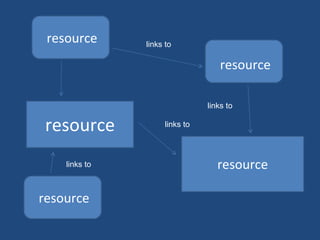
Currently the Web is a system of interconnected documents.
People use hyperlinks to navigate from one document to another.
resource resource resource resource resource links to links to links to links to
documents vs. things
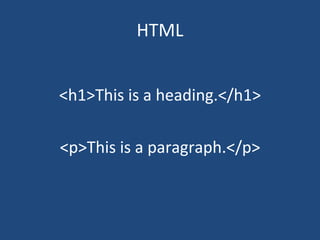
HTML <h1>This is a heading.</h1> <p>This is a paragraph.</p>
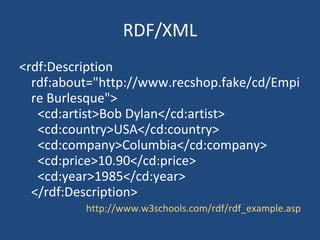
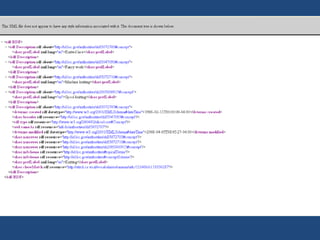
RDF/XML <rdf:Description rdf:about=&quot;http://www.recshop.fake/cd/Empire Burlesque&quot;>   <cd:artist>Bob Dylan</cd:artist>   <cd:country>USA</cd:country>   <cd:company>Columbia</cd:company>   <cd:price>10.90</cd:price>   <cd:year>1985</cd:year> </rdf:Description>   http://www.w3schools.com/rdf/rdf_example.asp
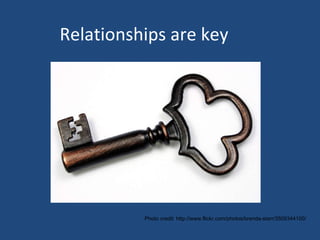
Relationships are key Photo credit: http://www.flickr.com/photos/brenda-starr/3509344100/
People can understand relationships between things. But machines should be able to understand these relationships too. Photo credit: http://www.flickr.com/photos/ksawyer/2075159262/
We are used to connecting pieces of information based on their context. Title:  A Christmas Carol Author: Charles Dickens Linked Data makes the relationships explicit. Charles Dickens is the author of  A Christmas Carol .
Linked Data makes the Web into a database.
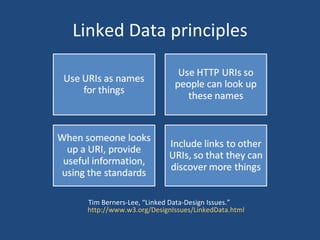
Linked Data principles Tim Berners-Lee, “Linked Data-Design Issues.”   http://www.w3.org/DesignIssues/LinkedData.html
URIs For Linked Data, we need to be able to identify things uniquely Uniform Resource Identifiers do this already
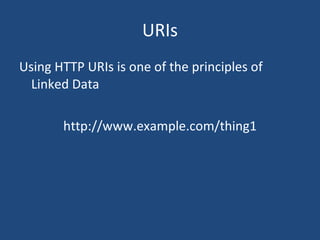
URIs Using HTTP URIs is one of the principles of Linked Data http://www.example.com/thing1
URIs URIs are like control numbers (LCCN, ISBN, etc.).
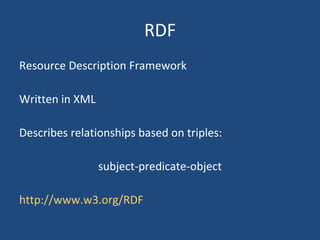
RDF Resource Description Framework Written in XML Describes relationships based on triples: subject-predicate-object http://www.w3.org/RDF
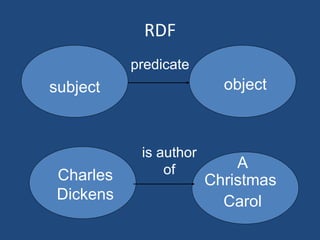
RDF subject object Charles Dickens A Christmas  Carol is author of predicate
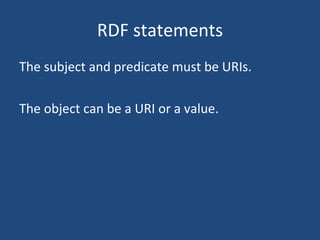
RDF statements The subject and predicate must be URIs. The object can be a URI or a value.
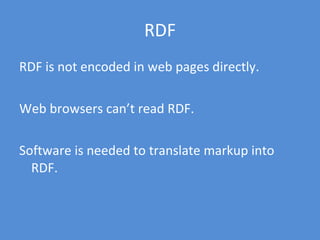
RDF RDF is not encoded in web pages directly. Web browsers can’t read RDF. Software is needed to translate markup into RDF.
Ontologies An ontology is a vocabulary of specific terms to be used  to describe resources. Sound familiar?
What could Linked Data mean for Libraries?
Part I: What could Linked Data mean for Library Data?
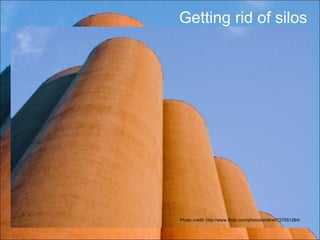
Photo credit: http://www.flickr.com/photos/eirikref/727551264/ Getting rid of silos
“ Our services must not only be on the Web, but need to be of the Web.” Karen Coyle RDA Vocabularies for a Twenty-First-Century Data Environment Library Technology Reports February 2010
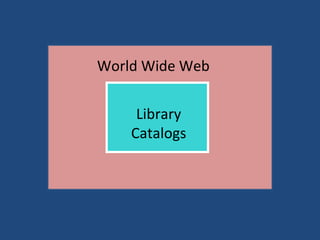
Library Catalogs World Wide Web
More open standards Our data standards are either not used by those outside libraries (MARC) Or not very semantically rich (Dublin Core) But Linked Data could get us to use standards that are both of these things.
bibliographic records vs.  bibliographic data
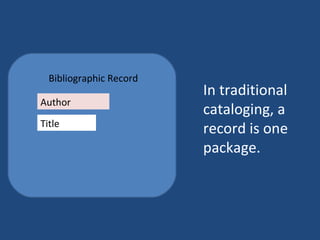
In traditional cataloging, a record is one package. Author Title Bibliographic Record
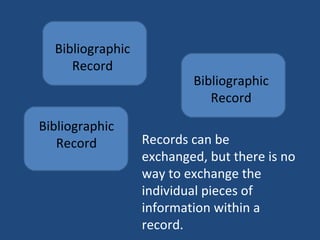
Records can be exchanged, but there is no way to exchange the individual pieces of information within a record. Bibliographic Record Bibliographic Record Bibliographic Record
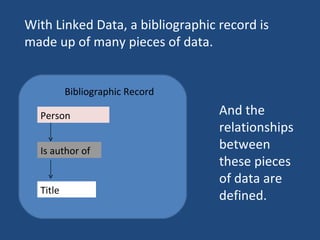
Person Is author of   Title Bibliographic Record With Linked Data, a bibliographic record is made up of many pieces of data. And the relationships between these pieces of data are defined.
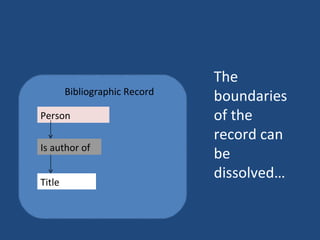
Person Is author of   Title Bibliographic Record The boundaries of the record can be dissolved…
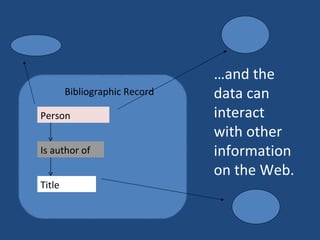
Person Is author of   Title Bibliographic Record … and the data can interact with other information on the Web.
Are there examples of Linked Data in libraries?
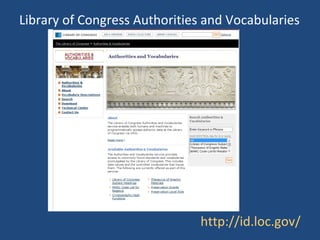
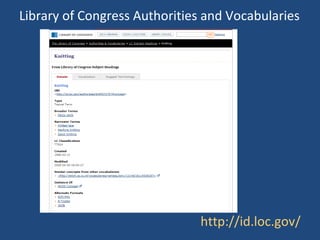
Library of Congress Authorities and Vocabularies http://id.loc.gov/
 
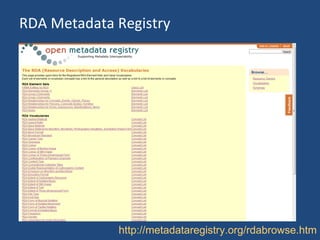
RDA Metadata Registry http://metadataregistry.org/rdabrowse.htm
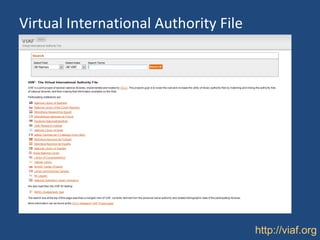
Virtual International Authority File http://viaf.org
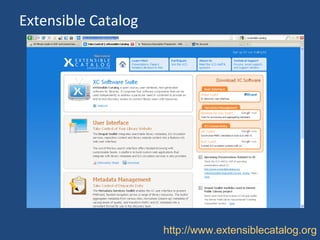
Extensible Catalog http://www.extensiblecatalog.org
So there’s a bunch of data out there. Now what?
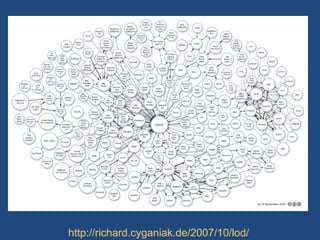
http://richard.cyganiak.de/2007/10/lod/
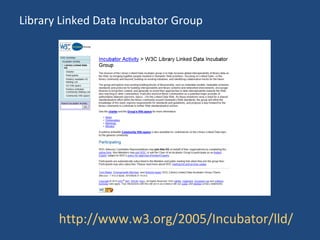
Library Linked Data Incubator Group http://www.w3.org/2005/Incubator/lld/
Part II: What Could Linked Data Mean for Librarians?
Different workflows Catalogers could use URIs for things like authors’ names or subject headings. If information changed, the URI could be changed and automatically update the information in our catalogs.
Evaluating metadata Metadata could come from various sources. “ Professional cataloging might be more of a job of aggregating and improving harvested or contributed metadata, rather than developing new metadata, like MARC records, for resources.” -Virginia Schilling “ The Catalogers’ Revenge: Unleasing the Semantic Web” PNLA Quarterly 74:3, 2010
New homes for librarians’ skills?   Example: The Internet Needs a Dewey Decimal System http://www.pcworld.com/businesscenter/article/206230/the_internet_needs_a_dewey_decimal_system.html
Are There Drawbacks to Linked Data?
Training and Software Development “ Nobody but the geekily inclined is going to be willing to invest the time and effort necessary to code semantically tagged web pages from scratch.” Virginia Schilling “ The Catalogers’ Revenge: Unleashing the Semantic Web.”  PNLA Quarterly  74:3 (Spring 2010).
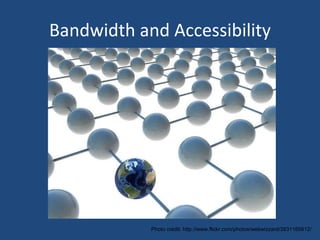
Bandwidth and Accessibility Photo credit: http://www.flickr.com/photos/webwizzard/3931165612/
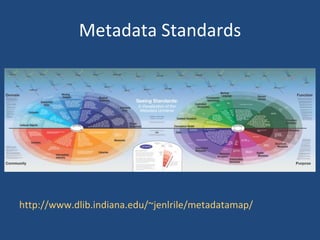
Metadata Standards http://www.dlib.indiana.edu/~jenlrile/metadatamap/
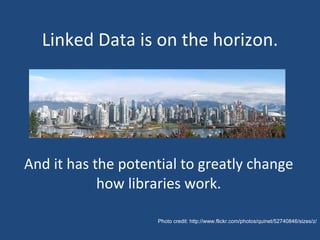
Linked Data is on the horizon. And it has the potential to greatly change how libraries work. Photo credit: http://www.flickr.com/photos/quinet/52740846/sizes/z/
Questions? Photo credit: http://www.flickr.com/photos/lwr/12364944/
Thank you! Emily Dust Nimsakont [email_address] http://www.delicious.com/enimsakont/linkeddata+nla2010 http://www.slideshare.net/enimsakont

What is Linked Data, and What Does It Mean for Libraries?

  • 1.
    What is LinkedData, and What Does It Mean for Libraries? Emily Dust Nimsakont NLA/NEMA Conference October 15, 2010 Photo credit: http://www.flickr.com/photos/mklingo/245562110/
  • 2.
    What is LinkedData, and What Does It Mean for Libraries? Emily Dust Nimsakont NLA/NEMA Conference October 15, 2010 Could Photo credit: http://www.flickr.com/photos/mklingo/245562110/
  • 3.
    This is anoverview… Photo credit: http://www.flickr.com/photos/magnusvk/4090803400/
  • 4.
  • 5.
    Wikipedia says… “The term Linked Data is used to describe a method of exposing, sharing, and connecting data via dereferenceable URIs on the Web.” http://en.wikipedia.org/wiki/Linked_Data
  • 6.
    Linked Data vs.Semantic Web vs. Web 3.0
  • 7.
    “ I havea dream for the Web [in which computers] become capable of analyzing all the data on the Web – the content, links, and transactions between people and computers.” Tim Berners-Lee, 1999
  • 8.
  • 9.
    web of documentsvs. web of data
  • 10.
    Currently the Webis a system of interconnected documents.
  • 11.
    People use hyperlinksto navigate from one document to another.
  • 12.
    resource resource resourceresource resource links to links to links to links to
  • 13.
  • 14.
    HTML <h1>This isa heading.</h1> <p>This is a paragraph.</p>
  • 15.
    RDF/XML <rdf:Description rdf:about=&quot;http://www.recshop.fake/cd/EmpireBurlesque&quot;>   <cd:artist>Bob Dylan</cd:artist>   <cd:country>USA</cd:country>   <cd:company>Columbia</cd:company>   <cd:price>10.90</cd:price>   <cd:year>1985</cd:year> </rdf:Description> http://www.w3schools.com/rdf/rdf_example.asp
  • 16.
    Relationships are keyPhoto credit: http://www.flickr.com/photos/brenda-starr/3509344100/
  • 17.
    People can understandrelationships between things. But machines should be able to understand these relationships too. Photo credit: http://www.flickr.com/photos/ksawyer/2075159262/
  • 18.
    We are usedto connecting pieces of information based on their context. Title: A Christmas Carol Author: Charles Dickens Linked Data makes the relationships explicit. Charles Dickens is the author of A Christmas Carol .
  • 19.
    Linked Data makesthe Web into a database.
  • 20.
    Linked Data principlesTim Berners-Lee, “Linked Data-Design Issues.” http://www.w3.org/DesignIssues/LinkedData.html
  • 21.
    URIs For LinkedData, we need to be able to identify things uniquely Uniform Resource Identifiers do this already
  • 22.
    URIs Using HTTPURIs is one of the principles of Linked Data http://www.example.com/thing1
  • 23.
    URIs URIs arelike control numbers (LCCN, ISBN, etc.).
  • 24.
    RDF Resource DescriptionFramework Written in XML Describes relationships based on triples: subject-predicate-object http://www.w3.org/RDF
  • 25.
    RDF subject objectCharles Dickens A Christmas Carol is author of predicate
  • 26.
    RDF statements Thesubject and predicate must be URIs. The object can be a URI or a value.
  • 27.
    RDF RDF isnot encoded in web pages directly. Web browsers can’t read RDF. Software is needed to translate markup into RDF.
  • 28.
    Ontologies An ontologyis a vocabulary of specific terms to be used to describe resources. Sound familiar?
  • 29.
    What could LinkedData mean for Libraries?
  • 30.
    Part I: Whatcould Linked Data mean for Library Data?
  • 31.
  • 32.
    “ Our servicesmust not only be on the Web, but need to be of the Web.” Karen Coyle RDA Vocabularies for a Twenty-First-Century Data Environment Library Technology Reports February 2010
  • 33.
  • 34.
    More open standardsOur data standards are either not used by those outside libraries (MARC) Or not very semantically rich (Dublin Core) But Linked Data could get us to use standards that are both of these things.
  • 35.
    bibliographic records vs. bibliographic data
  • 36.
    In traditional cataloging,a record is one package. Author Title Bibliographic Record
  • 37.
    Records can beexchanged, but there is no way to exchange the individual pieces of information within a record. Bibliographic Record Bibliographic Record Bibliographic Record
  • 38.
    Person Is authorof Title Bibliographic Record With Linked Data, a bibliographic record is made up of many pieces of data. And the relationships between these pieces of data are defined.
  • 39.
    Person Is authorof Title Bibliographic Record The boundaries of the record can be dissolved…
  • 40.
    Person Is authorof Title Bibliographic Record … and the data can interact with other information on the Web.
  • 41.
    Are there examplesof Linked Data in libraries?
  • 42.
    Library of CongressAuthorities and Vocabularies http://id.loc.gov/
  • 43.
    Library of CongressAuthorities and Vocabularies http://id.loc.gov/
  • 44.
  • 45.
    RDA Metadata Registryhttp://metadataregistry.org/rdabrowse.htm
  • 46.
    Virtual International AuthorityFile http://viaf.org
  • 47.
  • 48.
    So there’s abunch of data out there. Now what?
  • 49.
  • 50.
    Library Linked DataIncubator Group http://www.w3.org/2005/Incubator/lld/
  • 51.
    Part II: WhatCould Linked Data Mean for Librarians?
  • 52.
    Different workflows Catalogerscould use URIs for things like authors’ names or subject headings. If information changed, the URI could be changed and automatically update the information in our catalogs.
  • 53.
    Evaluating metadata Metadatacould come from various sources. “ Professional cataloging might be more of a job of aggregating and improving harvested or contributed metadata, rather than developing new metadata, like MARC records, for resources.” -Virginia Schilling “ The Catalogers’ Revenge: Unleasing the Semantic Web” PNLA Quarterly 74:3, 2010
  • 54.
    New homes forlibrarians’ skills? Example: The Internet Needs a Dewey Decimal System http://www.pcworld.com/businesscenter/article/206230/the_internet_needs_a_dewey_decimal_system.html
  • 55.
    Are There Drawbacksto Linked Data?
  • 56.
    Training and SoftwareDevelopment “ Nobody but the geekily inclined is going to be willing to invest the time and effort necessary to code semantically tagged web pages from scratch.” Virginia Schilling “ The Catalogers’ Revenge: Unleashing the Semantic Web.” PNLA Quarterly 74:3 (Spring 2010).
  • 57.
    Bandwidth and AccessibilityPhoto credit: http://www.flickr.com/photos/webwizzard/3931165612/
  • 58.
  • 59.
    Linked Data ison the horizon. And it has the potential to greatly change how libraries work. Photo credit: http://www.flickr.com/photos/quinet/52740846/sizes/z/
  • 60.
    Questions? Photo credit:http://www.flickr.com/photos/lwr/12364944/
  • 61.
    Thank you! EmilyDust Nimsakont [email_address] http://www.delicious.com/enimsakont/linkeddata+nla2010 http://www.slideshare.net/enimsakont

Editor's Notes

  • #34 There are a number of different ways in which our data is in a silo, compared to other data on the Web. It exists in our catalogs, which are not always accessible. It exists in MARC format, which is used by no one else.
  • #36 But I think that one of the major ways in which our information is in a silo of its own is because we insist on thinking about bibliographic records instead of bibliographic data.
  • #37 The elements of author, title, etc., only really have meaning in the context of the record.
  • #38 MARC format, our encoding standard, is set up to exchange records, not data.