Introduction toSemantic WebJose Emilio Labra GayoUniversity of Oviedo, Spainhttp://www.di.uniovi.es/~labra
The current WebCurrent Web = the biggest repository of information ever compiled by HumanityDesigned for direct human consumptionLots of information available in:Natural Language in HTMLEnglish, Spanish, Chinese, Italian, etc.More and More multimediaImages, audio, video, etc.Too much data, not enough knowledge
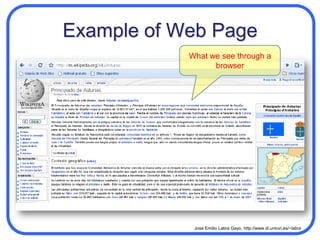
Example of Web PageWhat we see through a browser
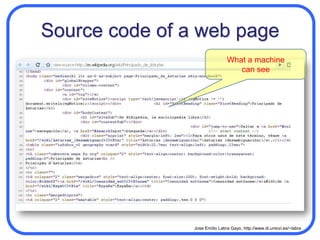
Source code of a web pageWhat a machine can see
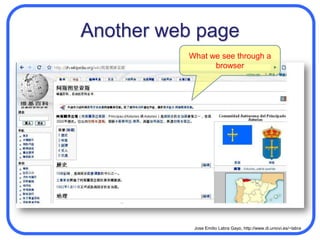
Another web pageWhat we see through a browser
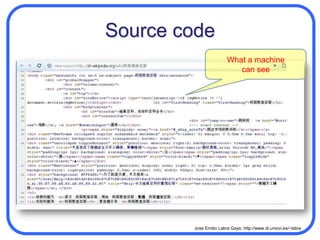
Source codeWhat a machine can see
Difficult queriesDifferent languagesMultimediaCombine different travel dataExample: Travel from Oviedo to RomeComplex questionsExample: Asturian people who play soccer
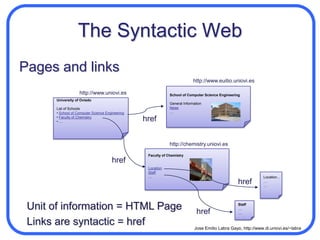
The Syntactic WebPages and linkshttp://www.euitio.uniovi.esSchool of Computer Science EngineeringGeneral InformationNews…http://www.uniovi.esUniversity of OviedoList of SchoolsSchool of Computer Science Engineering
Faculty of Chemistry
 …hrefhttp://chemistry.uniovi.esFaculty of ChemistryLocationStaff…hrefLocation………hrefUnit of information = HTML Page Links are syntactic = hrefStaff……href
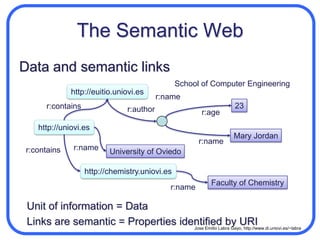
The Semantic WebData and semantic linksSchool of Computer Engineeringhttp://euitio.uniovi.esr:name23r:containsr:authorr:agehttp://uniovi.esMary Jordanr:namer:namer:containsUniversity of Oviedohttp://chemistry.uniovi.esFaculty of Chemistryr:nameUnit of information = DataLinks are semantic = Properties identified by URI
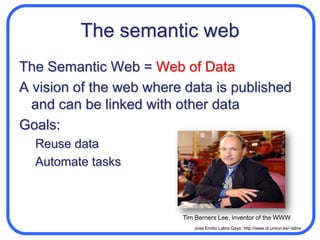
The semantic webThe Semantic Web = Web of DataA vision of the web where data is published and can be linked with other dataGoals:Reuse dataAutomate tasksTim Berners Lee, inventor of the WWW
Features of the Web Non-centralizedThe information may not be consistentDynamic informationData may change (or servers can fail)Lots of informationThe system cannot try to capture all the dataOpen systemMore information can appear in the future
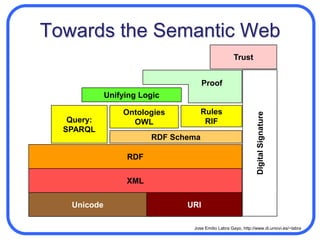
Towards the Semantic WebTrustDigital SignatureProofUnifying LogicQuery:SPARQLOntologiesOWLRulesRIFRDF SchemaRDFXMLURIUnicodeSemantic web layer cake, by Tim Berners Lee
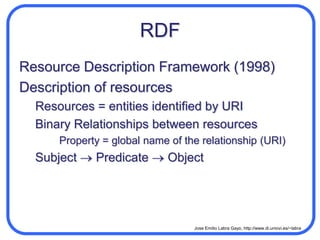
RDFResource Description Framework (1998)Description of resourcesResources = entities identified by URIBinary Relationships between resources	Property = global name of the relationship (URI)Subject  Predicate  Object
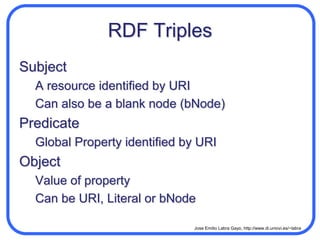
RDF TriplesSubjectA resource identified by URICan also be a blank node (bNode)PredicateGlobal Property identified by URIObjectValue of propertyCan be URI, Literal or bNode
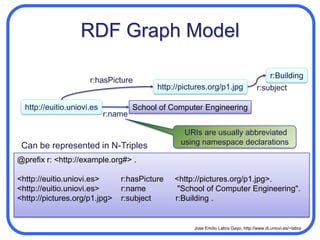
RDF Graph ModelCan be represented in N-Triples@prefix r: <http://example.org#> .<http://euitio.uniovi.es>  	r:hasPicture     <http://pictures.org/p1.jpg>.<http://euitio.uniovi.es>  	r:name 	"School of Computer Engineering".<http://pictures.org/p1.jpg> 	r:subject           r:Building .r:Buildingr:hasPicturehttp://pictures.org/p1.jpgr:subjecthttp://euitio.uniovi.esSchool of Computer Engineeringr:name URIs are usually abbreviated using namespace declarations
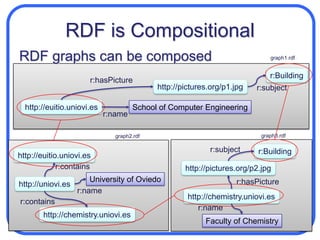
RDF is Compositionalgraph3.rdfgraph2.rdfr:subjectr:Buildinghttp://euitio.uniovi.esr:containshttp://pictures.org/p2.jpgUniversity of Oviedor:hasPicturehttp://uniovi.esr:namehttp://chemistry.uniovi.esr:containsr:namehttp://chemistry.uniovi.esFaculty of ChemistryRDF graphs can be composedgraph1.rdfr:Buildingr:hasPicturehttp://pictures.org/p1.jpgr:subjecthttp://euitio.uniovi.esSchool of Computer Engineeringr:name
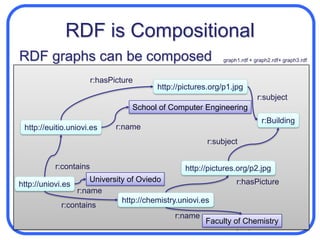
RDF is CompositionalRDF graphs can be composedgraph1.rdf + graph2.rdf+ graph3.rdfr:hasPicturehttp://pictures.org/p1.jpgr:subjectSchool of Computer Engineeringr:Buildinghttp://euitio.uniovi.esr:namer:subjectr:containshttp://pictures.org/p2.jpgUniversity of Oviedor:hasPicturehttp://uniovi.esr:namehttp://chemistry.uniovi.esr:containsr:nameFaculty of Chemistry
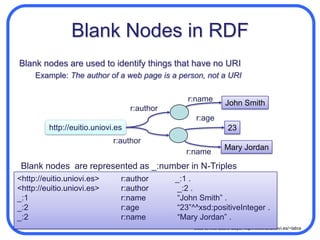
Blank Nodes in RDFBlank nodes  are represented as _:number in N-Triples<http://euitio.uniovi.es>  	r:author            _:1 .<http://euitio.uniovi.es>  	r:author 	_:2 ._:1                                   	r:name	“John Smith” ._:2                                   	r:age		“23”^^xsd:positiveInteger ._:2                                   	r:name	“Mary Jordan” .Blank nodes are used to identify things that have no URIExample: The author of a web page is a person, not a URIr:nameJohn Smithr:authorr:agehttp://euitio.uniovi.es23r:authorMary Jordanr:name
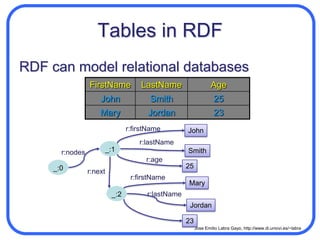
Tables in RDFRDF can model relational databasesr:firstNameJohnr:lastName_:1Smithr:nodesr:age_:025r:nextr:firstNameMary_:2r:lastNameJordanr:age23
RDF serialization formatsThere are several formats to represent RDF data:N3RDF/XMLN-TriplesTurtleetc.
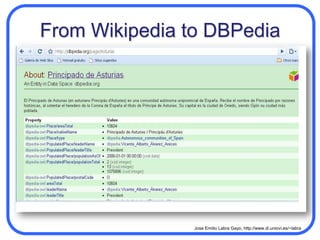
RDF DataLots of information is currently published in RDFSome examples: DBPedia offers RDF triples of more than 80,000 persons, 293,000 places, 62,000 music albums, 36,000 films, etc.
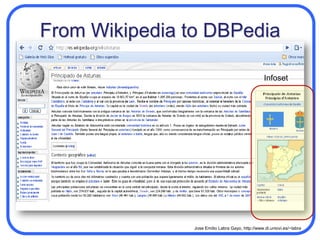
From Wikipedia to DBPediaInfoset
From Wikipedia to DBPedia
Benefits of RDFRDF enables better integration of dataTransform the Web from fileserver to databaseLinking open dataExpose open datasets in RDFSet links among the data of those datasetsSet up query endpointsAltogether billions of triples, millions of links
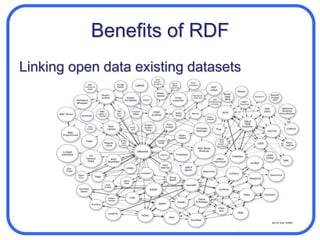
Benefits of RDFLinking open data existing datasets
RDF SchemaExtends RDF with a Schema vocabularyClass, Property, Resource,…type, subClassOf, subPropertyOf,…range, domain,…RDF Schema enables simple inferences
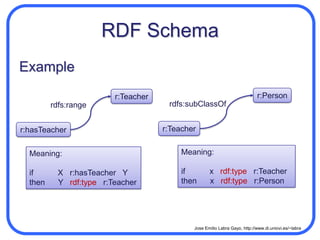
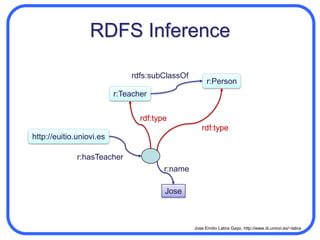
RDF SchemaExampler:Personr:Teacherrdfs:subClassOfrdfs:ranger:Teacherr:hasTeacherMeaning:if           x   rdf:type   r:Teacherthen      x   rdf:type   r:PersonMeaning:if           X   r:hasTeacher   Y then      Y   rdf:type   r:Teacher
RDFS Inference rdfs:subClassOfr:Personr:Teacherrdf:typerdf:typehttp://euitio.uniovi.esr:hasTeacherr:nameJose
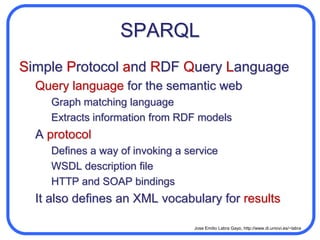
SPARQLSimple Protocol and RDF Query LanguageQuery languagefor the semantic webGraph matching languageExtracts information from RDF modelsA protocolDefines a way of invoking a serviceWSDL description fileHTTP and SOAP bindingsIt also defines an XML vocabulary for results
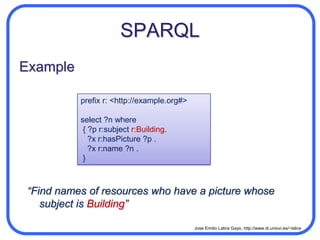
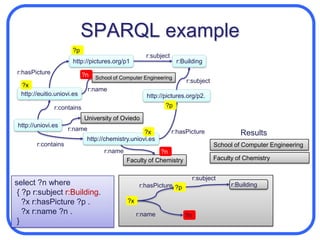
SPARQLExampleprefix r: <http://example.org#> select ?n where  { ?p r:subject r:Building.    ?x r:hasPicture ?p .   ?x r:name ?n .  }“Find names of resources who have a picture whose subject is Building”
SPARQL exampler:subjectr:Buildingr:hasPicture?p?xr:name?n?p?n?x?pResultsSchool of Computer Engineering?x?nr:subjecthttp://pictures.org/p1r:Buildingr:hasPictureSchool of Computer Engineeringr:subjectr:namehttp://euitio.uniovi.eshttp://pictures.org/p2.r:containsUniversity of Oviedohttp://uniovi.esr:namer:hasPicturehttp://chemistry.uniovi.esr:containsr:nameFaculty of ChemistryFaculty of Chemistryselect ?n where  { ?p r:subject r:Building.    ?x r:hasPicture ?p .   ?x r:name ?n .  }
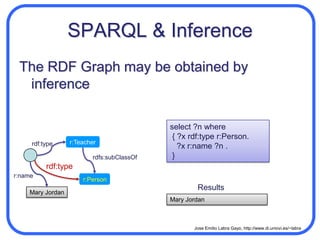
SPARQL & InferenceThe RDF Graph may be obtained by inferencerdf:typeResultsMary Jordanselect ?n where  { ?x rdf:type r:Person.    ?x r:name ?n .  }r:Teacherrdf:typerdfs:subClassOfr:namer:PersonMary Jordan
SPARQLMore featuresLimitthe number of returned results; remove duplicates, sort them, …Optional subpatterns (match if possible…)Specify several data sources within the query Construct a graph combining a separate pattern and the query results, or simply askwhether a pattern matches Use datatypes and/or language tags when matching a pattern
Obtaining RDFSPARQL Endpoints offer an integration mechanismBig RDF datasets accesible to applicationsExample: DBPediaNowadays Data is mostly in DatabasesIt is not feasible to convert all databases to RDF More practical to convert on the flySeveral systems: Oracle 11g, Sesame, …
RDF and HTMLProblems to embed RDF/XML in (x)HTMLIt can be linked from an HTML pageThere are some “scrappers” to extract the structure of web pages and dynamically generate RDFCan be a solution for legacy web contentNot very elegant2 proposals for a more systematic way:GRDDLRDFa
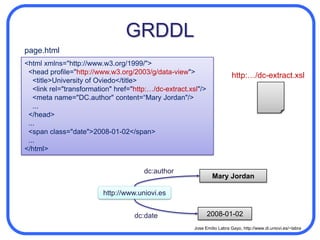
GRDDLdc:authorMary Jordanhttp://www.uniovi.es2008-01-02dc:datepage.html<html xmlns="http://www.w3.org/1999/">  <head profile="http://www.w3.org/2003/g/data-view">    <title>University of Oviedo</title>    <link rel="transformation" href="http:…/dc-extract.xsl"/>    <meta name="DC.author" content=“Mary Jordan"/>          ...  </head>  ...  <span class="date">2008-01-02</span>  ...</html>http:…/dc-extract.xsl
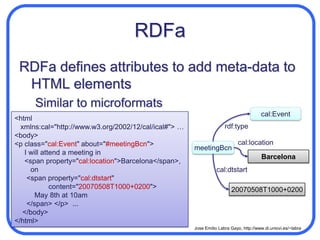
RDFaRDFa defines attributes to add meta-data to HTML elementsSimilar to microformatscal:Eventrdf:typecal:locationmeetingBcnBarcelonacal:dtstart20070508T1000+0200<html    xmlns:cal="http://www.w3.org/2002/12/cal/ical#"> …<body> <p class="cal:Event" about="#meetingBcn">      I will attend a meeting in     <span property="cal:location">Barcelona</span>,         on       <span property="cal:dtstart"                  content="20070508T1000+0200">          May 8th at 10am      </span> </p>  ...     </body> </html>
OntologiesRDFS does not solve all requirementsApplications need more expressivity and reasoningIn RDFS, it is not possible to create new subclassesOWL (Web Ontology Language) offers a common language to define ontologies
What is an Ontology?A model of (some aspect of) the world
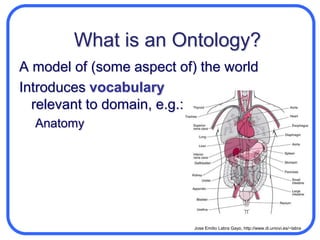
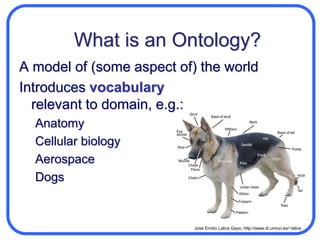
What is an Ontology?A model of (some aspect of) the worldIntroduces vocabularyrelevant to domain, e.g.:Anatomy
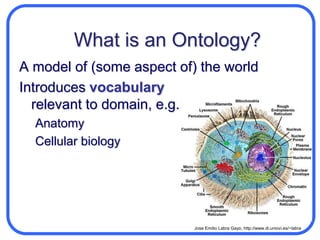
What is an Ontology?A model of (some aspect of) the worldIntroduces vocabularyrelevant to domain, e.g.:AnatomyCellular biology
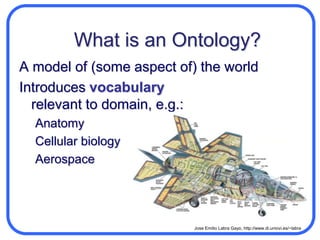
What is an Ontology?A model of (some aspect of) the worldIntroduces vocabularyrelevant to domain, e.g.:AnatomyCellular biologyAerospace
What is an Ontology?A model of (some aspect of) the worldIntroduces vocabularyrelevant to domain, e.g.:AnatomyCellular biologyAerospaceDogs
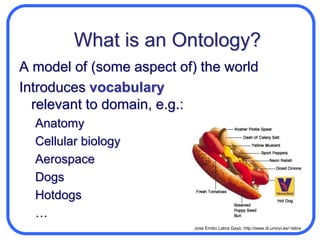
What is an Ontology?A model of (some aspect of) the worldIntroduces vocabularyrelevant to domain, e.g.:AnatomyCellular biologyAerospaceDogsHotdogs…
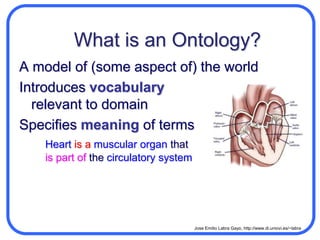
What is an Ontology?A model of (some aspect of) the worldIntroduces vocabularyrelevant to domainSpecifies meaning of termsHeartis amuscular organ thatis part of the circulatory system
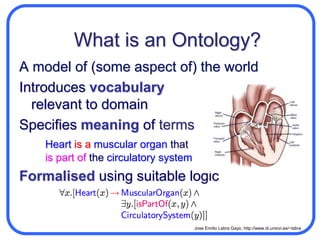
What is an Ontology?A model of (some aspect of) the worldIntroduces vocabularyrelevant to domainSpecifies meaning of termsHeartis amuscular organ thatis part of the circulatory systemFormalised using suitable logic
OWLOWL enables the description of new classesBy enumerationThrough intersection, union, complementThrough property restrictionsIt is based on Description LogicsWell defined semanticsA subset of Predicate Logic Limited use of variables Binary predicates = PropertiesUnary predicates = Classes
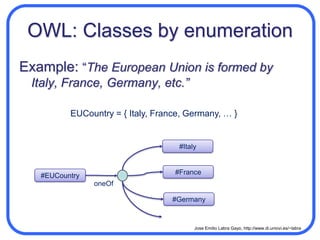
OWL: Classes by enumerationExample: “The European Union is formed by Italy, France, Germany, etc.”EUCountry = { Italy, France, Germany, … }#Italy#France#EUCountryoneOf#Germany…
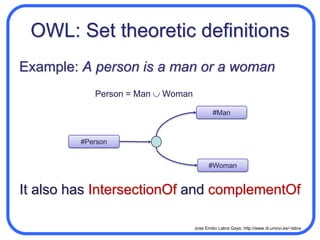
OWL: Set theoretic definitionsExample: A person is a man or a womanPerson = Man  Woman#Man#PersonunionOf#WomanIt also has IntersectionOf and complementOf
OWL: Property restrictionsIt is possible to define new classes by restricting the property values of some classReasoner acts as a classifier
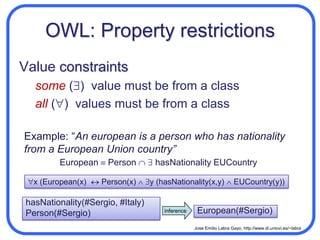
OWL: Property restrictionsValue constraintssome ()  value must be from a classall ()  values must be from a classExample: “An european is a person who has nationality from a European Union country”European  Person   hasNationality EUCountryhasNationality(#Sergio, #Italy)Person(#Sergio)inferenceEuropean(#Sergio)x (European(x)   Person(x)  y (hasNationality(x,y)  EUCountry(y))
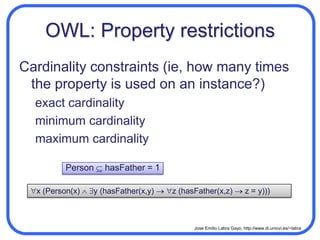
OWL: Property restrictionsCardinality constraints (ie, how many times the property is used on an instance?)exact cardinalityminimum cardinalitymaximum cardinalityPerson  hasFather = 1x (Person(x)  y (hasFather(x,y) z (hasFather(x,z)  z = y)))
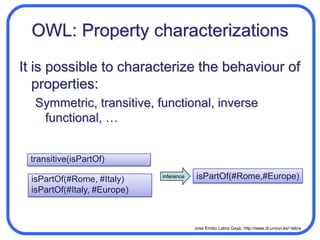
OWL: Property characterizationsIt is possible to characterize the behaviour of properties: Symmetric, transitive, functional, inverse functional, …transitive(isPartOf)inferenceisPartOf(#Rome,#Europe)isPartOf(#Rome, #Italy)isPartOf(#Italy, #Europe)
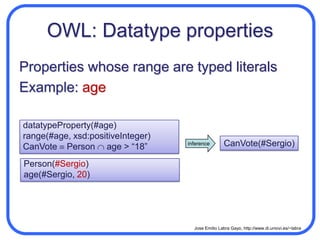
OWL: Datatype propertiesProperties whose range are typed literalsExample: agedatatypeProperty(#age)range(#age, xsd:positiveInteger)CanVote  Person  age > “18” inferenceCanVote(#Sergio)Person(#Sergio)age(#Sergio, 20)
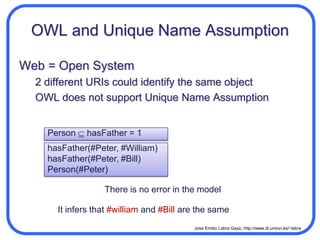
OWL and Unique Name AssumptionWeb = Open System2 different URIs could identify the same objectOWL does not support Unique Name AssumptionThere is no error in the modelIt infers that #williamand#Billare the samePerson  hasFather = 1hasFather(#Peter, #William)hasFather(#Peter, #Bill)Person(#Peter)
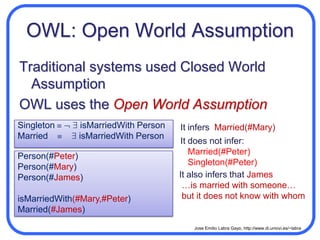
OWL: Open World AssumptionTraditional systems used Closed World Assumption OWL uses the Open World AssumptionSingleton    isMarriedWith PersonMarried         isMarriedWith PersonPerson(#Peter)Person(#Mary)Person(#James)isMarriedWith(#Mary,#Peter)Married(#James)It infers: Married(#Mary)It does not infer: Married(#Peter)    Singleton(#Peter)It also infers that James …is married with someone… but it does not know with whom
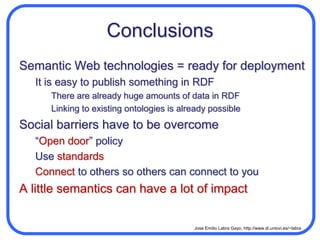
ConclusionsSemantic Web technologies = ready for deploymentIt is easy to publish something in RDFThere are already huge amounts of data in RDFLinking to existing ontologies is already possibleSocial barriers have to be overcome“Open door” policyUse standardsConnect to others so others can connect to youA little semantics can have a lot of impact
The EndQuestions?More information: http://www.di.uniovi.es/~labra
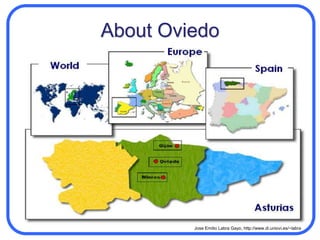
About Oviedo
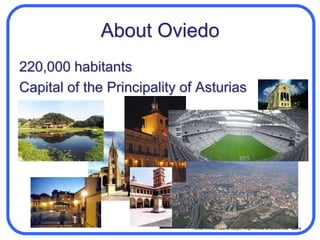
About Oviedo220,000 habitantsCapital of the Principality of Asturias
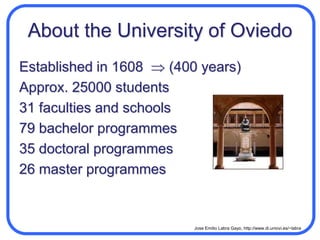
About the University of OviedoEstablished in 1608   (400 years)Approx. 25000 students31 faculties and schools79 bachelorprogrammes35 doctoral programmes26 masterprogrammes

Sem webmaubeuge

  • 1.
    Introduction toSemantic WebJoseEmilio Labra GayoUniversity of Oviedo, Spainhttp://www.di.uniovi.es/~labra
  • 2.
    The current WebCurrentWeb = the biggest repository of information ever compiled by HumanityDesigned for direct human consumptionLots of information available in:Natural Language in HTMLEnglish, Spanish, Chinese, Italian, etc.More and More multimediaImages, audio, video, etc.Too much data, not enough knowledge
  • 3.
    Example of WebPageWhat we see through a browser
  • 4.
    Source code ofa web pageWhat a machine can see
  • 5.
    Another web pageWhatwe see through a browser
  • 6.
    Source codeWhat amachine can see
  • 7.
    Difficult queriesDifferent languagesMultimediaCombinedifferent travel dataExample: Travel from Oviedo to RomeComplex questionsExample: Asturian people who play soccer
  • 8.
    The Syntactic WebPagesand linkshttp://www.euitio.uniovi.esSchool of Computer Science EngineeringGeneral InformationNews…http://www.uniovi.esUniversity of OviedoList of SchoolsSchool of Computer Science Engineering
  • 9.
  • 10.
    …hrefhttp://chemistry.uniovi.esFaculty ofChemistryLocationStaff…hrefLocation………hrefUnit of information = HTML Page Links are syntactic = hrefStaff……href
  • 11.
    The Semantic WebDataand semantic linksSchool of Computer Engineeringhttp://euitio.uniovi.esr:name23r:containsr:authorr:agehttp://uniovi.esMary Jordanr:namer:namer:containsUniversity of Oviedohttp://chemistry.uniovi.esFaculty of Chemistryr:nameUnit of information = DataLinks are semantic = Properties identified by URI
  • 12.
    The semantic webTheSemantic Web = Web of DataA vision of the web where data is published and can be linked with other dataGoals:Reuse dataAutomate tasksTim Berners Lee, inventor of the WWW
  • 13.
    Features of theWeb Non-centralizedThe information may not be consistentDynamic informationData may change (or servers can fail)Lots of informationThe system cannot try to capture all the dataOpen systemMore information can appear in the future
  • 14.
    Towards the SemanticWebTrustDigital SignatureProofUnifying LogicQuery:SPARQLOntologiesOWLRulesRIFRDF SchemaRDFXMLURIUnicodeSemantic web layer cake, by Tim Berners Lee
  • 15.
    RDFResource Description Framework(1998)Description of resourcesResources = entities identified by URIBinary Relationships between resources Property = global name of the relationship (URI)Subject  Predicate  Object
  • 16.
    RDF TriplesSubjectA resourceidentified by URICan also be a blank node (bNode)PredicateGlobal Property identified by URIObjectValue of propertyCan be URI, Literal or bNode
  • 17.
    RDF Graph ModelCanbe represented in N-Triples@prefix r: <http://example.org#> .<http://euitio.uniovi.es> r:hasPicture <http://pictures.org/p1.jpg>.<http://euitio.uniovi.es> r:name "School of Computer Engineering".<http://pictures.org/p1.jpg> r:subject r:Building .r:Buildingr:hasPicturehttp://pictures.org/p1.jpgr:subjecthttp://euitio.uniovi.esSchool of Computer Engineeringr:name URIs are usually abbreviated using namespace declarations
  • 18.
    RDF is Compositionalgraph3.rdfgraph2.rdfr:subjectr:Buildinghttp://euitio.uniovi.esr:containshttp://pictures.org/p2.jpgUniversityof Oviedor:hasPicturehttp://uniovi.esr:namehttp://chemistry.uniovi.esr:containsr:namehttp://chemistry.uniovi.esFaculty of ChemistryRDF graphs can be composedgraph1.rdfr:Buildingr:hasPicturehttp://pictures.org/p1.jpgr:subjecthttp://euitio.uniovi.esSchool of Computer Engineeringr:name
  • 19.
    RDF is CompositionalRDFgraphs can be composedgraph1.rdf + graph2.rdf+ graph3.rdfr:hasPicturehttp://pictures.org/p1.jpgr:subjectSchool of Computer Engineeringr:Buildinghttp://euitio.uniovi.esr:namer:subjectr:containshttp://pictures.org/p2.jpgUniversity of Oviedor:hasPicturehttp://uniovi.esr:namehttp://chemistry.uniovi.esr:containsr:nameFaculty of Chemistry
  • 20.
    Blank Nodes inRDFBlank nodes are represented as _:number in N-Triples<http://euitio.uniovi.es> r:author _:1 .<http://euitio.uniovi.es> r:author _:2 ._:1 r:name “John Smith” ._:2 r:age “23”^^xsd:positiveInteger ._:2 r:name “Mary Jordan” .Blank nodes are used to identify things that have no URIExample: The author of a web page is a person, not a URIr:nameJohn Smithr:authorr:agehttp://euitio.uniovi.es23r:authorMary Jordanr:name
  • 21.
    Tables in RDFRDFcan model relational databasesr:firstNameJohnr:lastName_:1Smithr:nodesr:age_:025r:nextr:firstNameMary_:2r:lastNameJordanr:age23
  • 22.
    RDF serialization formatsThereare several formats to represent RDF data:N3RDF/XMLN-TriplesTurtleetc.
  • 23.
    RDF DataLots ofinformation is currently published in RDFSome examples: DBPedia offers RDF triples of more than 80,000 persons, 293,000 places, 62,000 music albums, 36,000 films, etc.
  • 24.
    From Wikipedia toDBPediaInfoset
  • 25.
  • 26.
    Benefits of RDFRDFenables better integration of dataTransform the Web from fileserver to databaseLinking open dataExpose open datasets in RDFSet links among the data of those datasetsSet up query endpointsAltogether billions of triples, millions of links
  • 27.
    Benefits of RDFLinkingopen data existing datasets
  • 28.
    RDF SchemaExtends RDFwith a Schema vocabularyClass, Property, Resource,…type, subClassOf, subPropertyOf,…range, domain,…RDF Schema enables simple inferences
  • 29.
    RDF SchemaExampler:Personr:Teacherrdfs:subClassOfrdfs:ranger:Teacherr:hasTeacherMeaning:if x rdf:type r:Teacherthen x rdf:type r:PersonMeaning:if X r:hasTeacher Y then Y rdf:type r:Teacher
  • 30.
  • 31.
    SPARQLSimple Protocol andRDF Query LanguageQuery languagefor the semantic webGraph matching languageExtracts information from RDF modelsA protocolDefines a way of invoking a serviceWSDL description fileHTTP and SOAP bindingsIt also defines an XML vocabulary for results
  • 32.
    SPARQLExampleprefix r: <http://example.org#>select ?n where { ?p r:subject r:Building. ?x r:hasPicture ?p . ?x r:name ?n . }“Find names of resources who have a picture whose subject is Building”
  • 33.
    SPARQL exampler:subjectr:Buildingr:hasPicture?p?xr:name?n?p?n?x?pResultsSchool ofComputer Engineering?x?nr:subjecthttp://pictures.org/p1r:Buildingr:hasPictureSchool of Computer Engineeringr:subjectr:namehttp://euitio.uniovi.eshttp://pictures.org/p2.r:containsUniversity of Oviedohttp://uniovi.esr:namer:hasPicturehttp://chemistry.uniovi.esr:containsr:nameFaculty of ChemistryFaculty of Chemistryselect ?n where { ?p r:subject r:Building. ?x r:hasPicture ?p . ?x r:name ?n . }
  • 34.
    SPARQL & InferenceTheRDF Graph may be obtained by inferencerdf:typeResultsMary Jordanselect ?n where { ?x rdf:type r:Person. ?x r:name ?n . }r:Teacherrdf:typerdfs:subClassOfr:namer:PersonMary Jordan
  • 35.
    SPARQLMore featuresLimitthe numberof returned results; remove duplicates, sort them, …Optional subpatterns (match if possible…)Specify several data sources within the query Construct a graph combining a separate pattern and the query results, or simply askwhether a pattern matches Use datatypes and/or language tags when matching a pattern
  • 36.
    Obtaining RDFSPARQL Endpointsoffer an integration mechanismBig RDF datasets accesible to applicationsExample: DBPediaNowadays Data is mostly in DatabasesIt is not feasible to convert all databases to RDF More practical to convert on the flySeveral systems: Oracle 11g, Sesame, …
  • 37.
    RDF and HTMLProblemsto embed RDF/XML in (x)HTMLIt can be linked from an HTML pageThere are some “scrappers” to extract the structure of web pages and dynamically generate RDFCan be a solution for legacy web contentNot very elegant2 proposals for a more systematic way:GRDDLRDFa
  • 38.
    GRDDLdc:authorMary Jordanhttp://www.uniovi.es2008-01-02dc:datepage.html<html xmlns="http://www.w3.org/1999/"> <head profile="http://www.w3.org/2003/g/data-view"> <title>University of Oviedo</title> <link rel="transformation" href="http:…/dc-extract.xsl"/> <meta name="DC.author" content=“Mary Jordan"/> ... </head> ... <span class="date">2008-01-02</span> ...</html>http:…/dc-extract.xsl
  • 39.
    RDFaRDFa defines attributesto add meta-data to HTML elementsSimilar to microformatscal:Eventrdf:typecal:locationmeetingBcnBarcelonacal:dtstart20070508T1000+0200<html xmlns:cal="http://www.w3.org/2002/12/cal/ical#"> …<body> <p class="cal:Event" about="#meetingBcn"> I will attend a meeting in <span property="cal:location">Barcelona</span>, on <span property="cal:dtstart" content="20070508T1000+0200"> May 8th at 10am </span> </p> ... </body> </html>
  • 40.
    OntologiesRDFS does notsolve all requirementsApplications need more expressivity and reasoningIn RDFS, it is not possible to create new subclassesOWL (Web Ontology Language) offers a common language to define ontologies
  • 41.
    What is anOntology?A model of (some aspect of) the world
  • 42.
    What is anOntology?A model of (some aspect of) the worldIntroduces vocabularyrelevant to domain, e.g.:Anatomy
  • 43.
    What is anOntology?A model of (some aspect of) the worldIntroduces vocabularyrelevant to domain, e.g.:AnatomyCellular biology
  • 44.
    What is anOntology?A model of (some aspect of) the worldIntroduces vocabularyrelevant to domain, e.g.:AnatomyCellular biologyAerospace
  • 45.
    What is anOntology?A model of (some aspect of) the worldIntroduces vocabularyrelevant to domain, e.g.:AnatomyCellular biologyAerospaceDogs
  • 46.
    What is anOntology?A model of (some aspect of) the worldIntroduces vocabularyrelevant to domain, e.g.:AnatomyCellular biologyAerospaceDogsHotdogs…
  • 47.
    What is anOntology?A model of (some aspect of) the worldIntroduces vocabularyrelevant to domainSpecifies meaning of termsHeartis amuscular organ thatis part of the circulatory system
  • 48.
    What is anOntology?A model of (some aspect of) the worldIntroduces vocabularyrelevant to domainSpecifies meaning of termsHeartis amuscular organ thatis part of the circulatory systemFormalised using suitable logic
  • 49.
    OWLOWL enables thedescription of new classesBy enumerationThrough intersection, union, complementThrough property restrictionsIt is based on Description LogicsWell defined semanticsA subset of Predicate Logic Limited use of variables Binary predicates = PropertiesUnary predicates = Classes
  • 50.
    OWL: Classes byenumerationExample: “The European Union is formed by Italy, France, Germany, etc.”EUCountry = { Italy, France, Germany, … }#Italy#France#EUCountryoneOf#Germany…
  • 51.
    OWL: Set theoreticdefinitionsExample: A person is a man or a womanPerson = Man  Woman#Man#PersonunionOf#WomanIt also has IntersectionOf and complementOf
  • 52.
    OWL: Property restrictionsItis possible to define new classes by restricting the property values of some classReasoner acts as a classifier
  • 53.
    OWL: Property restrictionsValueconstraintssome () value must be from a classall () values must be from a classExample: “An european is a person who has nationality from a European Union country”European  Person   hasNationality EUCountryhasNationality(#Sergio, #Italy)Person(#Sergio)inferenceEuropean(#Sergio)x (European(x)  Person(x)  y (hasNationality(x,y)  EUCountry(y))
  • 54.
    OWL: Property restrictionsCardinalityconstraints (ie, how many times the property is used on an instance?)exact cardinalityminimum cardinalitymaximum cardinalityPerson  hasFather = 1x (Person(x)  y (hasFather(x,y) z (hasFather(x,z)  z = y)))
  • 55.
    OWL: Property characterizationsItis possible to characterize the behaviour of properties: Symmetric, transitive, functional, inverse functional, …transitive(isPartOf)inferenceisPartOf(#Rome,#Europe)isPartOf(#Rome, #Italy)isPartOf(#Italy, #Europe)
  • 56.
    OWL: Datatype propertiesPropertieswhose range are typed literalsExample: agedatatypeProperty(#age)range(#age, xsd:positiveInteger)CanVote  Person  age > “18” inferenceCanVote(#Sergio)Person(#Sergio)age(#Sergio, 20)
  • 57.
    OWL and UniqueName AssumptionWeb = Open System2 different URIs could identify the same objectOWL does not support Unique Name AssumptionThere is no error in the modelIt infers that #williamand#Billare the samePerson  hasFather = 1hasFather(#Peter, #William)hasFather(#Peter, #Bill)Person(#Peter)
  • 58.
    OWL: Open WorldAssumptionTraditional systems used Closed World Assumption OWL uses the Open World AssumptionSingleton    isMarriedWith PersonMarried   isMarriedWith PersonPerson(#Peter)Person(#Mary)Person(#James)isMarriedWith(#Mary,#Peter)Married(#James)It infers: Married(#Mary)It does not infer: Married(#Peter) Singleton(#Peter)It also infers that James …is married with someone… but it does not know with whom
  • 59.
    ConclusionsSemantic Web technologies= ready for deploymentIt is easy to publish something in RDFThere are already huge amounts of data in RDFLinking to existing ontologies is already possibleSocial barriers have to be overcome“Open door” policyUse standardsConnect to others so others can connect to youA little semantics can have a lot of impact
  • 60.
    The EndQuestions?More information:http://www.di.uniovi.es/~labra
  • 61.
  • 62.
    About Oviedo220,000 habitantsCapitalof the Principality of Asturias
  • 63.
    About the Universityof OviedoEstablished in 1608  (400 years)Approx. 25000 students31 faculties and schools79 bachelorprogrammes35 doctoral programmes26 masterprogrammes