Confusing Words


    COM 303 Editing: Brian Carroll w/adaptations & additions in January 2013
Who vs. Whom
Who
– Substitutes for the subject
– Example: Who let the dogs out?


Whom
–   Substitutes for objective pronouns (him, her)
–   Example: Whom did he question?
–   And serves as the object of a preposition
–   Example: Ask not for whom the bell tolls, it tolls for thee.
That vs. Which

That
– Use with essential phrases
– Example: Go to the door that reads, “Clinic 1.”

Which
– Use with non-essential phrases
– Example: The test, which was given Thursday, was
  difficult.
Among vs. Between
Between
– Use with two.
– Example: He split the Calzone between Tim and Susan,
  because it was bigger than Tim’s head.


Among
– Use with three or more.
– Example: We divided the money among the five children.
Compose vs. comprise
Compose
– Means to make up
– Example: The class is composed of 25 students.
Comprise
– Means to include
– Example: Our class comprises five women and six
  men.
Affect vs. effect

Affect
– A verb that means influence
– Example: The drought will affect the color of the
 fall foliage.


Effect
– A noun that means result
– Example: The medicine has unpleasant side
effects.
Affect vs. Effect

The majority of the time you use affect
with an a as a verb
and
effect with an e as a noun


                                     7
                                     7
Affect vs. Effect
Affect with an a means "to influence,"
 examples: "The arrows affected the aardvark,"
       " The rain affected Amy's hairdo."
Affect can also mean, roughly,
  "to act in a way that you don't feel,"
  examples: "She affected an air of superiority."
               “Her affect was disturbing to me: she
          was always trying to be something she
         was not”                               8
                                                8
Affect vs. Effect
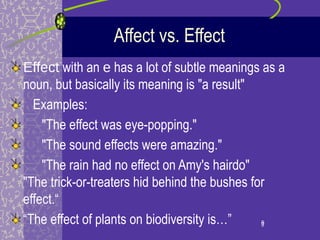
Effect with an e has a lot of subtle meanings as a
noun, but basically its meaning is "a result"
  Examples:
    "The effect was eye-popping."
    "The sound effects were amazing."
    "The rain had no effect on Amy's hairdo"
"The trick-or-treaters hid behind the bushes for
effect.“
“The effect of plants on biodiversity is…”     9
                                               9
Affect vs. Effect
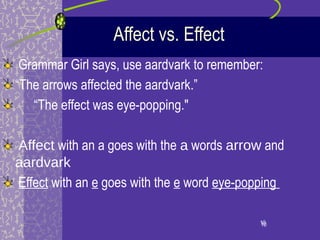
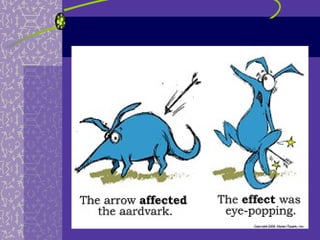
 Grammar Girl says, use aardvark to remember:
“The arrows affected the aardvark.”
   “The effect was eye-popping."

Affect with an a goes with the a words arrow and
aardvark
Effect with an e goes with the e word eye-popping

                                            10
                                            10
11
11

Confusing words affect:effect

  • 1.
    Confusing Words COM 303 Editing: Brian Carroll w/adaptations & additions in January 2013
  • 2.
    Who vs. Whom Who –Substitutes for the subject – Example: Who let the dogs out? Whom – Substitutes for objective pronouns (him, her) – Example: Whom did he question? – And serves as the object of a preposition – Example: Ask not for whom the bell tolls, it tolls for thee.
  • 3.
    That vs. Which That –Use with essential phrases – Example: Go to the door that reads, “Clinic 1.” Which – Use with non-essential phrases – Example: The test, which was given Thursday, was difficult.
  • 4.
    Among vs. Between Between –Use with two. – Example: He split the Calzone between Tim and Susan, because it was bigger than Tim’s head. Among – Use with three or more. – Example: We divided the money among the five children.
  • 5.
    Compose vs. comprise Compose –Means to make up – Example: The class is composed of 25 students. Comprise – Means to include – Example: Our class comprises five women and six men.
  • 6.
    Affect vs. effect Affect –A verb that means influence – Example: The drought will affect the color of the fall foliage. Effect – A noun that means result – Example: The medicine has unpleasant side effects.
  • 7.
    Affect vs. Effect Themajority of the time you use affect with an a as a verb and effect with an e as a noun 7 7
  • 8.
    Affect vs. Effect Affectwith an a means "to influence," examples: "The arrows affected the aardvark," " The rain affected Amy's hairdo." Affect can also mean, roughly, "to act in a way that you don't feel," examples: "She affected an air of superiority." “Her affect was disturbing to me: she was always trying to be something she was not” 8 8
  • 9.
    Affect vs. Effect Effectwith an e has a lot of subtle meanings as a noun, but basically its meaning is "a result" Examples: "The effect was eye-popping." "The sound effects were amazing." "The rain had no effect on Amy's hairdo" "The trick-or-treaters hid behind the bushes for effect.“ “The effect of plants on biodiversity is…” 9 9
  • 10.
    Affect vs. Effect Grammar Girl says, use aardvark to remember: “The arrows affected the aardvark.” “The effect was eye-popping." Affect with an a goes with the a words arrow and aardvark Effect with an e goes with the e word eye-popping 10 10
  • 11.