More
common
problems
By Bradley Wilson, Ph.D.
With thanks to Martin “Red” Gibson
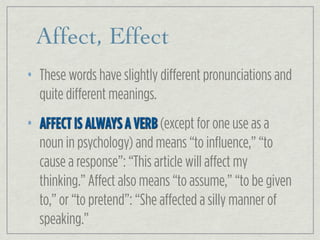
Affect, Effect
• These words have slightly different pronunciations and
quite different meanings.
• AFFECT IS ALWAYS A VERB (except for one use as a
noun in psychology) and means “to influence,” “to
cause a response”: “This article will affect my
thinking.” Affect also means “to assume,” “to be given
to,” or “to pretend”: “She affected a silly manner of
speaking.”
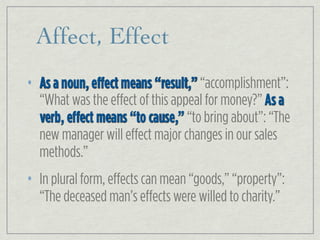
Affect, Effect
• As a noun, effect means “result,” “accomplishment”:
“What was the effect of this appeal for money?” As a
verb, effect means “to cause,” “to bring about”: “The
new manager will effect major changes in our sales
methods.”
• In plural form, effects can mean “goods,” “property”:
“The deceased man’s effects were willed to charity.”
Afterward
• Not afterwards.
All right
• Two words.
• Not alright.
Allude, elude
• To allude to something is to refer obliquely to it, a
veiled reference.
• You elude people who are chasing you.
Annual
• Nothing is annual the first time.
Averse, adverse
• If you are averse to something, you oppose it.
• Adverse is an adjective: “We work under adverse
conditions.”
Couple of
• You need the of.
Demolish, destroy
• Both mean to eliminate something, not to damage it.
Drown
• People drown. If they are drowned, we have a
homicide. Someone must have drowned them.
Due to, because of
• Don’t say, “The game was canceled due to rain.”
Say, “The game was canceled because of rain.”
Or “The cancellation was due to rain.”
Either
• It means one or the other, not both.
• Wrong: “The teams lined up on either side of the
field.”
• Right: “One team lined up on each side of the field.” or
“The teams lined up on both sides of the field.”
Funeral service
• Redundant. A funeral is a service.
Heads
• A person does not head up an organization.
He or she just heads it.
Hopefully
• An adverb, it historically means “in a hopeful manner,”
not “I hope.”
• Do not begin a sentence with hopefully.
“I Think”
• Wordy. Take it off the beginning of quotes.
Imply, infer
• A speaker or writer implies; listeners or readers infer.
Its, It’s
• Its, like his and hers and ours, is a possessive pronoun.
It has no apostrophe.
• It’s is a contraction for it is.
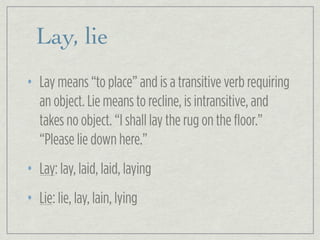
Lay, lie
• Lay means “to place” and is a transitive verb requiring
an object. Lie means to recline, is intransitive, and
takes no object. “I shall lay the rug on the floor.”
“Please lie down here.”
• Lay: lay, laid, laid, laying
• Lie: lie, lay, lain, lying
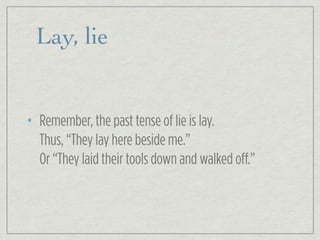
Lay, lie
• Remember, the past tense of lie is lay.
Thus, “They lay here beside me.”
Or “They laid their tools down and walked off.”
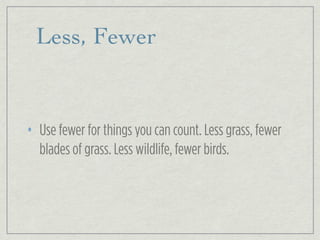
Less, Fewer
• Use fewer for things you can count. Less grass, fewer
blades of grass. Less wildlife, fewer birds.
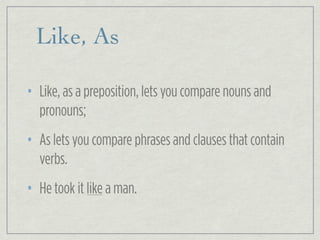
Like, As
• Like, as a preposition, lets you compare nouns and
pronouns;
• As lets you compare phrases and clauses that contain
verbs.
• He took it like a man.
Over, More Than
• Use more than with figures.
• Let over refer to space.
Principle, Principal
• The principal, our pal, is the chief administrator of a
school; it can also be an adjective as in “the principal
reasons.”
• A principle is a guiding rule.
Reluctant, Reticent
• People who don’t want to act are reluctant.
• If they don’t want to speak, they are reticent.
Temperature
• Temperature can get higher or lower, but not warmer
or colder.
• Weather gets warmer or colder.
That, Which
• Use which when what is introduced is not essential to
the meaning of the sentence (tangential thoughts).
Use that when what is introduced is essential to the
meaning of the sentence.
• Which introduces a clause set off by commas,
parentheses or dashes.
Who, Whom	

• Whom is the object.
BY BRADLEY WILSON, PH.D.
BRADLEYWILSON08@GMAIL.COM
BRADLEYWILSONONLINE.NET
TWITTER: BRADLEYWILSON09
PHOTO BY KEVIN NIBUR

Problems2

  • 1.
    More common problems By Bradley Wilson,Ph.D. With thanks to Martin “Red” Gibson
  • 2.
    Affect, Effect • Thesewords have slightly different pronunciations and quite different meanings. • AFFECT IS ALWAYS A VERB (except for one use as a noun in psychology) and means “to influence,” “to cause a response”: “This article will affect my thinking.” Affect also means “to assume,” “to be given to,” or “to pretend”: “She affected a silly manner of speaking.”
  • 3.
    Affect, Effect • Asa noun, effect means “result,” “accomplishment”: “What was the effect of this appeal for money?” As a verb, effect means “to cause,” “to bring about”: “The new manager will effect major changes in our sales methods.” • In plural form, effects can mean “goods,” “property”: “The deceased man’s effects were willed to charity.”
  • 4.
  • 5.
    All right • Twowords. • Not alright.
  • 6.
    Allude, elude • Toallude to something is to refer obliquely to it, a veiled reference. • You elude people who are chasing you.
  • 7.
    Annual • Nothing isannual the first time.
  • 8.
    Averse, adverse • Ifyou are averse to something, you oppose it. • Adverse is an adjective: “We work under adverse conditions.”
  • 9.
    Couple of • Youneed the of.
  • 10.
    Demolish, destroy • Bothmean to eliminate something, not to damage it.
  • 11.
    Drown • People drown.If they are drowned, we have a homicide. Someone must have drowned them.
  • 12.
    Due to, becauseof • Don’t say, “The game was canceled due to rain.” Say, “The game was canceled because of rain.” Or “The cancellation was due to rain.”
  • 13.
    Either • It meansone or the other, not both. • Wrong: “The teams lined up on either side of the field.” • Right: “One team lined up on each side of the field.” or “The teams lined up on both sides of the field.”
  • 14.
    Funeral service • Redundant.A funeral is a service.
  • 15.
    Heads • A persondoes not head up an organization. He or she just heads it.
  • 16.
    Hopefully • An adverb,it historically means “in a hopeful manner,” not “I hope.” • Do not begin a sentence with hopefully.
  • 17.
    “I Think” • Wordy.Take it off the beginning of quotes.
  • 18.
    Imply, infer • Aspeaker or writer implies; listeners or readers infer.
  • 19.
    Its, It’s • Its,like his and hers and ours, is a possessive pronoun. It has no apostrophe. • It’s is a contraction for it is.
  • 20.
    Lay, lie • Laymeans “to place” and is a transitive verb requiring an object. Lie means to recline, is intransitive, and takes no object. “I shall lay the rug on the floor.” “Please lie down here.” • Lay: lay, laid, laid, laying • Lie: lie, lay, lain, lying
  • 21.
    Lay, lie • Remember,the past tense of lie is lay. Thus, “They lay here beside me.” Or “They laid their tools down and walked off.”
  • 22.
    Less, Fewer • Usefewer for things you can count. Less grass, fewer blades of grass. Less wildlife, fewer birds.
  • 23.
    Like, As • Like,as a preposition, lets you compare nouns and pronouns; • As lets you compare phrases and clauses that contain verbs. • He took it like a man.
  • 24.
    Over, More Than •Use more than with figures. • Let over refer to space.
  • 25.
    Principle, Principal • Theprincipal, our pal, is the chief administrator of a school; it can also be an adjective as in “the principal reasons.” • A principle is a guiding rule.
  • 26.
    Reluctant, Reticent • Peoplewho don’t want to act are reluctant. • If they don’t want to speak, they are reticent.
  • 27.
    Temperature • Temperature canget higher or lower, but not warmer or colder. • Weather gets warmer or colder.
  • 28.
    That, Which • Usewhich when what is introduced is not essential to the meaning of the sentence (tangential thoughts). Use that when what is introduced is essential to the meaning of the sentence. • Which introduces a clause set off by commas, parentheses or dashes.
  • 29.
    Who, Whom • Whomis the object.
  • 30.
    BY BRADLEY WILSON,PH.D. BRADLEYWILSON08@GMAIL.COM BRADLEYWILSONONLINE.NET TWITTER: BRADLEYWILSON09 PHOTO BY KEVIN NIBUR