UNIVERSIDAD CENTRAL DEL ECUADOR FACULTAD DE FILOSOFIA CIENCIAS Y LETRAS DE LA EDUCACION ESCUELA DE IDIOMAS PRESENT PERFECT vs SIMPLE PAST KAREN CHAVEZ 5TO SEMESTRE
PRESENT PERFECT vs SIMPLE PAST The use of Simple Past and Present Perfect is quite strict. As soon as a time expression in the past is given, you have to use Simple Past.
If there are no signal words, you must decide if we just talk about an action in the past or if its consequence in the present is important, and you have to use Present Perfect.
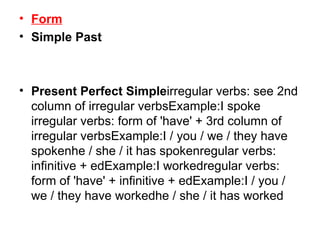
Form Simple Past Present Perfect Simple irregular verbs: see 2nd column of irregular verbsExample:I spoke irregular verbs: form of 'have' + 3rd column of irregular verbsExample:I / you / we / they have spokenhe / she / it has spokenregular verbs: infinitive + edExample:I workedregular verbs: form of 'have' + infinitive + edExample:I / you / we / they have workedhe / she / it has worked
The Simple Past   is used to talk about an action or a situation or an event that happens in the past and is completely finished in the past and dated I lived in France for ten years. (Simple Past, action finished because now I live in Ecuador.
The Present Perfect   it's used for an event that take place in the past but is still in progress in the present or have an effect on the present. I have eaten all the cake. (It is one action in the past, and the result is there is no more cake, so Present Perfect).
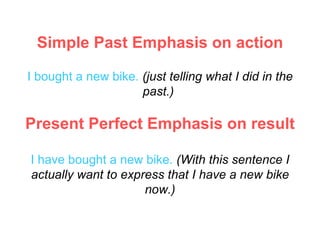
Simple Past  Emphasis on action I   bought a new bike.   (just telling what I did in the past.)  Present Perfect  Emphasis on result I have bought a new bike.   (With this sentence I actually want to express that I have a new bike now.)
Presente Perfect With yet, already, ever, before, always, the superlative and only. Do you want to express that an action happened at a certain time in the past (even if it was just a few seconds ago) or that an action has  just  /  already  /  not yet  happened? Use  yet  at the end of questions to ask about recent experiences. Have you seen the Great Wall  yet ? Has she tried Korean food  yet ?
Use  already  in affirmative statements and  yet  in negative statements I`ve  already  tried sushi, but I haven`t tried Indian food  yet .
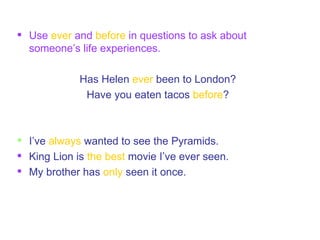
Use  ever  and  before  in questions to ask about someone’s life experiences. Has Helen  ever  been to London? Have you eaten tacos  before ? I’ve   always  wanted to see the Pyramids. King Lion is   the best  movie I’ve ever seen. My brother has   only  seen it once.
EXAMPLE I ate all the cake - Simple Past (completed action). I have eaten all the cake - Present Perfect(completed action).
In both case the cake is your stomack but, in Simple Past tense the writer of sentence don't want to show a difference between the past and the present. With the Present Perfect tense the writter wants to show us the result of the action.(to insist of the fact-there is no more cake).
Certain event in the past or how often so far? Do you want to express when a certain action took place or whether / how often an action has happened till now? Simple PastPresent Perfect Simple certain event in the past   Example:  He went to Canada last summer. whether / how often till now   Example:  Have you ever been to Canada? / I have been to Canada twice.
THANKS!!!!!

Presente perfect kat

  • 1.
    UNIVERSIDAD CENTRAL DELECUADOR FACULTAD DE FILOSOFIA CIENCIAS Y LETRAS DE LA EDUCACION ESCUELA DE IDIOMAS PRESENT PERFECT vs SIMPLE PAST KAREN CHAVEZ 5TO SEMESTRE
  • 2.
    PRESENT PERFECT vsSIMPLE PAST The use of Simple Past and Present Perfect is quite strict. As soon as a time expression in the past is given, you have to use Simple Past.
  • 3.
    If there areno signal words, you must decide if we just talk about an action in the past or if its consequence in the present is important, and you have to use Present Perfect.
  • 4.
    Form Simple PastPresent Perfect Simple irregular verbs: see 2nd column of irregular verbsExample:I spoke irregular verbs: form of 'have' + 3rd column of irregular verbsExample:I / you / we / they have spokenhe / she / it has spokenregular verbs: infinitive + edExample:I workedregular verbs: form of 'have' + infinitive + edExample:I / you / we / they have workedhe / she / it has worked
  • 5.
    The Simple Past is used to talk about an action or a situation or an event that happens in the past and is completely finished in the past and dated I lived in France for ten years. (Simple Past, action finished because now I live in Ecuador.
  • 6.
    The Present Perfect it's used for an event that take place in the past but is still in progress in the present or have an effect on the present. I have eaten all the cake. (It is one action in the past, and the result is there is no more cake, so Present Perfect).
  • 7.
    Simple Past Emphasis on action I bought a new bike. (just telling what I did in the past.) Present Perfect Emphasis on result I have bought a new bike. (With this sentence I actually want to express that I have a new bike now.)
  • 8.
    Presente Perfect Withyet, already, ever, before, always, the superlative and only. Do you want to express that an action happened at a certain time in the past (even if it was just a few seconds ago) or that an action has just / already / not yet happened? Use yet at the end of questions to ask about recent experiences. Have you seen the Great Wall yet ? Has she tried Korean food yet ?
  • 9.
    Use already in affirmative statements and yet in negative statements I`ve already tried sushi, but I haven`t tried Indian food yet .
  • 10.
    Use ever and before in questions to ask about someone’s life experiences. Has Helen ever been to London? Have you eaten tacos before ? I’ve always wanted to see the Pyramids. King Lion is the best movie I’ve ever seen. My brother has only seen it once.
  • 11.
    EXAMPLE I ateall the cake - Simple Past (completed action). I have eaten all the cake - Present Perfect(completed action).
  • 12.
    In both casethe cake is your stomack but, in Simple Past tense the writer of sentence don't want to show a difference between the past and the present. With the Present Perfect tense the writter wants to show us the result of the action.(to insist of the fact-there is no more cake).
  • 13.
    Certain event inthe past or how often so far? Do you want to express when a certain action took place or whether / how often an action has happened till now? Simple PastPresent Perfect Simple certain event in the past Example: He went to Canada last summer. whether / how often till now Example: Have you ever been to Canada? / I have been to Canada twice.
  • 14.