Mastering six troublesome
verbs

Why are these verbs troublesome?
Lie / Lay
Sit / Set
Rise / Raise
Review A
Review B
Why are these verbs
troublesome?

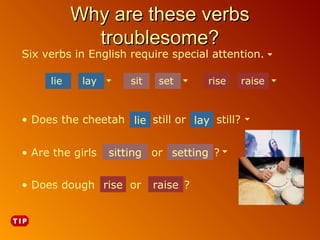
Six verbs in English require special attention.
lie

lay

sit

set

rise

• Does the cheetah lie still or lay still?
• Are the girls

sitting or setting ?

• Does dough rise or

raise ?

raise
Why are these verbs
troublesome? to ask …
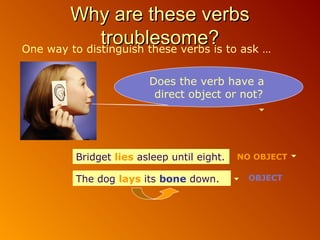
One way to distinguish these verbs is
Does the verb have a
direct object or not?

Bridget lies asleep until eight.
bone down.
The dog lays its bone down.

NO OBJECT
OBJECT
Lie / Lay

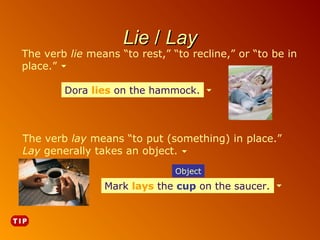
The verb lie means “to rest,” “to recline,” or “to be in
place.”
Dora lies on the hammock.

The verb lay means “to put (something) in place.”
Lay generally takes an object.
Object

Mark lays the cup on the saucer.
cup on the saucer.
Lie / Lay
Principal Parts of Lie and Lay

Principal Parts of Lie and Lay

Base
Form
lie
lay
lay

Present
Participle
[is] lying

Past
lay
lay

Past
Participle
[have] lain

[is] laying

laid

[have] laid

These verbs are easy to confuse because the past
form of lie is also lay.
BASE FORM
OF LAY

Could you lay this box on the shelf?

PAST FORM
OF LIE

The cat lay on the sofa until I shooed it off.
Lie / Lay

Principal Parts of Lie and Lay
Base
Form

Present
Participle

Past

Past
Participle

lie

[is] lying

lay

[is] laying

lay
laid
laid

[have] lain
[have] lain
[have] laid
[have] laid

Notice that the past participle of lie is [have] lain.
This coin has lain in the earth for two millennia.

The past and past participle forms of lay are laid and
[have] laid.
I have laid my change on the counter.
Dad laid the blanket across his lap.
Lie / Lay
On Your Own
Give the correct form of lie or lay in the blank for each of the
following sentences.

1. Robert will ______ down for a nap.
2. Please ______ your wet towel on the dryer.
3. My sister has ______ on the ground to watch ants.
4. Who ______ this rake where someone could step on it?
5. A snake was ______ across the trail, sunning itself.

[End of Section]
Sit / Set

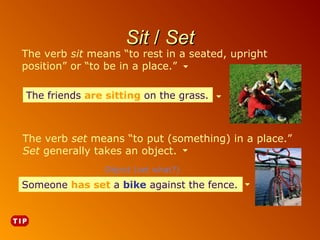
The verb sit means “to rest in a seated, upright
position” or “to be in a place.”
The friends are sitting on the grass.

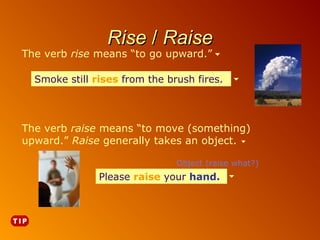
The verb set means “to put (something) in a place.”
Set generally takes an object.
Object (set what?)

Someone has set a bike against the fence.
bike against the fence.
Sit / Set

Principal Parts of Sit and Set
Base
Form

Present
Participle

Past

Past
Participle

sit

[is] sitting

set

[is] setting

sat
set

[have] sat
[have] sat
[have] set
[have] set

The past and past participle forms of sit are sat.
Before then I was no at a desk.
Because therehad sat room, I sat on the floor.

The past and past participle forms of set are set and
[have] set.
Mary forgot where she had set her keys.
The mail carrier set a package on the front step.
Sit / Set
On Your Own
Give the correct form of sit or set in the blank for each of the
following sentences.

1. Please ______ here, Mrs. Brown.
2. Did you ______ the dough in a warm place?
3. At the concert, Keith ______ near Isabelle.
4. Someone ______ a hot iron on my shirt!
5. We had ______ still for almost an hour.

[End of Section]
Rise / Raise

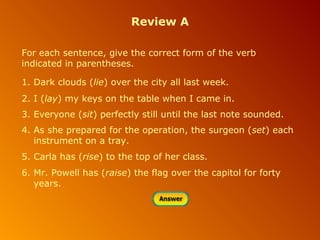
The verb rise means “to go upward.”

Smoke still rises from the brush fires.

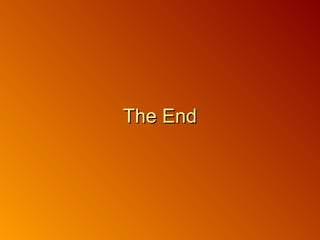
The verb raise means “to move (something)
upward.” Raise generally takes an object.
Object (raise what?)

Please raise your hand.
hand.
Rise / Raise

Principal Parts of Rise and Raise
Base
Form

Present
Participle

Past

Past
Participle

rise

[is] rising

raise

[is] raising

rose
rose
raised
raised

risen
[have] risen
[have] raised
[have] raised

The past and past participle forms of rise are rose
and [have] risen.
It had risen earlier today.
The sun roseby the time I woke up.

The past and past participle forms of raise are raised
and [have] raised.
The firefightershave raised their tail the truck.
Both peacocks raised a ladder from feathers.
Rise / Raise
On Your Own

Give the correct form of rise or raise in the blank for
each of the following sentences.
1. ______ your hand if you need more time.
2. The fans will ______ for the national anthem.
3. Fireworks ______ and exploded overhead.
4. The children ______ their flag for Cinco de Mayo.
5. The plane has ______ into the clouds.
[End of Section]
Review A
For each sentence, give the correct form of the verb
indicated in parentheses.
1. Dark clouds (lie) over the city all last week.
2. I (lay) my keys on the table when I came in.
3. Everyone (sit) perfectly still until the last note sounded.
4. As she prepared for the operation, the surgeon (set) each
instrument on a tray.
5. Carla has (rise) to the top of her class.
6. Mr. Powell has (raise) the flag over the capitol for forty
years.
Review B
If a verb in one of the following sentences is incorrect, write
the correct form. If it is already correct, write C.
1. The cattle were lying in the shade by the stream.
2. An owl was setting on a branch, watching us closely.
3. Do you think the temperature will raise much higher?
4. Why don’t you lie those things down?
5. The captain of the damaged ship rose a distress signal.

[End of Section]
The End

Troublesome verbs

  • 1.
    Mastering six troublesome verbs Whyare these verbs troublesome? Lie / Lay Sit / Set Rise / Raise Review A Review B
  • 2.
    Why are theseverbs troublesome? Six verbs in English require special attention. lie lay sit set rise • Does the cheetah lie still or lay still? • Are the girls sitting or setting ? • Does dough rise or raise ? raise
  • 3.
    Why are theseverbs troublesome? to ask … One way to distinguish these verbs is Does the verb have a direct object or not? Bridget lies asleep until eight. bone down. The dog lays its bone down. NO OBJECT OBJECT
  • 4.
    Lie / Lay Theverb lie means “to rest,” “to recline,” or “to be in place.” Dora lies on the hammock. The verb lay means “to put (something) in place.” Lay generally takes an object. Object Mark lays the cup on the saucer. cup on the saucer.
  • 5.
    Lie / Lay PrincipalParts of Lie and Lay Principal Parts of Lie and Lay Base Form lie lay lay Present Participle [is] lying Past lay lay Past Participle [have] lain [is] laying laid [have] laid These verbs are easy to confuse because the past form of lie is also lay. BASE FORM OF LAY Could you lay this box on the shelf? PAST FORM OF LIE The cat lay on the sofa until I shooed it off.
  • 6.
    Lie / Lay PrincipalParts of Lie and Lay Base Form Present Participle Past Past Participle lie [is] lying lay [is] laying lay laid laid [have] lain [have] lain [have] laid [have] laid Notice that the past participle of lie is [have] lain. This coin has lain in the earth for two millennia. The past and past participle forms of lay are laid and [have] laid. I have laid my change on the counter. Dad laid the blanket across his lap.
  • 7.
    Lie / Lay OnYour Own Give the correct form of lie or lay in the blank for each of the following sentences. 1. Robert will ______ down for a nap. 2. Please ______ your wet towel on the dryer. 3. My sister has ______ on the ground to watch ants. 4. Who ______ this rake where someone could step on it? 5. A snake was ______ across the trail, sunning itself. [End of Section]
  • 8.
    Sit / Set Theverb sit means “to rest in a seated, upright position” or “to be in a place.” The friends are sitting on the grass. The verb set means “to put (something) in a place.” Set generally takes an object. Object (set what?) Someone has set a bike against the fence. bike against the fence.
  • 9.
    Sit / Set PrincipalParts of Sit and Set Base Form Present Participle Past Past Participle sit [is] sitting set [is] setting sat set [have] sat [have] sat [have] set [have] set The past and past participle forms of sit are sat. Before then I was no at a desk. Because therehad sat room, I sat on the floor. The past and past participle forms of set are set and [have] set. Mary forgot where she had set her keys. The mail carrier set a package on the front step.
  • 10.
    Sit / Set OnYour Own Give the correct form of sit or set in the blank for each of the following sentences. 1. Please ______ here, Mrs. Brown. 2. Did you ______ the dough in a warm place? 3. At the concert, Keith ______ near Isabelle. 4. Someone ______ a hot iron on my shirt! 5. We had ______ still for almost an hour. [End of Section]
  • 11.
    Rise / Raise Theverb rise means “to go upward.” Smoke still rises from the brush fires. The verb raise means “to move (something) upward.” Raise generally takes an object. Object (raise what?) Please raise your hand. hand.
  • 12.
    Rise / Raise PrincipalParts of Rise and Raise Base Form Present Participle Past Past Participle rise [is] rising raise [is] raising rose rose raised raised risen [have] risen [have] raised [have] raised The past and past participle forms of rise are rose and [have] risen. It had risen earlier today. The sun roseby the time I woke up. The past and past participle forms of raise are raised and [have] raised. The firefightershave raised their tail the truck. Both peacocks raised a ladder from feathers.
  • 13.
    Rise / Raise OnYour Own Give the correct form of rise or raise in the blank for each of the following sentences. 1. ______ your hand if you need more time. 2. The fans will ______ for the national anthem. 3. Fireworks ______ and exploded overhead. 4. The children ______ their flag for Cinco de Mayo. 5. The plane has ______ into the clouds. [End of Section]
  • 14.
    Review A For eachsentence, give the correct form of the verb indicated in parentheses. 1. Dark clouds (lie) over the city all last week. 2. I (lay) my keys on the table when I came in. 3. Everyone (sit) perfectly still until the last note sounded. 4. As she prepared for the operation, the surgeon (set) each instrument on a tray. 5. Carla has (rise) to the top of her class. 6. Mr. Powell has (raise) the flag over the capitol for forty years.
  • 15.
    Review B If averb in one of the following sentences is incorrect, write the correct form. If it is already correct, write C. 1. The cattle were lying in the shade by the stream. 2. An owl was setting on a branch, watching us closely. 3. Do you think the temperature will raise much higher? 4. Why don’t you lie those things down? 5. The captain of the damaged ship rose a distress signal. [End of Section]
  • 16.