Building an Argument
Let’s have fun with an outrageous
claim.
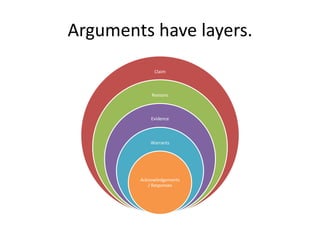
Arguments have layers.
Claim
Reasons
Evidence
Warrants
Acknowledgements
/ Responses
Claim
What do you think?
• Your response becomes
your thesis and includes
– Topic
– Stance / Opinion
Until we really understand
climate and how it works
in relation to the
Earth, we can not accept
global warming as truth.
Qualifications for Claim
Until we really understand
climate and how it works in
relation to the Earth, we can
not accept global warming as
truth.
• Is this claim contestable?
• Does this claim declare
something?
• Is this claim supportable with
evidence?
• Does it pass the reversible
test?
• Is the claim laid out well?
Reasons
Why do you think that?
1. There are numerous examples of both
cooler and warmer areas on Earth.
2. There are a number of natural
phenomenon that happen regularly that
can cause cooling (El Nino, volcanic
eruptions).
3. There are effects beyond our own
atmosphere that control climate (solar
flares).
4. There are natural cooling and warming
periods on Earth – both mini and long
term.
5. We do not have enough detailed data
on climate history to say how much
effect our activity has on our climate.
Qualifications for Reasons
• Do your reasons explain
why you think the
audience should accept
your claim?
• Do they represent
judgments not shared
by your audience?
• Do your reasons rest on
evidence?
Evidence
How do you know that’s true?
• There is that show mini
warming and cooling trends
lasting years – recent and
last two centuries.
• The Little Ice Age
• Medieval Warm Period.
• Solar flares and weather
effects.
• Mount Pinatubo and other
volcanoes
Qualifications for Evidence
• Could it be looked up?
• Is the evidence not contestable (at least for
the time being)?
• Is it comprised of representations of states of
affairs that are treated as facts?
• How closely do you need to match your
readers’ expectations?
• How strongly will your readers resist your
claim –will your evidence need to be
stronger if they will be more resistant? Along
with that, how fully do you expect your
readers to accept your claim?
• The four maxims of quality evidence
1. Is it accurate?
2. Is your reporting of evidence accurate
enough?
3. Is your evidence representative?
4. Are you using reliable sources?
Warrants
Why do the reasons and evidence
support the claims?
• My evidence shows that there
are changes in the patterns
throughout recorded history
that we have thoroughly
explained.
• This information shows there
is a lot we do not know about
climate.
• Until we understand it
better, we can’t know exactly
how much impact human
activity has on climate change.
Qualifications for Warrants
• Does is assert a logical connection
between your reason/evidence and
your claim?
• Does the warrant include both your
reason and your evidence?
• Can it be assumed, or does it need
stating?
Warrants Checklist:
1. What is your warrant?
2. Is it true?
3. Are your specific reasons/claims
legit examples of your warrant?
i.e. does your reason match your
warrant, and does your claim
match your warrant
Acknowledgements / Responses
What about alternative views or contrary
evidence?
• There are recording setting high
temperatures in many places
recently.
• WE have had higher temperature
trends in recent years in many places
worldwide.
• There are some extreme weather
patterns that include melting of ice
caps and droughts in unusual places.
• There is increased human activity
where we know pollution is being put
out at increasing amounts. It must
have a negative impact.
Qualifications for Acknowledgements
& Responses
• Acknowledgements:
– Raise alternative
views, reasons, claims, warra
nts
– Show how an argument can
be located amongst a field of
other arguments
– Give a nod to possible
concerns you think your
audience may have with the
argument
• Responses:
– Accept or reject an
acknowledged alternative or
explain problems within your
own argument.
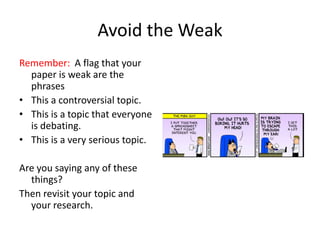
Avoid the Weak
Remember: A flag that your
paper is weak are the
phrases
• This a controversial topic.
• This is a topic that everyone
is debating.
• This is a very serious topic.
Are you saying any of these
things?
Then revisit your topic and
your research.

Building an Argument

  • 1.
    Building an Argument Let’shave fun with an outrageous claim.
  • 2.
  • 3.
    Claim What do youthink? • Your response becomes your thesis and includes – Topic – Stance / Opinion Until we really understand climate and how it works in relation to the Earth, we can not accept global warming as truth.
  • 4.
    Qualifications for Claim Untilwe really understand climate and how it works in relation to the Earth, we can not accept global warming as truth. • Is this claim contestable? • Does this claim declare something? • Is this claim supportable with evidence? • Does it pass the reversible test? • Is the claim laid out well?
  • 5.
    Reasons Why do youthink that? 1. There are numerous examples of both cooler and warmer areas on Earth. 2. There are a number of natural phenomenon that happen regularly that can cause cooling (El Nino, volcanic eruptions). 3. There are effects beyond our own atmosphere that control climate (solar flares). 4. There are natural cooling and warming periods on Earth – both mini and long term. 5. We do not have enough detailed data on climate history to say how much effect our activity has on our climate.
  • 6.
    Qualifications for Reasons •Do your reasons explain why you think the audience should accept your claim? • Do they represent judgments not shared by your audience? • Do your reasons rest on evidence?
  • 7.
    Evidence How do youknow that’s true? • There is that show mini warming and cooling trends lasting years – recent and last two centuries. • The Little Ice Age • Medieval Warm Period. • Solar flares and weather effects. • Mount Pinatubo and other volcanoes
  • 8.
    Qualifications for Evidence •Could it be looked up? • Is the evidence not contestable (at least for the time being)? • Is it comprised of representations of states of affairs that are treated as facts? • How closely do you need to match your readers’ expectations? • How strongly will your readers resist your claim –will your evidence need to be stronger if they will be more resistant? Along with that, how fully do you expect your readers to accept your claim? • The four maxims of quality evidence 1. Is it accurate? 2. Is your reporting of evidence accurate enough? 3. Is your evidence representative? 4. Are you using reliable sources?
  • 9.
    Warrants Why do thereasons and evidence support the claims? • My evidence shows that there are changes in the patterns throughout recorded history that we have thoroughly explained. • This information shows there is a lot we do not know about climate. • Until we understand it better, we can’t know exactly how much impact human activity has on climate change.
  • 10.
    Qualifications for Warrants •Does is assert a logical connection between your reason/evidence and your claim? • Does the warrant include both your reason and your evidence? • Can it be assumed, or does it need stating? Warrants Checklist: 1. What is your warrant? 2. Is it true? 3. Are your specific reasons/claims legit examples of your warrant? i.e. does your reason match your warrant, and does your claim match your warrant
  • 11.
    Acknowledgements / Responses Whatabout alternative views or contrary evidence? • There are recording setting high temperatures in many places recently. • WE have had higher temperature trends in recent years in many places worldwide. • There are some extreme weather patterns that include melting of ice caps and droughts in unusual places. • There is increased human activity where we know pollution is being put out at increasing amounts. It must have a negative impact.
  • 12.
    Qualifications for Acknowledgements &Responses • Acknowledgements: – Raise alternative views, reasons, claims, warra nts – Show how an argument can be located amongst a field of other arguments – Give a nod to possible concerns you think your audience may have with the argument • Responses: – Accept or reject an acknowledged alternative or explain problems within your own argument.
  • 13.
    Avoid the Weak Remember:A flag that your paper is weak are the phrases • This a controversial topic. • This is a topic that everyone is debating. • This is a very serious topic. Are you saying any of these things? Then revisit your topic and your research.