Choosing the Appropriate Word
Commission on Higher Education
Continuing Education Program:
English Language Proficiency Program
1. Your responsible for all
the errors that have been
committed.
2. There are lots of factors
to consider.
3. She hanged her picture
on the wall.
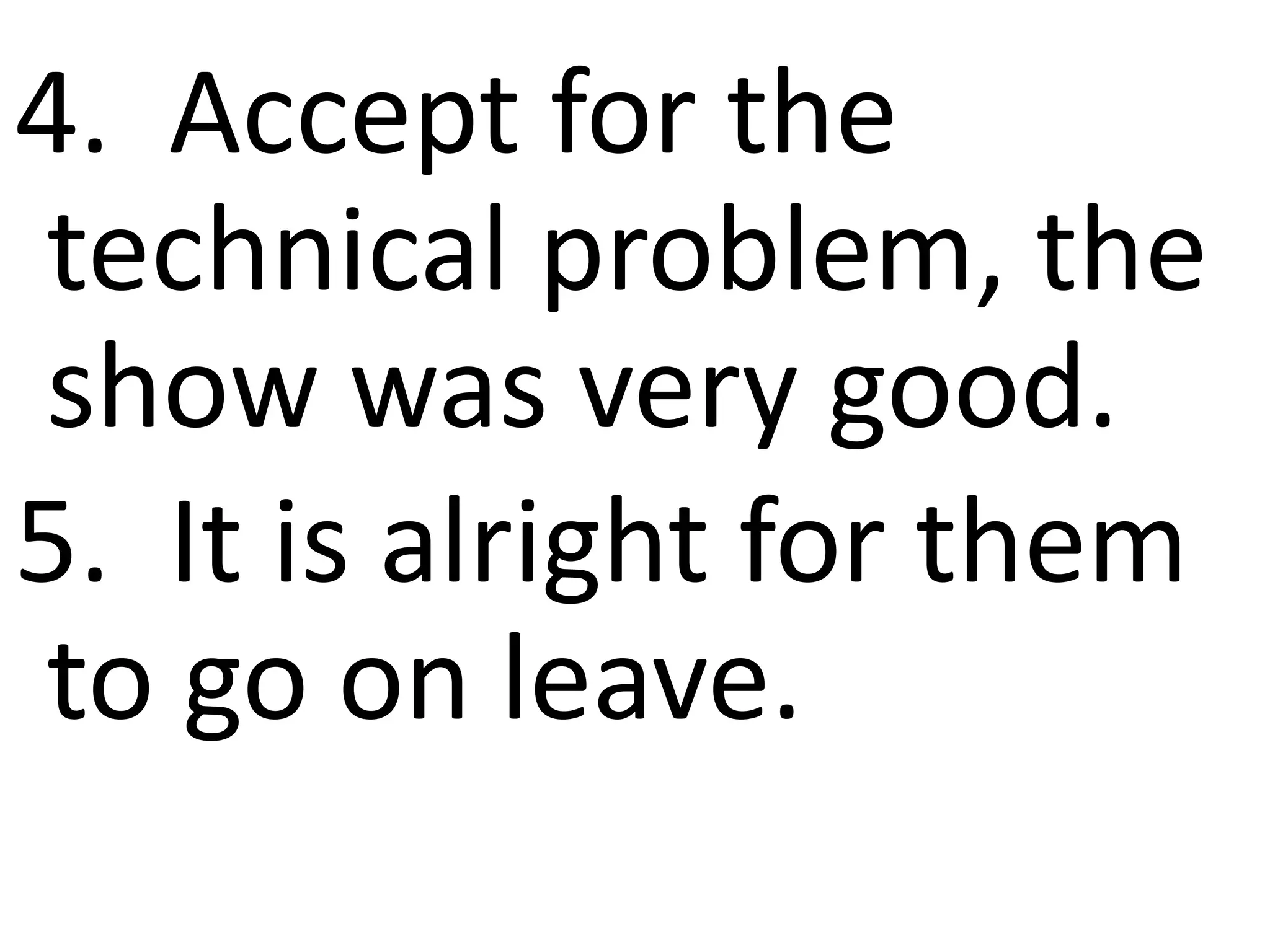
4. Accept for the
technical problem, the
show was very good.
5. It is alright for them
to go on leave.
6. Whose joining the rally tomorrow?
7. They are suppose to participate
actively in group tasks.
8. She maybe joking when she said
that.
9. The group left irregardless of
warnings.
10. The reason why it failed was because
they did not work as team.
11. Based on their reactions, they seemed
disinterested.
12. The imminent professor was awarded
the Nobel prize.
13. His pair of pants is very lose.
14. The teacher will discuss farther the
lesson next week.
15. Between the two options, the later is
more attractive.
16. The woman was quiet big when I
first saw her a year ago.
17. The two friends shared secrets
with one another.
18. Its so sweet.
19. The former president is known for
fighting for her principals.
20. The manager laid off some
personal.
Examples of troublesome words and
expressions
Accept Except
Accept is a verb
meaning “to
approve” or “to
receive”.
Ex: The gifted child
accepted a donation
from a generous
parent.
Except is usually a
preposition meaning
“not including.”
Ex: All faculty
members were
promoted except the
new ones.
Adapt Adopt
Adapt means “to
accommodate” or
“to adjust to
conditions”.
Ex: The class had a
hard time adapting
to the substitute
teacher.
Adopt means “to
accept” or “to use as
one’s own.”
Ex: The childless
couple adopted a
beautiful baby girl.
Advise Advice
Advise is a verb meaning
“to give advice.”
Ex: The Dean advised
the teacher against
taking a leave of
absence.
Advice is a noun
meaning “helpful
suggestion,
recommendation or
counsel”.
Ex: The girl sought
advice from the priest.
Affect Effect
Affect is a verb meaning
”to influence”
Ex: His family problems
have affected his work
performance.
Effect is usually a noun
meaning “a result or
consequence.”
Ex: The serious effects of
environmental
degradation are
unimaginable.
All ready Already
All ready means that
everyone is ready.
Ex: The children are all
ready for the evaluation
next week.
Already means
“previously” or “by this
time”.
Ex: Gordon has already
settled his account.
All together Altogether
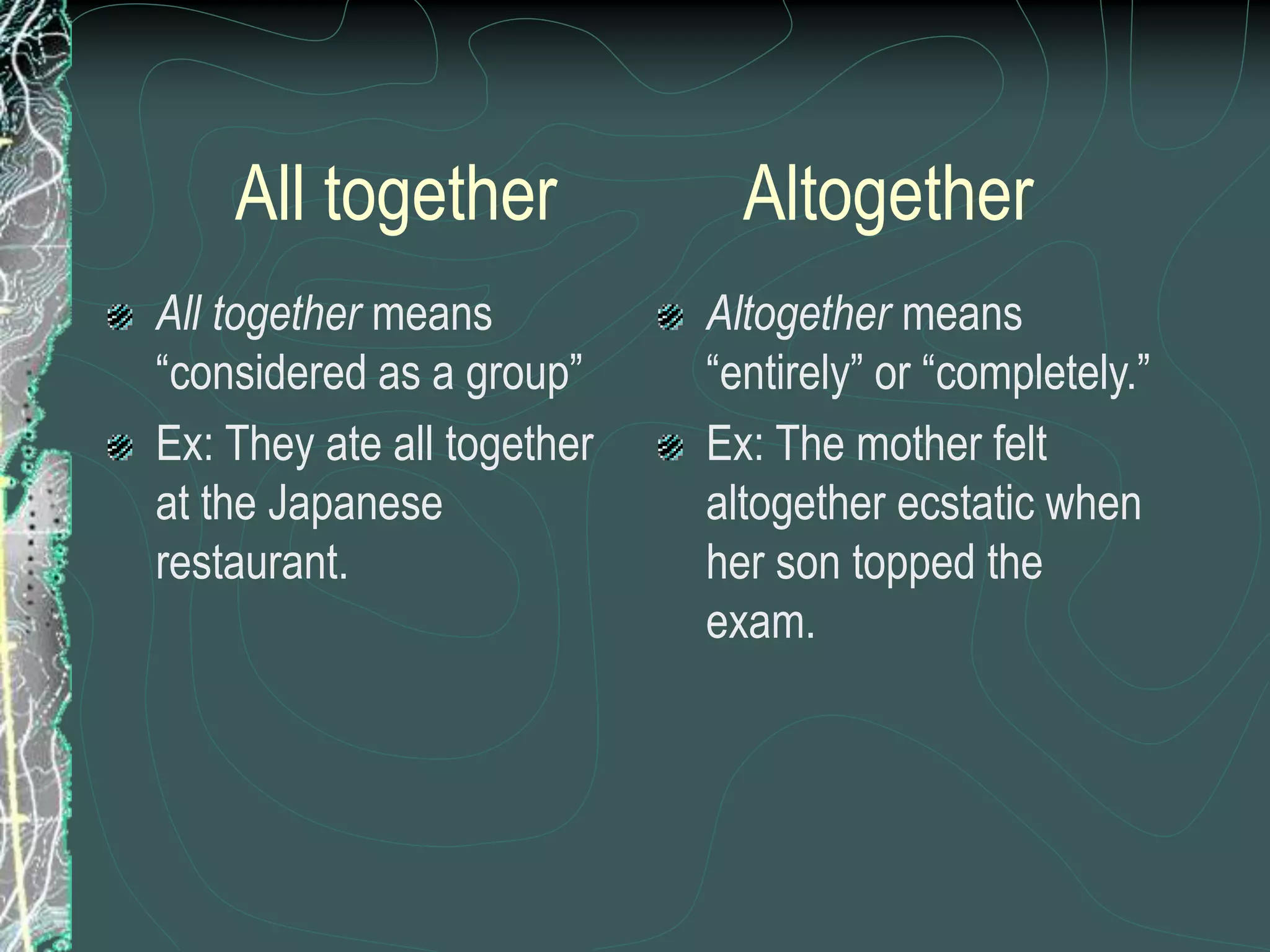
All together means
“considered as a group”
Ex: They ate all together
at the Japanese
restaurant.
Altogether means
“entirely” or “completely.”
Ex: The mother felt
altogether ecstatic when
her son topped the
exam.
Allusion Illusion
An allusion is an indirect
reference to something
Ex: In her essay, she
made an allusion to the
1987 Constitution.
An illusion is a false
perception or unreal
impression of something.
Ex: It is believed that a
magician’s trick is just an
illusion.
A lot (of), lots (of), alot
A lot or lots are colloquial for many or much.
Alot is a misspelling of a lot.
Ex:
His godfather gave him lots of money last
Christmas. (Colloquial)
His godfather gave him much money last
Christmas. (Formal)
Our math teacher has given us a lot of
assignments. (Colloquial)
Our math teacher has given us many
assignments. (Formal)
Allot
Allot means “to appropriate, assign, or distribute
according to a plan.”
Ex:
Congress allotted twenty million pesos for
infrastructure.
Alright
Nonstandard for all right
Do not use.
Anyone Any one
Anyone is an indefinite
pronoun meaning “any
person”.
Ex: Anyone can ask the
speaker questions about
the lecture.
Any one means “a single
person or thing.”
Ex: You are required to
answer any one of the
questions.
Awhile a while
Awhile is an adverb.
Ex: We stayed awhile in
my sister’s house.
Use a while (a noun) as
the object of a
preposition.
Ex:
The exam lasted for
awhile. (Nonstandard)
The exam lasted for a
while. (Formal)
Beside Besides
Beside is a preposition
meaning “by the side of.”
Ex: I stood beside my
dean at the convocation.
(by the side of)
Besides is a preposition
meaning “except” and an
adverb meaning “in
addition (to).”
Ex:
She thought of no one
besides him. (except)
Besides, she has what it
takes to be a star. (In
addition)
Burst, busted, bust
Burst is a verb meaning “to break apart or explode.”
Its principal parts are burst, burst, and burst.
Ex:
We were asked to bust the balloon.
(Nonstandard)
We were asked to burst the balloon. (Standard)
Cite, sight, site
Cite means “to name or mention”.
Sight means “to see”
Site means “place” or “location.”
Ex:
Writers of academic papers should cite sources of
information.
The military sighted the fugitive in a remote
province.
The site of the fastfood restaurant is beside the
university.
Coarse Course
Coarse means “rough in
texture”.
Ex:
The surface of the floor is
coarse.
Course refers to a unit of
study or a path.
Ex:
Two basic courses will be
offered next term.
Environmentalists
opposed the construction
of the golf course.
Complement Compliment
Complement means “to
complete or enhance.”
Ex:
His intelligence will
complement her
efficiency. (Verb)
For one to succeed,
discipline is a
complement for hard
work. (Noun)
Compliment means “to
express praise.”
Ex:
The students
complimented the chair
for her organizational
skills. (Verb)
Responses to
compliments may vary
across cultures. (Noun)
Continual Continuous
Continual means
“repeated frequently.”
Ex:
There was continual
laughter from the
audience during the
show.
Continuous means
“without interruption.”
Ex:
The clock ticks
continuously.
Council Counsel
Council is an noun that
refers to an assembly of
people.
Ex:
The council of deans
will meet on
Thursday. (Noun)
Counsel as a noun means
“advice or guidance,” or it
refers to an attorney.
Counsel as a verb means “to
advise” or “to give a helpful
recommendation.”
Ex:
The accused sat beside
her counsel during the
arraignment. (Noun)
The psychologist
counseled the
emotionally disturbed
person. (Verb)
DEsert Dessert
Desert as a noun with
the accent on the first
syllable means “a dry,
arid region of land.”
Desert as a noun with
the accent on the second
syllable means “a
deserved reward or
punishment.”
Dessert is a noun
meaning “sweets served
as the final course of a
meal.”
Ex:
A tray of assorted
fresh fruits makes a
great dessert.
DesErt
Desert as a verb (accent on
the second syllable) means
“to leave without any
intention to return.”
Ex:
Soldiers who desert the
military are punished
accordingly.
Device Devise
Device is a noun
meaning “a form of
equipment.”
Ex:
She bought the device in
the U.S.
Devise is a verb meaning
“to invent.”
Ex:
Jeffrey devised a plan to
motivate teachers to do
more research.
Different than Different from
Use different than when
the word than is used to
introduce a dependent
clause.
Ex:
The topics they were
told to study were
different than the
things that came out
in the exam.
More acceptable
Ex:
The teachers’ part in
the program was
entirely different from
the students’.
Disinterested Uninterested
Disinterested means
“impartial, not influenced
by personal bias.”
Ex:
A judge must be a
disinterested party in a
case.
Uninterested means “not
interested.”
Ex:
The students were
making noise because
they were uninterested in
the lecture.
Dyeing Dying
Dyeing means “imparting
color to a material.”
Ex:
He is dyeing his shirt
green.
Dying means “to cease
to be alive.”
Ex:
Pedro was beside his
grandmother when she
was dying.
Each other One another
Each other refers to two
people.
Ex:
Husband and wife should
bring out the best in each
other.
One another refers to
more than two people.
Ex:
The members of the
group helped one another
to get a high grade.
Emigrate Immigrate
Emigrate means “to
leave a country or
region.”
Ex:
Several families
emigrated from the
southern region due to
the deteriorating peace
and order situation in the
area.
Immigrate means “to
enter a country or
region.”
Ex:
Several families
immigrated to the city.
Eminent Imminent
Eminent means
“prominent in rank.”
Ex:
UN Secretary General
Kofi Annan is an eminent
person.
Imminent means “likely
to occur.”
Ex:
A coup d’etat is imminent
because of the current
political crisis.
Farther Further
Means “to a more distant
place”.
Ex:
The bus cannot go any
farther than Quezon.
Means “to a greater
extent” or “in addition”.
Ex:
She said she cannot help
him any further.
Fewer Less
Fewer refers to a number
of things.
Ex:
There were fewer
participants than we had
expected.
Less refers to an
amount.
Ex:
There is less water in the
glass.
Formally Formerly
Formally means “in a
proper form.”
Ex:
She was formally
introduced to his family.
Formerly means “at a
prior time.”
Ex:
The lady was formerly
connected with the
Accounting Division.
Hanged Hung
Use hanged as the past
tense or past participle of
hang only when it means
“an execution.”
Ex:
The criminal was hanged
in public.
In all other cases, use
hung .
Ex:
The entries in the lantern
contest were hung for
public viewing.
hisself, ourself, theirselves, themself
These are nonstandard forms of reflexive
pronouns.
Instead, use himself, ourselves, and themselves
Ex:
He has no one to blame but himself.
If Whether
Ex:
The President wanted to
know if you finished your
Ph.D.
Use whether when there
is an alternative or
choice
Ex:
My chair asked me
whether I took a service
leave or availed myself of
a sabbatical.
Imply Infer
Imply means “to
suggest.”
Making a suggestion
Ex:
The speaker implies that
there is corruption in
every agency of
government.
Infer means “to conclude
based on a suggestion.”
Drawing a conclusion
Ex:
From the given data we
can infer that the case
will not prosper.
Irregardless
Non-standard usage.
Use regardless instead.
Ex:
We should pursue our dreams regardless of the
consequences.
Its It’s
Possessive form of the
pronoun it.
Ex:
Its length is 120
centimeters.
Contraction for it is.
Ex:
It’s a wonderful day
today.
It’s me
Colloquial for it is I.
Ex:
It’s me again. (Colloquial)
It is I again. (Formal)
Kind of Sort of
Both expressions are colloquial.
Better to use somewhat or rather.
Ex:
The poor are kind of disadvantaged. (Colloquial)
The poor are somewhat disadvantaged. (Formal)
Later Latter
Later, a comparative
form of late, means “after
the due time” or “tardy.”
Ex:
She will see you later
today.
Latter is used to
compare things; it refers
to the last one
mentioned.
Ex:
Between love and career,
she chose the latter.
Lay Lie
Lay always takes an
object complement.
Lay means “to set or to
place.”
Ex:
She will lay her cards on
the table during her
meeting with the staff.
Lie never takes an
object.
Lie means to “rest.”
Ex:
He usually lies down on
the couch before dinner
time.
Loose Lose
Loose (rhymes with
moose) is the opposite of
tight.
Ex:
She always brings loose
coins when she travels.
Lose (rhymes with
shoes) means “to
remove from one’s
possession.”
Ex:
You will lose your chance
of getting a high grade.
Mad Angry
Mad means insane.
In writing, do not use
mad when the meaning
is angry.
Ex:
His teacher was mad at
him. (Colloquial)
Ex:
His teacher was angry at
him. (Formal)
Maybe May be
Maybe is an adverb that
means perhaps.
Ex:
Maybe you should see
me soon. (Adverb)
May be is a verb phrase
similar to might be.
Ex:
You may be reprimanded
for the lapse you have
committed. (Verb)
Most Almost
Do not use most when
you mean almost.
Ex:
Most all of the students
have left the school.
(Colloquial)
Almost is an adverb
meaning nearly. Most is
the superlative form of
more.
Ex:
Almost all of the students
have left the school.
(Formal)
myself (herself, himself, ourselves,
themselves, yourself)
Do not use reflexive pronouns where a personal
pronoun will fit.
Ex:
The members of the committee are Juan, Pia, and
myself. (Nonstandard)
The members of the committee are Juan, Pia, and I.
(Formal)
Passed Past
Passed (past tense of
the verb pass) refers to a
movement or successful
completion.
Ex:
The boy passed the
entrance exam given by
the prestigious school.
He passed the ball to his
teammate.
Past refers to a former
time.
As a preposition, past
means “beyond.”
Ex:
Our differences are all in
the past.
They walked past the
monument.
Personal Personnel
Personal is an adjective
meaning “private.”
Ex:
A resumé usually
includes personal data
about an applicant.
Personnel is a noun
meaning “workers” or
“employees.”
Ex:
The Director issued a
memorandum to all
personnel.
Principal Principle
Principal can be a noun (“a
leader, a chief part, or a sum
of money”) or an adjective
(“highest in rank”).
Ex:
The new high school
principal met with the
teachers.
She will pay the principal
plus interest.
Principle is a noun meaning
“a fundamental truth or law.”
Ex:
I admire people who do not
compromise their principles.
Quite Quiet
Quite (rhymes with right)
means “very.”
Ex:
The participants did quite
well in the competition.
Quiet (rhymes with diet)
means “not noisy.”
Ex:
She is looking for a quiet
place where she can
concentrate on her
review.
reason is because, reason why
The reason is because is
nonstandard usage.
Instead, use the reason is
that or just because.
Ex:
The reason I was absent is
because I was hospitalized.
(Nonstandard)
The reason I was absent is
that I was hospitalized.
(Formal)
I was absent because I was
hospitalized. (Formal)
The reason why is
redundant.
Instead, use either why or
the reason, but not both.
Ex:
You should know the reason
why I was absent. (Colloquial)
You should know why I was
absent. (Formal)
You should know the reason I
was absent. (Formal)
stationary stationery
Stationary means “fixed,
not moving.”
Ex:
The boats were in a
stationary position when
the giant waves swept
them.
Stationery is writing
paper.
Ex:
She bought two packs of
stationery at the
bookstore.
Suppose to Supposed to
Suppose to is
nonstandard.
Always use supposed to.
Ex:
We are supposed to
abide by the Constitution.
Sure Surely
Sure is an adjective.
Colloquially, sure is
sometimes used as an
adverb.
Ex:
Her siblings sure want
her to graduate this year.
(Colloquial)
Surely is an adverb.
Ex:
Her siblings surely want
her to graduate this year.
(Formal)
Than Then
Than is a conjunction used to
make comparisons.
Ex:
The lady basketball player is
taller than you.
Then is an adverb meaning
“at that time”, or it can be an
adverbial conjunction similar
to therefore.
Ex:
The teacher then moved on to
the group activities.
It rained for a whole day; then
all roads were impassable.
Their There
Their is a possessive
pronoun meaning
“belonging to them.”
Ex:
Sheila and Shirley turned
in their assignments
ahead of time.
There is an adverb
meaning the opposite of
here.
Also, there can be used
as the introductory word
of a sentence.
Ex:
I saw the cat there.
There are several
causes of air pollution.
They’re
They’re is a contraction for they are.
Ex:
They’re in Afghanistan as part of the UN
peacekeeping mission.
To Two
To is a preposition.
Ex:
He moved to Davao City
three years ago.
Two is a number.
Ex:
With her new diet she is
losing two pounds a day.
Too
Too is an adverb meaning “also” or “excessively.”
Ex:
Robert is too young to understand the current political crisis.
Toward Towards
Toward and towards are prepositions.
Either is proper as long as you are consistent.
Ex:
The snatcher headed towards a crowded area.
Then, he went towards the east.
Unique
Unique means “one of a kind” and “having no equal.”
Ex:
She loves to talk about her unique experience in Africa.
There are no degrees of uniqueness; therefore, do not
modify unique with very, more, or most.
Ex:
His African escapade was a very unique experience.
(Nonstandard)
This experience was even more unique than her Australian
tour. (Nonstandard)
His African escapade was a unique experience. (Formal)
While Whereas
While is used as a
conjunction meaning “during
the time that.”
Ex:
There was a power outage
while I was working on a
paper.
Do not use while when an
unspecified time period is
involved. Instead, use but,
whereas, or though.
Ex:
Eric is a priest while Hannah is
a nun. (Colloquial)
Eric is a priest whereas
Hannah is a nun. (Formal)
Who, which, that
Who refers to persons; which refers to things;
that refers to persons or things.
Ex:
The actor who (that) played the role of a retardate is
very convincing.
Lost in Translation, which stars Bill Murray, is a good
movie.
Whose Who’s
Whose is the possessive
form of who (“belonging
to whom”)
Ex:
Whose wallet is on the
table?
Who’s is a contraction for
who is or who has.
Ex:
Who’s going to see the
Dean tomorrow? (Who
is)
Who’s got loose coins?
(Who has)
Your You’re
Your is the possessive
form of you.
Ex:
Your proposal has been
turned down.
You’re is a contraction for
you are.
Ex:
You’re the source of
inspiration for so many
students.

Choosing-the-Appropriate-Word.ppt

  • 1.
    Choosing the AppropriateWord Commission on Higher Education Continuing Education Program: English Language Proficiency Program
  • 2.
    1. Your responsiblefor all the errors that have been committed. 2. There are lots of factors to consider. 3. She hanged her picture on the wall.
  • 3.
    4. Accept forthe technical problem, the show was very good. 5. It is alright for them to go on leave.
  • 4.
    6. Whose joiningthe rally tomorrow? 7. They are suppose to participate actively in group tasks. 8. She maybe joking when she said that. 9. The group left irregardless of warnings.
  • 5.
    10. The reasonwhy it failed was because they did not work as team. 11. Based on their reactions, they seemed disinterested. 12. The imminent professor was awarded the Nobel prize. 13. His pair of pants is very lose. 14. The teacher will discuss farther the lesson next week. 15. Between the two options, the later is more attractive.
  • 6.
    16. The womanwas quiet big when I first saw her a year ago. 17. The two friends shared secrets with one another. 18. Its so sweet. 19. The former president is known for fighting for her principals. 20. The manager laid off some personal.
  • 7.
    Examples of troublesomewords and expressions
  • 8.
    Accept Except Accept isa verb meaning “to approve” or “to receive”. Ex: The gifted child accepted a donation from a generous parent. Except is usually a preposition meaning “not including.” Ex: All faculty members were promoted except the new ones.
  • 9.
    Adapt Adopt Adapt means“to accommodate” or “to adjust to conditions”. Ex: The class had a hard time adapting to the substitute teacher. Adopt means “to accept” or “to use as one’s own.” Ex: The childless couple adopted a beautiful baby girl.
  • 10.
    Advise Advice Advise isa verb meaning “to give advice.” Ex: The Dean advised the teacher against taking a leave of absence. Advice is a noun meaning “helpful suggestion, recommendation or counsel”. Ex: The girl sought advice from the priest.
  • 11.
    Affect Effect Affect isa verb meaning ”to influence” Ex: His family problems have affected his work performance. Effect is usually a noun meaning “a result or consequence.” Ex: The serious effects of environmental degradation are unimaginable.
  • 12.
    All ready Already Allready means that everyone is ready. Ex: The children are all ready for the evaluation next week. Already means “previously” or “by this time”. Ex: Gordon has already settled his account.
  • 13.
    All together Altogether Alltogether means “considered as a group” Ex: They ate all together at the Japanese restaurant. Altogether means “entirely” or “completely.” Ex: The mother felt altogether ecstatic when her son topped the exam.
  • 14.
    Allusion Illusion An allusionis an indirect reference to something Ex: In her essay, she made an allusion to the 1987 Constitution. An illusion is a false perception or unreal impression of something. Ex: It is believed that a magician’s trick is just an illusion.
  • 15.
    A lot (of),lots (of), alot A lot or lots are colloquial for many or much. Alot is a misspelling of a lot. Ex: His godfather gave him lots of money last Christmas. (Colloquial) His godfather gave him much money last Christmas. (Formal) Our math teacher has given us a lot of assignments. (Colloquial) Our math teacher has given us many assignments. (Formal)
  • 16.
    Allot Allot means “toappropriate, assign, or distribute according to a plan.” Ex: Congress allotted twenty million pesos for infrastructure.
  • 17.
    Alright Nonstandard for allright Do not use.
  • 18.
    Anyone Any one Anyoneis an indefinite pronoun meaning “any person”. Ex: Anyone can ask the speaker questions about the lecture. Any one means “a single person or thing.” Ex: You are required to answer any one of the questions.
  • 19.
    Awhile a while Awhileis an adverb. Ex: We stayed awhile in my sister’s house. Use a while (a noun) as the object of a preposition. Ex: The exam lasted for awhile. (Nonstandard) The exam lasted for a while. (Formal)
  • 20.
    Beside Besides Beside isa preposition meaning “by the side of.” Ex: I stood beside my dean at the convocation. (by the side of) Besides is a preposition meaning “except” and an adverb meaning “in addition (to).” Ex: She thought of no one besides him. (except) Besides, she has what it takes to be a star. (In addition)
  • 21.
    Burst, busted, bust Burstis a verb meaning “to break apart or explode.” Its principal parts are burst, burst, and burst. Ex: We were asked to bust the balloon. (Nonstandard) We were asked to burst the balloon. (Standard)
  • 22.
    Cite, sight, site Citemeans “to name or mention”. Sight means “to see” Site means “place” or “location.” Ex: Writers of academic papers should cite sources of information. The military sighted the fugitive in a remote province. The site of the fastfood restaurant is beside the university.
  • 23.
    Coarse Course Coarse means“rough in texture”. Ex: The surface of the floor is coarse. Course refers to a unit of study or a path. Ex: Two basic courses will be offered next term. Environmentalists opposed the construction of the golf course.
  • 24.
    Complement Compliment Complement means“to complete or enhance.” Ex: His intelligence will complement her efficiency. (Verb) For one to succeed, discipline is a complement for hard work. (Noun) Compliment means “to express praise.” Ex: The students complimented the chair for her organizational skills. (Verb) Responses to compliments may vary across cultures. (Noun)
  • 25.
    Continual Continuous Continual means “repeatedfrequently.” Ex: There was continual laughter from the audience during the show. Continuous means “without interruption.” Ex: The clock ticks continuously.
  • 26.
    Council Counsel Council isan noun that refers to an assembly of people. Ex: The council of deans will meet on Thursday. (Noun) Counsel as a noun means “advice or guidance,” or it refers to an attorney. Counsel as a verb means “to advise” or “to give a helpful recommendation.” Ex: The accused sat beside her counsel during the arraignment. (Noun) The psychologist counseled the emotionally disturbed person. (Verb)
  • 27.
    DEsert Dessert Desert asa noun with the accent on the first syllable means “a dry, arid region of land.” Desert as a noun with the accent on the second syllable means “a deserved reward or punishment.” Dessert is a noun meaning “sweets served as the final course of a meal.” Ex: A tray of assorted fresh fruits makes a great dessert.
  • 28.
    DesErt Desert as averb (accent on the second syllable) means “to leave without any intention to return.” Ex: Soldiers who desert the military are punished accordingly.
  • 29.
    Device Devise Device isa noun meaning “a form of equipment.” Ex: She bought the device in the U.S. Devise is a verb meaning “to invent.” Ex: Jeffrey devised a plan to motivate teachers to do more research.
  • 30.
    Different than Differentfrom Use different than when the word than is used to introduce a dependent clause. Ex: The topics they were told to study were different than the things that came out in the exam. More acceptable Ex: The teachers’ part in the program was entirely different from the students’.
  • 31.
    Disinterested Uninterested Disinterested means “impartial,not influenced by personal bias.” Ex: A judge must be a disinterested party in a case. Uninterested means “not interested.” Ex: The students were making noise because they were uninterested in the lecture.
  • 32.
    Dyeing Dying Dyeing means“imparting color to a material.” Ex: He is dyeing his shirt green. Dying means “to cease to be alive.” Ex: Pedro was beside his grandmother when she was dying.
  • 33.
    Each other Oneanother Each other refers to two people. Ex: Husband and wife should bring out the best in each other. One another refers to more than two people. Ex: The members of the group helped one another to get a high grade.
  • 34.
    Emigrate Immigrate Emigrate means“to leave a country or region.” Ex: Several families emigrated from the southern region due to the deteriorating peace and order situation in the area. Immigrate means “to enter a country or region.” Ex: Several families immigrated to the city.
  • 35.
    Eminent Imminent Eminent means “prominentin rank.” Ex: UN Secretary General Kofi Annan is an eminent person. Imminent means “likely to occur.” Ex: A coup d’etat is imminent because of the current political crisis.
  • 36.
    Farther Further Means “toa more distant place”. Ex: The bus cannot go any farther than Quezon. Means “to a greater extent” or “in addition”. Ex: She said she cannot help him any further.
  • 37.
    Fewer Less Fewer refersto a number of things. Ex: There were fewer participants than we had expected. Less refers to an amount. Ex: There is less water in the glass.
  • 38.
    Formally Formerly Formally means“in a proper form.” Ex: She was formally introduced to his family. Formerly means “at a prior time.” Ex: The lady was formerly connected with the Accounting Division.
  • 39.
    Hanged Hung Use hangedas the past tense or past participle of hang only when it means “an execution.” Ex: The criminal was hanged in public. In all other cases, use hung . Ex: The entries in the lantern contest were hung for public viewing.
  • 40.
    hisself, ourself, theirselves,themself These are nonstandard forms of reflexive pronouns. Instead, use himself, ourselves, and themselves Ex: He has no one to blame but himself.
  • 41.
    If Whether Ex: The Presidentwanted to know if you finished your Ph.D. Use whether when there is an alternative or choice Ex: My chair asked me whether I took a service leave or availed myself of a sabbatical.
  • 42.
    Imply Infer Imply means“to suggest.” Making a suggestion Ex: The speaker implies that there is corruption in every agency of government. Infer means “to conclude based on a suggestion.” Drawing a conclusion Ex: From the given data we can infer that the case will not prosper.
  • 43.
    Irregardless Non-standard usage. Use regardlessinstead. Ex: We should pursue our dreams regardless of the consequences.
  • 44.
    Its It’s Possessive formof the pronoun it. Ex: Its length is 120 centimeters. Contraction for it is. Ex: It’s a wonderful day today.
  • 45.
    It’s me Colloquial forit is I. Ex: It’s me again. (Colloquial) It is I again. (Formal)
  • 46.
    Kind of Sortof Both expressions are colloquial. Better to use somewhat or rather. Ex: The poor are kind of disadvantaged. (Colloquial) The poor are somewhat disadvantaged. (Formal)
  • 47.
    Later Latter Later, acomparative form of late, means “after the due time” or “tardy.” Ex: She will see you later today. Latter is used to compare things; it refers to the last one mentioned. Ex: Between love and career, she chose the latter.
  • 48.
    Lay Lie Lay alwaystakes an object complement. Lay means “to set or to place.” Ex: She will lay her cards on the table during her meeting with the staff. Lie never takes an object. Lie means to “rest.” Ex: He usually lies down on the couch before dinner time.
  • 49.
    Loose Lose Loose (rhymeswith moose) is the opposite of tight. Ex: She always brings loose coins when she travels. Lose (rhymes with shoes) means “to remove from one’s possession.” Ex: You will lose your chance of getting a high grade.
  • 50.
    Mad Angry Mad meansinsane. In writing, do not use mad when the meaning is angry. Ex: His teacher was mad at him. (Colloquial) Ex: His teacher was angry at him. (Formal)
  • 51.
    Maybe May be Maybeis an adverb that means perhaps. Ex: Maybe you should see me soon. (Adverb) May be is a verb phrase similar to might be. Ex: You may be reprimanded for the lapse you have committed. (Verb)
  • 52.
    Most Almost Do notuse most when you mean almost. Ex: Most all of the students have left the school. (Colloquial) Almost is an adverb meaning nearly. Most is the superlative form of more. Ex: Almost all of the students have left the school. (Formal)
  • 53.
    myself (herself, himself,ourselves, themselves, yourself) Do not use reflexive pronouns where a personal pronoun will fit. Ex: The members of the committee are Juan, Pia, and myself. (Nonstandard) The members of the committee are Juan, Pia, and I. (Formal)
  • 54.
    Passed Past Passed (pasttense of the verb pass) refers to a movement or successful completion. Ex: The boy passed the entrance exam given by the prestigious school. He passed the ball to his teammate. Past refers to a former time. As a preposition, past means “beyond.” Ex: Our differences are all in the past. They walked past the monument.
  • 55.
    Personal Personnel Personal isan adjective meaning “private.” Ex: A resumé usually includes personal data about an applicant. Personnel is a noun meaning “workers” or “employees.” Ex: The Director issued a memorandum to all personnel.
  • 56.
    Principal Principle Principal canbe a noun (“a leader, a chief part, or a sum of money”) or an adjective (“highest in rank”). Ex: The new high school principal met with the teachers. She will pay the principal plus interest. Principle is a noun meaning “a fundamental truth or law.” Ex: I admire people who do not compromise their principles.
  • 57.
    Quite Quiet Quite (rhymeswith right) means “very.” Ex: The participants did quite well in the competition. Quiet (rhymes with diet) means “not noisy.” Ex: She is looking for a quiet place where she can concentrate on her review.
  • 58.
    reason is because,reason why The reason is because is nonstandard usage. Instead, use the reason is that or just because. Ex: The reason I was absent is because I was hospitalized. (Nonstandard) The reason I was absent is that I was hospitalized. (Formal) I was absent because I was hospitalized. (Formal) The reason why is redundant. Instead, use either why or the reason, but not both. Ex: You should know the reason why I was absent. (Colloquial) You should know why I was absent. (Formal) You should know the reason I was absent. (Formal)
  • 59.
    stationary stationery Stationary means“fixed, not moving.” Ex: The boats were in a stationary position when the giant waves swept them. Stationery is writing paper. Ex: She bought two packs of stationery at the bookstore.
  • 60.
    Suppose to Supposedto Suppose to is nonstandard. Always use supposed to. Ex: We are supposed to abide by the Constitution.
  • 61.
    Sure Surely Sure isan adjective. Colloquially, sure is sometimes used as an adverb. Ex: Her siblings sure want her to graduate this year. (Colloquial) Surely is an adverb. Ex: Her siblings surely want her to graduate this year. (Formal)
  • 62.
    Than Then Than isa conjunction used to make comparisons. Ex: The lady basketball player is taller than you. Then is an adverb meaning “at that time”, or it can be an adverbial conjunction similar to therefore. Ex: The teacher then moved on to the group activities. It rained for a whole day; then all roads were impassable.
  • 63.
    Their There Their isa possessive pronoun meaning “belonging to them.” Ex: Sheila and Shirley turned in their assignments ahead of time. There is an adverb meaning the opposite of here. Also, there can be used as the introductory word of a sentence. Ex: I saw the cat there. There are several causes of air pollution.
  • 64.
    They’re They’re is acontraction for they are. Ex: They’re in Afghanistan as part of the UN peacekeeping mission.
  • 65.
    To Two To isa preposition. Ex: He moved to Davao City three years ago. Two is a number. Ex: With her new diet she is losing two pounds a day. Too Too is an adverb meaning “also” or “excessively.” Ex: Robert is too young to understand the current political crisis.
  • 66.
    Toward Towards Toward andtowards are prepositions. Either is proper as long as you are consistent. Ex: The snatcher headed towards a crowded area. Then, he went towards the east.
  • 67.
    Unique Unique means “oneof a kind” and “having no equal.” Ex: She loves to talk about her unique experience in Africa. There are no degrees of uniqueness; therefore, do not modify unique with very, more, or most. Ex: His African escapade was a very unique experience. (Nonstandard) This experience was even more unique than her Australian tour. (Nonstandard) His African escapade was a unique experience. (Formal)
  • 68.
    While Whereas While isused as a conjunction meaning “during the time that.” Ex: There was a power outage while I was working on a paper. Do not use while when an unspecified time period is involved. Instead, use but, whereas, or though. Ex: Eric is a priest while Hannah is a nun. (Colloquial) Eric is a priest whereas Hannah is a nun. (Formal)
  • 69.
    Who, which, that Whorefers to persons; which refers to things; that refers to persons or things. Ex: The actor who (that) played the role of a retardate is very convincing. Lost in Translation, which stars Bill Murray, is a good movie.
  • 70.
    Whose Who’s Whose isthe possessive form of who (“belonging to whom”) Ex: Whose wallet is on the table? Who’s is a contraction for who is or who has. Ex: Who’s going to see the Dean tomorrow? (Who is) Who’s got loose coins? (Who has)
  • 71.
    Your You’re Your isthe possessive form of you. Ex: Your proposal has been turned down. You’re is a contraction for you are. Ex: You’re the source of inspiration for so many students.