1
Change Management
for Leaders
2
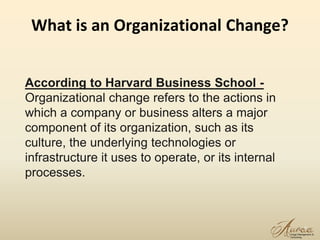
What is an Organizational Change?
According to Harvard Business School -
Organizational change refers to the actions in
which a company or business alters a major
component of its organization, such as its
culture, the underlying technologies or
infrastructure it uses to operate, or its internal
processes.
3
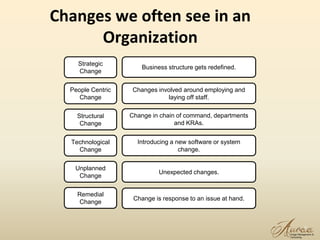
Changes we often see in an
Organization
Strategic
Change
People Centric
Change
Structural
Change
Technological
Change
Unplanned
Change
Remedial
Change
Business structure gets redefined.
Changes involved around employing and
laying off staff.
Change in chain of command, departments
and KRAs.
Introducing a new software or system
change.
Unexpected changes.
Change is response to an issue at hand.
4
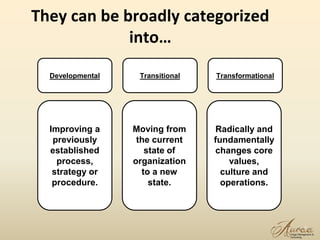
They can be broadly categorized
into…
Developmental Transitional Transformational
Improving a
previously
established
process,
strategy or
procedure.
Moving from
the current
state of
organization
to a new
state.
Radically and
fundamentally
changes core
values,
culture and
operations.
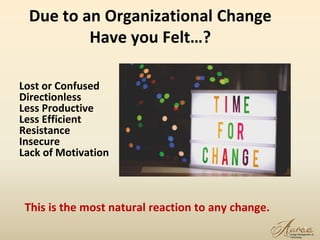
Due to an Organizational Change
Have you Felt…?
5
Lost or Confused
Directionless
Less Productive
Less Efficient
Resistance
Insecure
Lack of Motivation
This is the most natural reaction to any change.
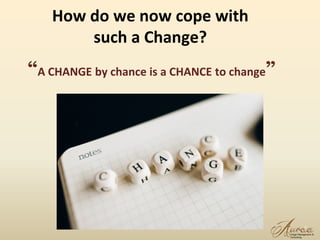
How do we now cope with
such a Change?
6
“A CHANGE by chance is a CHANCE to change”
7
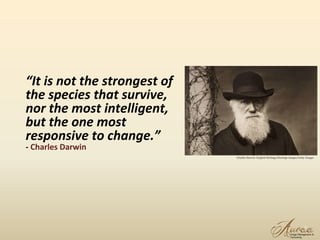
“It is not the strongest of
the species that survive,
nor the most intelligent,
but the one most
responsive to change.”
- Charles Darwin
Charles Darwin. English Heritage/Heritage Images/Getty Images
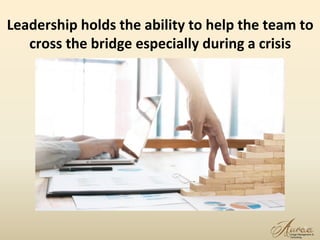
Leadership holds the ability to help the team to
cross the bridge especially during a crisis
8
Why do we need to manage Change?
9
• To successfully adopt the change
• To make employees understand the cause of change and
walk them through the change.
• To reduce wastage of time, money and other resources
occurred to the change.
• To keep the stakeholders invested in the company’s
growth.
• To boost employee morale.
10
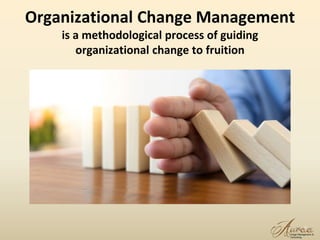
Organizational Change Management
is a methodological process of guiding
organizational change to fruition
11
How does a manager respond to an
Organizational Change?
As a manager overseeing the organizational
change or guiding your employees through it, it’s
important to know what the process looks like and
what to expect.
Change, although challenging, can be a major
opportunity for growth and career advancement, so
long as you know how to approach it.
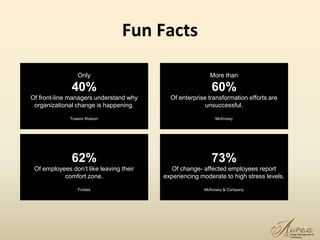
Fun Facts
12
Only
40%
Of front-line managers understand why
organizational change is happening.
Towers Watson
More than
60%
Of enterprise transformation efforts are
unsuccessful.
McKinsey
62%
Of employees don’t like leaving their
comfort zone.
Forbes
73%
Of change- affected employees report
experiencing moderate to high stress levels.
McKinsey & Company
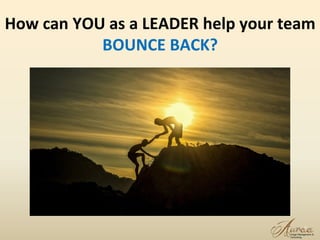
How can YOU as a LEADER help your team
BOUNCE BACK?
13
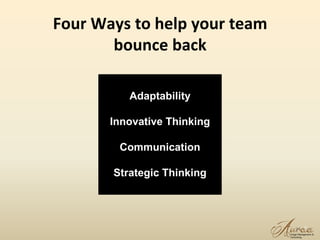
Four Ways to help your team
bounce back
14
Adaptability
Innovative Thinking
Communication
Strategic Thinking
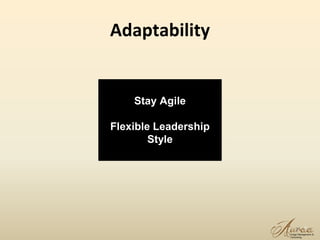
Adaptability
15
Stay Agile
Flexible Leadership
Style
Adaptability : Stay Agile
16
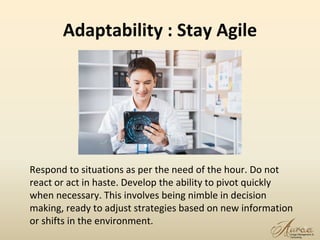
Respond to situations as per the need of the hour. Do not
react or act in haste. Develop the ability to pivot quickly
when necessary. This involves being nimble in decision
making, ready to adjust strategies based on new information
or shifts in the environment.
Adaptability :
Flexible Leadership Style
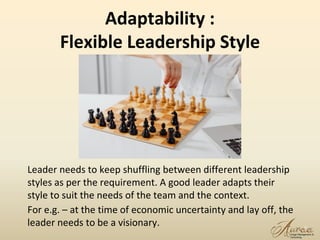
Leader needs to keep shuffling between different leadership
styles as per the requirement. A good leader adapts their
style to suit the needs of the team and the context.
For e.g. – at the time of economic uncertainty and lay off, the
leader needs to be a visionary. 17
Do you as a leader…
18
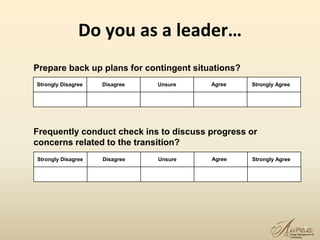
Prepare back up plans for contingent situations?
Strongly Disagree Disagree Unsure Agree Strongly Agree
Frequently conduct check ins to discuss progress or
concerns related to the transition?
Innovative Thinking
19
Leaders who view change as an opportunity for innovation can
develop a more optimistic and creative outlook on the entire process
of change.
Developing innovative thinking takes time and is not something that
is easily acquired. More than half of employees do not like to step
out of their comfort zone. The key is to ease into it. Lean into your
curiosities and instincts and let them guide you towards new ideas.
Communication
20
Clarity
Feedback
Coaching
Communication: Clarity
21
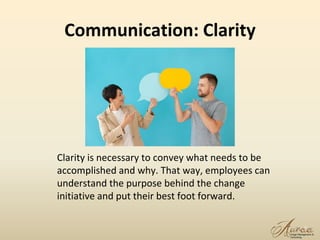
Clarity is necessary to convey what needs to be
accomplished and why. That way, employees can
understand the purpose behind the change
initiative and put their best foot forward.
Communication: Feedback and
Feedforward
22
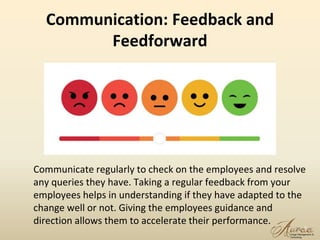
Communicate regularly to check on the employees and resolve
any queries they have. Taking a regular feedback from your
employees helps in understanding if they have adapted to the
change well or not. Giving the employees guidance and
direction allows them to accelerate their performance.
Communication: Coaching
23
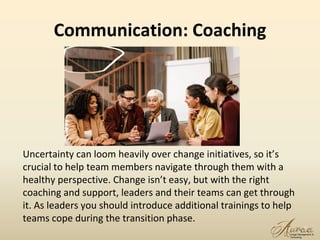
Uncertainty can loom heavily over change initiatives, so it’s
crucial to help team members navigate through them with a
healthy perspective. Change isn’t easy, but with the right
coaching and support, leaders and their teams can get through
it. As leaders you should introduce additional trainings to help
teams cope during the transition phase.
Strengthen Internal Communication
Ask the following questions to your team
24
What opportunities do you see in this change for
personal or professional growth?
What kind of feedback or communication would you
find most helpful as we navigate through this change?
What specific challenges or concerns do you foresee
during this transition?
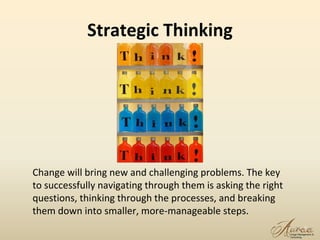
Strategic Thinking
25
Change will bring new and challenging problems. The key
to successfully navigating through them is asking the right
questions, thinking through the processes, and breaking
them down into smaller, more-manageable steps.
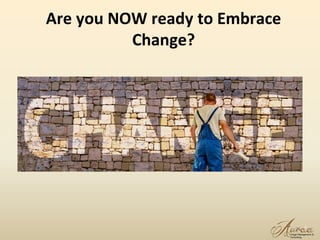
Are you NOW ready to Embrace
Change?
26
Contact Us
Phone Number
Website
Email Address
+91 9958934766/ +91 7830222285
samira@auraaimage.com/
nayanika@auraaimage.com
https://auraaimage.com
https://samiragupta.com
For more insights follow us on -
@auraaimageandlife
@coachsamira
https://www.facebook.com/auraaimage
https://www.linkedin.com/company/aura-
image-management-and-consulting/
https://www.linkedin.com/in/coach-samira-
gupta-pcc
THANK YOU!
Samira Chandra Gupta
Executive Presence & Leadership Communication Coach, Life
Coach, NLP Practitioner, Image Consultant, Fire-walking
Instructor, Corp Facilitator
+91 9958934766
samira@auraaimage.com

Effective Change Management for Leaders.pdf

  • 1.
  • 2.
    2 What is anOrganizational Change? According to Harvard Business School - Organizational change refers to the actions in which a company or business alters a major component of its organization, such as its culture, the underlying technologies or infrastructure it uses to operate, or its internal processes.
  • 3.
    3 Changes we oftensee in an Organization Strategic Change People Centric Change Structural Change Technological Change Unplanned Change Remedial Change Business structure gets redefined. Changes involved around employing and laying off staff. Change in chain of command, departments and KRAs. Introducing a new software or system change. Unexpected changes. Change is response to an issue at hand.
  • 4.
    4 They can bebroadly categorized into… Developmental Transitional Transformational Improving a previously established process, strategy or procedure. Moving from the current state of organization to a new state. Radically and fundamentally changes core values, culture and operations.
  • 5.
    Due to anOrganizational Change Have you Felt…? 5 Lost or Confused Directionless Less Productive Less Efficient Resistance Insecure Lack of Motivation This is the most natural reaction to any change.
  • 6.
    How do wenow cope with such a Change? 6 “A CHANGE by chance is a CHANCE to change”
  • 7.
    7 “It is notthe strongest of the species that survive, nor the most intelligent, but the one most responsive to change.” - Charles Darwin Charles Darwin. English Heritage/Heritage Images/Getty Images
  • 8.
    Leadership holds theability to help the team to cross the bridge especially during a crisis 8
  • 9.
    Why do weneed to manage Change? 9 • To successfully adopt the change • To make employees understand the cause of change and walk them through the change. • To reduce wastage of time, money and other resources occurred to the change. • To keep the stakeholders invested in the company’s growth. • To boost employee morale.
  • 10.
    10 Organizational Change Management isa methodological process of guiding organizational change to fruition
  • 11.
    11 How does amanager respond to an Organizational Change? As a manager overseeing the organizational change or guiding your employees through it, it’s important to know what the process looks like and what to expect. Change, although challenging, can be a major opportunity for growth and career advancement, so long as you know how to approach it.
  • 12.
    Fun Facts 12 Only 40% Of front-linemanagers understand why organizational change is happening. Towers Watson More than 60% Of enterprise transformation efforts are unsuccessful. McKinsey 62% Of employees don’t like leaving their comfort zone. Forbes 73% Of change- affected employees report experiencing moderate to high stress levels. McKinsey & Company
  • 13.
    How can YOUas a LEADER help your team BOUNCE BACK? 13
  • 14.
    Four Ways tohelp your team bounce back 14 Adaptability Innovative Thinking Communication Strategic Thinking
  • 15.
  • 16.
    Adaptability : StayAgile 16 Respond to situations as per the need of the hour. Do not react or act in haste. Develop the ability to pivot quickly when necessary. This involves being nimble in decision making, ready to adjust strategies based on new information or shifts in the environment.
  • 17.
    Adaptability : Flexible LeadershipStyle Leader needs to keep shuffling between different leadership styles as per the requirement. A good leader adapts their style to suit the needs of the team and the context. For e.g. – at the time of economic uncertainty and lay off, the leader needs to be a visionary. 17
  • 18.
    Do you asa leader… 18 Prepare back up plans for contingent situations? Strongly Disagree Disagree Unsure Agree Strongly Agree Strongly Disagree Disagree Unsure Agree Strongly Agree Frequently conduct check ins to discuss progress or concerns related to the transition?
  • 19.
    Innovative Thinking 19 Leaders whoview change as an opportunity for innovation can develop a more optimistic and creative outlook on the entire process of change. Developing innovative thinking takes time and is not something that is easily acquired. More than half of employees do not like to step out of their comfort zone. The key is to ease into it. Lean into your curiosities and instincts and let them guide you towards new ideas.
  • 20.
  • 21.
    Communication: Clarity 21 Clarity isnecessary to convey what needs to be accomplished and why. That way, employees can understand the purpose behind the change initiative and put their best foot forward.
  • 22.
    Communication: Feedback and Feedforward 22 Communicateregularly to check on the employees and resolve any queries they have. Taking a regular feedback from your employees helps in understanding if they have adapted to the change well or not. Giving the employees guidance and direction allows them to accelerate their performance.
  • 23.
    Communication: Coaching 23 Uncertainty canloom heavily over change initiatives, so it’s crucial to help team members navigate through them with a healthy perspective. Change isn’t easy, but with the right coaching and support, leaders and their teams can get through it. As leaders you should introduce additional trainings to help teams cope during the transition phase.
  • 24.
    Strengthen Internal Communication Askthe following questions to your team 24 What opportunities do you see in this change for personal or professional growth? What kind of feedback or communication would you find most helpful as we navigate through this change? What specific challenges or concerns do you foresee during this transition?
  • 25.
    Strategic Thinking 25 Change willbring new and challenging problems. The key to successfully navigating through them is asking the right questions, thinking through the processes, and breaking them down into smaller, more-manageable steps.
  • 26.
    Are you NOWready to Embrace Change? 26
  • 27.
    Contact Us Phone Number Website EmailAddress +91 9958934766/ +91 7830222285 samira@auraaimage.com/ nayanika@auraaimage.com https://auraaimage.com https://samiragupta.com For more insights follow us on - @auraaimageandlife @coachsamira https://www.facebook.com/auraaimage https://www.linkedin.com/company/aura- image-management-and-consulting/ https://www.linkedin.com/in/coach-samira- gupta-pcc
  • 28.
    THANK YOU! Samira ChandraGupta Executive Presence & Leadership Communication Coach, Life Coach, NLP Practitioner, Image Consultant, Fire-walking Instructor, Corp Facilitator +91 9958934766 samira@auraaimage.com