1
Change Management
for Managers
2
What is an Organizational Change?
According to Harvard Business School -
Organizational change refers to the actions in which
a company or business alters a major component of
its organization, such as its culture, the underlying
technologies or infrastructure it uses to operate, or
its internal processes.
3
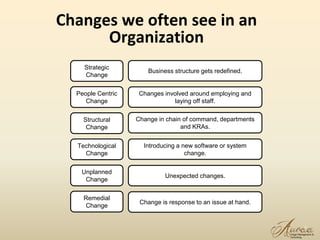
Changes we often see in an
Organization
Strategic
Change
People Centric
Change
Structural
Change
Technological
Change
Unplanned
Change
Remedial
Change
Business structure gets redefined.
Changes involved around employing and
laying off staff.
Change in chain of command, departments
and KRAs.
Introducing a new software or system
change.
Unexpected changes.
Change is response to an issue at hand.
Challenges faced during
Change Management
4
Poor Leadership
Lack of Resources
Lack of Agility
Slow approval process
Insecurities and Conflict
Resisting Change
Lack of Commitment
Poor Communication
Anxiety & Stress
Power Struggle
Required Managerial Skillset
5
• Effective communication, including actively listening
to your team and colleagues
• A highly developed level of emotional intelligence
• Strong organizational skills
• Attention to detail
• Problem-solving and decision-making skills
• Delegating without micromanaging
Ways in which you can manage
CHANGE
6
Define Goals
Be Transparent
Work with Employees
Communicate Clearly
Ask for Feedback
Boost Team Morale
Engage the Team
Create SOPs
7
Define clear and SMART Goals to manage the change.
Results at the end can be compared to the goals set at
the beginning
1. Define Goals
8
Over 30% of employees say that their employer is not
always honest and truthful.
In order to implement transitions successfully,
employers should be honest and transparent.
As most employees don’t feel comfortable with changes,
being transparent at every step of the change
management process helps build trust and connection
with employees.
2. Be Transparent
9
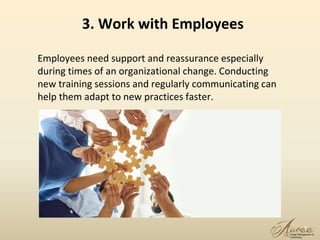
Employees need support and reassurance especially
during times of an organizational change. Conducting
new training sessions and regularly communicating can
help them adapt to new practices faster.
3. Work with Employees
10
Employee relations have a big impact on encouraging
conversations before, during and after the changes are
implemented.
Start a conversation among your employees in order to
find out how they feel about the new initiatives.
Understand that true communication is a two-way
conversation.
Taking regular feedback helps in implementing
strategic changes wherever required.
4. Communicate clearly
and take Feedback
11
Empower employees to engage in the change process by giving
them freedom to make their own decisions and share their ideas
and opinions. Reward employees for their efficiency.
Higher employee engagement smoothens the process of adapting
to change.
5. Boost Team Morale
and Team Engagement
12
Creating standard operating procedures provides a roadmap to
the team and streamlines the process. The risk of failing to adapt
to change reduces when SOPs are followed.
6. Create SOPs
13
Make two groups of participants
Both the groups have members working in marketing, sales,
production, finance and operations.
Once you are assigned your group, decide which department you
are working in.
Group 1 – has to devise a strategic plan for touching 50 crores
sales for e bikes in the first quarter of 2024.
Group 2 – has to devise a strategic plan for successfully planning
10 weddings as a part of an event planning company in two
months.
Fun Activity
14
Discuss with the group for 15 mins
Post which the host will shuffle departments between group 1
and 2 and members will be assigned new departments and
groups but the topics remain the same. They then have to rework
the task post the shuffle.
Fun Activity Continued…
15
Change Management Models
Sharing theories on change management with the intention for
you to choose a more suitable theory for your organization.
McKinsey 7-S Model
16
The 7 S’s of the McKinsey 7-S Model make it one of the more
complex models, but that complexity may be necessary when
implementing complicated organization-wide changes.
Strategy, Structure, Systems, Shared Values, Style, Staff, Skills.
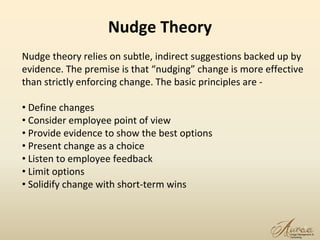
Nudge Theory
17
Nudge theory relies on subtle, indirect suggestions backed up by
evidence. The premise is that “nudging” change is more effective
than strictly enforcing change. The basic principles are -
• Define changes
• Consider employee point of view
• Provide evidence to show the best options
• Present change as a choice
• Listen to employee feedback
• Limit options
• Solidify change with short-term wins
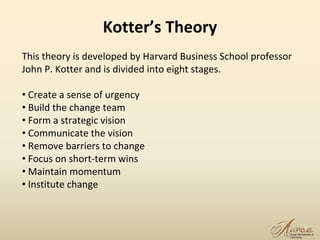
Kotter’s Theory
18
This theory is developed by Harvard Business School professor
John P. Kotter and is divided into eight stages.
• Create a sense of urgency
• Build the change team
• Form a strategic vision
• Communicate the vision
• Remove barriers to change
• Focus on short-term wins
• Maintain momentum
• Institute change
Are you as a manager equipped with
the skills needed to be resilient?
19
Conduct Self Analysis & Unleash
your full potential
using
20
THE JOHARI WINDOW
Increase Self Awareness
21
THE JOHARI WINDOW
Known to Self Unknown to Self
Known
to
Others
Unknown
to
Others
OPEN BLIND
HIDDEN UNKNOWN
Things that are
known to you and
everyone else.
Things that you
are unaware of
but others know.
Things that you
know but others
are unaware of.
Things that are
unknown by you
and everyone else.
What is the one quality a manager should
possess especially in times of a crisis?
22
EMOTIONAL MATURITY
What is Emotional Maturity?
23
A person’s ability to remain stable and balanced. Being
emotional mature means, you are able to understand the
emotions you are experiencing and you are able to
control them.
When life throws things your way you are better
equipped to remain productive and capable through it.
Emotional maturity is when you do not hide your
emotions but learn to manage them well.
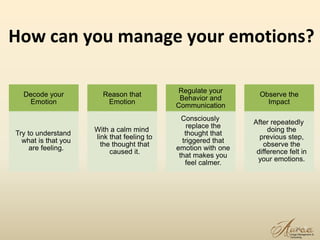
How can you manage your emotions?
24
Decode your
Emotion
Try to understand
what is that you
are feeling.
Reason that
Emotion
With a calm mind
link that feeling to
the thought that
caused it.
Regulate your
Behavior and
Communication
Consciously
replace the
thought that
triggered that
emotion with one
that makes you
feel calmer.
Observe the
Impact
After repeatedly
doing the
previous step,
observe the
difference felt in
your emotions.
Contact Us
Phone Number
Website
Email Address
+91 9958934766/ +91 7830222285
samira@auraaimage.com/
nayanika@auraaimage.com
https://auraaimage.com
https://samiragupta.com
For more insights follow us on -
@auraaimageandlife
@coachsamira
https://www.facebook.com/auraaimage
https://www.linkedin.com/company/aura-
image-management-and-consulting/
https://www.linkedin.com/in/coach-samira-
gupta-pcc
THANK YOU!
Samira Chandra Gupta
Executive Presence & Leadership Communication Coach, Life
Coach, NLP Practitioner, Image Consultant, Fire-walking
Instructor, Corp Facilitator
+91 9958934766
samira@auraaimage.com

Change Management Guide for Managers.pdf

  • 1.
  • 2.
    2 What is anOrganizational Change? According to Harvard Business School - Organizational change refers to the actions in which a company or business alters a major component of its organization, such as its culture, the underlying technologies or infrastructure it uses to operate, or its internal processes.
  • 3.
    3 Changes we oftensee in an Organization Strategic Change People Centric Change Structural Change Technological Change Unplanned Change Remedial Change Business structure gets redefined. Changes involved around employing and laying off staff. Change in chain of command, departments and KRAs. Introducing a new software or system change. Unexpected changes. Change is response to an issue at hand.
  • 4.
    Challenges faced during ChangeManagement 4 Poor Leadership Lack of Resources Lack of Agility Slow approval process Insecurities and Conflict Resisting Change Lack of Commitment Poor Communication Anxiety & Stress Power Struggle
  • 5.
    Required Managerial Skillset 5 •Effective communication, including actively listening to your team and colleagues • A highly developed level of emotional intelligence • Strong organizational skills • Attention to detail • Problem-solving and decision-making skills • Delegating without micromanaging
  • 6.
    Ways in whichyou can manage CHANGE 6 Define Goals Be Transparent Work with Employees Communicate Clearly Ask for Feedback Boost Team Morale Engage the Team Create SOPs
  • 7.
    7 Define clear andSMART Goals to manage the change. Results at the end can be compared to the goals set at the beginning 1. Define Goals
  • 8.
    8 Over 30% ofemployees say that their employer is not always honest and truthful. In order to implement transitions successfully, employers should be honest and transparent. As most employees don’t feel comfortable with changes, being transparent at every step of the change management process helps build trust and connection with employees. 2. Be Transparent
  • 9.
    9 Employees need supportand reassurance especially during times of an organizational change. Conducting new training sessions and regularly communicating can help them adapt to new practices faster. 3. Work with Employees
  • 10.
    10 Employee relations havea big impact on encouraging conversations before, during and after the changes are implemented. Start a conversation among your employees in order to find out how they feel about the new initiatives. Understand that true communication is a two-way conversation. Taking regular feedback helps in implementing strategic changes wherever required. 4. Communicate clearly and take Feedback
  • 11.
    11 Empower employees toengage in the change process by giving them freedom to make their own decisions and share their ideas and opinions. Reward employees for their efficiency. Higher employee engagement smoothens the process of adapting to change. 5. Boost Team Morale and Team Engagement
  • 12.
    12 Creating standard operatingprocedures provides a roadmap to the team and streamlines the process. The risk of failing to adapt to change reduces when SOPs are followed. 6. Create SOPs
  • 13.
    13 Make two groupsof participants Both the groups have members working in marketing, sales, production, finance and operations. Once you are assigned your group, decide which department you are working in. Group 1 – has to devise a strategic plan for touching 50 crores sales for e bikes in the first quarter of 2024. Group 2 – has to devise a strategic plan for successfully planning 10 weddings as a part of an event planning company in two months. Fun Activity
  • 14.
    14 Discuss with thegroup for 15 mins Post which the host will shuffle departments between group 1 and 2 and members will be assigned new departments and groups but the topics remain the same. They then have to rework the task post the shuffle. Fun Activity Continued…
  • 15.
    15 Change Management Models Sharingtheories on change management with the intention for you to choose a more suitable theory for your organization.
  • 16.
    McKinsey 7-S Model 16 The7 S’s of the McKinsey 7-S Model make it one of the more complex models, but that complexity may be necessary when implementing complicated organization-wide changes. Strategy, Structure, Systems, Shared Values, Style, Staff, Skills.
  • 17.
    Nudge Theory 17 Nudge theoryrelies on subtle, indirect suggestions backed up by evidence. The premise is that “nudging” change is more effective than strictly enforcing change. The basic principles are - • Define changes • Consider employee point of view • Provide evidence to show the best options • Present change as a choice • Listen to employee feedback • Limit options • Solidify change with short-term wins
  • 18.
    Kotter’s Theory 18 This theoryis developed by Harvard Business School professor John P. Kotter and is divided into eight stages. • Create a sense of urgency • Build the change team • Form a strategic vision • Communicate the vision • Remove barriers to change • Focus on short-term wins • Maintain momentum • Institute change
  • 19.
    Are you asa manager equipped with the skills needed to be resilient? 19
  • 20.
    Conduct Self Analysis& Unleash your full potential using 20 THE JOHARI WINDOW
  • 21.
    Increase Self Awareness 21 THEJOHARI WINDOW Known to Self Unknown to Self Known to Others Unknown to Others OPEN BLIND HIDDEN UNKNOWN Things that are known to you and everyone else. Things that you are unaware of but others know. Things that you know but others are unaware of. Things that are unknown by you and everyone else.
  • 22.
    What is theone quality a manager should possess especially in times of a crisis? 22 EMOTIONAL MATURITY
  • 23.
    What is EmotionalMaturity? 23 A person’s ability to remain stable and balanced. Being emotional mature means, you are able to understand the emotions you are experiencing and you are able to control them. When life throws things your way you are better equipped to remain productive and capable through it. Emotional maturity is when you do not hide your emotions but learn to manage them well.
  • 24.
    How can youmanage your emotions? 24 Decode your Emotion Try to understand what is that you are feeling. Reason that Emotion With a calm mind link that feeling to the thought that caused it. Regulate your Behavior and Communication Consciously replace the thought that triggered that emotion with one that makes you feel calmer. Observe the Impact After repeatedly doing the previous step, observe the difference felt in your emotions.
  • 25.
    Contact Us Phone Number Website EmailAddress +91 9958934766/ +91 7830222285 samira@auraaimage.com/ nayanika@auraaimage.com https://auraaimage.com https://samiragupta.com For more insights follow us on - @auraaimageandlife @coachsamira https://www.facebook.com/auraaimage https://www.linkedin.com/company/aura- image-management-and-consulting/ https://www.linkedin.com/in/coach-samira- gupta-pcc
  • 26.
    THANK YOU! Samira ChandraGupta Executive Presence & Leadership Communication Coach, Life Coach, NLP Practitioner, Image Consultant, Fire-walking Instructor, Corp Facilitator +91 9958934766 samira@auraaimage.com