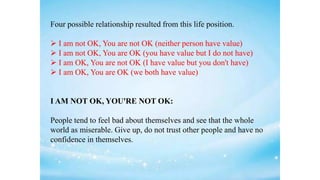
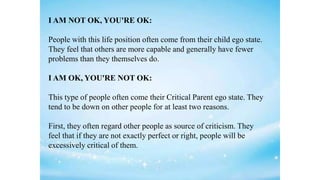
Conflict Definition
• Conflictprocess refers to a series of events that begin when
an individual or a group perceives that another individual or
group has negatively affected or is about to disrupt
something significant to them.
• It arises when the goals, interests, or values of different
individuals or groups are incompatible, and those individuals
or groups block or thwart one another’s attempts to achieve
their objectives.
3.
Views of Conflict
1.Traditional views of Conflict
• The belief that all conflict is harmful and must be avoided.
2. Human relations view of Conflict
• The belief that conflict is a natural and inevitable outcome in any group.
3. Interactionist view of Conflict
• The belief that conflict is not only a positive force in a group but that it is
absolutely necessary for a group to perform effectively.
4.
Features
• Universal
• Conflictarises because of incompatibility like goal, interest, methods
or any other.
• It occurs when an individual is not able to choose among the available
course of action.
• It is temporary and intermittent process (not continuous)
Conflict Resolution
• Communication
•Bringing in outsiders (third party intervention)
• Restructuring the organization
• Expansion of resources
• Avoidance
• Compromising
10.
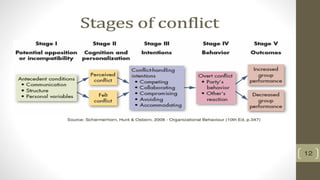
5 Stages ofConflict Process
• Stage 1: Potential Opposition or Incompatibility
• Stage 2: Cognition and Personalization
• Stage 3: Intentions
• Stage 4: Behavior
• Stage 5: Outcomes
12.
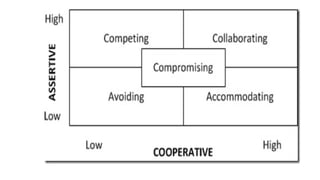
Conflict Management Techniques
•Here are five strategies from conflict management theory for
managing stressful situations.
1. Collaborating − win/win
2. Compromising − win some/lose some
3. Accommodating − lose/win
4. Competing − win/lose
5. Avoiding − no winners/no losers
14.
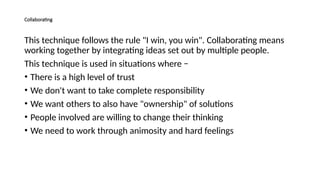
Collaborating
This technique followsthe rule "I win, you win". Collaborating means
working together by integrating ideas set out by multiple people.
This technique is used in situations where −
• There is a high level of trust
• We don't want to take complete responsibility
• We want others to also have "ownership" of solutions
• People involved are willing to change their thinking
• We need to work through animosity and hard feelings
15.
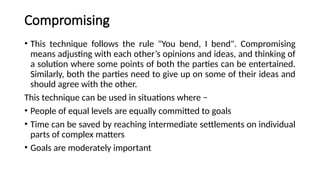
Compromising
• This techniquefollows the rule "You bend, I bend". Compromising
means adjusting with each other’s opinions and ideas, and thinking of
a solution where some points of both the parties can be entertained.
Similarly, both the parties need to give up on some of their ideas and
should agree with the other.
This technique can be used in situations where −
• People of equal levels are equally committed to goals
• Time can be saved by reaching intermediate settlements on individual
parts of complex matters
• Goals are moderately important
16.
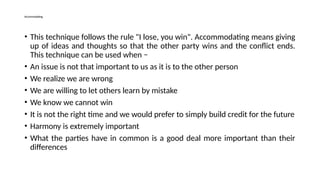
Accommodating
• This techniquefollows the rule "I lose, you win". Accommodating means giving
up of ideas and thoughts so that the other party wins and the conflict ends.
This technique can be used when −
• An issue is not that important to us as it is to the other person
• We realize we are wrong
• We are willing to let others learn by mistake
• We know we cannot win
• It is not the right time and we would prefer to simply build credit for the future
• Harmony is extremely important
• What the parties have in common is a good deal more important than their
differences
17.
Competing
• This techniquefollows the rule "I win, you lose". Competing means
when there is a dispute a person or a group is not willing to
collaborate or adjust but it simply wants the opposite party to lose.
This technique can be used when −
• We know you are right.
• Time is short and a quick decision is to be made.
• A strong personality is trying to steamroll us and we don't want to be
taken advantage of.
• We need to stand up for our rights.
18.
Avoiding
• This techniquefollows the rule "No winners, no losers". Avoiding
means the ideas suggested by both the parties are rejected and a
third person is involved who takes a decision without favoring any of
the parties. This technique can be used when −
• The conflict is small and relationships are at stake
• We are counting to ten to cool off
• More important issues are pressing and we feel we don't have time to
deal with this particular one
• We have no power and we see no chance of getting our concerns met
• We are too emotionally involved and others around us can solve the
conflict more successfully
26.
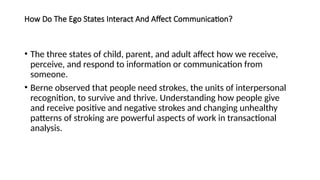
How Do TheEgo States Interact And Affect Communication?
• The three states of child, parent, and adult affect how we receive,
perceive, and respond to information or communication from
someone.
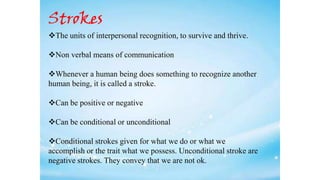
• Berne observed that people need strokes, the units of interpersonal
recognition, to survive and thrive. Understanding how people give
and receive positive and negative strokes and changing unhealthy
patterns of stroking are powerful aspects of work in transactional
analysis.
27.
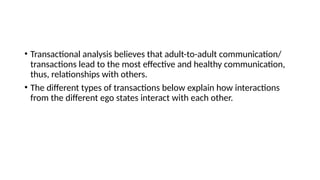
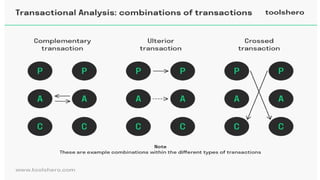
• Transactional analysisbelieves that adult-to-adult communication/
transactions lead to the most effective and healthy communication,
thus, relationships with others.
• The different types of transactions below explain how interactions
from the different ego states interact with each other.