




























































Content teamwork: Aligning your
people and process
Kathy Wagner and Melissa Breker
Content Strategy Inc.
ContentStrategyInc.com #CSITeamwork #ConfabMN @Team_CS_Inc
We need to
align people +
process.
The truth is…
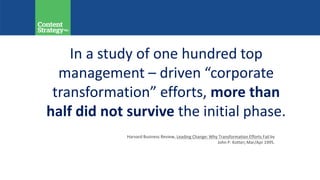
In a study of one hundred top
management – driven “corporate
transformation” efforts, more than
half did not survive the initial phase.
Harvard Business Review, Leading Change: Why Transformation Efforts Fail by
John P. Kotter; Mar/Apr 1995.
Enterprises fail at execution because
they neglect the most powerful
drivers of effectiveness:
decision rights & information flow.
Harvard Business Review, The Secrets to Successful Strategy Execution by
Gary L. Neilson, Karla L. Martin, Elizabeth Powers; June 2008.
We need to
align people +
process.
We need to align people
and process.
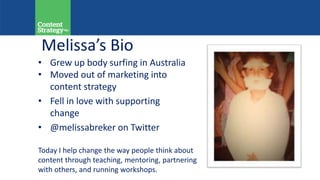
Melissa’s Bio
Today I help change the way people think about
content through teaching, mentoring, partnering
with others, and running workshops.
• Grew up body surfing in Australia
• Moved out of marketing into
content strategy
• Fell in love with supporting
change
• @melissabreker on Twitter
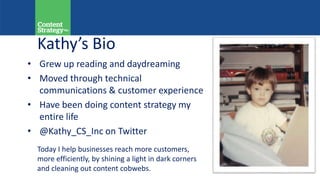
Kathy’s Bio
• Grew up reading and daydreaming
• Moved through technical
communications & customer experience
• Have been doing content strategy my
entire life
• @Kathy_CS_Inc on Twitter
Today I help businesses reach more customers,
more efficiently, by shining a light in dark corners
and cleaning out content cobwebs.
And what
about
you?
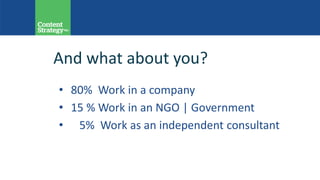
And what about you?
• 80% Work in a company
• 15 % Work in an NGO | Government
• 5% Work as an independent consultant
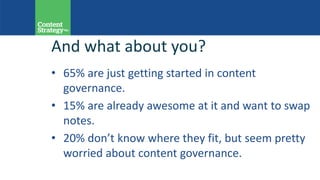
And what about you?
• 65% are just getting started in content
governance.
• 15% are already awesome at it and want to swap
notes.
• 20% don’t know where they fit, but seem pretty
worried about content governance.
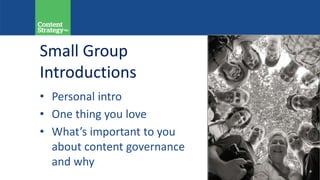
Small Group
Introductions
• Personal intro
• One thing you love
• What’s important to you
about content governance
and why
We need to
align people +
process.
What’s up for today?
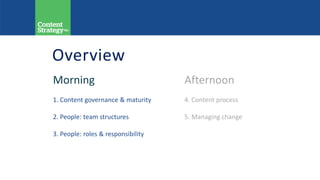
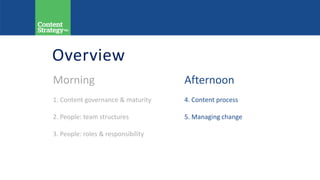
Overview
Morning
1. Content governance & maturity
2. People: team structures
3. People: roles & responsibility
Afternoon
4. Content process
5. Managing change
Overview
Morning
1. Content governance & maturity
2. People: team structures
3. People: roles & responsibility
Afternoon
4. Content process
5. Managing change
We need to
align people +
process.
We need you.
Be involved
Be respectful
Be responsible
We need to
align people +
process.
Content governance
& maturity1
©2016 Content Strategy Inc ContentStrategyInc.com #CSITeamwork #ConfabMN @Team_CS_Inc
What
people
want
What
people
think
What
people
need
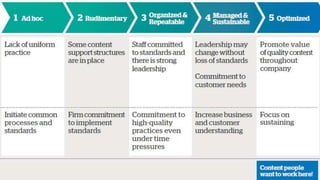
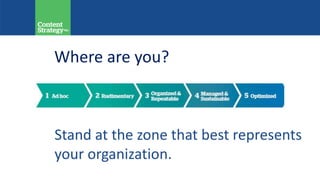
How mature are
your content
practices?
5 min: Share
Where are you?
Stand at the zone that best represents
your organization.
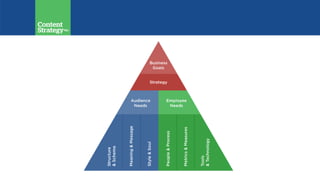
What are content
practices?
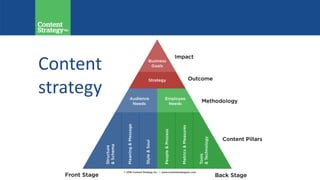
Content
strategy
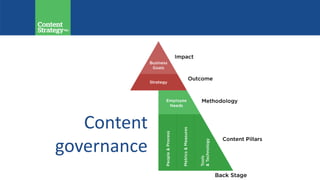
Content
governance
How mature are
your content
practices?
3 min: Share
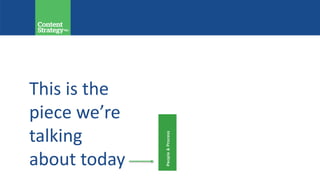
This is the
piece we’re
talking
about today
Three
questions.
Three
minutes.
What could your
organization do to
mature its content
practices?
What could your
organization do to
move up a level?
What could be the
positive business
impact of
maturing your
content practices?
What are the six
content pillars?
(Three front stage
and three back stage)
Questions?
Short stories?
True story…
We need to
align people +
process.
People: Team structures2
©2016 Content Strategy Inc ContentStrategyInc.com #CSITeamwork #ConfabMN @Team_CS_Inc
Organizational content
governance models
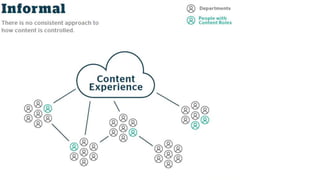
There are 4 different models:
• Informal
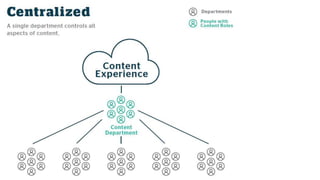
• Centralized
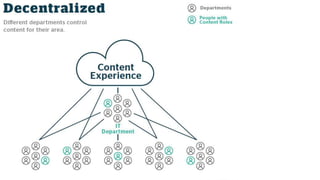
• Decentralized
• Hybrid
Advantages:
• Easy to identify
content champions
• Low cost
Disadvantages:
• Too many to list
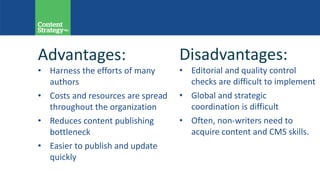
Advantages:
• Harness the efforts of many
authors
• Costs and resources are spread
throughout the organization
• Reduces content publishing
bottleneck
• Easier to publish and update
quickly
Disadvantages:
• Editorial and quality control
checks are difficult to implement
• Global and strategic
coordination is difficult
• Often, non-writers need to
acquire content and CMS skills.
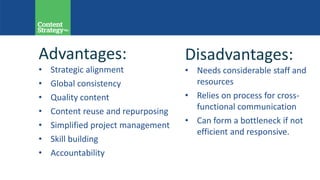
Advantages:
• Strategic alignment
• Global consistency
• Quality content
• Content reuse and repurposing
• Simplified project management
• Skill building
• Accountability
Disadvantages:
• Needs considerable staff and
resources
• Relies on process for cross-
functional communication
• Can form a bottleneck if not
efficient and responsive.
Centralized and decentralized content
models refer to the reporting structure,
not physical distribution.
In a centralized model, writers can sit
within different product teams or in
different locations.
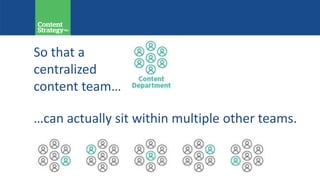
So that a
centralized
content team…
…can actually sit within multiple other teams.
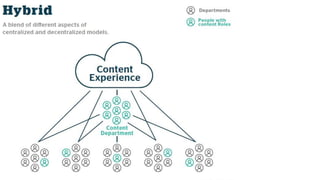
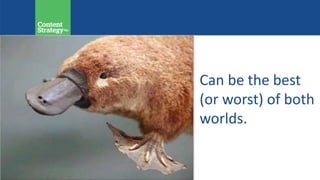
Can be the best
(or worst) of both
worlds.
How do you decide?
• Business goals
• Maturity model goals
• Organizational culture
• Scalability
• Ease of execution (readiness for change).
As content specialists, we often prefer the
idea of a centralized model.
It allows for maximum control over content
strategy, quality, and functionality.
BUT…
It’s usually
hybrid.
It’s about
finding the
right lines to
draw between
centralized and
decentralized.
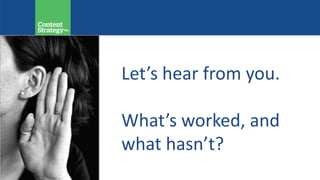
Let’s hear from you.
What’s worked, and
what hasn’t?
Content team
structure
Content teams can be effective with
different structures:
• Self-managed
• Cross-functional
• Matrix
A SELF-MANAGED team structure is:
• Centralized
• Able to make decisions
• Able to implement
• Responsible for the outcome
Team members need to be motivated and driven
to create positive change.
Self-managed
content teams are
good when your
primary business
purpose is to
produce content.
A CROSS-FUNCTIONAL team structure is:
• Any governance model
• Built from different business functions
• Designed to achieve a common task
• A working (rather than reporting) structure
Team members need to trust each other, work
together, and share a common vision.
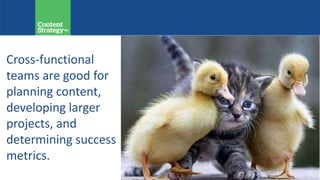
Cross-functional
teams are good for
planning content,
developing larger
projects, and
determining success
metrics.
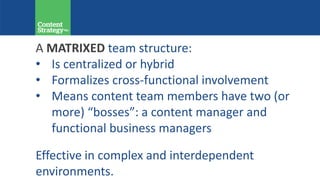
A MATRIXED team structure:
• Is centralized or hybrid
• Formalizes cross-functional involvement
• Means content team members have two (or
more) “bosses”: a content manager and
functional business managers
Effective in complex and interdependent
environments.
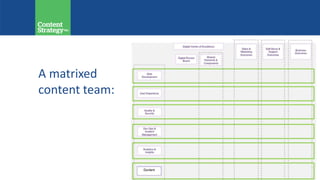
A matrixed content
team enables
content creators to
develop deep
expertise in specific
business areas.
A matrixed
content team:
Factors for team success:
• Strong leadership and trust
• Enough resources
• Adequate incentives
• Team composition
• Conflict management
• Team processes
Three
questions.
Three
minutes.
Which governance
model is your
organization
currently using?
How do you know?
Which content
team structures
are present in
your
organization?
What changes
could be made
to improve
team impact
and efficiency?
Table discussion:
• Discuss the various governance models
and team structures you all have.
• How could changing the governance
models or team structures, or offering
more team support impact things?
Share
Lunch
Take a break
We need to
align people +
process.
People: Skills, roles, and
responsibilities
3
©2016 Content Strategy Inc ContentStrategyInc.com #CSITeamwork #ConfabMN @Team_CS_Inc
Building your content team
Know your goals, audience, and strategy!
What we know for sure...
All teams need a strong
leader.
Managers
Strategists
All teams need
skilled content
creators.
Writers
Photographers
Videographers
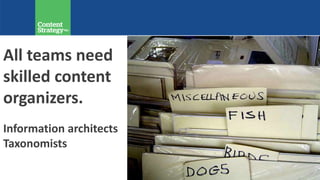
All teams need
skilled content
organizers.
Information architects
Taxonomists
All teams need easy
access and interaction
with other expertise.
Researchers
Analysts
Designers
Subject matter experts
All teams need
someone to keep
things on track.
Project managers
Producers
This is just as true if you
have a team of two, or
twenty, or two hundred.
Titles are not roles!
In practice, titles are often meaningless or
confusing.
Ideally, titles should provide information
about that person’s primary role.
True story…
Exercise: What are all of the different
ways in which you impact content?
2 minutes: Silent brainstorming
5 minutes: Share with table. As a group,
how many different things do you do?
Share
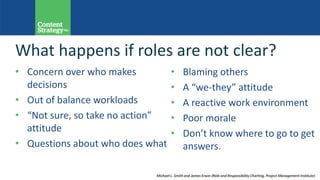
What happens if roles are not clear?
• Concern over who makes
decisions
• Out of balance workloads
• “Not sure, so take no action”
attitude
• Questions about who does what
• Blaming others
• A “we-they” attitude
• A reactive work environment
• Poor morale
• Don’t know where to go to get
answers.
True story…
How do you
assign roles?
What does the
job require?
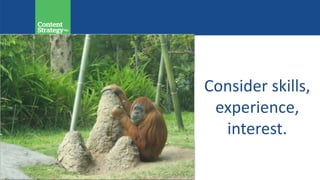
Consider skills,
experience,
interest.
Just a few writing-
specific skills
Web writing
Marketing
Journalism
Technical writing
Creative writing
Blog writing
Business writing
Editing
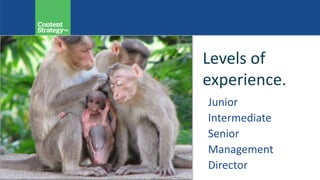
Levels of
experience.
Junior
Intermediate
Senior
Management
Director
Interest
Passionate
about what?
Decide and
communicate
roles
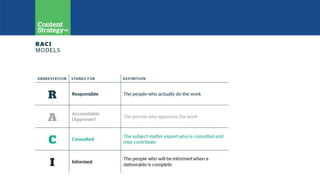
Responsible
One or more people need to be responsible.
Things to think about:
• If one person has many Rs, they may have more work than they
can handle.
• If one deliverable or activity has many Rs, can tasks be more
streamlined so team members have more autonomy?
Accountable
Ideally, only one person should be accountable.
Things to think about:
• If nobody is accountable, then there is a high risk of not meeting
project or strategic goals.
• For complex situations, there may need to be more than one person
accountable. This will simply take longer to move through approvals.
Consulted
Several people may be consulted. Ensure two-way
communication.
Things to think about:
• Too many Cs lead to swirl and slow down the process.
• Too few Cs can result in poor quality through lack of accuracy or
strategic alignment.
Informed
Several people may be informed. Communication
only goes one way.
Things to think about:
• If there are a lot of Is, find ways to inform people in batches, at
logical intervals.
• Develop a system (preferably automated) to inform people.
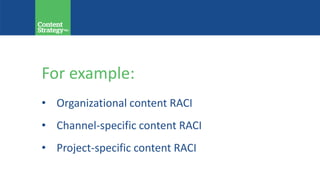
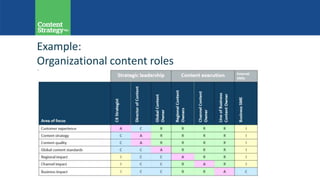
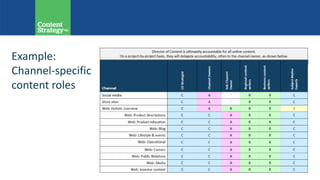
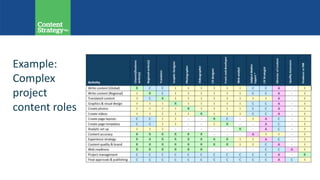
For example:
• Organizational content RACI
• Channel-specific content RACI
• Project-specific content RACI
Example:
Organizational content roles
Example:
Channel-specific
content roles
Example:
Complex
project
content roles
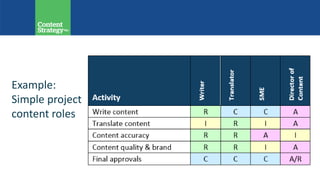
Example:
Simple project
content roles
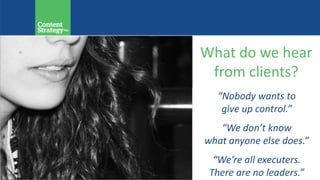
What do we hear
from clients?
“Nobody wants to
give up control.”
“We don’t know
what anyone else does.”
“We’re all executers.
There are no leaders.”
Three
questions.
Three
minutes.
Who leads and
provides
content
oversight for
different areas
in your
organization?
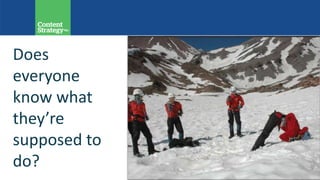
Does
everyone
know what
they’re
supposed to
do?
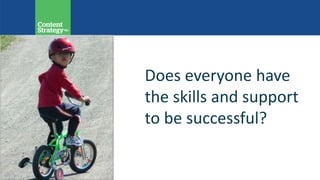
Does everyone have
the skills and support
to be successful?
Learning
Exercise
Complete the RACI quiz
• Think about your work environment.
• Share your answers and discuss with a partner.
In different groups of 3 or 4:
1. As a group, brainstorm some content project
scenarios you could use RACIs for.
2. Choose one.
3. Create a RACI for this project.
Refer to the Sample RACI Template handout
Share
Questions?
Short stories?
Lunch then
change tables
We need to
align people +
process.
Content processes4
©2016 Content Strategy Inc ContentStrategyInc.com #CSITeamwork #ConfabMN @Team_CS_Inc
Welcome back
• Personal intro
• One thing you learned
this morning
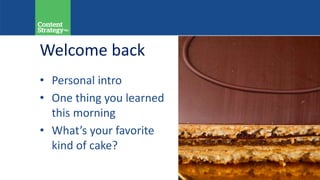
• What’s your favorite
kind of cake?
In nature, we never see
anything isolated, but
everything in connection
with something else.
Johann Wolfgang Van Goethe
How does it all work?
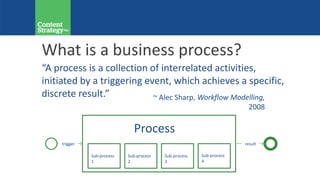
What is a business process?
Process
Sub-process
1
trigger result
“A process is a collection of interrelated activities,
initiated by a triggering event, which achieves a specific,
discrete result.”
Sub-process
2
Sub-process
3
Sub-process
4
~ Alec Sharp, Workflow Modelling,
2008
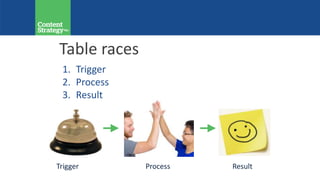
Table races
1. Trigger
2. Process
3. Result
Trigger Process Result
Why formalize and standardize processes?
• Align operations with business strategy
• Improve team and cross-team communications
• Increase control and consistency
• Improve operational efficiencies
• Make training faster and easier
Basically, so that people know what they’re supposed to do.
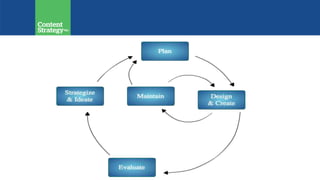
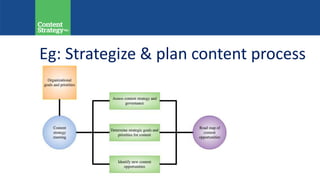
Eg: Strategize & plan content process
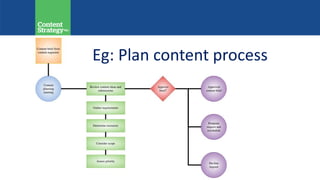
Eg: Plan content process
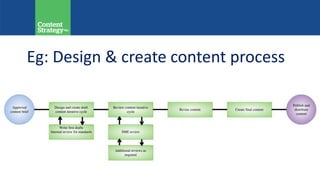
Eg: Design & create content process
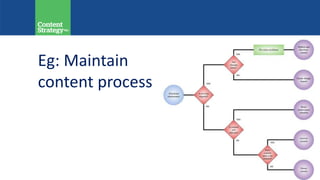
Eg: Maintain
content process
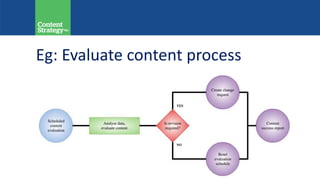
Eg: Evaluate content process
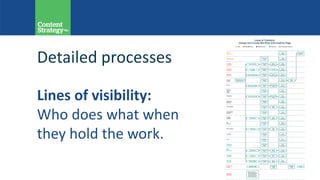
Detailed processes
Lines of visibility:
Who does what when
they hold the work.
Start high-level.
Provide more detail
as needed.
Start with common
scenarios.
Define alternative or uncommon
processes only as needed.
What do we hear
from clients?
“We don’t really follow any
organized process.”
(But they actually do!)
“Our team needs autonomy,
so they don’t want process.”
Three
questions.
Three
minutes.
What business
problems can be
solved by better
content
processes?
Which content
processes are
most important
in your work
environment?
Which variations
or sub-processes
are part of these
important
processes?
Table-Top Workshop:
Designing high-level
content processes
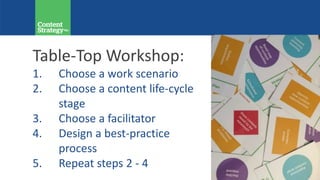
Table-Top Workshop:
1. Choose a work scenario
2. Choose a content life-cycle
stage
3. Choose a facilitator
4. Design a best-practice
process
5. Repeat steps 2 - 4
Share
True story…
Questions?
Short stories?
Lunch
Take a break
We need to
align people +
process.
Managing change5
©2016 Content Strategy Inc ContentStrategyInc.com #CSITeamwork #ConfabMN @Team_CS_Inc
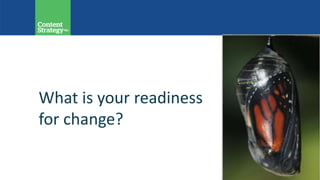
What is your readiness
for change?
We need to
align people +
process.
Change is a process, not
an event.
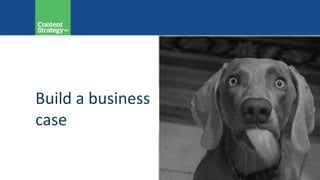
Build a business
case
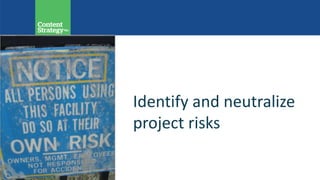
Identify and neutralize
project risks
We need to
align people +
process.
Coming together is a
beginning. Keeping together is
progress. Working together is
success.”
~HENRY FORD
Find an internal
champion
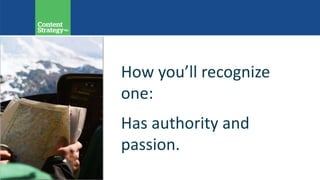
How you’ll recognize
one:
Has authority and
passion.
What they’ll do:
Get you on the road.
Get budget, break
down silos, and
support progress.
Start small.
Pilot projects and
bite-sized chunks.
Small wins.
Big voice.
Know your budget.
Grow your budget.
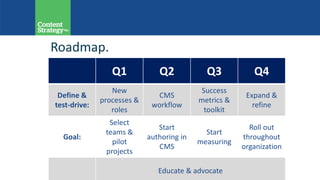
Create a
roadmap.
Q1 Q2 Q3 Q4
Define &
test-drive:
New
processes &
roles
CMS
workflow
Success
metrics &
toolkit
Expand &
refine
Goal:
Select
teams &
pilot
projects
Start
authoring in
CMS
Start
measuring
Roll out
throughout
organization
Educate & advocate
Roadmap.
Take people along for
the ride!
Know your resources.
Grow your resources.
1. Implement strong content practices
2. Demonstrate positive results
3. Provide tools and resources
4. Become expert content advisors
5. Advocate and educate
No control or authority?
Influence like crazy!
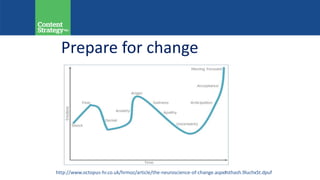
Prepare for change
http://www.octopus-hr.co.uk/hrmoz/article/the-neuroscience-of-change.aspx#sthash.9luchxSt.dpuf
pic.twitter.com/yI22oiF6Si
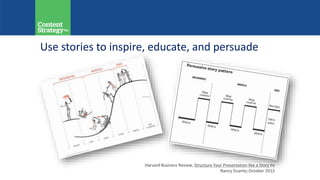
Use stories to inspire, educate, and persuade
Harvard Business Review, Structure Your Presentation like a Story by
Nancy Duarte; October 2012
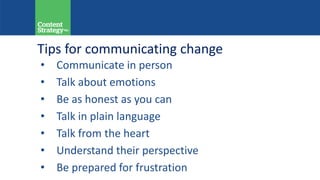
Tips for communicating change
• Communicate in person
• Talk about emotions
• Be as honest as you can
• Talk in plain language
• Talk from the heart
• Understand their perspective
• Be prepared for frustration
What do we hear
from clients?
“People don’t want to give
up control.”
“It’s hard to make time for
change.”
“We’ve tried before, but we
slip back to our old ways.”
Three
questions.
Three
minutes.
Who will be
your content
champion?
What budget and
resources do you
have to work with?
How can you
get people
excited?
Learning Exercise
Individual exercise
Determine your organization’s
readiness for change by completing
the following questions…
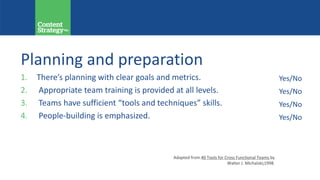
Planning and preparation
1. There’s planning with clear goals and metrics.
2. Appropriate team training is provided at all levels.
3. Teams have sufficient “tools and techniques” skills.
4. People-building is emphasized.
Yes/No
Yes/No
Yes/No
Yes/No
Adapted from 40 Tools for Cross Functional Teams by
Walter J. Michalski;1998.
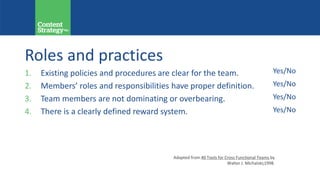
Roles and practices
1. Existing policies and procedures are clear for the team.
2. Members’ roles and responsibilities have proper definition.
3. Team members are not dominating or overbearing.
4. There is a clearly defined reward system.
Yes/No
Yes/No
Yes/No
Yes/No
Adapted from 40 Tools for Cross Functional Teams by
Walter J. Michalski;1998.
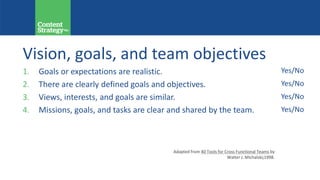
Vision, goals, and team objectives
1. Goals or expectations are realistic.
2. There are clearly defined goals and objectives.
3. Views, interests, and goals are similar.
4. Missions, goals, and tasks are clear and shared by the team.
Yes/No
Yes/No
Yes/No
Yes/No
Adapted from 40 Tools for Cross Functional Teams by
Walter J. Michalski;1998.
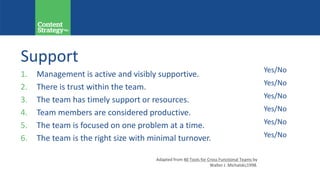
Support
1. Management is active and visibly supportive.
2. There is trust within the team.
3. The team has timely support or resources.
4. Team members are considered productive.
5. The team is focused on one problem at a time.
6. The team is the right size with minimal turnover.
Yes/No
Yes/No
Yes/No
Yes/No
Yes/No
Yes/No
Adapted from 40 Tools for Cross Functional Teams by
Walter J. Michalski;1998.
Share
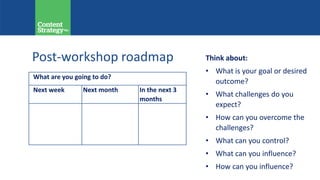
What are you going to do?
Next week Next month In the next 3
months
Think about:
• What is your goal or desired
outcome?
• What challenges do you
expect?
• How can you overcome the
challenges?
• What can you control?
• What can you influence?
• How can you influence?
Post-workshop roadmap
We need to
align people +
process.
“The most difficult thing is
the decision to act. The rest
is merely tenacity.”
~ AMELIA EARHART
Final activity
• Take a sheet of paper
• Write your name on the
paper (for a special draw!)
• Write down your top 3
insights
• Stand up
We need to
align people +
process.
Share…
• The insights you put into the circle
• The insights you took from the circle
• One thing you’re committed to doing
next week
Questions?
Short stories?
Things to do next week
1. Review these slides and your notes.
2. Think about your commitment for next week.
3. Take action!
4. Send us a tweet to let us know what you did:
@Team_CS_Inc #CSITeamwork
On our blog:
contentstrategyinc.com/articles/
• Understanding the content maturity model
• How to use a RACI chart to define content roles
• Content RACI templates
• Best practices for archiving and deleting content
Other resources
Let’s stay in touch!
Kathy Wagner and Melissa Breker
ContentStrategyInc.com
@Kathy_CS_Inc
@MelissaBreker
contentstrategyinc.com/content-teamwork/

Confab 2016: Content Teamwork Workshop