Chapter 9: PeopleLaura Cipolla
Veronica Painter
3/23/14
Social Media
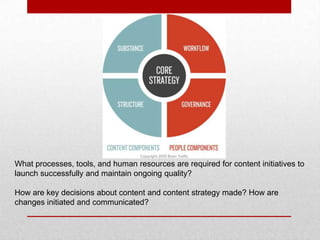
What processes, tools, and human resources are required for content initiatives to
launch successfully and maintain ongoing quality?
How are key decisions about content and content strategy made? How are
changes initiated and communicated?
★ Defining ownership and roles
★ Designing content processes
★ Documenting your processes
★ Making it all happen
Whose job is it?
Each person
MUST know
what their role
is.
Business Units
- Cross team
collaboration.
- If creating a new
business unit for
content strategy
cannot
happen, designate
a person or
several people to
have content
strategy as part of
their job.
INDIVIDUALS: RESPONSIBILITY
Web editor-in-chief: Helps establish and enforce all web
content policies, standards, and guidelines.
Web manager or editor: Plan and oversee the publication of
content.
Content creator: Responsible for producing
accurate, compelling text that clearly conveys messages to
the target audience and supports your content strategy
objectives.
Sourcing manager or curator: similar to web editors, but
also responsible for aggregating or curating content.
Individuals Cont’d
Search engine optimization (SEO) specialist: Analyzes
website’s business objectives, content, and intended audiences in
order to win prominent listings in results pages of web search
engines.
Subject matter expert (SME): Marketing and branding, product
development and operations, can be the business owners of the
content or someone with insights on how to get content right.
Reviewer and/or approver: Includes: subject matter
experts, product or service managers, legal counsel, etc.
Outsource or Hire?
Outsourcing:
Best if you:
- Want to focus on core
competencies rather than content
- Limited $
Requires:
- Collaborative spirit
- Short-term investing
You get:
- Content Expertise
- Fresh, objective perspective
- Cost savings
In-House
Best if you:
- If you are passionate about and have time to devote to content
- Have $ , time, understanding and approval to hire at least one
employee
- Ongoing need for content support
Requires:
- Alignment
- Empowerment
- Definition of roles
- $
You get:
- Full time content care
- Content expertise
- Deep organizational/product knowledge
Committees and Councils
Form councils or committees
Goal: ensure your content or content strategy stays aligned with
business goals and user needs.
Internal Advisory Council
- Asked to weigh in on content activities and decisions.
- Keeps people informed
- Participates in meetings w/ content team
- Discuss problems
Audience Advisory Committee
- Feedback
- Differ in size
- Incentives
- Representative of different groups
- Length of time in group pre-determined
- Trained on goals of organization
Designing Workflow and
Governance Processes
The content development process is complex
Four areas of focus:
- Create/source new content
- Maintain existing content
- Evaluate content effectiveness
- Govern strategies, plans, policies, and
procedures
CREATING AND SOURCING
CONTENT
- Original content creation
- Curated or aggregated content
- Content migration
Editorial Calendars
- Spreadsheet w/ future ideas and schedules current
content for publishing.
- Steps to create calendar
- Less is more
- Focus on top priorities
- Things to include (date, channel, content
element, etc.)
Maintaining Content
• Accuracy, consistency, timeliness and audience
relevance.
• Tools to carry out maintaining content:
- Content inventory
- Content maintenance
- Content maintenance log
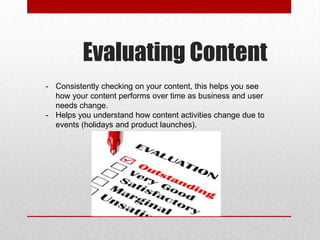
Evaluating Content
- Consistently checking on your content, this helps you see
how your content performs over time as business and user
needs change.
- Helps you understand how content activities change due to
events (holidays and product launches).
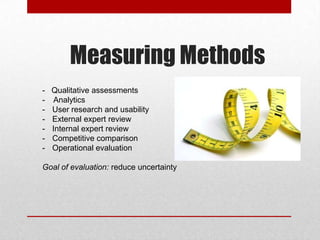
Measuring Methods
- Qualitative assessments
- Analytics
- User research and usability
- External expert review
- Internal expert review
- Competitive comparison
- Operational evaluation
Goal of evaluation: reduce uncertainty
Tasks for Evaluating
Content
- Define what content will be evaluated
- Define criteria by which the content will be evaluated
- Recruit reviewers
- Design evaluation
- Conduct evaluation
- Record results
- Analyze data
- Create report
- Communicate results
Tools: measurement scorecard – spreadsheet or similar tool that
helps stakeholders understand the results of your measurement
findings.
Governing Content
Create, Maintain & Update
- Core strategy
- Authority and ownership policies
- Processes and procedures
- Plans and priorities
- Content policies
- Guidelines
Tasks for governing content
Tools: style guide – guideline that ensures that content is
consistent, used by anyone who creates, reviews, edits, or
publishes content.
Examples: voice and tone guidelines, product trademark usage.
Documenting Your
Processes
- Determine a starting point
- Figure out a logical place for the process to end
- Identify all players from beginning to end of the process
- Sketch the tasks
- Identify interaction patterns among players and task
- Allocate timeframe for tasks
- Identify notification pattern: who needs to know what
- Identify approval patterns
- Determine all the “what ifs”
- Once all roles are identified, tasks are sketched, and
notification and approval patterns are identified, examine
your workflow to see if it can be simplified
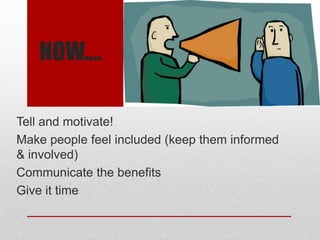
NOW….
Tell and motivate!
Make people feel included (keep them informed
& involved)
Communicate the benefits
Give it time

Social media ch.9 review

  • 1.
    Chapter 9: PeopleLauraCipolla Veronica Painter 3/23/14 Social Media
  • 2.
    What processes, tools,and human resources are required for content initiatives to launch successfully and maintain ongoing quality? How are key decisions about content and content strategy made? How are changes initiated and communicated?
  • 3.
    ★ Defining ownershipand roles ★ Designing content processes ★ Documenting your processes ★ Making it all happen
  • 4.
    Whose job isit? Each person MUST know what their role is.
  • 5.
    Business Units - Crossteam collaboration. - If creating a new business unit for content strategy cannot happen, designate a person or several people to have content strategy as part of their job.
  • 6.
    INDIVIDUALS: RESPONSIBILITY Web editor-in-chief:Helps establish and enforce all web content policies, standards, and guidelines. Web manager or editor: Plan and oversee the publication of content. Content creator: Responsible for producing accurate, compelling text that clearly conveys messages to the target audience and supports your content strategy objectives. Sourcing manager or curator: similar to web editors, but also responsible for aggregating or curating content.
  • 7.
    Individuals Cont’d Search engineoptimization (SEO) specialist: Analyzes website’s business objectives, content, and intended audiences in order to win prominent listings in results pages of web search engines. Subject matter expert (SME): Marketing and branding, product development and operations, can be the business owners of the content or someone with insights on how to get content right. Reviewer and/or approver: Includes: subject matter experts, product or service managers, legal counsel, etc.
  • 8.
  • 9.
    Outsourcing: Best if you: -Want to focus on core competencies rather than content - Limited $ Requires: - Collaborative spirit - Short-term investing You get: - Content Expertise - Fresh, objective perspective - Cost savings
  • 10.
    In-House Best if you: -If you are passionate about and have time to devote to content - Have $ , time, understanding and approval to hire at least one employee - Ongoing need for content support Requires: - Alignment - Empowerment - Definition of roles - $ You get: - Full time content care - Content expertise - Deep organizational/product knowledge
  • 11.
    Committees and Councils Formcouncils or committees Goal: ensure your content or content strategy stays aligned with business goals and user needs. Internal Advisory Council - Asked to weigh in on content activities and decisions. - Keeps people informed - Participates in meetings w/ content team - Discuss problems Audience Advisory Committee - Feedback - Differ in size - Incentives - Representative of different groups - Length of time in group pre-determined - Trained on goals of organization
  • 12.
    Designing Workflow and GovernanceProcesses The content development process is complex Four areas of focus: - Create/source new content - Maintain existing content - Evaluate content effectiveness - Govern strategies, plans, policies, and procedures
  • 13.
    CREATING AND SOURCING CONTENT -Original content creation - Curated or aggregated content - Content migration
  • 14.
    Editorial Calendars - Spreadsheetw/ future ideas and schedules current content for publishing. - Steps to create calendar - Less is more - Focus on top priorities - Things to include (date, channel, content element, etc.)
  • 15.
    Maintaining Content • Accuracy,consistency, timeliness and audience relevance. • Tools to carry out maintaining content: - Content inventory - Content maintenance - Content maintenance log
  • 16.
    Evaluating Content - Consistentlychecking on your content, this helps you see how your content performs over time as business and user needs change. - Helps you understand how content activities change due to events (holidays and product launches).
  • 17.
    Measuring Methods - Qualitativeassessments - Analytics - User research and usability - External expert review - Internal expert review - Competitive comparison - Operational evaluation Goal of evaluation: reduce uncertainty
  • 18.
    Tasks for Evaluating Content -Define what content will be evaluated - Define criteria by which the content will be evaluated - Recruit reviewers - Design evaluation - Conduct evaluation - Record results - Analyze data - Create report - Communicate results Tools: measurement scorecard – spreadsheet or similar tool that helps stakeholders understand the results of your measurement findings.
  • 19.
    Governing Content Create, Maintain& Update - Core strategy - Authority and ownership policies - Processes and procedures - Plans and priorities - Content policies - Guidelines Tasks for governing content Tools: style guide – guideline that ensures that content is consistent, used by anyone who creates, reviews, edits, or publishes content. Examples: voice and tone guidelines, product trademark usage.
  • 20.
    Documenting Your Processes - Determinea starting point - Figure out a logical place for the process to end - Identify all players from beginning to end of the process - Sketch the tasks - Identify interaction patterns among players and task - Allocate timeframe for tasks - Identify notification pattern: who needs to know what - Identify approval patterns - Determine all the “what ifs” - Once all roles are identified, tasks are sketched, and notification and approval patterns are identified, examine your workflow to see if it can be simplified
  • 21.
    NOW…. Tell and motivate! Makepeople feel included (keep them informed & involved) Communicate the benefits Give it time