Universal Design
CREATED

BY:

HEIDI
What is Universal Design
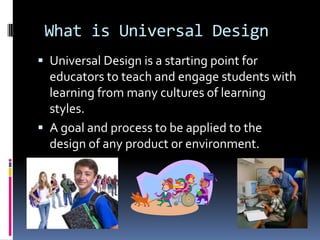
 Universal Design is a starting point for

educators to teach and engage students with
learning from many cultures of learning
styles.
 A goal and process to be applied to the
design of any product or environment.
3 Principles of Universal Design
 Principle 1: How does
the learner pick up on

the information?
 Principle 2: How do
learners express and
act on that
information?
 Principle 3: How are
learners engaged by
the learning situation?
Principle 1:
Provide Multiple Means of Representation
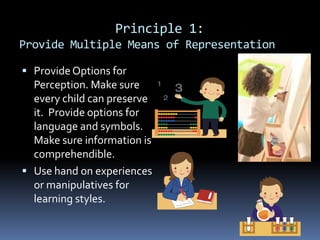
 Provide Options for

Perception. Make sure
every child can preserve
it. Provide options for
language and symbols.
Make sure information is
comprehendible.
 Use hand on experiences
or manipulatives for
learning styles.
Principle 2:
Provide multiple Means of Action and Expression

 Provide options for physical action. Provide
options for expressive skills and fluency as well

as options for executive functions.
 Allow students to show off what they know
skillfully in writing and through pictures.
 Allow goals to be made and met, as well as
monitoring own progress through out the class
room.
 https://www.youtube.com/watch?v=11164umpS
H0
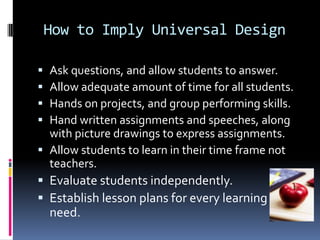
Principle 3:
Multiple Means of Engagement
 Provide options for
interest in all kinds of

learners. Not
everything interests all
students, must try new
ideas. Try to provide
options for effort and
persistence. Finally let
learners be self
regulated.
How to Imply Universal Design





Ask questions, and allow students to answer.
Allow adequate amount of time for all students.
Hands on projects, and group performing skills.
Hand written assignments and speeches, along
with picture drawings to express assignments.
 Allow students to learn in their time frame not
teachers.
 Evaluate students independently.
 Establish lesson plans for every learning

need.
Sources
 Burgstahler, S. (n.d.). Retrieved from

http://www.washington.edu/doit/Brochures/P
rograms/ud.html
 UDL Center. (n.d.). Retrieved from
https://www.youtube.com/watch?v=rfsx3DGp
v5o&feature=relmfu
 UDL Center. (n.d.). Retrieved from
https://www.youtube.com/watch?v=vr3ardm
q0a0&feature=relmfu

Heidi Beachler UDL Presentation

  • 1.
  • 2.
    What is UniversalDesign  Universal Design is a starting point for educators to teach and engage students with learning from many cultures of learning styles.  A goal and process to be applied to the design of any product or environment.
  • 3.
    3 Principles ofUniversal Design  Principle 1: How does the learner pick up on the information?  Principle 2: How do learners express and act on that information?  Principle 3: How are learners engaged by the learning situation?
  • 4.
    Principle 1: Provide MultipleMeans of Representation  Provide Options for Perception. Make sure every child can preserve it. Provide options for language and symbols. Make sure information is comprehendible.  Use hand on experiences or manipulatives for learning styles.
  • 5.
    Principle 2: Provide multipleMeans of Action and Expression  Provide options for physical action. Provide options for expressive skills and fluency as well as options for executive functions.  Allow students to show off what they know skillfully in writing and through pictures.  Allow goals to be made and met, as well as monitoring own progress through out the class room.  https://www.youtube.com/watch?v=11164umpS H0
  • 6.
    Principle 3: Multiple Meansof Engagement  Provide options for interest in all kinds of learners. Not everything interests all students, must try new ideas. Try to provide options for effort and persistence. Finally let learners be self regulated.
  • 7.
    How to ImplyUniversal Design     Ask questions, and allow students to answer. Allow adequate amount of time for all students. Hands on projects, and group performing skills. Hand written assignments and speeches, along with picture drawings to express assignments.  Allow students to learn in their time frame not teachers.  Evaluate students independently.  Establish lesson plans for every learning need.
  • 8.
    Sources  Burgstahler, S.(n.d.). Retrieved from http://www.washington.edu/doit/Brochures/P rograms/ud.html  UDL Center. (n.d.). Retrieved from https://www.youtube.com/watch?v=rfsx3DGp v5o&feature=relmfu  UDL Center. (n.d.). Retrieved from https://www.youtube.com/watch?v=vr3ardm q0a0&feature=relmfu