



Pablo Neruda
Prepared by Nishat H

I do not love you as if you were salt-rose, or topaz,
or the arrow of carnations the fire shoots off.
 This "love sonnet" opens with the speaker talking to his beloved.
 First, the speaker describes the ways in which he does not love this woman.
 Salt-rose most likely refers to a type of rose that grows near the ocean. Topaz is
a mineral that comes in a variety of colors. It's usually quite pretty.
 " arrow of carnations the fire shoots off “ The speaker is describing the
brightness of a carnation (a type of flower). He compares looking at the flower
to seeing an shiny arrow that's flaming like fire.
 What does the speaker mean by it all? Basically, he is saying that his love for
his paramour is not the same as the love one has for beautiful things like
precious metals and flowers.
 Because roses and carnations are are common symbols of love and
affection, the speaker might also be using this as a way to show the
uniqueness of his love. His love isn't any old rose or carnation. What is it then?
Close Reading
@nishiraa24

I love you as certain dark things are to be loved,
in secret, between the shadow and the soul.
 Now the speaker starts to describe the way in which
he does love his paramour. He loves her the way people
love "dark things," "in secret, between shadow and soul."
 Is this because his love is not ‘public’ – it is not something that he
feels he has to show off, it is a love that dwells deep inside him
and is very intimate and special to him?
 This secret place is external (like a shadow) but also deep
down inside (like a soul).
 It's also possible that Neruda is actually talking about loving
someone in secret – like an affair.
@nishiraa24

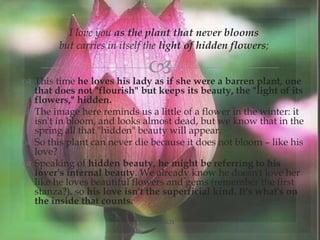
I love you as the plant that never blooms
but carries in itself the light of hidden flowers;
 This time he loves his lady as if she were a barren plant, one
that does not "flourish" but keeps its beauty, the "light of its
flowers," hidden.
 The image here reminds us a little of a flower in the winter: it
isn't in bloom, and looks almost dead, but we know that in the
spring all that "hidden" beauty will appear.
 So this plant can never die because it does not bloom – like his
love?
 Speaking of hidden beauty, he might be referring to his
lover's internal beauty. We already know he doesn't love her
like he loves beautiful flowers and gems (remember the first
stanza?), so his love isn't the superficial kind. It's what's on
the inside that counts.
@nishiraa24

thanks to your love a certain solid fragrance,
risen from the earth, lives darkly in my body.
 As a result of the paramour’s love, a "quickening aroma"
now lives "darkly" (or secretly) within the speaker.
 It sounds like the speaker is describing a plant sprouting
from the earth; probably that barren plant we met before.
The aroma that results from the new growth of a plant
becomes a metaphor to describe the feeling of love. New
love, perhaps.
 Being loved by somebody is like smelling a new flower. And
apparently Neruda likes the secretive parts of new love.
He's not shouting it from the rooftops; instead, he's
carrying the feeling inside him.
 We notice here that Neruda is invoking the sense of smell.
This is a very sensory poem: he also references sight and
touch quite a bit (can you find those lines?). You'll notice
that all of our “symbols" are sensory ones!
@nishiraa24

I love you without knowing how, or when, or from where.
I love you straightforwardly, without complexities or pride;
so I love you because I know no other way
The speaker loves this woman, plain and simple. He doesn’t know the
specifics; he "simply" loves her.
Is the speaker suggesting that he can’t explain why he loves the paramour?
This is a common problem we all have. It's not easy to define love or to
explain it away – we just feel it, right?
Without complexities or pride - it seems to be some kind of comment on the
purity of the speaker’s love: he's humble and his love is legit.
The idea of having "no pride" in love will pop up again later in the poem, so
keep it in mind.
The ninth line of a Petrarchan sonnet is usually supposed to change the
direction of the poem. Sometimes it offers a resolution to the problems posed
in the first eight lines, or it just marks a shift in tone. It is often called
the volta (in Italian), or turn
@nishiraa24

that this: where I does not exist, nor you,
so close that your hand on my chest is my hand,
so close that your eyes close as I fall asleep.
The speaker explains why he loves his paramour the way he does.
Answer? Because it's the only way he knows how. He can only love
when "I am not and you are not."
This sounds like a very powerful love in which the two lovers become
one person; they cease to be their individual selves and instead become
one.
Without any pride in a relationship, the two individuals are able to
forget about their own self-interests and focus on the couple instead.
You'll also notice that this is the third time the words "I love you" have
opened a line in the poem. This repetition of words at the beginnings of
lines is called anaphora. What effect does it have on the poem?
@nishiraa24
The speaker further describes the way he loves: he and his
paramour are so close that her hand is his, and her eyes see
his dreams.
Obviously this is physically impossible, but it’s the speaker’s
beautifully metaphorical way of describing the ways in
which lovers are connected or a part of each other.
It is a love in which there are no barriers; the speaker and his
paramour are completely open with each other; They have
no secrets.
Notice that each of the final two lines of the poem start with
the words "So close". This is another instance of anaphora .
Why do you think Neruda chose to do this? And why now,
at the end of the poem?
@nishiraa24

 The major theme in this poem is love. Love can be
felt in many levels and Neruda uses a very
straightforward technique that is very effective.
Neruda does a wonderful job of showing a love
poem does not have to be about flowers and
rainbows for it to be effective. He is able to make this
poem very real and focus on the human psyche of a
man and love.

@nishiraa24
 Vivid images inspired by nature
 The Romantic element of the poem rather than
modern style
 Poet’s emphasis on “ powerful feelings and emotion
over reason”
 The paradoxical nature of love
 Poet’s example from nature to display the complex
nature of love or love is both simple and complex.
 Tone : Intimate, passionate and very loving
 Literary Devices: Similes, sensory images , anaphora,
metaphors and symbols.
Quick review
@nishiraa24

The Italian or Petrarchan sonnet consists of two parts; an OCTAVE and a
SESTET.
The octave can be broken down into two QUATRAINTS; likewise, the
sestet is made up of two TERCETS. The octave presents an idea to be
contrasted by the ending sestet.
The particular quatrains and tercets are divided by change in rhyme.
Petrarch typically used an ABBA ABBA pattern for the octave, followed
by either CDE CDE or CDC DCD rhymes in the sestet
What is the difference between a Shakespeare and petrarchan sonnet?
The Italian or Petrarchan sonnet consists of two parts; an octave and a
sestet. The octave can be broken down into two quatrains; likewise, the
sestet is made up of two tercets. The English or Shakespearean sonnet,
consists of three quatrains and a concluding couplet.
@nishiraa24

The English or Shakespearean sonnet, consists of three quatrains and a
concluding COUPLET. The rhyme scheme is a simple ABAB CDCD
EFEF GG format.
Like Petrarch, Shakespeare used structure to explore the multiple
facets of a theme in a short piece. In petrarchan sonnet, the focus shifts
at the break between octave and sestet.
Neruda’s poem follows the Petrarchan form of sonnets in that it is
divided into and 8-line introduction and a 6-line resolution. The first 8
lines discuss the narrator’s love in dark but delicate terms that leave
something to be desired- as if he cannot quite find the words. The last
6 lines address the narrator’s love directly and starkly.
@nishiraa24

The change in the rhyme scheme makes the sonnet his. Neruda changes
the form to harmonize it to the tone of the sonnet. Neruda's sonnet
express the emotion of love in a unique fashion, which contradicts
traditional love sonnets like, Shall I compare thee to a summer's day?
Neruda is not comparing love to a summer's day; instead, he describes
love as a powerful emotion kept within the darkness of the soul. The fact
the Neruda decides to break away from the traditional rhyme pattern
parallels the theme of his anti-traditional love sonnet.
The one aspect of this sonnet that is enjoyable the most is the break away
from the traditional love poem. The traditional love poem has become
cliché and to read a modern poet write in the same fashion is unoriginal.
This sonnet broke away from the traditional template and created voyage
into the human spirit where love grows. Neruda's originality makes one
love this poem.
@nishiraa24

The modern sonnet has evolved from its very structured form to a
variation of forms that display the characteristics of the sonnet. Pablo
Neruda's Sonnet XVII is a wonderful example of how the sonnet has
evolved
This poem is beautiful despite its dark and twisted nature. Neruda
describes his love as covetous and dark, yet incredibly intimate. His love
is not like a burning passion(2), but is hidden in the place “between the
shadow and the soul” (4).
The first 8 lines of the poem are very dark and harsh, but
the last 6 are soft and gentle. The narrator exposes his emotions in
a struggle to put a definition to his love. He fails, ultimately, to confine
his love to just a few words, and instead creates the incredibly romantic
and slightly possessive sentiment that love is not passion for another,
but is knowing another soul as your own self and humbling yourself to
admit it.
@nishiraa24
 Discuss how Pablo Neruda uses darkness to describe his love towards his
beloved.
 In Sonnet 43, what does the speaker's definition of love reveal about the
character of the speaker herself?
 In Sonnet 17, why does the speaker start off by listing the ways
he doesn'tlove his beloved? Explain the paradoxical nature of love
manifested in the poem. Provide examples from the poem
 Sonnet 18 is one of the most famous poems in the English language. Why
do you think this is the case? How does the speaker use natural imagery to
create a picture of the beloved’s beauty?
 “So long as men can breathe or eyes can see,
So long lives this, and this gives life to thee. “ – Explain these lines in the
context of Sonnet XVIII. Do you think that the speaker has been successful
in immortalizing his love in the words of this poem?
Questions on Sonnets
@nishiraa24

 Compare and contrast the 3 sonnets in terms of :
-structure & form
- use of poetic devices
- message/ purpose of the poem
Activity
@nishiraa24

Sonnet xvii--prepared by nishat h

  • 1.
  • 2.
     I do notlove you as if you were salt-rose, or topaz, or the arrow of carnations the fire shoots off.  This "love sonnet" opens with the speaker talking to his beloved.  First, the speaker describes the ways in which he does not love this woman.  Salt-rose most likely refers to a type of rose that grows near the ocean. Topaz is a mineral that comes in a variety of colors. It's usually quite pretty.  " arrow of carnations the fire shoots off “ The speaker is describing the brightness of a carnation (a type of flower). He compares looking at the flower to seeing an shiny arrow that's flaming like fire.  What does the speaker mean by it all? Basically, he is saying that his love for his paramour is not the same as the love one has for beautiful things like precious metals and flowers.  Because roses and carnations are are common symbols of love and affection, the speaker might also be using this as a way to show the uniqueness of his love. His love isn't any old rose or carnation. What is it then? Close Reading @nishiraa24
  • 3.
     I love youas certain dark things are to be loved, in secret, between the shadow and the soul.  Now the speaker starts to describe the way in which he does love his paramour. He loves her the way people love "dark things," "in secret, between shadow and soul."  Is this because his love is not ‘public’ – it is not something that he feels he has to show off, it is a love that dwells deep inside him and is very intimate and special to him?  This secret place is external (like a shadow) but also deep down inside (like a soul).  It's also possible that Neruda is actually talking about loving someone in secret – like an affair. @nishiraa24
  • 4.
     I love youas the plant that never blooms but carries in itself the light of hidden flowers;  This time he loves his lady as if she were a barren plant, one that does not "flourish" but keeps its beauty, the "light of its flowers," hidden.  The image here reminds us a little of a flower in the winter: it isn't in bloom, and looks almost dead, but we know that in the spring all that "hidden" beauty will appear.  So this plant can never die because it does not bloom – like his love?  Speaking of hidden beauty, he might be referring to his lover's internal beauty. We already know he doesn't love her like he loves beautiful flowers and gems (remember the first stanza?), so his love isn't the superficial kind. It's what's on the inside that counts. @nishiraa24
  • 5.
     thanks to yourlove a certain solid fragrance, risen from the earth, lives darkly in my body.  As a result of the paramour’s love, a "quickening aroma" now lives "darkly" (or secretly) within the speaker.  It sounds like the speaker is describing a plant sprouting from the earth; probably that barren plant we met before. The aroma that results from the new growth of a plant becomes a metaphor to describe the feeling of love. New love, perhaps.  Being loved by somebody is like smelling a new flower. And apparently Neruda likes the secretive parts of new love. He's not shouting it from the rooftops; instead, he's carrying the feeling inside him.  We notice here that Neruda is invoking the sense of smell. This is a very sensory poem: he also references sight and touch quite a bit (can you find those lines?). You'll notice that all of our “symbols" are sensory ones! @nishiraa24
  • 6.
     I love youwithout knowing how, or when, or from where. I love you straightforwardly, without complexities or pride; so I love you because I know no other way The speaker loves this woman, plain and simple. He doesn’t know the specifics; he "simply" loves her. Is the speaker suggesting that he can’t explain why he loves the paramour? This is a common problem we all have. It's not easy to define love or to explain it away – we just feel it, right? Without complexities or pride - it seems to be some kind of comment on the purity of the speaker’s love: he's humble and his love is legit. The idea of having "no pride" in love will pop up again later in the poem, so keep it in mind. The ninth line of a Petrarchan sonnet is usually supposed to change the direction of the poem. Sometimes it offers a resolution to the problems posed in the first eight lines, or it just marks a shift in tone. It is often called the volta (in Italian), or turn @nishiraa24
  • 7.
     that this: whereI does not exist, nor you, so close that your hand on my chest is my hand, so close that your eyes close as I fall asleep. The speaker explains why he loves his paramour the way he does. Answer? Because it's the only way he knows how. He can only love when "I am not and you are not." This sounds like a very powerful love in which the two lovers become one person; they cease to be their individual selves and instead become one. Without any pride in a relationship, the two individuals are able to forget about their own self-interests and focus on the couple instead. You'll also notice that this is the third time the words "I love you" have opened a line in the poem. This repetition of words at the beginnings of lines is called anaphora. What effect does it have on the poem? @nishiraa24
  • 8.
    The speaker furtherdescribes the way he loves: he and his paramour are so close that her hand is his, and her eyes see his dreams. Obviously this is physically impossible, but it’s the speaker’s beautifully metaphorical way of describing the ways in which lovers are connected or a part of each other. It is a love in which there are no barriers; the speaker and his paramour are completely open with each other; They have no secrets. Notice that each of the final two lines of the poem start with the words "So close". This is another instance of anaphora . Why do you think Neruda chose to do this? And why now, at the end of the poem? @nishiraa24
  • 9.
      The majortheme in this poem is love. Love can be felt in many levels and Neruda uses a very straightforward technique that is very effective. Neruda does a wonderful job of showing a love poem does not have to be about flowers and rainbows for it to be effective. He is able to make this poem very real and focus on the human psyche of a man and love.  @nishiraa24
  • 10.
     Vivid imagesinspired by nature  The Romantic element of the poem rather than modern style  Poet’s emphasis on “ powerful feelings and emotion over reason”  The paradoxical nature of love  Poet’s example from nature to display the complex nature of love or love is both simple and complex.  Tone : Intimate, passionate and very loving  Literary Devices: Similes, sensory images , anaphora, metaphors and symbols. Quick review @nishiraa24
  • 11.
     The Italian orPetrarchan sonnet consists of two parts; an OCTAVE and a SESTET. The octave can be broken down into two QUATRAINTS; likewise, the sestet is made up of two TERCETS. The octave presents an idea to be contrasted by the ending sestet. The particular quatrains and tercets are divided by change in rhyme. Petrarch typically used an ABBA ABBA pattern for the octave, followed by either CDE CDE or CDC DCD rhymes in the sestet What is the difference between a Shakespeare and petrarchan sonnet? The Italian or Petrarchan sonnet consists of two parts; an octave and a sestet. The octave can be broken down into two quatrains; likewise, the sestet is made up of two tercets. The English or Shakespearean sonnet, consists of three quatrains and a concluding couplet. @nishiraa24
  • 12.
     The English orShakespearean sonnet, consists of three quatrains and a concluding COUPLET. The rhyme scheme is a simple ABAB CDCD EFEF GG format. Like Petrarch, Shakespeare used structure to explore the multiple facets of a theme in a short piece. In petrarchan sonnet, the focus shifts at the break between octave and sestet. Neruda’s poem follows the Petrarchan form of sonnets in that it is divided into and 8-line introduction and a 6-line resolution. The first 8 lines discuss the narrator’s love in dark but delicate terms that leave something to be desired- as if he cannot quite find the words. The last 6 lines address the narrator’s love directly and starkly. @nishiraa24
  • 13.
     The change inthe rhyme scheme makes the sonnet his. Neruda changes the form to harmonize it to the tone of the sonnet. Neruda's sonnet express the emotion of love in a unique fashion, which contradicts traditional love sonnets like, Shall I compare thee to a summer's day? Neruda is not comparing love to a summer's day; instead, he describes love as a powerful emotion kept within the darkness of the soul. The fact the Neruda decides to break away from the traditional rhyme pattern parallels the theme of his anti-traditional love sonnet. The one aspect of this sonnet that is enjoyable the most is the break away from the traditional love poem. The traditional love poem has become cliché and to read a modern poet write in the same fashion is unoriginal. This sonnet broke away from the traditional template and created voyage into the human spirit where love grows. Neruda's originality makes one love this poem. @nishiraa24
  • 14.
     The modern sonnethas evolved from its very structured form to a variation of forms that display the characteristics of the sonnet. Pablo Neruda's Sonnet XVII is a wonderful example of how the sonnet has evolved This poem is beautiful despite its dark and twisted nature. Neruda describes his love as covetous and dark, yet incredibly intimate. His love is not like a burning passion(2), but is hidden in the place “between the shadow and the soul” (4). The first 8 lines of the poem are very dark and harsh, but the last 6 are soft and gentle. The narrator exposes his emotions in a struggle to put a definition to his love. He fails, ultimately, to confine his love to just a few words, and instead creates the incredibly romantic and slightly possessive sentiment that love is not passion for another, but is knowing another soul as your own self and humbling yourself to admit it. @nishiraa24
  • 15.
     Discuss howPablo Neruda uses darkness to describe his love towards his beloved.  In Sonnet 43, what does the speaker's definition of love reveal about the character of the speaker herself?  In Sonnet 17, why does the speaker start off by listing the ways he doesn'tlove his beloved? Explain the paradoxical nature of love manifested in the poem. Provide examples from the poem  Sonnet 18 is one of the most famous poems in the English language. Why do you think this is the case? How does the speaker use natural imagery to create a picture of the beloved’s beauty?  “So long as men can breathe or eyes can see, So long lives this, and this gives life to thee. “ – Explain these lines in the context of Sonnet XVIII. Do you think that the speaker has been successful in immortalizing his love in the words of this poem? Questions on Sonnets @nishiraa24
  • 16.
      Compare andcontrast the 3 sonnets in terms of : -structure & form - use of poetic devices - message/ purpose of the poem Activity @nishiraa24