Conditional sentences
Conditional sentences are sometimes confusing for learners of English as a
second language.
Watch out:
1. Which type of conditional sentences is it?
2. Where is the if-clause (e.g. at the beginning or at the end of the conditional
sentence)?
There are three types of conditional sentences.
type condition
I condition possible to fulfill
II condition in theory possible to fulfill
III condition not possible to fulfill (too late)
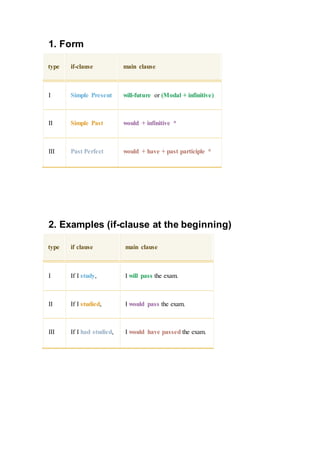
1. Form
type if-clause main clause
I Simple Present will-future or (Modal + infinitive)
II Simple Past would + infinitive *
III Past Perfect would + have + past participle *
2. Examples (if-clause at the beginning)
type if clause main clause
I If I study, I will pass the exam.
II If I studied, I would pass the exam.
III If I had studied, I would have passed the exam.
3. Examples (if-clause at the end)
type main clause if-clause
I I will pass the exam if I study.
II I would pass the exam if I studied.
III I would have passed the exam if I had studied.
4. Examples (affirmative and negative
sentences)
type Examples
long forms short/contracted forms
I
+ If I study, I will pass the exam. If I study, I'll pass the exam.
-
If I study, I will not fail the
exam.
If I do not study, I will fail the
exam.
If I study, I won't fail the exam.
If I don't study, I'll fail the
exam.
type Examples
long forms short/contracted forms
II
+
If I studied, I would pass the
exam.
If I studied, I'd pass the exam.
-
If I studied, I would not
fail the exam.
If I did not study, I would
fail the exam.
If I studied, I wouldn't fail the
exam.
If I didn't study, I'd fail the
exam.
III
+
If I had studied, I would have
passedthe exam.
If I'd studied, I'd have
passedthe exam.
-
If I had studied, I would not
have failed the exam.
If I had not studied, I would
have failed the exam.
If I'd studied, I wouldn't have
failed the exam.
If I hadn't studied, I'd have
failed the exam.
* We can substitute could or might for would (should, may or must are
sometimes possible, too).
 I would pass the exam.
 I could pass the exam.
 I might pass the exam.
 I may pass the exam.
 I should pass the exam.
 I must pass the exam.
Uses of the Conditional
1. First conditional
a. Nature: Open condition, what is said in the condition is
possible.
b. Time: This condition refers either to present or to future
time.
e.g. If he is late, we will have to go without him.
If my mother knows about this, we are in serious trouble.
2. Second conditional
a. Nature: unreal (impossible) or improbable situations.
b. Time: present; the TENSE is past, but we are talking about
the present, now.
e.g. If I knew her name, I would tell you.
If I were you, I would tell my father.
Compare: If I become president, I will change the social
security system. (Said by a presidential candidate)
If I became president, I would change the social security
system. (Said by a schoolboy: improbable)
If we win this match, we are qualified for the semifinals.
If I won a million pounds, I would stop teaching.
(improbable)
3. Third conditional
a. Nature: unreal
b. Time: Past (so we are talking about a situation that
was not so in the past.)
e.g. If you had warned me, I would not have told your
father about that party.(But you didn't, and I have).
Exercise 1
1. If you practice your English often, (to improve)
2. If I looked like him, (to be)
3. If we had taken the earlier train, (to arrive)
4. If it rains on their wedding day, (to cancel)
5. If you read this English book, (to learn)
6. If she had practiced speaking, (to pass)
7. If they cheated in the test, (to report)
8. If you eat too much chocolate, (to get)
9. If I take more classes, (to do)
10. If the motorway had been less busy, (to get)
11. If you look at the picture closely, (to see)
12. If he had asked me for the pen, (to give)
Exercise 2
1. They will buy the textbook… (to recommend)
2. You would learn more… (to study)
3. I will get the new car… (to be)
4. He gets very angry… (to talk)
5. We would be happier… (to have)
6. Luke would have passed the exam… (to practice)
7. He will pass next time… (to take)
8. I would have liked the book… (to be)
9. The cat purrs… (to stroke)
10. People in Brighton will get upset… (to rain)
11. They would tell us… (to want)
12. It would have been beautiful… (to work)

Conditional

  • 1.
    Conditional sentences Conditional sentencesare sometimes confusing for learners of English as a second language. Watch out: 1. Which type of conditional sentences is it? 2. Where is the if-clause (e.g. at the beginning or at the end of the conditional sentence)? There are three types of conditional sentences. type condition I condition possible to fulfill II condition in theory possible to fulfill III condition not possible to fulfill (too late)
  • 2.
    1. Form type if-clausemain clause I Simple Present will-future or (Modal + infinitive) II Simple Past would + infinitive * III Past Perfect would + have + past participle * 2. Examples (if-clause at the beginning) type if clause main clause I If I study, I will pass the exam. II If I studied, I would pass the exam. III If I had studied, I would have passed the exam.
  • 3.
    3. Examples (if-clauseat the end) type main clause if-clause I I will pass the exam if I study. II I would pass the exam if I studied. III I would have passed the exam if I had studied. 4. Examples (affirmative and negative sentences) type Examples long forms short/contracted forms I + If I study, I will pass the exam. If I study, I'll pass the exam. - If I study, I will not fail the exam. If I do not study, I will fail the exam. If I study, I won't fail the exam. If I don't study, I'll fail the exam.
  • 4.
    type Examples long formsshort/contracted forms II + If I studied, I would pass the exam. If I studied, I'd pass the exam. - If I studied, I would not fail the exam. If I did not study, I would fail the exam. If I studied, I wouldn't fail the exam. If I didn't study, I'd fail the exam. III + If I had studied, I would have passedthe exam. If I'd studied, I'd have passedthe exam. - If I had studied, I would not have failed the exam. If I had not studied, I would have failed the exam. If I'd studied, I wouldn't have failed the exam. If I hadn't studied, I'd have failed the exam. * We can substitute could or might for would (should, may or must are sometimes possible, too).  I would pass the exam.  I could pass the exam.  I might pass the exam.  I may pass the exam.  I should pass the exam.  I must pass the exam.
  • 5.
    Uses of theConditional 1. First conditional a. Nature: Open condition, what is said in the condition is possible. b. Time: This condition refers either to present or to future time. e.g. If he is late, we will have to go without him. If my mother knows about this, we are in serious trouble. 2. Second conditional a. Nature: unreal (impossible) or improbable situations. b. Time: present; the TENSE is past, but we are talking about the present, now. e.g. If I knew her name, I would tell you. If I were you, I would tell my father. Compare: If I become president, I will change the social security system. (Said by a presidential candidate) If I became president, I would change the social security system. (Said by a schoolboy: improbable) If we win this match, we are qualified for the semifinals. If I won a million pounds, I would stop teaching. (improbable) 3. Third conditional a. Nature: unreal b. Time: Past (so we are talking about a situation that was not so in the past.) e.g. If you had warned me, I would not have told your father about that party.(But you didn't, and I have). Exercise 1 1. If you practice your English often, (to improve) 2. If I looked like him, (to be) 3. If we had taken the earlier train, (to arrive) 4. If it rains on their wedding day, (to cancel) 5. If you read this English book, (to learn) 6. If she had practiced speaking, (to pass) 7. If they cheated in the test, (to report) 8. If you eat too much chocolate, (to get)
  • 6.
    9. If Itake more classes, (to do) 10. If the motorway had been less busy, (to get) 11. If you look at the picture closely, (to see) 12. If he had asked me for the pen, (to give) Exercise 2 1. They will buy the textbook… (to recommend) 2. You would learn more… (to study) 3. I will get the new car… (to be) 4. He gets very angry… (to talk) 5. We would be happier… (to have) 6. Luke would have passed the exam… (to practice) 7. He will pass next time… (to take) 8. I would have liked the book… (to be) 9. The cat purrs… (to stroke) 10. People in Brighton will get upset… (to rain) 11. They would tell us… (to want) 12. It would have been beautiful… (to work)