Andrea Miller-Nesbitt
April, 2015
The	
  role	
  of	
  libraries	
  in	
  suppor0ng	
  
teaching	
  and	
  research	
  in	
  the	
  sciences	
  
How	
  can	
  academic	
  libraries	
  best	
  
respond	
  to	
  the	
  needs	
  of	
  science	
  
faculty	
  and	
  students	
  taking	
  into	
  
account	
  new	
  trends	
  in	
  scholarly	
  
communica0on	
  and	
  teaching?	
  
Open science
“Open	
  science	
  is	
  the	
  idea	
  that	
  scien0fic	
  
knowledge	
  of	
  all	
  kinds	
  should	
  be	
  openly	
  
shared	
  as	
  early	
  as	
  is	
  prac0cal	
  in	
  the	
  
discovery	
  process.”	


Michael	
  Nielson	
  
Gezelter,	
  D.	
  (2011)	
  
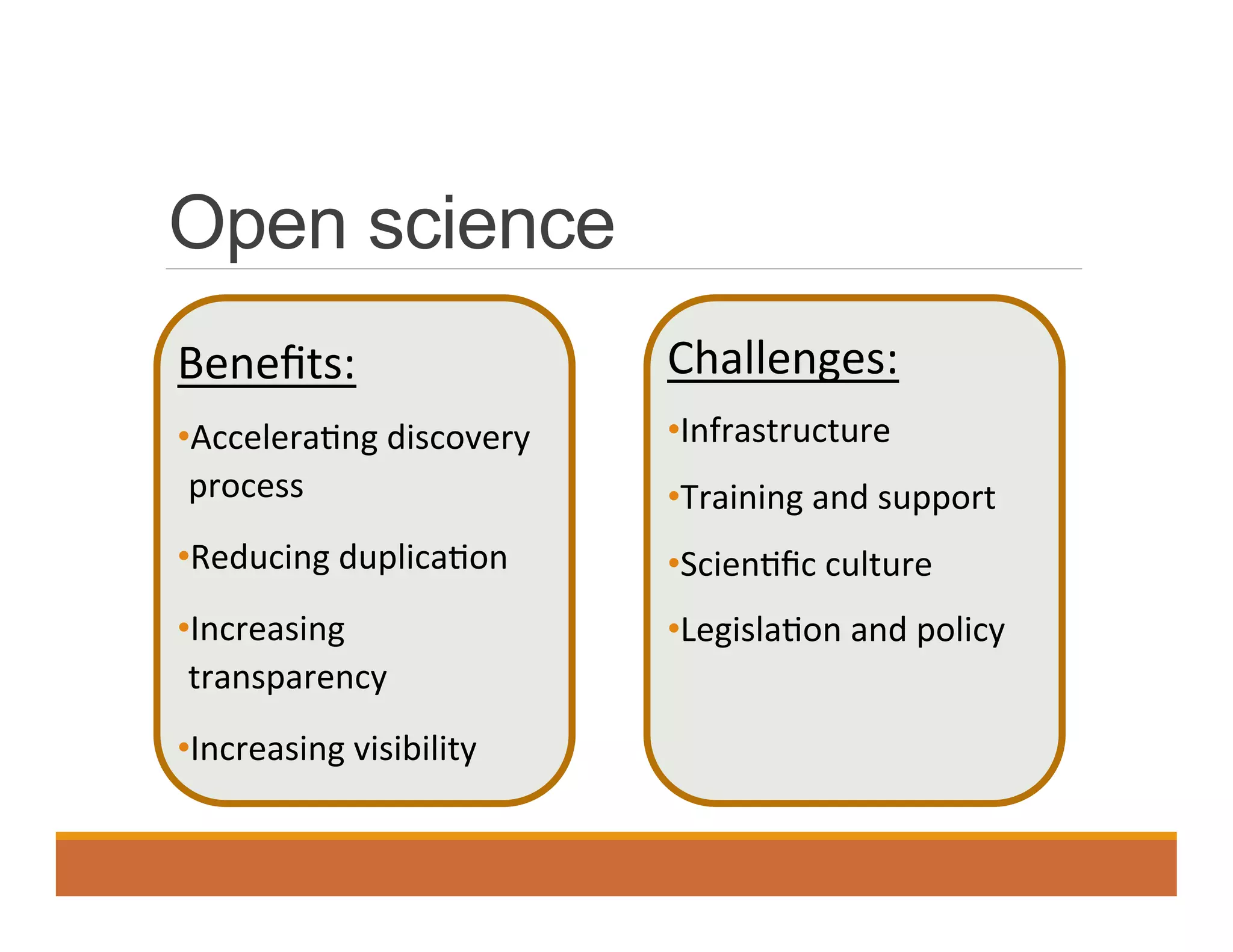
Open science
Benefits:	
  
• Accelera0ng	
  discovery	
  
process	
  
• Reducing	
  duplica0on	
  
• Increasing	
  
transparency	
  
• Increasing	
  visibility	
  
Challenges:	
  
• Infrastructure	
  
• Training	
  and	
  support	
  
• Scien0fic	
  culture	
  
• Legisla0on	
  and	
  policy	
  
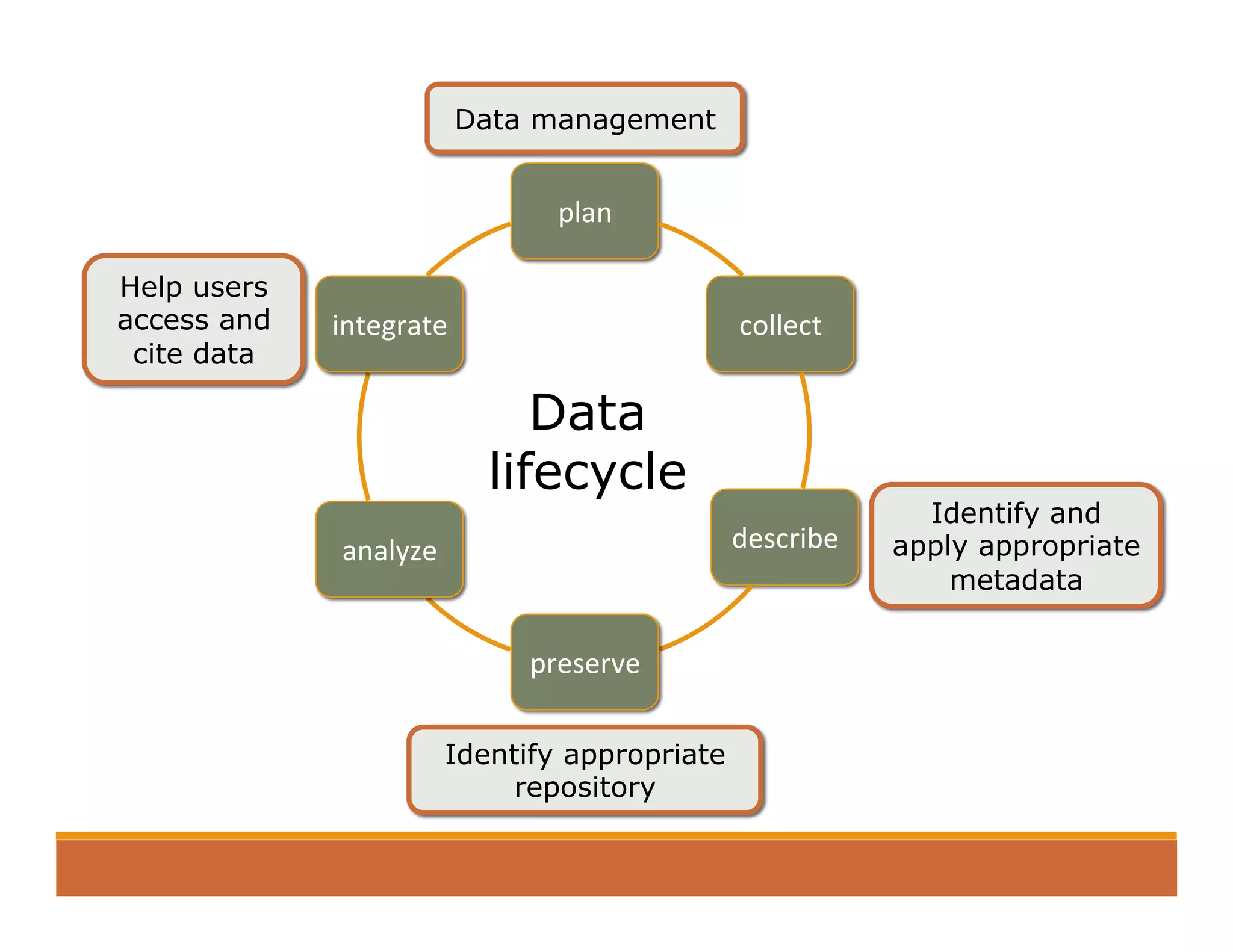
plan	
  
collect	
  
describe	
  
preserve	
  
analyze	
  
integrate	
  
Data
lifecycle
Data management
Identify and
apply appropriate
metadata
Identify appropriate
repository
Help users
access and
cite data
Open science
Open access
	
   Tri-­‐Agency	
  Open	
  Access	
  Policy	
  on	
  Publica0ons	
  
CIHR	
  
NSERC	
  
SSHRC	
  
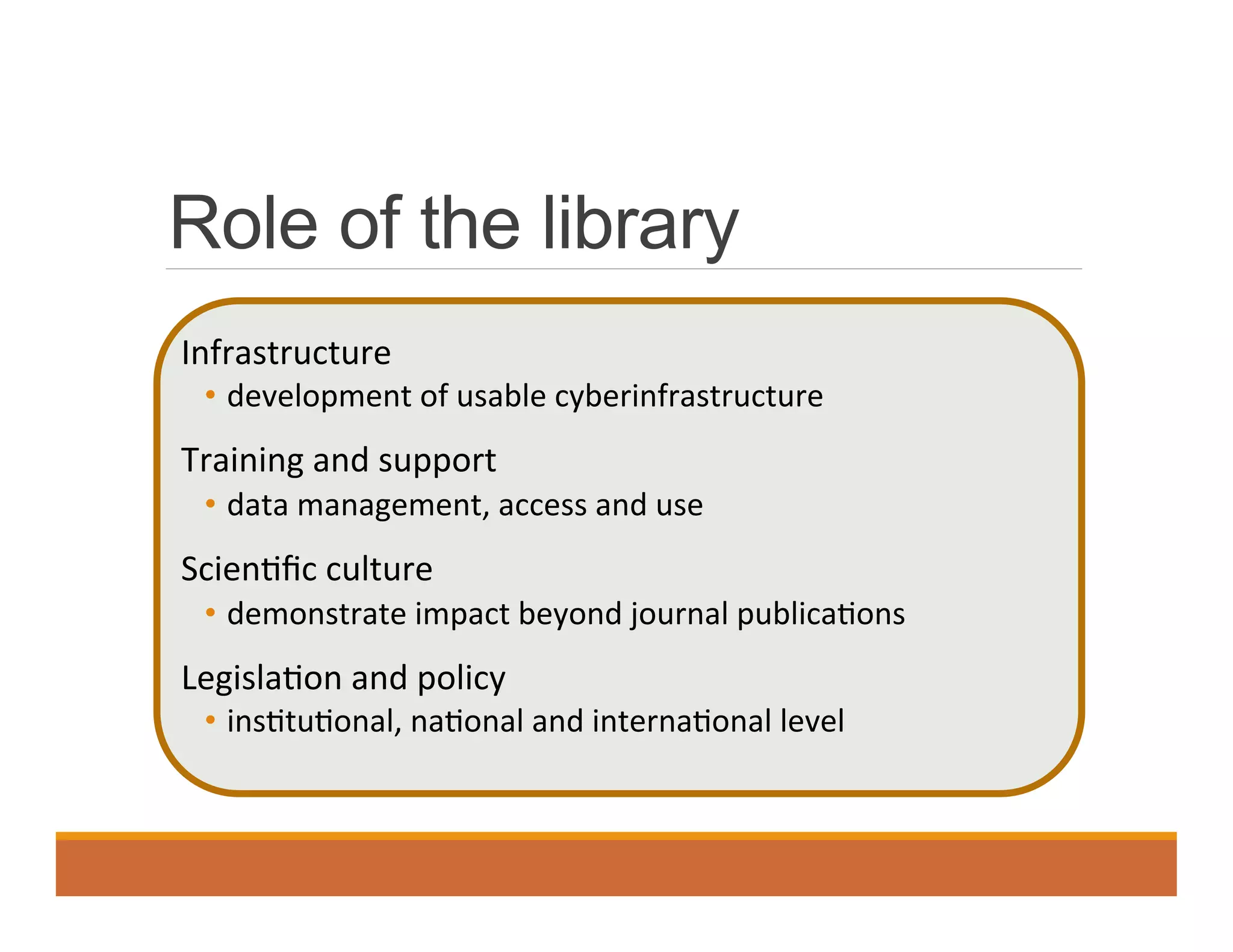
Role of the library
Infrastructure	
  
•  development	
  of	
  usable	
  cyberinfrastructure	
  	
  
Training	
  and	
  support	
  
•  data	
  management,	
  access	
  and	
  use	
  
Scien0fic	
  culture	
  
•  demonstrate	
  impact	
  beyond	
  journal	
  publica0ons	
  
Legisla0on	
  and	
  policy	
  
•  ins0tu0onal,	
  na0onal	
  and	
  interna0onal	
  level	
  	
  
Open education
	
  
Pedagogical	
  philosophy	
  that	
  aims	
  to	
  
improve	
  educa0onal	
  experiences	
  and	
  
increase	
  student	
  achievement	
  through	
  
reducing	
  barriers	
  to	
  	
  
higher	
  educa0on.	
  
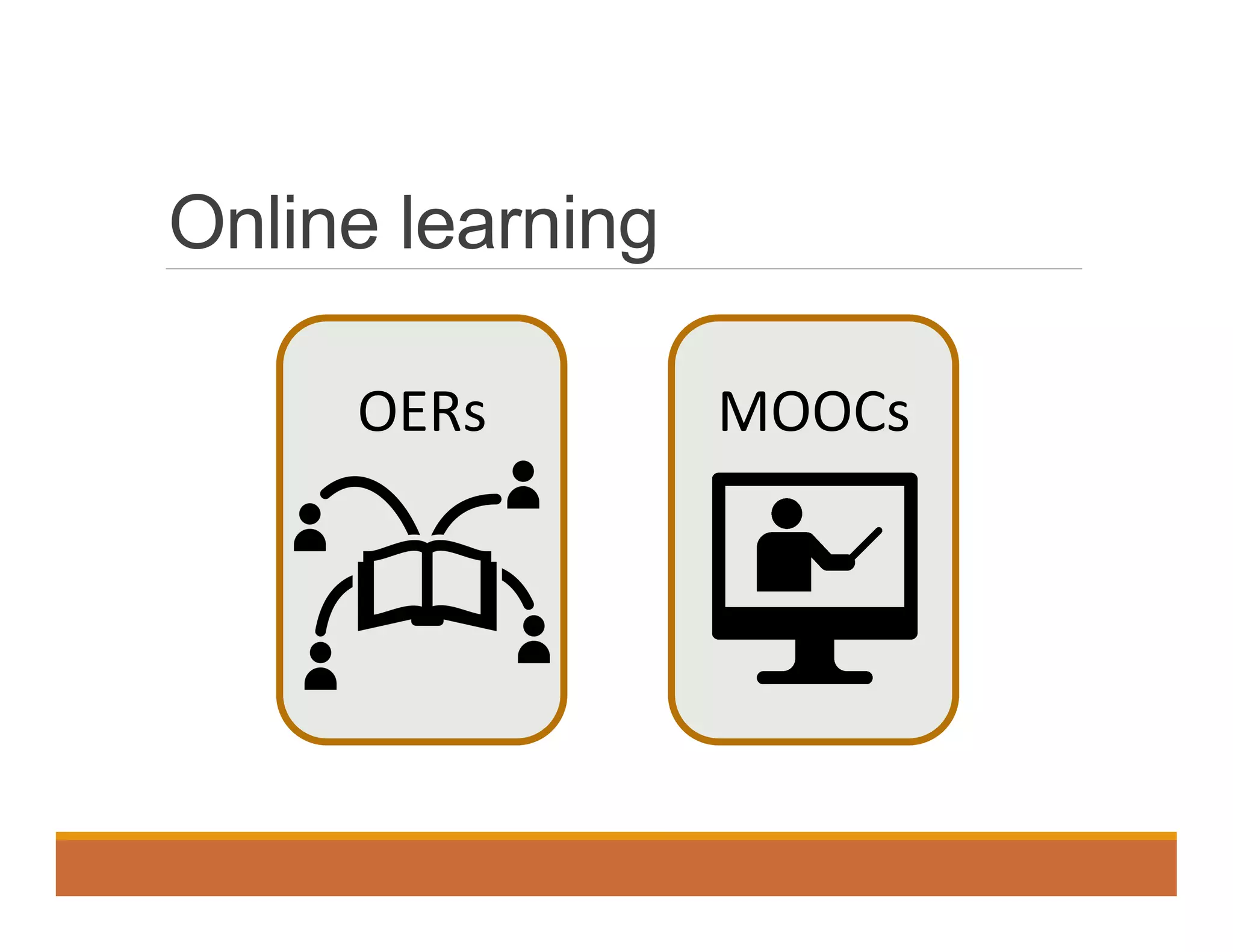
Online learning
MOOCs	


OERs	


Universal Design for
Learning
	
   A	
  framework	
  used	
  to	
  guide	
  the	
  
instruc0onal	
  goals,	
  method,	
  materials	
  and	
  
assessment	
  in	
  order	
  to	
  improve	


   and	
  op0mize	
  learning	
  for	


   all	
  people.	


Role of the library
Open	
  textbooks	
  
•  Increase	
  awareness	
  on	
  campus	
  by	
  collabora0ng	
  with	
  
instructors	
  and	
  other	
  campus	
  departments	
  	
  
•  Support	
  the	
  adop0on	
  of	
  open	
  textbooks	
  
•  Deposit	
  faculty	
  authored	
  OERs	
  in	
  ins0tu0onal	
  repositories	
  
Massive	
  Open	
  Online	
  Courses	
  
•  Iden0fy	
  and	
  locate	
  teaching	
  materials	
  
•  Navigate	
  copyright	
  issues	
  
•  Understand	
  content	
  licensing	
  op0ons	
  
•  Ensure	
  accessibility	
  of	
  course	
  content	
  
Andrea Miller-Nesbitt
andreaemn@gmail.com	
  	
  
Selected references
	
    Bell,	
  S.	
  (2010).	
  Textbook	
  turmoil:	
  The	
  library's	
  role	
  in	
  the	
  textbook	
  revolu0on.	
  Library	
  Issues,	
  31(1),	
  1-­‐4.	
  
	
    Belliston,	
  C.	
  J.	
  (2009).	
  Open	
  Educa0onal	
  Resources:	
  Crea0ng	
  the	
  instruc0on	
  commons.	
  College	
  &	
  Research	
  Libraries	
  News,	
  70(5),	
  284-­‐303.	


    Bonk,	
  C.	
  J.	
  (2009).	
  The	
  world	
  is	
  open:	
  How	
  web	
  technology	
  is	
  revoluKonizing	
  educaKon.	
  John	
  Wiley	
  &	
  Sons.	
  
	
    Butler,	
  B.	
  (2012).	
  Massive	
  open	
  online	
  courses:	
  Legal	
  and	
  policy	
  issues	
  for	
  research	
  libraries	
  AssociaKon	
  of	
  Research	
  Libraries.	
  
	
    Educase.	
  (Feb	
  2012).	
  Things	
  You	
  Should	
  Know	
  About	
  Flipped	
  Classrooms.	
  Educase	
  Learning	
  IniKaKve.	


    Gezelter,	
  D.	
  (2011).	
  An	
  informal	
  defini0on	
  of	
  Open	
  Science.	
  	
  Retrieved	
  from	
  hdp://www.openscience.org/blog/?p=454	
  
	
    Hey,	
  A.	
  J.	
  G.,	
  Tansley,	
  S.,	
  &	
  Tolle,	
  K.	
  M.	
  (2009).	
  The	
  fourth	
  paradigm	
  :	
  data-­‐intensive	
  scienKfic	
  discovery.	
  Redmond,	
  Wash.:	
  MicrosoT	
  Research.	
  
	
    Jensen,	
  K.,	
  &	
  West,	
  Q.	
  (2015).	
  Open	
  educa0onal	
  resources	
  and	
  the	
  higher	
  educa0on	
  environment:	
  A	
  leadership	
  opportunity	
  for	
  libraries.	
  College	
  &	
  Research	
  Libraries	
  News,	
  76(4),	
  
215-­‐218.	


    Kim,	
  B.	
  (May	
  2013).	
  Keeping	
  up	
  with...Gamifica0on.	
  Keeping	
  up	
  with.	
  	
  Retrieved	
  April	
  10,	
  2015,	
  from	
  hWp://www.ala.org/acrl/publicaKons/keeping_up_with/gamificaKon	


    Lockman,	
  R.	
  (2015).	
  Academic	
  librarians	
  and	
  social	
  jus0ce:	
  A	
  call	
  to	
  microac0vism.	
  College	
  &	
  Research	
  Libraries	
  News,	
  76(4),	
  193-­‐194.	


    Mathiesen,	
  K.,	
  &	
  Fallis,	
  D.	
  (2008).	
  Informa0on	
  ethics	
  and	
  the	
  library	
  profession	
  Handbook	
  of	
  informaKon	
  and	
  computer	
  ethics.	
  New	
  York:	
  John	
  Wiley	
  and	
  Sons.	
  
	
    Pasek,	
  J.	
  E.	
  (2015).	
  Organizing	
  the	
  liaison	
  role:	
  A	
  concept	
  map.	
  College	
  &	
  Research	
  Libraries	
  News,	
  76(4),	
  202-­‐205.	


    Planning,	
  A.	
  R.,	
  &	
  Commidee,	
  R.	
  (2014).	
  Top	
  trends	
  in	
  academic	
  libraries:	
  A	
  review	
  of	
  the	
  trends	
  and	
  issues	
  affec0ng	
  academic	
  libraries	
  in	
  higher	
  educa0on.	
  College	
  &	
  Research	
  
Libraries	
  News,	
  75(6),	
  294-­‐302.	


    Roemer,	
  R.	
  C.,	
  &	
  Borchardt,	
  R.	
  (2013).	
  Altmetrics.	
  InformaKon	
  Standards	
  Quarterly,	
  25(2).	
  	
  
Image credits
	
   Slide	
  2—”Test	
  tube”	
  icon	
  by	
  Zach	
  Graham	
  
	
   Slide	
  3—”Share”	
  icon	
  by	
  Anand	
  A	
  Nair	


   Slide	
  5—”Nuclear”	
  by	
  the	
  Noun	
  Project	


   Slide	
  6—”Lecturer”	
  by	
  Zbigniew	
  Flakus	


   Slide	
  10—”MOOC”	
  and	
  “Microlecture”	
  by	
  Duke	
  Innova0on	
  Co-­‐Lab	
  
	
   Slide	
  11—”Blended	
  learning”	
  and	
  ”Games	
  for	
  learning”	
  by	
  Duke	
  Innova0on	
  
Co-­‐Lab,	
  “Thinking”	
  by	
  Edward	
  Boatman	


   Slide	
  12—”Mental	
  health”	
  by	
  the	
  Noun	
  Project	
  
	
   Slide	
  15—”Students	
  raise”	
  from	
  
hdp://imgkid.com/students-­‐in-­‐classroom-­‐raising-­‐hands.shtml	
  	
  
Images	
  on	
  slides	
  2	
  to	
  12	
  from	
  thenounproject.com	


The role of libraries in supporting teaching and research in the sciences

  • 1.
    Andrea Miller-Nesbitt April, 2015 The  role  of  libraries  in  suppor0ng   teaching  and  research  in  the  sciences  
  • 2.
    How  can  academic  libraries  best   respond  to  the  needs  of  science   faculty  and  students  taking  into   account  new  trends  in  scholarly   communica0on  and  teaching?  
  • 5.
    Open science “Open  science  is  the  idea  that  scien0fic   knowledge  of  all  kinds  should  be  openly   shared  as  early  as  is  prac0cal  in  the   discovery  process.”     Michael  Nielson   Gezelter,  D.  (2011)  
  • 6.
    Open science Benefits:   • Accelera0ng  discovery   process   • Reducing  duplica0on   • Increasing   transparency   • Increasing  visibility   Challenges:   • Infrastructure   • Training  and  support   • Scien0fic  culture   • Legisla0on  and  policy  
  • 7.
    plan   collect   describe   preserve   analyze   integrate   Data lifecycle Data management Identify and apply appropriate metadata Identify appropriate repository Help users access and cite data
  • 8.
  • 9.
    Open access   Tri-­‐Agency  Open  Access  Policy  on  Publica0ons   CIHR   NSERC   SSHRC  
  • 10.
    Role of thelibrary Infrastructure   •  development  of  usable  cyberinfrastructure     Training  and  support   •  data  management,  access  and  use   Scien0fic  culture   •  demonstrate  impact  beyond  journal  publica0ons   Legisla0on  and  policy   •  ins0tu0onal,  na0onal  and  interna0onal  level    
  • 11.
    Open education   Pedagogical  philosophy  that  aims  to   improve  educa0onal  experiences  and   increase  student  achievement  through   reducing  barriers  to     higher  educa0on.  
  • 12.
  • 13.
    Universal Design for Learning   A  framework  used  to  guide  the   instruc0onal  goals,  method,  materials  and   assessment  in  order  to  improve       and  op0mize  learning  for       all  people.      
  • 14.
    Role of thelibrary Open  textbooks   •  Increase  awareness  on  campus  by  collabora0ng  with   instructors  and  other  campus  departments     •  Support  the  adop0on  of  open  textbooks   •  Deposit  faculty  authored  OERs  in  ins0tu0onal  repositories   Massive  Open  Online  Courses   •  Iden0fy  and  locate  teaching  materials   •  Navigate  copyright  issues   •  Understand  content  licensing  op0ons   •  Ensure  accessibility  of  course  content  
  • 16.
  • 17.
    Selected references   Bell,  S.  (2010).  Textbook  turmoil:  The  library's  role  in  the  textbook  revolu0on.  Library  Issues,  31(1),  1-­‐4.      Belliston,  C.  J.  (2009).  Open  Educa0onal  Resources:  Crea0ng  the  instruc0on  commons.  College  &  Research  Libraries  News,  70(5),  284-­‐303.        Bonk,  C.  J.  (2009).  The  world  is  open:  How  web  technology  is  revoluKonizing  educaKon.  John  Wiley  &  Sons.      Butler,  B.  (2012).  Massive  open  online  courses:  Legal  and  policy  issues  for  research  libraries  AssociaKon  of  Research  Libraries.      Educase.  (Feb  2012).  Things  You  Should  Know  About  Flipped  Classrooms.  Educase  Learning  IniKaKve.        Gezelter,  D.  (2011).  An  informal  defini0on  of  Open  Science.    Retrieved  from  hdp://www.openscience.org/blog/?p=454      Hey,  A.  J.  G.,  Tansley,  S.,  &  Tolle,  K.  M.  (2009).  The  fourth  paradigm  :  data-­‐intensive  scienKfic  discovery.  Redmond,  Wash.:  MicrosoT  Research.      Jensen,  K.,  &  West,  Q.  (2015).  Open  educa0onal  resources  and  the  higher  educa0on  environment:  A  leadership  opportunity  for  libraries.  College  &  Research  Libraries  News,  76(4),   215-­‐218.        Kim,  B.  (May  2013).  Keeping  up  with...Gamifica0on.  Keeping  up  with.    Retrieved  April  10,  2015,  from  hWp://www.ala.org/acrl/publicaKons/keeping_up_with/gamificaKon        Lockman,  R.  (2015).  Academic  librarians  and  social  jus0ce:  A  call  to  microac0vism.  College  &  Research  Libraries  News,  76(4),  193-­‐194.        Mathiesen,  K.,  &  Fallis,  D.  (2008).  Informa0on  ethics  and  the  library  profession  Handbook  of  informaKon  and  computer  ethics.  New  York:  John  Wiley  and  Sons.      Pasek,  J.  E.  (2015).  Organizing  the  liaison  role:  A  concept  map.  College  &  Research  Libraries  News,  76(4),  202-­‐205.        Planning,  A.  R.,  &  Commidee,  R.  (2014).  Top  trends  in  academic  libraries:  A  review  of  the  trends  and  issues  affec0ng  academic  libraries  in  higher  educa0on.  College  &  Research   Libraries  News,  75(6),  294-­‐302.        Roemer,  R.  C.,  &  Borchardt,  R.  (2013).  Altmetrics.  InformaKon  Standards  Quarterly,  25(2).    
  • 18.
    Image credits   Slide  2—”Test  tube”  icon  by  Zach  Graham     Slide  3—”Share”  icon  by  Anand  A  Nair       Slide  5—”Nuclear”  by  the  Noun  Project       Slide  6—”Lecturer”  by  Zbigniew  Flakus       Slide  10—”MOOC”  and  “Microlecture”  by  Duke  Innova0on  Co-­‐Lab     Slide  11—”Blended  learning”  and  ”Games  for  learning”  by  Duke  Innova0on   Co-­‐Lab,  “Thinking”  by  Edward  Boatman       Slide  12—”Mental  health”  by  the  Noun  Project     Slide  15—”Students  raise”  from   hdp://imgkid.com/students-­‐in-­‐classroom-­‐raising-­‐hands.shtml     Images  on  slides  2  to  12  from  thenounproject.com