COURSE INTEGRATED
LIBRARY
INSTRUCTION
Danielle Portway
Fall 2011
LIBR 210
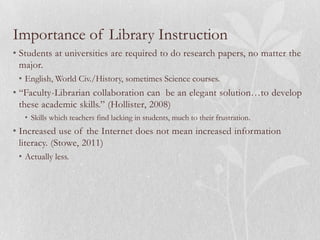
Importance of Library Instruction
• Students at universities are required to do research papers, no matter the
  major.
 • English, World Civ./History, sometimes Science courses.
• “Faculty-Librarian collaboration can be an elegant solution…to develop
  these academic skills.” (Hollister, 2008)
   • Skills which teachers find lacking in students, much to their frustration.
• Increased use of the Internet does not mean increased information
  literacy. (Stowe, 2011)
 • Actually less.
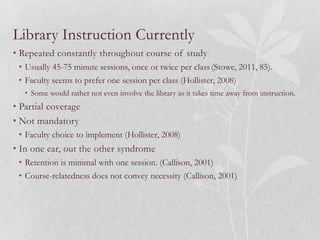
Library Instruction Currently
• Repeated constantly throughout course of study .
 • Usually 45-75 minute sessions, once or twice per class (Stowe, 2011, 85).
 • Faculty seems to prefer one session per class (Hollister, 2008)
   • Some would rather not even involve the library as it takes time away from instruction.
• Partial coverage
• Not mandatory
 • Faculty choice to implement (Hollister, 2008)
• In one ear, out the other syndrome
 • Retention is minimal with one session. (Callison, 2001)
 • Course-relatedness does not convey necessity (Callison, 2001)
Ways to Implement Further Integration
• Make part of curriculum classes that are mandatory at the university.
  (Callison, 2001)
 • Especially useful for required classes like World History (Hollister, 2008) and
   basic English classes.
• Examples in successful practice
 • Long Island University and the Brooklyn Campus Library (Stowe, 2011)
   • Class-integration of library instruction for English classes
 • Albany Medical College (Geyer & Irish, 2008)
   • Web-based self-directed learning, building on past comprehension throughout
Ways to Implement Further Integration
• Work with faculty to tailor classes for more in-depth learning of library
  resources.
 • Outside meetings with faculty to determine class needs and best ways to instruct
   • Learn faculty preferences and adjust accordingly
 • Creation of products like web guides customized with faculty. (Hollister, 2008)
   • Collaborate with teachers to best suit classes.
• Example in successful practice
 • University at Buffalo (Hollister, 2008)
   • Librarian outreach to create a partnership
     • Adjusted each semester to suit needs of departments
Ways to Implement Further Integration
• Create online tutorials to compliment classes or replace entirely (Gilbert
  et al, 2006)
 • Takes less time and money to do.
   • Also can be openly available and hold attention better. (Callison, 2001)
• Example in successful practice
 • San Jose State University and the King Library (Gilbert et al., 2006)
   • Online tutorials to assist students
Ways to Implement Further Integration
• Embed librarians “within a course, an academic department or college
  structure” (Jacobs, 2010).
 • Librarians assigned to work in tandem.
 • Offer office hours and appointments for one-on-one consultations with students
   and faculty. (Hollister, 2008)
• Example in successful practice
 • University of Alabama (Keever & Raymond, 1976)
   • Personalized learning (4 units) and librarian/teacher instruction (7 sessions)
Benefits from Further Integration
• Student results
 • Better understanding of resources, citations and plagiarism (Stowe, 2011)
 • More access to librarians and familiarity with reference services (Jacobs, 2010)
• Library results
 • Better communication with faculty and students to help with assignments (Jacobs,
   2010)
 • Better understanding of what is needed to be added to library’s collection (Jacobs,
   2010)
• Faculty results
 • Less frustration over students lacking research skills for papers (Hollister, 2008)
Sources
• 1. Stowe, B. (2011). “I can’t find anything” Towards establishing a continuum in curriculum -integrated library
            instruction. Reference Services Review, 39(1), 81-97.
• 2. Gilbert, L. M., Liu, M., Matoush, T, & Whitlatch J. B. (2006). Assessing Digital Reference and Online
             Instructional Services in an Integrated Public University Library. The Reference Librarian, 95/96, 149-
             172.
• 3. Jacobs, W. N. (2010). Embedded Librarianship is a Winning Proposition. Education Libraries, 33(2), 3-10.
• 4. Keever, E. H. & Raymond J. C. (1976). Integrated Library Instruction on the University Campus: Experiment
            at the University of Alabama. The Journal of Academic Librarianship, 2(4), 185-187.
• 5. Geyer, E. M. & Irish, D. E. (2008). Isolated to Integrated: An Evolving Medical Informatics Curriculum.
            Medical Reference Services Quarterly, 27(4), 451-461.
• 6. Hollister, C. V. (2008). Meeting Them Where They Are: Library Instruction for Today’s Students in the World
             Civilizations Course. Public Service Quarterly, 4(1), 15-27.
• 7. Callison, D. (2001). Integrated Instruction. School Library Media Activities Monthly, 17(5), 33-39.

Course integrated library instruction

  • 1.
  • 2.
    Importance of LibraryInstruction • Students at universities are required to do research papers, no matter the major. • English, World Civ./History, sometimes Science courses. • “Faculty-Librarian collaboration can be an elegant solution…to develop these academic skills.” (Hollister, 2008) • Skills which teachers find lacking in students, much to their frustration. • Increased use of the Internet does not mean increased information literacy. (Stowe, 2011) • Actually less.
  • 3.
    Library Instruction Currently •Repeated constantly throughout course of study . • Usually 45-75 minute sessions, once or twice per class (Stowe, 2011, 85). • Faculty seems to prefer one session per class (Hollister, 2008) • Some would rather not even involve the library as it takes time away from instruction. • Partial coverage • Not mandatory • Faculty choice to implement (Hollister, 2008) • In one ear, out the other syndrome • Retention is minimal with one session. (Callison, 2001) • Course-relatedness does not convey necessity (Callison, 2001)
  • 4.
    Ways to ImplementFurther Integration • Make part of curriculum classes that are mandatory at the university. (Callison, 2001) • Especially useful for required classes like World History (Hollister, 2008) and basic English classes. • Examples in successful practice • Long Island University and the Brooklyn Campus Library (Stowe, 2011) • Class-integration of library instruction for English classes • Albany Medical College (Geyer & Irish, 2008) • Web-based self-directed learning, building on past comprehension throughout
  • 5.
    Ways to ImplementFurther Integration • Work with faculty to tailor classes for more in-depth learning of library resources. • Outside meetings with faculty to determine class needs and best ways to instruct • Learn faculty preferences and adjust accordingly • Creation of products like web guides customized with faculty. (Hollister, 2008) • Collaborate with teachers to best suit classes. • Example in successful practice • University at Buffalo (Hollister, 2008) • Librarian outreach to create a partnership • Adjusted each semester to suit needs of departments
  • 6.
    Ways to ImplementFurther Integration • Create online tutorials to compliment classes or replace entirely (Gilbert et al, 2006) • Takes less time and money to do. • Also can be openly available and hold attention better. (Callison, 2001) • Example in successful practice • San Jose State University and the King Library (Gilbert et al., 2006) • Online tutorials to assist students
  • 7.
    Ways to ImplementFurther Integration • Embed librarians “within a course, an academic department or college structure” (Jacobs, 2010). • Librarians assigned to work in tandem. • Offer office hours and appointments for one-on-one consultations with students and faculty. (Hollister, 2008) • Example in successful practice • University of Alabama (Keever & Raymond, 1976) • Personalized learning (4 units) and librarian/teacher instruction (7 sessions)
  • 8.
    Benefits from FurtherIntegration • Student results • Better understanding of resources, citations and plagiarism (Stowe, 2011) • More access to librarians and familiarity with reference services (Jacobs, 2010) • Library results • Better communication with faculty and students to help with assignments (Jacobs, 2010) • Better understanding of what is needed to be added to library’s collection (Jacobs, 2010) • Faculty results • Less frustration over students lacking research skills for papers (Hollister, 2008)
  • 9.
    Sources • 1. Stowe,B. (2011). “I can’t find anything” Towards establishing a continuum in curriculum -integrated library instruction. Reference Services Review, 39(1), 81-97. • 2. Gilbert, L. M., Liu, M., Matoush, T, & Whitlatch J. B. (2006). Assessing Digital Reference and Online Instructional Services in an Integrated Public University Library. The Reference Librarian, 95/96, 149- 172. • 3. Jacobs, W. N. (2010). Embedded Librarianship is a Winning Proposition. Education Libraries, 33(2), 3-10. • 4. Keever, E. H. & Raymond J. C. (1976). Integrated Library Instruction on the University Campus: Experiment at the University of Alabama. The Journal of Academic Librarianship, 2(4), 185-187. • 5. Geyer, E. M. & Irish, D. E. (2008). Isolated to Integrated: An Evolving Medical Informatics Curriculum. Medical Reference Services Quarterly, 27(4), 451-461. • 6. Hollister, C. V. (2008). Meeting Them Where They Are: Library Instruction for Today’s Students in the World Civilizations Course. Public Service Quarterly, 4(1), 15-27. • 7. Callison, D. (2001). Integrated Instruction. School Library Media Activities Monthly, 17(5), 33-39.