Changes in Social Studies
Program
The Long Island School Library Systems
2nd Annual Regional Fall Institute
November 3, 2015
Brian Dowd – Long Island Council for the Social Studies
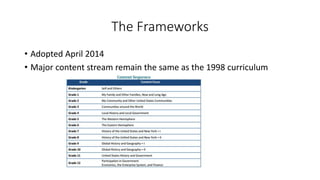
The Frameworks
• Adopted April 2014
• Major content stream remain the same as the 1998 curriculum
The Frameworks
Focus on the New York State Learning Standards
• History of the United States and New York
• US History
• Geography
• Economics
• Civics, Citizenship and Government
Include Common Core Literacy Skills for Social
Studies
Reading Standards:
• Key Ideas and Details
• Craft and Structure
• Integrating Knowledge and Ideas
• Range of Reading and Level of Text Complexity
Writing Standards:
• Text Types and Purposes
• Production and Distribution of Writing
• Research to Build and Present Knowledge
• Range of Writing
Speaking and Listening Standards:
• Comprehension and Collaboration
• Presentation of Knowledge and Ideas
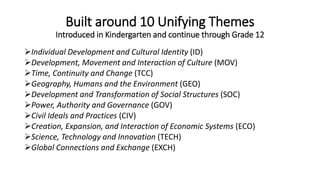
Built around 10 Unifying Themes
Introduced in Kindergarten and continue through Grade 12
Individual Development and Cultural Identity (ID)
Development, Movement and Interaction of Culture (MOV)
Time, Continuity and Change (TCC)
Geography, Humans and the Environment (GEO)
Development and Transformation of Social Structures (SOC)
Power, Authority and Governance (GOV)
Civil Ideals and Practices (CIV)
Creation, Expansion, and Interaction of Economic Systems (ECO)
Science, Technology and Innovation (TECH)
Global Connections and Exchange (EXCH)
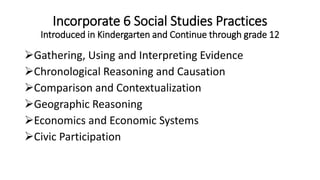
Incorporate 6 Social Studies Practices
Introduced in Kindergarten and Continue through grade 12
Gathering, Using and Interpreting Evidence
Chronological Reasoning and Causation
Comparison and Contextualization
Geographic Reasoning
Economics and Economic Systems
Civic Participation
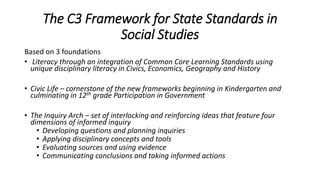
The C3 Framework for State Standards in
Social Studies
Based on 3 foundations
• Literacy through an integration of Common Core Learning Standards using
unique disciplinary literacy in Civics, Economics, Geography and History
• Civic Life – cornerstone of the new frameworks beginning in Kindergarten and
culminating in 12th grade Participation in Government
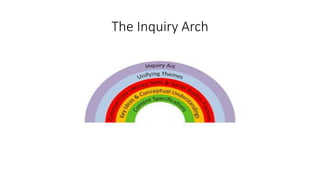
• The Inquiry Arch – set of interlocking and reinforcing ideas that feature four
dimensions of informed inquiry
• Developing questions and planning inquiries
• Applying disciplinary concepts and tools
• Evaluating sources and using evidence
• Communicating conclusions and taking informed actions
The Inquiry Arch
Encompass
Three Major Shifts
in Instruction
The Frameworks
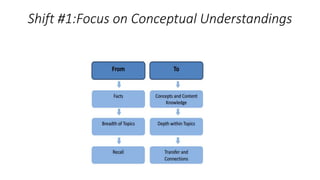
Shift #1:Focus on Conceptual Understandings
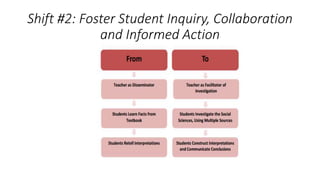
Shift #2: Foster Student Inquiry, Collaboration
and Informed Action
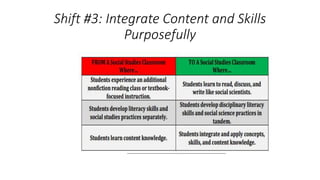
Shift #3: Integrate Content and Skills
Purposefully
Each grade level
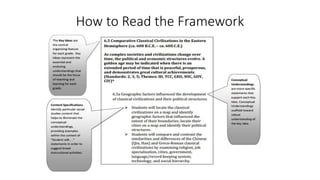
• Key ideas: Aligned to the standards and represent enduring
understandings that should be the focus of teaching and learning at
each grade. Designed to address large social studies perspectives,
trends or issues. Each grade level is comprised of 8-12 key ideas.
• Conceptual Understandings: More specific statements that support the
Key ideas. Each Key idea has 2-7 conceptual understandings. Together the
key idea and conceptual understanding represent the body of Social
Studies concepts that should be the focus of teaching and learning
• Content Specifications: Identify specific social studies content
“Students will”. Articulate a specific concept that must be taught to
illuminate the conceptual understanding. The content specification
work in tandem with the conceptual understanding to support the key
idea
How to Read the Framework
The Resource Toolkit
http://www.c3teachers.org/new-york-toolkit-video-series/
The Resource Toolkit
The toolkit was designed to bridge the gap between the New York State
Frameworks and the teachers’ classroom practices. Its name indicates exactly what
it is a toolkit to assist the teacher in covering the curriculum as designed in the
framework.
Three elements define the toolkit approach
• Use of the Inquiry Design Model – offers pedagogical suggestions but relies on
the teachers expertise and experience for implementation. Incorporated into the
IDM is the one page blueprint with the questions, tasks and sources. Each inquiry
has a short description on how it might be taught.
• Refinement through use of educators to write and vet the inquiries in classrooms
in New York State.
• Commitment to include a set of professional development resources to assist
teachers
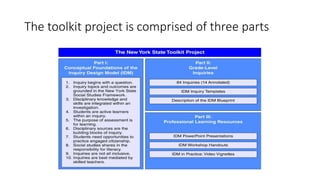
The toolkit project is comprised of three parts
The Toolkit
• While the inquiries are align with the New York State frameworks
they are not intended to be comprehensive nor are they a series of
prescribed lesson plans. They are designed to serve as pedagogically
rich examples of ways in which content and skills can be addressed.
They are typically designed to fit within 5-7 days of instruction.
• Writing curriculum based on the state framework requires paying
close attention to the scope of content included in the framework.
There are explicit connections between the ideas and practices
represented in the frameworks.
Inquiries
• Inquiries begin with a question. The heart of social studies is the desire to
understand why people do what they do. No social issue can be answered
through a single disciplinary lens, because no social problem is only
economic, or historical or political or geographic. The challenge is to use
the skills and content knowledge of history and the other social sciences to
address them. The questions examined do not lend themselves to
simplistic conclusions.
• The approach taken in the toolkit is to frame grade-level inquiries around
the NY State K-12 Social Studies Framework. The compelling question
within each inquiry address key issues and topics in and across the social
science disciplines and history. Compelling questions should also represent
concerns and interests relevant to the students’ lives .
Inquiries
• Inquiry topics and outcomes are grounded in the NYS Frameworks
• All are linked to Key Ideas, Conceptual Understandings, Content
Specifications, and Social Studies Practices
• Are designed to take 5-7 instructional days
• Disciplinary knowledge and skill are integrated within the inquiries
• Require students to be active learners
• Inquiries are not meant to be all inclusive. The term inquiry was a
conscious effort to avoid the term unit
• Teachers teach best when they are able to mold the materials around the
needs of their students
• Inquiries are best mediated by skilled teachers
3 Parts of an Inquiry
Part 1: Questions
• Questions – Compelling and Supporting
• Compelling
• Sets the opening frame of the inquiry
• Expresses the intellectual rigor and student relevance of an inquiry
• Sets up the summative performance task
• Are not Essential Questions
• Essential Questions have the connotation about designing the “right” question for all students
in all classrooms
• Compelling questions are designed with the students in your classroom in mind
• Supporting
• Contribute to the understanding of Compelling Questions
• Focus on descriptions, definitions and processes
3 Parts of an Inquiry
Part 2: Sources
• Sources
• What are Sources?
• Any material that provides information useful in answering a question
• Three characteristics
• Information contained in the source
• Composition of the source
• Perspective or bias of the source
• What makes a source disciplinary?
• Sources are disciplinary when they have features that are distinctive within the discipline and when using
them requires processes unique within the discipline
• Political Science- Legislation – evaluating public policy
• Economics – Data and Stats –quantItative reasoning
• Geography – Maps - spatial reasoning
• History – Oral history and diaries – determining perspective
• What is the relationship between sources and tasks?
• IDM tasks are anchored by sources
• Sources and tasks must work in tandem
3 Parts of an Inquiry
Part 3 Tasks
• Tasks
• Tasks are demonstrations of student understanding
• Tasks are not instructional strategies
• Tasks in the IDM
• Summative Performance Tasks
• Formative Performance Tasks
• Additional Performance Tasks
• Staging the Compelling Question
• Summative Extensions/Adaptations
• Taking Informed Action
3 Parts of an Inquiry
Tasks cont’d.
• The instructional Use of Sources
• Sources can be used to
• Spark curiosity
• Build knowledge
• Construct arguments
• Preparing Sources for use in an Inquiry
• When planning to use sources in an inquiry teachers should consider the following
• Selecting sources – requires knowledge of content - where can they be found?
• Adapting Sources – Excerpting, Annotating, Modifying
• Scaffolding- provide support for complex academic work
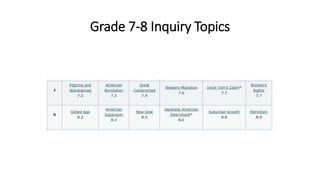
Grade 7-8 Inquiry Topics
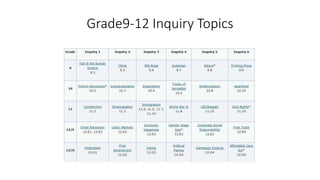
Grade9-12 Inquiry Topics
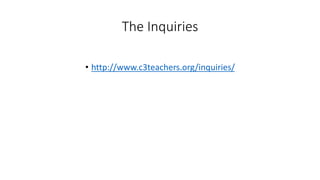
The Inquiries
• http://www.c3teachers.org/inquiries/

Changes in Social Studies Program

  • 1.
    Changes in SocialStudies Program The Long Island School Library Systems 2nd Annual Regional Fall Institute November 3, 2015 Brian Dowd – Long Island Council for the Social Studies
  • 2.
    The Frameworks • AdoptedApril 2014 • Major content stream remain the same as the 1998 curriculum
  • 3.
    The Frameworks Focus onthe New York State Learning Standards • History of the United States and New York • US History • Geography • Economics • Civics, Citizenship and Government
  • 4.
    Include Common CoreLiteracy Skills for Social Studies Reading Standards: • Key Ideas and Details • Craft and Structure • Integrating Knowledge and Ideas • Range of Reading and Level of Text Complexity Writing Standards: • Text Types and Purposes • Production and Distribution of Writing • Research to Build and Present Knowledge • Range of Writing Speaking and Listening Standards: • Comprehension and Collaboration • Presentation of Knowledge and Ideas
  • 5.
    Built around 10Unifying Themes Introduced in Kindergarten and continue through Grade 12 Individual Development and Cultural Identity (ID) Development, Movement and Interaction of Culture (MOV) Time, Continuity and Change (TCC) Geography, Humans and the Environment (GEO) Development and Transformation of Social Structures (SOC) Power, Authority and Governance (GOV) Civil Ideals and Practices (CIV) Creation, Expansion, and Interaction of Economic Systems (ECO) Science, Technology and Innovation (TECH) Global Connections and Exchange (EXCH)
  • 6.
    Incorporate 6 SocialStudies Practices Introduced in Kindergarten and Continue through grade 12 Gathering, Using and Interpreting Evidence Chronological Reasoning and Causation Comparison and Contextualization Geographic Reasoning Economics and Economic Systems Civic Participation
  • 7.
    The C3 Frameworkfor State Standards in Social Studies Based on 3 foundations • Literacy through an integration of Common Core Learning Standards using unique disciplinary literacy in Civics, Economics, Geography and History • Civic Life – cornerstone of the new frameworks beginning in Kindergarten and culminating in 12th grade Participation in Government • The Inquiry Arch – set of interlocking and reinforcing ideas that feature four dimensions of informed inquiry • Developing questions and planning inquiries • Applying disciplinary concepts and tools • Evaluating sources and using evidence • Communicating conclusions and taking informed actions
  • 8.
  • 9.
    Encompass Three Major Shifts inInstruction The Frameworks
  • 10.
    Shift #1:Focus onConceptual Understandings
  • 11.
    Shift #2: FosterStudent Inquiry, Collaboration and Informed Action
  • 12.
    Shift #3: IntegrateContent and Skills Purposefully
  • 13.
    Each grade level •Key ideas: Aligned to the standards and represent enduring understandings that should be the focus of teaching and learning at each grade. Designed to address large social studies perspectives, trends or issues. Each grade level is comprised of 8-12 key ideas. • Conceptual Understandings: More specific statements that support the Key ideas. Each Key idea has 2-7 conceptual understandings. Together the key idea and conceptual understanding represent the body of Social Studies concepts that should be the focus of teaching and learning • Content Specifications: Identify specific social studies content “Students will”. Articulate a specific concept that must be taught to illuminate the conceptual understanding. The content specification work in tandem with the conceptual understanding to support the key idea
  • 14.
    How to Readthe Framework
  • 15.
  • 16.
    The Resource Toolkit Thetoolkit was designed to bridge the gap between the New York State Frameworks and the teachers’ classroom practices. Its name indicates exactly what it is a toolkit to assist the teacher in covering the curriculum as designed in the framework. Three elements define the toolkit approach • Use of the Inquiry Design Model – offers pedagogical suggestions but relies on the teachers expertise and experience for implementation. Incorporated into the IDM is the one page blueprint with the questions, tasks and sources. Each inquiry has a short description on how it might be taught. • Refinement through use of educators to write and vet the inquiries in classrooms in New York State. • Commitment to include a set of professional development resources to assist teachers
  • 17.
    The toolkit projectis comprised of three parts
  • 18.
    The Toolkit • Whilethe inquiries are align with the New York State frameworks they are not intended to be comprehensive nor are they a series of prescribed lesson plans. They are designed to serve as pedagogically rich examples of ways in which content and skills can be addressed. They are typically designed to fit within 5-7 days of instruction. • Writing curriculum based on the state framework requires paying close attention to the scope of content included in the framework. There are explicit connections between the ideas and practices represented in the frameworks.
  • 19.
    Inquiries • Inquiries beginwith a question. The heart of social studies is the desire to understand why people do what they do. No social issue can be answered through a single disciplinary lens, because no social problem is only economic, or historical or political or geographic. The challenge is to use the skills and content knowledge of history and the other social sciences to address them. The questions examined do not lend themselves to simplistic conclusions. • The approach taken in the toolkit is to frame grade-level inquiries around the NY State K-12 Social Studies Framework. The compelling question within each inquiry address key issues and topics in and across the social science disciplines and history. Compelling questions should also represent concerns and interests relevant to the students’ lives .
  • 20.
    Inquiries • Inquiry topicsand outcomes are grounded in the NYS Frameworks • All are linked to Key Ideas, Conceptual Understandings, Content Specifications, and Social Studies Practices • Are designed to take 5-7 instructional days • Disciplinary knowledge and skill are integrated within the inquiries • Require students to be active learners • Inquiries are not meant to be all inclusive. The term inquiry was a conscious effort to avoid the term unit • Teachers teach best when they are able to mold the materials around the needs of their students • Inquiries are best mediated by skilled teachers
  • 21.
    3 Parts ofan Inquiry Part 1: Questions • Questions – Compelling and Supporting • Compelling • Sets the opening frame of the inquiry • Expresses the intellectual rigor and student relevance of an inquiry • Sets up the summative performance task • Are not Essential Questions • Essential Questions have the connotation about designing the “right” question for all students in all classrooms • Compelling questions are designed with the students in your classroom in mind • Supporting • Contribute to the understanding of Compelling Questions • Focus on descriptions, definitions and processes
  • 22.
    3 Parts ofan Inquiry Part 2: Sources • Sources • What are Sources? • Any material that provides information useful in answering a question • Three characteristics • Information contained in the source • Composition of the source • Perspective or bias of the source • What makes a source disciplinary? • Sources are disciplinary when they have features that are distinctive within the discipline and when using them requires processes unique within the discipline • Political Science- Legislation – evaluating public policy • Economics – Data and Stats –quantItative reasoning • Geography – Maps - spatial reasoning • History – Oral history and diaries – determining perspective • What is the relationship between sources and tasks? • IDM tasks are anchored by sources • Sources and tasks must work in tandem
  • 23.
    3 Parts ofan Inquiry Part 3 Tasks • Tasks • Tasks are demonstrations of student understanding • Tasks are not instructional strategies • Tasks in the IDM • Summative Performance Tasks • Formative Performance Tasks • Additional Performance Tasks • Staging the Compelling Question • Summative Extensions/Adaptations • Taking Informed Action
  • 24.
    3 Parts ofan Inquiry Tasks cont’d. • The instructional Use of Sources • Sources can be used to • Spark curiosity • Build knowledge • Construct arguments • Preparing Sources for use in an Inquiry • When planning to use sources in an inquiry teachers should consider the following • Selecting sources – requires knowledge of content - where can they be found? • Adapting Sources – Excerpting, Annotating, Modifying • Scaffolding- provide support for complex academic work
  • 25.
  • 26.
  • 27.