MEMORY: SEQUENCE / PROCESS
Individual artefacts by adult ESL learners in a blended class
Permission granted by all students to publish slides to be included as an artefact in their capstone eportfolio projects
Photos and images: courtesy of ClipArt
1
How we conceptualized
memory after a lecture on
cognition by Pearson/Longman.
Based on the Pearson/Longman Contemporary Topics lecture on cognitive psychology
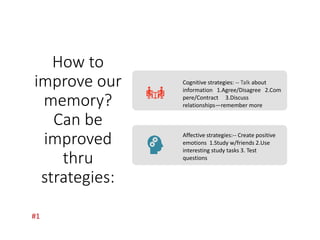
How to
improve our
memory?
Can be
improved
thru
strategies:
Cognitive strategies: -- Talk about
information 1.Agree/Disagree 2.Com
pere/Contract 3.Discuss
relationships—remember more
Affective strategies:-- Create positive
emotions 1.Study w/friends 2.Use
interesting study tasks 3. Test
questions
#1
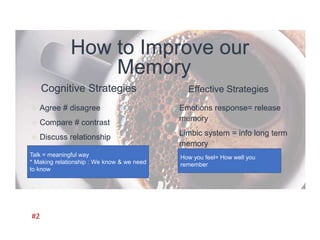
How to Improve our
Memory
Cognitive Strategies
 Agree # disagree
 Compare # contrast
 Discuss relationship
Effective Strategies
 Emotions response= release
memory
 Limbic system = info long term
memory
Talk = meaningful way
* Making relationship : We know & we need
to know
How you feel= How well you
remember
#2
How to improve memory: 🤔
(declarative memory)
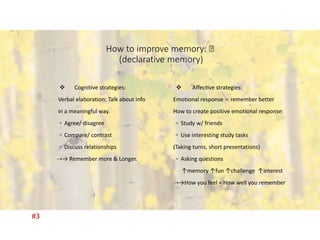
 Cognitive strategies:
Verbal elaboration: Talk about info
in a meaningful way.
◦ Agree/ disagree
◦ Compare/ contrast
◦ Discuss relationships
⇢→ Remember more & Longer.
 Affective strategies:
Emotional response ⌲ remember better
How to create positive emotional response:
◦ Study w/ friends
◦ Use interesting study tasks
(Taking turns, short presentations)
◦ Asking questions
↑memory ↑fun ↑challenge ↑interest
⇢→How you feel = How well you remember
#3
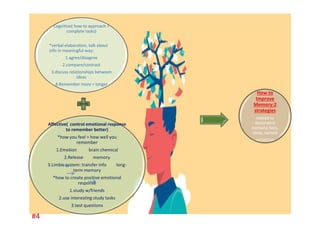
Cognitive( how to approach +
complete tasks)
*verbal elaboration, talk about
info in meaningful way:
1.agree/disagree
2.compare/contrast
3.discuss relationships between
ideas
4.Remember more + longer
Affective( control emotional response
to remember better)
*how you feel = how well you
remember
1.Emotion brain chemical
2.Release memory
3.Limbic system: transfer info long-
term memory
*how to create positive emotional
response
1.study w/friends
2.use interesting study tasks
3.test questions
How to
Improve
Memory:2
strategies
related to
declarative
memory( facts,
ideas, names)
conscious
#4
Cognitive Psychology: Memory -
Pearson/Longman Contemporary Topics
We
learned
Meaningful
ideas
We
know
Fun – Challenge - Interesting
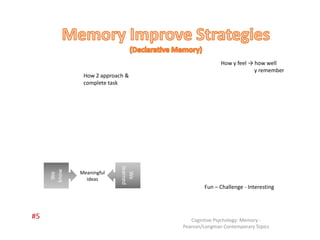
How y feel → how well
y remember
How 2 approach &
complete task
#5
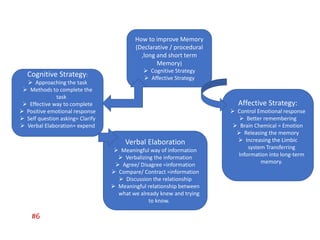
Verbal Elaboration
 Meaningful way of information
 Verbalizing the information
 Agree/ Disagree =information
 Compare/ Contract =information
 Discussion the relationship
 Meaningful relationship between
what we already knew and trying
to know.
Cognitive Strategy:
 Approaching the task
 Methods to complete the
task
 Effective way to complete
 Positive emotional response
 Self question asking= Clarify
 Verbal Elaboration= expend
How to improve Memory
(Declarative / procedural
,long and short term
Memory)
 Cognitive Strategy
 Affective Strategy
Affective Strategy:
 Control Emotional response
 Better remembering
 Brain Chemical = Emotion
 Releasing the memory
 Increasing the Limbic
system Transferring
Information into long-term
memory.
#6
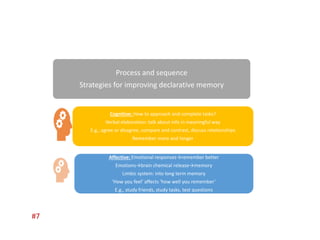
Process and sequence
Strategies for improving declarative memory
Cognitive: How to approach and complete tasks?
Verbal elaboration: talk about info in meaningful way
E.g., agree or disagree, compare and contrast, discuss relationships
Remember more and longer
Affective: Emotional responses→remember better
Emotions→brain chemical release→memory
Limbic system: into long term memory
‘How you feel’ affects ‘how well you remember’
E.g., study friends, study tasks, test questions
#7
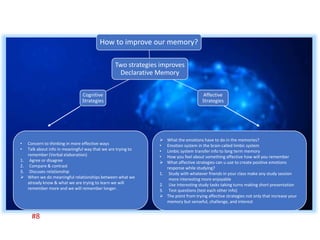
Two strategies improves
Declarative Memory
How to improve our memory?
Affective
Strategies
Cognitive
Strategies
 What the emotions have to do in the memories?
• Emotion system in the brain called limbic system
• Limbic system transfer info to long term memory
• How you feel about something affective how will you remember
 What affective strategies can u use to create positive emotions
response while studying?
1. Study with whatever friends in your class make any study session
more interesting more enjoyable
2. Use interesting study tasks taking turns making short presentation
3. Test questions (test each other info)
 The point from trying affective strategies not only that increase your
memory but senseful, challenge, and interest
• Concern to thinking in more effective ways
• Talk about info in meaningful way that we are trying to
remember (Verbal elaboration)
1. Agree or disagree
2. Compare & contrast
3. Discuses relationship
 When we do meaningful relationships between what we
already know & what we are trying to learn we will
remember more and we will remember longer.
#8
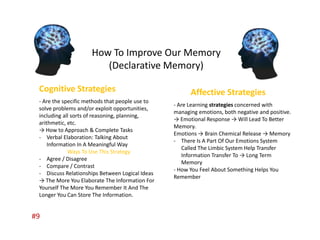
Cognitive Strategies Affective Strategies
How To Improve Our Memory
(Declarative Memory)
- Are the specific methods that people use to
solve problems and/or exploit opportunities,
including all sorts of reasoning, planning,
arithmetic, etc.
→ How to Approach & Complete Tasks
- Verbal Elaboration: Talking About
Information In A Meaningful Way
Ways To Use This Strategy
- Agree / Disagree
- Compare / Contrast
- Discuss Relationships Between Logical Ideas
→ The More You Elaborate The Information For
Yourself The More You Remember It And The
Longer You Can Store The Information.
- Are Learning strategies concerned with
managing emotions, both negative and positive.
→ Emotional Response → Will Lead To Better
Memory.
Emotions → Brain Chemical Release → Memory
- There Is A Part Of Our Emotions System
Called The Limbic System Help Transfer
Information Transfer To → Long Term
Memory
- How You Feel About Something Helps You
Remember
#9
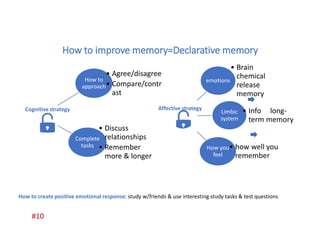
How to improve memory=Declarative memory
How to
approach
• Agree/disagree
• Compare/contr
ast
Complete
tasks
• Discuss
relationships
• Remember
more & longer
emotions
• Brain
chemical
release
memory
Limbic
system
• Info long-
term memory
How you
feel
• how well you
remember
Cognitive strategy Affective strategy
How to create positive emotional response: study w/friends & use interesting study tasks & test questions
#10
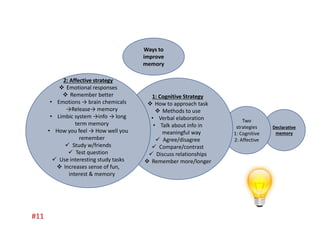
Ways to
improve
memory
Declarative
memory
Two
strategies
1: Cognitive
2: Affective
1: Cognitive Strategy
 How to approach task
 Methods to use
• Verbal elaboration
• Talk about info in
meaningful way
 Agree/disagree
 Compare/contrast
 Discuss relationships
 Remember more/longer
2: Affective strategy
 Emotional responses
 Remember better
• Emotions → brain chemicals
→Release→ memory
• Limbic system →info → long
term memory
• How you feel → How well you
remember
 Study w/friends
 Test question
 Use interesting study tasks
 Increases sense of fun,
interest & memory
#11
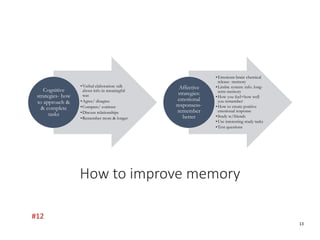
How to improve memory
•Verbal elaboration: talk
about info in meaningful
was
•Agree/ disagree
•Compare/ contrast
•Discuss relationships
•Remember more & longer
Cognitive
strategies- how
to approach &
& complete
tasks
•Emotions-brain chemical
release- memory
•Limbic system: info. long-
term memory
•How you feel=how well
you remember
•How to create positive
emotional response
•Study w/friends
•Use interesting study tasks
•Test questions
Affective
strategies:
emotional
responsess-
remember
better
#12
13
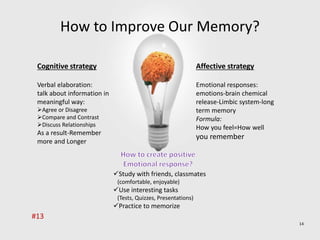
How to Improve Our Memory?
Cognitive strategy
Verbal elaboration:
talk about information in
meaningful way:
Agree or Disagree
Compare and Contrast
Discuss Relationships
As a result-Remember
more and Longer
Affective strategy
Emotional responses:
emotions-brain chemical
release-Limbic system-long
term memory
Formula:
How you feel=How well
you remember
Study with friends, classmates
(comfortable, enjoyable)
Use interesting tasks
(Tests, Quizzes, Presentations)
Practice to memorize
#13
14
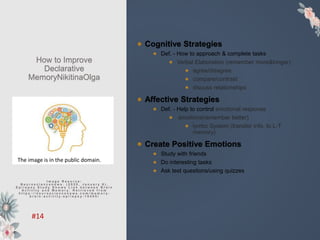
How to Improve
Declarative
MemoryNikitinaOlga
Cognitive Strategies
Def. - How to approach & complete tasks
Verbal Elaboration (remember more&longer)
agree/disagree
compare/contrast
discuss relationships
Affective Strategies
Def. - Help to control emotional response
emotions(remember better)
lymbc System (transfer info. to L-T
memory)
Create Positive Emotions
Study with friends
Do interesting tasks
Ask test questions/using quizzes
I m a g e R e s o r c e :
N e u r o s c i e n c e n e w s . ( 2 0 2 0 , J a n u a r y 6 ) .
E p i l e p s y S t u d y S h o w s L i n k b e t w e e n B r a i n
A c t i v i t y a n d M e m o r y . R e t r i e v e d f r o m
h t t p s : / / n e u r o s c i e n c e n e w s . c o m / m e m o r y -
b r a i n - a c t i v i t y - e p i l e p s y - 1 5 4 0 5 /
The image is in the public domain.
#14
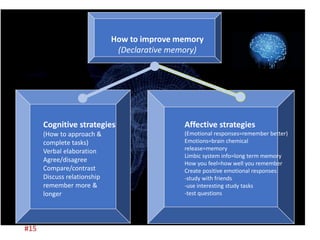
How to improve memory
(Declarative memory)
Cognitive strategies
(How to approach &
complete tasks)
Verbal elaboration
Agree/disagree
Compare/contrast
Discuss relationship
remember more &
longer
Affective strategies
(Emotional responses=remember better)
Emotions=brain chemical
release=memory
Limbic system info=long term memory
How you feel=how well you remember
Create positive emotional responses:
-study with friends
-use interesting study tasks
-test questions
#15
17
#16
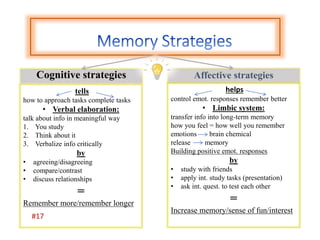
Cognitive strategies Affective strategies
tells
how to approach tasks complete tasks
• Verbal elaboration:
talk about info in meaningful way
1. You study
2. Think about it
3. Verbalize info critically
by
• agreeing/disagreeing
• compare/contrast
• discuss relationships
=
Remember more/remember longer
helps
control emot. responses remember better
• Limbic system:
transfer info into long-term memory
how you feel = how well you remember
emotions brain chemical
release memory
Building positive emot. responses
by
• study with friends
• apply int. study tasks (presentation)
• ask int. quest. to test each other
=
Increase memory/sense of fun/interest
#17
19
#18
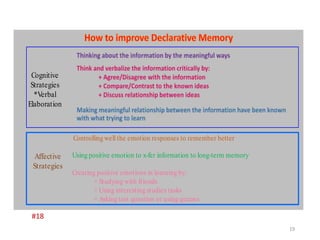
Cognitive
Strategies
*Verbal
Elaboration
Affective
Strategies
Using positive emotion to x-fer information to long-term memory
Controlling well the emotion responses to remember better
Creating positive emotions in learning by:
+ Studying with friends
+ Using interesting studies tasks
+ Asking test question or using quizzes
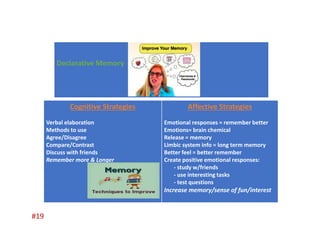
Declarative Memory
Cognitive Strategies
Verbal elaboration
Methods to use
Agree/Disagree
Compare/Contrast
Discuss with friends
Remember more & Longer
Affective Strategies
Emotional responses = remember better
Emotions= brain chemical
Release = memory
Limbic system info = long term memory
Better feel = better remember
Create positive emotional responses:
- study w/friends
- use interesting tasks
- test questions
Increase memory/sense of fun/interest
#19
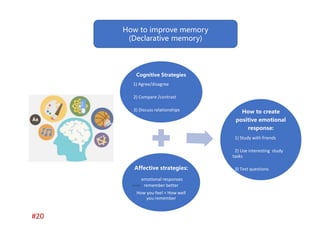
How to improve memory
(Declarative memory)
Cognitive Strategies
1) Agree/disagree
2) Compare /contrast
3) Discuss relationships
Affective strategies:
emotional responses
remember better
How you feel = How well
you remember
How to create
positive emotional
response:
1) Study with friends
2) Use interesting study
tasks
3) Test questions
#20
22
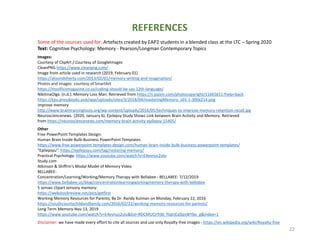
REFERENCES
Some of the sources used for: Artefacts created by EAP2 students in a blended class at the LTC – Spring 2020
Text: Cognitive Psychology: Memory - Pearson/Longman Contemporary Topics
Images:
Courtesy of ClipArt / Courtesy of GoogleImages
CleanPNG https://www.cleanpng.com/
Image from article used in research (2019, February 01)
https://alisondoherty.com/2013/02/01/memory-writing-and-imagination/
Photos and images: courtesy of SmartArt
https://myofficemagazine.co.za/coding-should-be-sas-12th-language/
NikitinaOlga. (n.d.). Memory Loss Man. Retrieved from https://v.paixin.com/photocopyright/11665611?help=back
https://kpu.pressbooks.pub/app/uploads/sites/3/2018/04/masteringMemory_v01-1-300x214.png
improve memory
http://www.braintrainingtools.org/wp-content/uploads/2016/05/techniques-to-improve-memory-retention-recall.jpg
Neurosciencenews. (2020, January 6). Epilepsy Study Shows Link between Brain Activity and Memory. Retrieved
from https://neurosciencenews.com/memory-brain-activity-epilepsy-15405/
Other
Free PowerPoint Templates Design:
Human Brain Inside Bulb-Business PowerPoint Templates
https://www.free-powerpoint-templates-design.com/human-brain-inside-bulb-business-powerpoint-templates/
"Epilepsyu": https://epilepsyu.com/tag/restoring-memory/
Practical Psychology: https://www.youtube.com/watch?v=E4evnus2olo
Study.com
Atkinson & Shiffrin's Modal Model of Memory Video
BELLABEE:
Concentration/Learning/Working/Memory Therapy with Bellabee - BELLABEE: 7/12/2019
https://www.bellabee.us/blog/concentrationlearningworkingmemory-therapy-with-bellabee
5 senses clipart sensory memory:
https://webstockreview.net/pict/getfirst
Working Memory Resources for Parents, By Dr. Randy Kulman on Monday, February 22, 2016
https://southcountychildandfamily.com/2016/02/22/working-memory-resources-for-parents/
Long Term Memory-Nov 13, 2019
https://www.youtube.com/watch?v=E4evnus2olo&list=RDCMUCir93b_ftqInEaDpsWYbo_g&index=1
Disclaimer: we have made every effort to cite all sources and use only Royalty-free images - https://en.wikipedia.org/wiki/Royalty-free

CONCEPTUAL FRAMEWORK: SEQUENCE / PROCESS

  • 1.
    MEMORY: SEQUENCE /PROCESS Individual artefacts by adult ESL learners in a blended class Permission granted by all students to publish slides to be included as an artefact in their capstone eportfolio projects Photos and images: courtesy of ClipArt 1 How we conceptualized memory after a lecture on cognition by Pearson/Longman. Based on the Pearson/Longman Contemporary Topics lecture on cognitive psychology
  • 2.
    How to improve our memory? Canbe improved thru strategies: Cognitive strategies: -- Talk about information 1.Agree/Disagree 2.Com pere/Contract 3.Discuss relationships—remember more Affective strategies:-- Create positive emotions 1.Study w/friends 2.Use interesting study tasks 3. Test questions #1
  • 3.
    How to Improveour Memory Cognitive Strategies  Agree # disagree  Compare # contrast  Discuss relationship Effective Strategies  Emotions response= release memory  Limbic system = info long term memory Talk = meaningful way * Making relationship : We know & we need to know How you feel= How well you remember #2
  • 4.
    How to improvememory: 🤔 (declarative memory)  Cognitive strategies: Verbal elaboration: Talk about info in a meaningful way. ◦ Agree/ disagree ◦ Compare/ contrast ◦ Discuss relationships ⇢→ Remember more & Longer.  Affective strategies: Emotional response ⌲ remember better How to create positive emotional response: ◦ Study w/ friends ◦ Use interesting study tasks (Taking turns, short presentations) ◦ Asking questions ↑memory ↑fun ↑challenge ↑interest ⇢→How you feel = How well you remember #3
  • 5.
    Cognitive( how toapproach + complete tasks) *verbal elaboration, talk about info in meaningful way: 1.agree/disagree 2.compare/contrast 3.discuss relationships between ideas 4.Remember more + longer Affective( control emotional response to remember better) *how you feel = how well you remember 1.Emotion brain chemical 2.Release memory 3.Limbic system: transfer info long- term memory *how to create positive emotional response 1.study w/friends 2.use interesting study tasks 3.test questions How to Improve Memory:2 strategies related to declarative memory( facts, ideas, names) conscious #4
  • 6.
    Cognitive Psychology: Memory- Pearson/Longman Contemporary Topics We learned Meaningful ideas We know Fun – Challenge - Interesting How y feel → how well y remember How 2 approach & complete task #5
  • 7.
    Verbal Elaboration  Meaningfulway of information  Verbalizing the information  Agree/ Disagree =information  Compare/ Contract =information  Discussion the relationship  Meaningful relationship between what we already knew and trying to know. Cognitive Strategy:  Approaching the task  Methods to complete the task  Effective way to complete  Positive emotional response  Self question asking= Clarify  Verbal Elaboration= expend How to improve Memory (Declarative / procedural ,long and short term Memory)  Cognitive Strategy  Affective Strategy Affective Strategy:  Control Emotional response  Better remembering  Brain Chemical = Emotion  Releasing the memory  Increasing the Limbic system Transferring Information into long-term memory. #6
  • 8.
    Process and sequence Strategiesfor improving declarative memory Cognitive: How to approach and complete tasks? Verbal elaboration: talk about info in meaningful way E.g., agree or disagree, compare and contrast, discuss relationships Remember more and longer Affective: Emotional responses→remember better Emotions→brain chemical release→memory Limbic system: into long term memory ‘How you feel’ affects ‘how well you remember’ E.g., study friends, study tasks, test questions #7
  • 9.
    Two strategies improves DeclarativeMemory How to improve our memory? Affective Strategies Cognitive Strategies  What the emotions have to do in the memories? • Emotion system in the brain called limbic system • Limbic system transfer info to long term memory • How you feel about something affective how will you remember  What affective strategies can u use to create positive emotions response while studying? 1. Study with whatever friends in your class make any study session more interesting more enjoyable 2. Use interesting study tasks taking turns making short presentation 3. Test questions (test each other info)  The point from trying affective strategies not only that increase your memory but senseful, challenge, and interest • Concern to thinking in more effective ways • Talk about info in meaningful way that we are trying to remember (Verbal elaboration) 1. Agree or disagree 2. Compare & contrast 3. Discuses relationship  When we do meaningful relationships between what we already know & what we are trying to learn we will remember more and we will remember longer. #8
  • 10.
    Cognitive Strategies AffectiveStrategies How To Improve Our Memory (Declarative Memory) - Are the specific methods that people use to solve problems and/or exploit opportunities, including all sorts of reasoning, planning, arithmetic, etc. → How to Approach & Complete Tasks - Verbal Elaboration: Talking About Information In A Meaningful Way Ways To Use This Strategy - Agree / Disagree - Compare / Contrast - Discuss Relationships Between Logical Ideas → The More You Elaborate The Information For Yourself The More You Remember It And The Longer You Can Store The Information. - Are Learning strategies concerned with managing emotions, both negative and positive. → Emotional Response → Will Lead To Better Memory. Emotions → Brain Chemical Release → Memory - There Is A Part Of Our Emotions System Called The Limbic System Help Transfer Information Transfer To → Long Term Memory - How You Feel About Something Helps You Remember #9
  • 11.
    How to improvememory=Declarative memory How to approach • Agree/disagree • Compare/contr ast Complete tasks • Discuss relationships • Remember more & longer emotions • Brain chemical release memory Limbic system • Info long- term memory How you feel • how well you remember Cognitive strategy Affective strategy How to create positive emotional response: study w/friends & use interesting study tasks & test questions #10
  • 12.
    Ways to improve memory Declarative memory Two strategies 1: Cognitive 2:Affective 1: Cognitive Strategy  How to approach task  Methods to use • Verbal elaboration • Talk about info in meaningful way  Agree/disagree  Compare/contrast  Discuss relationships  Remember more/longer 2: Affective strategy  Emotional responses  Remember better • Emotions → brain chemicals →Release→ memory • Limbic system →info → long term memory • How you feel → How well you remember  Study w/friends  Test question  Use interesting study tasks  Increases sense of fun, interest & memory #11
  • 13.
    How to improvememory •Verbal elaboration: talk about info in meaningful was •Agree/ disagree •Compare/ contrast •Discuss relationships •Remember more & longer Cognitive strategies- how to approach & & complete tasks •Emotions-brain chemical release- memory •Limbic system: info. long- term memory •How you feel=how well you remember •How to create positive emotional response •Study w/friends •Use interesting study tasks •Test questions Affective strategies: emotional responsess- remember better #12 13
  • 14.
    How to ImproveOur Memory? Cognitive strategy Verbal elaboration: talk about information in meaningful way: Agree or Disagree Compare and Contrast Discuss Relationships As a result-Remember more and Longer Affective strategy Emotional responses: emotions-brain chemical release-Limbic system-long term memory Formula: How you feel=How well you remember Study with friends, classmates (comfortable, enjoyable) Use interesting tasks (Tests, Quizzes, Presentations) Practice to memorize #13 14
  • 15.
    How to Improve Declarative MemoryNikitinaOlga CognitiveStrategies Def. - How to approach & complete tasks Verbal Elaboration (remember more&longer) agree/disagree compare/contrast discuss relationships Affective Strategies Def. - Help to control emotional response emotions(remember better) lymbc System (transfer info. to L-T memory) Create Positive Emotions Study with friends Do interesting tasks Ask test questions/using quizzes I m a g e R e s o r c e : N e u r o s c i e n c e n e w s . ( 2 0 2 0 , J a n u a r y 6 ) . E p i l e p s y S t u d y S h o w s L i n k b e t w e e n B r a i n A c t i v i t y a n d M e m o r y . R e t r i e v e d f r o m h t t p s : / / n e u r o s c i e n c e n e w s . c o m / m e m o r y - b r a i n - a c t i v i t y - e p i l e p s y - 1 5 4 0 5 / The image is in the public domain. #14
  • 16.
    How to improvememory (Declarative memory) Cognitive strategies (How to approach & complete tasks) Verbal elaboration Agree/disagree Compare/contrast Discuss relationship remember more & longer Affective strategies (Emotional responses=remember better) Emotions=brain chemical release=memory Limbic system info=long term memory How you feel=how well you remember Create positive emotional responses: -study with friends -use interesting study tasks -test questions #15
  • 17.
  • 18.
    Cognitive strategies Affectivestrategies tells how to approach tasks complete tasks • Verbal elaboration: talk about info in meaningful way 1. You study 2. Think about it 3. Verbalize info critically by • agreeing/disagreeing • compare/contrast • discuss relationships = Remember more/remember longer helps control emot. responses remember better • Limbic system: transfer info into long-term memory how you feel = how well you remember emotions brain chemical release memory Building positive emot. responses by • study with friends • apply int. study tasks (presentation) • ask int. quest. to test each other = Increase memory/sense of fun/interest #17
  • 19.
    19 #18 Cognitive Strategies *Verbal Elaboration Affective Strategies Using positive emotionto x-fer information to long-term memory Controlling well the emotion responses to remember better Creating positive emotions in learning by: + Studying with friends + Using interesting studies tasks + Asking test question or using quizzes
  • 20.
    Declarative Memory Cognitive Strategies Verbalelaboration Methods to use Agree/Disagree Compare/Contrast Discuss with friends Remember more & Longer Affective Strategies Emotional responses = remember better Emotions= brain chemical Release = memory Limbic system info = long term memory Better feel = better remember Create positive emotional responses: - study w/friends - use interesting tasks - test questions Increase memory/sense of fun/interest #19
  • 21.
    How to improvememory (Declarative memory) Cognitive Strategies 1) Agree/disagree 2) Compare /contrast 3) Discuss relationships Affective strategies: emotional responses remember better How you feel = How well you remember How to create positive emotional response: 1) Study with friends 2) Use interesting study tasks 3) Test questions #20
  • 22.
    22 REFERENCES Some of thesources used for: Artefacts created by EAP2 students in a blended class at the LTC – Spring 2020 Text: Cognitive Psychology: Memory - Pearson/Longman Contemporary Topics Images: Courtesy of ClipArt / Courtesy of GoogleImages CleanPNG https://www.cleanpng.com/ Image from article used in research (2019, February 01) https://alisondoherty.com/2013/02/01/memory-writing-and-imagination/ Photos and images: courtesy of SmartArt https://myofficemagazine.co.za/coding-should-be-sas-12th-language/ NikitinaOlga. (n.d.). Memory Loss Man. Retrieved from https://v.paixin.com/photocopyright/11665611?help=back https://kpu.pressbooks.pub/app/uploads/sites/3/2018/04/masteringMemory_v01-1-300x214.png improve memory http://www.braintrainingtools.org/wp-content/uploads/2016/05/techniques-to-improve-memory-retention-recall.jpg Neurosciencenews. (2020, January 6). Epilepsy Study Shows Link between Brain Activity and Memory. Retrieved from https://neurosciencenews.com/memory-brain-activity-epilepsy-15405/ Other Free PowerPoint Templates Design: Human Brain Inside Bulb-Business PowerPoint Templates https://www.free-powerpoint-templates-design.com/human-brain-inside-bulb-business-powerpoint-templates/ "Epilepsyu": https://epilepsyu.com/tag/restoring-memory/ Practical Psychology: https://www.youtube.com/watch?v=E4evnus2olo Study.com Atkinson & Shiffrin's Modal Model of Memory Video BELLABEE: Concentration/Learning/Working/Memory Therapy with Bellabee - BELLABEE: 7/12/2019 https://www.bellabee.us/blog/concentrationlearningworkingmemory-therapy-with-bellabee 5 senses clipart sensory memory: https://webstockreview.net/pict/getfirst Working Memory Resources for Parents, By Dr. Randy Kulman on Monday, February 22, 2016 https://southcountychildandfamily.com/2016/02/22/working-memory-resources-for-parents/ Long Term Memory-Nov 13, 2019 https://www.youtube.com/watch?v=E4evnus2olo&list=RDCMUCir93b_ftqInEaDpsWYbo_g&index=1 Disclaimer: we have made every effort to cite all sources and use only Royalty-free images - https://en.wikipedia.org/wiki/Royalty-free