
GEOGRAPHICAL
THOUGHT
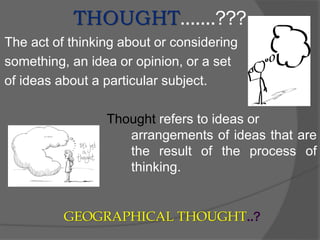
THOUGHT…….???
The act of thinking about or considering
something, an idea or opinion, or a set
of ideas about a particular subject.
Thought refers to ideas or
arrangements of ideas that are
the result of the process of
thinking.
GEOGRAPHICAL THOUGHT..?
DEFINITION
 What is Where?
 Mass of information about different
lands and people
 Areal differentiation view
 Spatial Pattern
GEOGRAPHY
 “Geography is concerned to provide accurate, orderly,
and rational description and interpretation of the variable
characters of the Earth’s surface” – Richard Hartshorne
(1959).
 Geography may be defined as the study of the
inter-relationship between the physical and
the social environment through time over
space.
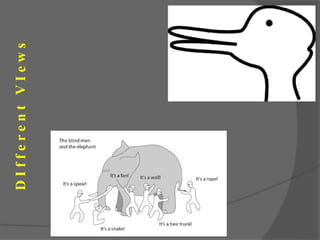
D
I
f
f
e
r
e
n
t
V
I
e
w
s
PARADIGMS
 Paradigm: “Universally recognised scientific
achievements that for a time provide model
problems and solutions to a community of
practitioners” (Thomas Kuhn, 1962).
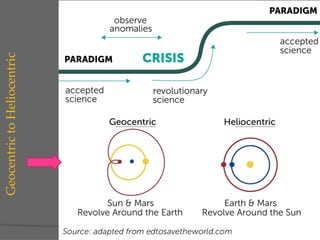
PARADIGM SHIFT
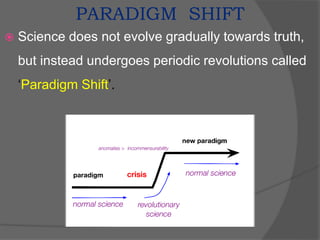
 Science does not evolve gradually towards truth,
but instead undergoes periodic revolutions called
‘Paradigm Shift’.
Geocentric
to
Heliocentric
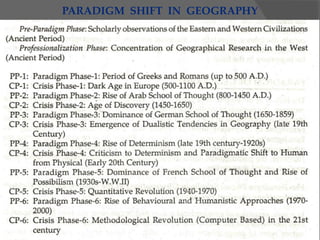
PARADIGM SHIFT IN GEOGRAPHY
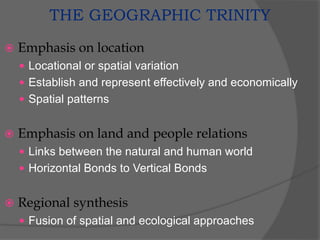
THE GEOGRAPHIC TRINITY
 Emphasis on location
 Locational or spatial variation
 Establish and represent effectively and economically
 Spatial patterns
 Emphasis on land and people relations
 Links between the natural and human world
 Horizontal Bonds to Vertical Bonds
 Regional synthesis
 Fusion of spatial and ecological approaches
THANK YOU

CONCEPT of GEOGRAPHY.pdf

  • 1.
  • 2.
    THOUGHT…….??? The act ofthinking about or considering something, an idea or opinion, or a set of ideas about a particular subject. Thought refers to ideas or arrangements of ideas that are the result of the process of thinking. GEOGRAPHICAL THOUGHT..?
  • 3.
    DEFINITION  What isWhere?  Mass of information about different lands and people  Areal differentiation view  Spatial Pattern
  • 4.
    GEOGRAPHY  “Geography isconcerned to provide accurate, orderly, and rational description and interpretation of the variable characters of the Earth’s surface” – Richard Hartshorne (1959).  Geography may be defined as the study of the inter-relationship between the physical and the social environment through time over space.
  • 5.
  • 6.
    PARADIGMS  Paradigm: “Universallyrecognised scientific achievements that for a time provide model problems and solutions to a community of practitioners” (Thomas Kuhn, 1962).
  • 7.
    PARADIGM SHIFT  Sciencedoes not evolve gradually towards truth, but instead undergoes periodic revolutions called ‘Paradigm Shift’.
  • 8.
  • 9.
  • 10.
    THE GEOGRAPHIC TRINITY Emphasis on location  Locational or spatial variation  Establish and represent effectively and economically  Spatial patterns  Emphasis on land and people relations  Links between the natural and human world  Horizontal Bonds to Vertical Bonds  Regional synthesis  Fusion of spatial and ecological approaches
  • 12.