Mrs. Sneha Sahay Youtham
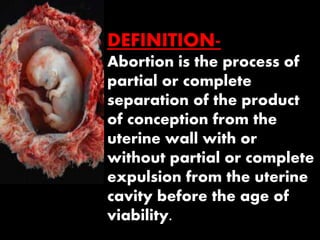
DEFINITION-
Abortion is the process of
partial or complete
separation of the product
of conception from the
uterine wall with or
without partial or complete
expulsion from the uterine
cavity before the age of
viability.
• Termination of pregnancy before
the fetus is viable.i.e.before 24
weeks gestation.
• CLASSIFICATION OF ABORTION-
ABORTION
SPONTANEOUS INDUCED
Isolated Recurrent Legal Illegal
Threatened Inevitable complete Incomplete
Missed Septic
Spontaneous
abortion is
defined as the
involuntary loss of
the products of
conception prior to
28 week s of
gestation, when the
fetus weights
approximately
1,000gm or less.
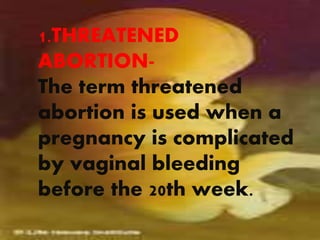
1.THREATENED
ABORTION-
The term threatened
abortion is used when a
pregnancy is complicated
by vaginal bleeding
before the 20th week.
DEFINITION-
process of abortion
has started but
has not progressed
to a state from
which recovery is
impossible.
CLINICAL FEATURES:-
• Bleeding per vaginam :-
slight , bright red in color
, brisk, sharp it may
remains as bright red.
MANAGEMENT
• General and systemic examination.
• Investigations include Hb, ABO grouping
and Rh, VDRL, Urine routine and blood
glucose.
• Thyroid functions tests .
• the patient is admitted and given complete
rest in bed.
• If pregnancy continues, the possibility of
IUGR, due to poor placental function must
be considered. There is also an increased
risk of preterm labor.
• Provide sedatives and analgesics.
2-INEVITABLE ABORTION:-
In case of inevitable abortion, a clinical
pregnancy is complicated by both
vaginal bleeding and cramp-like lower
abdominal pain. The cervix is
frequently partially dilated, attesting to
the inevitability of the process .
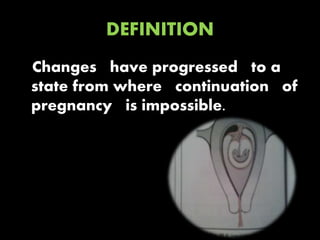
DEFINITION
Changes have progressed to a
state from where continuation of
pregnancy is impossible.
CLINICAL FEATURE:-
• Increased vaginal bleeding
• Pain lower abdomen may be
colicky in nature.
• Visible blood loss
• Internal examination shows
dilated internal OS of the cervix
through which the products of
conception are felt.
• Intermittent lower abdominal pain.
MANAGEMENT-
• To accelerate process of expulsion
• To maintain strict asepsis.
• Morphine 15 mgm is given IM
• Bleeding controlled by
administration of (syntocinon or
ergometrine) methargin 0.2 mgm if
cervix is dilated & size of uterus is
less than 12 weeks .
• Shock is corrected by IV fluid therapy
& blood transfusion.
3-INCOMPLETE ABORTION:-
• Incomplete Abortion In addition to
vaginal bleeding, cramp-like pain,
and cervical dilatation, an
incomplete abortion involves the
passage of products of conception,
often described by the women as
looking like pieces of skin or liver.
DEFINATION:-
• When entire products of
conception are not expelled
instead a part of it is left inside the
uterine cavity. It is called
incomplete abortion.
CLINICAL FEATURE :-
• History of expulsion of fleshly mass
per vagina
• Continues pain in lower abdomen it is
colicky in nature
• Persistent of vaginal bleeding .
• Internal vaginal examination-
• Uterus smaller than period of
amenorrhea.
• On examination expelled mass is
found incomplete.
MANAGEMENT
• Same like inevitable abortion if it is in
shock due to blood loss
• Patient should be resuscitated before
any active treatment is undertaken.
• Early abortion dilatation & evacuation
under G.A.
• Late abortion product is removed with
ovum forcep by blunt curette D& C
done to remove the bits of tissues left
behind
• Removed material send to histological
examination.
•
4-COMPLETE ABORTION:-
• In complete abortion, after
passage of all the products of
conception, the uterine contractions
and bleeding abate, the cervix
closes, and the uterus is smaller
than the period of amenorrhea
would suggest.
DEFINITION:
• When products of conception are
expelled out completely is caused
complete abortion.
CLINICAL FEATURE :-
_ Fleshly mass per vagina
–Abdominal pain
–Vaginal bleeding traces or
absent.
–Internal examination
–Uterus smaller
–Bleeding is trace
–Examination of expelled fleshy
mass intact.
MANAGEMENT
• If doubt absent complete expulsion of
the products uterine curettage should
be done.
• Transvaginal Sonography can be
done
• Rh negative women protected by anti-
D ,gamma globulin -50 micrograme or
100 micrograme IM in case of early
abortion respectively within 72 hrs
5-MISSED ABORTION:-
• In missed abortion, the embryo dies
despite the presence of a viable
placenta and the sac is retained. Death
of the embryo occurs before 8 weeks of
gestation but the mother’s body fails to
recognize the demise. A brown
discharge from the degeneration of
placental tissue may be present and
threatened miscarriage is suspected.
DEFINITION:-
• when fetus is dead & retained
inside the uterus for more than
4 weeks it is called missed
abortion.
CLINICAL FEATURES:-
• Persistence of brownish vaginal
discharge.
• Subsidence of pregnancy symptoms
• Breast changes.
• Cessation of uterine growth .
• FHS is not audible with Doppler.
• Often there is failure to gain weight.
• The uterus is smaller.
• USG will show smaller than expected
uterus with distorted or broken sac.
MANAGEMENT:_-
• Uterus is less than 12 weeks
• S& E with slow dilatation of cervix
under GA.
• Uterus more than 12weeks induction
done by
• 1. OXYTOCIN 10-20 units in 500ml of 5%
dextrose at rate of 30 drops per min
2. PROSTAGLANDIN IM .
6-SEPTIC ABORTION:-
• A septic abortion is an abortion
associated with an infection inside a
pregnant woman's uterus
CAUSES
• A septic abortion can occur when
bacteria enters the uterus. The bacteria
may also belong to the vaginal flora.
Also, sexually transmitted infections
(STI) such as Chlamydia may also cause
septic abortion.
RISK FACTORS-
• The fetal membranes surrounding
the unborn child have ruptured,
sometimes without being detected
• The woman has a sexually
transmitted infection such as
Chlamydia
• An intrauterine device (IUD) was
left in place during the pregnancy.
• Tissue from the unborn child or
placenta is left inside the uterus
after a miscarriage or elective
abortion procedure
• Unsafe abortion was made to end
the pregnancy
• Insertion of tools, chemicals, or
soaps into the uterus
PREVENTION
• Better birth control and legal abortion
have dramatically reduced the number
of septic abortions. To cut the risk
further, a woman should be tested for
common sexually transmitted infections
in the first trimester of her pregnancy.
MANAGEMENT-
• The woman should have intravenous fluids to
maintain blood pressure and urine output.
• Broad-spectrum intravenous antibiotics
should be given.
• A dilatation and curettage (D&C) .
• Due to bleeding, iron supplementation may
be
given.
• -Analgesics and sedatives, as required, are to
be prescribed.
• -blood transfusion is given to improve
anaemia.
RECURRENT ABORTION –
As a sequence of 3 or more
consecutive spontaneous abortion
before 20 weeks.
INVESTIGATIONS’-
• Blood –BLOOD glucose, VDRL, Thyroid
function test, ABO and Rh grouping.
• Autoimmune screening
• Serum LH on D2/D3 of the cycle.
• Ultrasonography.
MANAGEMENT-
• 1. To alleviate anxiety & to improve the
psychology.
• 2.To correct uterine pathology.
• 3.chromosomal problems refer to
genetic counseling for future risk of
abortion.
• 4. To treat the endocrine dysfunction
or genital tract infection etc.
• 5. USG should be used to detect a
viable pregnancy.
INDUCED ABORTION –
• Deliberate termination of
pregnancy either by medical or by
surgical methods before the
viability of the fetus is called
induction of abortion .the induced
abortion may be legal or illegal
(criminal).
THE abortion was legalized
by “medical termination of
pregnancy act “of 1971, and
has been enforced in the
year April 1972. The provision
of the act have been revised
in 1975.
MTP [LEGAL ABORTION]
• Since legislation of abortion in India,
deliberate induction of abortion prior to
20 weeks gestation by a registered
medical practitioner in the interest of
mother’s health and life is protected
under the MTP Act.
PROVISION FOR MTP UNDER THE MPT ACT:-
• The continuation of pregnancy would
involve serious risk of life.
• Risk of the child being born with the
serious physical and mental
abnormalities.
• The pregnancy is the result of rape.
• The failure is caused as a result of
failure of contraceptive.
• Social and economic factor.
METHODS OF TERMINATION of
pregnancy
• In first trimester-
Menstrual regulation.
Suction evacuation and curettage.
Dilatation and evacuation.
Pharmacological methods.
-Mifepristone.
-Methotrexate
• In second trimester(up to 20 weeks)-
Intrauterine instillation.
Extra uterine instillation.
Prostaglandins.
Oxytocin.
Hysterectomy.
ILLIGAL
NURSING PROCESS:-
ASSESSMENT-
• Vaginal bleeding, spotting,
• clots.
• Low abdominal cramping.
• Passing of tissue through the vagina.
• Shock decreased B.P, increased pulse rate.
• Women may verbalize fear, disappointment
or feelings of guilt.
NURSING DIAGNOSIS:-
•Risk for fetal injury.
•Risk for infection.
•Ineffective airway clearance.
•Actual/ risk for aspiration.
•Anxiety.
•Anticipatory grieving.
•Altered family processes.
•Actual/risk for altered parenting.
•Health seeking behavior.
PLANNING:-
•Provide information regarding
treatment plan.
•Provide support and reassurance
regarding nursing care.
•Promote maternal physical well-being.
•Provide opportunities for counseling
and support.
•Provide teaching related to self care.
IMPLEMENTATION:-
• Observe for vaginal bleeding and cramping.
• Save expelled tissue and clot for examination.
• Monitor vital signs every 5 min. to 4 hrs.
Depending on maternal status.
• Maintain women on bed rest.
• Observe for signs of shock, and institute
treatment measures.
• Prepare for D & C if appropriate.
• Provide support, but avoid offering false
assurance.
EVALUATION:-
• Ensure that the women
• Is free from anemia and infection.
• Is free from vaginal bleeding.
• Returns to normal physiological status
following the abortion.
• Verbalizes feelings regarding the event
and the outcome as does her significant
other/spouse.
• Understands self care measures.
HEALTH EDUCATION:-
• Midwives need to support the mother and
her family at the time when they are grieving
for their lost baby.
• Give psychological support.
• Follow-up visits must be made in 2-4 weeks
after abortion.
• Counseling on contraception is of
importance to these women who are or have
been faced with the reality of an unwanted
pregnancy.
D.C.Dutta; Textbook of Obstetrics; 6th Edition; Page
no158-167.
Annamma Jacob; Textbook of Obstetrics; 4th Edition;
Page no.142, 251,255,777.
Myles; Textbook of Obstetrics15th Edition; Page
no.11073, 314-318,329.
N. Kumari, Text book of midwifery and gynecological
nursing,1st edition 2010,page no.134-145.
Myles; text book for midwives 14th edition 2009,page
no 1031,280,282,284.
Jump up to: a b c Culwell KR, Vekemans M, de Silva U,
Hurwitz M (July 2010). "Critical gaps in universal access
to reproductive health: Contraception and prevention
of unsafe abortion". International Journal of
Gynecology & Obstetrics 110: S13–16.
Doi:10.1016/j.ijgo.2010.04.003. PMID 20451196. Incidence
BIBLIOGRAPHY
Abortion pt

Abortion pt

  • 1.
  • 2.
    DEFINITION- Abortion is theprocess of partial or complete separation of the product of conception from the uterine wall with or without partial or complete expulsion from the uterine cavity before the age of viability.
  • 3.
    • Termination ofpregnancy before the fetus is viable.i.e.before 24 weeks gestation.
  • 4.
    • CLASSIFICATION OFABORTION- ABORTION SPONTANEOUS INDUCED Isolated Recurrent Legal Illegal Threatened Inevitable complete Incomplete Missed Septic
  • 5.
    Spontaneous abortion is defined asthe involuntary loss of the products of conception prior to 28 week s of gestation, when the fetus weights approximately 1,000gm or less.
  • 6.
    1.THREATENED ABORTION- The term threatened abortionis used when a pregnancy is complicated by vaginal bleeding before the 20th week.
  • 7.
    DEFINITION- process of abortion hasstarted but has not progressed to a state from which recovery is impossible.
  • 8.
    CLINICAL FEATURES:- • Bleedingper vaginam :- slight , bright red in color , brisk, sharp it may remains as bright red.
  • 9.
    MANAGEMENT • General andsystemic examination. • Investigations include Hb, ABO grouping and Rh, VDRL, Urine routine and blood glucose. • Thyroid functions tests . • the patient is admitted and given complete rest in bed. • If pregnancy continues, the possibility of IUGR, due to poor placental function must be considered. There is also an increased risk of preterm labor. • Provide sedatives and analgesics.
  • 10.
    2-INEVITABLE ABORTION:- In caseof inevitable abortion, a clinical pregnancy is complicated by both vaginal bleeding and cramp-like lower abdominal pain. The cervix is frequently partially dilated, attesting to the inevitability of the process .
  • 11.
    DEFINITION Changes have progressedto a state from where continuation of pregnancy is impossible.
  • 12.
    CLINICAL FEATURE:- • Increasedvaginal bleeding • Pain lower abdomen may be colicky in nature. • Visible blood loss • Internal examination shows dilated internal OS of the cervix through which the products of conception are felt. • Intermittent lower abdominal pain.
  • 13.
    MANAGEMENT- • To accelerateprocess of expulsion • To maintain strict asepsis. • Morphine 15 mgm is given IM • Bleeding controlled by administration of (syntocinon or ergometrine) methargin 0.2 mgm if cervix is dilated & size of uterus is less than 12 weeks . • Shock is corrected by IV fluid therapy & blood transfusion.
  • 14.
    3-INCOMPLETE ABORTION:- • IncompleteAbortion In addition to vaginal bleeding, cramp-like pain, and cervical dilatation, an incomplete abortion involves the passage of products of conception, often described by the women as looking like pieces of skin or liver.
  • 15.
    DEFINATION:- • When entireproducts of conception are not expelled instead a part of it is left inside the uterine cavity. It is called incomplete abortion.
  • 16.
    CLINICAL FEATURE :- •History of expulsion of fleshly mass per vagina • Continues pain in lower abdomen it is colicky in nature • Persistent of vaginal bleeding . • Internal vaginal examination- • Uterus smaller than period of amenorrhea. • On examination expelled mass is found incomplete.
  • 17.
    MANAGEMENT • Same likeinevitable abortion if it is in shock due to blood loss • Patient should be resuscitated before any active treatment is undertaken. • Early abortion dilatation & evacuation under G.A. • Late abortion product is removed with ovum forcep by blunt curette D& C done to remove the bits of tissues left behind • Removed material send to histological examination. •
  • 18.
    4-COMPLETE ABORTION:- • Incomplete abortion, after passage of all the products of conception, the uterine contractions and bleeding abate, the cervix closes, and the uterus is smaller than the period of amenorrhea would suggest.
  • 19.
    DEFINITION: • When productsof conception are expelled out completely is caused complete abortion.
  • 20.
    CLINICAL FEATURE :- _Fleshly mass per vagina –Abdominal pain –Vaginal bleeding traces or absent. –Internal examination –Uterus smaller –Bleeding is trace –Examination of expelled fleshy mass intact.
  • 21.
    MANAGEMENT • If doubtabsent complete expulsion of the products uterine curettage should be done. • Transvaginal Sonography can be done • Rh negative women protected by anti- D ,gamma globulin -50 micrograme or 100 micrograme IM in case of early abortion respectively within 72 hrs
  • 22.
    5-MISSED ABORTION:- • Inmissed abortion, the embryo dies despite the presence of a viable placenta and the sac is retained. Death of the embryo occurs before 8 weeks of gestation but the mother’s body fails to recognize the demise. A brown discharge from the degeneration of placental tissue may be present and threatened miscarriage is suspected.
  • 23.
    DEFINITION:- • when fetusis dead & retained inside the uterus for more than 4 weeks it is called missed abortion.
  • 24.
    CLINICAL FEATURES:- • Persistenceof brownish vaginal discharge. • Subsidence of pregnancy symptoms • Breast changes. • Cessation of uterine growth . • FHS is not audible with Doppler. • Often there is failure to gain weight. • The uterus is smaller. • USG will show smaller than expected uterus with distorted or broken sac.
  • 26.
    MANAGEMENT:_- • Uterus isless than 12 weeks • S& E with slow dilatation of cervix under GA. • Uterus more than 12weeks induction done by • 1. OXYTOCIN 10-20 units in 500ml of 5% dextrose at rate of 30 drops per min 2. PROSTAGLANDIN IM .
  • 27.
    6-SEPTIC ABORTION:- • Aseptic abortion is an abortion associated with an infection inside a pregnant woman's uterus
  • 28.
    CAUSES • A septicabortion can occur when bacteria enters the uterus. The bacteria may also belong to the vaginal flora. Also, sexually transmitted infections (STI) such as Chlamydia may also cause septic abortion.
  • 29.
    RISK FACTORS- • Thefetal membranes surrounding the unborn child have ruptured, sometimes without being detected • The woman has a sexually transmitted infection such as Chlamydia • An intrauterine device (IUD) was left in place during the pregnancy.
  • 30.
    • Tissue fromthe unborn child or placenta is left inside the uterus after a miscarriage or elective abortion procedure • Unsafe abortion was made to end the pregnancy • Insertion of tools, chemicals, or soaps into the uterus
  • 31.
    PREVENTION • Better birthcontrol and legal abortion have dramatically reduced the number of septic abortions. To cut the risk further, a woman should be tested for common sexually transmitted infections in the first trimester of her pregnancy.
  • 32.
    MANAGEMENT- • The womanshould have intravenous fluids to maintain blood pressure and urine output. • Broad-spectrum intravenous antibiotics should be given. • A dilatation and curettage (D&C) . • Due to bleeding, iron supplementation may be given. • -Analgesics and sedatives, as required, are to be prescribed. • -blood transfusion is given to improve anaemia.
  • 33.
    RECURRENT ABORTION – Asa sequence of 3 or more consecutive spontaneous abortion before 20 weeks.
  • 34.
    INVESTIGATIONS’- • Blood –BLOODglucose, VDRL, Thyroid function test, ABO and Rh grouping. • Autoimmune screening • Serum LH on D2/D3 of the cycle. • Ultrasonography.
  • 35.
    MANAGEMENT- • 1. Toalleviate anxiety & to improve the psychology. • 2.To correct uterine pathology. • 3.chromosomal problems refer to genetic counseling for future risk of abortion. • 4. To treat the endocrine dysfunction or genital tract infection etc. • 5. USG should be used to detect a viable pregnancy.
  • 36.
    INDUCED ABORTION – •Deliberate termination of pregnancy either by medical or by surgical methods before the viability of the fetus is called induction of abortion .the induced abortion may be legal or illegal (criminal).
  • 37.
    THE abortion waslegalized by “medical termination of pregnancy act “of 1971, and has been enforced in the year April 1972. The provision of the act have been revised in 1975.
  • 38.
    MTP [LEGAL ABORTION] •Since legislation of abortion in India, deliberate induction of abortion prior to 20 weeks gestation by a registered medical practitioner in the interest of mother’s health and life is protected under the MTP Act.
  • 39.
    PROVISION FOR MTPUNDER THE MPT ACT:- • The continuation of pregnancy would involve serious risk of life. • Risk of the child being born with the serious physical and mental abnormalities. • The pregnancy is the result of rape. • The failure is caused as a result of failure of contraceptive. • Social and economic factor.
  • 41.
    METHODS OF TERMINATIONof pregnancy • In first trimester- Menstrual regulation. Suction evacuation and curettage. Dilatation and evacuation. Pharmacological methods. -Mifepristone. -Methotrexate
  • 49.
    • In secondtrimester(up to 20 weeks)- Intrauterine instillation. Extra uterine instillation. Prostaglandins. Oxytocin. Hysterectomy.
  • 51.
  • 53.
    NURSING PROCESS:- ASSESSMENT- • Vaginalbleeding, spotting, • clots. • Low abdominal cramping. • Passing of tissue through the vagina. • Shock decreased B.P, increased pulse rate. • Women may verbalize fear, disappointment or feelings of guilt.
  • 54.
    NURSING DIAGNOSIS:- •Risk forfetal injury. •Risk for infection. •Ineffective airway clearance. •Actual/ risk for aspiration. •Anxiety. •Anticipatory grieving. •Altered family processes. •Actual/risk for altered parenting. •Health seeking behavior.
  • 55.
    PLANNING:- •Provide information regarding treatmentplan. •Provide support and reassurance regarding nursing care. •Promote maternal physical well-being. •Provide opportunities for counseling and support. •Provide teaching related to self care.
  • 56.
    IMPLEMENTATION:- • Observe forvaginal bleeding and cramping. • Save expelled tissue and clot for examination. • Monitor vital signs every 5 min. to 4 hrs. Depending on maternal status. • Maintain women on bed rest. • Observe for signs of shock, and institute treatment measures. • Prepare for D & C if appropriate. • Provide support, but avoid offering false assurance.
  • 57.
    EVALUATION:- • Ensure thatthe women • Is free from anemia and infection. • Is free from vaginal bleeding. • Returns to normal physiological status following the abortion. • Verbalizes feelings regarding the event and the outcome as does her significant other/spouse. • Understands self care measures.
  • 58.
    HEALTH EDUCATION:- • Midwivesneed to support the mother and her family at the time when they are grieving for their lost baby. • Give psychological support. • Follow-up visits must be made in 2-4 weeks after abortion. • Counseling on contraception is of importance to these women who are or have been faced with the reality of an unwanted pregnancy.
  • 60.
    D.C.Dutta; Textbook ofObstetrics; 6th Edition; Page no158-167. Annamma Jacob; Textbook of Obstetrics; 4th Edition; Page no.142, 251,255,777. Myles; Textbook of Obstetrics15th Edition; Page no.11073, 314-318,329. N. Kumari, Text book of midwifery and gynecological nursing,1st edition 2010,page no.134-145. Myles; text book for midwives 14th edition 2009,page no 1031,280,282,284. Jump up to: a b c Culwell KR, Vekemans M, de Silva U, Hurwitz M (July 2010). "Critical gaps in universal access to reproductive health: Contraception and prevention of unsafe abortion". International Journal of Gynecology & Obstetrics 110: S13–16. Doi:10.1016/j.ijgo.2010.04.003. PMID 20451196. Incidence BIBLIOGRAPHY