Putcha V. Narasimham
Knowledge Enabler Systems
1405, Aparna Aura, Road No 79, Shaikpet,
Hyderabad-500104
Our Ref: Structured Study Process & Reporting Format
Date: 17NOV09, 05NOV12, 01JAN17
Res. Mobile 98660 71582 Page No 1 of 6
e-mail putchavn@yahoo.com, kenablersys@yahoo.com
Copyright © 2009, 2012 and 2017 by Putcha V. Narasimham. All rights reserved.
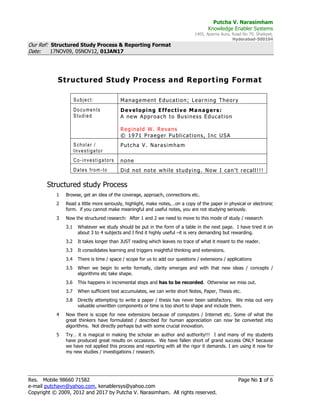
Structured Study Process and Reporting Format
Subject: Management Education; Learning Theory
Documents
Studied
Developing Effective Managers:
A new Approach to Business Education
Reginald W. Revans
© 1971 Praeger Publications, Inc USA
Scholar /
Investigator
Putcha V. Narasimham
Co-investigators none
Dates from-to Did not note while studying. Now I can’t recall!!!
Structured study Process
1 Browse, get an idea of the coverage, approach, connections etc.
2 Read a little more seriously, highlight, make notes,…on a copy of the paper in physical or electronic
form. if you cannot make meaningful and useful notes, you are not studying seriously.
3 Now the structured research: After 1 and 2 we need to move to this mode of study / research
3.1 Whatever we study should be put in the form of a table in the next page. I have tried it on
about 3 to 4 subjects and I find it highly useful –it is very demanding but rewarding.
3.2 It takes longer than JUST reading which leaves no trace of what it meant to the reader.
3.3 It consolidates learning and triggers insightful thinking and extensions.
3.4 There is time / space / scope for us to add our questions / extensions / applications
3.5 When we begin to write formally, clarity emerges and with that new ideas / concepts /
algorithms etc take shape.
3.6 This happens in incremental steps and has to be recorded. Otherwise we miss out.
3.7 When sufficient text accumulates, we can write short Notes, Paper, Thesis etc.
3.8 Directly attempting to write a paper / thesis has never been satisfactory. We miss out very
valuable unwritten components or time is too short to shape and include them.
4 Now there is scope for new extensions because of computers / Internet etc. Some of what the
great thinkers have formulated / described for human appreciation can now be converted into
algorithms. Not directly perhaps but with some crucial innovation.
5 Try… it is magical in making the scholar an author and authority!!! I and many of my students
have produced great results on occasions. We have fallen short of grand success ONLY because
we have not applied this process and reporting with all the rigor it demands. I am using it now for
my new studies / investigations / research.
Putcha V. Narasimham
Knowledge Enabler Systems
1405, Aparna Aura, Road No 79, Shaikpet,
Hyderabad-500104
Our Ref: Structured Study Process & Reporting Format
Date: 17NOV09, 05NOV12, 01JAN17
Res. Mobile 98660 71582 Page No 2 of 6
e-mail putchavn@yahoo.com, kenablersys@yahoo.com
Copyright © 2009, 2012 and 2017 by Putcha V. Narasimham. All rights reserved.
Template for Structured Study Process & Reporting
1. 2. 3.
Selected Text / Ref
Appreciation or
Criticism
of contents of Col 1 with
Reasons
Further Action,
Extension, correction,
improvement, innovation
Preface Page xviii
Did not note the full reference.
I do not share many of the present
values of the academic world. My
insistence that the first need of any
science, namely, that one should
continuously observe its field of
action at first hand---that we
should involve the managers
themselves in collecting and
interpreting the data necessary of
successful decision-making---has
been dismissed as unscientific, as
poor research, and as unlikely to
lead to any understanding of
management, either as art or as
science.
“dismissed as
unscientific…”
Why? What is unscientific
about it? No hypothesis or
theory?
Perhaps there should be
an objective and some
hypothesis ….then theory
may evolve and explain
phenomena
Is this the point?
Did not get around to it.
I conclude with a quotation from
Hazlitt’s essay “on the Ignorance
of the Learned”
Learning is, in many cases…. A
substitute for true knowledge.
Books are less often made use of as
spectacles to look at nature with,
than as blinds to keep out its
strong light and shifting scenery
from weak eyes and indolent
dispositions …. The most sensible
people to be met with in society are
men of business and of business and
of the world, who argue from what
they see and know, instead of
spinning cobweb distinctions of what
things ought to be.
It is a good criticism but is
NOT valid.
Yes, it is designed to be
that way to enable those
who may not have direct
experience & firsthand
knowledge, also to
KNOW. [Howard Gardner
the need for and use of
context learning
multiple intelligences]
But it should NOT be a
total substitute. Soon
enough direct or simulated
experience must be
provided
Good metaphor
Putcha V. Narasimham
Knowledge Enabler Systems
1405, Aparna Aura, Road No 79, Shaikpet,
Hyderabad-500104
Our Ref: Structured Study Process & Reporting Format
Date: 17NOV09, 05NOV12, 01JAN17
Res. Mobile 98660 71582 Page No 3 of 6
e-mail putchavn@yahoo.com, kenablersys@yahoo.com
Copyright © 2009, 2012 and 2017 by Putcha V. Narasimham. All rights reserved.
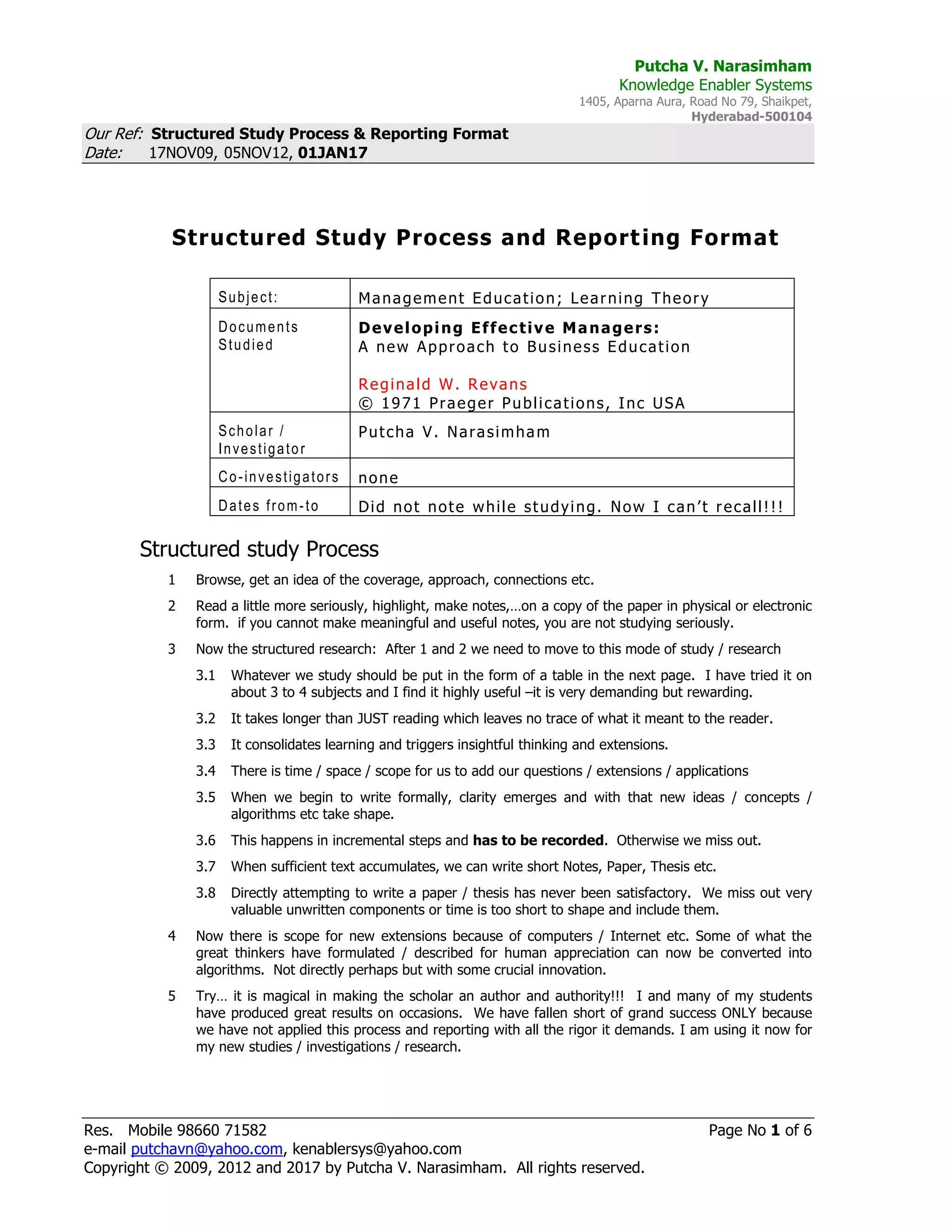
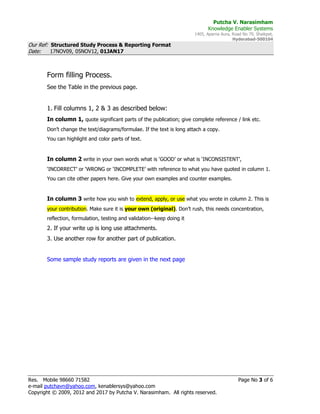
Form filling Process.
See the Table in the previous page.
1. Fill columns 1, 2 & 3 as described below:
In column 1, quote significant parts of the publication; give complete reference / link etc.
Don’t change the text/diagrams/formulae. If the text is long attach a copy.
You can highlight and color parts of text.
In column 2 write in your own words what is ‘GOOD’ or what is ‘INCONSISTENT’,
‘INCORRECT’ or ‘WRONG or ‘INCOMPLETE’ with reference to what you have quoted in column 1.
You can cite other papers here. Give your own examples and counter examples.
In column 3 write how you wish to extend, apply, or use what you wrote in column 2. This is
your contribution. Make sure it is your own (original). Don’t rush, this needs concentration,
reflection, formulation, testing and validation--keep doing it
2. If your write up is long use attachments.
3. Use another row for another part of publication.
Some sample study reports are given in the next page
Putcha V. Narasimham
Knowledge Enabler Systems
1405, Aparna Aura, Road No 79, Shaikpet,
Hyderabad-500104
Our Ref: Structured Study Process & Reporting Format
Date: 17NOV09, 05NOV12, 01JAN17
Res. Mobile 98660 71582 Page No 4 of 6
e-mail putchavn@yahoo.com, kenablersys@yahoo.com
Copyright © 2009, 2012 and 2017 by Putcha V. Narasimham. All rights reserved.
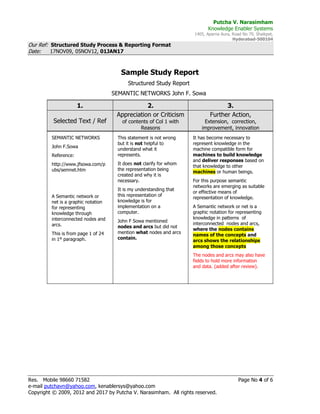
Sample Study Report
Structured Study Report
SEMANTIC NETWORKS John F. Sowa
1. 2. 3.
Selected Text / Ref
Appreciation or Criticism
of contents of Col 1 with
Reasons
Further Action,
Extension, correction,
improvement, innovation
SEMANTIC NETWORKS
John F.Sowa
Reference:
http://www.jfsowa.com/p
ubs/semnet.htm
A Semantic network or
net is a graphic notation
for representing
knowledge through
interconnected nodes and
arcs.
This is from page 1 of 24
in 1st
paragraph.
This statement is not wrong
but it is not helpful to
understand what it
represents.
It does not clarify for whom
the representation being
created and why it is
necessary.
It is my understanding that
this representation of
knowledge is for
implementation on a
computer.
John F Sowa mentioned
nodes and arcs but did not
mention what nodes and arcs
contain.
It has become necessary to
represent knowledge in the
machine compatible form for
machines to build knowledge
and deliver responses based on
that knowledge to other
machines or human beings.
For this purpose semantic
networks are emerging as suitable
or effective means of
representation of knowledge.
A Semantic network or net is a
graphic notation for representing
knowledge in patterns of
interconnected nodes and arcs,
where the nodes contains
names of the concepts and
arcs shows the relationships
among those concepts
The nodes and arcs may also have
fields to hold more information
and data. (added after review).
Putcha V. Narasimham
Knowledge Enabler Systems
1405, Aparna Aura, Road No 79, Shaikpet,
Hyderabad-500104
Our Ref: Structured Study Process & Reporting Format
Date: 17NOV09, 05NOV12, 01JAN17
Res. Mobile 98660 71582 Page No 5 of 6
e-mail putchavn@yahoo.com, kenablersys@yahoo.com
Copyright © 2009, 2012 and 2017 by Putcha V. Narasimham. All rights reserved.
Sample Study Report
Grady Booch, James Rumbaugh and Ivar Jacobson
The Unified Modeling Languages User Guide © 1997,Addison-Wesly
1. 2. 3.
Selected Text / Ref
Appreciation or Criticism
of contents of Col 1 with
Reasons
Further Action,
Extension, correction,
improvement, innovation
Chapter 19
Activity Diagrams
Page 266 Figure 19-7
Swimlanes
Objects may be
involved in the flow of
control associated with
an activity diagram.
For example, in the
workflow of processing
an order as in 19-7,
the vocabulary of your
problem space will also
include such classes as
Order and Bill.
In the real-world, objects
like material and people
also flow from one process
or activity to another
process or activity and that
needs to be represented
explicitly. So, introduction
of Object Flow in UML is
very useful. Activity
Diagram is the only one
which facilitates this.
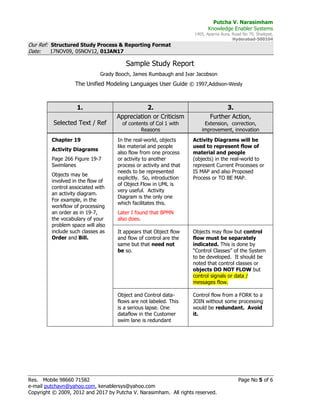
Later I found that BPMN
also does.
Activity Diagrams will be
used to represent flow of
material and people
(objects) in the real-world to
represent Current Processes or
IS MAP and also Proposed
Process or TO BE MAP.
It appears that Object flow
and flow of control are the
same but that need not
be so.
Objects may flow but control
flow must be separately
indicated. This is done by
“Control Classes” of the System
to be developed. It should be
noted that control classes or
objects DO NOT FLOW but
control signals or data /
messages flow.
Object and Control data-
flows are not labeled. This
is a serious lapse. One
dataflow in the Customer
swim lane is redundant
Control flow from a FORK to a
JOIN without some processing
would be redundant. Avoid
it.
Putcha V. Narasimham
Knowledge Enabler Systems
1405, Aparna Aura, Road No 79, Shaikpet,
Hyderabad-500104
Our Ref: Structured Study Process & Reporting Format
Date: 17NOV09, 05NOV12, 01JAN17
Res. Mobile 98660 71582 Page No 6 of 6
e-mail putchavn@yahoo.com, kenablersys@yahoo.com
Copyright © 2009, 2012 and 2017 by Putcha V. Narasimham. All rights reserved.
Sample Study Report
Grady Booch, James Rumbaugh and Ivar Jacobson
The Unified Modeling Languages User Guide © 1997,Addison-Wesly
1. 2. 3.
Selected Text / Ref
Appreciation or Criticism
of contents of Col 1 with
Reasons
Further Action,
Extension, correction,
improvement, innovation
Page 267 Figure 19-8
Object Flow
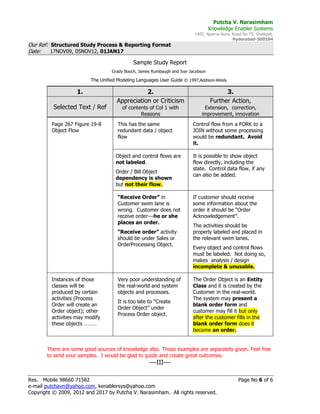
This has the same
redundant data / object
flow
Control flow from a FORK to a
JOIN without some processing
would be redundant. Avoid
it.
Object and control flows are
not labeled.
Order / Bill Object
dependency is shown
but not their flow.
It is possible to show object
flow directly, including the
state. Control data flow, if any
can also be added.
“Receive Order” in
Customer swim lane is
wrong. Customer does not
receive order---he or she
places an order.
“Receive order” activity
should be under Sales or
OrderProcessing Object.
If customer should receive
some information about the
order it should be “Order
Acknowledgement”.
The activities should be
properly labeled and placed in
the relevant swim lanes.
Every object and control flows
must be labeled. Not doing so,
makes analysis / design
incomplete & unusable.
Instances of those
classes will be
produced by certain
activities (Process
Order will create an
Order object); other
activities may modify
these objects ………
Very poor understanding of
the real-world and system
objects and processes.
It is too late to “Create
Order Object” under
Process Order object.
The Order Object is an Entity
Class and it is created by the
Customer in the real-world.
The system may present a
blank order form and
customer may fill it but only
after the customer fills in the
blank order form does it
become an order.
There are some good sources of knowledge also. Those examples are separately given. Feel free
to send your samples. I would be glad to guide and create great outcomes.
---III---

Structured Study Process and Reporting Format

  • 1.
    Putcha V. Narasimham KnowledgeEnabler Systems 1405, Aparna Aura, Road No 79, Shaikpet, Hyderabad-500104 Our Ref: Structured Study Process & Reporting Format Date: 17NOV09, 05NOV12, 01JAN17 Res. Mobile 98660 71582 Page No 1 of 6 e-mail putchavn@yahoo.com, kenablersys@yahoo.com Copyright © 2009, 2012 and 2017 by Putcha V. Narasimham. All rights reserved. Structured Study Process and Reporting Format Subject: Management Education; Learning Theory Documents Studied Developing Effective Managers: A new Approach to Business Education Reginald W. Revans © 1971 Praeger Publications, Inc USA Scholar / Investigator Putcha V. Narasimham Co-investigators none Dates from-to Did not note while studying. Now I can’t recall!!! Structured study Process 1 Browse, get an idea of the coverage, approach, connections etc. 2 Read a little more seriously, highlight, make notes,…on a copy of the paper in physical or electronic form. if you cannot make meaningful and useful notes, you are not studying seriously. 3 Now the structured research: After 1 and 2 we need to move to this mode of study / research 3.1 Whatever we study should be put in the form of a table in the next page. I have tried it on about 3 to 4 subjects and I find it highly useful –it is very demanding but rewarding. 3.2 It takes longer than JUST reading which leaves no trace of what it meant to the reader. 3.3 It consolidates learning and triggers insightful thinking and extensions. 3.4 There is time / space / scope for us to add our questions / extensions / applications 3.5 When we begin to write formally, clarity emerges and with that new ideas / concepts / algorithms etc take shape. 3.6 This happens in incremental steps and has to be recorded. Otherwise we miss out. 3.7 When sufficient text accumulates, we can write short Notes, Paper, Thesis etc. 3.8 Directly attempting to write a paper / thesis has never been satisfactory. We miss out very valuable unwritten components or time is too short to shape and include them. 4 Now there is scope for new extensions because of computers / Internet etc. Some of what the great thinkers have formulated / described for human appreciation can now be converted into algorithms. Not directly perhaps but with some crucial innovation. 5 Try… it is magical in making the scholar an author and authority!!! I and many of my students have produced great results on occasions. We have fallen short of grand success ONLY because we have not applied this process and reporting with all the rigor it demands. I am using it now for my new studies / investigations / research.
  • 2.
    Putcha V. Narasimham KnowledgeEnabler Systems 1405, Aparna Aura, Road No 79, Shaikpet, Hyderabad-500104 Our Ref: Structured Study Process & Reporting Format Date: 17NOV09, 05NOV12, 01JAN17 Res. Mobile 98660 71582 Page No 2 of 6 e-mail putchavn@yahoo.com, kenablersys@yahoo.com Copyright © 2009, 2012 and 2017 by Putcha V. Narasimham. All rights reserved. Template for Structured Study Process & Reporting 1. 2. 3. Selected Text / Ref Appreciation or Criticism of contents of Col 1 with Reasons Further Action, Extension, correction, improvement, innovation Preface Page xviii Did not note the full reference. I do not share many of the present values of the academic world. My insistence that the first need of any science, namely, that one should continuously observe its field of action at first hand---that we should involve the managers themselves in collecting and interpreting the data necessary of successful decision-making---has been dismissed as unscientific, as poor research, and as unlikely to lead to any understanding of management, either as art or as science. “dismissed as unscientific…” Why? What is unscientific about it? No hypothesis or theory? Perhaps there should be an objective and some hypothesis ….then theory may evolve and explain phenomena Is this the point? Did not get around to it. I conclude with a quotation from Hazlitt’s essay “on the Ignorance of the Learned” Learning is, in many cases…. A substitute for true knowledge. Books are less often made use of as spectacles to look at nature with, than as blinds to keep out its strong light and shifting scenery from weak eyes and indolent dispositions …. The most sensible people to be met with in society are men of business and of business and of the world, who argue from what they see and know, instead of spinning cobweb distinctions of what things ought to be. It is a good criticism but is NOT valid. Yes, it is designed to be that way to enable those who may not have direct experience & firsthand knowledge, also to KNOW. [Howard Gardner the need for and use of context learning multiple intelligences] But it should NOT be a total substitute. Soon enough direct or simulated experience must be provided Good metaphor
  • 3.
    Putcha V. Narasimham KnowledgeEnabler Systems 1405, Aparna Aura, Road No 79, Shaikpet, Hyderabad-500104 Our Ref: Structured Study Process & Reporting Format Date: 17NOV09, 05NOV12, 01JAN17 Res. Mobile 98660 71582 Page No 3 of 6 e-mail putchavn@yahoo.com, kenablersys@yahoo.com Copyright © 2009, 2012 and 2017 by Putcha V. Narasimham. All rights reserved. Form filling Process. See the Table in the previous page. 1. Fill columns 1, 2 & 3 as described below: In column 1, quote significant parts of the publication; give complete reference / link etc. Don’t change the text/diagrams/formulae. If the text is long attach a copy. You can highlight and color parts of text. In column 2 write in your own words what is ‘GOOD’ or what is ‘INCONSISTENT’, ‘INCORRECT’ or ‘WRONG or ‘INCOMPLETE’ with reference to what you have quoted in column 1. You can cite other papers here. Give your own examples and counter examples. In column 3 write how you wish to extend, apply, or use what you wrote in column 2. This is your contribution. Make sure it is your own (original). Don’t rush, this needs concentration, reflection, formulation, testing and validation--keep doing it 2. If your write up is long use attachments. 3. Use another row for another part of publication. Some sample study reports are given in the next page
  • 4.
    Putcha V. Narasimham KnowledgeEnabler Systems 1405, Aparna Aura, Road No 79, Shaikpet, Hyderabad-500104 Our Ref: Structured Study Process & Reporting Format Date: 17NOV09, 05NOV12, 01JAN17 Res. Mobile 98660 71582 Page No 4 of 6 e-mail putchavn@yahoo.com, kenablersys@yahoo.com Copyright © 2009, 2012 and 2017 by Putcha V. Narasimham. All rights reserved. Sample Study Report Structured Study Report SEMANTIC NETWORKS John F. Sowa 1. 2. 3. Selected Text / Ref Appreciation or Criticism of contents of Col 1 with Reasons Further Action, Extension, correction, improvement, innovation SEMANTIC NETWORKS John F.Sowa Reference: http://www.jfsowa.com/p ubs/semnet.htm A Semantic network or net is a graphic notation for representing knowledge through interconnected nodes and arcs. This is from page 1 of 24 in 1st paragraph. This statement is not wrong but it is not helpful to understand what it represents. It does not clarify for whom the representation being created and why it is necessary. It is my understanding that this representation of knowledge is for implementation on a computer. John F Sowa mentioned nodes and arcs but did not mention what nodes and arcs contain. It has become necessary to represent knowledge in the machine compatible form for machines to build knowledge and deliver responses based on that knowledge to other machines or human beings. For this purpose semantic networks are emerging as suitable or effective means of representation of knowledge. A Semantic network or net is a graphic notation for representing knowledge in patterns of interconnected nodes and arcs, where the nodes contains names of the concepts and arcs shows the relationships among those concepts The nodes and arcs may also have fields to hold more information and data. (added after review).
  • 5.
    Putcha V. Narasimham KnowledgeEnabler Systems 1405, Aparna Aura, Road No 79, Shaikpet, Hyderabad-500104 Our Ref: Structured Study Process & Reporting Format Date: 17NOV09, 05NOV12, 01JAN17 Res. Mobile 98660 71582 Page No 5 of 6 e-mail putchavn@yahoo.com, kenablersys@yahoo.com Copyright © 2009, 2012 and 2017 by Putcha V. Narasimham. All rights reserved. Sample Study Report Grady Booch, James Rumbaugh and Ivar Jacobson The Unified Modeling Languages User Guide © 1997,Addison-Wesly 1. 2. 3. Selected Text / Ref Appreciation or Criticism of contents of Col 1 with Reasons Further Action, Extension, correction, improvement, innovation Chapter 19 Activity Diagrams Page 266 Figure 19-7 Swimlanes Objects may be involved in the flow of control associated with an activity diagram. For example, in the workflow of processing an order as in 19-7, the vocabulary of your problem space will also include such classes as Order and Bill. In the real-world, objects like material and people also flow from one process or activity to another process or activity and that needs to be represented explicitly. So, introduction of Object Flow in UML is very useful. Activity Diagram is the only one which facilitates this. Later I found that BPMN also does. Activity Diagrams will be used to represent flow of material and people (objects) in the real-world to represent Current Processes or IS MAP and also Proposed Process or TO BE MAP. It appears that Object flow and flow of control are the same but that need not be so. Objects may flow but control flow must be separately indicated. This is done by “Control Classes” of the System to be developed. It should be noted that control classes or objects DO NOT FLOW but control signals or data / messages flow. Object and Control data- flows are not labeled. This is a serious lapse. One dataflow in the Customer swim lane is redundant Control flow from a FORK to a JOIN without some processing would be redundant. Avoid it.
  • 6.
    Putcha V. Narasimham KnowledgeEnabler Systems 1405, Aparna Aura, Road No 79, Shaikpet, Hyderabad-500104 Our Ref: Structured Study Process & Reporting Format Date: 17NOV09, 05NOV12, 01JAN17 Res. Mobile 98660 71582 Page No 6 of 6 e-mail putchavn@yahoo.com, kenablersys@yahoo.com Copyright © 2009, 2012 and 2017 by Putcha V. Narasimham. All rights reserved. Sample Study Report Grady Booch, James Rumbaugh and Ivar Jacobson The Unified Modeling Languages User Guide © 1997,Addison-Wesly 1. 2. 3. Selected Text / Ref Appreciation or Criticism of contents of Col 1 with Reasons Further Action, Extension, correction, improvement, innovation Page 267 Figure 19-8 Object Flow This has the same redundant data / object flow Control flow from a FORK to a JOIN without some processing would be redundant. Avoid it. Object and control flows are not labeled. Order / Bill Object dependency is shown but not their flow. It is possible to show object flow directly, including the state. Control data flow, if any can also be added. “Receive Order” in Customer swim lane is wrong. Customer does not receive order---he or she places an order. “Receive order” activity should be under Sales or OrderProcessing Object. If customer should receive some information about the order it should be “Order Acknowledgement”. The activities should be properly labeled and placed in the relevant swim lanes. Every object and control flows must be labeled. Not doing so, makes analysis / design incomplete & unusable. Instances of those classes will be produced by certain activities (Process Order will create an Order object); other activities may modify these objects ……… Very poor understanding of the real-world and system objects and processes. It is too late to “Create Order Object” under Process Order object. The Order Object is an Entity Class and it is created by the Customer in the real-world. The system may present a blank order form and customer may fill it but only after the customer fills in the blank order form does it become an order. There are some good sources of knowledge also. Those examples are separately given. Feel free to send your samples. I would be glad to guide and create great outcomes. ---III---