One Actor &
One Session
per UseCase
Putcha V. Narasimham
Kenablersys@yahoo.com
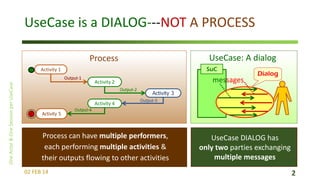
UseCase is a DIALOG---NOT A PROCESS
UseCase: A dialog

Process

SuC

Activity 1
Output-1

messages

Activity 2
Output-2

Activity 4
Activity 5

Activity 3
Output-3

Output-4

Process can have multiple performers,
each performing multiple activities &
their outputs flowing to other activities
02 FEB 14

Dialog

UseCase DIALOG has
only two parties exchanging
multiple messages
2
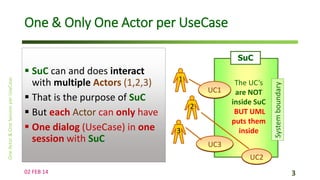
One & Only One Actor per UseCase
SuC

 SuC can and does interact
with multiple Actors (1,2,3)
 That is the purpose of SuC
 But each Actor can only have
 One dialog (UseCase) in one
session with SuC

1
UC1
2

3

The UC’s
are NOT
inside SuC
BUT UML
puts them
inside

UC3
UC2

02 FEB 14

3
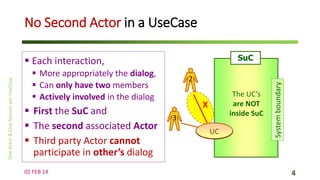
No Second Actor in a UseCase
SuC

 Each interaction,
 More appropriately the dialog,
 Can only have two members
 Actively involved in the dialog

 First the SuC and
 The second associated Actor
 Third party Actor cannot
participate in other’s dialog
02 FEB 14

2
The UC’s
are NOT
inside SuC

X
3
UC

4
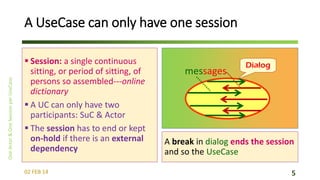
A UseCase can only have one session
 Session: a single continuous
sitting, or period of sitting, of
persons so assembled---online
dictionary
 A UC can only have two
participants: SuC & Actor
 The session has to end or kept
on-hold if there is an external
dependency
02 FEB 14

messages

Dialog

A break in dialog ends the session
and so the UseCase
5
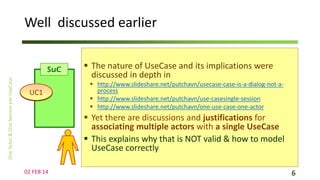
Well discussed earlier
SuC
UC1

 The nature of UseCase and its implications were
discussed in depth in
 http://www.slideshare.net/putchavn/usecase-case-is-a-dialog-not-aprocess
 http://www.slideshare.net/putchavn/use-casesingle-session
 http://www.slideshare.net/putchavn/one-use-case-one-actor

 Yet there are discussions and justifications for
associating multiple actors with a single UseCase
 This explains why that is NOT valid & how to model
UseCase correctly
02 FEB 14

6
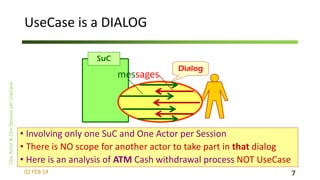
UseCase is a DIALOG
SuC

messages

Dialog

• Involving only one SuC and One Actor per Session
• There is NO scope for another actor to take part in that dialog
• Here is an analysis of ATM Cash withdrawal process NOT UseCase
02 FEB 14

7
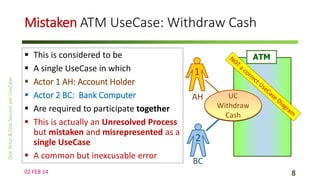
Mistaken ATM UseCase: Withdraw Cash







This is considered to be
A single UseCase in which
Actor 1 AH: Account Holder
Actor 2 BC: Bank Computer
Are required to participate together
This is actually an Unresolved Process
but mistaken and misrepresented as a
single UseCase
 A common but inexcusable error
02 FEB 14

ATM

1
AH

UC
Withdraw
Cash

2
BC
8
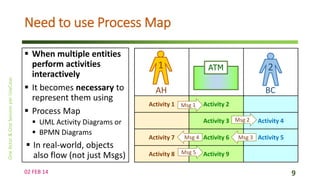
Need to use Process Map
 When multiple entities
perform activities
interactively
 It becomes necessary to
represent them using
 Process Map
 UML Activity Diagrams or
 BPMN Diagrams

 In real-world, objects
also flow (not just Msgs)
02 FEB 14

1

2

ATM

AH

BC

Activity 1 Msg 1

Activity 2
Activity 3 Msg 2

Activity 7

Msg 4 Activity 6

Activity 8 Msg 5

Activity 4

Msg 3 Activity 5

Activity 9

9
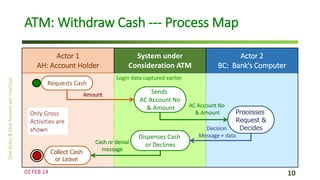
ATM: Withdraw Cash --- Process Map
Actor 1
AH: Account Holder

System under
Consideration ATM
Login data captured earlier

Requests Cash
Amount

Only Gross
Activities are
shown
Collect Cash
or Leave
02 FEB 14

Actor 2
BC: Bank's Computer

Cash or denial
message

Sends
AC Account No
& Amount

Dispenses Cash
or Declines

AC Account No
& Amount

Processes
Request &
Decides

Decision
Message + data

10
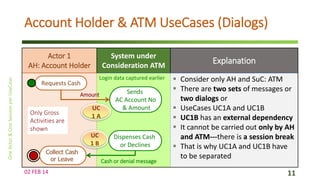
Account Holder & ATM UseCases (Dialogs)
Actor 1
AH: Account Holder

System under
Consideration ATM
Login data captured earlier

Requests Cash

Amount

Only Gross
Activities are
shown
Collect Cash
or Leave
02 FEB 14

UC
1A
UC
1B

Sends
AC Account No
& Amount

Dispenses Cash
or Declines
Cash or denial message

Explanation
 Consider only AH and SuC: ATM
 There are two sets of messages or
two dialogs or
 UseCases UC1A and UC1B
 UC1B has an external dependency
 It cannot be carried out only by AH
and ATM---there is a session break
 That is why UC1A and UC1B have
to be separated
11
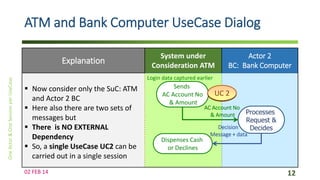
ATM and Bank Computer UseCase Dialog
Explanation

System under
Consideration ATM

Actor 2
BC: Bank Computer

Login data captured earlier

 Now consider only the SuC: ATM
and Actor 2 BC
 Here also there are two sets of
messages but
 There is NO EXTERNAL
Dependency
 So, a single UseCase UC2 can be
carried out in a single session
02 FEB 14

Sends
AC Account No
& Amount

Dispenses Cash
or Declines

UC 2
AC Account No
& Amount

Processes
Request &
Decides

Decision
Message + data

12
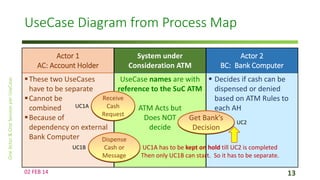
UseCase Diagram from Process Map
Actor 1
AC: Account Holder

System under
Consideration ATM

Actor 2
BC: Bank Computer

 These two UseCases
UseCase names are with  Decides if cash can be
have to be separate
reference to the SuC ATM
dispensed or denied
Receive
 Cannot be
based on ATM Rules to
UC1A
Cash
combined
ATM Acts but
each AH
Request
 Because of
Does NOT
Get Bank’s
UC2
dependency on external
decide
Decision
Bank Computer
Dispense
UC1B

02 FEB 14

Cash or
Message

UC1A has to be kept on hold till UC2 is completed
Then only UC1B can start. So it has to be separate.

13
ATM Example & Analysis





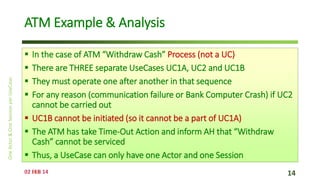
In the case of ATM “Withdraw Cash” Process (not a UC)
There are THREE separate UseCases UC1A, UC2 and UC1B
They must operate one after another in that sequence
For any reason (communication failure or Bank Computer Crash) if UC2
cannot be carried out
 UC1B cannot be initiated (so it cannot be a part of UC1A)
 The ATM has take Time-Out Action and inform AH that “Withdraw
Cash” cannot be serviced
 Thus, a UseCase can only have one Actor and one Session
02 FEB
31 JAN 14

14
Summary & Conclusion
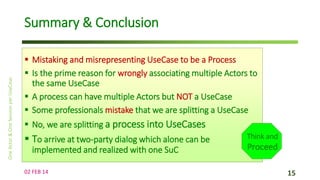
 Mistaking and misrepresenting UseCase to be a Process
 Is the prime reason for wrongly associating multiple Actors to
the same UseCase
 A process can have multiple Actors but NOT a UseCase
 Some professionals mistake that we are splitting a UseCase
 No, we are splitting a process into UseCases

 To arrive at two-party dialog which alone can be
implemented and realized with one SuC
02 FEB 14

Think and

Proceed
15

One Actor & One Session per UseCase

  • 1.
    One Actor & OneSession per UseCase Putcha V. Narasimham Kenablersys@yahoo.com
  • 2.
    UseCase is aDIALOG---NOT A PROCESS UseCase: A dialog Process SuC Activity 1 Output-1 messages Activity 2 Output-2 Activity 4 Activity 5 Activity 3 Output-3 Output-4 Process can have multiple performers, each performing multiple activities & their outputs flowing to other activities 02 FEB 14 Dialog UseCase DIALOG has only two parties exchanging multiple messages 2
  • 3.
    One & OnlyOne Actor per UseCase SuC  SuC can and does interact with multiple Actors (1,2,3)  That is the purpose of SuC  But each Actor can only have  One dialog (UseCase) in one session with SuC 1 UC1 2 3 The UC’s are NOT inside SuC BUT UML puts them inside UC3 UC2 02 FEB 14 3
  • 4.
    No Second Actorin a UseCase SuC  Each interaction,  More appropriately the dialog,  Can only have two members  Actively involved in the dialog  First the SuC and  The second associated Actor  Third party Actor cannot participate in other’s dialog 02 FEB 14 2 The UC’s are NOT inside SuC X 3 UC 4
  • 5.
    A UseCase canonly have one session  Session: a single continuous sitting, or period of sitting, of persons so assembled---online dictionary  A UC can only have two participants: SuC & Actor  The session has to end or kept on-hold if there is an external dependency 02 FEB 14 messages Dialog A break in dialog ends the session and so the UseCase 5
  • 6.
    Well discussed earlier SuC UC1 The nature of UseCase and its implications were discussed in depth in  http://www.slideshare.net/putchavn/usecase-case-is-a-dialog-not-aprocess  http://www.slideshare.net/putchavn/use-casesingle-session  http://www.slideshare.net/putchavn/one-use-case-one-actor  Yet there are discussions and justifications for associating multiple actors with a single UseCase  This explains why that is NOT valid & how to model UseCase correctly 02 FEB 14 6
  • 7.
    UseCase is aDIALOG SuC messages Dialog • Involving only one SuC and One Actor per Session • There is NO scope for another actor to take part in that dialog • Here is an analysis of ATM Cash withdrawal process NOT UseCase 02 FEB 14 7
  • 8.
    Mistaken ATM UseCase:Withdraw Cash       This is considered to be A single UseCase in which Actor 1 AH: Account Holder Actor 2 BC: Bank Computer Are required to participate together This is actually an Unresolved Process but mistaken and misrepresented as a single UseCase  A common but inexcusable error 02 FEB 14 ATM 1 AH UC Withdraw Cash 2 BC 8
  • 9.
    Need to useProcess Map  When multiple entities perform activities interactively  It becomes necessary to represent them using  Process Map  UML Activity Diagrams or  BPMN Diagrams  In real-world, objects also flow (not just Msgs) 02 FEB 14 1 2 ATM AH BC Activity 1 Msg 1 Activity 2 Activity 3 Msg 2 Activity 7 Msg 4 Activity 6 Activity 8 Msg 5 Activity 4 Msg 3 Activity 5 Activity 9 9
  • 10.
    ATM: Withdraw Cash--- Process Map Actor 1 AH: Account Holder System under Consideration ATM Login data captured earlier Requests Cash Amount Only Gross Activities are shown Collect Cash or Leave 02 FEB 14 Actor 2 BC: Bank's Computer Cash or denial message Sends AC Account No & Amount Dispenses Cash or Declines AC Account No & Amount Processes Request & Decides Decision Message + data 10
  • 11.
    Account Holder &ATM UseCases (Dialogs) Actor 1 AH: Account Holder System under Consideration ATM Login data captured earlier Requests Cash Amount Only Gross Activities are shown Collect Cash or Leave 02 FEB 14 UC 1A UC 1B Sends AC Account No & Amount Dispenses Cash or Declines Cash or denial message Explanation  Consider only AH and SuC: ATM  There are two sets of messages or two dialogs or  UseCases UC1A and UC1B  UC1B has an external dependency  It cannot be carried out only by AH and ATM---there is a session break  That is why UC1A and UC1B have to be separated 11
  • 12.
    ATM and BankComputer UseCase Dialog Explanation System under Consideration ATM Actor 2 BC: Bank Computer Login data captured earlier  Now consider only the SuC: ATM and Actor 2 BC  Here also there are two sets of messages but  There is NO EXTERNAL Dependency  So, a single UseCase UC2 can be carried out in a single session 02 FEB 14 Sends AC Account No & Amount Dispenses Cash or Declines UC 2 AC Account No & Amount Processes Request & Decides Decision Message + data 12
  • 13.
    UseCase Diagram fromProcess Map Actor 1 AC: Account Holder System under Consideration ATM Actor 2 BC: Bank Computer  These two UseCases UseCase names are with  Decides if cash can be have to be separate reference to the SuC ATM dispensed or denied Receive  Cannot be based on ATM Rules to UC1A Cash combined ATM Acts but each AH Request  Because of Does NOT Get Bank’s UC2 dependency on external decide Decision Bank Computer Dispense UC1B 02 FEB 14 Cash or Message UC1A has to be kept on hold till UC2 is completed Then only UC1B can start. So it has to be separate. 13
  • 14.
    ATM Example &Analysis     In the case of ATM “Withdraw Cash” Process (not a UC) There are THREE separate UseCases UC1A, UC2 and UC1B They must operate one after another in that sequence For any reason (communication failure or Bank Computer Crash) if UC2 cannot be carried out  UC1B cannot be initiated (so it cannot be a part of UC1A)  The ATM has take Time-Out Action and inform AH that “Withdraw Cash” cannot be serviced  Thus, a UseCase can only have one Actor and one Session 02 FEB 31 JAN 14 14
  • 15.
    Summary & Conclusion Mistaking and misrepresenting UseCase to be a Process  Is the prime reason for wrongly associating multiple Actors to the same UseCase  A process can have multiple Actors but NOT a UseCase  Some professionals mistake that we are splitting a UseCase  No, we are splitting a process into UseCases  To arrive at two-party dialog which alone can be implemented and realized with one SuC 02 FEB 14 Think and Proceed 15