What is a
learner?
 The learner is an embodied
spirit.
 He/she is a union of a sentient
body and a rational soul.
 His/her soul is the principle of
spiritual acts, the source of
intellectual abstraction, self-
reflection, and free rational volition.
 His/her body experiences
sensations and feels pleasure and
pain.
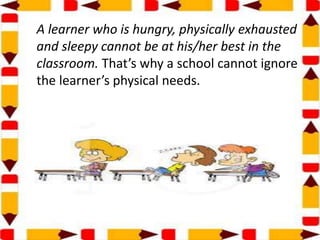
A learner who is hungry, physically exhausted
and sleepy cannot be at his/her best in the
classroom. That’s why a school cannot ignore
the learner’s physical needs.
The learner has also a spiritual nature.
“ Man does not leave by bread alone but
every word that comes from the mouth of
God”, said the Greatest Teacher.
He/she needs to be fed with sublime thoughts, words
of inspiration, spiritual advice drawn from the Bible
for Christians, Koran for Muslims, the Vedas for the
Hindus, Gautama’s Buddha’s teachings for the
Buddhists
Only When the learner is nourished
materially and spiritually can he/she be
complete for that is his/her very nature.
 Five senses
Instinct
 Imagination
Memory
 Intellect
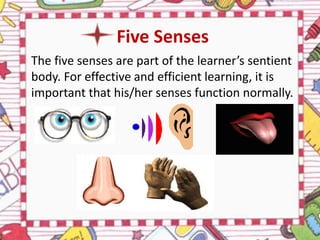
Five Senses
The five senses are part of the learner’s sentient
body. For effective and efficient learning, it is
important that his/her senses function normally.
Instincts
o The learner is also equipped with instincts.
The word instinct comes from the Latin word
instinctus which means impulse.
o This means that the learner has a natural or
inherent capacity or tendency to respond to
environment stimuli such as danger signs for
survival or self-preservation.
Imagination
It is the ability to form a mental image of
something that is not perceived through
the senses. It is the ability of the mind to
build mental scenes, objects or events
that do not exist; are not present or have
happened in the past.
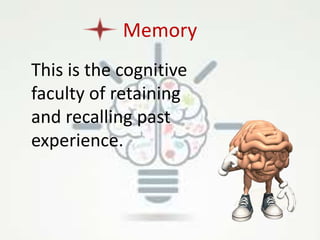
Memory
This is the cognitive
faculty of retaining
and recalling past
experience.
Intellect
o By his/her intellect, the learner can engage
in cognitive processes such as forming ideas
or concepts, reasoning out and making
judgement.
o Early concepts get modified and expanded
as the child grows and develops. There is so
much concept formation that takes in every
teaching-learning process.
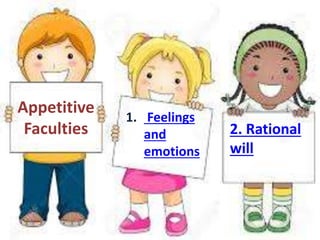
Appetitive
Faculties
1. Feelings
and
emotions
2. Rational
will
Feelings and Emotions
Emotions is the on/off switch for learning.
Positive feelings and emotions make teaching-
learning process exciting and a joyful, fruitful
affair. Negative feelings and emotions make
the same process a burden.
Will
The learner’s will serves as guiding force
and the main integrating force in his/her
character. By his/her will, the learner will
what his/her intellect presents as good
and desirable. It is this will that makes
the learner free to choose or not to
choose to do the good as presented by
his/her intellect. It is this free will that
will not allow the learner to be totally
determined by his/her environment.
Factors that contribute to the
differences among learners :
1. Ability
2. Aptitude
3. Interests
4. Family and cultural background
5. Attitudes and values
Ability
oThe learners’ native ability
dictates the prospects of success
in any purposeful activity.
oAbility determines the learners’
capacity to understand and
assimilate information for their
own use and application.
Aptitude
Refers to the
learners’ innate
talent or gift. It
indicates a
natural capacity
to learn certain
skills.
Interests
Learners’ interest in learning makes
learning no longer a task but a pleasure.
Interests are not inherited. They are
developed. A classroom set-up could offer
centers of interest to give learners an
opportunity to develop interests in many
things.
Family and cultural background
Students who come from
different socioeconomic
background manifest a
wide range of behavior
due to differences in
upbringing practices. Some
families allow their
members to express their
preferences regarding self
discipline while others are
left passively follow home
regulation.
Attitudes and values
A positive attitude will enhance
the maximum and optimum use
of the learner’s cognitive and
affective faculties for learning.
Learners with a positive attitude
will demonstrate the value of
persistence in their studies.
Persistent students sustain
interest in learning activity not
mindful of the extra time and
effort being spent.
The Learner

The Learner

  • 2.
  • 3.
     The learneris an embodied spirit.  He/she is a union of a sentient body and a rational soul.
  • 4.
     His/her soulis the principle of spiritual acts, the source of intellectual abstraction, self- reflection, and free rational volition.  His/her body experiences sensations and feels pleasure and pain.
  • 5.
    A learner whois hungry, physically exhausted and sleepy cannot be at his/her best in the classroom. That’s why a school cannot ignore the learner’s physical needs.
  • 6.
    The learner hasalso a spiritual nature. “ Man does not leave by bread alone but every word that comes from the mouth of God”, said the Greatest Teacher. He/she needs to be fed with sublime thoughts, words of inspiration, spiritual advice drawn from the Bible for Christians, Koran for Muslims, the Vedas for the Hindus, Gautama’s Buddha’s teachings for the Buddhists Only When the learner is nourished materially and spiritually can he/she be complete for that is his/her very nature.
  • 7.
     Five senses Instinct Imagination Memory  Intellect
  • 8.
    Five Senses The fivesenses are part of the learner’s sentient body. For effective and efficient learning, it is important that his/her senses function normally.
  • 9.
    Instincts o The learneris also equipped with instincts. The word instinct comes from the Latin word instinctus which means impulse. o This means that the learner has a natural or inherent capacity or tendency to respond to environment stimuli such as danger signs for survival or self-preservation.
  • 10.
    Imagination It is theability to form a mental image of something that is not perceived through the senses. It is the ability of the mind to build mental scenes, objects or events that do not exist; are not present or have happened in the past.
  • 11.
    Memory This is thecognitive faculty of retaining and recalling past experience.
  • 12.
    Intellect o By his/herintellect, the learner can engage in cognitive processes such as forming ideas or concepts, reasoning out and making judgement. o Early concepts get modified and expanded as the child grows and develops. There is so much concept formation that takes in every teaching-learning process.
  • 13.
  • 14.
    Feelings and Emotions Emotionsis the on/off switch for learning. Positive feelings and emotions make teaching- learning process exciting and a joyful, fruitful affair. Negative feelings and emotions make the same process a burden.
  • 15.
    Will The learner’s willserves as guiding force and the main integrating force in his/her character. By his/her will, the learner will what his/her intellect presents as good and desirable. It is this will that makes the learner free to choose or not to choose to do the good as presented by his/her intellect. It is this free will that will not allow the learner to be totally determined by his/her environment.
  • 16.
    Factors that contributeto the differences among learners : 1. Ability 2. Aptitude 3. Interests 4. Family and cultural background 5. Attitudes and values
  • 17.
    Ability oThe learners’ nativeability dictates the prospects of success in any purposeful activity. oAbility determines the learners’ capacity to understand and assimilate information for their own use and application.
  • 18.
    Aptitude Refers to the learners’innate talent or gift. It indicates a natural capacity to learn certain skills.
  • 19.
    Interests Learners’ interest inlearning makes learning no longer a task but a pleasure. Interests are not inherited. They are developed. A classroom set-up could offer centers of interest to give learners an opportunity to develop interests in many things.
  • 20.
    Family and culturalbackground Students who come from different socioeconomic background manifest a wide range of behavior due to differences in upbringing practices. Some families allow their members to express their preferences regarding self discipline while others are left passively follow home regulation.
  • 21.
    Attitudes and values Apositive attitude will enhance the maximum and optimum use of the learner’s cognitive and affective faculties for learning. Learners with a positive attitude will demonstrate the value of persistence in their studies. Persistent students sustain interest in learning activity not mindful of the extra time and effort being spent.