z
Entrepreneurship
Padmini y s
z
Introduction
 the activity of setting up a business or businesses, taking on
financial risks in the hope of profit.
 Entrepreneurship is the process of designing, launching and
running a new business, which is often initially a small business The
people who create these businesses are called entrepreneurs.
 the "capacity and willingness to develop, organize and manage a
business venture along with any of its risks in order to make a profit"
z
 Any business have to close due to "lack of funding, bad business
decisions, an economic crisis, lack of market demand.
The operation of entrepreneurial opportunities may include:
 Developing a business plan
 Hiring the human resources
 Acquiring financial and material resources
 Providing leadership
 Being responsible for both the ventures success or failure
z
Importance of
Entrepreneurship
 Wealth & a high majority of jobs are created by
the small business.
 More opportunity to exercise creative
freedoms, self esteem & sense of control over
their own lives.
z
1. Development of managerial capabilities:
It helps in identifying and developing managerial capabilities of entrepreneurs. An entrepreneur
studies a problem, identifies its alternatives, compares the alternatives in terms of cost and
benefits implications, and finally chooses the best alternative.
2. Creation of organizations:
Entrepreneurship results into creation of organizations when entrepreneurs assemble and
coordinate physical, human and financial resources and direct them towards achievement of
objectives through managerial skills.
3. Improving standards of living:
By creating productive organizations, entrepreneurship helps in making a wide variety of goods
and services available to the society which results into higher standards of living for the people.
4. Means of economic development:
Entrepreneurship involves creation and use of innovative ideas, maximization of output from
given resources, development of managerial skills, etc., and all these factors are so essential for
the economic development of a country.
z
Characteristics of successful
entrepreneurCalculated Risk-taker
Innovator
Organiser
Creative
Achievement Motivated
Technically Competent
Self-confident
Socially Responsible
Optimistic
Equipped with Capability to drive
z
Blessed with Mental Ability
Human Relations Ability
Communication Ability
Decision-Making
Business Planning
Visionary
z
Classification of
entrepreneurs
1. According to the Type of Business
i. Business entrepreneur: Business entrepreneurs are those
entrepreneurs who conceive the idea of a new product or
service and then translate their ideas into reality.
ii. Trading entrepreneur: As the very name indicates trading
entrepreneur is concerned with trading activities and not
manufacturing.
iii. Industrial entrepreneur: As the very name indicates, an
industrial entrepreneur is one who sets up an industrial unit.
iv. Corporate entrepreneur: Corporate entrepreneur is the one
who plans,develops and manages a corporate body.
v. Agricultural entrepreneur: Agricultural entrepreneur is the
one who is engaged in the agricultural activities.
z
According to Motivation
i. Pure entrepreneur: Pure entrepreneur is one
who may or may not possess an aptitude for
entrepreneurship but is tempted by the monetary
rewards or profits to be earned from the business
venture.
ii. Induced entrepreneur: Induced entrepreneur is
attracted by the various incentives, subsidies and
facilities offered by the government.
z
According to use of
technology
i. Technical entrepreneur: The strength of a technical
entrepreneur is in his skill in production techniques. He
concentrates more on production than on marketing.
ii. Non-technical entrepreneur: Unlike technical
entrepreneur, non-technical entrepreneur is not concerned
with the technical aspect of the product rather he spends
more time in developing alternative strategies of the
marketing and distribution to promote his business.
iii. Professional entrepreneur: Professional entrepreneur
means an entrepreneur who is interested in floating a
business but does not want to manage or operate it.
z
According to stages of
development
i. First generation entrepreneur: First generation
entrepreneur are those entrepreneur who do not
possess any entrepreneurial background.
ii. Second generation entrepreneur: Second
generation entrepreneur are those entrepreneurs
who inherit the family business firms and pass it
from one generation to another.
iii. Classical entrepreneur: A classical entrepreneur is
a stereotype entrepreneur whose aim is to maximize
his economic returns at a level consistent with the
survival of the unit but with or without an element of
growth.
z
According to capital
ownership
i. Private entrepreneur: When an individual or a
group of individuals set up an enterprise, arrange
finance, bear the risk and adopt the latest
techniques in the business with the intention to earn
profits, he or the group is called as private
entrepreneur/entrepreneurs.
ii. State entrepreneur: As the name indicates, state
entrepreneur means the trading or industrial venture
undertaken by the state or the government itself.
iii. Joint entrepreneur: Joint entrepreneur means the
combination of private entrepreneur and state
entrepreneur who join hands.
z
According to Gender and Age
i. Man entrepreneur
ii. Woman entrepreneur
iii. Young entrepreneur
iv. Old entrepreneur
v. Middle-aged entrepreneur
z
According to area
i. Urban entrepreneur
ii. Rural entrepreneur
z
According to scale
i. Large scale industry entrepreneur
ii. Medium scale industry entrepreneur
iii. Small scale industry entrepreneur
iv. Tiny industry entrepreneur
z
To become a successful entrepreneur
1. Acquire sufficient and all-round knowledge about an enterprise you intend to
start.
2. Be conservative in calculating income and lavish in calculating expenditure.
3. Don’t expect quick and easy returns from your venture.
4. Be prepared for delegation of work when needed.
5. Take moderate risks; neither too high nor too low.
6. Plan systematically and march ahead step by step according to the plan to
achieve your goal.
7. Time management is necessary to maximum utilisation of your resources.
8. Collect maximum information about your competitor on continuous basis.
9. Don’t avoid or run away from problems.
10. Take the help of experts and experienced persons when in doubt.
z
 An entrepreneur performs various type of functions.
Growth of his enterprise depends upon the way, he
performs various functions like innovation, risk-
taking, decision-making, organization and
management.
z
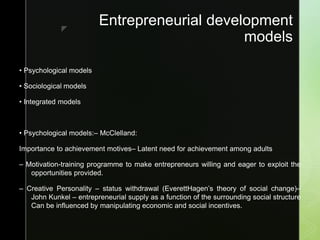
Entrepreneurial development
models
• Psychological models
• Sociological models
• Integrated models
• Psychological models:– McClelland:
Importance to achievement motives– Latent need for achievement among adults
– Motivation-training programme to make entrepreneurs willing and eager to exploit the
opportunities provided.
– Creative Personality – status withdrawal (EverettHagen’s theory of social change)–
John Kunkel – entrepreneurial supply as a function of the surrounding social structure
Can be influenced by manipulating economic and social incentives.
z
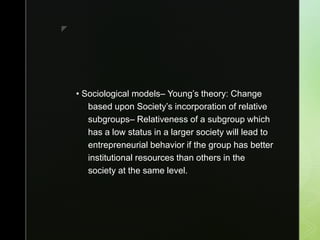
• Sociological models– Young’s theory: Change
based upon Society’s incorporation of relative
subgroups– Relativeness of a subgroup which
has a low status in a larger society will lead to
entrepreneurial behavior if the group has better
institutional resources than others in the
society at the same level.
z
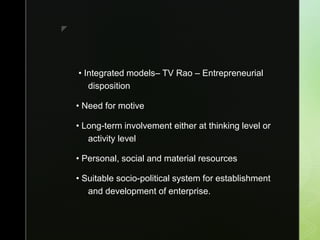
• Integrated models– TV Rao – Entrepreneurial
disposition
• Need for motive
• Long-term involvement either at thinking level or
activity level
• Personal, social and material resources
• Suitable socio-political system for establishment
and development of enterprise.

Entrepreneurship

  • 1.
  • 2.
    z Introduction  the activityof setting up a business or businesses, taking on financial risks in the hope of profit.  Entrepreneurship is the process of designing, launching and running a new business, which is often initially a small business The people who create these businesses are called entrepreneurs.  the "capacity and willingness to develop, organize and manage a business venture along with any of its risks in order to make a profit"
  • 3.
    z  Any businesshave to close due to "lack of funding, bad business decisions, an economic crisis, lack of market demand. The operation of entrepreneurial opportunities may include:  Developing a business plan  Hiring the human resources  Acquiring financial and material resources  Providing leadership  Being responsible for both the ventures success or failure
  • 4.
    z Importance of Entrepreneurship  Wealth& a high majority of jobs are created by the small business.  More opportunity to exercise creative freedoms, self esteem & sense of control over their own lives.
  • 5.
    z 1. Development ofmanagerial capabilities: It helps in identifying and developing managerial capabilities of entrepreneurs. An entrepreneur studies a problem, identifies its alternatives, compares the alternatives in terms of cost and benefits implications, and finally chooses the best alternative. 2. Creation of organizations: Entrepreneurship results into creation of organizations when entrepreneurs assemble and coordinate physical, human and financial resources and direct them towards achievement of objectives through managerial skills. 3. Improving standards of living: By creating productive organizations, entrepreneurship helps in making a wide variety of goods and services available to the society which results into higher standards of living for the people. 4. Means of economic development: Entrepreneurship involves creation and use of innovative ideas, maximization of output from given resources, development of managerial skills, etc., and all these factors are so essential for the economic development of a country.
  • 6.
    z Characteristics of successful entrepreneurCalculatedRisk-taker Innovator Organiser Creative Achievement Motivated Technically Competent Self-confident Socially Responsible Optimistic Equipped with Capability to drive
  • 7.
    z Blessed with MentalAbility Human Relations Ability Communication Ability Decision-Making Business Planning Visionary
  • 8.
    z Classification of entrepreneurs 1. Accordingto the Type of Business i. Business entrepreneur: Business entrepreneurs are those entrepreneurs who conceive the idea of a new product or service and then translate their ideas into reality. ii. Trading entrepreneur: As the very name indicates trading entrepreneur is concerned with trading activities and not manufacturing. iii. Industrial entrepreneur: As the very name indicates, an industrial entrepreneur is one who sets up an industrial unit. iv. Corporate entrepreneur: Corporate entrepreneur is the one who plans,develops and manages a corporate body. v. Agricultural entrepreneur: Agricultural entrepreneur is the one who is engaged in the agricultural activities.
  • 9.
    z According to Motivation i.Pure entrepreneur: Pure entrepreneur is one who may or may not possess an aptitude for entrepreneurship but is tempted by the monetary rewards or profits to be earned from the business venture. ii. Induced entrepreneur: Induced entrepreneur is attracted by the various incentives, subsidies and facilities offered by the government.
  • 10.
    z According to useof technology i. Technical entrepreneur: The strength of a technical entrepreneur is in his skill in production techniques. He concentrates more on production than on marketing. ii. Non-technical entrepreneur: Unlike technical entrepreneur, non-technical entrepreneur is not concerned with the technical aspect of the product rather he spends more time in developing alternative strategies of the marketing and distribution to promote his business. iii. Professional entrepreneur: Professional entrepreneur means an entrepreneur who is interested in floating a business but does not want to manage or operate it.
  • 11.
    z According to stagesof development i. First generation entrepreneur: First generation entrepreneur are those entrepreneur who do not possess any entrepreneurial background. ii. Second generation entrepreneur: Second generation entrepreneur are those entrepreneurs who inherit the family business firms and pass it from one generation to another. iii. Classical entrepreneur: A classical entrepreneur is a stereotype entrepreneur whose aim is to maximize his economic returns at a level consistent with the survival of the unit but with or without an element of growth.
  • 12.
    z According to capital ownership i.Private entrepreneur: When an individual or a group of individuals set up an enterprise, arrange finance, bear the risk and adopt the latest techniques in the business with the intention to earn profits, he or the group is called as private entrepreneur/entrepreneurs. ii. State entrepreneur: As the name indicates, state entrepreneur means the trading or industrial venture undertaken by the state or the government itself. iii. Joint entrepreneur: Joint entrepreneur means the combination of private entrepreneur and state entrepreneur who join hands.
  • 13.
    z According to Genderand Age i. Man entrepreneur ii. Woman entrepreneur iii. Young entrepreneur iv. Old entrepreneur v. Middle-aged entrepreneur
  • 14.
    z According to area i.Urban entrepreneur ii. Rural entrepreneur
  • 15.
    z According to scale i.Large scale industry entrepreneur ii. Medium scale industry entrepreneur iii. Small scale industry entrepreneur iv. Tiny industry entrepreneur
  • 16.
    z To become asuccessful entrepreneur 1. Acquire sufficient and all-round knowledge about an enterprise you intend to start. 2. Be conservative in calculating income and lavish in calculating expenditure. 3. Don’t expect quick and easy returns from your venture. 4. Be prepared for delegation of work when needed. 5. Take moderate risks; neither too high nor too low. 6. Plan systematically and march ahead step by step according to the plan to achieve your goal. 7. Time management is necessary to maximum utilisation of your resources. 8. Collect maximum information about your competitor on continuous basis. 9. Don’t avoid or run away from problems. 10. Take the help of experts and experienced persons when in doubt.
  • 17.
    z  An entrepreneurperforms various type of functions. Growth of his enterprise depends upon the way, he performs various functions like innovation, risk- taking, decision-making, organization and management.
  • 18.
    z Entrepreneurial development models • Psychologicalmodels • Sociological models • Integrated models • Psychological models:– McClelland: Importance to achievement motives– Latent need for achievement among adults – Motivation-training programme to make entrepreneurs willing and eager to exploit the opportunities provided. – Creative Personality – status withdrawal (EverettHagen’s theory of social change)– John Kunkel – entrepreneurial supply as a function of the surrounding social structure Can be influenced by manipulating economic and social incentives.
  • 19.
    z • Sociological models–Young’s theory: Change based upon Society’s incorporation of relative subgroups– Relativeness of a subgroup which has a low status in a larger society will lead to entrepreneurial behavior if the group has better institutional resources than others in the society at the same level.
  • 20.
    z • Integrated models–TV Rao – Entrepreneurial disposition • Need for motive • Long-term involvement either at thinking level or activity level • Personal, social and material resources • Suitable socio-political system for establishment and development of enterprise.