ENT - All 5 units study material & Question Bank.pdf
1.
- 1 -
UNIT– I: Entrepreneurial Perspectives
(1). Introduction to Entrepreneurship:
Entrepreneurship is the act of being an entrepreneur or “one who undertakes
innovations, finance and business acumen in an effort to transform innovations into
economic goods”. This may result in new organizations or may be part of revitalizing
mature organizations in response to a perceived opportunity.
The most obvious form of entrepreneurship is that of starting new businesses
(referred as a startup company); however, in recent years, the term has been extended to
include social and political forms of entrepreneurial activity.
When entrepreneurship is describing activities within a firm or large organization it
is referred to as intra-preneurship and may include corporate venturing, when large entities
spin-off organizations.
(2). Evolution of Entrepreneurship:
In the Earliest period, definition of entrepreneurship began as early as the Marco
Polo who comes to the Middle East for trade. Marco Polo has signed an agreement with the
capitalists to sell their products. In the contract merchant adventurer took a loan at 22.5% rate
including insurance. Capitalist was the passive risk bearer and merchant adventurer took the
active role in trading, bearing all physical and emotional risks. When the merchant adventurer
successfully sold the goods and completed the trip, the profits were divided with the capitalist
taking most of them up to 75%, while the merchant adventurer settled for the remaining 25%.
In middle ages, Entrepreneur is described as someone who is involved in the care and
control of a large production projects. It is possible to control the project using the resources
provided by the government. In this case, the entrepreneur does not bear any risk.
2.
- 2 -
Entrepreneursin this age, is a have control and authority of construction works such as public
buildings and churches. A typical entrepreneur in the middle age was the priest.
In 17th century (1-Jan-1601 to 31-12-1700), the evolution of entrepreneurship can
be related with the relationship between risk and entrepreneurs. Entrepreneurship is the
person who signed the contract agreement with the government to provide a service or supply
products that have been determined. The contract price is fixed. Then, the entrepreneurs are
fully responsible for the gains and losses of the business. John law, a Frenchman was one of
the entrepreneurs in that period. The founder of the royal bank of France and the Mississippi
Company, which had an exclusive franchise to trade between France and the new world.
Monopoly on French trade eventually led to collapse of the company. Richard Cantillion, an
economist defines entrepreneurs earlier. In his view, the entrepreneur is risk insurers.
Merchants, farmers, craftsmen, and so is an entrepreneurs. They buy things at a certain price
and sell it at a price that is uncertain, with the risks
In the 18th century (1-Jan-1701 to 31-12-1800), 3 MAIN CONCEPTS EVOLVED:
It was Richard Cantillon, French Economist, who applied the term entrepreneur to business
for the first time (1734). He is regarded by some as the founder of the term.
Concept 1: ENTREPRENEUR = RISK BEARER : Richard Cantillon defined an entrepreneur
as a person or an agent who buys factor services at certain prices with a view to sell them at
uncertain prices in the future.
Concept 2: ENTREPRENEUR = ORGANISER: Jean-Baptiste Say, (aristocratic industrialist)
in 1803— An entrepreneur is an economic agent who unites all means of production- land,
labour and capital to produce a product or service. Product sales pay rent, wages, interest and
what remains is profit. He shifts economic resources from an area of lower to an area of
higher productivity.
Concept 3: ENTREPRENEUR = INNOVATOR: Joseph A. Schumpeter (1934) • The
entrepreneur in an advanced economy is an individual who introduce something new in the
economy- a method of production not yet tested by experience in the branch of
manufacturing, a product with which consumers are not yet familiar, a new source of raw
material or of new markets and the like.
In 19th century (1-Jan-1801 to 31-12-1900) and 20th century (1-Jan-1901 to 31-
12-2000), Entrepreneurs are not always associated with the management. According to
Merriam-Webster's online dictionary, an entrepreneur is one who organizes, manages, and
assumes the risk of a business or an enterprise. The entrepreneur organizes and manages an
3.
- 3 -
enterprisefor personal gain. The materials consumed in the business, for the use of the land,
for the services he employs, and for the capital he requires. Andrew Carnegie is one of the
best examples of this definition. Carnegie, who descended from a poor Scottish family, made
the American Steel Industry one of the wonders of the industrial world.
1910: Adam Smith – An entrepreneur is a person who only provides capital without taking
active part in the leading role in the enterprise.
1961: David McClelland— A person with a high need for achievement [N-Ach] who is
energetic and a moderate risk taker.
1964: Peter Drucker— one who searches for change, responds to it and exploits
opportunities. Innovation is a specific tool of an entrepreneur hence an effective entrepreneur
converts a source into a resource.
In 21st century (1-Jan-2001 to 31-12-2100), Entrepreneurs are known as a hero for
Free Enterprise market. Entrepreneur of the century created many products and services and
is willing to face a lot of risks in the business. According to Kuratko & Hodgetts, most people
say entrepreneurs are pioneers in creating new businesses. In the year 2005 Hisrich, Peter and
Shepherd regarded entrepreneur as an organizer who controls, systematize, purchases raw
materials, arranges infrastructure, throw in his own inventiveness, expertise, plans and
administers the venture.
The Future of entrepreneurship will be growth with development of technologies. The
modern technologies and internet have improved the ways of conduct business. Entrepreneurs
now have the luxury of putting their business idea into action through the click of button.
(3). Concept of Entrepreneurship:
An entrepreneur is an individual who creates a new business, bearing most of the risks and
enjoying most of the rewards. The process of setting up a business is known as
entrepreneurship. The entrepreneur is commonly seen as an innovator, a source of new
ideas, goods, services, and business/or procedures.
Entrepreneurs play a key role in any economy, using the skills and initiative necessary to
anticipate needs and bringing good new ideas to market. Entrepreneurship that proves to be
successful in taking on the risks of creating a startup is rewarded with profits, fame, and
continued growth opportunities. Entrepreneurship that fails results in losses and less
prevalence in the markets for those involved.
4.
- 4 -
SmallBusiness vs. Entrepreneurship:
A small business and entrepreneurship have a lot in common but they are different. A small
business is a company, usually, a sole-proprietorship or partnership that is not a medium-
sized or large-sized business, operates locally, and does not have access to a vast amount of
resources or capital.
Entrepreneurship refers to an individual that has an idea and intends to execute on that idea,
usually to disrupt the current market with a new product or service. Entrepreneurship usually
starts as a small business but the long-term vision is much greater, to seek high profits and
capture market share with an innovative new idea.
Entrepreneur vs. Intrapreneur:
As both entrepreneur and intrapreneur share similar qualities like conviction, creativity, zeal
and insight, the two are used interchangeably. However, the two are different, as
an entrepreneur is a person who takes a considerable amount of risk to own and operate the
business, with an aim of earning returns and rewards, from that business. He is the most
important person who envisions new opportunities, products, techniques and business lines
and coordinates all the activities to make them real.
On the contrary, an intrapreneur is an employee of the organization who is paid
remuneration according to the success of the business unit, for which he/she is hired or
responsible.
The primary difference between an entrepreneur and intrapreneur is that the former refers to
a person who starts his own business with a new idea or concept, the latter represents an
employee who promotes innovation within the limits of the organization.
Definitions of Entrepreneur:
An entrepreneur is “one who organizes, manages, and assumes the risks of a business or
enterprise”
An entrepreneur can be described as “one who creates a new business in the face of risk
and uncertainty for the purpose of achieving profit and growth by identifying significant
opportunities and assembling the necessary resources to capitalize on them”
-- Zimmerer & Scarborough.
Definitions of Entrepreneurship:
A concise definition of entrepreneurship “is that it is the process of pursuing opportunities
without limitation by resources currently in hand”
-- Brooks
5.
- 5 -
Entrepreneurshipis “the process of doing something new and something different for the
purpose of creating wealth for the individual and adding value to society”
-- Kao
Entrepreneurship can be defined as “a field of business that seeks to understand how
opportunities to create something new (e.g., new products or services, new markets, new
production processes or raw materials, new ways of organizing existing technologies) arise
and are discovered or created by specific persons, who then use various means to exploit or
develop them, thus producing a wide range of effects.”
-- Baron, Shane, & Reuber
Enterprise
Enterprise is another word for a for-profit business or company, but it is most often
associated with entrepreneurial ventures. People who have entrepreneurial success are often
referred to as enterprising.
Importance of Entrepreneurship:
Creation of Employment- Entrepreneurship generates employment. It provides an entry-
level job, required for gaining experience and training for unskilled workers.
Innovation- It is the hub of innovation that provides new product ventures, market,
technology and quality of goods, etc., and increases the standard of living of people.
Impact on Society and Community Development- A society becomes greater if the
employment base is large and diversified. It brings about changes in society and promotes
facilities like higher expenditure on education, better sanitation, fewer slums, a higher level
of homeownership. Therefore, entrepreneurship assists the organisation towards a more
stable and high quality of community life.
Increase Standard of Living- Entrepreneurship helps to improve the standard of living of a
person by increasing the income. The standard of living means, increase in the consumption
of various goods and services by a household for a particular period.
Supports research and development- New products and services need to be researched
and tested before launching in the market. Therefore, an entrepreneur also dispenses finance
for research and development with research institutions and universities. This promotes
research, general construction, and development in the economy.
Characteristics of Entrepreneurship:
Not all entrepreneurs are successful; there are definite characteristics that make
entrepreneurship successful. A few of them are mentioned below:
6.
- 6 -
Abilityto take a risk- Starting any new venture involves a considerable amount of failure
risk. Therefore, an entrepreneur needs to be courageous and able to evaluate and take risks,
which is an essential part of being an entrepreneur.
Innovation- It should be highly innovative to generate new ideas, start a company and earn
profits out of it. Change can be the launching of a new product that is new to the market or a
process that does the same thing but in a more efficient and economical way.
Visionary and Leadership quality- To be successful, the entrepreneur should have a clear
vision of his new venture. However, to turn the idea into reality, a lot of resources and
employees are required. Here, leadership quality is paramount because leaders impart and
guide their employees towards the right path of success.
Open-Minded- In a business, every circumstance can be an opportunity and used for the
benefit of a company. For example, Paytm recognized the gravity of demonetization and
acknowledged the need for online transactions would be more, so it utilized the situation and
expanded massively during this time.
Flexible- An entrepreneur should be flexible and open to change according to the situation.
To be on the top, a businessperson should be equipped to embrace change in a product and
service, as and when needed.
Know your Product-A company owner should know the product offerings and also be
aware of the latest trend in the market. It is essential to know if the available product or
service meets the demands of the current market, or whether it is time to tweak it a little.
Being able to be accountable and then alter as needed is a vital part of entrepreneurship.
(4). Types of Entrepreneurs:
7.
- 7 -
Entrepreneursare classified into different types based on different classifications as
mentioned in the above image are explained here:
I. Based on the Type of Business:
1. Trading Entrepreneur:
As the name itself suggests, the trading entrepreneur undertake the trading activities. They
procure the finished products from the manufacturers and sell these to the customers directly
or through a retailer. These serve as the middlemen as wholesalers, dealers, and retailers
between the manufacturers and customers.
2. Manufacturing Entrepreneur:
The manufacturing entrepreneurs manufacture products. They identify the needs of the
customers and, then, explore the resources and technology to be used to manufacture the
products to satisfy the customers’ needs. In other words, the manufacturing entrepreneurs
convert raw materials into finished products.
3. Agricultural Entrepreneur:
The entrepreneurs who undertake agricultural pursuits are called agricultural entrepreneurs.
They cover a wide spectrum of agricultural activities like cultivation, marketing of
agricultural produce, irrigation, mechanization, and technology.
II. Based on the Use of Technology:
1. Technical Entrepreneur:
The entrepreneurs who establish and run science and technology-based industries are called
‘technical entrepreneurs.’ Speaking alternatively, these are the entrepreneurs who make use
of science and technology in their enterprises. Expectedly, they use new and innovative
methods of production in their enterprises.
2. Non-Technical Entrepreneur:
Based on the use of technology, the entrepreneurs who are not technical entrepreneurs are
non-technical entrepreneurs. The forte of their enterprises is not science and technology.
They are concerned with the use of alternative and imitative methods of marketing and
distribution strategies to make their business survive and thrive in the competitive market.
III. Based on Ownership:
1. Private Entrepreneur:
A private entrepreneur is one who as an individual sets up a business enterprise. He / she it’s
the sole owner of the enterprise and bears the entire risk involved in it.
8.
- 8 -
2.State Entrepreneur:
When the trading or industrial venture is undertaken by the State or the Government, it is
called ‘state entrepreneur.’
3. Joint Entrepreneurs:
When a private entrepreneur and the Government jointly run a business enterprise, it is called
‘joint entrepreneurs.’
IV. Based on Gender:
1. Men Entrepreneurs:
When business enterprises are owned, managed, and controlled by men, these are called ‘men
entrepreneurs.’
2. Women Entrepreneurs:
Women entrepreneurs are defined as the enterprises owned and controlled by a woman or
women having a minimum financial interest of 51 per cent of the capital and giving at least
51 per cent of employment generated in the enterprises to women.
V. Based on the Size of Enterprise:
1. Small-Scale Entrepreneur:
An entrepreneur who has made investment in plant and machinery up to Rs 1.00 crore is
called ‘small-scale entrepreneur.’
2. Medium-Scale Entrepreneur:
The entrepreneur who has made investment in plant and machinery above Rs 1.00 crore but
below Rs 5.00 crore is called ‘medium-scale entrepreneur.’
3. Large-Scale entrepreneur:
The entrepreneur who has made investment in plant and machinery more than Rs 5.00 crore
is called ‘large-scale entrepreneur.’
VI. Based on Clarence Danhof Classification:
Clarence Danhof (1949), on the basis of his study of the American Agriculture, classified
entrepreneurs in the manner that at the initial stage of economic development, entrepreneurs
have less initiative and drive and as economic development proceeds, they become more
innovating and enthusiastic.
Based on this, he classified entrepreneurs into four types:
1. Innovating Entrepreneurs:
Innovating entrepreneurs are one who introduce new goods, inaugurate new method of
production, discover new market and reorganize the enterprise. It is important to note that
9.
- 9 -
suchentrepreneurs can work only when a certain level of development is already achieved,
and people look forward to change and improvement.
2. Imitative Entrepreneurs:
These are characterized by readiness to adopt successful innovations inaugurated by
innovating entrepreneurs. Imitative entrepreneurs do not innovate the changes themselves,
they only imitate techniques and technology innovated by others. Such types of entrepreneurs
are particularly suitable for the underdeveloped regions for bringing a mushroom drive of
imitation of new combinations of factors of production already available in developed
regions.
3. Fabian Entrepreneurs:
Fabian entrepreneurs are characterized by very great caution and skepticism in experimenting
any change in their enterprises. They imitate only when it becomes perfectly clear that failure
to do so would result in a loss of the relative position in the enterprise.
4. Drone Entrepreneurs:
These are characterized by a refusal to adopt opportunities to make changes in production
formulae even at the cost of severely reduced returns relative to other like producers. Such
entrepreneurs may even suffer from losses but they are not ready to make changes in their
existing production methods.
(5).Entrepreneurial Competencies: Generally, a competency is an underlying characteristic
of a person which leads to his/her superior performance in a job. Thus, entrepreneurial
competencies are the underlying characteristics of an entrepreneur which result in superior
entrepreneurial performance.
An entrepreneur is a person who creates something new and assumes the risks and rewards
associated with that innovation. There are some major competencies that lead to superior
entrepreneurial performance. These are as follows:
(1) Initiative: It is an entrepreneur who initiates a business activity.
(2) Looking for opportunities: Entrepreneur always looks for an opportunity and takes
appropriate actions accordingly.
(3) Persistence: He follows the Japanese proverb “Fall seven times; stand up eight”. He
makes repeated efforts to overcome harriers.
(4) Information seeker: Entrepreneur always searches for information from various
researchers and consulting experts.
(5) Quality Conscious: An entrepreneur always tries to beat the existing standard of quality.
10.
- 10 -
(6)Committed to working: Entrepreneur does every sacrifice to get the task completed.
(7) Efficiency seeker: Entrepreneur always tries to get the task completed within minimum
costs and time.
(8) Perfect Planning: Entrepreneur always tries to develop realistic and proper plans and
then executes carefully to accomplish the task.
(9) Problem solver: Entrepreneur always tries to find out ways and means to tide over the
difficult times.
(10) Self-confidence: Entrepreneur has a strong belief in his strengths and abilities.
(11) Assertive: Entrepreneur is always assertive.
(12) Persuasive: Entrepreneur is able to successfully persuade others to do what he actually
wants from them.
(13) Efficient monitors: Entrepreneur personally supervises the work so that it is done as per
the desired standard.
(14) Employees’ well-wisher: Entrepreneur has great concern and also takes the necessary
steps to improve the welfare of the employees.
(15) Effective strategists: Entrepreneur introduces the most effective strategies to affect
employees to achieve the enterprise goal.
(6). Capacity Building for Entrepreneurs:
To be a successful entrepreneur, individuals must build capacities in four key strategic areas
– Operational, Management, Financial Management, and Personal capacities.
Entrepreneur capacity building involves developing the combination of all four capacity
elements, to provide the ingredients for a great entrepreneurial success soup.
Some of these capacities are gained through experience throughout your career, while others
are learned through educational avenues. Some successful entrepreneurs are born with
strong personality traits, and some behaviors are strengthened through learned responses in
the business environment.
Here are the four key categories of capacity building leading to the development of successful
entrepreneurs.
Operational Capacity Building
Having a brilliant understanding of an industry and business at ground level builds
operational capacity. This of course involves working in a variety of business operations for
a period of time prior to diving into entrepreneurship. This is where you gain valuable
insight into what makes businesses tick. Understanding the dynamics on the floor, in the
11.
- 11 -
cubicles,in the field and out on the road, gives you the perspective on how to lead, organize
and plan for operations.
Management Capacity Building
Taking operational experience one more step, gaining management experience in a field or
business will be directly applicable to managing your own business. The valuable experience
you gain managing operations, resources and people will give you the applicable tools for
your own business. With a few years of management experience, you will gain management
capacity and an understanding of responsibilities and accountabilities at that level… all
precursors to managing your own company.
Financial Management Capacity Building
Through a combination of work experience and education, you need to be well-grounded and
versed in managing finances. You need to be able to accurately estimate and build financial
statements and to understand them. With gained skills, you will need to be able to analyze
financial statements, looking at trends and indicators and what those all mean to your
business. Financial reports provide key indicators and information on the business’ financial
health…there is a wealth of information in the financial statements. Other parties, partners
and financial institutions will be looking at you and your organization’s ability to manage
finances.
Personal Capacity Building
Of extreme importance, if you don’t have some key personal, entrepreneurial traits you may
be closing up shop fast. Some people are born with strong traits while other behaviors can be
picked up along the development pathway. Demonstrating strong traits and behaviors such as
dedication, perseverance, ambition, determination, strong-will, openness, honesty,
transparency, fairness, etc may move you along the pathway to become a successful
entrepreneur.
(7). Entrepreneurial training methods:
The various methods of providing training to the entrepreneurs are as follows:
1) Lecture Method:
As the name suggests, lecture method involves providing information to the trainees orally.
In case of any doubt arising in the minds of trainees, clarification can be given spontaneously
by the instructors.
12.
- 12 -
2)Written Instructional Method:
When the training contents are to be used in the future by the trainees, this method is used
and it is most popular in case of standardized production system.
3) Individual Instruction:
In this method, only one person is chosen for providing entrepreneurial training. When a
tough skill is to be imparted in the candidate, this type.of training becomes very useful.
4) Group Instruction:
When the training is to be provided to the group of different individuals, this method is
adopted particularly when these persons have to perform the same type of activities and
similar instructions are to be given to all the candidates.
5) Demonstration Method:
This method is mainly useful when the physical exposure is to be imparted by the trainer. In
this method, the main focus is on providing practical knowledge rather than theoretical
knowledge.
6) Meetings:
This method of training mainly involves the group of people to discuss the different issues
faced by them. They share their views, ideas and different conclusions are drawn on the basis
of various alternatives and suggestions.
7) Conference:
This method is generally used for imparting knowledge regarding new ideas and techniques
to the trainees. Here, conferences are organized and experts from different fields are called to
share their knowledge and experiences useful for the trainees.
13.
- 13 -
(8).Entrepreneurial Motivations:
Motivation may be defined as the willingness to exert high levels of effort toward
organizational goals, conditioned by the effort and ability to satisfy some individual need.
Entrepreneurial Motivation serves as fuel or power that makes the organisation run. The
components of Entrepreneurial Motivation are as follows:
Internal Factors (Push factors):
They include:
1. Desire to do something new: Human being by nature is always willing to do something
new. It inspires people to be innovative to start up new ventures.
2. Become Independent: There are many people who don’t wish to work for a salary. They
want to be independent. For this, they are always willing to start their own business.
3. Achieve, what one wants to have in life: People have a certain vision in their life, to
fulfill their own vision they become entrepreneurs.
4. Be recognized for one’s contribution: Some people are motivated to be recognized in
society for their contribution. For this, they involve themselves in entrepreneurial activities.
5. Educational background: Educated people are more prone to entrepreneurship. They
apply their knowledge achieved through formal education in the entrepreneurial venture.
Hence, a strong educational background also motivates people towards entrepreneurship.
14.
- 14 -
6.Occupational background and experience: Some people are motivated towards
entrepreneurship due to their occupational background and the experience that they develop
from working in relevant fields.
External Factors (Pull factors):
They include:
1. Government assistance and support: If the govt. assists and supports the people in
establishing and operating businesses, it drives people towards entrepreneurship.
2. Availability of factors of production: If there is the availability of factors of production
such as capital, labour, technology and raw material, it drives the people towards
entrepreneurship.
3. Encouragement from big business houses: Big businesses require input from other
businesses in the form of raw material or other products. In such a situation, they encourage
people to start different ventures. It provides entrepreneurial motivation.
4. Promising demand for the product: If the demand for the product is high, there is
possibility of high sales as well as profit. The demand factor eventually drives people towards
entrepreneurship.
(9). Models for Entrepreneurial development:
I. Psychological models / theories for entrepreneurial development
II. Sociological models / theories for entrepreneurial development
III. Integrated models / theories for entrepreneurial development
I. Psychological models / theories for entrepreneurial development put emphasis on
the emotional and mental aspects of the individuals that drive their entrepreneurial
activities (Baum, Frese, & Baron, 2014). Three of the most popular psychological
theories of entrepreneurship today include:
15.
- 15 -
1.McCelland’s theory,
2. Rotter’s locus of control theory and
3. Action regulation theory.
McClelland’s theory explains the needs for achievement that often regulate the actions of
an entrepreneur. Consequently, Rotter’s theory puts light on the locus of control whether
internal or external that influence entrepreneurial actions. Finally, the action regulation
theory elucidates that the performance of entrepreneurs depends on their actions.
1. McClelland’s theory
David McClelland, a Harvard psychologist formulated the Theory of Achievement
Motivation in 1967. McClelland through his theory had tried to outline why few
communities are more economically booming as compared to others. Furthermore,
according to him, entrepreneurs are classified on the basis of their need for achievement
which is the driving factor for their economic growth (Miner, Organizational behaviour 1:
Essential theories of motivation and leadership, 2015). According to McClelland, an
entrepreneur works in a structured and creative way which eventually leads to better
decision making in predicaments. McClelland’s theory also states that traits of
entrepreneurship are incorporated by individuals through learning and this learning can be
motivated to achieve a higher level.
As seen from McClelland’s need-based theory on motivation, three motivators or needs
have been prioritized for:
1. affiliation,
2. achievement and,
3. power.
Furthermore individuals possess these three dominant motivators irrespective of their age,
gender or culture. These three motivators are directly proportional to life experiences and
culture experienced by individuals (Khurana & Joshi, 2017). Entrepreneurs use these
motivators to influence the performance of employees by setting goals for them, offering
motivation and rewards.
2.Rotter’s locus of control theory
Rotter’s locus of control has garnered prominent attention amongst personality theories of
entrepreneurship (Lefcourt, 2014). This theory was formulated in 1954 by Julian Rotter.
16.
- 16 -
Furthermore,locus of Control offers people the belief that control resides within them i.e.
internally or can be created externally.
High internal locus of control: In this case, people believe that they are in charge
of their actions and fortune. Events would be determined on the basis of their
qualities and conduct.
High external locus of control: In this scenario, individuals believe that
outcomes are out of their control and it completely depends on external factors
such as fate, change etc.
Individuals who have a high tendency towards risks are more likely to become an
entrepreneur (Bodill & Roberts, 2013). Furthermore, risk-taking is the most elementary
action that entrepreneurs do to achieve high-level performance and success. Therefore,
this theory manages to explain that entrepreneurs with internals locus believe that
emergence of success is due to their capabilities and actions. While entrepreneurs with
external locus assume chances of success or survival are driven by institutional and
external forces.
3.Action regulation theory
Michael Frese outlines the application of Action theory with relation to entrepreneurship.
It is elaborated as the meta-theory which regulates the goal-directed behaviour (Baum,
Frese, & Baron, 2014). This theory explains how individuals control their cognitive
behaviour with the help of cognitive processes which consist of selection and
development, orientation, monitoring and planning and processing feedbacks.
17.
- 17 -
Inorder to examine human action according to this theory there are three dimensions:
1. sequence highlights the path taken from goals to feedback.
2. focus extends from activities to self and,
3. structure structure outlines the level of actions which are often regulated.
The basic application of this theory to entrepreneurship is seen in terms of planning. In
order to describe entrepreneurial planning behaviour, four action processes have been
suggested; opportunistic, complete planning and review (Baum, Frese, & Baron, 2014).
Based on Frese’s theory, early-stage entrepreneurs are likely to observe a new task. Also,
this occurs repeatedly and this occurrence of the action is likely to feature in the coming
few years. Furthermore, it highlights the fact cognitive ability is much more crucial to
entrepreneurs. Compared to the other two theories, this theory is significantly less
criticized.
II. Sociological models / theories for entrepreneurial development are different from
other theories because they analyze entrepreneurial activities from the standpoint of social
contexts and corresponding processes and effects. They subscribe to the notion that
construction of entrepreneurship is narrowly a purposive action that leads to the
formation of a new formal organization. They also broadly indicate various efforts that
help introduce robust innovations in routines, technologies, organisational structures and
social institutions (Ruef and Lounsbury, 2007).
Various entrepreneurship theories have been proposed by scholars over different periods
of time that aid in the process of development of the field of entrepreneurship. They are
broadly segregated into:
economic entrepreneurship theories,
psychological entrepreneurship theories,
sociological entrepreneurship theories,
anthropological entrepreneurship theories and,
cultural entrepreneurship theories.
The identifying feature of sociological entrepreneurship theories is that they focus on the
social context of entrepreneurship development (Simpeh, 2011). Among some of the
prominent theories include Max Weber’s theory of social change, EE Hagen’s theory,
18.
- 18 -
Theoryof Frank Young, Cochran theory, and Attention-Motivation Theory of
McClelland. Some of them are discussed in this section.
1. Cochran theory of entrepreneurship
The Cochran theory was introduced by Thomas Cochran in 1965. This theory explains the
entrepreneurial approaches of an individual from standpoints like occupational hazards
that he encounters and expectations he has from his own profession (Pawar, 2013;
Otaghsara and Hosseini, 2014). It explains that entrepreneurship is determined by
variables like cultural values, role expectations, and social sanctions. This theory also
proposes that entrepreneurs are not supernormal individuals. Rather, they are people who
represent the modal personality of the society. ‘Modal personality’ is the term used by the
anthropologist Cora DuBois in order to indicate behavioural traits few individuals
develop in response to psychological, neurological and cultural factors (Birx and
Fogelson, 2012). Thus, if a person performs like an entrepreneur, their performance is
shaped by factors such as:
the attitude of the person towards their profession,
their societal role expectations that are held by sanctioning groups and,
the operational requirements of the job he is engaged with (Pawar, 2013).
2. EE Hagen’s theory of social change
EE Hagen introduced the theory of social change as an endeavour to explain how
individuals change their social status in order to gain societal respect. The core notion
that drives this sociological theory is that when individuals feel that they are no longer
respected by the society, they tend to implement innovative ways by means of which their
social status can get positively transformed. The aim is to regain their lost status.
This desire to change the prevailing social status can be indicated as the acquired
tendency of an individual to become an entrepreneur. This happens in three situations:
1. When the individual loses their existing social status to someone who has
suddenly regained superiority and enhanced social respect.
2. If there is any form of defamation of the values and position of the individual by
someone superior to him.
3. If the individual is unable to accept the newly acquired social status due to the
transformation of the existing society into a new social order (Hagen, 1963).
19.
- 19 -
Thus,this theory emphatically shows that withdrawal from existing social status acts as a
driver which influences entrepreneurial qualities in an individual. Eventually, this
transforms an individual from an ordinary person to an entrepreneur (Hagen, 1963;
Lehmann, 2010).
3. Max Weber’s theory of social change
The theory of social change was proposed in the 1980s by the most socially compelling
thinker of is time, Max Weber. The major basis of this theory is religion and social
change. Thus, in order to explain this theory elaborately, the scholar indicates that
religious beliefs have a strong influence on the process of development of
entrepreneurship.
This sociological theory proposes that the entrepreneurial qualities of an individual or a
group remain ingrained within the society the person belongs to. This perspective of the
society is in turn influenced by religious and ethical beliefs it subscribes to (Jackson,
1983; Rao and Singh, 2018). In addition to this, the Weberian theory of social change also
talks about the integral role of capitalism in the process of developing entrepreneurial
qualities in an individual (Beetham, 2018).
Weber particularly extended his theory on entrepreneurship to Indian society and
explained that the religious belief of Hinduism that exists in India lacks the spirit of
capitalism. Moreover, the ethical values prevalent in India are mostly concentrated
towards individuals rather than the Hindu society at large. Hence, it fails to excite the
feeling of entrepreneurship in the country (Pawar, 2013). Thus, in explaining the
emergence of modern entrepreneurship traits in an individual, this theory shows that his
religious and ethical approaches serve as the major determinant. Furthermore, the theory
also explains that if the individual belongs to a society where capitalistic approaches
dominate, they will possess entrepreneurial qualities.
4. Theory of Frank Young
The entrepreneurial theory that was proposed by Frank Young is distinct from many other
theories of entrepreneurship because it objects the idea that individual-level calibre and
beliefs help in developing entrepreneurship. According to this theory, paying attention to
individual-level qualities will never be conducive for developing entrepreneurship
tendencies (Nee and Young, 1991; Pawar, 2013). Rather, entrepreneurship can only
20.
- 20 -
developwhen groups or individuals are able to identify and appreciate clusters of
qualities that are needed for developing such a quality.
In terms of modern sociological theories of entrepreneurship, this theory suggests that the
identification of clusters of entrepreneurial qualities act as a motivation that influences an
individual to accomplish these credibility goals so that they can become a successful
entrepreneur. However, the theory emphasizes that individual-level entrepreneurial
characteristics should always be under sided and group level pattern should be
preliminarily emphasized if successful entrepreneurship qualities are to be developed
(Pawar, 2013). This shows that a group of individuals have more propensity to become
successful entrepreneurs than individuals.
In the modern entrepreneurial setting, several sociological factors are undergoing a
change. For instance, digitalisation is picking pace rapidly, penetrating almost every
sector of business. The startup culture facilitated by various governments is also bringing
about a change in attitudes and aspirations of an entrepreneur to drive bigger changes in
society. However, some instances of modern entrepreneurship are radically different from
those that existed during the nineteenth and twentieth century’s, warranting a new class of
sociological elements in societies. Therefore, newer sociological theories of
entrepreneurship need to be developed that encompass these factors and build upon their
relevance.
III. Integrated Models for entrepreneurial development:
Includes:
1. Entrepreneurial disposition (T.V.Rao)
2. Stages for promoting small entrepreneurship (B.S.Venkata Rao)
3. Entrepreneurial development cycle (M.P.Akhori)
1. Entrepreneurial disposition (T.V.Rao): T.V. Rao had included some factor in
entrepreneurial disposition which fosters entrepreneurial development.
Factors as follows:
(i) Long-term involvement is the purpose of an entrepreneurial endeavour,
whether at the activity or thinking level. An entrepreneur's long-term participation
is viewed as a goal to be met.
(ii) The primary motivation for starting a business is a lack of motivation.
21.
- 21 -
(iii)Social resources, material resources, and personal resources are all necessary
for entrepreneurship to succeed.
2. Stages for promoting small entrepreneurship (B.S.Venkata Rao): B.S. Venkat
Rao proposed 5 phases for promoting small entrepreneurship. Those are:
Phase-I: Stimulation
It is the initial stage in which individuals in underdeveloped areas are
taught about entrepreneurship and their desire to engage in industrial activity is
piqued. The following are some of the actions that are carried out at this stage:
Setting up industrial environment
Defining policy statement highlighting the role of small enterprises.
Planning special schemes and organising industrial development
programmes.
Phase-II: Identification
The prospective entrepreneurs identified from ,
Workers in factory
People who have completed graduation in business administration
People trained in engineering and technology
Phase-III: Development
It includes development of managerial training and motivational
programmes.
Phase-III: Promotion
In includes initiatives of the govt. to promote small enterprises.
Phase-III: Follow-up
In this, the government's policies and programmes are examined in order to
improve their efficacy.
3. Entrepreneurial development cycle (M.P.Akhori): Cycle includes various
activities like:
Stimulatory activities
Planned publicity for entrepreneurial opportunities
Providing education related to entrepreneurship
Identifying the best entrepreneurs and rewarding them
22.
- 22 -
Support activities
Registration of enterprise
Developing product prototype / sample products
Arrangement of land, power and common facilities.
Getting approvals and licenses.
Sustaining activities
Modernization
Diversification
Expansion
Getting additional finance
R&D support
(10). The process of Entrepreneurial Development:
Every entrepreneurship development process comprises several steps. Here are the vital steps
of building an effective development programme to help individuals –
1. Learn about the Business Idea
It is the starting process of entrepreneurship. Once an individual has generated the idea for a
business, he/she will subsequently need to evaluate and identify its business opportunities.
23.
- 23 -
Hence,he/she has to learn more about the business and its consumers. However, it is not an
easy task. To find relevant information, an entrepreneur has to talk to his/her employees, the
marketing team, product designing team, etc. Apart from these, consumer surveys often
unearth various new pieces of information. They can help individuals to learn more about
their business ideas.
2. Thorough Evaluation
Before moving forward, entrepreneurs need to evaluate a business idea or opportunity
thoroughly. It is considered one of the most crucial parts of the Entrepreneurship
Development Process. An entrepreneur can do it by himself/herself by considering the
following points –
Whether an opportunity or idea is worth investing in or not.
What are the requirements for this product?
Is it feasible or not based on its cost?
What are the competitive advantages?
The capital that is required to put in the business, before the launch of that certain
product or service. And where to get this capital.
Associated risks that are inherent with the product or service?. Such risks can be of
many types like Technical risks, Economic risks, Social and Environmental Risks.
Whether it coincides with the company’s goal or not
Additionally, an entrepreneur must evaluate his/her skills and if he/she can manage such it.
3. Business Plan
After identifying the opportunity and gathering information about it, an entrepreneur needs to
create a comprehensive business plan to make most of this opportunity. It is one of the vital
stages of the entrepreneurship development process. Such a plan acts as the base of a venture
as well as the benchmark. It shows whether the business is on track or not.
Creating a business plan requires time and effort, and an entrepreneur must be dedicated to it.
The significant pieces of a business plan, i.e. its vision, goal, objectives, capital and the
product itself must be figured out in this process.
24.
- 24 -
4.Finding Resources
Once the entire business plan is ready, the next step of entrepreneurship development and
management is to locate sources of finance and human resources. Here entrepreneurs find
investors for his/her venture. Moreover, recruits individuals as per their skill and abilities to
carry out different business activities.
Especially the marketing team, as it is the most important aspect for the growth of businesses
nowadays. Special care is also needed to find the HR person, who will manage the entire
human resource of the company.
5. Framing out the Management Structure
It is a crucial concept of entrepreneurship development. After raising funds and hiring the
required employees, this is the next process on the list. An entrepreneur must frame out the
hierarchy in the organisation. Thus, it becomes easier to resolve any problem through this
chain of command.
6. Plan the Future
Once a business is up and running smoothly, an entrepreneur has to consider its future. In this
final point of entrepreneur development programme notes, businesspersons decide the next
step of the business. Based on actual data generated by the company and pitting it against the
projected one gives a clear idea of how the business is performing. If everything is positive
and on track, then an entrepreneur decides to invest in expansion.
25.
1
Unit-II: New VentureCreation
(1).New Venture Creation (Introduction): It is the process of turning a new idea or
technology into a business that can succeed and will attract investors: Potential entrepreneurs
trying to identify a possible business idea, pay attention to everything in the media. It is
defined as a process that involves an establishment of a new business venture from scratch,
growing the venture and then effectively harvesting it.
(2). Mobility of Entrepreneurs:
Movement and mobility is an integral part of human life. Entrepreneurs, being human beings,
do also move from one location to another and also from one occupation to another. This
movement of entrepreneurs from one location to another and from one occupation to another
occupation may be termed as entrepreneurial mobility.
Various factors influence entrepreneurial mobility. These factors may serve as “pull” and
“push” factors. Generally, the following factors do influence entrepreneurial mobility:
(1) Education: Education enlarges one’s thinking and understanding. He/she also enables to
adjust with the different conditions more easily and clearly and communicate others in a
better manner. This is why an educated entrepreneur tends to be more mobile than an
uneducated entrepreneur.
(2) Experience: An entrepreneur’s past experience in business and industry also increases
his/her tendency to move. An experienced entrepreneur better perceives the available
opportunities, better analyses his/her strengths and weaknesses and also understands the
complexities involved in running an enterprise.
(3) Availability of facilities: Entrepreneurs tend to move from the areas with no or fewer
facilities to the areas with more and better facilities. Ex: Govt. facilities; availability of raw
materials, labors, market facilities.
(4) Political conditions: Entrepreneurial mobility is also influenced by political factors.
Hortal, strike, red-tapism, bribe system, political pressure etc. affect the entrepreneurial
mobility seriously.
26.
2
(5) Size ofenterprise: Size of enterprises also has a vital effect on entrepreneurial mobility.
Generally, larger business houses are more mobile than smaller business houses. Because a
large size of the enterprise will have the capability to start a new business at a new place.
(3). Models for Opportunity Evaluation:
Business opportunity evaluation is a process in which a business opportunity is analyzed. If a
business idea does have initial merit, you should also perform a more detailed business
opportunity evaluation.
There are two models to evaluate business opportunities.
They are:
I. The RAMP Model
II. The Seven-Domain Framework.
I. The RAMP Model developed by Ryan P. Allis, CEO of several successful marketing
software and consulting companies.
RAMP stands for Return, Advantages, Market, and Potential. Here is an inside look at this
method of evaluating business opportunities:
1. Return
The big question that an entrepreneur should ask is whether a business opportunity will
generate revenue, and ultimately, profit. Without a potential profit, a great business idea is
just a great idea without financial merit.
Can you make a product that generates more money than you spend?
How much investment will you need to get the business idea off the ground?
And ultimately, what are you or your investors’ return requirements?
2. Advantages
To identify the advantages of pursuing this potential business opportunity, look at factors that
this idea has that others don’t.
What makes your business idea better than others?
Is your idea unique, and does it have minimal competition?
Do you have intellectual property like a patent that gives your business idea an
advantage?
27.
3
3. Market
Another pillarin your business evaluation process is analyzing the market. If there isn’t a big
enough market for your product or service, you should rethink whether this business
opportunity makes sense.
Who will be your target consumer?
Is there a need for your business idea?
Can you fill a market need?
For instance, you might think of a great business idea to produce a carbonated beverage
flavored with roots, berries, and other natural flavors.
However, in your RAMP evaluation you might find that this type of product is already
saturated in the market. The idea is good and a market exists, but if the market is flooded with
competitors it would not likely be profitable.
4. Potential
The bottom line of any business is to make money. Without positive cash flow, you won’t
succeed. Business owners with the best of intentions often fail because the financial potential
isn’t big enough.
Will there be sufficient financial reward?
Do you see a potentially growing market for the product?
Do you have others who believe in your business ideas?
Are there other businesses that are similar (which is a validation that this potential
business opportunity could be worth pursuing)?
You as an entrepreneur have a lot of thinking to do. Come up with great business ideas. Be
creative. Get enthusiastic about your ideas. However, always take the time to perform sound
business opportunity evaluation.
You can learn a lot about your business ideas and their potential by performing a simple
RAMP analysis. Only after your genius idea passes the RAMP test should you begin to invest
your time and money.
II. The Seven-Domain Framework (Mullin’s Seven-Domain Framework):
Can you imagine buying a car without first taking it for a test drive? Or buying a home
without first inspecting every room?
In everyday life, it's instinctive to test products and to look at them from different angles
before parting with your money. This helps you confirm that you're making the right choice.
28.
4
The same shouldbe true before you start a business, or launch a new project or product. You
need to look at it thoroughly, and examine it from a number of different perspectives. After
all, you could be about to invest several years of your life into the venture, and it would be
heart-breaking if it failed for reasons that you could have foreseen at the outset.
Mullins' Seven Domains Model helps you explore the impact of seven key factors – or
"domains" – on your planned venture. In turn, this helps you think about whether the idea is
viable. We'll look at the seven domains in this article, and suggest questions and tools that
you can use to explore your business idea.
John Mullins, an entrepreneur and professor at London Business School, developed the Seven
Domains Model and published it in his 2003 book, "The New Business Road Test." It was
created for entrepreneurs interested in starting new businesses. However, you can also use it
within your organization to decide whether to pursue a new product, or launch a new project.
The model, shown in below figure is designed to be used before writing a business plan.
The model separates your proposed new venture into seven "domains": four that look at the
small-scale (micro) and large-scale (macro) aspects of your market and industry, and three
that focus on your team.
When you look at each of these domains and ask key questions about each, you'll have a
clearer idea about how likely your business idea is to succeed.
29.
5
You'll also identifypossible challenges that you'll need to address when you write your
business plan. This is especially important if you need outside funding for your business.
Looking at the Seven Domains
Let's look at the seven domains, and explore how you can use them to analyze your potential
venture.
Market Domain/Macro Level: Market Attractiveness
This domain looks at market attractiveness from a macro (large-scale) perspective.
Look at the whole market. How big is it, in terms of the number of customers, the value of
sales, and the quantity of units sold? Then, look at trends within the market. Has it grown in
recent years? If so, is this growth likely to continue?
What you're doing here is checking that the market is big enough to give you the growth you
want and that it's growing healthily – after all, it's much easier to grow a business in a
growing market than it is in a declining one.
Also, use PEST analysis to explore the large-scale factors that affect your market. Do these
look healthy?
PEST Analysis is a simple and widely used tool that helps you to analyze the Political,
Economic, Socio-Cultural, and Technological changes in your business environment. So you
can gain a better understanding of the "big picture" forces of change that you're exposed to,
and, from this, take advantage of the opportunities that they present.
Market Domain/Micro Level: Sector Market Benefits and Attractiveness
Realistically, it's unlikely that your venture will meet the needs of everyone in the market.
You'll be more successful if you target your idea at one market sector or segment, and aim to
meet its needs fully.
To identify this segment, look at the market on a micro level. Think about the following
questions:
Which segment of the overall market is most likely to benefit from your venture?
How is your venture or product different from others already servicing this segment?
What trends is this segment showing? Is it growing, and, if so, is this growth set to
continue?
What other market segments could you access if you're successful in this one?
Look for qualitative and quantitative data. Talk to prospective customers to gather feedback
on their needs, and to find out how well competitors are meeting these. Then, look for data on
30.
6
the sector you'retargeting, for example, by reading analysts' reports and market research
reports.
Industry Domain/Macro Level: Industry Attractiveness
It's now time to look at how attractive your industry is on a macro level.
Mullins suggests using Porter's Five Forces (i. Competitive Rivalry, ii. Supplier Power, iii.
Buyer Power, iv. Threat of Substitution, v. Threat of New Entry) to assess which factors
affect the profitability of your industry.
To do this, first define the industry that you will be competing in, and then ask yourself how
easy it is to enter this industry. If it's easy to get into, you can quickly be flooded with
competitors if you are seen to make a success of your business.
Next, look at your competition. Is rivalry in this market fierce or civilized? Are organizations
stealing ideas from others in the industry? Take time to gather intelligence about your
potential competitors to see what they're up to.
Last, look at buyers and suppliers. How much power do they have? Are they setting their own
terms and conditions because of this power? If so, how will this affect your offering?
Industry Domain/Micro Level: Sustainable Advantage
Once you've looked at your industry from a macro level, it's time to examine it close up.
Start with a USP Analysis (Unique Selling Proposition: is the unique thing that you can offer
that your competitors can't). What can you do to build and sustain a USP? Next, explore
the competencies (What makes your business, or you as a person, stand out from the
crowd) that you'll need, and think about how to develop and sustain these.
Then think about how easy it will be for your competitors to duplicate your product or
service.
Also, what resources do you possess that your competitors don't? Do a VRIO Analysis
(According to Barney, the resources and assets that are valuable, rare and inimitable, and that
you are organized to use effectively, will likely contribute most to delivering your
organization's mission) to answer this question, and then look at your competitors' resources.
What do they have that you don't? This could include patents, established processes, and
finances. How will these affect your ability to compete?
31.
7
Team Domain: Mission,Aspirations, Propensity for Risk
In this domain, located in the center of the model, you're going to analyze commitment –
yours, and that of your team – to this idea.
Think about why you want to start this business. Are you passionate about this idea, and, if
so, why? What do you want to do with this business – are you ambitious for it, or do you
want it to be a "lifestyle business"? What are your personal goals and values, and how does
this venture align with these? And are you prepared to take the risk and put in the hard work
needed to build this business?
Explore the motivations of your team, too. What are they hoping to achieve, and why? Do
their motivations align with yours? And are they prepared to work really hard to make the
business a success?
Money and/or reputations could be at stake if the venture fails, so think about attitudes
towards risk within the team.
Team Domain: Ability to Execute on Critical Success Factors
You now need to identify the CSFs (Critical Success Factors: They are the areas of your
business or project that are vital to its success) for the business, and think realistically about
whether your team can deliver on these.
Start doing this by thinking about these questions:
Which decisions or activities will harm the business significantly if you get them
wrong, even when everything else is going right?
Which decisions or activities will deliver disproportionately high benefits or enhance
performance, even if other things are going poorly?
Then look at the knowledge and skills of the team that you've put together. How certain are
you that you and your team can deliver successfully on these CSFs? If you see a gap in skills
or abilities, who can you bring on board to fill this gap?
Team Domain: Connectedness up, Down, Across Value Chain
This last domain is all about your connections and how important they are to the success of
your business.
First, look at your suppliers and investors. Who do you know that can supply you with the
resources you need to pursue this venture? How good are your relationships with these
people?
32.
8
Next, look atyour potential customers and distributors. In what ways can you capitalize on
your connections here?
Last, look across the value chain. Do you know any of your competitors personally? If so,
how could this relationship help or hinder your venture? And could these people be partners
if you thought about them differently?
(4). Business Plan – concept and purpose:
Business Plan:
A Business Plan is a document in which a business opportunity or a business already under
way, is identified, described and analyzed, examining its technical, economic and financial
feasibility. The Plan develops all of the procedures and strategies necessary in order to
convert the business opportunity into an actual business project.
It is an indispensable tool in order to start up a business project, independently of the size of
the project and/or of the amount of business experience of the entrepreneur.
It provides an answer to simple questions like below (about a new business or a business
already under way):
Purpose of writing a business plan:
The following are the key points to prepare the business plan:
A business plan is created to determine the business's direction and to identify any
potential obstacles.
It is ready to frame successful company plans in order to meet established objectives.
It is ready to form strong and healthy relationships by enlisting the help of reputable
commercial partners.
It allows the entrepreneur to concentrate on the most important areas of the firm.
It assists large-scale enterprises' executives in making capital investment decisions.
33.
9
It aidsentrepreneurs in identifying issues with their financial planning and taking
corrective action.
It assists in successful communication with corporate stakeholders.
It helps in creating startup decisions, assuring investors, and planning operations in
accordance with forecasts.
(5). Contents of a Business Plan:
A business plan is a document that contains the operational and financial plan of a business,
and details how its objectives will be achieved. It serves as a road map for the business and
can be used when pitching investors or financial institutions for debt or equity financing.
A business plan should follow a standard format and contain all the important business plan
elements. Typically, it should present whatever information an investor or financial
institution expects to see before providing financing to a business.
Contents:
A business plan should be structured in a way that it contains all the important information
that investors are looking for. Here are the main sections of a business plan:
1. Title Page
The title page captures the legal information of the business, which includes the registered
business name, physical address, phone number, email address, date, and the company logo.
34.
10
2. Executive Summary
Theexecutive summary is the most important section because it is the first section that
investors and bankers see when they open the business plan. It provides a summary of the
entire business plan. It should be written last to ensure that you don’t leave any details out. It
must be short and to the point, and it should capture the reader’s attention. The executive
summary should not exceed two pages.
3. Industry Overview
The industry overview section provides information about the specific industry that the
business operates in. Some of the information provided in this section includes major
competitors, industry trends, and estimated revenues. It also shows the company’s position in
the industry and how it will compete in the market against other major players.
4. Market Analysis and Competition
The market analysis section details the target market for the company’s product offerings.
This section confirms that the company understands the market and that it has already
analyzed the existing market to determine that there is adequate demand to support its
proposed business model.
Market analysis includes information about the target market’s demographics, geographical
location, consumer behavior, and market needs. The company can present numbers and
sources to give an overview of the target market size.
A business can choose to consolidate the market analysis and competition analysis into one
section or present them as two separate sections.
5. Sales and Marketing Plan
The sales and marketing plan details how the company plans to sell its products to the target
market. It attempts to present the business’s unique selling proposition and the channels it
will use to sell its goods and services. It details the company’s advertising and promotion
activities, pricing strategy, sales and distribution methods, and after-sales support.
6. Management Plan
The management plan provides an outline of the company’s legal structure, its management
team, and internal and external human resource requirements. It should list the number of
employees that will be needed and the remuneration to be paid to each of the employees.
Any external professionals, such as lawyers, valuers, architects, and consultants that the
company will need should also be included. If the company intends to use the business plan
to source funding from investors, it should list the members of the executive team, as well as
the members of the advisory board.
35.
11
7. Operating Plan
Theoperating plan provides an overview of the company’s physical requirements, such as
office space, machinery, labor, supplies, and inventory. For a business that requires custom
warehouses and specialized equipment, the operating plan will be more detailed, as compared
to, say, a home-based consulting business. If the business plan is for a manufacturing
company, it will include information on raw material requirements and the supply chain.
8. Financial Plan
The financial plan is an important section that will often determine whether the business will
obtain required financing from financial institutions, investors, or venture capitalists. It
should demonstrate that the proposed business is viable and will return enough revenues to be
able to meet its financial obligations. Some of the information contained in the financial plan
includes a projected income statement, balance sheet, and cash flow.
9. Appendices and Exhibits
The appendices and exhibits part is the last section of a business plan. It includes any
additional information that banks and investors may be interested in or that adds credibility to
the business. Some of the information that may be included in the appendices section
includes office/building plans, detailed market research, products/services offering
information, marketing brochures, and credit histories of the promoters.
(6). Presenting a Business Plan:
When presenting a Business Plan, keep the following points in mind:
A Business Plan should be prepared in straightforward language and contain only
important information.
The Business Plan should be presented in a visually appealing and impressive manner
so that it is easy to read.
It must be concise, clear, and well-organized.
The paper used to print the business plan should be A4 in size, with a standard layout
and clear headings on each page.
To begin a new Section, start with a blank page. Dividers can help make content more
accessible.
Information such as the document date, page number, title, and file name should be
included in the header and footer.
The business plan must be prepared by key members of management by using the
services of expert consultants.
36.
12
Because abusiness plan is a dynamic document, each version should be clearly
identified, and prior versions should be kept as backups to track the company's
growth.
The contact information for the personnel in charge of the business plan should be
provided so that they may be accessed.
A business strategy should highlight the key aspects that will attract investors'
attention.
While preparing the business plan, realistic assumptions should be established.
The executive summary should be written once the business plan is finished because
it is the first component that the readers will read. As a result, the business concept
should excite them.
(7). Procedure for setting up enterprise:
For setting up an enterprise we need to follow several steps as mentioned in the below table:
Step No. Step Description
1 Decision to be an Entrepreneur
2 Choosing your form of Business Organisation
3 Making a Product Choice
4 Location of Industry
5 Preparation of Business Plan
6 Sourcing Process, Raw Materials, Machineries and Equipments
7 Infrastructure - Land & Building, Water and Power Supply
8 Legal Aspects (DIN, PAN, TAN, PF, PTax, GST etc...)
9 Finance and Working Capital to Start Business
10 Human Resource
11 Production
12 Pricing
13 Marketing
14 Paying Back Loans and Profit Generation
15 Modernization and Protection from Sickness
16 Feedback and Reporting
37.
13
1. Decision tobe an Entrepreneur
The overriding reason for anyone to think of establishing an enterprise can be summarised in
one word - opportunity. An opportunity to be your own boss, to provide a product or service,
to implement your ideas, which can generate sufficient surplus, is reason to think of starting
up an enterprise.
Starting a small business takes a lot of courage. To be successful - to stay in business - you
need a combination of hard work, skill and perseverance.
2. Choosing your form of Business Organisation
Many first time entrepreneurs do not have a clear perspective of the issues, legal or
otherwise, involved in choosing one or the other form of a business. This often results in
avoidable mistakes, which later cost time and money to rectify. The options of the form of
business with their pros and cons have been explained below. In India setting up a private
limited company was the most popular choice among our sample of entrepreneurs.
Franchising is also emerging as a major business format. An extensive overview of its
features is provided since it is believed that it will grow the same way in India as it has
abroad.
3. Making a Product Choice
Make a careful analysis of the product or service you are choosing, sometimes in short run,
there is a shortage of a particular commodity in the market, you may even come to know you
will get almost two weeks in advance to supply fresh stock. Does that mean you can jump
into that business? First thing in such a condition is to analyze the situation. Keep in mind
that shortages may occur due to a number of reasons and a good entrepreneur always
examine the pros and cons before setting up a business. It may tempt you to think that
perhaps you have found a good businesses idea. But do not be easily influenced by these
temporary shortages. Carefully analyze the future demand-supply position of the product, say
for the next 3 to 5 years. Only when you are certain that the shortage will remain there for
considerable period of time and you would be able to generate enough profits in the very first
or second year of operation and that you can produce quality item within an acceptable
pricing, then only you should venture into such a business.
4. Location of Industry
After deciding the issues of product, the next important question is, where to set up the unit ?
For many tiny units and service-based units, the home is perhaps the best starting point. But
38.
14
not all typeof SSI can be set up in home either due to size or due to nature of the industry.
Then the entrepreneurs may like to locate their business in industrial estates, areas, parks,
complexes developed by concerned state government organisation or private bodies or in a
privately leased land subject to approvals by various state and municipal bodies.
State level Government agencies like DSIDC, HPSIDC, GIDC, TIDCO, UPSIDC assist
entrepreneurs in identifying suitable locations/sites for the project, besides helping in the
process of getting all the necessary clearances for the project.
5. Preparation of Business Plan
A Business Plan is a document where you plan your Business to have an organized and
effective response to a situation which may arise in future. Business plan is not just for a start
up company but also for those, which are growing. It can be used it to establish realistic goals
or targets to achieve and to determine the current position.
Start a business plan with describing your business and product or services. Tell about the
market you are targeting and the stage of development your company.
6. Sourcing Process, Raw Materials, Machineries and Equipments
Choices of process technology emerge once the product is finalized. For some complex
products, process know-how has to be imported. In such cases agreements for technology
transfer should be made with due care to safeguard interest. A lot of appropriate technology is
being developed at CSIR and Defense Research Labs and some of these technologies can
now be bought. There are some intermediaries like APCTT, TBSE, which can help you to
locate the relevant technologies. Besides there are some In-house R & D centers of
companies, which develop technologies and sell them to interested parties. Indigenously
developed process know-how has intrinsic benefits such as appropriateness, relative
inexpensiveness and possibility to work with technology developer.
7. Infrastructure - Land & Building, Water and Power Supply
Once an industrial plot for the unit is secured, then the next job is that of finding a suitable
architect to design the outlay of area and factory. Design of factory building has to be in
consonance with the type of industry. Have an appropriate plant layout. If you are setting
business in home, plan the area, which is to be used as your production centre or office
judiciously. You may like to take help of a professional to ensure that the area is utilised
optimally.
39.
15
An architect's estimateof building construction is essential for loan applications. Further,
architect's certificate for money spent on building is needed for disbursement of loan.
8. Legal Aspects
Few simple steps to take care of legal aspects of setting business are to Register your unit
with relevant organisation, check out the labour laws that would be applicable to you, pay
your commercial taxes and taking care of environmental aspects. Each of these aspects given
below:
Acquiring a Director Identification Number (DIN)
Acquiring a Digital Signature Certificate
Obtaining an Incorporation Certificate
Acquiring a Permanent Account Number (PAN)
Acquiring a Tax Account Number (TAN)
Obtaining a certificate from the State/Municipal Inspector under the Shops and
Establishment Act
Applying for GST Registration
Obtaining a Profession Tax Certificate from the State Profession Tax Office
Completing a National Employees’ Provident Fund Registration
9. Finance and Working Capital to Start Business
To start and set up their business all Enterprises need monetary support. Before seeking fund
estimate the cost including that of working capital required for a minimum of 6-8 months and
always keep a provision for buffer. you can take help of an CA or concerned officials in
Entrepreneurship Development Institutes to work out the total financial cost of your project.
Decide the form in which you are going to raise the capital i.e. should it be equity finance,
debt finance, loans or a combination of these.
10. Human Resource
Human Resource is an important element to be kept in consideration while setting up an
business. Though, projections for manpower and staffing are made in the project report,
however it is necessary to time the induction of manpower in a planned manner. For example:
The engineers and operatives must be available before the installation of the machinery.
While planning for manpower following points should be kept in consideration.
40.
16
11. Production
Today's competitivemarket, it is difficult to maintain stable relationships with suppliers,
customers, brokers, distributors, and even your own company personnel. Competitors are
stealing your best customers. To maintain the edge entrepreneurs need to synchronies their
production process, capacity, and delivery schedule.
Plan out your work area keeping in mind the requirement of your business. More often than
not the area available to small businesses is limited and within that area all the work needs to
be carried out, right from storing the raw materials to the final product. The space for each of
these should be clearly chalked out.
12. Pricing
In India, price is often affected by excise duty, sales tax and local taxes, thereby making it
difficult to maintain a uniform price throughout the country. You may opt for any of the
following policies or modify and combine them depending upon your objective or you can
have your own pricing policy.
13. Marketing
Marketing is an important tool to be used while setting up your business. Study, but don't
necessarily copy your competitor's moves. Visit their businesses, watch their ads, figure out
their strategies, and keep your eyes open. You may not be able to keep up with your
competitor's strategy move by move. You should, however, be ready and able to blunt or
block the impact of their moves through effective marketing. Then, later, you can make your
own offensive move at your own pace.
14. Paying Back Loans and Profit Generation
Manage your cash Flow to pay back your loans, debts or credits. A healthy cash flow is an
essential part of any successful business. If you fail to have enough cash to pay your
suppliers, creditors, or your employees, chances are you will be out of business very soon.
You should pay back the loans so that when you need loans in future, you get one. You can
pay the loans or debts as per terms and conditions initially agreed upon, if you can't pay in
time inform the creditor, ask for an extension stating the reasons. Proper management of your
cash flow will ensure the same and is a very important step in making business successful.
15. Modernization and Protection from Sickness
Once you have started the production most important aim for long run should be to remain at
the forefront of business and avoid being obsolete in terms of products, services or
41.
17
management aspect. Listenand gauge the market, anticipate the future demands. There are
many market survey document or market reports published by individual agencies and
government departments on this aspect. An entrepreneur can use these as indicative guide to
project the future conditions.
In face of competitive environment entrepreneur should keep abreast of process and
technological changes that are taking place and wherever possible incorporate the changes
which could increase the productivity, efficiency and /or reduce the cost of production.
16. Feedback and Reporting
Have a suitable feedback mechanism in place to learn from experiences, to gain an insight
into what is actually happening in your business, if you don't have one develop a suitable
mechanism, which suits your necessities. Think of your experiences, when you wanted to
know from others how you were performing your jobs or chores or tried to find out how you
performed in your a particular assignment.
(8).Institutions supporting enterprises / startups – Central Level, State Level and Other
Institutions Initiatives:
42.
18
Central level Institutions:
1.NB MSME (The National Board for Micro, Small & Medium Enterprises)
NBMSME was established / notified for the first time on 15th May 2007 consisting of 47
members including Chairman, Vice Chairman and Member Secretary in accordance with the
Sub Section 1 of Section 3 of MSMED Act, 2006 and National Board for Micro, Small &
Medium Enterprises Rules, 2006. The Minister in-charge of Ministry of MSME is ex-officio
Chairman of the National Board.
Salient Features of the NBMSME:
NBMSME is consisting of 47 members (18 Ex-officio members and 29 members- the
tenure of members is for two years from the date of notification).
Has statutory backing.
Provides representation to all sections/segments including Associations of Micro,
Small and Medium manufacturing and service enterprises, women enterprises, Central
Ministries, States representing different regions of the country, trade unions, etc.
Quarterly meeting of the Board mandatory as per MSMED Act, 2006 - the Board has
met six times from the date of its establishment.
Functions:
To examine matters referred by the NBMSME concerning promotion and
development of MSME sector and enhancing its competitiveness.
To provide advice to the Central Government on issues related to the promotion,
development and enhancement of competitiveness of micro, small and medium
enterprises, covered under Section 9 to 12 and Section 14 of the MSMED Act, 2006,
which include issues concerning Credit Facilities, Procurement of Preference Policy,
Constitution and Administration of Funds, etc.
To provide advice to the State Governments (in case sought by any of them) on issues
relating to notifying any rule made to carry out the provisions of the MSMED Act-
2006 including the composition of Micro, Small Enterprises Facilitation Councils etc.
as provided under section 30.
Recommend or advice Central Government or State Governments or the Board, as the
case may be, in connection with the classification of a class(es) of enterprises after
taking into consideration the level of employment, investments, need of higher
investment in plant and machinery or equipment for technology up gradation,
employment generation and enhanced competitiveness and international standards for
classification of small and medium enterprises.
43.
19
2. KVIC (Khadiand Village Industries Commission):
Khadi and Village Industries Commission was established in 1953 with the primary objective
of developing khadi and village industries and improving rural employment opportunities. Its
wide range of activities include training of artisans, extension of assistance for procurement
of raw materials, marketing of finished products and arrangement for manufacturing and
distribution of improved tools, equipments and machinery to producers on concessional
terms.
KVIC provides assistance to Khadi and Village Industries which require low capital
investment and ideally suited for manufacturing utility goods by using locally available
resources. There are many specified village industries such as processing of cereals and
pulses, leather, matches, gur and khandsari, non-edible oils and soaps, bee-keeping, village
pottery, carpentry and blacksmithy etc.
KVIC’s policies and programmes are executed through State Khadi and Village Industries
Boards registered under the Societies Registration Act, 1960 and Industrial Cooperative
Societies registered under State Cooperative Societies Act. Activities involving pioneering
type of work such as developing new industries in hilly, backward and inaccessible areas are
undertaken by KVIC directly.
3. NSIC (Small Industries Corporation):
The National Small Industries Corporation (NSIC) was set up in 1955 with the objective of
supplying machinery and equipment to small enterprises on a hire- purchase basis and
assisting them in procuring Government orders for various items of stores. The supply of
machines on hire-purchase is in a way an offer of funds, an offer of foreign exchange
facilities, guidance on adopting modernized technology for improved methods of production
and combination of all.
NSIC takes upon itself the entire purchase procedure, starting from locating competent
suppliers to delivery of machines. In case of imported machines, NSIC obtains clearance
from Director General to arrange foreign exchange, obtain import licence, opens the letter of
credit and looks after the customs requirement and clearance of machines.
The Corporation’s Head office is at Delhi and it has four regional offices at Delhi, Mumbai,
Chennai and Kolkata and eleven branch offices. It has one central liaison office at Delhi and
depots and sub-centers.
44.
20
Functions of NSIC:
TheNSIC has taken up the challenging task of promoting and developing small scale
industries almost from scratch and has adopted an integrated approach to achieve the socio-
economic objectives.
The followings are the main functions of NSIC:
i. To develop small scale units as ancillary units to large-scale industries.
ii. To provide machines to small scale industries on hire-purchase basis.
iii. To assist small enterprises to participate in stores purchase programme of the Central
Government.
iv. To assist small industries with marketing facilities.
v. To distribute basic raw materials through their depots.
vi. To import and distribute components and parts to actual small scale users in specific
industries.
vii. To construct industrial estates and establish and run prototype production cum-training
centers.
4. NSTEDB (The National Science & Technology Entrepreneurship Development
Board): established in 1982 by the Government of India under the aegis of Department of
Science & Technology, is an institutional mechanism to help promote knowledge driven and
technology intensive enterprises. The Board, having representations from socio-economic
and scientific Ministries/Departments, aims to convert "job-seekers" into "job-generators"
through Science & Technology (S&T) interventions.
Objectives:
To promote and develop high-end entrepreneurship for S&T manpower as well as
self-employment by utilising S&T infrastructure and by using S&T methods.
To facilitate and conduct various informational services relating to promotion of
entrepreneurship.
To network agencies of the support system, academic institutions and Research &
Development (R&D) organisations to foster entrepreneurship and self-employing
using S&T with special focus on backward areas as well.
To act as a policy advisory body with regard to entrepreneurship.
45.
21
5. NPC (NationalProductivity Council of India): established in the year 1958, is an
autonomous organization under Department for Promotion of Industry & Internal Trade,
Ministry of Commerce and Industry, Government of India. Besides undertaking research in
the area of productivity, NPC has been providing consultancy and training services in areas
of Industrial Engineering, Agri-Business, Economic Services, Quality Management, Human
Resources Management, Information Technology, Technology Management, Energy
Management, Environmental Management etc., to the Government and Public & Private
sector organizations. NPC is a constituent of the Tokyo-based Asian Productivity
Organisation (APO), an Inter-Governmental Body of which the Government of India is a
founding member.
Objectives
To promote innovation - led productivity in a sustained manner in all spheres of national
economy through holistic and inclusive approach by addressing the triple bottom line –
Economic, Environmental and Social.
To propagate productivity consciousness and culture amongst Govt., Business and
Society.
To demonstrate value addition through generation and application of advanced
productivity tools and techniques for multiplier effect.
To act as a total solution provider for Industry, Services, and Agriculture sectors for
augmenting productivity through Training, Consultancy and Research wherever needed
through alliances and partnerships
To act as a catalyst in institution building and developing platforms for collaborative
networking to strengthen the productivity movement.
To act as a think tank by providing productivity related evidence based policy support
and advice in while tracking the emerging trends.
To be an independent oversight entity for various national programs, schemes and
interventions.
To recognize productivity champions through awards, affiliations, certifications,
accreditations etc.
To be repository of productivity and competitiveness data across all sectors at the state
and national level.
To devise national productivity standards across all sectors and self assessment web
based measurement tools for productivity diagnosis.
46.
22
6. NIESBD (NationalInstitute of Entrepreneurship and Small Business Development):
The National Institute for Entrepreneurship and Small Business Development is a premier
organization of the Ministry of Skill Development and Entrepreneurship, engaged in training,
consultancy, research, etc. in order to promote entrepreneurship and Skill Development. The
major activities of the Institute include Training of Trainers, Management Development
Programmes, Entrepreneurship-cum-Skill Development Programmes, Entrepreneurship
Development Programmes and Cluster Intervention. The Institute has been actively
delivering International Trainings for the ITEC nation participants under the aegis of Ministry
of External Affairs. The institute has been financially self-sufficient since 2007-08.
The Institute is operating from an integrated Campus in A-23, Sector-62, Noida, Uttar
Pradesh and a Regional Office at Dehradun, Uttarakhand. It is established in an area of
10,000 sq. meters with about 40,000 sq. feet of built up area. The infrastructure comprises of
8 class rooms, 1 auditorium, and 1 conference hall, besides library. There is also a hostel
consisting of 32 rooms, and other facilities.
Major Activities:
The major activities of the Institute inter alia include:
Training: The training programmes being organized by the Institute inter-alia include
Trainers’ Training Programmes (TTPs); Management Development Programmes (MDPs);
Orientation Programmes for Head of Departments (HoDs) and Senior Executives;
Entrepreneurship Development Programmes (EDPs); Entrepreneurship-cum-Skill
Development Programmes (ESDPs) and specially designed sponsored activities for different
target groups.
Research/Evaluation Studies: Besides the primary/basic research, the Institute has been
undertaking review/evaluation of different government schemes/programmes, training need
assessment- Skill Gap studies, industrial potential survey etc. The broad objective of these
activities is the promotion of the Entrepreneurship across the country.
Development of Course Curriculum/Syllabi: The Institute has developed Model Syllabi for
organizing Entrepreneurship Development Programmes. It also assists in Standardization of
Common Training programmes.
Publications and Training Aids: The Institute has been bringing out different Publications
on entrepreneurship and allied subjects. The Institute brings out a quarterly Newsletter
showcasing the activities, achievements and interventions under the Entrepreneurial
landscape of the country.
47.
23
State Level Institutions:
1.SIDC (States industrial development corporation):
Currently, there are 28 SIDC that are present in India. The full form of SIDC states industrial
development corporation. The main objective of establishing SIDC was to increase the process of
industrialization in India. Also, it is considered as one of a financial institution to be established in
India.
Functions:
The SIDC is set up by the various states governments. Also, these governments fully
own the corporation. SIDC is more than a financial institution. Thus, they act as an
instrument to speed up the process of industrialization in the respective states.
So, to achieve this process, they provide loans, guarantees, subscription of shares, etc to
the companies. Besides loans to the respective industries, SIDC undertakes various
promotional programs like project identification, techno-economic surveys, preparation
of feasibility studies, and entrepreneurial training.
2. DICS (District Industries Centers):
The District Industries Centers programme was launched in 1978 for effective promotion of
cottage and small-scale industries widely dispersed in rural areas and small towns. These
centers are the focal points providing under one roof all the services and support required by
small scale and village entrepreneurs. These serve as an integrated administrative framework
at the district level for industrial development.
The main functions of DICs are as follows:
(i) Surveys:
A DIC conducts surveys to assess industrial potential of a district keeping in view the
availability of raw materials, human skills, infrastructure, demand, etc. It prepares techno-
economic feasibility studies, identifies product lines and work out costs. On the basis of such
investigation, it provides investment advice to entrepreneurs.
(ii) Action Plans:
On the basis of endowments and possibilities in the district, a DIC prepares an action plan for
industrial development. This plan is coordinated with District Credit plan of the lead bank.
(iii) Appraisal:
A DIC appraises the various investment proposals received from entrepreneurs. Then it helps
worthy entrepreneurs in obtaining credit by explaining various credit schemes, preparing
48.
24
application forms, helpingin assessing the applications, keeping liaison with banks and
financial institutions and monitoring flow of industrial credit in the district.
(iv) Guidance:
A DIC guides and assists entrepreneurs in identifying appropriate machinery and equipment,
ascertaining sources of machinery and equipment, helping in planning orders, helping in
importing machinery, etc. It also ascertains raw material requirements and their sources,
arranges bulk purchase of raw materials and interacts with various authorities for the supply
of scarce and critical raw materials.
3. SFCs (The State Finance Corporations): are integral parts of institutional finance structure of
a country. Where SEC promotes small and medium industries of the states. Besides, SFC help in
ensuring balanced regional development, higher investment, more employment generation and
broad ownership of various industries.
Functions of State Finance Corporations
The various important functions of State Finance Corporations are:
(i) The SFCs provides loans mainly for the acquisition of fixed assets like land, building, plant,
and machinery.
(ii) The SFCs help financial assistance to industrial units whose paid-up capital and reserves do
not exceed Rs. 3 crore (or such higher limit up to Rs. 30 crores as may be notified by the central
government).
(iii) The SFCs underwrite new stocks, shares, debentures etc., of industrial units.
(iv) The SFCs grant guarantee loans raised in the capital market by scheduled banks, industrial
concerns, and state co-operative banks to be repayable within 20 years.
4. SSIDCs (State Small Industries Development Corporations):
These have been set up under the Companies Act to cater to the primary developmental needs
of village and small scale units in respective States.
The main functions of SSIDCs are as follows:
(i) Procurement and distribution of scarce raw materials.
(ii) Supply of machinery on hire-purchase basis/system.
(iii) Providing assistance for marketing of the products of small-scale units.
(iv) Construction of industrial estates and their maintenance.
(v) Extending seed capital assistance on behalf of the State Government.
(vi) Promoting joint ventures and trade centers for small-scale sector.
(vii) Providing managerial assistance.
49.
25
5. T-Hub (TechnologyHub): is an innovation intermediary and business incubator based in
Hyderabad, Telangana, India. Based on the triple helix model of innovation, it is a
partnership between the Government of Telangana, three academic institutes in Hyderabad
(the International Institute of Information Technology, the Indian School of Business and the
National Academy of Legal Studies and Research) and the private sector. T-Hub provides
Indian and international startups access to technology, talent, mentors, customers, corporate,
investors, and government agencies. T-Hub also helps state and central government
organizations build innovation ecosystems.
Other Institutions:
1. NABARD (National Bank for Agriculture and Rural Development):
was established in 1982 for providing credit for the promotion of agriculture, small-scale
industries, cottage and village industries, handicrafts and other rural crafts and other allied
economic activities in rural areas with a view to promote integrated rural development and
secure prosperity of rural areas.
Functions of NABARD:
i.) NABARD provides short-term refinance assistance for periods not exceeding 18 months to
state co-operative banks, regional rural banks and other financial institutions for a wide range
of purposes including marketing and trading relating to rural economy.
These short term loans can be converted by the NABARD into medium term loans for
periods not exceeding seven years under conditions of drought, famine or other natural
calamities, military operations or enemy action.
ii). NABARD can grant medium-terms loans to the State Co-operative Banks and Regional
Rural Banks for periods extending from 18 months to 7 years for agriculture and rural
development.
iii). NABARD is empowered to provide by way of refinance assistance long term loans
extending up to maximum period of 25 years to the State Land Development Bank, Regional
Rural Banks, Scheduled Commercial Banks, State Co-operative Banks or any other financial
institution approved by the Reserve Bank for giving loans to artisans, small-scale industries,
village and cottage industries etc.
2. EPCs (Export Promotion Councils): are organisations set up by the Government of India
to help and assist Indian exporters by providing access to international markets, promoting
Indian products through various activities and increasing the overall exports from India.
50.
26
Every country hastheir own export promotion organisations to perform this job. In India,
there are about 37 organisations that cater to exporters of different product categories. This
categorization provides better focus in promoting products and helps EPCs offer better
assistance to exporters.
3. SIDBI (Small Industries Development Bank of India):
With a view of ensuring larger flow of financial and non-financial assistance to the small-
scale sector, the Government of India set up the Small Industries Development Bank of India
(SIDBI) under a special act of the Parliament in October 1989 as a wholly owned subsidiary
of IDBI.
The bank commenced its operations from April 2, 1990 with its head office in Lucknow. The
SIDBI has taken the outstanding portfolio of the IDBI relating to the small-scale sector worth
over Rs. 4000 crores. The authorised capital of SIDBI is Rs. 250 crores with a provision to
increase it to Rs. 1000 crores.
Functions of SIDBI:
The SIDBI was set up to function as the principal financial institution for the promotion,
development and financing of industry in the small scale sector and for co-ordinating the
functions of institutions engaged in similar activities. It has taken over the responsibility for
administering Small Industries Development Fund and National Equity Fund which were
earlier administered by the IDBI.
4. HUDCO (Housing and Urban Development Corporation Ltd)
HUDCO is a unique institution with its motto of "Profitability with Social Justice". A Public
Sector Company, under the Ministry of Housing and Urban Affairs (MoHUA), HUDCO has
been a key partner with the Government in building assets for the Nation. In its operations,
HUDCO lays a considerable emphasis on the housing need of the "deprived" that is
Economically Weaker Sections (EWS) and Low-Income Groups (LIG).
Housing and Urban Development Corporation Ltd (HUDCO), the premier techno-financing
public sector enterprise, in the field of housing and infrastructure development in our country.
With an authorized capital of Rs 2,500 crore, as on date HUDCO has a paid up equity of Rs.
2,001.90 Crore
5. TCOs (Technical Consultancy Organisations):
All India financial institutions and state governments have set lip a net work Of technical
consultancy organizations. .
51.
27
The functions ofthe TCOs include, conducting surveys on industrial potential, preparing
project profiles, undertaking techno-economic appraisal of projects, carrying out market
research, providing technical and managerial assistance to entrepreneurs, assistance in
modernization, technology upgradations and rehabilitation programmes and organising
information cell and Data Bank concerning industrial and economic activities and provide
these to entrepreneurs.
6. IIA (Indian Industries Association): is an apex representative body of Micro, Small
and Medium Enterprises (MSME) with a strong membership base of about 0 Micro, Small
and Medium Enterprises (MSMEs). IIA is a member of National Board of MSME as well
as an accredited association from NABET, QCI with GOLD GRADE. IIAs motto is to
create an enabling environment for the development of MSMEs in today’s ever changing
and extremely competitive industrial scenario.
Functions:
In association with the Govt. or otherwise IIA organizes Conventions, Trade Fairs,
Seminars and Conferences to educate and inform entrepreneurs and thus facilitate
industrial growth.
IIA represents its MSME member industries before the Government for effective
policy formulation and modification.
IIA liaisons at the Government and department levels to help the member units in
overcoming their troubles.
7. NGO (A non-governmental organization): is an organization that generally is formed
independent from government. They are typically nonprofit entities, and many of them are
active in humanitarianism or the social sciences; they can also
include clubs and associations that provide services to their members and others. Surveys
indicate that NGOs have a high degree of public trust, which can make them a useful proxy
for the concerns of society and stakeholders.
52.
1
UNIT – III:Management of MSMEs and Sick Enterprises
Concept of MSMEs:
In India, MSMEs contribute nearly 8% of the country’s GDP, around 45% of the
manufacturing output, and approximately 40% of the country’s exports. It won’t be wrong
to refer them as the ‘Backbone of the country.’
The Government of India has introduced MSME or Micro, Small, and Medium
Enterprises in agreement with Micro, Small and Medium Enterprises Development
(MSMED) Act of 2006. These enterprises primarily engaged in the production,
manufacturing, processing, or preservation of goods and commodities.
Classification of enterprises into micro, small and medium enterprises (in Rs.):
A proposal was made to redefine MSMEs by the Micro, Small and Medium Enterprises
Development (Amendment) Bill, 2018, to classify them as manufacturing or service-
providing enterprises, based on their annual turnover.
Kind of enterprise
Act of 2006 Bill of 2018
Manufacturing
(Investment
towards plant &
machinery
Services
(Investment
towards equipment)
All enterprises
(Annual Turnover)
Micro 25 lakhs 10 lakhs 5 Cr.
Small 25 lakhs to 5 Cr. 10 lakhs to 2 Cr. 5 Cr. to 75 Cr.
Medium 5 Cr. to 10 Cr. 2 Cr. to 5 Cr. 75 Cr. to 250 Cr.
53.
2
(1). Challenges ofMSMEs:
A lot more has to be done to bring MSMEs in India to the organic competition. Despite good
tidings, several challenges prevent this sector from hitting its full potential. So, what are these
issues that are acting as a hindrance in the development of MSMEs? Keep reading as we
outline the most common challenges MSMEs in India face.
1. Finance-Related Challenges
One of the biggest challenges that MSMEs face in India is the lack of finance. You see, one
of the significant reasons behind financial challenges is the lack of financial literacy. The
majority of MSME owners are from education-deprived and poverty-hit regions.
Thus, they are unaware of the special financial privileges given to them by the government.
This carelessness causes them to make some impractical financial decisions, leading to
financial crises.
Apart from this, India’s MSME sector usually does not enjoy the same creditworthiness as
other big shot companies. It might be due to two reasons. First, MSME owners usually do not
have any asset in their name.
Second, the banks are unsure about their repayment capabilities. Lack of finance options, lack
of liquidity, long paperwork, and approval process rob their chances of capitalizing on real-
time business opportunities.
Solution –
MSME owners should invest some time in getting acquainted with the latest schemes
and policies of the government.
Apart from this, many private and public sector banks have also come forward to
offer financial help to MSMEs. The majority of them are giving business loans to
small, medium, and micro-entrepreneurs.
Low-interest rates, flexible repayment policies, and easy processing are the highlights
of these schemes.
2. Marketing and Managerial-Related Challenges:
The lack of managerial, entrepreneurial, and marketing skills is taking a toll on the growth of
the MSME sector. We all know the relevance of the right marketing strategies to boost sales
and acquire new customers. But the lack of professionalism and structured top management is
making it impossible for the enterprises to step into the competition.
54.
3
Moreover, lack ofeducation, knowledge of market trends, consumer preferences, and access
to advanced technology has also acted as a bottleneck in the development of this sector.
Apart from this, ineffective marketing strategies, the absence of market analysis, and
identification of the target audience are also a challenge for MSMEs in India.
Constraints on expansion and modernization, improper product development, and poor
product promotion are pulling back MSMEs out of the competition. As far as management is
concerned, MSMEs hardly get any professional exposure to management practices in
marketing, distribution, branding, or production. Above all, the continuous entry of private
players in the market is taking the competition to another level.
Solution –
MSME owners should take the initiative to improve their stand in the competition.
They should also connect with a professional to refine their marketing skills, pricing
policies, and network.
The government has also launched several exclusive schemes like DMP, EMP, and
MCY, to promote the sale of domestic goods.
3. Labour-Related Challenges:
Skilled manpower is the backbone of a successful manufacturing enterprise. Unfortunately,
MSMEs face a lot of inconsistencies when it comes to skilled manpower and labour law
compliances. Moreover, the non-availability of a skilled workforce at an affordable cost is
adding to the woes of the MSME sector.
Poor employee management and improper training and development facilities is also a big
issue in India. The local labour markets are quite rigid, making it impossible for the MSMEs
to function smoothly. Many companies also complain of poor industrial relationships and
lack of manpower planning.
Solution –
MSMEs should make efforts to organize things at their end. The entrepreneurs
should also try to offer higher wages to the workers.
On-the-job training will boost the productivity and morale of the employees.
On the other hand, the government should also simplify labour laws in the
country.
55.
4
The constitutionof structured trade unions will also help in safeguarding the rights
of the employees.
4. Technology-Related Challenges:
When it comes to technology, the MSME sector is quite behind in the race. Limited access to
IT education, knowledge, and information is restricting the growth of this sector. This
challenge has created a huge backlog of unfilled returns, payments, and orders.
Lack of education can also be blamed for this issue. Apart from this, MSME owners cannot
afford to buy and use expensive technical equipment. Even if they do so, the workforce is not
qualified enough to operate advanced machinery. The result is, they are still using outdated
machinery and methods of production.
The result is slower production processes and compromised product quality. One more issue
that comes in the way of MSME development is the lack of online safety and security.
Enterprises hardly invest in these measures and end up compromising their privacy and data.
Solution –
MSME owners should enroll themselves in government IT development programs. It
will help them in understanding the latest technological developments in their sector.
It will also increase their access to modern technology.
The Indian government should also encourage the MSME owners by opening IT
centers in rural and underdeveloped areas.
5. Competition-Related Challenges:
It is another challenge that micro, small, and medium enterprises in India are facing right
now. You see, a business has to fulfill the needs and exceed the expectations of its consumers
to thrive in the competition. And any business that is not progressing with time will move
backwards over time.
As far as marketing and advertising are concerned, MSMEs still follow the traditional
methods. They are not adopting innovative marketing channels. Moreover, their sales
promotion and advertising are quite weaker than those of multinational companies. Poor
marketing channels and ineffective advertising leads to very low sales in MSMEs.
56.
5
Solution –
MSMEsmust be open to welcome changes in business strategies according to the
feedback of the consumers.
They should also try to identify and analyze the causes of their low sales. Using
versatile modes to promote products and services will prove to be a masterstroke for
this sector.
Excellent customer service and high-quality products at affordable rates are the
secrets to success in this industry.
The government, on the other hand, should also motivate MSMEs by promoting
domestic products in the market.
Although there are many advantages of MSME in India, this sector is still lagging in many
aspects. The Indian government needs to refine its MSME development policies. In contrast,
young entrepreneurs should also make efforts to develop their technological and production
skills. They should also learn the latest marketing tactics to put their best foot forward in the
market and help the sector grow.
(2). Preventing Sickness in Enterprises:
An enterprise need to take the following measures to prevent the sickness
In order to survive in a market-based economy, a business, particularly a small one,
should focus more on effective planning of operations and discovering new markets
with innovative products or services.
An entrepreneur should be aware of current market trends and be able to use new
information technology inventions to keep up with them.
In order to generate innovative products or services, increase quality, and effectively
utilise resources, an entrepreneur should focus more on R&D.
To improve professionalism and leadership, a company should focus more on
managerial training programmes.
To boost entrepreneurial activities, the government should concentrate on
infrastructure development.
To gain a competitive advantage over competitors in the market, an entrepreneur
should concentrate on plant modernization. The government should provide financial
aid to these units.
57.
6
In orderto receive frequent orders, a company should work on maintaining solid
marketing relationships with potential customers.
In order to reach more people, a company should focus on creative advertising for its
products through a wider range of media.
An organisation should take great care to maintain its liquidity by collecting all
receivables and lowering the cost of working capital.
(3). Specific Management Problems of entrepreneurs:
The following are some of the specific management problems which entrepreneurs are
facing in their business:
1. Problems related to management:
One of the main reasons for the sickness of your needs is management-related issues, such as
a lack of adequate management. The majority of the issues that businesses confront are
related to a lack of professionalism, a lack of technical and modernizing knowledge, and so
on.
2. Problems related to financial management:
Another significant issue is a lack of financial resources. Most entrepreneurs face financial
constraints when it comes to establishing and diversifying their businesses. In order to
maximise profits and wealth, it is vital to plan profits and create successful asset realizations.
3. Problems related to operational management:
The majority of entrepreneurs, particularly small-scale businesses, encounter numerous
operational management challenges. Shortages of resources such as labour and raw materials,
as well as time and cost overruns in manufacturing and technical issues at all stages of
production, are among the issues.
4. Problems related to personal management:
Entrepreneurs often face problems related to personal management which includes recruiting
skilled and a right personal and providing training to them to perform their role effectively.
The entrepreneurs can outsource the recruitment and training services from the training
institutes and consultancies.
5. Technical problems:
Entrepreneurs always face technical problems as the technology changes continuously. It
becomes a challenging task to the entrepreneurs to select the best technology which is cost-
effective and highly productive.
58.
7
6. Project relatedproblems:
The problems that the entrepreneurs often face related to the projects are:
Delay in obtaining clearance for infrastructure facilities
Failure to assist the smaller units through higher purchase
Lack of technical assistance to the entrepreneurs
Overlapping of reserved items
Over regulation by the labour related laws
Lack of proper coordination among institutions assisting the entrepreneur such as
banks and other agencies
Lack of professionalism of bank in providing timely support Problem of liquidity due
to delays in bills payments.
(4). Industrial Sickness:
Industrial sickness can be defined as a steady imbalance in the debt-equity ratio and distortion
in the financial position of the unit. A sick unit is one which is unable to support itself
through the operation of internal resources.
Once the sick units continue to operate below the break-even point (at which total revenue =
total cost), industries are forced to depend on the external sources for funds of their long-term
survival.
According to the criteria accepted by the Reserve Bank of India, “a sick unit is one which has
reported cash loss for the year of its operation and in the judgment of the financing bank is
likely to incur cash loss for the current year as also in the following year.”
Industrial Sickness – Special Provisions Act, 1985 / SIC Act, 1985:
The government defined industrial sickness for the first time in the Sick Industrial Companies
(Special Provisions) Act, 1985.
According to this Act, a medium or large (i.e. non-SSI) company was defined as sick if:
(1) It was registered for at least 7 years (later reduced to 5 years)
(2) It incurred cash losses in the current year and the preceding year.
(3) Its entire net worth (i.e. paid-up capital and reserves) was eroded.
A company is regarded, as weak or incipiently sick on the erosion of 50% of its peak net
worth during any of the preceding five financial years.
59.
8
Causes of IndustrialSickness:
The reasons for industrial sickness in India can be divided into two categories:
1. Internal causes – which includes
Faults at the initial levels of planning and construction.
Financial constraints.
Labour and management problems.
Defective, inefficient, and age-old machinery.
Incompetence on the parts of entrepreneurs.
Unskilled laborers to work with modern technology.
2. External causes are those which are beyond the control of its management and
include –
Sudden changes in government policies.
Erratic supply of inputs.
Non-availability of energy resources and raw materials.
Increased competition.
Power cuts.
Demand and credit restraints.
Delay on the part of the Government in sanctioning licenses, permits, etc.
(5). Industrial Sickness in India:
The total number of MSMEs in India is 68 lakhs of which the highest number of
MSMEs is located in the states of Maharashtra, Bihar, Tamil Nadu, UP and MP.
Sickness in MSMEs in India has been increasing every year at a rate of 28 %. The
outstanding amount of bank credit also increasing simultaneously at a rate of 13% of
every year.
In India majority of the contribution to sick units has been identified in Kerala
(21.02%) and Tamil Nadu (11.41 %.).
At the end of 2017 the total sick units in MSMEs were 4, 86,291. There exist some
fluctuations in the number of sick units during the reference period.
The number of sick units in MSMEs increased in double fold from 2012 to 2013
(2, 22, 2042); 2015 to 2016 (4, 80,291).
60.
9
However governmentsboth state and central along with banks and other institutions
are undoubtedly providing their support to revive the sick units to healthy or normal
units.
Despite government taking many measures to develop and support MSME sector, it is
a matter of concern that several units in the sector fail to sustain their operations and
becoming stressed.
The MSME Ministry maintains data of registered MSMEs through Udhyam Portal,
Udyog Aadhar Registration and Entrepreneur Memorandum-II.
However, in order to provide the needs of sick units/closed units and to figure out
reasons for their sickness or closure, the government faces certain limitations due to
lack of accurate data.
In fact, according to the government, the current data source does not provide enough
information on sick/closed units.
So the MSME Ministry has invited bids from government organisations, institutions,
and enterprises for “conducting a two-month study on assessment of sick or closed
MSMEs in the past five years and Covid-19 impact,”
(6). Symptoms of Industrial Sickness:
The prolonged condition of the signals for a longer period turned out to the symptoms of
industrial sickness. The symptoms include adverse effects of sickness of the productivity,
marketing relations, share value etc.
The following are the key symptoms at different stages during the implementation of the
project which reflects the sickness.
i) During the stage of implementation: At this stage, the symptoms of sickness include-
Lack of management commitment
Unexpected delays
Lack of cooperation among the departments and with the supporting agencies
ii) During the operational stage: At this stage the symptoms of sickness include-
Delays in the payment of liabilities
Increased level of stock, bills receivables and payments
Increase the returns from the customers
Increase the problems related to industrial relations
61.
10
iii) Position ofcash and credit accounts: The symptoms at this stage include-
Crossing the overdraft dues
Check bounce compliance
Over valuing the blood to the stocks intentionally
Not applying insurance for the stocks
(7). Process of Sick Units:
The following are the different stages in the process of industrial sickness-
1. Normal / Healthy Unit:
In the first stage, the normal unit is said to be healthy unit which is efficient in its operations
such as production, marketing, finance etc. A normal unit yield normal profits for which
current ratio is always above and have a positive net worth.
2. Trending towards sickness:
In the second stage the normal unit of the fix in its operations that means it is slowly tending
to sickness. Justice is characterized by profits and unexpected losses.
3. Incipient/ Budding Sickness:
This disease characterized by continuous defects or errors in the operations and losses
continued from the last year.
62.
11
4. Complete Sickness:
Thisstage is characterized by continuous decline in the debt equity ratio to its minimum and
ineffective operations. The cash losses and change in the current time the succeeding years.
This stage has the least current ratio.
(8). Rehabilitation and Revival measures:
The government undertakes the following measures to revive and rehabilitate the sick
industrial units.
1. Financial Assistance:
As per the directions of the RBI, the commercial banks granted the following concessions to
sick industrial units:
Rescheduling of loans and interest
Grant of additional working capital
Waiving off interest on loans
Moratorium on payment of interest, etc.
2. Organizational measures:
The different organizational measures are given below:
State-level inter-institutional committees: These are set up by the RBI to ensure better
coordination between the banks, state governments, and other concerned financial
institutions.
Special Cell: It was set up by the Rehabilitation Finance Division of the IDBI to assist
the banks for the revival of sick units.
3. Fiscal Concessions:
The government amended the Income Tax Act in 1977 to provide a tax benefit to
those units which take over the sick units for reviving them.
The government announced a scheme for the grant of excise loans to sick/weak units.
Under this scheme, selected sick units are eligible for excise loans not exceeding 50%
of the excise duty paid over the preceding 5 years.
63.
- 1 -
UNIT– IV: Managing Marketing and Growth of Enterprises
(1). Essential Marketing Mix of Services:
The service marketing mix is also known as an extended marketing mix and is an integral
part of a service blueprint design. The service marketing mix consists of 7 P’s as compared to
the 4 P’s of a product marketing mix. Simply said, the service marketing mix assumes the
service as a product itself. However it adds 3 more P’s which are required for
optimum service delivery.
The product marketing mix consists of the 4 P’s which are Product, Pricing, Promotions and
Placement.
The extended service marketing mix places 3 further P’s which include People, Process
and Physical evidence. All of these factors are necessary for optimum service delivery. Let us
discuss the same in further detail.
1) Product
The product in service marketing mix is intangible in nature. Like physical products such as
soap or a detergent, service products cannot be measured. Tourism industry or the education
industry can be an excellent example. At the same time service products
are heterogeneous, perishable and cannot be owned.
The service product thus has to be designed with care. Generally service blue printing is done
to define the service product. For example – a restaurant blue print will be prepared before
establishing a restaurant business. This service blue print defines exactly how the product
(in this case the restaurant) is going to be.
64.
- 2 -
2)Place
Place in case of services determine where is the service product going to be located. The best
place to open up a petrol pump is on the highway or in the city. A place where there is
minimum traffic is a wrong location to start a petrol pump. Similarly a software company will
be better placed in a business hub with a lot of companies nearby rather than being placed in
a town or rural area. Read more about the role of business locations or Place element.
3) Promotion
Promotions have become a critical factor in the service marketing mix. Services are easy to
be duplicated and hence it is generally the brand which sets a service apart from its
counterpart. You will find a lot of banks and telecom companies promoting them rigorously.
Why is that? It is because competition in this service sector is generally high and promotions
are necessary to survive. Thus banks, IT companies, and dotcoms place themselves above the
rest by advertising or promotions.
4) Pricing
Pricing in case of services is rather more difficult than in case of products. If you were a
restaurant owner, you can price people only for the food you are serving. But then who will
pay for the nice ambiance you have built up for your customers? Who will pay for the band
you have for music?
Thus these elements have to be taken into consideration while costing. Generally
service pricing involves taking into consideration labor, material cost and overhead costs. By
adding a profit mark up you get your final service pricing. You can also read about pricing
strategies.
Here on we start towards the extended service marketing mix.
5) People
People are one of the elements of service marketing mix. People define a service. If you have
an IT company, your software engineers define you. If you have a restaurant, your chef and
service staff defines you. If you are into banking, employees in your branch and their
behavior towards customers define you. In case of service marketing, people can make or
break an organization.
Thus many companies nowadays are involved into specially getting their staff trained in
interpersonal skills and customer service with a focus towards customer satisfaction. In fact
many companies have to undergo accreditation to show that their staff is better than the rest.
Definitely a ‘USP’ in case of services.
65.
- 3 -
6)Process
Service process is the way in which a service is delivered to the end customer. Let’s take the
example of two very good companies – McDonalds and FedEx. Both the companies thrive on
their quick service and the reason they can do that is their confidence on their processes.
On top of it, the demand of these services is such that they have to deliver optimally without
a loss in quality. Thus the process of a service company in delivering its product is of utmost
importance. It is also a critical component in the service blueprint, wherein before
establishing the service, the company defines exactly what should be the process of the
service product reaching the end customer.
7) Physical Evidence
The last element in the service marketing mix is a very important element. As said before,
services are intangible in nature. However, to create a better customer experience tangible
elements are also delivered with the service. Take an example of a restaurant which has only
chairs and tables and good food, or a restaurant which has ambient lighting, nice music along
with good seating arrangement and this also serves good food. Which one will you prefer?
The one with the nice ambience. That’s physical evidence.
Several times, physical evidence is used as a differentiator in service marketing. Imagine a
private hospital and a government hospital. A private hospital will have plush offices and
well dressed staff. Same cannot be said for a government hospital. Thus physical evidence
acts as a differentiator.
(2). Key Success Factors in Service Marketing:
The key success factors for a product business are well known, starting with selling every
unit with a gross margin of 50 percent or more, building a patent and other intellectual
property, and continuous product improvement.
If your forte is a service, such as consulting or website design, it’s harder to find guidance on
what will get you funded, and how you can scale your business.
On the product side, once you have a proven product and business model, all you need is
money to build inventory, and a sales and marketing operation to drive the business. With
services, scaling the business often implies cloning yourself, since you are the intellectual
property and the competitive advantage. You have no shelf life, so you can’t make money
while you sleep.
66.
- 4 -
Indeed,there are some success factors that are common to both environments. For example,
both need to provide exemplary customer service, build customer loyalty and provide real
value for a competitive price. Here are the additional success factors that are really key to a
startup with a services offering:
1. Get your service out of your head and down on paper. If you can’t measure or
document your service for repeatability and new employee training, you will kill
yourself trying to grow the business. Even artisan-based services (artisan is
someone that works with their hands to create unique, functional and/or
decorative items using traditional techniques.), such as graphic design and
writing good ad copy, have innovative processes and principles. Capture your “secret
sauce.” (Chief factor in the success of something).
2. Start with a service you know and love. A successful services business, more than a
product business, comes from a skill or insight that you have sharpened from
experience. If you don’t have a high level of commitment and passion, your
customers won’t seek you out. Now all you have to do is pass it to the many new
members as you grow your team.
3. Don’t let your service be viewed as a commodity. Low cost and low margin
products can be winners, if the volume is high enough. You don’t have enough hours
in a day, or trained people, to succeed with lower margins in a services startup. Thus
you need to highlight how your service is more innovative and of higher value to your
target customers.
4. Recruit only the best people, with the right base skills. Customers won’t pay to see
your new employees learning on the job, and outsourcing the real work to a cheap
labor source is a recipe for disaster. Make sure they bring solid base skills, so your
training can focus on the innovative and unique elements that your service brings to
the arena.
5. Be a visible and available expert in your domain. Be accessible on social media,
write a blog or articles for industry publications, and participate in conference panels
and speaking engagements. This substantiates your expertise and value, builds peer
relationships and gives you access to the people and technology to keep you current.
67.
- 5 -
6.Practice being a good communicator. Customers can touch and see a great product,
but services are a bit ethereal. You have to communicate how your service is the
best to your own team as well as to customers. If you deliver a great service, but no
one knows it, your business will suffer. Make sure everyone understands your vision
and values.
7. The customer experience is more than the service. Product companies sometimes
equate customer satisfaction with customer service, but it’s more than that, especially
with services. Make sure that every interaction with every customer is positive, the
service delivered is excellent, and always follow up for reference and repeat business.
8. Retain your customers. Some service firms don’t focus on retaining customers, their
aim is to make a one-time bulk sales of the business. Retaining the old customers is
more important to the business than to win new customers. Because the firm doesn’t
need to make much efforts in selling the services to the existing customers as they are
already convinced with the business.
9. Collect feedback from Employees and Customers. Through customer feedback, the
service firm gets a clear idea of how it is performing in the market. In addition to that,
it also helps the firms in improving the service quality. Sometimes feedback gives
new ideas to the firm for new services which are not being offered in the market.
(3). Cost and Pricing:
Cost Concept: A firm carries out business to earn maximum profits. Profits are the revenues
collected by a business firm after production and sale of their goods and services. But to gain
something, the producer has to lose something. That means, to earn revenues the producer
has to incur costs.
A cost is an expenditure incurred by a firm to produce goods and services for sale in the
market. In other words, a cost is the outflow of money from the business to gain inflow of
money after sale of the commodity. A producer has to incur various costs in order to produce
goods and services. These costs are of various types:
68.
- 6 -
Costsin terms of Treatment
1. Accounting costs
Accounting costs are those for which the entrepreneur pays direct cash for procuring resources
for production. These include costs of the price paid for raw materials and machines, wages paid
to workers, electricity charges, the cost incurred in hiring or purchasing a building or plot, etc.
Accounting costs are treated as expenses. Chartered accountants record them in financial
statements.
2. Economic costs
There are certain costs that accounting costs disregard. These include money which the
entrepreneur forgoes but would have earned had he invested his time, efforts and investments in
other ventures. For example, the entrepreneur would have earned an income had he sold his
services to others instead of working on his own business
Similarly, potential returns on the capital he employed in his business instead of giving it to
others, the output generated by his resources which he could have used for others’ benefits, etc.
are other examples of economic costs.
Economic costs help the entrepreneur calculate supernormal profits, i.e. profits he would earn
above the normal profits by investing in ventures other than his.
69.
- 7 -
Costsin terms of the Nature of Expenses
1. Outlay costs
The actual expenses incurred by the entrepreneur in employing inputs are called outlay costs.
These include costs on payment of wages, rent, electricity or fuel charges, raw materials, etc. We
have to treat them are general expenses for the business.
2. Opportunity costs
Opportunity costs are incomes from the next best alternative that is foregone when the
entrepreneur makes certain choices.
For example, the entrepreneur could have earned a salary had he worked for others instead of
spending time on his own business. These costs calculate the missed opportunity and calculate
income that we can earn by following some other policy.
Costs in terms of Traceability
1. Direct costs
Direct costs are related to a specific process or product. They are also called traceable costs as
we can directly trace them to a particular activity, product or process.
They can vary with changes in the activity or product. Examples of direct costs include
manufacturing costs relating to production, customer acquisition costs pertaining to sales, etc.
2. Indirect costs
Indirect costs, or untraceable costs, are those which do not directly relate to a specific activity or
component of the business. For example, an increase in charges of electricity or taxes payable on
income. Although we cannot trace indirect costs, they are important because they affect overall
profitability.
Costs in terms of the Purpose
1. Incremental costs
These costs are incurred when the business makes a policy decision. For example, change of
product line, acquisition of new customers, upgrade of machinery to increase output are
incremental costs.
2. Sunk costs
Suck costs are costs which the entrepreneur has already incurred and he cannot recover them
again now. These include money spent on advertising, conducting research, and acquiring
machinery.
70.
- 8 -
Costsin terms of Payers
1. Private costs
These costs are incurred by the business in furtherance of its own objectives. Entrepreneurs
spend them for their own private and business interests. For example, costs of manufacturing,
production, sale, advertising, etc.
2. Social costs
As the name suggests, it is the society that bears social costs for private interests and expenses of
the business. These include social resources for which the firm does not incur expenses, like
atmosphere, water resources and environmental pollution.
Costs in terms of Variability
1. Fixed costs
Fixed costs are those which do not change with the volume of output. The business incurs them
regardless of their level of production. Examples of these include payment of rent, taxes, interest
on a loan, etc.
2. Variable costs
These costs will vary depending upon the output that the business generates. Less production
will cost fewer expenses, and vice versa, the business will pay more when its production is
greater. Expenses on the purchase of raw material and payment of wages are examples of
variable costs.
Pricing Concept: Pricing is a process of fixing the value that a manufacturer will receive in
the exchange of services and goods. Pricing method is exercised to adjust the cost of the
producer’s offerings suitable to both the manufacturer and the customer. The pricing depends
on the company’s average prices, and the buyer’s perceived value of an item, as compared to
the perceived value of competitor’s product.
Every businessperson starts a business with a motive and intention of earning profits. This
ambition can be acquired by the pricing method of a firm. While fixing the cost of a product
and services the following point should be considered:
The identity of the goods and services
The cost of similar goods and services in the market
The target audience for whom the goods and services are produces
The total cost of production (raw material, labour cost, machinery cost, transit,
inventory cost etc).
External elements like government rules and regulations, policies, economy, etc.,
71.
- 9 -
Objectivesof Pricing:
Survival- The objective of pricing for any company is to fix a price that is reasonable
for the consumers and also for the producer to survive in the market. Every company
is in danger of getting ruled out from the market because of rigorous competition,
change in customer’s preferences and taste. Therefore, while determining the cost of a
product all the variables and fixed cost should be taken into consideration. Once the
survival phase is over the company can strive for extra profits.
Expansion of current profits-Most of the company tries to enlarge their profit
margin by evaluating the demand and supply of services and goods in the market. So
the pricing is fixed according to the product’s demand and the substitute for that
product. If the demand is high, the price will also be high.
Ruling the market- Firm’s impose low figure for the goods and services to get hold
of large market size. The technique helps to increase the sale by increasing the
demand and leading to low production cost.
A market for an innovative idea- Here, the company charge a high price for their
product and services that are highly innovative and use cutting-edge technology. The
price is high because of high production cost. Mobile phone, electronic gadgets are a
few examples.
Pricing Method:
Pricing method is a technique that a company apply to evaluate the cost of their products.
This process is the most challenging challenge encountered by a company, as the price should
match the current market structure and also compliment the expenses of a company and gain
profits. Also, it has to take the competitor’s product pricing into consideration so, choosing
the correct pricing method is essential.
Types of Pricing Method:
The pricing method is divided into two parts:
1. Cost Oriented Pricing Method– It is the base for evaluating the price of the finished
goods, and most of the company applies this method to calculate the cost of the product. This
method is divided further into the following ways.
Cost-Plus Pricing- In this pricing, the manufacturer calculates the cost of
production sustained and includes a fixed percentage (also known as mark up) to
obtain the selling price. The mark up of profit is evaluated on the total cost (fixed
and variable cost).
72.
- 10 -
Markup Pricing- Here, the fixed number or a percentage of the total cost of a
product is added to the product’s end price to get the selling price of a product.
Target-Returning Pricing- The Company or a firm fix the cost of the product
to achieve the Rate of Return on Investment.
2. Market-Oriented Pricing Method- Under this category, the is determined on the base of
market research
Perceived-Value Pricing- In this method, the producer establish the cost
taking into consideration the customer’s approach towards the goods and
services, including other elements such as product quality, advertisement,
promotion, distribution, etc. that impacts the customer’s point of view.
Value pricing- Here, the company produces a product that is high in quality
but low in price.
Going-Rate Pricing- In this method, the company reviews the competitor’s
rate as a foundation in deciding the rate of their product. Usually, the cost of
the product will be more or less the same as the competitors.
Auction Type Pricing- With more usage of internet, this contemporary
pricing method is blooming day by day. Many online platforms like OLX,
Quickr, eBay, etc. use online sites to buy and sell the product to the customer.
Differential Pricing- This method is applied when the pricing has to be
different for different groups or customers. Here, the pricing might differ
according to the region, area, product, time etc.
Factors impact on pricing decisions:
The influencing factors for a price decision can be divided into two groups:
73.
- 11 -
(A)Internal Factors:
1. Organisational Factors:
Pricing decisions occur on two levels in the organisation. Over-all price strategy is dealt with
by top executives. They determine the basic ranges that the product falls into in terms of
market segments. The actual mechanics of pricing are dealt with at lower levels in the firm
and focus on individual product strategies. Usually, some combination of production and
marketing specialists are involved in choosing the price.
2. Marketing Mix:
Marketing experts view price as only one of the many important elements of the marketing
mix. A shift in any one of the elements has an immediate effect on the other three—
Production, Promotion and Distribution. In some industries, a firm may use price reduction as
a marketing technique.
Other firms may raise prices as a deliberate strategy to build a high-prestige product line. In
either case, the effort will not succeed unless the price change is combined with a total
marketing strategy that supports it. A firm that raises its prices may add a more impressive
looking package and may begin a new advertising campaign.
3. Product Differentiation:
The price of the product also depends upon the characteristics of the product. In order to
attract the customers, different characteristics are added to the product, such as quality, size,
colour, attractive package, alternative uses etc. Generally, customers pay more prices for the
product which is of the new style, fashion, better package etc.
4. Cost of the Product:
Cost and price of a product are closely related. The most important factor is the cost of
production. In deciding to market a product, a firm may try to decide what prices are realistic,
considering current demand and competition in the market. The product ultimately goes to
the public and their capacity to pay will fix the cost, otherwise product would be flapped in
the market.
5. Objectives of the Firm:
A firm may have various objectives and pricing contributes its share in achieving such goals.
Firms may pursue a variety of value-oriented objectives, such as maximizing sales revenue,
maximizing market share, maximizing customer volume, minimizing customer volume,
maintaining an image, maintaining stable price etc. Pricing policy should be established only
after proper considerations of the objectives of the firm.
74.
- 12 -
(B)External Factors:
1. Demand:
The market demand for a product or service obviously has a big impact on pricing. Since
demand is affected by factors like, number and size of competitors, the prospective buyers,
their capacity and willingness to pay, their preference etc. are taken into account while fixing
the price.
A firm can determine the expected price in a few test-markets by trying different prices in
different markets and comparing the results with a controlled market in which price is not
altered. If the demand of the product is inelastic, high prices may be fixed. On the other hand,
if demand is elastic, the firm should not fix high prices, rather it should fix lower prices than
that of the competitors.
2. Competition:
Competitive conditions affect the pricing decisions. Competition is a crucial factor in price
determination. A firm can fix the price equal to or lower than that of the competitors,
provided the quality of product, in no case, be lower than that of the competitors.
3. Suppliers:
Suppliers of raw materials and other goods can have a significant effect on the price of a
product. If the price of cotton goes up, the increase is passed on by suppliers to
manufacturers. Manufacturers, in turn, pass it on to consumers.
Sometimes, however, when a manufacturer appears to be making large profits on a particular
product, suppliers will attempt to make profits by charging more for their supplies. In other
words, the price of a finished product is intimately linked up with the price of the raw
materials. Scarcity or abundance of the raw materials also determines pricing.
4. Economic Conditions:
The inflationary or deflationary tendency affects pricing. In recession period, the prices are
reduced to a sizeable extent to maintain the level of turnover. On the other hand, the prices
are increased in boom period to cover the increasing cost of production and distribution. To
meet the changes in demand, price etc.
Several pricing decisions are available:
(a) Prices can be boosted to protect profits against rising cost,
(b) Price protection systems can be developed to link the price on delivery to current costs,
(c) Emphasis can be shifted from sales volume to profit margin and cost reduction etc.
75.
- 13 -
5.Buyers:
The various consumers and businesses that buy a company’s products or services may have
an influence in the pricing decision. Their nature and behaviour for the purchase of a
particular product, brand or service etc. affect pricing when their number is large.
6. Government:
Price discretion is also affected by the price-control by the government through enactment of
legislation, when it is thought proper to arrest the inflationary trend in prices of certain
products. The prices cannot be fixed higher, as government keeps a close watch on pricing in
the private sector. The marketers obviously can exercise substantial control over the internal
factors, while they have little, if any, control over the external ones.
(4). Branding:
Branding is a way of identifying your business. It is how your customers recognise and
experience your business. A strong brand is more than just a logo – it's reflected in everything
from your customer service style, staff uniforms, business cards and premises to your
marketing materials and advertising.
Your brand should reflect what your business stands for and what sets it apart from your
competitors – it expresses the qualities, strengths and 'personality' of your business.
Creating a strong brand involves in-depth market research to work out why customers should
be attracted to your business. A strong brand will help customers to remember your business
and feel greater confidence that your products or services will suit their needs. Customers
tend to be loyal to a brand they trust.
Branding should be considered in the early stages of starting a business – launching a
business with a strong brand will give you a greater chance of success.
Characteristics of Branding:
There are so many businesses out there vying for the limelight, so for a brand to stand out
from the crowd it needs to do everything in its power to continually better itself. Here we
have some of the top characteristics of a successful brand.
1. Competitiveness
For a brand to truly succeed it needs to be as competitive as possible. This includes having an
entire team working behind a brand, from the most basic administrative assistants to those in
a higher power position. There is no use in sitting back and hoping for the best; a successful
76.
- 14 -
brandgoes above and beyond consumer expectations to remain on the cutting edge of its
industry.
2. Distinctiveness
To have a memorable brand identity you need to be distinctive. Some of the world’s most
popular brands, such as Apple, Starbucks and Domino’s Pizza, have successfully achieved
this. For instance, Apple is widely known for its minimalist approach to design and
technology as well as its innovative products. Starbucks is known for its high-quality goods
and services that are consistent across every store worldwide. Giving your customers a
specific reason to use your services will without doubt keep them returning to your brand,
time and time again.
3. Passion
Though it’s possible to build a brand on a short-term basis without passion, maintaining the
success of that brand over the long term is incredibly difficult without passion. Some of the
world’s most successful people, such as Steve Jobs, Roger Federer and Oprah Winfrey, did
not or have not succeeded without passion.
Passion is the force that drives us even through the most challenging of moments, propelling
us to work harder than everyone else to continually deliver greatness. If you possess a
genuine passion for your brand, that passion will rub off on your customers who will feel just
as enthusiastic and excited about your products or services as you are.
4. Consistency
With all of the above being said, it is still important to be consistent in everything you do as a
brand. Consistency is the blood that runs through your brand, differentiating it from the
competition and enabling it to remain in the memories of your consumers for longer. It also
brings familiarity to your brand, which automatically leads to loyalty. Provided you
consistently deliver high-quality goods and services, you can expect your customers to return
back to your business in future.
5. Leadership
The world’s greatest brands are supported by influential leaders who continually aspire for
greatness. Whether that involves a sports team, a large corporation or a small business, the
most successful of these will have an influential leader backing them. When you think of
Apple you immediately think of Steve Jobs, who was an extraordinary leader who taught us
all many valuable lessons about strength and leadership.
77.
- 15 -
Asa business owner, you need to live and breathe your brand in order to inspire both your
workforce and your clientele to possess the same enthusiasm and passion for your brand. This
in turn will lead everyone associated with your brand to feel deeply affiliated with it as your
passion for what you do truly shines through.
6. Exposure
Another important characteristic of a successful brand is exposure. Well-known sports
brand, Puma, combines numerous marketing channels to reach out to its target audience,
including video, social media and experiential marketing to truly immerse its customers into
the brand.
Although you may not have a budget as vast as Puma’s, thanks to the internet it has never
been easier to increase exposure of your business. By developing a presence on social media
sites such as Instagram, Facebook and Twitter and reaching out to customers through
multiple channels, you have a better chance than ever to reach consumers and establish your
brand on a global scale.
7. Audience knowledge
Last but not least, you cannot achieve any of the above without having a thorough knowledge
of your target audience. You can easily do this by performing in-depth research about the
demographics of your target audience.
This not only improves the quality of your content but also helps you to communicate with
your audience in a way that directly appeals to them, which in turn encourages you to create a
strong, human connection between your business and your target audience.
Types of Branding:
Brands may be concept brands, designed to support and promote an idea, or commodity
brands, which are associated with a product or service.
The following are a few examples of the many types of brands.
1. Attitude brands
Attitude branding is based on the 'feeling', rather than the physical characteristics, of a
product. The product may be promoted as making people feel free, energetic or powerful.
This is commonly used for soft drinks and sportswear.
78.
- 16 -
2.Symbolic brands
Symbolic branding is similar to attitude branding and it is often used for services, such as
banks and phone companies. Symbolic branding uses the emotional aspects of a service, such
as a sense of security, to attract and retain customers.
3. Functional brands
In some cases, the functional or physical characteristics of a product or service are more
powerful than the emotional aspects. Functional branding promotes the reasons why someone
should buy a product or service. These could be that it is unique or that it offers a better price
or performs better than other products on the market.
4. Individual brands
Some businesses choose to give each of their products and services a separate brand. These
can sometimes compete against each other, such as with different flavours of soft drink that
are produced by the same company. Individual branding can also be used to keep different
parts of a business separate, particularly if they span a number of areas, such as in a business
that sells food as well as clothing.
Some companies also create new brands of the same product. They launch both products in
apparent competition so that they can gain extra market share. This is usually done by large
companies, and is risky if the new brand takes business away from the one that the business is
built around.
5. Own brands
Own brands, sometimes referred to as private labels or store brands, are brands that carry the
retailer's name. These are commonly used by large supermarket chains. Smaller businesses
may also use their own brands – for example, a beautician may also have their own line of
beauty products that they use and sell.
Advantages and Disadvantages of Branding:
Some of the advantages of branding:
1. Awareness and Differentiation
Branding makes the customer aware about the product or service, because without branding
how customer will recognize the product or the service. There are so many similar products
and services that are used for same cause and for satisfying the same customer needs. Just
imagine if there was no branding then all cold drinks would have been same? It's hard to
79.
- 17 -
imagineI know, that’s why branding helped many customers to prefer to use Coca - Cola
while some other preferred to use Pepsi and so on.
2. Premium prices
Branding helps the company in charging a premium price for their product because a strong
brand can charge a higher price than its competitors which in turn leads to higher profit
margins for the company. An example would be Apple and Samsung charging a higher price
of their smart phones than Sony and Huawei because customers have that brand image that
Apple and Samsung have the best quality when it comes to smart phones.
3. Barrier to entry on the market
Having a strong and established brand under your portfolio in the market can be a barrier for
entrance of new competitors on the same market as yours. The potential new competitors will
know that there is a strong leading brand and they may never make a decision to entry on the
market.
Some of the disadvantages of branding:
1. Huge development costs
The biggest disadvantage of branding is that it involves huge cost because brands are not
created overnight and companies have to spend huge sums on advertising and publicity.
Often the brand marketers calculate the ROBI (Return of Brand Investment) as they tend to
predict and justify the brand development process.
2. Limited quality flexibility
Limited flexibility in the quality of the products and services of the brands is emerging from
the fact that they offer quality for premium price. The only reason why customers will pay
this premium price is the guaranteed quality. So, no exclusions here.
3. Changing the perception for the brand is hard
Another disadvantage of branding is that if due to some reason brand gets a bad name or
reputation than it is very difficult, if not impossible to regain the original position or status of
the brand. It's similar to basketball, one bad pass can led to losing the game and you're no
more.
(5). New Techniques in Marketing
1. SMS marketing:
SMS marketing is one of the fastest ways to reach customers and drive sales. 90% of texts are
opened and read (compared to 20%–30% off emails). It takes five minutes to set up a
campaign. It’s an affordable way to connect with your customer base.
80.
- 18 -
2.SEO:
Search Engine Optimization is technically used as a marketing technique. It enhances the
marketing scopes and magnifies the reach for a particular brand by attracting an increasing
number of potential users. SEO basically optimizes a web page and makes it more engaging
for the end-users. The majority of your store’s online traffic will come from search engines
like Google.
3. Email marketing
Email marketing refers to sending marketing messages to potential and current customers to
sell, educate, and build affinity. Email is an owned marketing channel, which means you
control the content and distribution.
4. Influencer marketing:
Influencer marketing is one of the best ways to market your brand and build awareness
online. It involves partnering with creators who align with your brand messaging, and
promoting products through their channels. The top five influencer marketing channels are:
Instagram
YouTube
Facebook
Blogs
Twitter
5. Google Ads:
Google Ads is the most misunderstood channel for marketing an online business. Many stick
to social media ads on Facebook or Instagram for ease of use but miss out on finding
customers on the two largest search engines in the world: Google and YouTube.
6.AIforMarketing:
Artificial intelligence has taken huge leaps in recent times. What AI does so effectively, is
connect millions of data points within seconds and create an understandable cause-effect
model? This is a great method for tailor-made marketing focused on individuals as per their
expectations and needs.
It has revolutionized personalized marketing and the best part is that it doesn’t take a lot of
manpower. By automating intelligence, brands can create a smart funnel.
7.IoT~InternetofThings:
Communicating with smart products has already begun. People make use of smart TVs,
smart-watches, and many other products in their day to day lives.
81.
- 19 -
Thisinteraction with artificial objects is increasing by the year & it presents companies with
invaluable insights on consumer behavior due to the more organic interactions between the
gadget and its user. This collected data opens up a whole new world of personalized
marketing, from companies directly to people’s smart homes.
Many startups are hiring app developers to create IoT solution applications. The connection
of smart products with the feasibility of mobile apps is a recipe for scalable success.
8.Hyper-LocalMarketing
Localized marketing isn’t necessarily new to the market but it has gained new significance
due to the growing popularity of IoT.
Google commonly uses GPS to provide location-based search results. For instance, a person
who searches coffee places on Google will get results of coffee places near him. This
localized strategy is going to become more commonplace.
9.Geofencing+IoT:
A virtual geographical boundary put in place for some pre-programmed action is the basis of
Geofencing. For instance, if a person gets a welcome greeting on their phone, the moment
they step inside the mall (triggering the Geofencing/virtual boundary).
This is a very successful marketing technique. No money or resource is wasted in converting
an uninterested customer. Instead of Geofencing, brands can target users who are inside the
mall & near their showroom.
10. Conversion:
As per survey, brands that use video marketing get 66% more qualified leads each year. The
live comments on videos & the interactive Q&A’s create a more intimate connection with
people. A survey revealed that viewers retain 95% of the intended message when watching a
video compared to 10% when reading a text.
11. AR & VR:
Augmented reality and virtual reality are very promising technologies with unlimited scope.
Snap chat & Instagram are popular for their interactive & exciting photo filters, an
application of augmented reality.
Beauty brands, eye-wear companies, retail brands, etc have started to realize the potential of
marketing with AR & VR.
Showcasing a visually captivating and transformative “before & after purchase” experience is
a very motivating factor to buy the product.
82.
- 20 -
Beautybrands show the new look after using their product, home decor companies show the
home makeover that an apartment can have. These visual expressions are memorable and
substantially increase brand recall & sales.
(6). International Trade:
If you can walk into a supermarket and find Costa Rican bananas, Brazilian coffee, and a
bottle of South African wine, you're experiencing the impacts of international trade.
International trade allows countries to expand their markets and access goods and services
that otherwise may not have been available domestically. As a result of international trade,
the market is more competitive. This ultimately results in more competitive pricing and
brings a cheaper product home to the consumer.
International trade was key to the rise of the global economy. In the global economy, supply
and demand—and thus prices—both impact and are impacted by global events.
Political change in Asia, for example, could result in an increase in the cost of labor. This
could increase the manufacturing costs for an American sneaker company that is based in
Malaysia, which would then result in an increase in the price charged for a pair of sneakers
that an American consumer might purchase at their local mall.
Imports and Exports
A product that is sold to the global market is called an export, and a product that is bought
from the global market is an import. Imports and exports are accounted for in the current
account section of a country's balance of payments.
Global trade allows wealthy countries to use their resources—for example, labor,
technology, or capital—more efficiently. Different countries are endowed with different
assets and natural resources: land, labor, capital, technology, etc.
This allows some countries to produce the same good more efficiently; in other words, more
quickly and at a lower cost. Therefore, they may sell it more cheaply than other countries. If
a country cannot efficiently produce an item, it can obtain it by trading with another country
that can. This is known as specialization in international trade.
For example, England and Portugal have historically both benefited by specializing and
trading according to their comparative advantages. Portugal has plentiful vineyards and can
make wine at a low cost, while England is able to more cheaply manufacture cloth given its
pastures is full of sheep.
83.
- 21 -
FreeTrade vs. Protectionism
International trade has two contrasting views regarding the level of control placed on trade
between countries.
Free Trade:
Free trade is the simpler of the two theories. This approach is also sometimes referred to
as laissez-faire economics. With a laissez-faire approach, there are no restrictions on trade.
The main idea is that supply and demand factors, operating on a global scale, will ensure
that production happens efficiently. Therefore, nothing must be done to protect or promote
trade and growth because market forces will do this automatically.
Protectionism:
Protectionism holds that regulation of international trade is important to ensure that markets
function properly. Advocates of this theory believe that market inefficiencies may hamper
the benefits of international trade, and they aim to guide the market accordingly.
Protectionism exists in many different forms, but the most common are tariffs, subsidies,
and quotas. These strategies attempt to correct any inefficiency in the international market.
Benefits of International Trade for a Business:
The benefits of international trade for a business are a larger potential customer base,
meaning more profits and revenues, possibly less competition in a foreign market that hasn't
been accessed as yet, diversification, and possible benefits through foreign exchange rates.
Need for International Trade:
International trade arises from the differences in certain areas of each nation. Typically,
differences in technology, education, demand, government policies, labor laws, natural
resources, wages, and financing opportunities spur international trade.
Types of International Trade Barriers:
International trade is carried out by both businesses and governments—as long as no one puts
up trade barriers. In general, trade barriers keep firms from selling to one another in foreign
markets. The major obstacles to international trade are natural barriers, tariff barriers, and
nontariff barriers.
84.
- 22 -
1.Natural Barriers:
Natural barriers to trade can be either physical or cultural. For instance, even though raising
beef in the relative warmth of Argentina may cost less than raising beef in the bitter cold of
Siberia, the cost of shipping the beef from South America to Siberia might drive the price too
high. Distance is thus one of the natural barriers to international trade.
Language is another natural trade barrier. People who can’t communicate effectively may not
be able to negotiate trade agreements or may ship the wrong goods.
2. Tariff Barriers:
A tariff is a tax imposed by a nation on imported goods. It may be a charge per unit, such as
per barrel of oil or per new car; it may be a percentage of the value of the goods, such as 5
percent of a $500,000 shipment of shoes; or it may be a combination. No matter how it is
assessed, any tariff makes imported goods more costly, so they are less able to compete with
domestic products. Protective tariffs make imported products less attractive to buyers than
domestic products.
3. Nontariff Barriers:
Governments also use other tools besides tariffs to restrict trade. One type of nontariff barrier
is the import quota, or limits on the quantity of a certain good that can be imported. The goal
of setting quotas is to limit imports to the specific amount of a given product. The United
States protects its shrinking textile industry with quotas.
Economic Institutions that facilitate International Trade:
Almost every country exports and imports products to benefit from the growing international
trade. The growth of international trade can be increased, if the countries follow a common
set of rules, regulations, and standards related to import and export.
These common rules and regulations are set by various international economic institutions.
These institutions aim to provide a level playing field for all the countries and develop
economic cooperation.
These institutions also help in solving the currency issues among countries related to
stabilizing the exchange rates. There are three major international economic institutions,
namely, WTO, IMF, and UNCTAD.
85.
- 23 -
1.WTO (World Trade Organization):
WTO was formed in 1995 to replace the General Agreement on Tariffs and Trade (GATT),
which was started in 1948. GATT was replaced by WTO because GATT was biased in favor
of developed countries. WTO was formed as a global international organization dealing with
the rules of international trade among countries.
The main objective of WTO is to help the global organizations to conduct their businesses.
WTO, headquartered at Geneva, Switzerland, consists of 153 members and represents more
than 97% of world’s trade.
The main objectives of WTO are as follows:
a. Raising the standard of living of people, promoting full employment, expanding production
and trade, and utilizing the world’s resources optimally
b. Ensuring that developing and less developed countries have better share of growth in the
world trade
c. Introducing sustainable development in which balanced growth of trade and environment
goes together
The main functions of WTO are as follows:
a. Setting the framework for trade policies
b. Reviewing the trade policies of different countries
c. Providing technical cooperation to less developed and developing countries
d. Setting a forum for addressing trade-related disputes among different countries
e. Reducing the barriers to international trade
f. Facilitating the implementation, administration, and operation of agreements
g. Setting a negotiation forum for multilateral trade agreements
h. Cooperating with the international institutions, such as IMF and World Bank for making
global economic policies
i. Ensuring the transparency of trade policies
j. Conducting economic research and analysis
2. IMF (International Monetary Fund):
IMF, established in 1945, consists of 187 member countries. It works to secure financial
stability, develop global monetary cooperation, facilitate international trade, and reduce
poverty and maintain sustainable economic growth around the world. Its headquarters are in
Washington, D.C., United States.
86.
- 24 -
Theobjectives of IMF are as follows:
a. Helping in increasing employment and real income of people
b. Solving the international monetary problems that distort the economic development of
different nations
c. Maintaining stability in the international exchange rates
d. Strengthening the economic integrity of the nations
e. Providing funds to the member nations as and when required
f. Monitoring the financial and economic policies of member nations
g. Assisting low developed countries in effectively managing their economies
WTO and IMF have total 150 common members. Thus, they both work together where the
central focus of WTO is on the international trade and of IMF is on the international
monetary and financial system. These organizations together ensure a sound system of global
trade and financial stability in the world.
3. UNCTAD (United Nations Conference on Trade and Development):
UNCTAD, established in 1964, is the principal organ of United Nations General Assembly. It
provides a forum where the developing countries can discuss the problems related to
economic development. UNCTAD is headquartered in Geneva, Switzerland and has 193
member countries.
The conference of these member countries is held after every four years. UNCTAD was
created because the existing institutions, such as GATT, IMF, and World Bank were not
concerned with the problem of developing countries. UNCTAD’s main objective is to
formulate the policies related to areas of development, such as trade, finance, transport, and
technology.
The main objectives of UNCTAD are as follows:
a. Eliminating trade barriers that act as constraints for developing countries
b. Promoting international trade for speeding up the economic development
c. Formulating principles and policies related to international trade
d. Negotiating the multinational trade agreements
Steps involved in export procedures:
“Export” here conveys the meaning of transporting or carrying away the goods from one
place to another or may be one country to another. Export trade starts from the receipt of an
export order. In this, there is an agreement between the importer and the exporter agreeing to
87.
- 25 -
theterms and conditions or the licenses as per mentioned in the document. After the
documentation work is done, exporter starts producing or procuring goods for shipment.
IEC stands for Importer Exporter Code. This is a code required or important for those who
are either exporting or importing any item, good, or service from country to country. This IE
code is issued by Directorate General of Foreign Trade (DGFT) that comes under the
Ministry of Communication and Industries enacted by Govt. of India.
Steps that are enacted when an Export Order is processed:-
Export Procedure can be divided into following stages:-
Stage 1:- Registration Procedure.
Stage2:- Pre-Shipment Procedure.
Stage3:- Shipment Procedure.
Stage4:- Realizing Export Incentives.
Stage5:- Post-Shipment Procedure.
1st stage here involves the process of receiving or receipt of agreement between exporter
and importer as:-
1) Simply as stated above, before producing and procuring goods, for shipment agreement in
the form of the document is mandatory.
2) In this step, there would be overall checking or examining of the goods and services to be
exported may contain the items like Product description, terms of payment, terms of
shipment, inspection and insurance requirement, last date of return and other terms and
conditions.
Hereby, 2nd stage arrives that is of Pre- shipment procedure:-
3) It follows some crucial steps including Inquiry and Offer, Foreign Buyers, Opening of the
letter of credit and last but not the least is the arrangement of Pre- Shipment Finance.
4) Then comes the pre-shipment inspection whereby inspection certificate is issued in
triplicate.
Original Copy is sent for the custom verification. The second copy is sent to the Importer and
third copy is kept with the exporter himself for his reference purpose.
Stage 3 includes Shipment Procedure:-
5) The exporter has to contact the shipping company well in advance for booking the required
space in the vessel for shipment.
6) Arranging Internal Transport from factory/warehouse to the port of shipment.
88.
- 26 -
7)Preparation and processing of shipping documents such as shipping bill, commercial
invoice, letter of credit together with the export contract, the centre of origin, GR form, AREI
form, packing list or packing note and last one are Excise Invoice.
Stage 4:-
8) The incentive is a kind of appraisal for encouraging people to behave in a certain way. The
govt. of India has formed several schemes to promote exports and to obtain foreign exchange.
Stage5:-
9) Here, submission of documents by the agents to the exporter is done.
10) Tasks like dispatching of documents and exchanging of documentary bills take place.
11) At last, GR form is processed.
89.
1
Unit – V:Strategic Perspectives in Entrepreneurship
(1). Strategic growth in entrepreneurship:
A growth strategy is an organization's plan for overcoming current and future challenges to
realize its goals for expansion. Examples of growth strategy goals include increasing market
share and revenue, acquiring assets, and improving the organization's products or services.
Entrepreneur can have strategy growth through strategic planning. Every entrepreneur must
do some kind of planning for succession of venture usefully it is informal and unsystematic.
Based on nature size and structure of the business the equipment of systematic planning
changes.
Small business can use informal planning whereas an emerging business with the increasing
employee’s size and market operations must have a formal planning.
Strategic planning:
Strategic planning is a long-term plan developer to guide the ventures performance and to
effectively manage the environmental opportunities and threats by considering its distance
and weaknesses. In other words it is an action plan designed to facilitate the venture to
achieve the desired performances by a careful analysis of opportunities threats strengths and
weaknesses.
Strategic planning process: Following are the steps in strategic planning process
90.
2
Step 1: Decidingon the business Mission: As small business units are operating in different
market conditions, business mission needs to be established by considering both the overall
corporate mission and objectives of the firm. Business mission must represent its motive of
existence into business and about its role.
Step 2: Performing SWOT analysis: SWOT analysis is conducted by the firm to evaluate
strength, weakness, opportunity and threat of each and every business unit. Strengths and
weakness analysis is done to analyze the internal strengths of the firm. Whereas opportunity
and threat analysis is done to analyze the external environment in order to determine the
future risk and return opportunities associated with the business.
Step 3: Analysis external environment for the identification of opportunities and
threats: External evaluation involves the determination of all those factors which are external
to the organisation and which provide opportunities or impose threats to the organisation.
Both macro and micro environmental factors are analyzed and monitored in the external
analysis. Through such analysis both potential opportunities and threats of the firm can be
identified so as to optimally exploit the opportunities and to overcome threats. Market
opportunity analysis is applied in determining the market attractiveness and probability of
success of the opportunity.
Step 4: Internal evaluation for strengths and weaknesses: Internal evaluation is performed
to be aware about the resources, behaviour, strengths, weaknesses, synergistic effects and
distinctive competencies. It is an evaluation of the internal capacity of the firm which can be
optimally utilised for the exploitation of existing opportunities and for opposing the external
threats of environment.
SWOT analysis is very effective and useful in marketing analysis and strategy formulation. It
helps in identifying the extent to which it is necessary to bring changes in a strategy.
Step 5: Formulation of business goals: The step ahead of the SWOT analysis involves the
formulation reliable and measurable goals for the business. Such goals are used to explain the
objectives of business related to its marketing expenditure for a particular period of time.
Achievement of a desired market share, profit, sales and level of reputation are some of the
business goals.
91.
3
Step 6: Formulationof business strategy: The long-term goal directed actions are usually
referred as a strategy. An appropriate strategy is selected by considering the strengths and
goals formulated for the business unit. Goals indicate what is to be achieved whereas strategy
represents the courses of action taken to achieve the goals.
Step 7: Formulation of programmes: After the business unit planning the marketing
manager needs to prepare a comprehensive supporting program. These programs need to be
functional that are helpful in the implementation of strategies. Marketing managers must
prepare a marketing plan which involves cost estimates allocation of budget and investment
related to space program. When program is implemented it specifies the structures
responsibilities and the role of every member of an organisation.
Step 8: Feedback and control: The final step in strategic planning process is to assess and
analyze the entire process at different points of time. Firm set standards and targets to
evaluate the performance and measures performance as per the standards. After comparing,
corrective actions need to be taken to fill the gap between the expected outcomes and actually
achieved outcomes.
(2). The Valuation Challenges in Entrepreneurship:
A business valuation is a general process of determining the economic value of a whole
business or company unit. Business valuation can be used to determine the fair value of a
business for a variety of reasons, including sale value, establishing partner ownership,
taxation, and even divorce proceedings.
Valuing a business is often complex task. In part, this complexity is due to the fact that
business evaluation is subjective. The simple fact is that the value of a business is often left
to the mercy of the person conducting the evaluation. Adding yet another level of complexity
is the fact that the person conducting the valuation has no choice but to assume that all the
information provided is, in fact, correct and accurate.
These are the challenges which affect business valuation:
Intangible Assets
Intangible assets can make determining the value of a business quite tricky. Intellectual
property ranging from patents to trademarks and copyrights can impact the value of a
business. These intangible assets are notoriously difficult to value.
92.
4
Product Diversity
One ofthe truisms of valuing a business is that businesses with only one product or service
are at much greater risk than a business that has multiple products or services. Product or
service diversity will play a role in most valuations.
ESOP Ownership
An employee stock ownership plan (ESOP) is a type of employee benefit plan which is
intended to encourage employees to acquire stocks or ownership in the company. A company
that is owned by its employees can present evaluators with a real challenge. Whether partially
or completely owned by employees, this situation can restrict marketability and in turn
impact value.
Critical Supply Sources
If a business is particularly vulnerable to supply disruptions, for example, using a single
supplier in order to achieve a low-cost competitive advance, then expect the evaluator to take
notice. The reason is that a supply disruption could mean that a business’ competitive edge is
subject to change and thus vulnerable. When supply is at risk then there could be a disruption
of delivery and evaluators will notice this factor.
Customer Concentration
If a company has just one or two key customers, which is often the situation with many small
businesses, this can be seen as a serious problem.
Company or Industry Life Cycle
A business, who by its very nature may be reaching the end of an industry life cycle, for
example, typewriter repair, will also face challenges during the evaluation process. A
business that is facing obsolescence usually has bleak prospects.
There are other issues that can also impact the valuation of a company. Some factors can
include out of date inventory, as well as reliance on short contracts and factors such as third-
party or franchise approvals being necessary for selling a company. The lists of factors that
can negatively impact the value of a company are indeed long. Working with a business
broker is one way to address these potential problems before placing a business up for sale
93.
5
(3). The FinalHarvest of New Ventures:
A harvest strategy is a marketing and business strategy that involves a reduction or a
termination of investments in a product, product line, or line of business so that the entities
involved can reap—or, harvest—the maximum profits. A harvest strategy is typically
employed toward the end of a product's life cycle when it is determined that further
investment will no longer boost product revenue.
A harvest strategy is a calculated decision to minimize all types of spending on a specific
product to maximize profitability, despite a potential decline in market share. A harvesting
strategy can be developed for product or business lines and serves as an “exit” plan should a
product become outdated.
Harvesting strategies are usually used and put into action at the end of a product or business
life cycle. At this point, it is decided that additional investment into the product or business
line will not increase revenue.
The Product or Business Life Cycle
To fully comprehend the use and applicability of a harvest strategy, it is beneficial to
understand the business/product life cycle. There are four common stages that every business
or product line is expected to follow. They include the start-up or introduction stage, the
growth stage, the maturity stage, and the renewal or decline stage.
The start-up stage is the very beginning of the cycle. The business model is still
being developed, and a significant amount of investment is needed to market the
94.
6
release of thenew product or business line. The start-up stage focuses on increasing
customer awareness and generating initial sales.
The growth stage of a product or business line is the stage at which demand starts to
increase, thereby offsetting an increase in overall production and product access and
availability. At the growth stage, the existing consumer base begins to mature, while
traction for new customers continues to increase.
The maturity stage of a business is the stage at which a business’ marketing and
production costs begin to decrease, and the business is generating its highest profits.
At the maturity stage, revenue is constant, and operations are efficient.
The renewal or decline stage is the stage where a product or business line starts to
lose market share as a result of increased competition and/or stagnant revenues. It is
also known as the cash-cow stage of the business or product, where more investment
is not necessary, as further investments may not result in increased sales.
A business faces three considerations for employing a harvest strategy – a reduction or
complete cut in capital expenditure and spending, a reduction or complete cut in marketing
expenditure, or a reduction or complete cut in operating expenditure. The strategy can also
include a plan on new avenues of investment where resources can be channeled to.
Reasons to Employ a Harvesting Strategy
A business may decide to employ a harvesting strategy for reasons including (but not limited
to):
Arrival of a product or business line at the cash-cow or declination stage. Here,
marketing the product is no longer necessary, and resources can be allocated to other
avenues that may be generating increased revenues.
Development of new products and other interests. The new product development
may require additional resources and investment to encourage increased income
generation.
Discontinuation of a product or business line. As a result of a business’ decision to
discontinue a product, further marketing and reinvestment are no longer necessary.
95.
7
(4). Technology BusinessIncubator (TBI) is a type of business incubator focused on
organizations that help startup companies and individual entrepreneurs which use modern
technologies as the primary means of innovation to develop their businesses by providing a
range of services, including training, brokering and financing. In several countries,
including India, China, and the Philippines there have been government initiatives to support
TBIs. Organizations under the title of technology business incubator often receive funding or
other forms of support from the national government.
Advantages of TBI:
Below listed are some of the major benefits of startups Incubator:
1. Networking Opportunities
We know that for startups, it's important to check these things before joining and
incubator your product and service very carefully. It should be unique and in demand. For
your business growth, it may not be enough to have a good product or service, networking is
equally important for the short term as well as for long-term growth. Networking is the act of
exchanging information and building relationships with other professionals, leaders, and
startup entrepreneurs within your industry.
If it is your first time in the business world, it will be difficult for you to find a strong
network. benefits of startup Incubators here provide you with a perfect way to do so. Building
your network will gain you contacts, referrals, opportunities, and exposure in your own
industry as well. Incubators give enough space and accommodate multiple companies and
startups that are looking for business growth.
2. Exposure to Leaders and Mentors
Incubators are home to angel investors, venture capitalists, and others who can mentor
entrepreneurs. It may be difficult for you or impossible for others to get an opportunity of
learning from experts in their respective areas. While working in an incubator, you will
obtain exposure to industry leaders and build a mentoring relationship.
Getting advice from those who have already gained success is like icing on the cake.
Learning from experienced leaders helps you in avoiding some common mistakes which
startups can make. Besides, these mentors will also challenge you in a manner that will assist
your startup in refining your business goals, vision, and future roadmap.
3. Access to Funding
We know the importance of funding for startups very well. Many times people with excellent
products and services did not get a proper start due to lack of funding. Incubators have
96.
8
numerous partners whoassist startups that are using the incubator. These partners also
provide funds and other valuable resources for startups.
Different incubators have a different focused area for funding and investment, so before
joining make sure that you join the incubators that are offering investing programs that are
the most important benefit of startup incubator or you and your business.
4. Low-Cost Space and Access to Expensive Equipment
One of the most important impacts that business incubators can have on startup companies is
that it provides you with a different range of space. Most business incubators offer supplies
and other resources to startups that are essential to get their organization up and running
efficiently. You will gain access to expensive equipment which your startup with limited
funding might not be able to afford. Also, you may also receive professional training and
supplies for the equipment.
(5). Women entrepreneurs:
Introduction to Women Entrepreneurs:
It is wells said by Pandit Jawaharlal Nehru, “When women move forward, the family moves,
the village moves, and the nation moves.”
When a single woman or a group of women commence a business and all the business
operations of that business are operated as well as managed by them, then it is known as
Women Entrepreneur. All in all, a Women Entrepreneur is the only thing regarding the
business operations, organize all the factors related to the production and the main focus is to
maximize their profits.
Women entrepreneurs are those women who think of a business enterprise, initiate it,
organise and combine factors of production, operate the enterprise and undertake risks and
handle economic uncertainty involved in running it.
Definitions of Women Entrepreneur:
Government of India – “A woman entrepreneur is defined as an enterprise owned and
controlled by a woman having a minimum financial interest of 51 percent of the capital and
giving at least 51 percent of the employment generated in the enterprise to women.”
Schumpeter – “Women entrepreneurs are those women who innovate, initiate or adopt a
business activity”.
97.
9
Frederick Harbison –“Any women or group of women which innovates, initiates or adopts
an economic activity may be called women entrepreneurship”.
According to J. Schumpeter, “Women who innovate, initiate or adopt business actively are
called women entrepreneurs.”
According to the Schumpeterian concept of Innovative Entrepreneurs, a woman who
innovates, initiate or adopt a business activity is known as “Women Entrepreneurs”.
Kamal Singh, a women Entrepreneur from Rajasthan, has defined woman Entrepreneur as
“a confident, innovative, and creative woman capable of achieving self-economic
independence individually or in collaboration, generates employment opportunities for others
through initiating, establishing and running the enterprise by keeping pace with her personal,
family and social life.”
Need for Women Entrepreneurs:
There are various reasons why women Entrepreneurs are always required in the world of
business. The first and foremost reason is that they have vast qualities that can beat any
enterprise operating by men. So, here are some of the reasons why we need Women
Entrepreneurs in the business. Let us have a look.
1. Better Management of Finance
It is a fact that women can easily utilize the funds whether it is raised for home expenses or
the business expenditure. They will provide a better as well as quick access to finance or
credit for a business. To exemplify, if you will give a thousand rupees to women, then she
will surely commence a business with her finance management skills. On the other side, she
can also utilize another 1000 INR to provide bread and butter to their family and also for their
employees as well.
2. Access and Vigilance
The basic characteristic of an Entrepreneur is that they must stay high on the updated
information related to science and technology which would be helpful in the business field.
So, it is undeniable that women have a lot of potential as well as entrepreneurial skills which
can be used for the production and manufacturing of various products innovatively and cost-
effectively.
98.
10
3. Challenges andopportunities
In this digital era, women are developing day by day and shifting from job-seekers to job
creators. They all are growing in all fields such as designers, exporters, clothing, interior
designers, etc. to give a contribution to the economic growth by partaking actively. Their
accessibility to local as well as foreign markets is remarkable.
4. Self-employment
As all women are doing study and capable to grab the job opportunities but due to less
availability of positions in their field of interest they are facing unemployment. Thus, the best
way to deal with this unemployment is to generate some income by commencing its own
business. Women Entrepreneurs are regarded as a strong strategy to eliminate all the issues of
rural and urban areas.
5. Achiever
Women have always a misconception in their minds that they cannot manage or run a
business like other men. However, they forget that they are the creators of this whole world
and can easily achieve anything as they want, just require confidence and a little change in
mentality.
6. Overcome from the conventional pattern and structures
The traditional patterns and cultures as setting up by the ancestors hinder the growth of
women and they keep their potential inside the walls of their home. Women need to take part
in advancements and grow by breakthrough the traditional culture.
8. Breakthrough Orthodox views
In this world of non-conventional business fields, women need to get up and stay strong to
change the conventional thinking of segregating different sectors for women and men as well.
9. Narrow down the Gender Gap
After making a lot of effort, then the gap between the men and women is still large, not equal
yet. Women Entrepreneurship motivates women to inspire and run a business. Not only
inspire a single woman to work but also give opportunities to other women and establish a
business kind of “made for women” only.
10. Better company culture
It has been observed that women-owned enterprises provide a well-developed and safe
atmosphere within the company. It is a pre-requisite to creating a strong as well as a positive
environment for ensuring long-term growth and success.
99.
11
Functions of WomenEntrepreneurs:
All the functions related to the establishment of a business firm is performed by the Women
Entrepreneurs as they are the owner of such an enterprise. Till the functions of an enterprise,
the Women Entrepreneurs face a lot of difficulties and deal with all such issues to fulfill all
the functions related to the business.
It includes various functions such as generation and screening of ideas, determining the
motives, preparation of the projects, analysis of products, determine different forms of
business, complete formalities related to promotions, fundraising, Innovation, business
operations, and procurement of men, machine, and materials.
Women Entrepreneurs have to link with new and emerging ideas, deals and demands and
therefore, create some new opportunities for others too. So, here are some functions that
Women Entrepreneurs have to do as similar to that of a men Entrepreneur. Let us have a look
at these below.
1. Risk-taking
Women Entrepreneurs must have to predict and take risks with a motive to fulfill the desires
as well as tastes of the consumers by making some changes in production techniques, and
adopting innovations. This risk can also be lower down as if some pre-planned initiative,
skills, and judgments were made.
2. Proper decisions
The product of the company is always the decision of a Women Entrepreneur and should
select the prospects that have a better prospect. Moreover, she can sell the products in such a
way that she can easily pay out her employees by taking out some profit for herself too.
3. Innovation
Improvement is always required in any product line as the taste of buyers change with the
time. It has to be done in a manner that would be viable for the economy and also fulfill
technological feasibility while making improvements in the existing products.
4. Managerial duties
All the managerial functions related to the business operations such as formulate plans for
production, arrangements of funds, production facilities, sales organization, and managing the
working employees within the organization.
100.
12
Some Vital EntrepreneurialTraits/Qualities of a Women Entrepreneur:
Flabbergasting how the Women Entrepreneurs are becoming such successful entrepreneurs?
Want to know about the essential traits to work like those inspirational ladies? As the women
empowerment is increasing, there is a gradual incline in the count of Women Entrepreneurs
who hit the list of best-ever entrepreneurs in the world.
Here, we have analyzed the qualities of a Women Entrepreneur which are a must to get into
the role of a successful business entrepreneur. Let us begin with courage.
1. Courage
The first and foremost trait that is required in Women Entrepreneurs is courage. Anyone can
commence a business with great passion but only a few dares to keep running the business for
the long term and get success in this field.
2. Sound mind
Women Entrepreneurs need to have an active and sound mind that encourages her to keep
going with the trends and demands in the market. However, a disturbed mind can hamper and
works as a hindrance in the way to successfully run a business. She needs to cross and tackle
hurdles to overcome the hard times of the business. A small setback in the business is a ritual.
3. Clear Vision with a strong mind
It is a decent sign of a successful Women Entrepreneur that she never gets distracted from her
goal. She should predict the upcoming market conditions and situations as maybe arise in
near future. A Women Entrepreneur must think out of the box and provide all the things that
are required by society.
4. Self-confidence and Bold
A tremendous faith, as well as her abilities, can help a Women Entrepreneur to succeed
rapidly in the business. She can withstand the difficult times and changes as introduced in the
market as per consumer’s demand and taste.
5. The orientation of Goals
Apart from fulfilling family responsibilities, many Women Entrepreneurs set their target
goals and working towards the same. They work harder to achieve the desired goals and
succeed in their business.
6. Optimistic approaches
An optimistic approach is very helpful in the business as the ideas need conversion and this
approach is an eye-catching aspect of a Women Entrepreneur to get the ideas into reality.
101.
13
There is noroom for fear failure on top of the head and they ought to stay strong and
determined while adverse situations too.
7. Assertive and make decisions
Various decisions need to be taken while running a business and being assertive is a must to
get the job done in a better way. She undertakes a venture and it requires a lot of firm
decisions to handling it effectively. She has to be clean, clear and assertive while working for
a business.
8. Maintain a work-life balance
She can effectively combat the level of stress by spending some quality time with their kith
and kin. A Women Entrepreneur better knows how to keep a balance between the work-life
which is a crucial key to success. Moreover, she has to spend time with her children to
support them in any way.
9. Build up networks
She must have a keen to meet new people and other Entrepreneurs to learn something new
and at the same token, she should attend social gatherings and parties. Ideally speaking, she
socializes with the people and grabs some innovative ways to develop her business as well as
widen their circles.
10. Brilliant Organizer and Manager
The vital quality of a Women Entrepreneur is having good organizing as well as managerial
skills. She should control and organize their employees in such a way that she can achieve the
set goals and also develop the qualities to manage the cash and ensure that there will be no
wastage of funds.
Roles of a Women Entrepreneur:
It has been recognized that a Women Entrepreneur is vital and also, untamed way to achieve
economic growth from the last few decades. Women Entrepreneurs have shifted from the
orthodox style of business to a non-traditional approach that increased their knowledge and
education related to the higher activities associated with the business.
After getting special training and entrepreneurial programs, they contribute towards the
growth of nations and play an unexplained role in its development. Here, we are having some
aspects where Women Entrepreneurs play a vital role in the below-given points. Let us have a
look.
102.
14
1. Generating employment
Notonly establishing an enterprise is the motive but they also generate growth and
employment opportunities for the job seekers. Women Entrepreneur is related to the position
of women in society and their role as an owner of the business. Thus, they have the potential
to create job opportunities for people and help to decline the unemployment rate across the
nations.
2. Development of economy
The business firm manufactures and produces products as well as services that come up with
a proportion of gross domestic product of the nation. Women Entrepreneurs bring strength
and dynamism in the market because of their entrepreneurial activity. So, they increase the
national income of the country.
3. Optimum Utilization of resources
It signifies that a women-owned firm gives rise to the development of the industries to better
utilize resources such as labor, capital, and raw material. Thus, not even a single business
resource gets wasted due to the less utilization of the resources. It ensures better management
of resources as per the usage.
4. Improvement in quality of life
Nowadays, women started thinking independently and take decisions accordingly. Moreover,
they are capable of growing up their children in a very better way as they want to be. Better
education is the foremost motive which will increase the quality of life by improving the
standard of living.
Factors Influencing Women Entrepreneurship:
1. Family culture and traditions – Family culture and traditions influence entrepreneurship.
Women entrepreneur will remain entrepreneur if its family tradition is so or if she belongs
to a pioneer entrepreneur.
2. Geographical factors and social factors – The society the state and the area to which she
belongs also influence the entrepreneurship. If she is a Punjabi or Gujrati belonging to their
respective state, will become entrepreneurs.
3. Caste system – The caste system also influences as a women who is Sindhi may start a
business at an early stage as in their caste or communities it is a trend.
Government aids and policies – Government can never increase entrepreneurship, it always
helps an entrepreneur. A capable person only can become entrepreneur even if she gets aids
103.
15
or adopts policiesto start a venture.
4. Government can help poor class people with reservations. Government help can be of
significance if entrepreneur takes its help for logical conclusions. But for this, caliber of an
entrepreneur is also seen.
5. Inherent capabilities and efficiency – Capabilities to withstand the competition with
males requires guts and dare to become an entrepreneur. Females require same capabilities as
that of males. They get benefit of being females only when the service has to be rendered to
women only like in hospitals etc. Capabilities influence the entrepreneurship but efficiency is
also required as if the person has capability to become an entrepreneur but if she is not
efficient to run the venture she cannot become a better entrepreneurship.
i. Push Factors:
a. Death of bread winner
b. Permanent inadequacy in income of the family
c. Sudden fall in family income
ii. Pull Factors:
a. Need and perception of Women’s Liberation, Equity etc.
b. To gain recognition, importance and social status.
c. To get economic independence
d. To utilize their free time or education
e. Women’s desire to evaluate their talent
Segments of Women Entrepreneurs:
Four segments of women entrepreneurs exist, Self-help groups; those who are well served
and mentored by microfinance institutions.
1. Grassroots Entrepreneurs:
Those who are driven by a need to augment the family’s finances especially to secure their
children’s future — tailors, flower sellers, STD booth owners, paan shops. With turnover
aspiration of five lakh a year, they are very work focused, as they can see any increase in
their earnings as directly impacting their children’s lives.
They are hungry for formal skills and training and can clearly articulate what they want to
learn that will help them learn more. Domestic family, support, financial support and better
infrastructure and mechanization is what they ask for.
104.
16
2. Mid-Rung Entrepreneurs:
Theyare driven by a need to build reputation, become known, and improve quality and
satisfy creative instincts. Mostly graduate+, they typically have garments shops, poultry
farms, export businesses etc., with turnover aspirations from Rs.50 lakh to Rs.1 crore. Fairly
well supported by the family, their biggest need is for know-how to take the ‘quality of their
business’ to the next level. However, they do not want to scale too much, because to them,
there is an optimal level beyond which, they believe their children will get neglected.
3. Upper Crust:
Drawn from the top-most social class, very well educated, with businesses like export houses,
travel agencies, traders in pharmaceuticals, often adjuncts to their husband’s businesses, they
aspire to turnovers of more than Rs.5 crore.
Barriers in the Path of Women Entrepreneurs:
There are many barriers or constraints that restrict the expansion of women entrepreneurship.
The major barriers in the path of women entrepreneurs are as follows:
1. Financial Problem:
It refers to the major problem of women entrepreneurs that arise due to the lack of access to
funds. It is really difficult for them to arrange the requisite fund as they may not possess any
tangible security and credit in the market. Generally, the family members of women
entrepreneurs do not have confidence in their capability of running the business successfully.
Women entrepreneurs even face problems in financing day-to-day operations of enterprises,
Including, purchasing of raw materials and paying wages to labors. Lack of access to funds
makes the condition of women entrepreneurs extremely vulnerable. The complexities and the
complications in the process of obtaining bank loans usually deter women from establishing
enterprises.
2. Production Problem:
Production problem act as a main problem that discourages women to be entrepreneurs. The
data shows that the participation of women entrepreneurs in the production is minimal due to
complications involved in the production process. In a manufacturing enterprise, production
involves the coordination of a number of activities. Improper coordination and delay in
execution of any activity cause problems in production. This may become difficult for
women entrepreneurs to coordinate and control all the production activities.
105.
17
3. Marketing Problem:
Marketingproblem refers to the problems of women entrepreneurs in marketing their
products or services. Lack of mobility and heavy competition in the market makes the women
entrepreneurs dependent on middlemen. Middlemen take a huge amount of money to market
the products. Women entrepreneurs lack information on changing market and find it difficult
to capture the market and make their products popular.
4. Socio-Cultural Barriers:
Socio-cultural barriers refer to the constraints and barriers imposed on women entrepreneurs
by the society. In conventional countries, such as India, the major role of a woman is
acknowledged towards her family. She has to perform primarily her family duties irrespective
of her career as a working woman or an entrepreneur. A woman entrepreneur has to bear
double responsibilities; she has to manage her family as well as her business.
In our society, more importance is given to educating a male child than a female child. This
results in lack of education and vocational training of women. Lack of education and
technical skills becomes the root cause of lack of awareness of opportunities available by
women entrepreneurs. Our society even gives more preference to male labor than to female
labor. A male labor is paid more wages than a female labor. It is ascertained that male labor
force are generally reluctant to work under a female boss.
5. Lack of Confidence:
It refers to the personal problem of women entrepreneurs. Women have been dependent on
their family members for a long time. They have been always protected and guided by the
male members of their family. Right from taking any decision to going anywhere they are
accompanied by male. This makes women feel less confident even about their own
capabilities.
Despite these all barriers women entrepreneurs have proved themselves in all the walks of
industrial activities. They are successfully performing and managing their roles at work and
home. They have made a great level of adjustment and tuning between two roles of a woman.
They are confident, creative, and are very much capable of running an enterprise, regardless
of all the barriers in their path. They are equally talented as men and need a congenial
environment to grow themselves.
Entrepreneurship does not depend upon man or woman. It is an attitude of mind and requires
suitable motivation duly supported by cordial external conditions. Therefore, women
106.
18
entrepreneurs need tobe supported by congenial environment to develop the risk-taking and
decision-making qualities.
(6). Strategies to develop Women Entrepreneurs:
Women face many difficulties in balancing her work life and personal life because of narrow
perspective of society in viewing women as an entrepreneur. Following are some of the
strategies/suggestions to develop women entrepreneurs.
Women must be well educated and should posses enough confidence to overcome the
feeling of inferiority in them.
Information Technology like internet can be used by women entrepreneur to gather
information about competing products/services.
Seminars and workshops must be attended / conducted as they develop cordial
relation between women entrepreneurs and financial agencies.
Women entrepreneurs must undertake training of financial management to attract
bankers by understanding its implications.
Government must provide subsidies to women entrepreneurs at the initial stage of
their projects.
Women entrepreneurs must acquire training in technology, management skills and
communication skills to effectively run their business.
Empower the woman leader within: Women lead differently than men; qualities
such as being holistic, collaborative, inclusive, and consultative are strengths that will
help you succeed in a global economy.
Own your destiny: If you (women) push only to the edges of your comfort zone,
content with what you have, your growth may be stifled. If you have your mind on
growth and success, that will flow to your employees and support team.
Be the architect of your career: For entrepreneurs, building success includes putting
together networks that can connect you to money, markets, management and
suppliers.
107.
19
Translate thestories that numbers tell to drive strategic results. To run a
successful company, you must understand the financial fundamentals of your
company. Women put their heads in the sand when it comes to doing their
financials. Their company numbers often aren’t in order or presented well. It’s not
enough to want something; you have to prepare to receive it.
Create exceptional teams. Women are naturals at building teams. Women may have
an advantage when it comes to running teams. “Women are really good managers.
People love working for them … Women attracts teams that are very driven.
Turn possibilities into realities. Be open to all that life brings your way. Having fun
will keep you fresh and able to take on more. And, very important, reach back to
bring other women along. Give back to the community.
(7). Institutions Assisting Women Entrepreneurs:
In India, large numbers of institutions have been setup for the purpose of promoting women
entrepreneurs. They initiated different programmes for the development of women with the
partial or full support from the central government and state governments.
They are:
1. Association of Women Entrepreneurs of Karnataka (AWAKE):
AWAKE was established in 1983. The main objective of its establishment was to help
women
to start their own business. It is one of the premier institutions in India which is working in
the areas of training and helping the women to become entrepreneurs. The basic idea of this
association is to empower women and join them in the economic mainstream.
AWAKE is focusing its attention on both rural and urban women who have social and
economic backwardness to make them self-reliant AWAKE designs EDPs.
2. Federation of Indian Women Entrepreneurs (FIWE):
This was founded in the year 1993 on the eve of 4th International Conference of Women
Entrepreneurs held at Hyderabad. The objective of it is to interact with various women
associations of the country through its network to help the members in different activities.
Functions of FIWE:
a. It provides network facilities to women entrepreneurs in the country and abroad to develop
their ventures.
108.
20
b. It providesfacilities to member associations in the field of marketing, quality control,
export management, standardization etc.
c. It helps the member associations to participate in national and international seminars, trade
fairs, exhibitions to offer new exposure.
d. It helps member organization a better access to different business opportunities.
e. It helps member organizations to expand their business.
3. Self-Help Groups (SHGs):
A self-help group is a voluntary association of women in rural or urban areas formed to take
care of group welfare. The group with the help of commercial banks and other NGOs get its
needs satisfied. Each member of the group, according to byelaw, contributes little amount to
cover seed money. The other part of Fund’ will be taken care of by a financial institution or
NGOs. Sometimes, governments also undertake to provide finance through financial
institutions. In Karnataka, “Stree Shakti Sangh” scheme become very popular. It is providing
funds to women entrepreneurs through financial institutions.
4. Mahila Udyog Nidhi (MUN):
Mahila Udyog Nidhi and Mahila Vikas Nidhi (MVN) of SIDBI have been assisting women
entrepreneurs. MUN is an exclusive scheme for providing equity (i.e. seed capital) and MUN
offers developmental assistance for pursuit of income generating activities to women. SIDBI
has also taken a step to setup an informal channel for credit needs on liberal terms giving
special emphasis to women.
5. The Trade Related Entrepreneurship Assistance and Development (TREAD):
This is a scheme envisaged by Ministry of small scale industries, Government of India.
It helps women entrepreneurs to become economically strong. To achieve this objective, it
provides trade related training, information, counselling and extension activities related to
trades, products, services etc.
6. Bank of India’s Priyadarshini Yojana:
Under this scheme the banks provides long term and working capital assistance under various
categories.
7. Swarna Jayanthi Gram Swarojar Yojana:
This scheme has been in operation since April, 1999. The main objective of this scheme is to
provide proper self- employment opportunities to rural women who are living below poverty
line. The idea behind this is to improve the social and economic standard of rural women.
109.
21
Under this programme,forming a group of 10-15 women was adopted and encouraged them
to take up an economic activity accounting to their skills and locally available resources.
8. Rashtriya Mahila Kosha:
This fund was setup on March 30, 1993 to facilitate credit support to poor women for
uplifting their socio-economic status. The Support is being extended through NGOs, Women
Development Corporations, Dairy Federations, Municipal Councils etc., Rashtriya Mahila
Kosh is planned to extend loan facilities through these organisations at 8 percent per annum
interest. The financial assistance from this fund is totally security free and it doesn’t insist for
any kind of collateral security from organisations taking loan from it.
7. Other Schemes:
In addition to the above assistance, women entrepreneurs are also Untitled to financing under
other government sponsored schemes where capital subsidy is available and the rate of
interest is much lower.
They are:
(a) Indian Mahila Kendra
(b) Mahila Samiti Yojana
(c) Mahila Vikasnidhi
(d) Indira Mahila Yoj ana
(e) Working Women’s Forum
(f) Women’s Development Corporations
(g) Marketing of Non-Farm Products of Rural Women
(h) Assistance to Rural Women in Non-Farm Development Schemes
(i) Prime Minister’s Rozgar Yojana (PMRY)
(j) Self-Employment Programme for Urban Poor (SEPUP)
(k) Integrated Rural Development Programme (IRDP)
110.
B.Tech III YearII Sem.
Dept. of ECE
Questions Bank
Subject: Entrepreneurship
UNIT – I QUESTIONS
1 Define entrepreneur. (Short answer question)
2 What is meant by Entrepreneurship (Short answer question)
3 What is motivation? (Short answer question)
4 Define entrepreneur competence (Short answer question)
5 Define entrepreneur. (Short answer question)
6 Define entrepreneur, entrepreneurship and explain the types of entrepreneurs.
7 Write in detail the entrepreneurial competencies
8 Explain the key categories of capacity building which leading to the development of successful
entrepreneurs
9 Explain the models for entrepreneurial development.
10 What is entrepreneurial motivation? Explain in detail the factors influencing motivation.
UNIT – II QUESTIONS
1 What is Business plan? (Short answer question)
2 Write Purpose of Business plan (Short answer question)
3 Write Contents of Business plan (Short answer question)
4 Brief explain the Presenting Business Plan(Short answer question)
5 What factors motivate the Mobility of Entrepreneurs from one place to other or one profession
to another? Elucidate Clearly
6 Explain the Models for Opportunity Evaluation in detail.
7 Write the Procedure for setting up Enterprises.
8 Explain in detail about the Central level - Startup and State level - T Hub, Other Institutions
initiative.
111.
UNIT – IIIQUESTIONS
1 Define Micro Small Medium Enterprises. (Short answer question)
2 Write the objectives of Micro Small Medium Enterprises (Short answer question)
3 Explain the challenges faced by the MSMEs.
4 What measure to be taken for preventing Sickness in Enterprises? Elucidate clearly
5 What is Industrial sickness? Write the causes of Industrial sickness.
6 Write the situation of Industrial Sickness in India
7 Explain in detail Symptoms, Process and Rehabilitation of Sick Units.
UNIT IV QUESTIONS
1 Define Marketing Mix. (Short answer question)
2 What is cost in marketing point of view? (Short answer question)
3 Define pricing of product or service (Short answer question)
4 What is meant by branding? (Short answer question)
5 Define international trade. (Short answer question)
6 Elaborate the Essential Marketing Mix of Services
7 Write the important Key Success Factors in Service Marketing
8 Elucidate the New Techniques in Marketing.
9 Explain about the International Trade. Write its advantages and disadvantages
UNIT V QUESTIONS
1 Write a short note on strategic growth in entrepreneurship. (Short answer question)
2 Write a brief note on India way – Entrepreneurship (Short answer question)
3 Explain the valuation challenge in entrepreneurship.
4 Explain in brief the final harvest of new ventures, technology and business incubation.
5 Explain about women entrepreneurs. Write the strategies to develop women entrepreneurs,
6 Write a brief note on institutions supporting women entrepreneurship in India


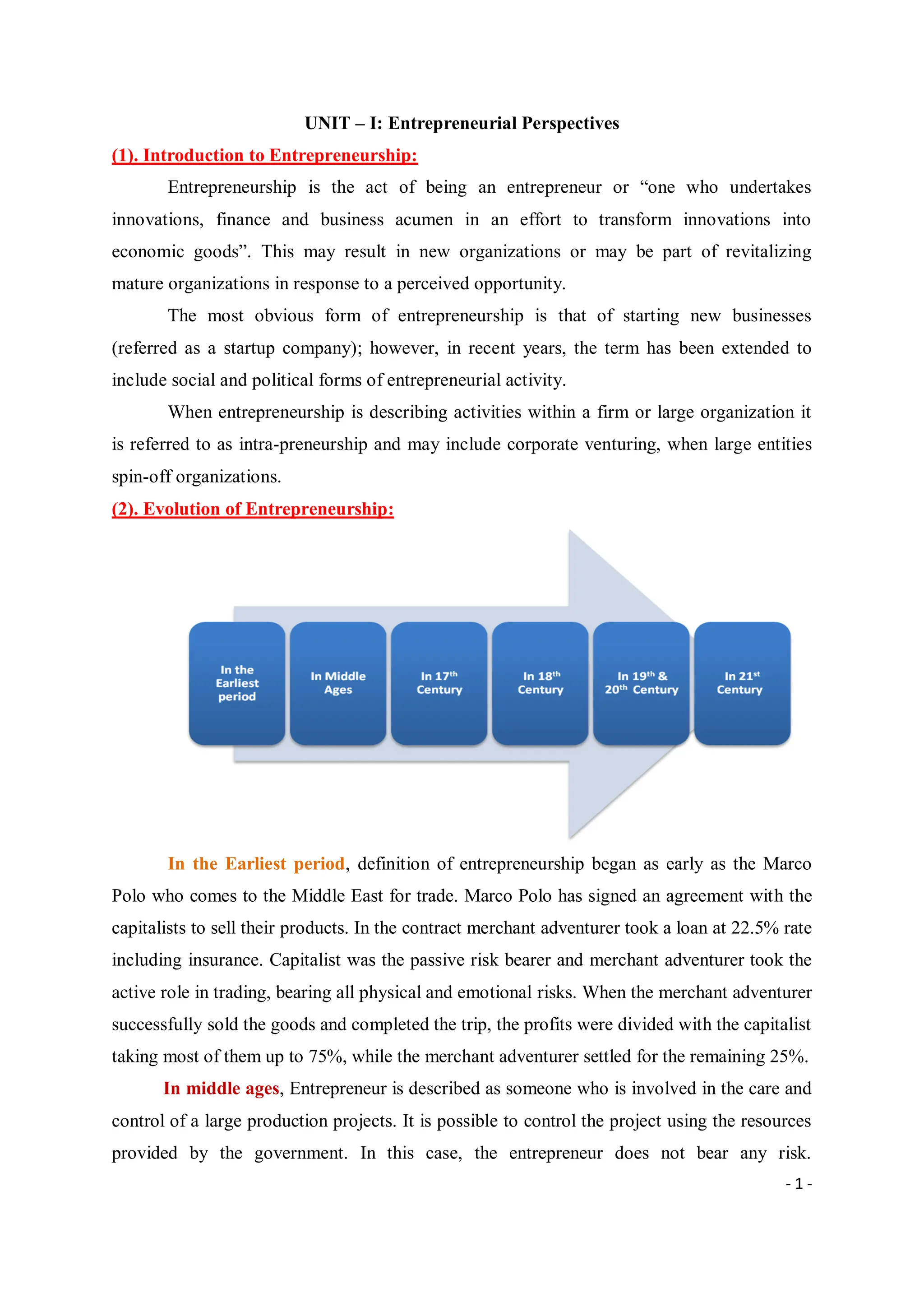
![- 3 -
enterprise for personal gain. The materials consumed in the business, for the use of the land,
for the services he employs, and for the capital he requires. Andrew Carnegie is one of the
best examples of this definition. Carnegie, who descended from a poor Scottish family, made
the American Steel Industry one of the wonders of the industrial world.
1910: Adam Smith – An entrepreneur is a person who only provides capital without taking
active part in the leading role in the enterprise.
1961: David McClelland— A person with a high need for achievement [N-Ach] who is
energetic and a moderate risk taker.
1964: Peter Drucker— one who searches for change, responds to it and exploits
opportunities. Innovation is a specific tool of an entrepreneur hence an effective entrepreneur
converts a source into a resource.
In 21st century (1-Jan-2001 to 31-12-2100), Entrepreneurs are known as a hero for
Free Enterprise market. Entrepreneur of the century created many products and services and
is willing to face a lot of risks in the business. According to Kuratko & Hodgetts, most people
say entrepreneurs are pioneers in creating new businesses. In the year 2005 Hisrich, Peter and
Shepherd regarded entrepreneur as an organizer who controls, systematize, purchases raw
materials, arranges infrastructure, throw in his own inventiveness, expertise, plans and
administers the venture.
The Future of entrepreneurship will be growth with development of technologies. The
modern technologies and internet have improved the ways of conduct business. Entrepreneurs
now have the luxury of putting their business idea into action through the click of button.
(3). Concept of Entrepreneurship:
An entrepreneur is an individual who creates a new business, bearing most of the risks and
enjoying most of the rewards. The process of setting up a business is known as
entrepreneurship. The entrepreneur is commonly seen as an innovator, a source of new
ideas, goods, services, and business/or procedures.
Entrepreneurs play a key role in any economy, using the skills and initiative necessary to
anticipate needs and bringing good new ideas to market. Entrepreneurship that proves to be
successful in taking on the risks of creating a startup is rewarded with profits, fame, and
continued growth opportunities. Entrepreneurship that fails results in losses and less
prevalence in the markets for those involved.](https://image.slidesharecdn.com/ent-all5unitsstudymaterialquestionbank-250222132509-8feb61e5/85/ENT-All-5-units-study-material-Question-Bank-pdf-3-320.jpg)
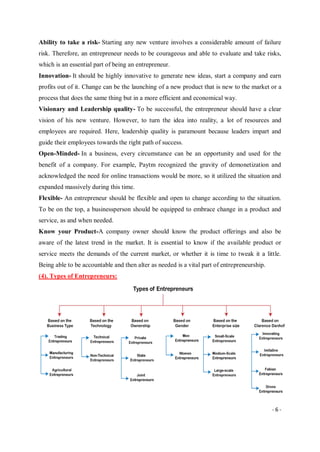
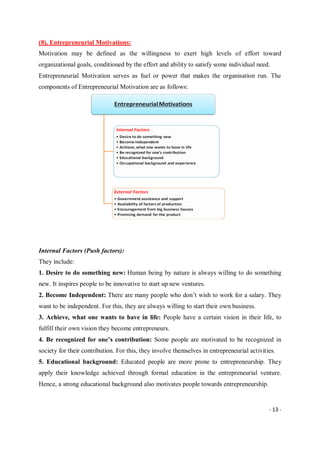
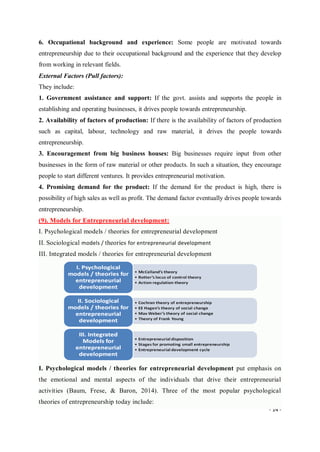
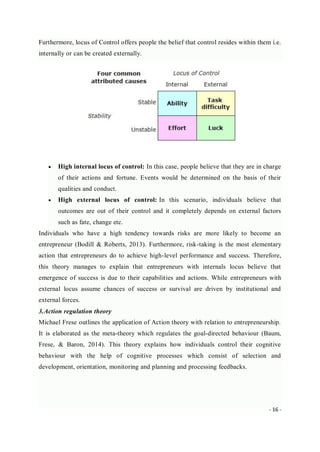
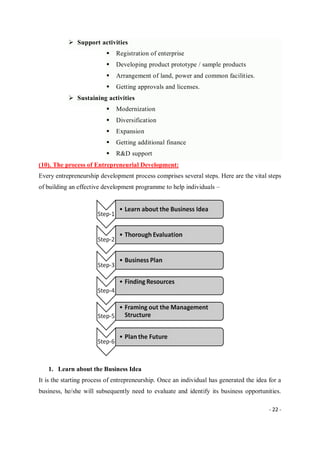
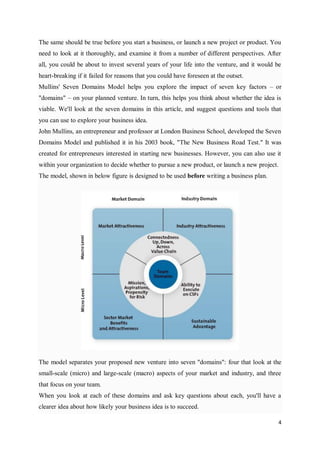
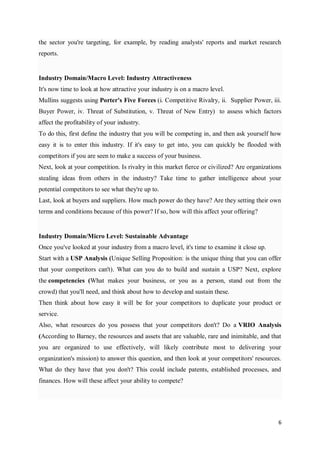
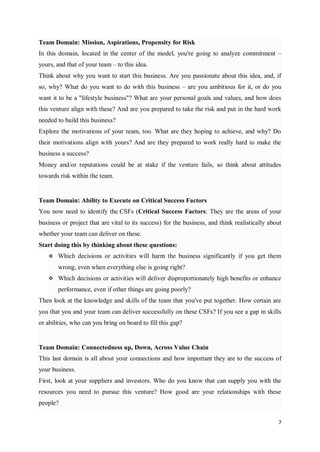
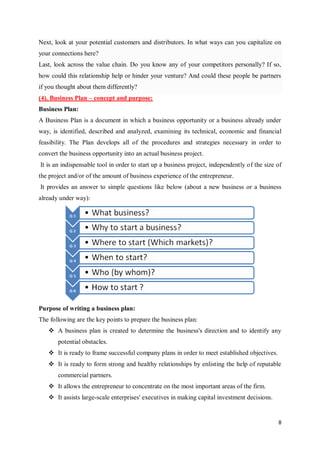
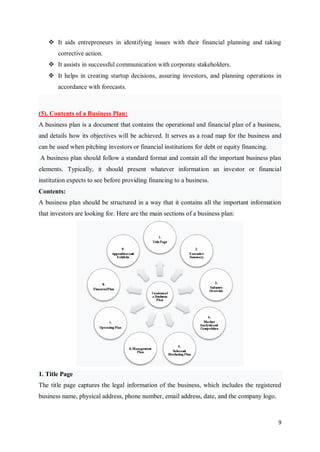
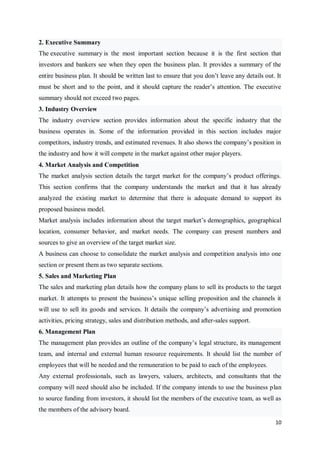
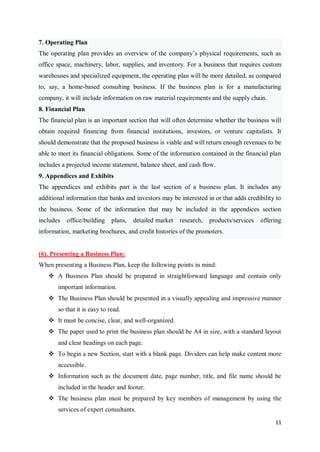
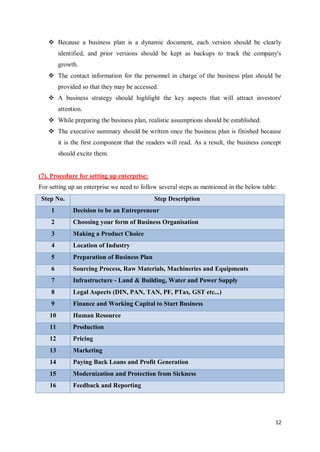
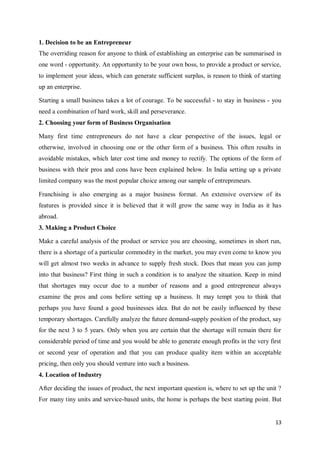
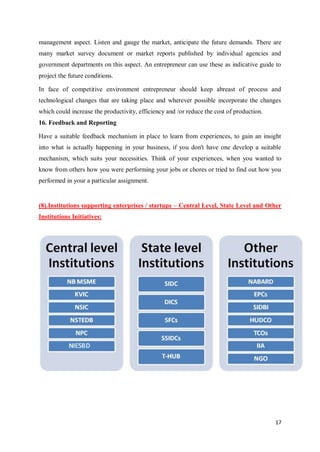
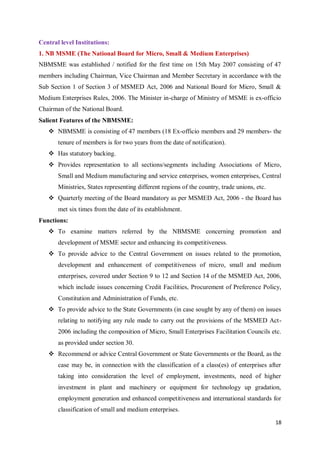
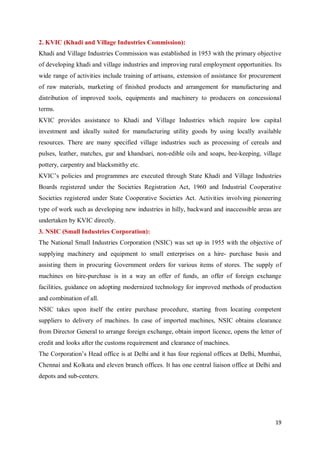
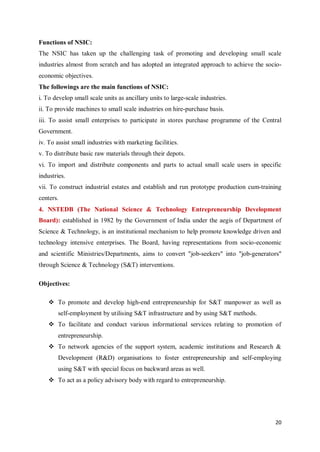
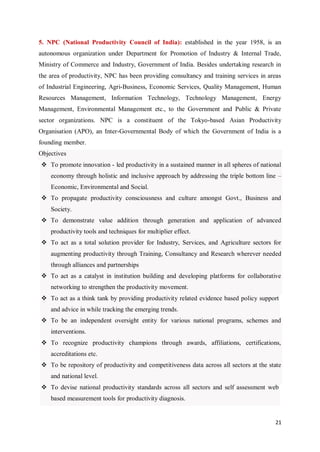
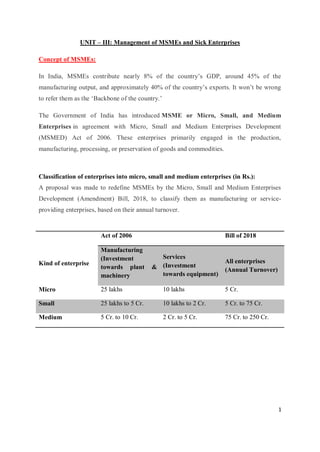
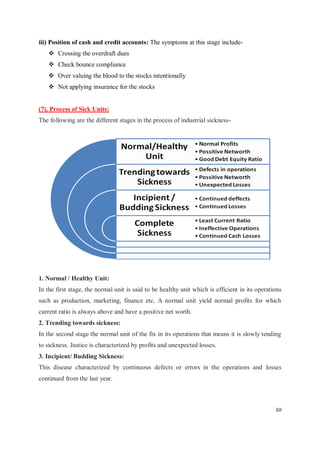
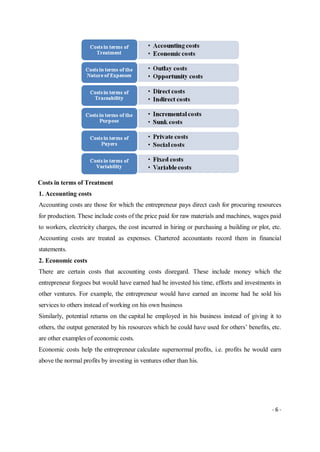



![Entrepreneurship Development [ Basic Concept ]](https://cdn.slidesharecdn.com/ss_thumbnails/enternprenurshipl1-220111232330-thumbnail.jpg?width=640&height=640&fit=bounds)


