satellite communication
Ms.S.Sindhumathy
Convolutional Coding:
 Coding Rate: Convolutional codes can achieve a wide range of coding
rates, allowing flexibility in trading off error correction capability with
bandwidth efficiency.
 Decoding Delay: They have low decoding delay, making them suitable for
real-time applications.
2
03-10-2023
Convolutional Coding:
 Usage: Convolutional codes are often used in applications where low to
moderate error correction is sufficient, such as voice and video
transmission in satellite TV.
 Implementation: They are relatively straightforward to implement in
hardware, making them a cost-effective choice for some satellite systems
3
03-10-2023
Block Coding:
 Coding Rate: Block codes have fixed coding rates, limiting flexibility in
adjusting error correction capability and bandwidth efficiency.
 Decoding Delay: Decoding delay can be higher than convolutional codes,
which may not be suitable for real-time applications with strict latency
requirements.
4
03-10-2023
Block Coding:
 Usage: Block codes are employed in scenarios where strong error
correction is required, such as military and government communications.
 Implementation: While block codes are more complex to implement than
convolutional codes, they are still feasible for many satellite systems.
5
03-10-2023
Turbo Coding:
 Coding Rate: Turbo codes offer a wide range of coding rates, similar to
convolutional codes, allowing flexibility in system design.
 Decoding Delay: They have moderate to high decoding delay, which may
not be suitable for latency-sensitive applications..
6
03-10-2023
Turbo Coding:
 Usage: Turbo codes are widely used in modern satellite communication,
particularly for broadband internet access via satellite and digital television
broadcasting.
 Implementation: Turbo codes require more computational resources for
encoding and decoding compared to convolutional and block codes.
7
03-10-2023
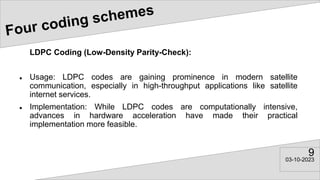
LDPC Coding (Low-Density Parity-Check):
 Coding Rate: LDPC codes offer a wide range of coding rates, similar to
turbo codes, providing flexibility in system design.
 Decoding Delay: LDPC codes have moderate decoding delay, making
them suitable for many applications, including multimedia streaming.
8
03-10-2023
LDPC Coding (Low-Density Parity-Check):
 Usage: LDPC codes are gaining prominence in modern satellite
communication, especially in high-throughput applications like satellite
internet services.
 Implementation: While LDPC codes are computationally intensive,
advances in hardware acceleration have made their practical
implementation more feasible.
9
03-10-2023
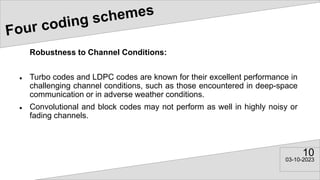
Robustness to Channel Conditions:
 Turbo codes and LDPC codes are known for their excellent performance in
challenging channel conditions, such as those encountered in deep-space
communication or in adverse weather conditions.
 Convolutional and block codes may not perform as well in highly noisy or
fading channels.
10
03-10-2023
Bandwidth Efficiency:
 LDPC codes and turbo codes are highly bandwidth-efficient, allowing more
data to be transmitted over the available frequency spectrum.
 Convolutional and block codes are less bandwidth-efficient, leading to
lower data rates for a given bandwidth.
11
03-10-2023

fourth coding schemes (Sindhumathy).pptx

  • 1.
  • 2.
    Convolutional Coding:  CodingRate: Convolutional codes can achieve a wide range of coding rates, allowing flexibility in trading off error correction capability with bandwidth efficiency.  Decoding Delay: They have low decoding delay, making them suitable for real-time applications. 2 03-10-2023
  • 3.
    Convolutional Coding:  Usage:Convolutional codes are often used in applications where low to moderate error correction is sufficient, such as voice and video transmission in satellite TV.  Implementation: They are relatively straightforward to implement in hardware, making them a cost-effective choice for some satellite systems 3 03-10-2023
  • 4.
    Block Coding:  CodingRate: Block codes have fixed coding rates, limiting flexibility in adjusting error correction capability and bandwidth efficiency.  Decoding Delay: Decoding delay can be higher than convolutional codes, which may not be suitable for real-time applications with strict latency requirements. 4 03-10-2023
  • 5.
    Block Coding:  Usage:Block codes are employed in scenarios where strong error correction is required, such as military and government communications.  Implementation: While block codes are more complex to implement than convolutional codes, they are still feasible for many satellite systems. 5 03-10-2023
  • 6.
    Turbo Coding:  CodingRate: Turbo codes offer a wide range of coding rates, similar to convolutional codes, allowing flexibility in system design.  Decoding Delay: They have moderate to high decoding delay, which may not be suitable for latency-sensitive applications.. 6 03-10-2023
  • 7.
    Turbo Coding:  Usage:Turbo codes are widely used in modern satellite communication, particularly for broadband internet access via satellite and digital television broadcasting.  Implementation: Turbo codes require more computational resources for encoding and decoding compared to convolutional and block codes. 7 03-10-2023
  • 8.
    LDPC Coding (Low-DensityParity-Check):  Coding Rate: LDPC codes offer a wide range of coding rates, similar to turbo codes, providing flexibility in system design.  Decoding Delay: LDPC codes have moderate decoding delay, making them suitable for many applications, including multimedia streaming. 8 03-10-2023
  • 9.
    LDPC Coding (Low-DensityParity-Check):  Usage: LDPC codes are gaining prominence in modern satellite communication, especially in high-throughput applications like satellite internet services.  Implementation: While LDPC codes are computationally intensive, advances in hardware acceleration have made their practical implementation more feasible. 9 03-10-2023
  • 10.
    Robustness to ChannelConditions:  Turbo codes and LDPC codes are known for their excellent performance in challenging channel conditions, such as those encountered in deep-space communication or in adverse weather conditions.  Convolutional and block codes may not perform as well in highly noisy or fading channels. 10 03-10-2023
  • 11.
    Bandwidth Efficiency:  LDPCcodes and turbo codes are highly bandwidth-efficient, allowing more data to be transmitted over the available frequency spectrum.  Convolutional and block codes are less bandwidth-efficient, leading to lower data rates for a given bandwidth. 11 03-10-2023