ADVANCED COMMUNICATION SOLUTIONS
IP Solutions: IP-DVB Encapsulation,
Multimedia Router/Receivers &
Communication Systems for SNGs
Steve Good
Director, Sales Engineering
Comtech EF Data
2
SSPI Brazil Broadcast Day
Agenda
• Efficiencies in Satellite Communications
• IP-DVB Encapsulation
• Multimedia Router/Receivers
• Communication Systems for SNGs
3
Comtech EF Data
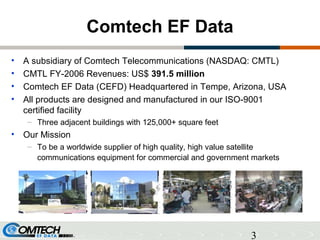
• A subsidiary of Comtech Telecommunications (NASDAQ: CMTL)
• CMTL FY-2006 Revenues: US$ 391.5 million
• Comtech EF Data (CEFD) Headquartered in Tempe, Arizona, USA
• All products are designed and manufactured in our ISO-9001
certified facility
– Three adjacent buildings with 125,000+ square feet
• Our Mission
– To be a worldwide supplier of high quality, high value satellite
communications equipment for commercial and government markets
ADVANCED COMMUNICATION SOLUTIONS
Efficiencies in Satellite
Communications
5
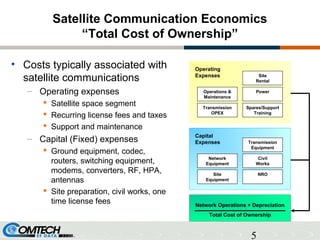
Satellite Communication Economics
“Total Cost of Ownership”
• Costs typically associated with
satellite communications
– Operating expenses
 Satellite space segment
 Recurring license fees and taxes
 Support and maintenance
– Capital (Fixed) expenses
 Ground equipment, codec,
routers, switching equipment,
modems, converters, RF, HPA,
antennas
 Site preparation, civil works, one
time license fees
Operating
Expenses
Capital
Expenses
Network Operations + Depreciation
Total Cost of Ownership
Operations &
Maintenance
Transmission
OPEX
Power
Spares/Support
Training
Site
Rental
Network
Equipment
Site
Equipment
Civil
Works
NRO
Transmission
Equipment
6
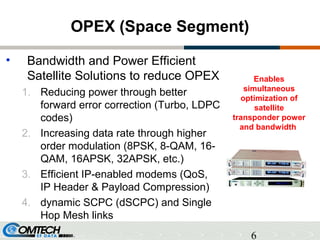
OPEX (Space Segment)
• Bandwidth and Power Efficient
Satellite Solutions to reduce OPEX
1. Reducing power through better
forward error correction (Turbo, LDPC
codes)
2. Increasing data rate through higher
order modulation (8PSK, 8-QAM, 16-
QAM, 16APSK, 32APSK, etc.)
3. Efficient IP-enabled modems (QoS,
IP Header & Payload Compression)
4. dynamic SCPC (dSCPC) and Single
Hop Mesh links
Enables
simultaneous
optimization of
satellite
transponder power
and bandwidth
7
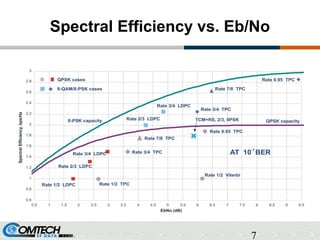
Spectral Efficiency vs. Eb/No
8
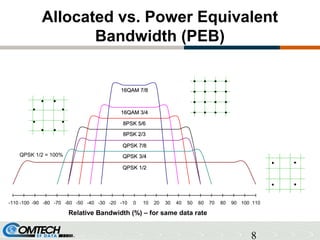
Allocated vs. Power Equivalent
Bandwidth (PEB)
Relative Bandwidth (%) – for same data rate
-110 -100 -90 -80 -70 -60 -50 -40 -30 -20 -10 0 10 20 30 40 50 60 70 80 90 100 110
16QAM 7/816QAM 7/8
16QAM 3/416QAM 3/4
8PSK 5/68PSK 5/6
8PSK 2/38PSK 2/3
QPSK 7/8QPSK 7/8
QPSK 3/4QPSK 3/4
QPSK 1/2QPSK 1/2
QPSK 1/2 = 100%
9
Allocated vs. Power
Equivalent Bandwidth (PEB)
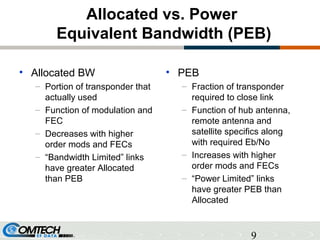
• Allocated BW
– Portion of transponder that
actually used
– Function of modulation and
FEC
– Decreases with higher
order mods and FECs
– “Bandwidth Limited” links
have greater Allocated
than PEB
• PEB
– Fraction of transponder
required to close link
– Function of hub antenna,
remote antenna and
satellite specifics along
with required Eb/No
– Increases with higher
order mods and FECs
– “Power Limited” links
have greater PEB than
Allocated
10
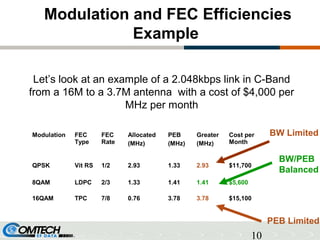
Modulation and FEC Efficiencies
Example
Modulation FEC
Type
FEC
Rate
Allocated
(MHz)
PEB
(MHz)
Greater
(MHz)
Cost per
Month
QPSK Vit RS 1/2 2.93 1.33 2.93 $11,700
8QAM LDPC 2/3 1.33 1.41 1.41 $5,600
16QAM TPC 7/8 0.76 3.78 3.78 $15,100
Let’s look at an example of a 2.048kbps link in C-Band
from a 16M to a 3.7M antenna with a cost of $4,000 per
MHz per month
BW Limited
PEB Limited
BW/PEB
Balanced
ADVANCED COMMUNICATION SOLUTIONS
IP-DVB
Encapsulation
12
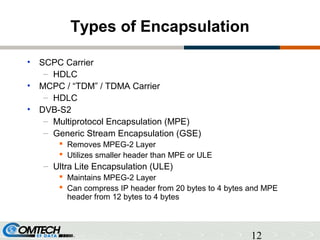
Types of Encapsulation
• SCPC Carrier
– HDLC
• MCPC / “TDM” / TDMA Carrier
– HDLC
• DVB-S2
– Multiprotocol Encapsulation (MPE)
– Generic Stream Encapsulation (GSE)
 Removes MPEG-2 Layer
 Utilizes smaller header than MPE or ULE
– Ultra Lite Encapsulation (ULE)
 Maintains MPEG-2 Layer
 Can compress IP header from 20 bytes to 4 bytes and MPE
header from 12 bytes to 4 bytes
13
Encapsulating IP Traffic into a
DVB-S2 Stream
• The original DVB-S standard was designed around video with
“the world of computers” not prioritized (listed last) in the DVB
Project’s Goals for DVB-S
• DVB-S2 has been designed from the ground up with IP in mind.
• The sharing of a single saturated carrier allows many
economies and joint services to be offered
• New technologies not only increase the efficiency of IP to
MPEG-2 TS conversion but also allow intelligent PID filtering
and conversion between video and data standards
– Can receive IP, convert to MPEG-2 TS
– Can receive MPEG-2 TS, convert to IP
– Can select both the channels to be watched and the means
how to watch them (video monitor, PC, etc.)
14
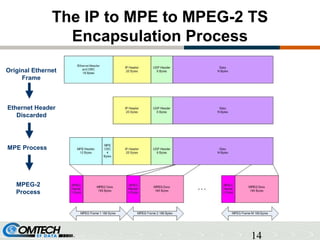
The IP to MPE to MPEG-2 TS
Encapsulation Process
Original Ethernet
Frame
Ethernet Header
Discarded
MPE Process
MPEG-2
Process
15
MPE/MPEG-2 Encapsulation
Efficiencies
• Function of packet size and whether Section Packing
is utilized or not
• With Section Packing and large (1500 byte packets),
efficiencies of 96.6% can be achieved
– Section Packing allows a single MPEG-2 frame to include
two different MPE packets
– Without Section Packing, portion of MPEG-2 frame goes
unused
• ULE and GSE are alternative methods of IP
encapsulation that have had differing levels of
acceptance in the market
• By using section packing with moderately sized
packets leads to indiscriminate differences in
efficiencies between MPE/MPEG-2 and ULE/GSE
16
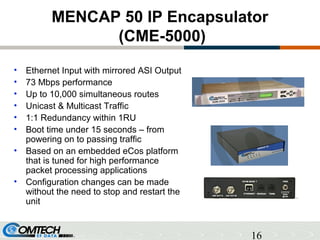
MENCAP 50 IP Encapsulator
(CME-5000)
• Ethernet Input with mirrored ASI Output
• 73 Mbps performance
• Up to 10,000 simultaneous routes
• Unicast & Multicast Traffic
• 1:1 Redundancy within 1RU
• Boot time under 15 seconds – from
powering on to passing traffic
• Based on an embedded eCos platform
that is tuned for high performance
packet processing applications
• Configuration changes can be made
without the need to stop and restart the
unit
ADVANCED COMMUNICATION SOLUTIONS
Multimedia
Router/Receivers
18
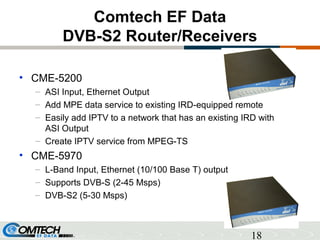
Comtech EF Data
DVB-S2 Router/Receivers
• CME-5200
– ASI Input, Ethernet Output
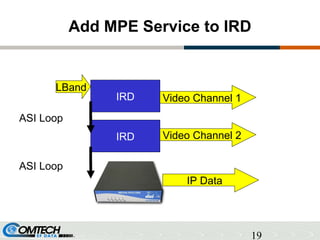
– Add MPE data service to existing IRD-equipped remote
– Easily add IPTV to a network that has an existing IRD with
ASI Output
– Create IPTV service from MPEG-TS
• CME-5970
– L-Band Input, Ethernet (10/100 Base T) output
– Supports DVB-S (2-45 Msps)
– DVB-S2 (5-30 Msps)
19
Add MPE Service to IRD
IRD
IRD
Video Channel 1
ASI Loop
Video Channel 2
ASI Loop
IP Data
LBand
20
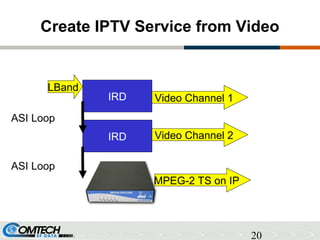
Create IPTV Service from Video
IRD
IRD
Video Channel 1
ASI Loop
Video Channel 2
ASI Loop
MPEG-2 TS on IP
LBand
21
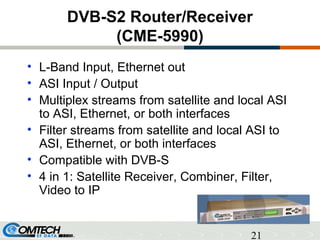
DVB-S2 Router/Receiver
(CME-5990)
• L-Band Input, Ethernet out
• ASI Input / Output
• Multiplex streams from satellite and local ASI
to ASI, Ethernet, or both interfaces
• Filter streams from satellite and local ASI to
ASI, Ethernet, or both interfaces
• Compatible with DVB-S
• 4 in 1: Satellite Receiver, Combiner, Filter,
Video to IP
22
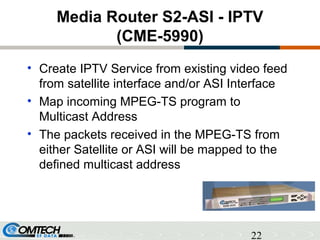
Media Router S2-ASI - IPTV
(CME-5990)
• Create IPTV Service from existing video feed
from satellite interface and/or ASI Interface
• Map incoming MPEG-TS program to
Multicast Address
• The packets received in the MPEG-TS from
either Satellite or ASI will be mapped to the
defined multicast address
23
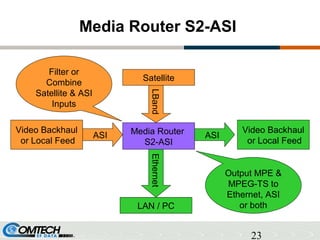
Media Router S2-ASI
Media Router
S2-ASI
ASI
LBand
ASI
Ethernet
LAN / PC
Satellite
Video Backhaul
or Local Feed
Video Backhaul
or Local Feed
Output MPE &
MPEG-TS to
Ethernet, ASI
or both
Filter or
Combine
Satellite & ASI
Inputs
24
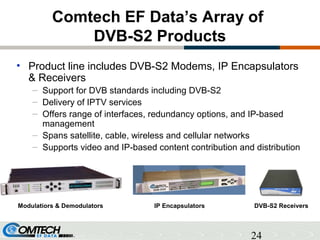
Comtech EF Data’s Array of
DVB-S2 Products
• Product line includes DVB-S2 Modems, IP Encapsulators
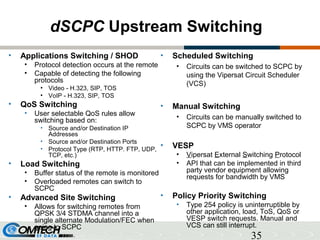
& Receivers
– Support for DVB standards including DVB-S2
– Delivery of IPTV services
– Offers range of interfaces, redundancy options, and IP-based
management
– Spans satellite, cable, wireless and cellular networks
– Supports video and IP-based content contribution and distribution
IP Encapsulators DVB-S2 ReceiversModulatiors & Demodulators
ADVANCED COMMUNICATION SOLUTIONS
Communications
Systems for SNGs
26
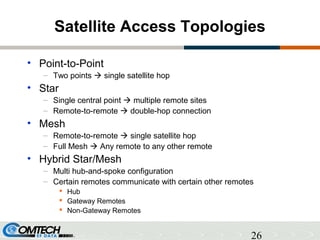
Satellite Access Topologies
• Point-to-Point
– Two points  single satellite hop
• Star
– Single central point  multiple remote sites
– Remote-to-remote  double-hop connection
• Mesh
– Remote-to-remote  single satellite hop
– Full Mesh  Any remote to any other remote
• Hybrid Star/Mesh
– Multi hub-and-spoke configuration
– Certain remotes communicate with certain other remotes
 Hub
 Gateway Remotes
 Non-Gateway Remotes
27
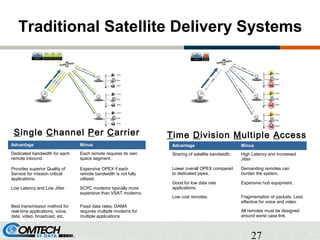
Traditional Satellite Delivery Systems
Advantage Minus
Dedicated bandwidth for each
remote inbound.
Each remote requires its own
space segment.
Provides superior Quality of
Service for mission critical
applications.
Expensive OPEX if each
remote bandwidth is not fully
utilized.
Low Latency and Low Jitter SCPC modems typically more
expensive than VSAT modems.
Best transmission method for
real-time applications, voice,
data, video, broadcast, etc.
Fixed data rates. DAMA
requires multiple modems for
multiple applications.
Advantage Minus
Sharing of satellite bandwidth. High Latency and Increased
Jitter
Lower overall OPEX compared
to dedicated pipes.
Demanding remotes can
burden the system.
Good for low data rate
applications.
Expensive hub equipment.
Low cost remotes. Fragmentation of packets. Less
effective for voice and video.
All remotes must be designed
around worst case link.
Single Channel Per Carrier Time Division Multiple Access
28
Satellite Access Technologies
(TDMA .. also RCS)
• Time Division Multiple Access allows multiple
remotes to access the same medium in an organized
fashion
• Media access control is required
– Reference bursts
 Timing references for all stations to allow proper burst
interleaving within TDMA frame
– Guard time
 Transmit timing accuracy and range rate variation of satellite
• Traffic burst
– One remote at a time
– Detailed traffic plan is calculated and disseminated
– One or many slots per burst
– One remote per slot
29
Satellite Access Technologies
(TDMA .. RCS)
• Utilizes a framing technique
– Frames can be viewed as portions or “chunks” of TDMA carrier
– For a network with VoIP, frame lengths are typically set to be 125
msec long to match the characteristics of human voice
• Each frame is divided into a number of slots
– Number of slots per frame determined by selected FEC technique
– Smaller FEC selection results in small slots
 Larger number of slots per frame
 Larger portion of TDMA overhead vs. traffic
– Larger FEC selection results in large slots
 Smaller number of slots per frame
 Smaller portion of TDMA overhead vs. traffic
– No sharing of slots  if IP data does not completely fill the slot, this
bandwidth
30
Satellite Access Technologies
(TDMA .. RCS)
• Two different data rates are important when sizing a TDMA
network… IP Rate and Information Rate
• IP Rate is the actual IP throughput including IP headers and
data at Layer 3 of the OSI model
– Represents actual LAN traffic on both remote and hub LANs
• Information Rate is the actual Layer 2 information, including
TDMA framing overhead, sent over the satellite
– Link budgets must account for this number and not IP Rate
– Different TDMA platforms have different IP Rate /
Information Rate efficiencies
 Depends on TDMA satellite access method (aloha, slotted
aloha, deterministic, selective, etc.)
31
Satellite Access Technologies
(SCPC)
• Single Channel per Carrier provides the ability for one
remote to access the same medium at a time in an
un-contended fashion
– No sharing of bandwidth between remotes within the
medium itself
– No concept of a timeframe as packets are tightly packed
without concern of contention
• No media access control is required
– Associated overhead eliminated
– All “bursts” are traffic, one after another not overhead
• Earth station has a set amount bandwidth available to
it at all times
32
Satellite Access Technologies
(dynamic SCPC)
• Dynamically switched SCPC links allocated to remotes
depending upon
– SIP, H.323 or TOS byte switching
– QoS rules based on address, port and/or protocol
– Traffic load
– Pre-determined scheduling
• Single Hop on Demand (SHOD)
– Single hop links from remote-to-remote
– Eliminates double-hopping
– Provides single carrier operation for simultaneous connections with
both hub and remote from a remote site
• Remote that is allocated SCPC carrier has the entire bandwidth
available to it
– When SCPC carrier not needed, de-allocated
• Master controller manages allocation of SCPC carriers
33
Dynamic SCPC (dSCPC)
• SCPC links are best you can get for providing “always-on” pipes.
• SCPC links are typically fixed at a specific data rate, requiring manual
intervention to re-size when additional applications need transport.
• Problem – why pay for “always-on” pipes when you don’t need them
24/7?
• Problem – how can you automate the bandwidth requirements of the
satellite link based on the numerous daily changes in applications
running over the link, and keep hardware and operational costs low?
• Solution – dSCPC provides the automated mechanism to:
– switch up SCPC links based on a variety of conditions:
 Application (H.323, SIP, ToS, QoS), Load, Schedule, VESP
– alter the SCPC bandwidth to handle each application:
 Carrier size is dynamically increased or decreased depending on type of
traffic over the link
– tear down the link when the application(s) are completed
 Returns the remote to “home state”
34
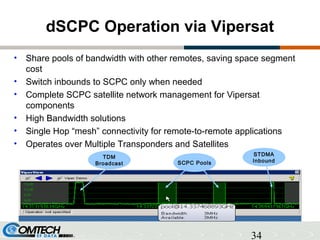
• Share pools of bandwidth with other remotes, saving space segment
cost
• Switch inbounds to SCPC only when needed
• Complete SCPC satellite network management for Vipersat
components
• High Bandwidth solutions
• Single Hop “mesh” connectivity for remote-to-remote applications
• Operates over Multiple Transponders and Satellites
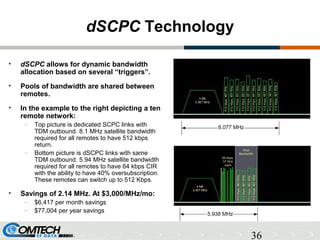
dSCPC Operation via Vipersat
STDMA
Inbound
TDM
Broadcast SCPC Pools
35
dSCPC Upstream Switching
• Applications Switching / SHOD
• Protocol detection occurs at the remote
• Capable of detecting the following
protocols
• Video - H.323, SIP, TOS
• VoIP - H.323, SIP, TOS
• QoS Switching
• User selectable QoS rules allow
switching based on:
• Source and/or Destination IP
Addresses
• Source and/or Destination Ports
• Protocol Type (RTP, HTTP. FTP, UDP,
TCP, etc.)
• Load Switching
• Buffer status of the remote is monitored
• Overloaded remotes can switch to
SCPC
• Advanced Site Switching
• Allows for switching remotes from
QPSK 3/4 STDMA channel into a
single alternate Modulation/FEC when
going to SCPC
• Scheduled Switching
• Circuits can be switched to SCPC by
using the Vipersat Circuit Scheduler
(VCS)
• Manual Switching
• Circuits can be manually switched to
SCPC by VMS operator
• VESP
• Vipersat External Switching Protocol
• API that can be implemented in third
party vendor equipment allowing
requests for bandwidth by VMS
• Policy Priority Switching
• Type 254 policy is uninterruptible by
other application, load, ToS, QoS or
VESP switch requests. Manual and
VCS can still interrupt.
36
dSCPC Technology
• dSCPC allows for dynamic bandwidth
allocation based on several “triggers”.
• Pools of bandwidth are shared between
remotes.
• In the example to the right depicting a ten
remote network:
– Top picture is dedicated SCPC links with
TDM outbound. 8.1 MHz satellite bandwidth
required for all remotes to have 512 kbps
return.
– Bottom picture is dSCPC links with same
TDM outbound. 5.94 MHz satellite bandwidth
required for all remotes to have 64 kbps CIR
with the ability to have 40% oversubscription.
These remotes can switch up to 512 Kbps.
• Savings of 2.14 MHz. At $3,000/MHz/mo:
– $6,417 per month savings
– $77,004 per year savings
37
Advanced Upstream Site Switch
• Allows remotes to switch into the bandwidth
pool in a mod/FEC combination other than that
of its home state.
• For example, remotes can switch out of home
state of QPSK, TPC ¾ to a higher order
modulation, i.e. 8QAM, 8PSK, 16QAM
• Yields greater bandwidth efficiencies.
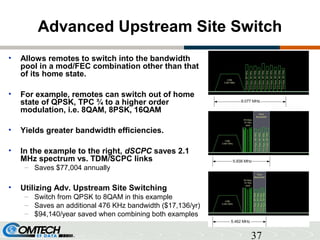
• In the example to the right, dSCPC saves 2.1
MHz spectrum vs. TDM/SCPC links
– Saves $77,004 annually
• Utilizing Adv. Upstream Site Switching
– Switch from QPSK to 8QAM in this example
– Saves an additional 476 KHz bandwidth ($17,136/yr)
– $94,140/year saved when combining both examples
38
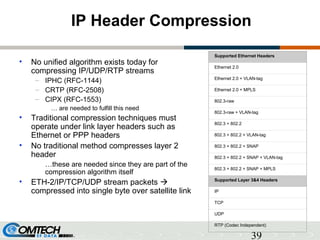
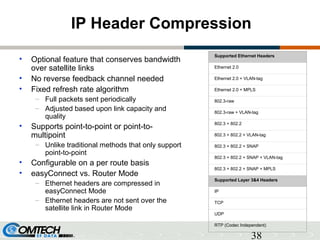
IP Header Compression
Supported Ethernet Headers
Ethernet 2.0
Ethernet 2.0 + VLAN-tag
Ethernet 2.0 + MPLS
802.3-raw
802.3-raw + VLAN-tag
802.3 + 802.2
802.3 + 802.2 + VLAN-tag
802.3 + 802.2 + SNAP
802.3 + 802.2 + SNAP + VLAN-tag
802.3 + 802.2 + SNAP + MPLS
Supported Layer 3&4 Headers
IP
TCP
UDP
RTP (Codec Independent)
• Optional feature that conserves bandwidth
over satellite links
• No reverse feedback channel needed
• Fixed refresh rate algorithm
– Full packets sent periodically
– Adjusted based upon link capacity and
quality
• Supports point-to-point or point-to-
multipoint
– Unlike traditional methods that only support
point-to-point
• Configurable on a per route basis
• easyConnect vs. Router Mode
– Ethernet headers are compressed in
easyConnect Mode
– Ethernet headers are not sent over the
satellite link in Router Mode
39
IP Header Compression
Supported Ethernet Headers
Ethernet 2.0
Ethernet 2.0 + VLAN-tag
Ethernet 2.0 + MPLS
802.3-raw
802.3-raw + VLAN-tag
802.3 + 802.2
802.3 + 802.2 + VLAN-tag
802.3 + 802.2 + SNAP
802.3 + 802.2 + SNAP + VLAN-tag
802.3 + 802.2 + SNAP + MPLS
Supported Layer 3&4 Headers
IP
TCP
UDP
RTP (Codec Independent)
• No unified algorithm exists today for
compressing IP/UDP/RTP streams
– IPHC (RFC-1144)
– CRTP (RFC-2508)
– CIPX (RFC-1553)
… are needed to fulfill this need
• Traditional compression techniques must
operate under link layer headers such as
Ethernet or PPP headers
• No traditional method compresses layer 2
header
…these are needed since they are part of the
compression algorithm itself
• ETH-2/IP/TCP/UDP stream packets 
compressed into single byte over satellite link
40
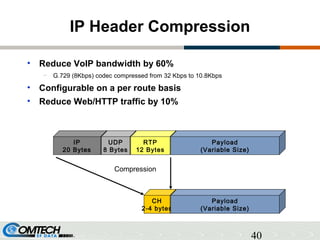
IP Header Compression
• Reduce VoIP bandwidth by 60%
– G.729 (8Kbps) codec compressed from 32 Kbps to 10.8Kbps
• Configurable on a per route basis
• Reduce Web/HTTP traffic by 10%
IP
20 Bytes
UDP
8 Bytes
RTP
12 Bytes
CH
2-4 bytes
Payload
(Variable Size)
Payload
(Variable Size)
Compression
41
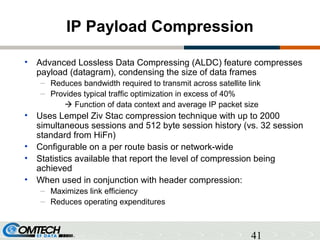
IP Payload Compression
• Advanced Lossless Data Compressing (ALDC) feature compresses
payload (datagram), condensing the size of data frames
– Reduces bandwidth required to transmit across satellite link
– Provides typical traffic optimization in excess of 40%
 Function of data context and average IP packet size
• Uses Lempel Ziv Stac compression technique with up to 2000
simultaneous sessions and 512 byte session history (vs. 32 session
standard from HiFn)
• Configurable on a per route basis or network-wide
• Statistics available that report the level of compression being
achieved
• When used in conjunction with header compression:
– Maximizes link efficiency
– Reduces operating expenditures
42
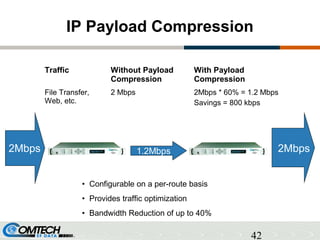
IP Payload Compression
Traffic Without Payload
Compression
With Payload
Compression
File Transfer,
Web, etc.
2 Mbps 2Mbps * 60% = 1.2 Mbps
Savings = 800 kbps
• Configurable on a per-route basis
• Provides traffic optimization
• Bandwidth Reduction of up to 40%
2Mbps 2Mbps1.2Mbps
43
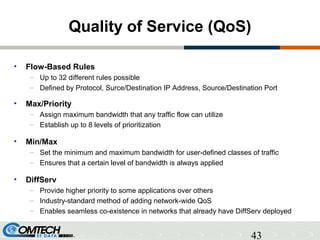
Quality of Service (QoS)
• Flow-Based Rules
– Up to 32 different rules possible
– Defined by Protocol, Surce/Destination IP Address, Source/Destination Port
• Max/Priority
– Assign maximum bandwidth that any traffic flow can utilize
– Establish up to 8 levels of prioritization
• Min/Max
– Set the minimum and maximum bandwidth for user-defined classes of traffic
– Ensures that a certain level of bandwidth is always applied
• DiffServ
– Provide higher priority to some applications over others
– Industry-standard method of adding network-wide QoS
– Enables seamless co-existence in networks that already have DiffServ deployed
44
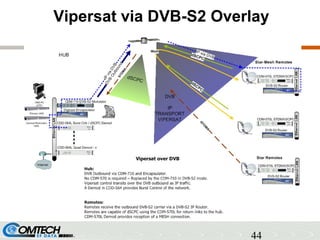
Vipersat via DVB-S2 Overlay
45
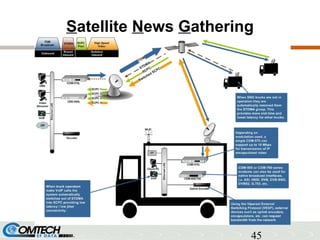
Satellite News Gathering
46
SSPI Brazil Broadcast Day
Agenda
• Efficiencies in Satellite Communications
• IP-DVB Encapsulation
• Multimedia Router/Receivers
• Communication Systems for SNGs
ADVANCED COMMUNICATION SOLUTIONS
IP Solutions: IP-DVB Encapsulation,
Multimedia Router/Receivers &
Communication Systems for SNGs
Steve Good
Director, Sales Engineering
Comtech EF Data

Broadcast day-2007-comtech

  • 1.
    ADVANCED COMMUNICATION SOLUTIONS IPSolutions: IP-DVB Encapsulation, Multimedia Router/Receivers & Communication Systems for SNGs Steve Good Director, Sales Engineering Comtech EF Data
  • 2.
    2 SSPI Brazil BroadcastDay Agenda • Efficiencies in Satellite Communications • IP-DVB Encapsulation • Multimedia Router/Receivers • Communication Systems for SNGs
  • 3.
    3 Comtech EF Data •A subsidiary of Comtech Telecommunications (NASDAQ: CMTL) • CMTL FY-2006 Revenues: US$ 391.5 million • Comtech EF Data (CEFD) Headquartered in Tempe, Arizona, USA • All products are designed and manufactured in our ISO-9001 certified facility – Three adjacent buildings with 125,000+ square feet • Our Mission – To be a worldwide supplier of high quality, high value satellite communications equipment for commercial and government markets
  • 4.
  • 5.
    5 Satellite Communication Economics “TotalCost of Ownership” • Costs typically associated with satellite communications – Operating expenses  Satellite space segment  Recurring license fees and taxes  Support and maintenance – Capital (Fixed) expenses  Ground equipment, codec, routers, switching equipment, modems, converters, RF, HPA, antennas  Site preparation, civil works, one time license fees Operating Expenses Capital Expenses Network Operations + Depreciation Total Cost of Ownership Operations & Maintenance Transmission OPEX Power Spares/Support Training Site Rental Network Equipment Site Equipment Civil Works NRO Transmission Equipment
  • 6.
    6 OPEX (Space Segment) •Bandwidth and Power Efficient Satellite Solutions to reduce OPEX 1. Reducing power through better forward error correction (Turbo, LDPC codes) 2. Increasing data rate through higher order modulation (8PSK, 8-QAM, 16- QAM, 16APSK, 32APSK, etc.) 3. Efficient IP-enabled modems (QoS, IP Header & Payload Compression) 4. dynamic SCPC (dSCPC) and Single Hop Mesh links Enables simultaneous optimization of satellite transponder power and bandwidth
  • 7.
  • 8.
    8 Allocated vs. PowerEquivalent Bandwidth (PEB) Relative Bandwidth (%) – for same data rate -110 -100 -90 -80 -70 -60 -50 -40 -30 -20 -10 0 10 20 30 40 50 60 70 80 90 100 110 16QAM 7/816QAM 7/8 16QAM 3/416QAM 3/4 8PSK 5/68PSK 5/6 8PSK 2/38PSK 2/3 QPSK 7/8QPSK 7/8 QPSK 3/4QPSK 3/4 QPSK 1/2QPSK 1/2 QPSK 1/2 = 100%
  • 9.
    9 Allocated vs. Power EquivalentBandwidth (PEB) • Allocated BW – Portion of transponder that actually used – Function of modulation and FEC – Decreases with higher order mods and FECs – “Bandwidth Limited” links have greater Allocated than PEB • PEB – Fraction of transponder required to close link – Function of hub antenna, remote antenna and satellite specifics along with required Eb/No – Increases with higher order mods and FECs – “Power Limited” links have greater PEB than Allocated
  • 10.
    10 Modulation and FECEfficiencies Example Modulation FEC Type FEC Rate Allocated (MHz) PEB (MHz) Greater (MHz) Cost per Month QPSK Vit RS 1/2 2.93 1.33 2.93 $11,700 8QAM LDPC 2/3 1.33 1.41 1.41 $5,600 16QAM TPC 7/8 0.76 3.78 3.78 $15,100 Let’s look at an example of a 2.048kbps link in C-Band from a 16M to a 3.7M antenna with a cost of $4,000 per MHz per month BW Limited PEB Limited BW/PEB Balanced
  • 11.
  • 12.
    12 Types of Encapsulation •SCPC Carrier – HDLC • MCPC / “TDM” / TDMA Carrier – HDLC • DVB-S2 – Multiprotocol Encapsulation (MPE) – Generic Stream Encapsulation (GSE)  Removes MPEG-2 Layer  Utilizes smaller header than MPE or ULE – Ultra Lite Encapsulation (ULE)  Maintains MPEG-2 Layer  Can compress IP header from 20 bytes to 4 bytes and MPE header from 12 bytes to 4 bytes
  • 13.
    13 Encapsulating IP Trafficinto a DVB-S2 Stream • The original DVB-S standard was designed around video with “the world of computers” not prioritized (listed last) in the DVB Project’s Goals for DVB-S • DVB-S2 has been designed from the ground up with IP in mind. • The sharing of a single saturated carrier allows many economies and joint services to be offered • New technologies not only increase the efficiency of IP to MPEG-2 TS conversion but also allow intelligent PID filtering and conversion between video and data standards – Can receive IP, convert to MPEG-2 TS – Can receive MPEG-2 TS, convert to IP – Can select both the channels to be watched and the means how to watch them (video monitor, PC, etc.)
  • 14.
    14 The IP toMPE to MPEG-2 TS Encapsulation Process Original Ethernet Frame Ethernet Header Discarded MPE Process MPEG-2 Process
  • 15.
    15 MPE/MPEG-2 Encapsulation Efficiencies • Functionof packet size and whether Section Packing is utilized or not • With Section Packing and large (1500 byte packets), efficiencies of 96.6% can be achieved – Section Packing allows a single MPEG-2 frame to include two different MPE packets – Without Section Packing, portion of MPEG-2 frame goes unused • ULE and GSE are alternative methods of IP encapsulation that have had differing levels of acceptance in the market • By using section packing with moderately sized packets leads to indiscriminate differences in efficiencies between MPE/MPEG-2 and ULE/GSE
  • 16.
    16 MENCAP 50 IPEncapsulator (CME-5000) • Ethernet Input with mirrored ASI Output • 73 Mbps performance • Up to 10,000 simultaneous routes • Unicast & Multicast Traffic • 1:1 Redundancy within 1RU • Boot time under 15 seconds – from powering on to passing traffic • Based on an embedded eCos platform that is tuned for high performance packet processing applications • Configuration changes can be made without the need to stop and restart the unit
  • 17.
  • 18.
    18 Comtech EF Data DVB-S2Router/Receivers • CME-5200 – ASI Input, Ethernet Output – Add MPE data service to existing IRD-equipped remote – Easily add IPTV to a network that has an existing IRD with ASI Output – Create IPTV service from MPEG-TS • CME-5970 – L-Band Input, Ethernet (10/100 Base T) output – Supports DVB-S (2-45 Msps) – DVB-S2 (5-30 Msps)
  • 19.
    19 Add MPE Serviceto IRD IRD IRD Video Channel 1 ASI Loop Video Channel 2 ASI Loop IP Data LBand
  • 20.
    20 Create IPTV Servicefrom Video IRD IRD Video Channel 1 ASI Loop Video Channel 2 ASI Loop MPEG-2 TS on IP LBand
  • 21.
    21 DVB-S2 Router/Receiver (CME-5990) • L-BandInput, Ethernet out • ASI Input / Output • Multiplex streams from satellite and local ASI to ASI, Ethernet, or both interfaces • Filter streams from satellite and local ASI to ASI, Ethernet, or both interfaces • Compatible with DVB-S • 4 in 1: Satellite Receiver, Combiner, Filter, Video to IP
  • 22.
    22 Media Router S2-ASI- IPTV (CME-5990) • Create IPTV Service from existing video feed from satellite interface and/or ASI Interface • Map incoming MPEG-TS program to Multicast Address • The packets received in the MPEG-TS from either Satellite or ASI will be mapped to the defined multicast address
  • 23.
    23 Media Router S2-ASI MediaRouter S2-ASI ASI LBand ASI Ethernet LAN / PC Satellite Video Backhaul or Local Feed Video Backhaul or Local Feed Output MPE & MPEG-TS to Ethernet, ASI or both Filter or Combine Satellite & ASI Inputs
  • 24.
    24 Comtech EF Data’sArray of DVB-S2 Products • Product line includes DVB-S2 Modems, IP Encapsulators & Receivers – Support for DVB standards including DVB-S2 – Delivery of IPTV services – Offers range of interfaces, redundancy options, and IP-based management – Spans satellite, cable, wireless and cellular networks – Supports video and IP-based content contribution and distribution IP Encapsulators DVB-S2 ReceiversModulatiors & Demodulators
  • 25.
  • 26.
    26 Satellite Access Topologies •Point-to-Point – Two points  single satellite hop • Star – Single central point  multiple remote sites – Remote-to-remote  double-hop connection • Mesh – Remote-to-remote  single satellite hop – Full Mesh  Any remote to any other remote • Hybrid Star/Mesh – Multi hub-and-spoke configuration – Certain remotes communicate with certain other remotes  Hub  Gateway Remotes  Non-Gateway Remotes
  • 27.
    27 Traditional Satellite DeliverySystems Advantage Minus Dedicated bandwidth for each remote inbound. Each remote requires its own space segment. Provides superior Quality of Service for mission critical applications. Expensive OPEX if each remote bandwidth is not fully utilized. Low Latency and Low Jitter SCPC modems typically more expensive than VSAT modems. Best transmission method for real-time applications, voice, data, video, broadcast, etc. Fixed data rates. DAMA requires multiple modems for multiple applications. Advantage Minus Sharing of satellite bandwidth. High Latency and Increased Jitter Lower overall OPEX compared to dedicated pipes. Demanding remotes can burden the system. Good for low data rate applications. Expensive hub equipment. Low cost remotes. Fragmentation of packets. Less effective for voice and video. All remotes must be designed around worst case link. Single Channel Per Carrier Time Division Multiple Access
  • 28.
    28 Satellite Access Technologies (TDMA.. also RCS) • Time Division Multiple Access allows multiple remotes to access the same medium in an organized fashion • Media access control is required – Reference bursts  Timing references for all stations to allow proper burst interleaving within TDMA frame – Guard time  Transmit timing accuracy and range rate variation of satellite • Traffic burst – One remote at a time – Detailed traffic plan is calculated and disseminated – One or many slots per burst – One remote per slot
  • 29.
    29 Satellite Access Technologies (TDMA.. RCS) • Utilizes a framing technique – Frames can be viewed as portions or “chunks” of TDMA carrier – For a network with VoIP, frame lengths are typically set to be 125 msec long to match the characteristics of human voice • Each frame is divided into a number of slots – Number of slots per frame determined by selected FEC technique – Smaller FEC selection results in small slots  Larger number of slots per frame  Larger portion of TDMA overhead vs. traffic – Larger FEC selection results in large slots  Smaller number of slots per frame  Smaller portion of TDMA overhead vs. traffic – No sharing of slots  if IP data does not completely fill the slot, this bandwidth
  • 30.
    30 Satellite Access Technologies (TDMA.. RCS) • Two different data rates are important when sizing a TDMA network… IP Rate and Information Rate • IP Rate is the actual IP throughput including IP headers and data at Layer 3 of the OSI model – Represents actual LAN traffic on both remote and hub LANs • Information Rate is the actual Layer 2 information, including TDMA framing overhead, sent over the satellite – Link budgets must account for this number and not IP Rate – Different TDMA platforms have different IP Rate / Information Rate efficiencies  Depends on TDMA satellite access method (aloha, slotted aloha, deterministic, selective, etc.)
  • 31.
    31 Satellite Access Technologies (SCPC) •Single Channel per Carrier provides the ability for one remote to access the same medium at a time in an un-contended fashion – No sharing of bandwidth between remotes within the medium itself – No concept of a timeframe as packets are tightly packed without concern of contention • No media access control is required – Associated overhead eliminated – All “bursts” are traffic, one after another not overhead • Earth station has a set amount bandwidth available to it at all times
  • 32.
    32 Satellite Access Technologies (dynamicSCPC) • Dynamically switched SCPC links allocated to remotes depending upon – SIP, H.323 or TOS byte switching – QoS rules based on address, port and/or protocol – Traffic load – Pre-determined scheduling • Single Hop on Demand (SHOD) – Single hop links from remote-to-remote – Eliminates double-hopping – Provides single carrier operation for simultaneous connections with both hub and remote from a remote site • Remote that is allocated SCPC carrier has the entire bandwidth available to it – When SCPC carrier not needed, de-allocated • Master controller manages allocation of SCPC carriers
  • 33.
    33 Dynamic SCPC (dSCPC) •SCPC links are best you can get for providing “always-on” pipes. • SCPC links are typically fixed at a specific data rate, requiring manual intervention to re-size when additional applications need transport. • Problem – why pay for “always-on” pipes when you don’t need them 24/7? • Problem – how can you automate the bandwidth requirements of the satellite link based on the numerous daily changes in applications running over the link, and keep hardware and operational costs low? • Solution – dSCPC provides the automated mechanism to: – switch up SCPC links based on a variety of conditions:  Application (H.323, SIP, ToS, QoS), Load, Schedule, VESP – alter the SCPC bandwidth to handle each application:  Carrier size is dynamically increased or decreased depending on type of traffic over the link – tear down the link when the application(s) are completed  Returns the remote to “home state”
  • 34.
    34 • Share poolsof bandwidth with other remotes, saving space segment cost • Switch inbounds to SCPC only when needed • Complete SCPC satellite network management for Vipersat components • High Bandwidth solutions • Single Hop “mesh” connectivity for remote-to-remote applications • Operates over Multiple Transponders and Satellites dSCPC Operation via Vipersat STDMA Inbound TDM Broadcast SCPC Pools
  • 35.
    35 dSCPC Upstream Switching •Applications Switching / SHOD • Protocol detection occurs at the remote • Capable of detecting the following protocols • Video - H.323, SIP, TOS • VoIP - H.323, SIP, TOS • QoS Switching • User selectable QoS rules allow switching based on: • Source and/or Destination IP Addresses • Source and/or Destination Ports • Protocol Type (RTP, HTTP. FTP, UDP, TCP, etc.) • Load Switching • Buffer status of the remote is monitored • Overloaded remotes can switch to SCPC • Advanced Site Switching • Allows for switching remotes from QPSK 3/4 STDMA channel into a single alternate Modulation/FEC when going to SCPC • Scheduled Switching • Circuits can be switched to SCPC by using the Vipersat Circuit Scheduler (VCS) • Manual Switching • Circuits can be manually switched to SCPC by VMS operator • VESP • Vipersat External Switching Protocol • API that can be implemented in third party vendor equipment allowing requests for bandwidth by VMS • Policy Priority Switching • Type 254 policy is uninterruptible by other application, load, ToS, QoS or VESP switch requests. Manual and VCS can still interrupt.
  • 36.
    36 dSCPC Technology • dSCPCallows for dynamic bandwidth allocation based on several “triggers”. • Pools of bandwidth are shared between remotes. • In the example to the right depicting a ten remote network: – Top picture is dedicated SCPC links with TDM outbound. 8.1 MHz satellite bandwidth required for all remotes to have 512 kbps return. – Bottom picture is dSCPC links with same TDM outbound. 5.94 MHz satellite bandwidth required for all remotes to have 64 kbps CIR with the ability to have 40% oversubscription. These remotes can switch up to 512 Kbps. • Savings of 2.14 MHz. At $3,000/MHz/mo: – $6,417 per month savings – $77,004 per year savings
  • 37.
    37 Advanced Upstream SiteSwitch • Allows remotes to switch into the bandwidth pool in a mod/FEC combination other than that of its home state. • For example, remotes can switch out of home state of QPSK, TPC ¾ to a higher order modulation, i.e. 8QAM, 8PSK, 16QAM • Yields greater bandwidth efficiencies. • In the example to the right, dSCPC saves 2.1 MHz spectrum vs. TDM/SCPC links – Saves $77,004 annually • Utilizing Adv. Upstream Site Switching – Switch from QPSK to 8QAM in this example – Saves an additional 476 KHz bandwidth ($17,136/yr) – $94,140/year saved when combining both examples
  • 38.
    38 IP Header Compression SupportedEthernet Headers Ethernet 2.0 Ethernet 2.0 + VLAN-tag Ethernet 2.0 + MPLS 802.3-raw 802.3-raw + VLAN-tag 802.3 + 802.2 802.3 + 802.2 + VLAN-tag 802.3 + 802.2 + SNAP 802.3 + 802.2 + SNAP + VLAN-tag 802.3 + 802.2 + SNAP + MPLS Supported Layer 3&4 Headers IP TCP UDP RTP (Codec Independent) • Optional feature that conserves bandwidth over satellite links • No reverse feedback channel needed • Fixed refresh rate algorithm – Full packets sent periodically – Adjusted based upon link capacity and quality • Supports point-to-point or point-to- multipoint – Unlike traditional methods that only support point-to-point • Configurable on a per route basis • easyConnect vs. Router Mode – Ethernet headers are compressed in easyConnect Mode – Ethernet headers are not sent over the satellite link in Router Mode
  • 39.
    39 IP Header Compression SupportedEthernet Headers Ethernet 2.0 Ethernet 2.0 + VLAN-tag Ethernet 2.0 + MPLS 802.3-raw 802.3-raw + VLAN-tag 802.3 + 802.2 802.3 + 802.2 + VLAN-tag 802.3 + 802.2 + SNAP 802.3 + 802.2 + SNAP + VLAN-tag 802.3 + 802.2 + SNAP + MPLS Supported Layer 3&4 Headers IP TCP UDP RTP (Codec Independent) • No unified algorithm exists today for compressing IP/UDP/RTP streams – IPHC (RFC-1144) – CRTP (RFC-2508) – CIPX (RFC-1553) … are needed to fulfill this need • Traditional compression techniques must operate under link layer headers such as Ethernet or PPP headers • No traditional method compresses layer 2 header …these are needed since they are part of the compression algorithm itself • ETH-2/IP/TCP/UDP stream packets  compressed into single byte over satellite link
  • 40.
    40 IP Header Compression •Reduce VoIP bandwidth by 60% – G.729 (8Kbps) codec compressed from 32 Kbps to 10.8Kbps • Configurable on a per route basis • Reduce Web/HTTP traffic by 10% IP 20 Bytes UDP 8 Bytes RTP 12 Bytes CH 2-4 bytes Payload (Variable Size) Payload (Variable Size) Compression
  • 41.
    41 IP Payload Compression •Advanced Lossless Data Compressing (ALDC) feature compresses payload (datagram), condensing the size of data frames – Reduces bandwidth required to transmit across satellite link – Provides typical traffic optimization in excess of 40%  Function of data context and average IP packet size • Uses Lempel Ziv Stac compression technique with up to 2000 simultaneous sessions and 512 byte session history (vs. 32 session standard from HiFn) • Configurable on a per route basis or network-wide • Statistics available that report the level of compression being achieved • When used in conjunction with header compression: – Maximizes link efficiency – Reduces operating expenditures
  • 42.
    42 IP Payload Compression TrafficWithout Payload Compression With Payload Compression File Transfer, Web, etc. 2 Mbps 2Mbps * 60% = 1.2 Mbps Savings = 800 kbps • Configurable on a per-route basis • Provides traffic optimization • Bandwidth Reduction of up to 40% 2Mbps 2Mbps1.2Mbps
  • 43.
    43 Quality of Service(QoS) • Flow-Based Rules – Up to 32 different rules possible – Defined by Protocol, Surce/Destination IP Address, Source/Destination Port • Max/Priority – Assign maximum bandwidth that any traffic flow can utilize – Establish up to 8 levels of prioritization • Min/Max – Set the minimum and maximum bandwidth for user-defined classes of traffic – Ensures that a certain level of bandwidth is always applied • DiffServ – Provide higher priority to some applications over others – Industry-standard method of adding network-wide QoS – Enables seamless co-existence in networks that already have DiffServ deployed
  • 44.
  • 45.
  • 46.
    46 SSPI Brazil BroadcastDay Agenda • Efficiencies in Satellite Communications • IP-DVB Encapsulation • Multimedia Router/Receivers • Communication Systems for SNGs
  • 47.
    ADVANCED COMMUNICATION SOLUTIONS IPSolutions: IP-DVB Encapsulation, Multimedia Router/Receivers & Communication Systems for SNGs Steve Good Director, Sales Engineering Comtech EF Data

Editor's Notes

  • #11 This slide takes into account all we’ve discussed and compares three different modulation and FEC selections for a given link.