

Syed Khurram Iqbal System Architect (Pakistan and Central Asia) O3B Networks
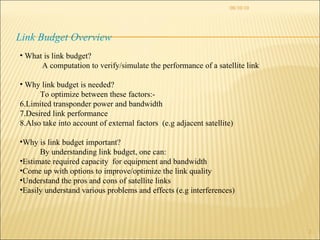
08/10/10 Link Budget Overview What is link budget?  A computation to verify/simulate the performance of a satellite link Why link budget is needed? To optimize between these factors:- Limited transponder power and bandwidth Desired link performance Also take into account of external factors  (e.g adjacent satellite) Why is link budget important? By understanding link budget, one can: Estimate required capacity  for equipment and bandwidth Come up with options to improve/optimize the link quality Understand the pros and cons of satellite links Easily understand various problems and effects (e.g interferences)
08/10/10 Learning Steps for Link Budget Step 1: Know the Definitions - Understand the parameters involved in link budget Step 2: Know the Relationships Understand how each parameter effects other parameters and link performance - Equations Step 3: Play with the parameters Identify the requirements Identify the limitations Optimize
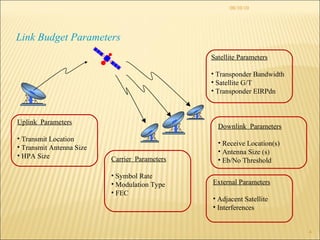
08/10/10 Link Budget Parameters Satellite Parameters Transponder Bandwidth Satellite G/T Transponder EIRPdn Uplink  Parameters Transmit Location Transmit Antenna Size HPA Size Carrier  Parameters Symbol Rate Modulation Type FEC Downlink  Parameters Receive Location(s) Antenna Size (s) Eb/No Threshold External Parameters Adjacent Satellite  Interferences
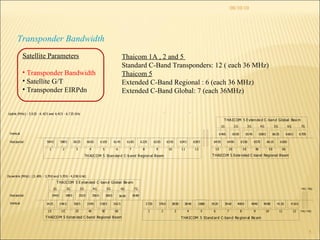
08/10/10 Transponder Bandwidth Thaicom 1A , 2 and 5  Standard C-Band Transponders: 12 ( each 36 MHz) Thaicom 5 Extended C-Band Regional : 6 (each 36 MHz) Extended C-Band Global: 7 (each 36MHz) Satellite Parameters Transponder Bandwidth Satellite G/T Transponder EIRPdn
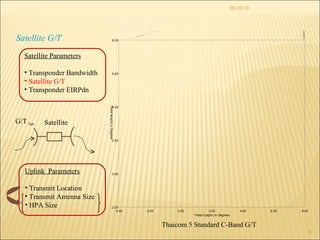
08/10/10 Satellite G/T Thaicom 5 Standard C-Band G/T G/T  Sat Uplink  Parameters Transmit Location Transmit Antenna Size HPA Size Satellite Satellite Parameters Transponder Bandwidth Satellite G/T Transponder EIRPdn
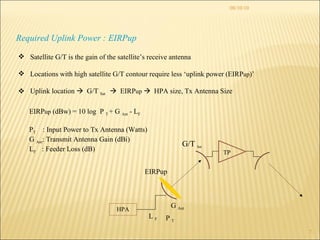
08/10/10 Required Uplink Power : EIRPup Satellite G/T is the gain of the satellite’s receive antenna Locations with high satellite G/T contour require less ‘uplink power (EIRP up )’ Uplink location     G/T  Sat     EIRP up      HPA size, Tx Antenna Size HPA TP EIRPup G/T  Sat EIRP up  (dBw) = 10 log  P  T  + G  Ant  - L F P T   : Input Power to Tx Antenna (Watts) G  Ant : Transmit Antenna Gain (dBi) L F  : Feeder Loss (dB) P  T G  Ant L  F
08/10/10 HPA Sizing Case Study:  Determine the HPA size required to uplink one 128kbsp and one 64kbps carriers. Tx antenna size is 2.4m. EIRPup 1  (for 128k) = 45.6dBw EIRPup 2  (for 64k)  = 42.6dBw EIRPup Total =  10log[10 (EIRPup1/10)  + 10 (EIRPup2/10) ] = 47.4 dBw G Ant   = 41.6 dBi  (from antenna spec) L F = 1dB  (actual loss may be higher    need more uplink power) P out = EIRPup Total  –G Ant  + L F  = 6.8 dBw More than one carrier from HPA, needs to back off to avoid intermods. ( see.  HPA Characteristic ) OBO hpa  = 3dB Saturated output power , P S  = P out  + OBO hpa  = 9.8 dBw Required HPA Size = 10^ (P S /10) =  9.55 Watts  HPA G  Ant L  F P out EIRP up P T
08/10/10 Transponder EIRPdn EIRPdn Thaicom 5 Standard C-Band EIRPdn Contour [ All standard c-band transponders on T5 have same contour pattern] Downlink  Parameters Receive Location(s) Antenna Size (s) Eb/No Threshold Satellite Satellite Parameters Transponder Bandwidth Satellite G/T Transponder EIRPdn
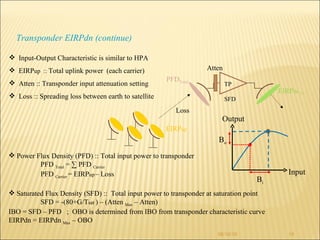
08/10/10 Transponder EIRPdn (continue) Power Flux Density (PFD) :: Total input power to transponder PFD  Total  = ∑ PFD  Carrier  PFD  Carrier  = EIRP up   – Loss  Saturated Flux Density (SFD) ::  Total input power to transponder at saturation point SFD = -(80+G/T sat  ) – (Atten  Max  – Atten) IBO = SFD – PFD  ;  OBO is determined from IBO from transponder characteristic curve EIRPdn = EIRPdn  Max  – OBO  Input-Output Characteristic is similar to HPA EIRP up  ::  Total uplink power  (each carrier) Atten :: Transponder input attenuation setting Loss :: Spreading loss between earth to satellite TP SFD EIRP dn  TP PFD Total EIRP up  Loss Atten Input Output B i B o
08/10/10 Carrier EIRPdn Transponder power is shared by all carriers using on the transponder Each carrier must operate within allowable limit of power allocated for its bandwidth Transponder Operation Modes Single Carrier Mode OBO = 0 dB Max Transponder EIRPdn : 40 dBw Allowable EIRPdn per carrier = 40dBW – 0 dB = 40 dBw  Two Carriers Mode OBO =  2 dB Max Transponder EIRPdn : 40 dBw – 2dB = 38 dBw Allowable EIRPdn per carrier = 38 dBw – 3dB = 35 dBw Multiple Carriers Mode OBO =  4 dB Max Transponder EIRPdn : 40 dBw – 4dB = 36dBw Allowable EIRPdn per carrier :  10log[(x/36)*{10^((36)/10)}] x : bandwidth (in MHz)  of the carrier 36MHz 18MHz 18MHz
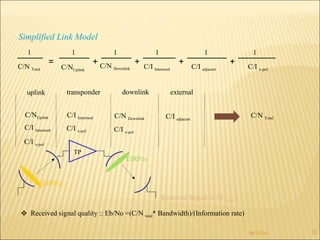
08/10/10 Simplified Link Model EIRP up C/I  Intermod C/I  x-pol C/I  adjacent C/N  Downlink C/N Uplink uplink downlink transponder external Received signal quality ::  Eb/No =(C/N  total * Bandwidth)/(Information rate) C/N  Total Received Signal (C/N  Total  ) C/I  Intermod C/I  x-pol C/I  x-pol 1 C/N  Total 1 C/I  Intermod C/N Uplink 1 C/N  Downlink 1 C/I  adjacent 1 = + + + + 1 C/I  x-pol TP EIRP dn
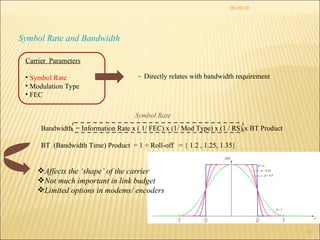
08/10/10 Symbol Rate and Bandwidth Directly relates with bandwidth requirement Bandwidth  = Information Rate x ( 1/ FEC) x (1/ Mod Type) x (1 / RS) x BT Product  BT  (Bandwidth Time) Product  = 1 + Roll-off  = { 1.2 , 1.25, 1.35} Affects the ‘shape’ of the carrier Not much important in link budget Limited options in modems/ encoders Symbol Rate Carrier  Parameters Symbol Rate Modulation Type FEC
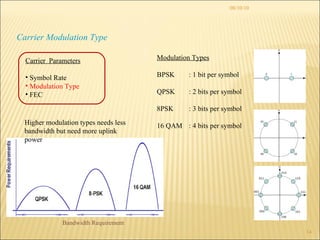
08/10/10 Carrier Modulation Type Modulation Types BPSK  : 1 bit per symbol QPSK  : 2 bits per symbol 8PSK  : 3 bits per symbol 16 QAM  : 4 bits per symbol Higher modulation types needs less bandwidth but need more uplink power Bandwidth Requirement Carrier  Parameters Symbol Rate Modulation Type FEC
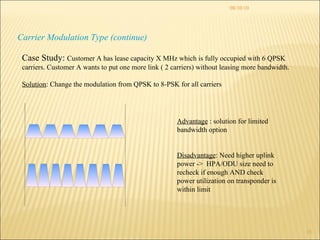
08/10/10 Carrier Modulation Type (continue) Case Study:  Customer A has lease capacity X MHz which is fully occupied with 6 QPSK carriers. Customer A wants to put one more link ( 2 carriers) without leasing more bandwidth. Solution : Change the modulation from QPSK to 8-PSK for all carriers Advantage  : solution for limited bandwidth option Disadvantage : Need higher uplink power ->  HPA/ODU size need to recheck if enough AND check power utilization on transponder is within limit
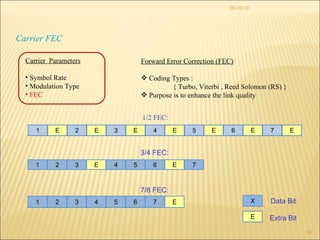
08/10/10 Carrier FEC    1/2 FEC: Data Bit Extra Bit 3/4 FEC: 7/8 FEC: Forward Error Correction (FEC) Coding Types : { Turbo, Viterbi , Reed Solomon (RS) } Purpose is to enhance the link quality Carrier  Parameters Symbol Rate Modulation Type FEC
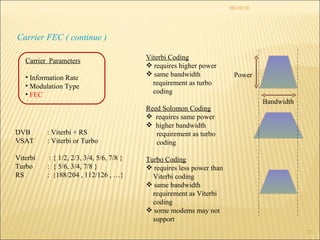
08/10/10 Carrier FEC ( continue ) DVB  : Viterbi + RS VSAT  : Viterbi or Turbo Viterbi  : { 1/2, 2/3, 3/4, 5/6, 7/8 } Turbo :  { 5/6, 3/4, 7/8 } RS  :  { 188/204 , 112/126 , …} Bandwidth Power Viterbi Coding requires higher power same bandwidth requirement as turbo coding Reed Solomon Coding requires same power  higher bandwidth requirement as turbo coding  Turbo Coding requires less power than Viterbi coding same bandwidth requirement as Viterbi coding some modems may not support Carrier  Parameters Information Rate Modulation Type FEC
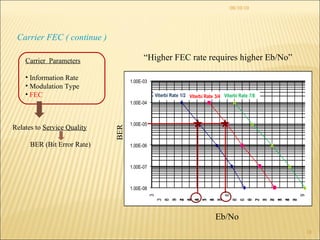
08/10/10 Carrier FEC ( continue ) Relates to  Service Quality BER (Bit Error Rate) “ Higher FEC rate requires higher Eb/No” Carrier  Parameters Information Rate Modulation Type FEC   BER Eb/No
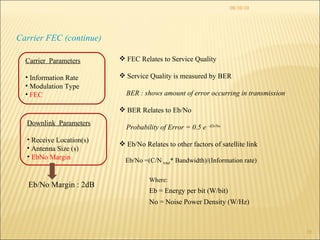
08/10/10 Carrier FEC (continue) Eb/No =(C/N  total * Bandwidth)/(Information rate) Where: Eb = Energy per bit (W/bit) No = Noise Power Density (W/Hz) FEC Relates to Service Quality  Service Quality is measured by BER BER : shows amount of error occurring in transmission BER Relates to Eb/No Probability of Error = 0.5 e  –Eb/No Eb/No Relates to other factors of satellite link Eb/No Margin : 2dB Carrier  Parameters Information Rate Modulation Type FEC   Downlink  Parameters Receive Location(s) Antenna Size (s) EbNo Margin
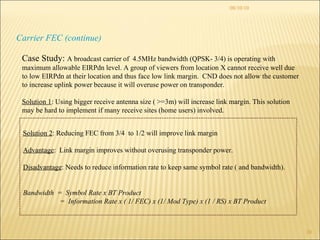
08/10/10 Carrier FEC (continue) Case Study:  A broadcast carrier of  4.5MHz bandwidth (QPSK- 3/4) is operating with maximum allowable EIRPdn level. A group of viewers from location X cannot receive well due to low EIRPdn at their location and thus face low link margin.  CND does not allow the customer to increase uplink power because it will overuse power on transponder.  Solution 1 : Using bigger receive antenna size ( >=3m) will increase link margin. This solution may be hard to implement if many receive sites (home users) involved. Solution 2 : Reducing FEC from 3/4  to 1/2 will improve link margin Advantage :  Link margin improves without overusing transponder power. Disadvantage : Needs to reduce information rate to keep same symbol rate ( and bandwidth). Bandwidth  =  Symbol Rate x BT Product =  Information Rate  x ( 1/ FEC) x (1/ Mod Type) x (1 / RS) x BT Product
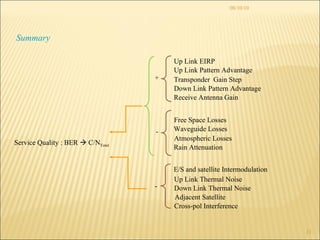
08/10/10 Summary Up Link EIRP Up Link Pattern Advantage Transponder  Gain Step Down Link Pattern Advantage Receive Antenna Gain Free Space Losses Waveguide Losses Atmospheric Losses Rain Attenuation E/S and satellite Intermodulation Up Link Thermal Noise Down Link Thermal Noise Adjacent Satellite Cross-pol Interference + - - Service Quality : BER    C/N Total
Thank You!
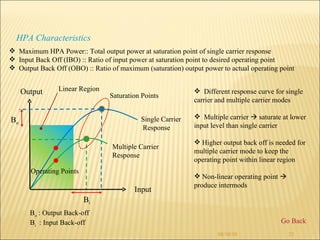
08/10/10 HPA Characteristics Input Output Linear Region Single Carrier Response Multiple Carrier  Response Saturation Points Operating Points B o B i B o  : Output Back-off B i   : Input Back-off Maximum HPA Power:: Total output power at saturation point of single carrier response Input Back Off (IBO) :: Ratio of input power at saturation point to desired operating point Output Back Off (OBO) :: Ratio of maximum (saturation) output power to actual operating point Different response curve for single carrier and multiple carrier modes Multiple carrier    saturate at lower input level than single carrier  Higher output back off is needed for multiple carrier mode to keep the operating point within linear region Non-linear operating point    produce intermods  Go Back

Link Budget

  • 1.
    Syed Khurram IqbalSystem Architect (Pakistan and Central Asia) O3B Networks
  • 2.
    08/10/10 Link BudgetOverview What is link budget? A computation to verify/simulate the performance of a satellite link Why link budget is needed? To optimize between these factors:- Limited transponder power and bandwidth Desired link performance Also take into account of external factors (e.g adjacent satellite) Why is link budget important? By understanding link budget, one can: Estimate required capacity for equipment and bandwidth Come up with options to improve/optimize the link quality Understand the pros and cons of satellite links Easily understand various problems and effects (e.g interferences)
  • 3.
    08/10/10 Learning Stepsfor Link Budget Step 1: Know the Definitions - Understand the parameters involved in link budget Step 2: Know the Relationships Understand how each parameter effects other parameters and link performance - Equations Step 3: Play with the parameters Identify the requirements Identify the limitations Optimize
  • 4.
    08/10/10 Link BudgetParameters Satellite Parameters Transponder Bandwidth Satellite G/T Transponder EIRPdn Uplink Parameters Transmit Location Transmit Antenna Size HPA Size Carrier Parameters Symbol Rate Modulation Type FEC Downlink Parameters Receive Location(s) Antenna Size (s) Eb/No Threshold External Parameters Adjacent Satellite Interferences
  • 5.
    08/10/10 Transponder BandwidthThaicom 1A , 2 and 5 Standard C-Band Transponders: 12 ( each 36 MHz) Thaicom 5 Extended C-Band Regional : 6 (each 36 MHz) Extended C-Band Global: 7 (each 36MHz) Satellite Parameters Transponder Bandwidth Satellite G/T Transponder EIRPdn
  • 6.
    08/10/10 Satellite G/TThaicom 5 Standard C-Band G/T G/T Sat Uplink Parameters Transmit Location Transmit Antenna Size HPA Size Satellite Satellite Parameters Transponder Bandwidth Satellite G/T Transponder EIRPdn
  • 7.
    08/10/10 Required UplinkPower : EIRPup Satellite G/T is the gain of the satellite’s receive antenna Locations with high satellite G/T contour require less ‘uplink power (EIRP up )’ Uplink location  G/T Sat  EIRP up  HPA size, Tx Antenna Size HPA TP EIRPup G/T Sat EIRP up (dBw) = 10 log P T + G Ant - L F P T : Input Power to Tx Antenna (Watts) G Ant : Transmit Antenna Gain (dBi) L F : Feeder Loss (dB) P T G Ant L F
  • 8.
    08/10/10 HPA SizingCase Study: Determine the HPA size required to uplink one 128kbsp and one 64kbps carriers. Tx antenna size is 2.4m. EIRPup 1 (for 128k) = 45.6dBw EIRPup 2 (for 64k) = 42.6dBw EIRPup Total = 10log[10 (EIRPup1/10) + 10 (EIRPup2/10) ] = 47.4 dBw G Ant = 41.6 dBi (from antenna spec) L F = 1dB (actual loss may be higher  need more uplink power) P out = EIRPup Total –G Ant + L F = 6.8 dBw More than one carrier from HPA, needs to back off to avoid intermods. ( see. HPA Characteristic ) OBO hpa = 3dB Saturated output power , P S = P out + OBO hpa = 9.8 dBw Required HPA Size = 10^ (P S /10) = 9.55 Watts HPA G Ant L F P out EIRP up P T
  • 9.
    08/10/10 Transponder EIRPdnEIRPdn Thaicom 5 Standard C-Band EIRPdn Contour [ All standard c-band transponders on T5 have same contour pattern] Downlink Parameters Receive Location(s) Antenna Size (s) Eb/No Threshold Satellite Satellite Parameters Transponder Bandwidth Satellite G/T Transponder EIRPdn
  • 10.
    08/10/10 Transponder EIRPdn(continue) Power Flux Density (PFD) :: Total input power to transponder PFD Total = ∑ PFD Carrier PFD Carrier = EIRP up – Loss Saturated Flux Density (SFD) :: Total input power to transponder at saturation point SFD = -(80+G/T sat ) – (Atten Max – Atten) IBO = SFD – PFD ; OBO is determined from IBO from transponder characteristic curve EIRPdn = EIRPdn Max – OBO Input-Output Characteristic is similar to HPA EIRP up :: Total uplink power (each carrier) Atten :: Transponder input attenuation setting Loss :: Spreading loss between earth to satellite TP SFD EIRP dn TP PFD Total EIRP up Loss Atten Input Output B i B o
  • 11.
    08/10/10 Carrier EIRPdnTransponder power is shared by all carriers using on the transponder Each carrier must operate within allowable limit of power allocated for its bandwidth Transponder Operation Modes Single Carrier Mode OBO = 0 dB Max Transponder EIRPdn : 40 dBw Allowable EIRPdn per carrier = 40dBW – 0 dB = 40 dBw Two Carriers Mode OBO = 2 dB Max Transponder EIRPdn : 40 dBw – 2dB = 38 dBw Allowable EIRPdn per carrier = 38 dBw – 3dB = 35 dBw Multiple Carriers Mode OBO = 4 dB Max Transponder EIRPdn : 40 dBw – 4dB = 36dBw Allowable EIRPdn per carrier : 10log[(x/36)*{10^((36)/10)}] x : bandwidth (in MHz) of the carrier 36MHz 18MHz 18MHz
  • 12.
    08/10/10 Simplified LinkModel EIRP up C/I Intermod C/I x-pol C/I adjacent C/N Downlink C/N Uplink uplink downlink transponder external Received signal quality :: Eb/No =(C/N total * Bandwidth)/(Information rate) C/N Total Received Signal (C/N Total ) C/I Intermod C/I x-pol C/I x-pol 1 C/N Total 1 C/I Intermod C/N Uplink 1 C/N Downlink 1 C/I adjacent 1 = + + + + 1 C/I x-pol TP EIRP dn
  • 13.
    08/10/10 Symbol Rateand Bandwidth Directly relates with bandwidth requirement Bandwidth = Information Rate x ( 1/ FEC) x (1/ Mod Type) x (1 / RS) x BT Product BT (Bandwidth Time) Product = 1 + Roll-off = { 1.2 , 1.25, 1.35} Affects the ‘shape’ of the carrier Not much important in link budget Limited options in modems/ encoders Symbol Rate Carrier Parameters Symbol Rate Modulation Type FEC
  • 14.
    08/10/10 Carrier ModulationType Modulation Types BPSK : 1 bit per symbol QPSK : 2 bits per symbol 8PSK : 3 bits per symbol 16 QAM : 4 bits per symbol Higher modulation types needs less bandwidth but need more uplink power Bandwidth Requirement Carrier Parameters Symbol Rate Modulation Type FEC
  • 15.
    08/10/10 Carrier ModulationType (continue) Case Study: Customer A has lease capacity X MHz which is fully occupied with 6 QPSK carriers. Customer A wants to put one more link ( 2 carriers) without leasing more bandwidth. Solution : Change the modulation from QPSK to 8-PSK for all carriers Advantage : solution for limited bandwidth option Disadvantage : Need higher uplink power -> HPA/ODU size need to recheck if enough AND check power utilization on transponder is within limit
  • 16.
    08/10/10 Carrier FEC 1/2 FEC: Data Bit Extra Bit 3/4 FEC: 7/8 FEC: Forward Error Correction (FEC) Coding Types : { Turbo, Viterbi , Reed Solomon (RS) } Purpose is to enhance the link quality Carrier Parameters Symbol Rate Modulation Type FEC
  • 17.
    08/10/10 Carrier FEC( continue ) DVB : Viterbi + RS VSAT : Viterbi or Turbo Viterbi : { 1/2, 2/3, 3/4, 5/6, 7/8 } Turbo : { 5/6, 3/4, 7/8 } RS : { 188/204 , 112/126 , …} Bandwidth Power Viterbi Coding requires higher power same bandwidth requirement as turbo coding Reed Solomon Coding requires same power higher bandwidth requirement as turbo coding Turbo Coding requires less power than Viterbi coding same bandwidth requirement as Viterbi coding some modems may not support Carrier Parameters Information Rate Modulation Type FEC
  • 18.
    08/10/10 Carrier FEC( continue ) Relates to Service Quality BER (Bit Error Rate) “ Higher FEC rate requires higher Eb/No” Carrier Parameters Information Rate Modulation Type FEC BER Eb/No
  • 19.
    08/10/10 Carrier FEC(continue) Eb/No =(C/N total * Bandwidth)/(Information rate) Where: Eb = Energy per bit (W/bit) No = Noise Power Density (W/Hz) FEC Relates to Service Quality Service Quality is measured by BER BER : shows amount of error occurring in transmission BER Relates to Eb/No Probability of Error = 0.5 e –Eb/No Eb/No Relates to other factors of satellite link Eb/No Margin : 2dB Carrier Parameters Information Rate Modulation Type FEC Downlink Parameters Receive Location(s) Antenna Size (s) EbNo Margin
  • 20.
    08/10/10 Carrier FEC(continue) Case Study: A broadcast carrier of 4.5MHz bandwidth (QPSK- 3/4) is operating with maximum allowable EIRPdn level. A group of viewers from location X cannot receive well due to low EIRPdn at their location and thus face low link margin. CND does not allow the customer to increase uplink power because it will overuse power on transponder. Solution 1 : Using bigger receive antenna size ( >=3m) will increase link margin. This solution may be hard to implement if many receive sites (home users) involved. Solution 2 : Reducing FEC from 3/4 to 1/2 will improve link margin Advantage : Link margin improves without overusing transponder power. Disadvantage : Needs to reduce information rate to keep same symbol rate ( and bandwidth). Bandwidth = Symbol Rate x BT Product = Information Rate x ( 1/ FEC) x (1/ Mod Type) x (1 / RS) x BT Product
  • 21.
    08/10/10 Summary UpLink EIRP Up Link Pattern Advantage Transponder Gain Step Down Link Pattern Advantage Receive Antenna Gain Free Space Losses Waveguide Losses Atmospheric Losses Rain Attenuation E/S and satellite Intermodulation Up Link Thermal Noise Down Link Thermal Noise Adjacent Satellite Cross-pol Interference + - - Service Quality : BER  C/N Total
  • 22.
  • 23.
    08/10/10 HPA CharacteristicsInput Output Linear Region Single Carrier Response Multiple Carrier Response Saturation Points Operating Points B o B i B o : Output Back-off B i : Input Back-off Maximum HPA Power:: Total output power at saturation point of single carrier response Input Back Off (IBO) :: Ratio of input power at saturation point to desired operating point Output Back Off (OBO) :: Ratio of maximum (saturation) output power to actual operating point Different response curve for single carrier and multiple carrier modes Multiple carrier  saturate at lower input level than single carrier Higher output back off is needed for multiple carrier mode to keep the operating point within linear region Non-linear operating point  produce intermods Go Back