111
SMALL STEPS TOWARDS
RISK MITIGATION
Claudio Frugis
Head manager
Advantech Wireless do Brasil
VSAT Day 2012 – Rio de Janeiro
2
Scope
The VSAT industry is
continually changing as new
technologies, frequencies,
applications and platforms
are brought to market.
DVB-S→ DVB-S2→ DVB-S3(?)
Ka-Band →V Band
Hardware costs drop 30% every
10 years
Throughput increases x10 every
10 years
2
Small Steps Towards Risk Mitigation
3
Scope
To what extent do costs have to be driven down
further?
Are there products in place that enable greater
innovation by service providers?
What are the market implications?
3
Small Steps Towards Risk Mitigation
4
Ka & V Band Experience
Canadian Space Agency (CSA) program started in early 1990s for
communications for Canada in 2000 and beyond.
Advantech Wireless (part of Spar Aerospace) led Ka Band study in the early 1990s
with Telesat, Norsat, Comdev
Study identified Ka Band as the next major new technology
SES BBI (ARCS) Program
Delivered DVB-RCS system based on Ka Band inbounds and Ku Band outbounds
(2000)
CSA V Band Program
Advantech Wireless (with MDA, Telesat, Comdev) investigated use of V Band
Delivered 2 DVB-RCS Ka Band hubs
to Telesat for Vancouver and Winnipeg
Delivered 3 DVB-RCS Ka Band hubs
to DISA for WGS
DVB-RCS Experience
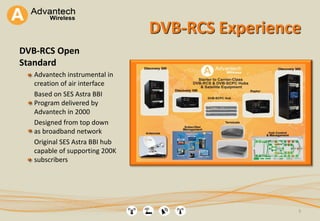
DVB-RCS Open
Standard
Advantech instrumental in
creation of air interface
Based on SES Astra BBI
Program delivered by
Advantech in 2000
Designed from top down
as broadband network
Original SES Astra BBI hub
capable of supporting 200K
subscribers
5
DVB-RCS Experience
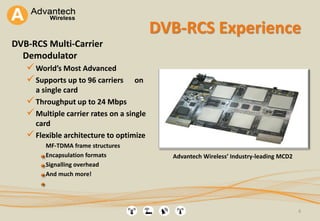
DVB-RCS Multi-Carrier
Demodulator
World’s Most Advanced
Supports up to 96 carriers on
a single card
Throughput up to 24 Mbps
Multiple carrier rates on a single
card
Flexible architecture to optimize
MF-TDMA frame structures
Encapsulation formats
Signalling overhead
And much more!
6
Advantech Wireless’ Industry-leading MCD2
7
Introduction
Main driver to lower OPEX
Efficient use of satellite resources
Critical for efficiency
A satellite access technique well
matched to the network traffic and
applications
Increasing demand for improved
satellite efficiency
Scarcity of bandwidth in certain
markets
How can this be
achieved ?
7
88888
Review of
Satellite Network
Access Technologies
9
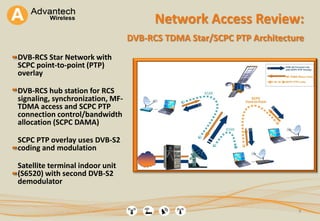
Network Access Review:
DVB-RCS TDMA Star/SCPC PTP Architecture
DVB-RCS Star Network with
SCPC point-to-point (PTP)
overlay
DVB-RCS hub station for RCS
signaling, synchronization, MF-
TDMA access and SCPC PTP
connection control/bandwidth
allocation (SCPC DAMA)
SCPC PTP overlay uses DVB-S2
coding and modulation
Satellite terminal indoor unit
(S6520) with second DVB-S2
demodulator
9
1010
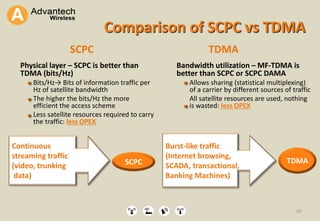
Comparison of SCPC vs TDMA
SCPC
Physical layer – SCPC is better than
TDMA (bits/Hz)
Bits/Hz→ Bits of information traffic per
Hz of satellite bandwidth
The higher the bits/Hz the more
efficient the access scheme
Less satellite resources required to carry
the traffic: less OPEX
TDMA
Bandwidth utilization – MF-TDMA is
better than SCPC or SCPC DAMA
Allows sharing (statistical multiplexing)
of a carrier by different sources of traffic
All satellite resources are used, nothing
is wasted: less OPEX
Burst-like traffic
(Internet browsing,
SCADA, transactional,
Banking Machines)
Continuous
streaming traffic
(video, trunking
data)
SCPC TDMA
11
Problem
11
Issue
Define access scheme to be used at time of
purchase
Solution
An access scheme that adapts dynamically to the
requirements of the data to be transmitted from
remote terminals to hub station
12
What is A-SAT™?
12
Adaptive Satellite Access Technology (A-SAT™)
Adapts to the type of traffic to be transmitted
Can dynamically switch its:
Access SCPC (FDMA) DAMA or MF-TDMA DAMA
Modulation QPSK, 8PSK, etc.
Coding FEC strength (LDPC, TCC) and Coding Rate (1/2,
2/3, ¾, 5/6, etc.)
Latency (64K, 16K, 4K LDPC block sizes vs. TCC)
Encapsulation/Access Scheme in Forward and Return Link
1313
A-SAT™
Features
1414
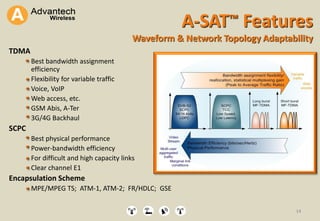
A-SAT™ Features
Waveform & Network Topology Adaptability
TDMA
Best bandwidth assignment
efficiency
Flexibility for variable traffic
Voice, VoIP
Web access, etc.
GSM Abis, A-Ter
3G/4G Backhaul
SCPC
Best physical performance
Power-bandwidth efficiency
For difficult and high capacity links
Clear channel E1
Encapsulation Scheme
MPE/MPEG TS; ATM-1, ATM-2; FR/HDLC; GSE
15
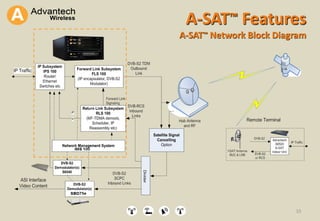
A-SAT™ Features
A-SAT™ Network Block Diagram
15
16
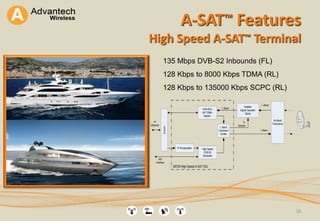
A-SAT™ Features
High Speed A-SAT™ Terminal
DVB-RCS
MF-TDMA
Modem
Ku-Band
Transceiver
Satellite
Signal Canceller
Option
High Speed
DVB-S2
Modulator
IP Encapsulator
Switch
IP
Ethernet
ASI
Interface
L-Band
L-Band
S6720 High Speed A-SAT IDU
L-Band
Combiner/
Divider
Tx
Sample
L-Band
16
135 Mbps DVB-S2 Inbounds (FL)
128 Kbps to 8000 Kbps TDMA (RL)
128 Kbps to 135000 Kbps SCPC (RL)
17
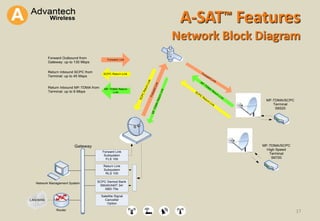
A-SAT™ Features
Network Block Diagram
Forward Link
Subsystem
FLS 100
Return Link
Subsystem
RLS 100
SCPC Demod Bank
S6040/AMT 34/
SBD 75e
Network Management System
Router
ForwardLink
Forward LinkM
F-TDM
A
Return
Link
SCPC
Return
Link
MF-TDMAReturnLink
SCPCReturnLink
Forward Link
SCPC Return Link
MF-TDMA Return
Link
Forward Outbound from
Gateway: up to 135 Mbps
Return Inbound MF-TDMA from
Terminal: up to 8 Mbps
Return Inbound SCPC from
Terminal: up to 45 Msps
MF-TDMA/SCPC
High Speed
Terminal
S6720
LAN/WAN
Gateway
MF-TDMA/SCPC
Terminal
S6520
Satellite Signal
Canceller
Option
17
18
A-SAT™ Features
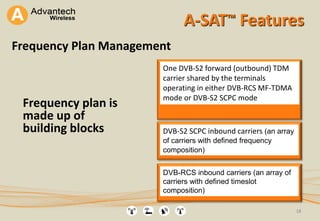
Frequency plan is
made up of
building blocks
18
Frequency Plan Management
One DVB-S2 forward (outbound) TDM
carrier shared by the terminals
operating in either DVB-RCS MF-TDMA
mode or DVB-S2 SCPC mode
DVB-S2 SCPC inbound carriers (an array
of carriers with defined frequency
composition)
DVB-RCS inbound carriers (an array of
carriers with defined timeslot
composition)
19
A-SAT™ Features
Operational States
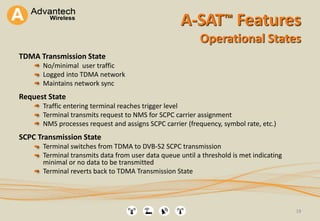
TDMA Transmission State
• No/minimal user traffic
• Logged into TDMA network
• Maintains network sync
Request State
• Traffic entering terminal reaches trigger level
• Terminal transmits request to NMS for SCPC carrier assignment
• NMS processes request and assigns SCPC carrier (frequency, symbol rate, etc.)
SCPC Transmission State
• Terminal switches from TDMA to DVB-S2 SCPC transmission
• Terminal transmits data from user data queue until a threshold is met indicating
minimal or no data to be transmitted
• Terminal reverts back to TDMA Transmission State
19
2020
A-SAT™
Performance
A-SAT™ Performance
Carrier Access Efficiency
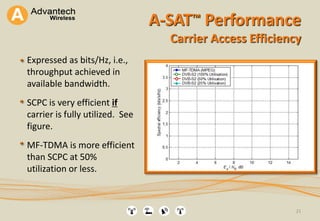
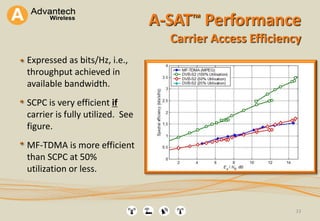
Expressed as bits/Hz, i.e.,
throughput achieved in
available bandwidth.
SCPC is very efficient if
carrier is fully utilized. See
figure.
MF-TDMA is more efficient
than SCPC at 50%
utilization or less.
21
A-SAT™ Performance
Carrier Access Efficiency
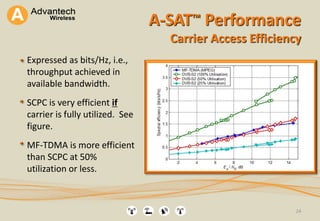
Expressed as bits/Hz, i.e.,
throughput achieved in
available bandwidth.
SCPC is very efficient if
carrier is fully utilized. See
figure.
MF-TDMA is more efficient
than SCPC at 50%
utilization or less.
22
A-SAT™ Performance
Carrier Access Efficiency
Expressed as bits/Hz, i.e.,
throughput achieved in
available bandwidth.
SCPC is very efficient if
carrier is fully utilized. See
figure.
MF-TDMA is more efficient
than SCPC at 50%
utilization or less.
23
A-SAT™ Performance
Carrier Access Efficiency
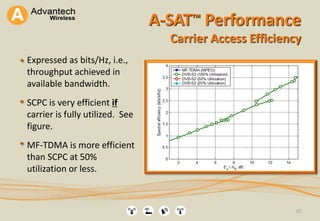
Expressed as bits/Hz, i.e.,
throughput achieved in
available bandwidth.
SCPC is very efficient if
carrier is fully utilized. See
figure.
MF-TDMA is more efficient
than SCPC at 50%
utilization or less.
24
25
A-SAT™ Performance
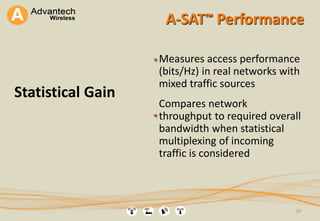
Measures access performance
(bits/Hz) in real networks with
mixed traffic sources
Compares network
throughput to required overall
bandwidth when statistical
multiplexing of incoming
traffic is considered
25
Statistical Gain
A-SAT™ Performance
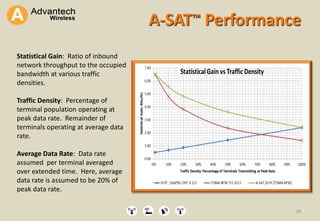
Statistical Gain: Ratio of inbound
network throughput to the occupied
bandwidth at various traffic
densities.
Traffic Density: Percentage of
terminal population operating at
peak data rate. Remainder of
terminals operating at average data
rate.
Average Data Rate: Data rate
assumed per terminal averaged
over extended time. Here, average
data rate is assumed to be 20% of
peak data rate.
26
27
A-SAT™ Performance
Statistical Gain
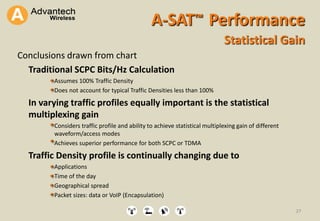
Conclusions drawn from chart
Traditional SCPC Bits/Hz Calculation
Assumes 100% Traffic Density
Does not account for typical Traffic Densities less than 100%
In varying traffic profiles equally important is the statistical
multiplexing gain
Considers traffic profile and ability to achieve statistical multiplexing gain of different
waveform/access modes
Achieves superior performance for both SCPC or TDMA
Traffic Density profile is continually changing due to
Applications
Time of the day
Geographical spread
Packet sizes: data or VoIP (Encapsulation)
27
28
A-SAT™ Performance
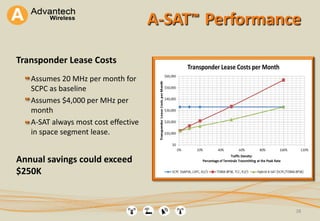
Transponder Lease Costs
Assumes 20 MHz per month for
SCPC as baseline
Assumes $4,000 per MHz per
month
A-SAT always most cost effective
in space segment lease.
Annual savings could exceed
$250K
28
29
A-SAT™ Performance
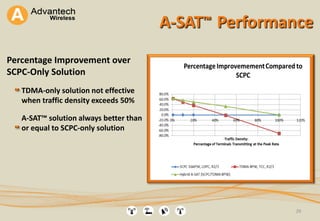
Percentage Improvement over
SCPC-Only Solution
TDMA-only solution not effective
when traffic density exceeds 50%
A-SAT™ solution always better than
or equal to SCPC-only solution
29
3030
A-SAT™
Summary
A-SAT™ Summary
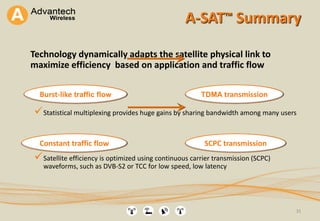
Technology dynamically adapts the satellite physical link to
maximize efficiency based on application and traffic flow
Statistical multiplexing provides huge gains by sharing bandwidth among many users
Satellite efficiency is optimized using continuous carrier transmission (SCPC)
waveforms, such as DVB-S2 or TCC for low speed, low latency
31
TDMA transmissionBurst-like traffic flow
SCPC transmissionConstant traffic flow
A-SAT™ Summary
32
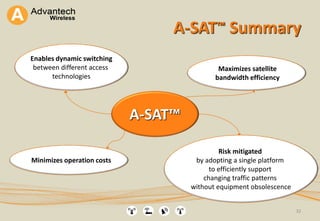
Minimizes operation costs
Maximizes satellite
bandwidth efficiency
A-SAT™
Enables dynamic switching
between different access
technologies
Risk mitigated
by adopting a single platform
to efficiently support
changing traffic patterns
without equipment obsolescence
33
Thank you!
33
For more information please visit:
www.advantechwireless.com

Advantech vsat day_2012

  • 1.
    111 SMALL STEPS TOWARDS RISKMITIGATION Claudio Frugis Head manager Advantech Wireless do Brasil VSAT Day 2012 – Rio de Janeiro
  • 2.
    2 Scope The VSAT industryis continually changing as new technologies, frequencies, applications and platforms are brought to market. DVB-S→ DVB-S2→ DVB-S3(?) Ka-Band →V Band Hardware costs drop 30% every 10 years Throughput increases x10 every 10 years 2 Small Steps Towards Risk Mitigation
  • 3.
    3 Scope To what extentdo costs have to be driven down further? Are there products in place that enable greater innovation by service providers? What are the market implications? 3 Small Steps Towards Risk Mitigation
  • 4.
    4 Ka & VBand Experience Canadian Space Agency (CSA) program started in early 1990s for communications for Canada in 2000 and beyond. Advantech Wireless (part of Spar Aerospace) led Ka Band study in the early 1990s with Telesat, Norsat, Comdev Study identified Ka Band as the next major new technology SES BBI (ARCS) Program Delivered DVB-RCS system based on Ka Band inbounds and Ku Band outbounds (2000) CSA V Band Program Advantech Wireless (with MDA, Telesat, Comdev) investigated use of V Band Delivered 2 DVB-RCS Ka Band hubs to Telesat for Vancouver and Winnipeg Delivered 3 DVB-RCS Ka Band hubs to DISA for WGS
  • 5.
    DVB-RCS Experience DVB-RCS Open Standard Advantechinstrumental in creation of air interface Based on SES Astra BBI Program delivered by Advantech in 2000 Designed from top down as broadband network Original SES Astra BBI hub capable of supporting 200K subscribers 5
  • 6.
    DVB-RCS Experience DVB-RCS Multi-Carrier Demodulator World’sMost Advanced Supports up to 96 carriers on a single card Throughput up to 24 Mbps Multiple carrier rates on a single card Flexible architecture to optimize MF-TDMA frame structures Encapsulation formats Signalling overhead And much more! 6 Advantech Wireless’ Industry-leading MCD2
  • 7.
    7 Introduction Main driver tolower OPEX Efficient use of satellite resources Critical for efficiency A satellite access technique well matched to the network traffic and applications Increasing demand for improved satellite efficiency Scarcity of bandwidth in certain markets How can this be achieved ? 7
  • 8.
  • 9.
    9 Network Access Review: DVB-RCSTDMA Star/SCPC PTP Architecture DVB-RCS Star Network with SCPC point-to-point (PTP) overlay DVB-RCS hub station for RCS signaling, synchronization, MF- TDMA access and SCPC PTP connection control/bandwidth allocation (SCPC DAMA) SCPC PTP overlay uses DVB-S2 coding and modulation Satellite terminal indoor unit (S6520) with second DVB-S2 demodulator 9
  • 10.
    1010 Comparison of SCPCvs TDMA SCPC Physical layer – SCPC is better than TDMA (bits/Hz) Bits/Hz→ Bits of information traffic per Hz of satellite bandwidth The higher the bits/Hz the more efficient the access scheme Less satellite resources required to carry the traffic: less OPEX TDMA Bandwidth utilization – MF-TDMA is better than SCPC or SCPC DAMA Allows sharing (statistical multiplexing) of a carrier by different sources of traffic All satellite resources are used, nothing is wasted: less OPEX Burst-like traffic (Internet browsing, SCADA, transactional, Banking Machines) Continuous streaming traffic (video, trunking data) SCPC TDMA
  • 11.
    11 Problem 11 Issue Define access schemeto be used at time of purchase Solution An access scheme that adapts dynamically to the requirements of the data to be transmitted from remote terminals to hub station
  • 12.
    12 What is A-SAT™? 12 AdaptiveSatellite Access Technology (A-SAT™) Adapts to the type of traffic to be transmitted Can dynamically switch its: Access SCPC (FDMA) DAMA or MF-TDMA DAMA Modulation QPSK, 8PSK, etc. Coding FEC strength (LDPC, TCC) and Coding Rate (1/2, 2/3, ¾, 5/6, etc.) Latency (64K, 16K, 4K LDPC block sizes vs. TCC) Encapsulation/Access Scheme in Forward and Return Link
  • 13.
  • 14.
    1414 A-SAT™ Features Waveform &Network Topology Adaptability TDMA Best bandwidth assignment efficiency Flexibility for variable traffic Voice, VoIP Web access, etc. GSM Abis, A-Ter 3G/4G Backhaul SCPC Best physical performance Power-bandwidth efficiency For difficult and high capacity links Clear channel E1 Encapsulation Scheme MPE/MPEG TS; ATM-1, ATM-2; FR/HDLC; GSE
  • 15.
  • 16.
    16 A-SAT™ Features High SpeedA-SAT™ Terminal DVB-RCS MF-TDMA Modem Ku-Band Transceiver Satellite Signal Canceller Option High Speed DVB-S2 Modulator IP Encapsulator Switch IP Ethernet ASI Interface L-Band L-Band S6720 High Speed A-SAT IDU L-Band Combiner/ Divider Tx Sample L-Band 16 135 Mbps DVB-S2 Inbounds (FL) 128 Kbps to 8000 Kbps TDMA (RL) 128 Kbps to 135000 Kbps SCPC (RL)
  • 17.
    17 A-SAT™ Features Network BlockDiagram Forward Link Subsystem FLS 100 Return Link Subsystem RLS 100 SCPC Demod Bank S6040/AMT 34/ SBD 75e Network Management System Router ForwardLink Forward LinkM F-TDM A Return Link SCPC Return Link MF-TDMAReturnLink SCPCReturnLink Forward Link SCPC Return Link MF-TDMA Return Link Forward Outbound from Gateway: up to 135 Mbps Return Inbound MF-TDMA from Terminal: up to 8 Mbps Return Inbound SCPC from Terminal: up to 45 Msps MF-TDMA/SCPC High Speed Terminal S6720 LAN/WAN Gateway MF-TDMA/SCPC Terminal S6520 Satellite Signal Canceller Option 17
  • 18.
    18 A-SAT™ Features Frequency planis made up of building blocks 18 Frequency Plan Management One DVB-S2 forward (outbound) TDM carrier shared by the terminals operating in either DVB-RCS MF-TDMA mode or DVB-S2 SCPC mode DVB-S2 SCPC inbound carriers (an array of carriers with defined frequency composition) DVB-RCS inbound carriers (an array of carriers with defined timeslot composition)
  • 19.
    19 A-SAT™ Features Operational States TDMATransmission State • No/minimal user traffic • Logged into TDMA network • Maintains network sync Request State • Traffic entering terminal reaches trigger level • Terminal transmits request to NMS for SCPC carrier assignment • NMS processes request and assigns SCPC carrier (frequency, symbol rate, etc.) SCPC Transmission State • Terminal switches from TDMA to DVB-S2 SCPC transmission • Terminal transmits data from user data queue until a threshold is met indicating minimal or no data to be transmitted • Terminal reverts back to TDMA Transmission State 19
  • 20.
  • 21.
    A-SAT™ Performance Carrier AccessEfficiency Expressed as bits/Hz, i.e., throughput achieved in available bandwidth. SCPC is very efficient if carrier is fully utilized. See figure. MF-TDMA is more efficient than SCPC at 50% utilization or less. 21
  • 22.
    A-SAT™ Performance Carrier AccessEfficiency Expressed as bits/Hz, i.e., throughput achieved in available bandwidth. SCPC is very efficient if carrier is fully utilized. See figure. MF-TDMA is more efficient than SCPC at 50% utilization or less. 22
  • 23.
    A-SAT™ Performance Carrier AccessEfficiency Expressed as bits/Hz, i.e., throughput achieved in available bandwidth. SCPC is very efficient if carrier is fully utilized. See figure. MF-TDMA is more efficient than SCPC at 50% utilization or less. 23
  • 24.
    A-SAT™ Performance Carrier AccessEfficiency Expressed as bits/Hz, i.e., throughput achieved in available bandwidth. SCPC is very efficient if carrier is fully utilized. See figure. MF-TDMA is more efficient than SCPC at 50% utilization or less. 24
  • 25.
    25 A-SAT™ Performance Measures accessperformance (bits/Hz) in real networks with mixed traffic sources Compares network throughput to required overall bandwidth when statistical multiplexing of incoming traffic is considered 25 Statistical Gain
  • 26.
    A-SAT™ Performance Statistical Gain:Ratio of inbound network throughput to the occupied bandwidth at various traffic densities. Traffic Density: Percentage of terminal population operating at peak data rate. Remainder of terminals operating at average data rate. Average Data Rate: Data rate assumed per terminal averaged over extended time. Here, average data rate is assumed to be 20% of peak data rate. 26
  • 27.
    27 A-SAT™ Performance Statistical Gain Conclusionsdrawn from chart Traditional SCPC Bits/Hz Calculation Assumes 100% Traffic Density Does not account for typical Traffic Densities less than 100% In varying traffic profiles equally important is the statistical multiplexing gain Considers traffic profile and ability to achieve statistical multiplexing gain of different waveform/access modes Achieves superior performance for both SCPC or TDMA Traffic Density profile is continually changing due to Applications Time of the day Geographical spread Packet sizes: data or VoIP (Encapsulation) 27
  • 28.
    28 A-SAT™ Performance Transponder LeaseCosts Assumes 20 MHz per month for SCPC as baseline Assumes $4,000 per MHz per month A-SAT always most cost effective in space segment lease. Annual savings could exceed $250K 28
  • 29.
    29 A-SAT™ Performance Percentage Improvementover SCPC-Only Solution TDMA-only solution not effective when traffic density exceeds 50% A-SAT™ solution always better than or equal to SCPC-only solution 29
  • 30.
  • 31.
    A-SAT™ Summary Technology dynamicallyadapts the satellite physical link to maximize efficiency based on application and traffic flow Statistical multiplexing provides huge gains by sharing bandwidth among many users Satellite efficiency is optimized using continuous carrier transmission (SCPC) waveforms, such as DVB-S2 or TCC for low speed, low latency 31 TDMA transmissionBurst-like traffic flow SCPC transmissionConstant traffic flow
  • 32.
    A-SAT™ Summary 32 Minimizes operationcosts Maximizes satellite bandwidth efficiency A-SAT™ Enables dynamic switching between different access technologies Risk mitigated by adopting a single platform to efficiently support changing traffic patterns without equipment obsolescence
  • 33.
    33 Thank you! 33 For moreinformation please visit: www.advantechwireless.com