Session 1: Introduction to Communication
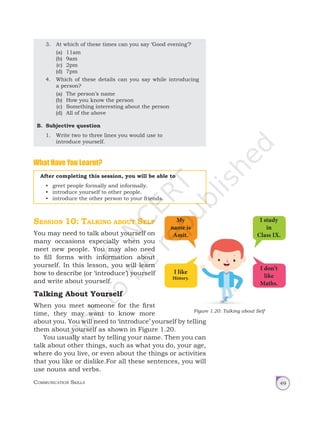
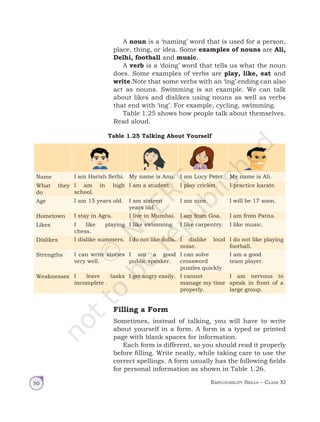
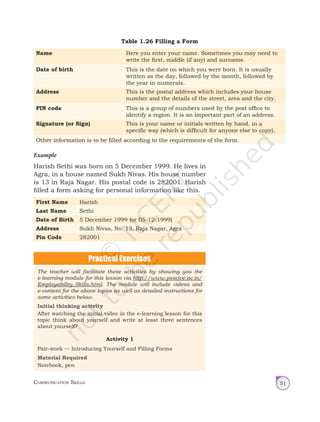
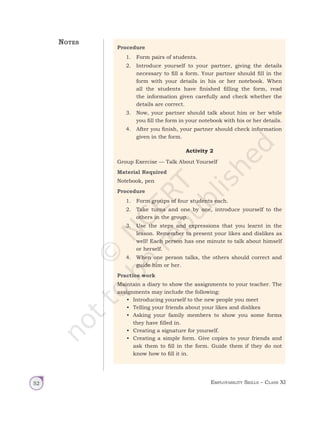
You probably hear people talking about communication
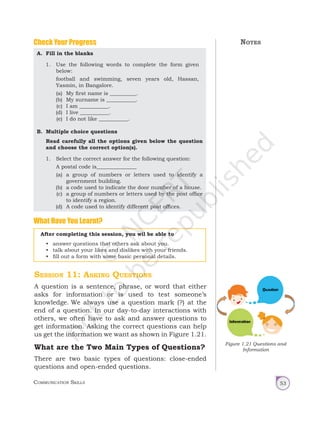
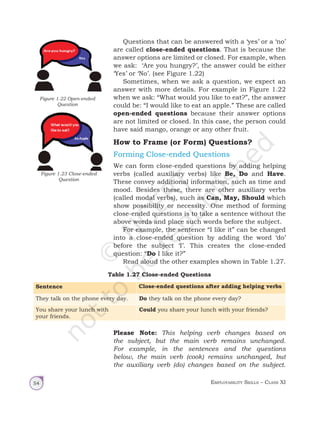
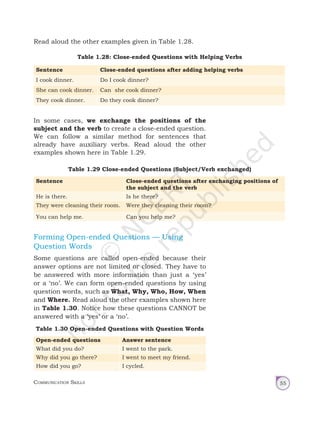
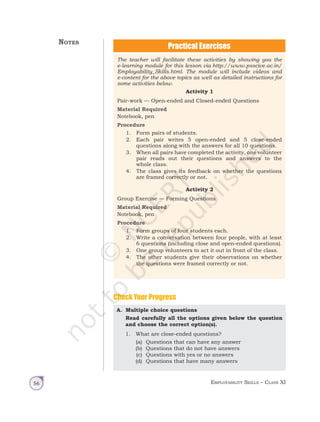
all the time. Everyone needs it and wants it, but what
exactly is communication? Let us try to understand it.
Unit
Unit
Communication
Skills
1
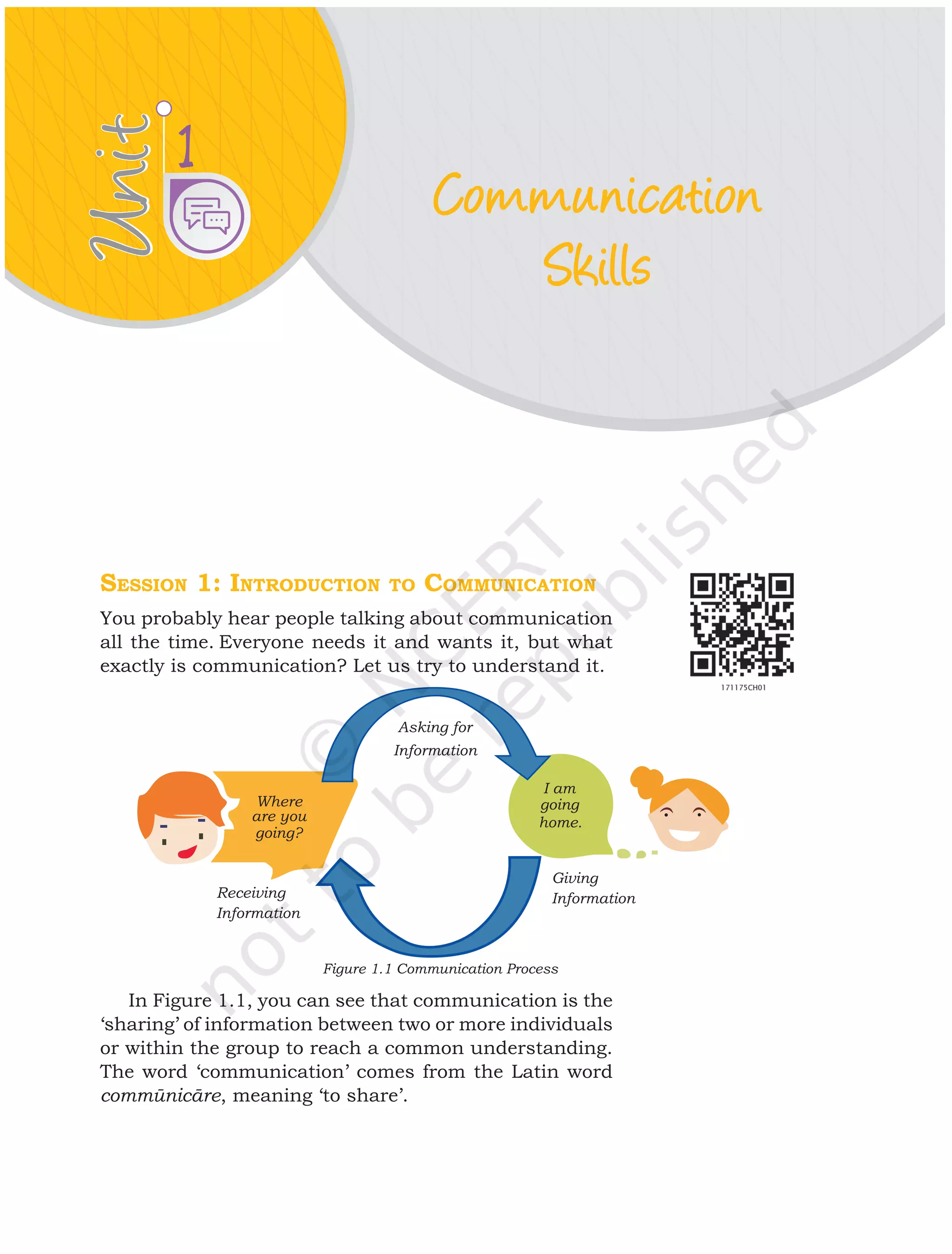
Figure 1.1 Communication Process
In Figure 1.1, you can see that communication is the
‘sharing’ of information between two or more individuals
or within the group to reach a common understanding.
The word ‘communication’ comes from the Latin word
commūnicāre, meaning ‘to share’.
Employability Skills – Class XI
2
Importance of Communication
Your ability to communicate clearly and share thoughts,
feelings and ideas will help you in all your relations
with other people. As a student, you may study any
language, but it is important that you are able to read,
write, speak and listen well in order to communicate
properly. Speaking more than one language can help
you to communicate well with people around the world.
Learning English can help you to communicate with
people who understand English besides the language
you have been exposed to in your family, for example,
your mother tongue.
Communication skills are needed to
• Inform – for example, communicating the time of a
meeting.
• Influence – for example, negotiating with a
shopkeeper to reduce the price.
• Express feelings – for example, to say or show
that you are excited about your success or about
a given task.
Elements of Communication
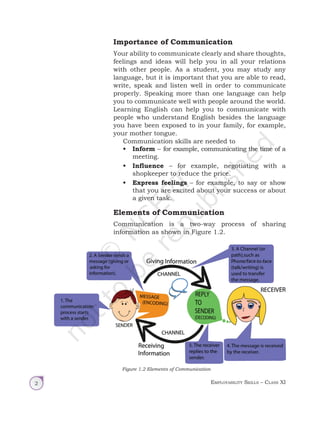
Communication is a two-way process of sharing
information as shown in Figure 1.2.
Figure 1.2 Elements of Communication
Unit 1.indd 2 14-03-2019 10:37:47
Communication Skills 3
As you can see, communication is a two-way
exchange of information, i.e., giving and receiving.
Speaking and writing to someone are examples of
giving information. Reading and listening to someone
are examples of receiving information.
Perspectives in Communication
Perspectives are ideas, views, or fixed ways of thinking.
These sometimes affect our communication. For example,
if you have a fixed idea that your teacher or father is
strict, even when they are being friendly, you may think
they are scolding you. In the same way, others may also
have fixed ideas about you, which affects whatever you
say to them.
Factors Affecting Perspectives in Communication
Sometimes, we are not able to communicate clearly
because of barriers that stop us from sharing and
understanding messages. Some of these are summarised
in Table 1.1.
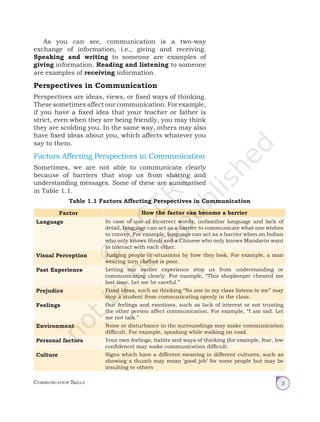
Table 1.1 Factors Affecting Perspectives in Communication
Factor How the factor can become a barrier
Language In case of use of incorrect words, unfamiliar language and lack of
detail, language can act as a barrier to communicate what one wishes
to convey. For example, language can act as a barrier when an Indian
who only knows Hindi and a Chinese who only knows Mandarin want
to interact with each other.
Visual Perception Judging people or situations by how they look. For example, a man
wearing torn clothes is poor.
Past Experience Letting our earlier experience stop us from understanding or
communicating clearly. For example, “This shopkeeper cheated me
last time. Let me be careful.”
Prejudice Fixed ideas, such as thinking “No one in my class listens to me” may
stop a student from communicating openly in the class.
Feelings Our feelings and emotions, such as lack of interest or not trusting
the other person affect communication. For example, “I am sad. Let
me not talk.”
Environment Noise or disturbance in the surroundings may make communication
difficult. For example, speaking while walking on road.
Personal factors Your own feelings, habits and ways of thinking (for example, fear, low
confidence) may make communication difficult.
Culture Signs which have a different meaning in different cultures, such as
showing a thumb may mean ‘good job’ for some people but may be
insulting to others
Unit 1.indd 3 14-03-2019 10:37:47
Employability Skills – Class XI
4
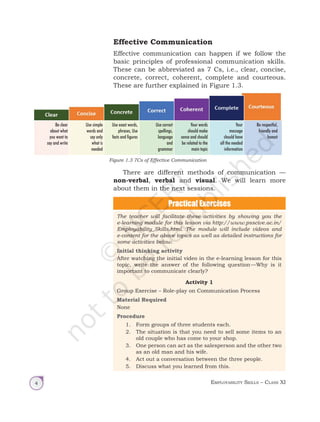
Figure 1.3 7Cs of Effective Communication
Effective Communication
Effective communication can happen if we follow the
basic principles of professional communication skills.
These can be abbreviated as 7 Cs, i.e., clear, concise,
concrete, correct, coherent, complete and courteous.
These are further explained in Figure 1.3.
There are different methods of communication —
non-verbal, verbal and visual. We will learn more
about them in the next sessions.
The teacher will facilitate these activities by showing you the
e-learning module for this lesson via http://www.psscive.ac.in/
Employability_Skills.html. The module will include videos and
e-content for the above topics as well as detailed instructions for
some activities below.
Initial thinking activity
After watching the initial video in the e-learning lesson for this
topic, write the answer of the following question—Why is it
important to communicate clearly?
Activity 1
Group Exercise – Role-play on Communication Process
Material Required
None
Procedure
1. Form groups of three students each.
2. The situation is that you need to sell some items to an
old couple who has come to your shop.
3. One person can act as the salesperson and the other two
as an old man and his wife.
4. Act out a conversation between the three people.
5. Discuss what you learned from this.
Be clear
about what
you want to
say and write
Use simple
words and
say only
what is
needed
Use exact words,
phrases, Use
facts and figures
Use correct
spellings,
language
and
grammar
Your words
should make
sense and should
be related to the
main topic
Your
message
should have
all the needed
information
Be respectful,
friendly and
honest
Unit 1.indd 4 14-03-2019 10:37:47
Communication Skills 5
Activity 2
Group Exercise — Factors Affecting Perspectives in Communication
Material Required
None
Procedure
1. Form groups of three students each.
2. Each group selects any one of the eight factors (from
Table 1.1) which act as barriers to communication.
3. Discuss how it can affect or become a barrier to good
communication with family, friends, in school or at a
retail store.
4. Each group shares their experiences related to one of the
eight factors which can act as a communication barrier.
Activity 3
Classroom Discussion — on 7Cs of Effective Communication
Material Required
Paper and Pencil
Procedure
Each student writes down examples of the 7Cs of communication
in his or her notebook. For each of the 7 Cs, a student volunteers
to give his or her example of how to communicate well. The
other students (with teacher guidance) say whether it is correct
or wrong.
Activity 4
Assignment — Chart Making on Elements of Communication
Material Required
Chart Paper, Colours and Pencil
Procedure
Make a chart showing the elements of communication in the
communication cycle or communication process (can be done
as homework, if there is less time during the class).
Check Your Progress
A. Multiple choice questions
Read carefully all the options given below the question
and choose the correct option(s).
1. What is the purpose of communication?
(a) Inform (tell someone about something)
(b) Influence (get someone to do something you want)
(c) Share thoughts, ideas, feelings
(d) All of the above
Notes
Unit 1.indd 5 14-03-2019 10:37:47
Employability Skills – Class XI
6
Notes 2. Which of the following method is used to receive
information from the sender?
(a) Listening
(b) Speaking
(c) Telling
(d) Writing
3. By which action can a sender send his or her messages?
(a) Listening
(b) Speaking
(c) Sleeping
(d) None of the above
B. Match the Following
Column A Column B
Communication
Barriers
Examples
1. Language A. Taking an official call on your mobile
where the mobile phone reception is poor
2. Emotional B. Hugging a person in a foreign country
where such an act is rude and disrespectful
3. Environmental C. Talking in Hindi when others know only
German
4. Cultural D. Teacher is too angry and is not willing to
accept any reason from a student who is
late for an examination
C. Subjective question
1. Write down the seven factors affecting perspectives
in communication. Provide examples, explaining how
each factor affects communication.
What Have You Learnt?
After completing this session, you will be able to
• identify the elements of communication.
• draw a communication cycle showing all the elements of
communication.
• identify the factors affecting our perspectives in
communication.
Session 2: Verbal Communication
Verbal communication is the sharing of information
using words. It is what most people use as a method
of communication. We will learn about non-verbal
and visual communication in the next session. Verbal
communication is important because if you do not
Unit 1.indd 6 14-03-2019 10:37:47
Communication Skills 7
use the right words, you will cause confusion and you
will not be able to communicate what you want. The
important forms of verbal communication are given
in Table 1.2.
Table 1.2 Verbal Communication
Type of Verbal
Communication
Examples
Oral or Spoken
Communication:
Communication which
involves talking
Face-to-face conversation: When you can
see the listener.
For example, group discussion, talking to
family members at home, public speeches,
etc.
Talking on a phone: This is for personal
and official communication.
Phone conversations should begin with a
greeting (Hello), talking and listening to
each other. The conversation can end with
a ‘Thank you’ and ‘Bye’.
Classroom teaching, business meeting
and public speeches are other examples
of oral communication, where one person
talks to many others at once.
Written
Communication:
Communication which
involves written or
typed words
Writing on paper: letters, notes, etc.
SMS (Short Message Service): These can
be sent through a phone to a person or
a group.
Using email to share news, thoughts,
documents and files (including photos,
videos, music, etc.). e-mail can be used to
send messages to a person or to a group.
Printed books and newspapers
Unit 1.indd 7 14-03-2019 10:37:48
Employability Skills – Class XI
8
Advantages of Verbal Communication
It is easy and quick. You can say what you want and get
a quick response. It is an easier form of communication
when you have to exchange ideas. You keep changing
your communication as per the other person’s reply.
Disadvantages of Verbal Communication
Since verbal communication depends on words,
sometimes the meanings become confusing and difficult
to understand if the right words are not used.
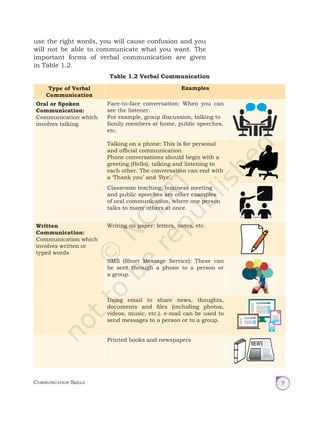
Public Speaking
Speaking in front of a large group makes most people
nervous. You can use the 3Ps (Prepare, Practice,
Perform) method to get over your fears, and become a
confident and effective speaker. These points are shown
in Table 1.3.
The teacher will facilitate these activities by showing you the
e-learning module for this lesson via http://www.psscive.ac.in/
Employability_Skills.html. The module will include videos and
e-content for the above topics as well as detailed instructions for
some activities below.
Initial thinking activity
After watching the video in the e-Learning lesson for this
topic write down why do you think Tina’s directions were not
understood? How would you give directions on the phone?
Table 1.3 3Ps of Public Speaking
3Ps of Public Speaking
Prepare Think about your topic
Think about what your listeners need to know about the topic
Think about the best way to make your listeners understand your topic
Write what you plan to say
Practice Practice by yourself first. Talk in front of a mirror
Talk in front of your family and friends and ask them what they think
Speak clearly, loudly and at the right speed (not very fast nor very slow)
Perform Take a few deep breaths if you are feeling nervous
Think about what you have prepared and start speaking confidently
Unit 1.indd 8 14-03-2019 10:37:48
Communication Skills 9
Activity 1
Group Exercise — Role-play of a Phone Conversation
Material Required
Notebook, pen
Procedure
1. Form groups with three students in each group. Write
a phone conversation based on a scene given by your
teacher. Use proper sentences.
2. One student acts as caller and the other as receiver.
Speak out the conversation aloud. The third student
gives feedback. The students give feedback based on the
7 Cs of communication.
Activity 2
Group Exercise — Public Speaking
Material Required
Notebook, pen
Procedure
1. Choose a topic for a very short speech.
2. Write your thoughts on the topic in paragraphs.
3. Students to volunteer and give speech in front of the class.
4. Students listening to the speech will have to give
suggestions to improve the delivery of speech.
A. Multiple choice questions
Read carefully all the options given below the question
and choose the correct option(s).
1. Choose the correct example of oral communication.
(a) Reports
(b) Newspapers
(c) Face-to-face interaction
(d) Notes
2. What are the words we should use when we
communicate verbally?
(a) Use straight words
(b) Use simple words
(c) Use precise words
(d) Use fixed words
3. Why do we send emails?
(a) To communicate information
(b) To share documents and files
(c) To talk to each other
(d) Both (a) and (b)
B. Subjective question
1. Write down the different types of verbal communication
with examples of each.
Check Your Progress
Notes
Unit 1.indd 9 14-03-2019 10:37:48
Employability Skills – Class XI
10
After completing this session, you will be able to
• explain what the verbal method of communication is.
• list the different types of verbal communication.
• list the 7Cs of communication.
• speak confidently in public using the 7Cs
of communication.
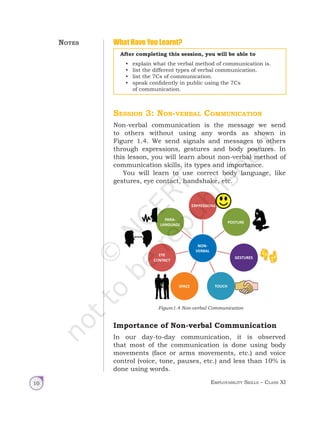
Figure1.4 Non-verbal Communication
PARA-
LANGUAGE
EXPRESSIONS
POSTURE
EYE
CONTACT
GESTURES
SPACE TOUCH
NON-
VERBAL
Notes What Have You Learnt?
Session 3: Non-verbal Communication
Non-verbal communication is the message we send
to others without using any words as shown in
Figure 1.4. We send signals and messages to others
through expressions, gestures and body postures. In
this lesson, you will learn about non-verbal method of
communication skills, its types and importance.
You will learn to use correct body language, like
gestures, eye contact, handshake, etc.
Importance of Non-verbal Communication
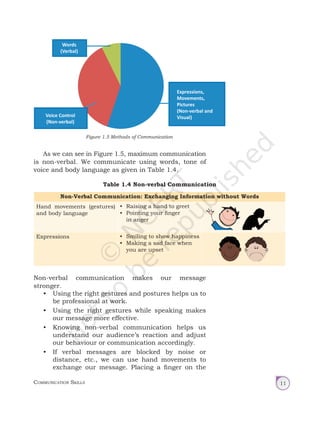
In our day-to-day communication, it is observed
that most of the communication is done using body
movements (face or arms movements, etc.) and voice
control (voice, tone, pauses, etc.) and less than 10% is
done using words.
Unit 1.indd 10 14-03-2019 10:37:49
Communication Skills 11
Voice Control
(Non-verbal)
Expressions,
Movements,
Pictures
(Non-verbal and
Visual)
Words
(Verbal)
Figure 1.5 Methods of Communication
As we can see in Figure 1.5, maximum communication
is non-verbal. We communicate using words, tone of
voice and body language as given in Table 1.4.
Table 1.4 Non-verbal Communication
Non-Verbal Communication: Exchanging Information without Words
Hand movements (gestures)
and body language
• Raising a hand to greet
• Pointing your finger
in anger
Expressions • Smiling to show happiness
• Making a sad face when
you are upset
Non-verbal communication makes our message
stronger.
• Using the right gestures and postures helps us to
be professional at work.
• Using the right gestures while speaking makes
our message more effective.
• Knowing non-verbal communication helps us
understand our audience’s reaction and adjust
our behaviour or communication accordingly.
• If verbal messages are blocked by noise or
distance, etc., we can use hand movements to
exchange our message. Placing a finger on the
Unit 1.indd 11 14-03-2019 10:37:49
Employability Skills – Class XI
12
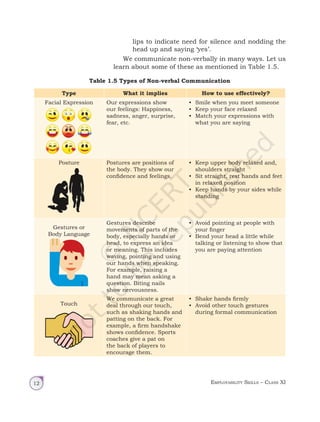
Table 1.5 Types of Non-verbal Communication
Type What it implies How to use effectively?
Facial Expression Our expressions show
our feelings: Happiness,
sadness, anger, surprise,
fear, etc.
• Smile when you meet someone
• Keep your face relaxed
• Match your expressions with
what you are saying
Posture Postures are positions of
the body. They show our
confidence and feelings.
• Keep upper body relaxed and,
shoulders straight
• Sit straight, rest hands and feet
in relaxed position
• Keep hands by your sides while
standing
Gestures or
Body Language
Gestures describe
movements of parts of the
body, especially hands or
head, to express an idea
or meaning. This includes
waving, pointing and using
our hands when speaking.
For example, raising a
hand may mean asking a
question. Biting nails
show nervousness.
• Avoid pointing at people with
your finger
• Bend your head a little while
talking or listening to show that
you are paying attention
Touch
We communicate a great
deal through our touch,
such as shaking hands and
patting on the back. For
example, a firm handshake
shows confidence. Sports
coaches give a pat on
the back of players to
encourage them.
• Shake hands firmly
• Avoid other touch gestures
during formal communication
lips to indicate need for silence and nodding the
head up and saying ‘yes’.
We communicate non-verbally in many ways. Let us
learn about some of these as mentioned in Table 1.5.
Unit 1.indd 12 14-03-2019 10:37:49
Communication Skills 13
Space Space is the physical
distance maintained
between two people. It
is important to maintain
a proper distance when
speaking with someone.
• Maintain proper space
depending on the relationship,
which could be formal or
informal as the closeness with
the person with whom you are
talking.
Eye Contact
The way we look at someone
can communicate things,
such as interest or anger.
Eye contact is when two
people are looking directly
into one another’s eyes. It
shows that we are paying
attention to the person.
Looking away can make the
other person feel ignored.
• Look at the person who is
speaking
• Keep a relaxed, pleasant look.
• Break the look every few
seconds
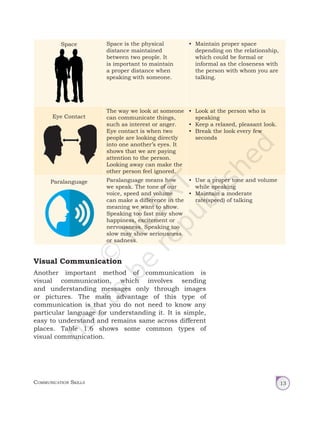
Paralanguage Paralanguage means how
we speak. The tone of our
voice, speed and volume
can make a difference in the
meaning we want to show.
Speaking too fast may show
happiness, excitement or
nervousness. Speaking too
slow may show seriousness
or sadness.
• Use a proper tone and volume
while speaking
• Maintain a moderate
rate(speed) of talking
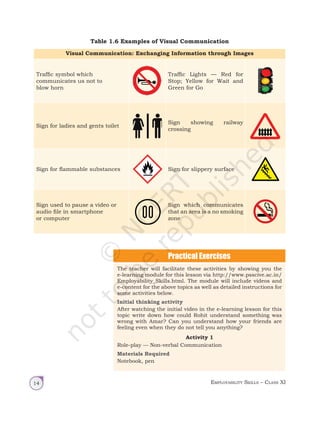
Visual Communication
Another important method of communication is
visual communication, which involves sending
and understanding messages only through images
or pictures. The main advantage of this type of
communication is that you do not need to know any
particular language for understanding it. It is simple,
easy to understand and remains same across different
places. Table 1.6 shows some common types of
visual communication.
Unit 1.indd 13 14-03-2019 10:37:49
Employability Skills – Class XI
14
The teacher will facilitate these activities by showing you the
e-learning module for this lesson via http://www.psscive.ac.in/
Employability_Skills.html. The module will include videos and
e-content for the above topics as well as detailed instructions for
some activities below.
Initial thinking activity
After watching the initial video in the e-learning lesson for this
topic write down how could Rohit understand something was
wrong with Amar? Can you understand how your friends are
feeling even when they do not tell you anything?
Activity 1
Role-play — Non-verbal Communication
Materials Required
Notebook, pen
Table 1.6 Examples of Visual Communication
Visual Communication: Exchanging Information through Images
Traffic symbol which
communicates us not to
blow horn
Traffic Lights — Red for
Stop; Yellow for Wait and
Green for Go
Sign for ladies and gents toilet
Sign showing railway
crossing
Sign for flammable substances Sign for slippery surface
Sign used to pause a video or
audio file in smartphone
or computer
Sign which communicates
that an area is a no smoking
zone
Unit 1.indd 14 14-03-2019 10:37:49
Communication Skills 15
Procedure
1. Form groups of three students each.
2. Prepare the script for the role-play, based on the scenario
given by your teacher.
3. Act it out in front of your group.
4. One of the groups volunteers to act before the whole class.
5. Discuss how students used non-verbal communication.
Activity 2
Group Exercise — Dos and Don’ts to Avoid Body Language
Mistakes
Material Required
Notebook, pen
Procedure
1. With the same group of three students as in Activity 1,
discuss what things you should do and what you should
not do to avoid mistakes in communication.
2. Every student should write down a list of these Dos
and Don’ts.
Activity 3
Group Exercise — Comparing Methods of Communication
Materials Required
Notebook, pen
Procedure
1. In the same group of three students as in Activity 2,
discuss the three methods of communication (Verbal,
Non-verbal and Visual).
2. Identify the different types of non-verbal gestures used
in communication by the teacher and students (e.g.
looking away while talking to others, tieing shoe laces
while talking to a friend, etc.)
Check Your Progress
A. Multiple choice questions
Read carefully all the options given below the question
and choose the correct option(s).
1. Which of these is a positive (good) facial expression?
(a) Staring hard
(b) Nodding while listening
(c) Wrinkled forehead
(d) Looking away from the speaker
Notes
Unit 1.indd 15 14-03-2019 10:37:50
Employability Skills – Class XI
16
2. What does an upright (straight) body posture convey or
show?
(a) Shyness
(b) Fear
(c) Confidence
(d) Intelligence
3. Which of these is not an appropriate non-verbal
communication at work?
(a) Putting arm around a coworker’s shoulder
(b) Shaking hands firmly
(c) Looking at the speaker with a smile
(d) Standing with an upright posture
4. When you are preparing for a presentation, you should
(a) focus on the message
(b) practice hand gestures
(c) try different speaking techniques
(d) All of the above
B. Now let’s have a recap of what you have understood by
non-verbal communication. Put a X mark against the
actions below which are bad for non-verbal communication
• Laughing during formal communication
• Scratching head
• Smiling while speaking to a friend
• Nodding when you agree with something.
• Standing straight
• Yawning while listening
• Sitting straight
• Maintaining eye contact while speaking
• Biting nails
• Firm handshake
• Clenching jaws
• Looking away when someone is speaking to you
• Intense stare
C. Subjective question
1. Draw any two common signs used for
visual communication.
After completing this session, you will be able to
• explain the importance of non-verbal and visual communication.
• identify different types of non-verbal communication.
• use the right non-verbal communication at work.
• avoid common mistakes in non-verbal communication.
What Have You Learnt?
Notes
Unit 1.indd 16 14-03-2019 10:37:50
Communication Skills 17
Session 4: Pronunciation Basics
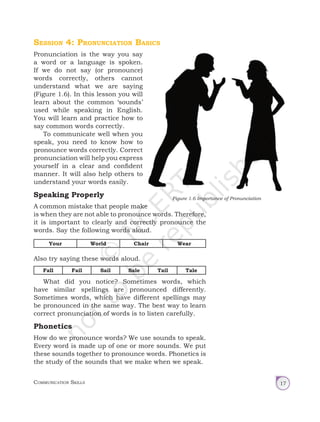
Pronunciation is the way you say
a word or a language is spoken.
If we do not say (or pronounce)
words correctly, others cannot
understand what we are saying
(Figure 1.6). In this lesson you will
learn about the common ‘sounds’
used while speaking in English.
You will learn and practice how to
say common words correctly.
To communicate well when you
speak, you need to know how to
pronounce words correctly. Correct
pronunciation will help you express
yourself in a clear and confident
manner. It will also help others to
understand your words easily.
Speaking Properly
A common mistake that people make
is when they are not able to pronounce words. Therefore,
it is important to clearly and correctly pronounce the
words. Say the following words aloud.
Your World Chair Wear
Also try saying these words aloud.
Fall Fail Sail Sale Tail Tale
What did you notice? Sometimes words, which
have similar spellings are pronounced differently.
Sometimes words, which have different spellings may
be pronounced in the same way. The best way to learn
correct pronunciation of words is to listen carefully.
Phonetics
How do we pronounce words? We use sounds to speak.
Every word is made up of one or more sounds. We put
these sounds together to pronounce words. Phonetics is
the study of the sounds that we make when we speak.
Figure 1.6 Importance of Pronunciation
Unit 1.indd 17 01-04-2019 16:39:14
Employability Skills – Class XI
18
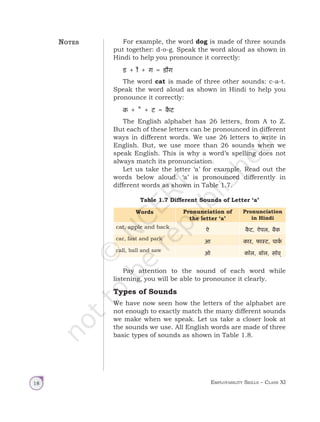
For example, the word dog is made of three sounds
put together: d-o-g. Speak the word aloud as shown in
Hindi to help you pronounce it correctly:
ड + ौ + ग = डौग
The word cat is made of three other sounds: c-a-t.
Speak the word aloud as shown in Hindi to help you
pronounce it correctly:
क + ै + ट = क
ै ट
The English alphabet has 26 letters, from A to Z.
But each of these letters can be pronounced in different
ways in different words. We use 26 letters to write in
English. But, we use more than 26 sounds when we
speak English. This is why a word’s spelling does not
always match its pronunciation.
Let us take the letter ‘a’ for example. Read out the
words below aloud. ‘a’ is pronounced differently in
different words as shown in Table 1.7.
Table 1.7 Different Sounds of Letter ‘a’
Words Pronunciation of
the letter ‘a’
Pronunciation
in Hindi
cat, apple and back
ऐ क
ै ट, ऐपल, बैक
car, fast and park
आ कार, फास्‍ट, पार
्क
call, ball and saw
ऑ कॉल, बॉल, सॉव ्
Pay attention to the sound of each word while
listening, you will be able to pronounce it clearly.
Types of Sounds
We have now seen how the letters of the alphabet are
not enough to exactly match the many different sounds
we make when we speak. Let us take a closer look at
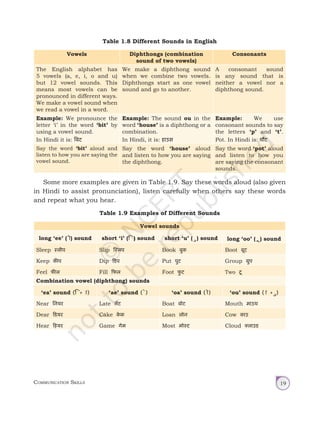
the sounds we use. All English words are made of three
basic types of sounds as shown in Table 1.8.
Notes
Unit 1.indd 18 14-03-2019 10:37:50
Communication Skills 19
Table 1.8 Different Sounds in English
Vowels Diphthongs (combination
sound of two vowels)
Consonants
The English alphabet has
5 vowels (a, e, i, o and u)
but 12 vowel sounds. This
means most vowels can be
pronounced in different ways.
We make a vowel sound when
we read a vowel in a word.
We make a diphthong sound
when we combine two vowels.
Diphthongs start as one vowel
sound and go to another.
A consonant sound
is any sound that is
neither a vowel nor a
diphthong sound.
Example: We pronounce the
letter ‘i’ in the word ‘bit’ by
using a vowel sound.
In Hindi it is: बिट
Example: The sound ou in the
word ‘house’ is a diphthong or a
combination.
In Hindi, it is: हाउस
Example: We use
consonant sounds to say
the letters ‘p’ and ‘t’.
Pot. In Hindi is: पौट
Say the word ‘bit’ aloud and
listen to how you are saying the
vowel sound.
Say the word ‘house’ aloud
and listen to how you are saying
the diphthong.
Say the word ‘pot’ aloud
and listen to how you
are saying the consonant
sounds.
Some more examples are given in Table 1.9. Say these words aloud (also given
in Hindi to assist pronunciation), listen carefully when others say these words
and repeat what you hear.
Table 1.9 Examples of Different Sounds
Vowel sounds
long ‘ee’ ( ी) sound short ‘i’ (ि ‍
) sound short ‘u’ ( ु) sound long ‘oo’ ( ू ) sound
Sleep स्लीप Slip स्लिप Book बुक‍ Boot बूट‍
Keep कीप Dip डिप Put पुट Group ‍
ग्रुप
Feel फील Fill फिल Foot फ
ु ट Two टू‍
Combination vowel (diphthong) sounds
‘ea’ sound (ि + ा) ‘ae’ sound ( े) ‘oa’ sound ( ो) ‘ou’ sound ( ा + ु)
Near नियर Late लेट Boat बोट Mouth माउथ
Dear डियर Cake क
े क Loan लोन Cow काउ
Hear हियर Game गेम Most मोस्‍ट Cloud क्‍लाउड
Unit 1.indd 19 14-03-2019 10:37:50
Employability Skills – Class XI
20
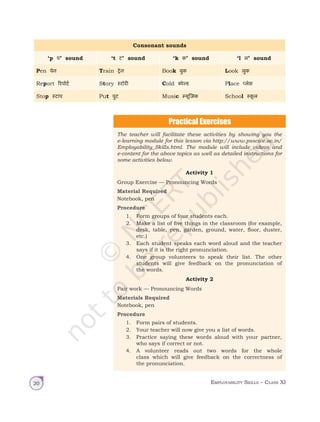
Consonant sounds
‘p प’ sound ‘t ट’ sound ‘k क’ sound ‘l ल’ sound
Pen पेन Train ट्रेन Book बुक Look लुक
Report रिपोर्ट Story स्‍टोरी Cold काेल्‍ड Place प्‍लेस
Stop स्टाप Put पुट Music म्यूजिक School स्‍क‍
ू ल
The teacher will facilitate these activities by showing you the
e-learning module for this lesson via http://www.psscive.ac.in/
Employability_Skills.html. The module will include videos and
e-content for the above topics as well as detailed instructions for
some activities below.
Activity 1
Group Exercise — Pronouncing Words
Material Required
Notebook, pen
Procedure
1. Form groups of four students each.
2. Make a list of five things in the classroom (for example,
desk, table, pen, garden, ground, water, floor, duster,
etc.)
3. Each student speaks each word aloud and the teacher
says if it is the right pronunciation.
4. One group volunteers to speak their list. The other
students will give feedback on the pronunciation of
the words.
Activity 2
Pair work — Pronouncing Words
Materials Required
Notebook, pen
Procedure
1. Form pairs of students.
2. Your teacher will now give you a list of words.
3. Practice saying these words aloud with your partner,
who says if correct or not.
4. A volunteer reads out two words for the whole
class which will give feedback on the correctness of
the pronunciation.
Unit 1.indd 20 14-03-2019 10:37:50
Communication Skills 21
Check Your Progress
A. Multiple choice questions
Read carefully all the options given below the question
and choose the correct option(s).
1. What is phonetics?
(a) It is the study of how we write words in English.
(b) It is the study of how people understand sentences.
(c) It is the study of how many words the English
language has.
(d) It is the study of the sounds we make when we speak.
2. What are the different types of sounds we use in
English pronunciation?
(a) Vowel sounds
(b) Diphthong sounds
(c) Consonant sounds
(d) All of the above
What Have You Learnt?
After completing this session, you will be able to
• explain the meaning of Phonetics.
• differentiate between Vowel, Diphthong and Consonant.
• pronounce simple words properly.
Session 5: Communication Styles —
Assertiveness
You have learnt about the different types of
communication. In this lesson we will learn about
a new concept ‘communication styles’. A ‘style’ of
communication includes verbal and non-verbal skills.
Using the correct style of communication makes your
communication more effective as others will be able to
clearly understand what you say and respond to you in
a better way.
Important Communication Styles
Have you ever wondered why you feel good after some
conversations but some conversations make you feel
angry? This may be due to the different communication
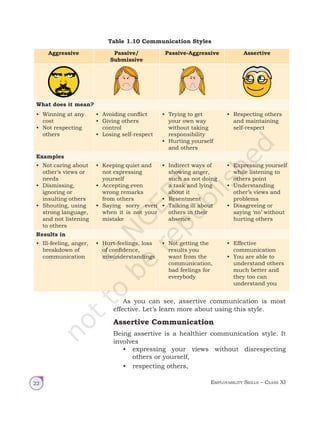
styles used. Table 1.10 shows some of the most
commonly used communication styles.
Notes
Unit 1.indd 21 14-03-2019 10:37:50
Employability Skills – Class XI
22
Table 1.10 Communication Styles
Aggressive Passive/
Submissive
Passive-Aggressive Assertive
What does it mean?
• Winning at any
cost
• Not respecting
others
• Avoiding conflict
• Giving others
control
• Losing self-respect
• Trying to get
your own way
without taking
responsibility
• Hurting yourself
and others
• Respecting others
and maintaining
self-respect
Examples
• Not caring about
other’s views or
needs
• Dismissing,
ignoring or
insulting others
• Shouting, using
strong language,
and not listening
to others
• Keeping quiet and
not expressing
yourself
• Accepting even
wrong remarks
from others
• Saying sorry even
when it is not your
mistake
• Indirect ways of
showing anger,
such as not doing
a task and lying
about it
• Resentment
• Talking ill about
others in their
absence
• Expressing yourself
while listening to
others point
• Understanding
other’s views and
problems
• Disagreeing or
saying ‘no’ without
hurting others
Results in
• Ill-feeling, anger,
breakdown of
communication
• Hurt-feelings, loss
of confidence,
misunderstandings
• Not getting the
results you
want from the
communication,
bad feelings for
everybody
• Effective
communication
• You are able to
understand others
much better and
they too can
understand you
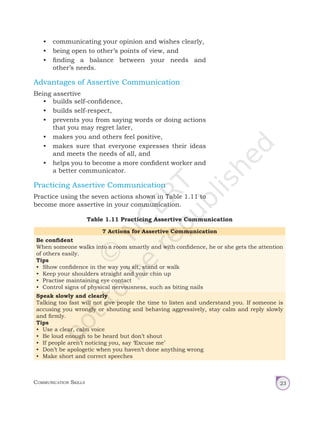
As you can see, assertive communication is most
effective. Let’s learn more about using this style.
Assertive Communication
Being assertive is a healthier communication style. It
involves
• expressing your views without disrespecting
others or yourself,
• respecting others,
Unit 1.indd 22 14-03-2019 10:37:50
Communication Skills 23
• communicating your opinion and wishes clearly,
• being open to other’s points of view, and
• finding a balance between your needs and
other’s needs.
Advantages of Assertive Communication
Being assertive
• builds self-confidence,
• builds self-respect,
• prevents you from saying words or doing actions
that you may regret later,
• makes you and others feel positive,
• makes sure that everyone expresses their ideas
and meets the needs of all, and
• helps you to become a more confident worker and
a better communicator.
Practicing Assertive Communication
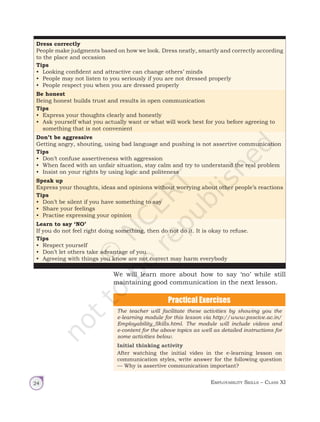
Practice using the seven actions shown in Table 1.11 to
become more assertive in your communication.
Table 1.11 Practicing Assertive Communication
7 Actions for Assertive Communication
Be confident
When someone walks into a room smartly and with confidence, he or she gets the attention
of others easily.
Tips
• Show confidence in the way you sit, stand or walk
• Keep your shoulders straight and your chin up
• Practise maintaining eye contact
• Control signs of physical nervousness, such as biting nails
Speak slowly and clearly
Talking too fast will not give people the time to listen and understand you. If someone is
accusing you wrongly or shouting and behaving aggressively, stay calm and reply slowly
and firmly.
Tips
• Use a clear, calm voice
• Be loud enough to be heard but don’t shout
• If people aren’t noticing you, say ‘Excuse me’
• Don’t be apologetic when you haven’t done anything wrong
• Make short and correct speeches
Unit 1.indd 23 14-03-2019 10:37:50
Employability Skills – Class XI
24
Dress correctly
People make judgments based on how we look. Dress neatly, smartly and correctly according
to the place and occasion
Tips
• Looking confident and attractive can change others’ minds
• People may not listen to you seriously if you are not dressed properly
• People respect you when you are dressed properly
Be honest
Being honest builds trust and results in open communication
Tips
• Express your thoughts clearly and honestly
• Ask yourself what you actually want or what will work best for you before agreeing to
something that is not convenient
Don’t be aggressive
Getting angry, shouting, using bad language and pushing is not assertive communication
Tips
• Don’t confuse assertiveness with aggression
• When faced with an unfair situation, stay calm and try to understand the real problem
• Insist on your rights by using logic and politeness
Speak up
Express your thoughts, ideas and opinions without worrying about other people’s reactions
Tips
• Don’t be silent if you have something to say
• Share your feelings
• Practise expressing your opinion
Learn to say ‘NO’
If you do not feel right doing something, then do not do it. It is okay to refuse.
Tips
• Respect yourself
• Don’t let others take advantage of you
• Agreeing with things you know are not correct may harm everybody
We will learn more about how to say ‘no’ while still
maintaining good communication in the next lesson.
The teacher will facilitate these activities by showing you the
e-learning module for this lesson via http://www.psscive.ac.in/
Employability_Skills.html. The module will include videos and
e-content for the above topics as well as detailed instructions for
some activities below.
Initial thinking activity
After watching the initial video in the e-learning lesson on
communication styles, write answer for the following question
— Why is assertive communication important?
Unit 1.indd 24 14-03-2019 10:37:50
Communication Skills 25
Notes
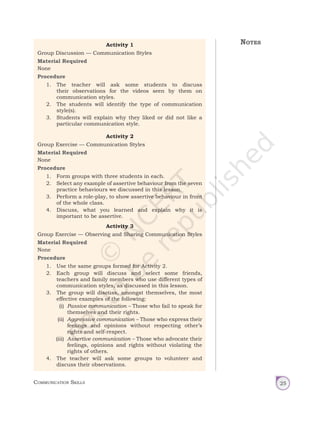
Activity 1
Group Discussion — Communication Styles
Material Required
None
Procedure
1. The teacher will ask some students to discuss
their observations for the videos seen by them on
communication styles.
2. The students will identify the type of communication
style(s).
3. Students will explain why they liked or did not like a
particular communication style.
Activity 2
Group Exercise — Communication Styles
Material Required
None
Procedure
1. Form groups with three students in each.
2. Select any example of assertive behaviour from the seven
practice behaviours we discussed in this lesson.
3. Perform a role-play, to show assertive behaviour in front
of the whole class.
4. Discuss, what you learned and explain why it is
important to be assertive.
Activity 3
Group Exercise — Observing and Sharing Communication Styles
Material Required
None
Procedure
1. Use the same groups formed for Activity 2.
2. Each group will discuss and select some friends,
teachers and family members who use different types of
communication styles, as discussed in this lesson.
3. The group will discuss, amongst themselves, the most
effective examples of the following:
(i) Passive communication – Those who fail to speak for
themselves and their rights.
(ii) Aggressive communication – Those who express their
feelings and opinions without respecting other’s
rights and self-respect.
(iii) Assertive communication – Those who advocate their
feelings, opinions and rights without violating the
rights of others.
4. The teacher will ask some groups to volunteer and
discuss their observations.
Unit 1.indd 25 14-03-2019 10:37:50
Employability Skills – Class XI
26
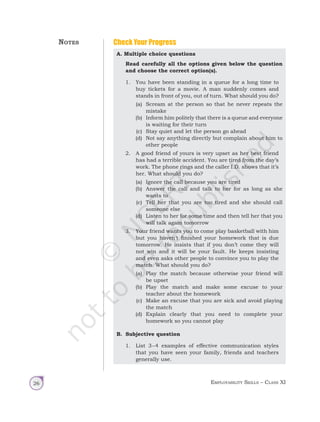
A. Multiple choice questions
Read carefully all the options given below the question
and choose the correct option(s).
1. You have been standing in a queue for a long time to
buy tickets for a movie. A man suddenly comes and
stands in front of you, out of turn. What should you do?
(a) Scream at the person so that he never repeats the
mistake
(b) Inform him politely that there is a queue and everyone
is waiting for their turn
(c) Stay quiet and let the person go ahead
(d) Not say anything directly but complain about him to
other people
2. A good friend of yours is very upset as her best friend
has had a terrible accident. You are tired from the day’s
work. The phone rings and the caller I.D. shows that it’s
her. What should you do?
(a) Ignore the call because you are tired
(b) Answer the call and talk to her for as long as she
wants to
(c) Tell her that you are too tired and she should call
someone else
(d) Listen to her for some time and then tell her that you
will talk again tomorrow
3. Your friend wants you to come play basketball with him
but you haven’t finished your homework that is due
tomorrow. He insists that if you don’t come they will
not win and it will be your fault. He keeps insisting
and even asks other people to convince you to play the
match. What should you do?
(a) Play the match because otherwise your friend will
be upset
(b) Play the match and make some excuse to your
teacher about the homework
(c) Make an excuse that you are sick and avoid playing
the match
(d) Explain clearly that you need to complete your
homework so you cannot play
B. Subjective question
1. List 3–4 examples of effective communication styles
that you have seen your family, friends and teachers
generally use.
Check Your Progress
Notes
Unit 1.indd 26 14-03-2019 10:37:50
Communication Skills 27
After completing this session, you will be able to
• differentiate between assertive, aggressive, passive-
aggressive and submissive styles of communication.
• give examples of assertive communication.
Session 6: Saying No — Refusal Skills
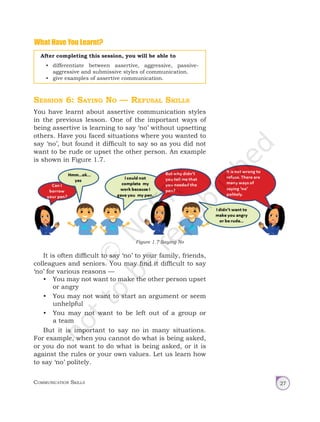
You have learnt about assertive communication styles
in the previous lesson. One of the important ways of
being assertive is learning to say ‘no’ without upsetting
others. Have you faced situations where you wanted to
say ‘no’, but found it difficult to say so as you did not
want to be rude or upset the other person. An example
is shown in Figure 1.7.
What Have You Learnt?
Figure 1.7 Saying No
It is often difficult to say ‘no’ to your family, friends,
colleagues and seniors. You may find it difficult to say
‘no’ for various reasons —
• You may not want to make the other person upset
or angry
• You may not want to start an argument or seem
unhelpful
• You may not want to be left out of a group or
a team
But it is important to say no in many situations.
For example, when you cannot do what is being asked,
or you do not want to do what is being asked, or it is
against the rules or your own values. Let us learn how
to say ‘no’ politely.
Unit 1.indd 27 14-03-2019 10:37:50
Employability Skills – Class XI
28
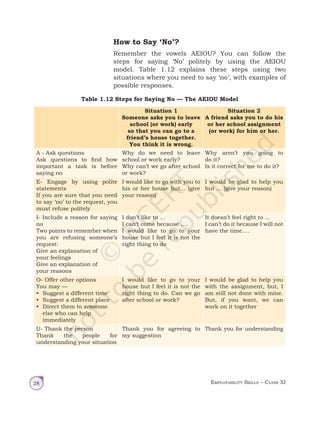
How to Say ‘No’?
Remember the vowels AEIOU? You can follow the
steps for saying ‘No’ politely by using the AEIOU
model. Table 1.12 explains these steps using two
situations where you need to say ‘no’, with examples of
possible responses.
Table 1.12 Steps for Saying No — The AEIOU Model
Situation 1
Someone asks you to leave
school (or work) early
so that you can go to a
friend’s house together.
You think it is wrong.
Situation 2
A friend asks you to do his
or her school assignment
(or work) for him or her.
A - Ask questions
Ask questions to find how
important a task is before
saying no
Why do we need to leave
school or work early?
Why can’t we go after school
or work?
Why aren’t you going to
do it?
Is it correct for me to do it?
E- Engage by using polite
statements
If you are sure that you need
to say ‘no’ to the request, you
must refuse politely
I would like to go with you to
his or her house but… (give
your reason)
I would be glad to help you
but … (give your reason)
I- Include a reason for saying
no
Two points to remember when
you are refusing someone’s
request:
Give an explanation of
your feelings
Give an explanation of
your reasons
I don’t like to ...
I can’t come because ….
I would like to go to your
house but I feel it is not the
right thing to do
It doesn’t feel right to ...
I can’t do it because I will not
have the time….
O- Offer other options
You may —
• Suggest a different time
• Suggest a different place
• Direct them to someone
else who can help
immediately
I would like to go to your
house but I feel it is not the
right thing to do. Can we go
after school or work?
I would be glad to help you
with the assignment, but, I
am still not done with mine.
But, if you want, we can
work on it together
U- Thank the person
Thank the people for
understanding your situation
Thank you for agreeing to
my suggestion
Thank you for understanding
Unit 1.indd 28 14-03-2019 10:37:50
Communication Skills 29
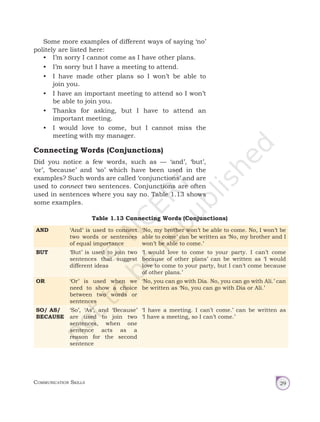
Some more examples of different ways of saying ‘no’
politely are listed here:
• I’m sorry I cannot come as I have other plans.
• I’m sorry but I have a meeting to attend.
• I have made other plans so I won’t be able to
join you.
• I have an important meeting to attend so I won’t
be able to join you.
• Thanks for asking, but I have to attend an
important meeting.
• I would love to come, but I cannot miss the
meeting with my manager.
Connecting Words (Conjunctions)
Did you notice a few words, such as — ‘and’, ‘but’,
‘or’, ‘because’ and ‘so’ which have been used in the
examples? Such words are called ‘conjunctions’ and are
used to connect two sentences. Conjunctions are often
used in sentences where you say no. Table 1.13 shows
some examples.
Table 1.13 Connecting Words (Conjunctions)
AND ‘And’ is used to connect
two words or sentences
of equal importance
‘No, my brother won’t be able to come. No, I won’t be
able to come’ can be written as ‘No, my brother and I
won’t be able to come.’
BUT ‘But’ is used to join two
sentences that suggest
different ideas
‘I would love to come to your party. I can’t come
because of other plans’ can be written as ‘I would
love to come to your party, but I can’t come because
of other plans.’
OR ‘Or’ is used when we
need to show a choice
between two words or
sentences
‘No, you can go with Dia. No, you can go with Ali.’ can
be written as ‘No, you can go with Dia or Ali.’
SO/ AS/
BECAUSE
‘So’, ‘As’, and ‘Because’
are used to join two
sentences, when one
sentence acts as a
reason for the second
sentence
‘I have a meeting. I can’t come.’ can be written as
‘I have a meeting, so I can’t come.’
Unit 1.indd 29 14-03-2019 10:37:50
Employability Skills – Class XI
30
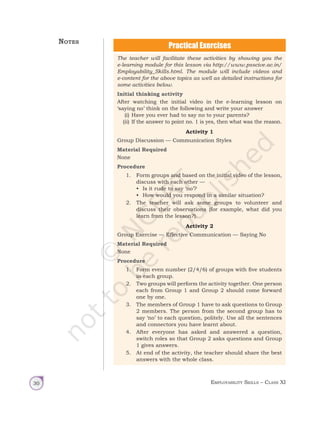
The teacher will facilitate these activities by showing you the
e-learning module for this lesson via http://www.psscive.ac.in/
Employability_Skills.html. The module will include videos and
e-content for the above topics as well as detailed instructions for
some activities below.
Initial thinking activity
After watching the initial video in the e-learning lesson on
‘saying no’ think on the following and write your answer
(i) Have you ever had to say no to your parents?
(ii) If the answer to point no. 1 is yes, then what was the reason.
Activity 1
Group Discussion — Communication Styles
Material Required
None
Procedure
1. Form groups and based on the initial video of the lesson,
discuss with each other —
• Is it rude to say ‘no’?
• How would you respond in a similar situation?
2. The teacher will ask some groups to volunteer and
discuss their observations (for example, what did you
learn from the lesson?).
Activity 2
Group Exercise — Effective Communication — Saying No
Material Required
None
Procedure
1. Form even number (2/4/6) of groups with five students
in each group.
2. Two groups will perform the activity together. One person
each from Group 1 and Group 2 should come forward
one by one.
3. The members of Group 1 have to ask questions to Group
2 members. The person from the second group has to
say ‘no’ to each question, politely. Use all the sentences
and connectors you have learnt about.
4. After everyone has asked and answered a question,
switch roles so that Group 2 asks questions and Group
1 gives answers.
5. At end of the activity, the teacher should share the best
answers with the whole class.
Notes
Unit 1.indd 30 14-03-2019 10:37:51
Communication Skills 31
A. Multiple choice questions
Read carefully all the options given below the question
and choose the correct option(s).
1. One of your friends is taking a leave and wants you to
tell the teacher that he is sick. What should you tell
your friend?
(a) Yes, I can do that.
(b) No, I cannot do that because I don’t want to lie to the
teacher.
(c) I understand that you want to take leave but why
don’t you tell the correct reason?
(d) No. I cannot help you.
2. Select the option which completes the sentence
correctly — I have to go to the doctor____ I will not be
coming to school on Monday.
(a) and
(b) but
(c) so
(d) because
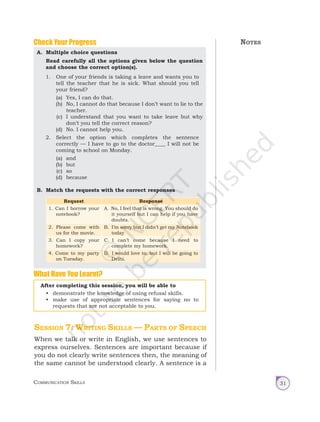
B. Match the requests with the correct responses
Request Response
1. Can I borrow your
notebook?
A. No, I feel that is wrong. You should do
it yourself but I can help if you have
doubts.
2. Please come with
us for the movie.
B. I’m sorry but I didn’t get my Notebook
today
3. Can I copy your
homework?
C. I can’t come because I need to
complete my homework.
4. Come to my party
on Tuesday.
D. I would love to, but I will be going to
Delhi.
Notes
Check Your Progress
What Have You Learnt?
After completing this session, you will be able to
• demonstrate the knowledge of using refusal skills.
• make use of appropriate sentences for saying no to
requests that are not acceptable to you.
Session 7: Writing Skills — Parts of Speech
When we talk or write in English, we use sentences to
express ourselves. Sentences are important because if
you do not clearly write sentences then, the meaning of
the same cannot be understood clearly. A sentence is a
Unit 1.indd 31 14-03-2019 10:37:51
Employability Skills – Class XI
32
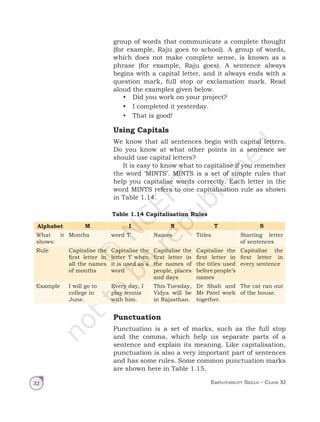
Table 1.14 Capitalisation Rules
Alphabet M I N T S
What it
shows:
Months word ‘I’ Names Titles Starting letter
of sentences
Rule Capitalise the
first letter in
all the names
of months
Capitalise the
letter ‘I’ when
it is used as a
word
Capitalise the
first letter in
the names of
people, places
and days
Capitalise the
first letter in
the titles used
before people’s
names
Capitalise the
first letter in
every sentence
Example I will go to
college in
June.
Every day, I
play tennis
with him.
This Tuesday,
Vidya will be
in Rajasthan.
Dr Shah and
Mr Patel work
together.
The cat ran out
of the house.
group of words that communicate a complete thought
(for example, Raju goes to school). A group of words,
which does not make complete sense, is known as a
phrase (for example, Raju goes). A sentence always
begins with a capital letter, and it always ends with a
question mark, full stop or exclamation mark. Read
aloud the examples given below.
• Did you work on your project?
• I completed it yesterday.
• That is good!
Using Capitals
We know that all sentences begin with capital letters.
Do you know at what other points in a sentence we
should use capital letters?
It is easy to know what to capitalise if you remember
the word ‘MINTS’. MINTS is a set of simple rules that
help you capitalise words correctly. Each letter in the
word MINTS refers to one capitalisation rule as shown
in Table 1.14.
Punctuation
Punctuation is a set of marks, such as the full stop
and the comma, which help us separate parts of a
sentence and explain its meaning. Like capitalisation,
punctuation is also a very important part of sentences
and has some rules. Some common punctuation marks
are shown here in Table 1.15.
Unit 1.indd 32 14-03-2019 10:37:51
Communication Skills 33
Table 1.15 Punctuation
Punctuation
name
Sign Use Example
Full stop . Shows the end of a sentence. Also
used to show short form of long
words, for example, ‘doctor’ can be
shortened when we use it as a title
before a name.
This is a sentence. This is
another sentence.
Sanjay is a doctor. His
patients call him Dr Sanjay.
Comma , • Sometimes, we use a comma to
indicate a pause in the sentence.
After the waiter gave me a
menu card, I ordered food.
• We can also use a comma to
separate items when we are listing
out more than two items in a row.
I bought apples, oranges and
grapes.
Question
mark
? We use a question mark at the end of
a question.
What is your name?
How old are you?
Exclamation
mark
! We use an exclamation mark at the
end of a word or a sentence to indicate
a strong feeling, such as surprise,
shock or anger.
What a pleasant surprise!
You are late!
Apostrophe (‘) We use an apostrophe followed by an
‘s’ to show that something belongs to
someone.
That is Divya’s pen.
Are these Abdul’s books?
We also use an apostrophe to indicate
the shortened form of some words in
informal speech.
Let’s go. (Instead of Let us go.)
He isn’t here. (Instead of He is
not here.)
Nouns
Verbs
Pronouns
Adverbs
Adjectives
Figure 1.8 Parts of Speech
Basic Parts of Speech
Unit 1.indd 33 14-03-2019 10:37:51
Employability Skills – Class XI
34
Let us now see how these words are used. Read aloud
the sentence given below.
Wow! Reema went to the studio and met a
famous actor.
We already know that Reema, studio and actor are
nouns. Famous is an adjective here because it describes
the noun ‘actor’ and the words ‘went’ and ‘met’ are verbs
because they describe an action.
The different types of words we use in sentences
are called parts of speech. Some examples are nouns,
pronouns, adjectives, verbs and adverbs as shown in
Figure 1.8. Let us read more about them in Table 1.16.
Table 1.16 Parts of Speech
Parts of Speech What they do Example sentences Example words
Noun Nouns are words that
refer to a person, place,
thing or idea. These are
‘naming words’
In the sentence,
“Reema wrote a letter.”
both Reema and letter
are nouns.
Dog
Kindness
India
Sanjay
Pronoun A pronoun is a word
used in place of a noun
In the second sentence,
“Reema wrote a letter.
She is tired.” ‘She’ is
used in place of the
noun Reema, and it is
a pronoun
I
They
He
You
Adjectives Adjectives are words that
describe other words
In the sentence:
“Reema wrote a
long letter.” ‘Long’
is an adjective that
describes the noun
‘letter’.
Small
Blue
Sharp
Loud
Verbs Verbs are words that
show action
In the sentence:
“Reema wrote a letter.”
‘Wrote’ is the verb.
It tells what action
Reema did.
Run
Eat
Think
Sit
Adverbs Adverbs are words that
add meaning to verbs,
adjectives, or other
adverbs. They answer
the questions — How?
How often? When? and
Where?
In the sentence:
“Reema quickly wrote
a letter.” ‘Quickly’ is
an adverb. It tells us
how Reema did the
action (writing)
Easily
Always
Inside
Before
Unit 1.indd 34 14-03-2019 10:37:51
Communication Skills 35
What about the remaining words in this sentence:
wow, to, the, and? What are these words called? We
use such supporting words to join the main parts of
speech together and to add information to the sentences
we make. Let us now look at some types of these
supporting words.
Supporting Parts of Speech Types
Along with the main ‘Parts of Speech’, there are some
more words we need for making a sentence. These are
shown in Figure 1.9. Let us learn more about them
using Table 1.17.
Table 1.17 Supporting Parts of Speech
Supporting
Parts of Speech
Use Example
Articles The words ‘a’, ‘an’ and ‘the’ are
known as articles. Articles are
generally used before nouns.
An is used before words beginning
with a vowel (a.e.i.o.u) sound
A is used before nouns with a
consonant (all other alphabets)
sound
The is used to refer to specific or
particular words
The car stopped suddenly because a
cat ran in front of it.
A book
An apple
An umbrella
The sun
Conjunctions Conjunctions are words that
join two nouns, phrases or
sentences. Some common
conjunctions are ‘and’, ‘or’ and
‘but’.
Instead of: Sheela went to the
market. I went to the market.
Sheela and I went to the market.
Instead of: Do you want oranges? Do
you want apples?
Do you want oranges or apples?
Figure 1.9 Supporting Parts of Speech
Articles Conjunctions Prepositions Interjections
Unit 1.indd 35 14-03-2019 10:37:51
Employability Skills – Class XI
36
Prepositions Prepositions connect one word
with another to show the relation
between them. They usually
answer the questions ‘where’,
‘when’ and ‘how’.
Some common prepositions are ‘on’,
‘at’, ‘under’ and ‘in’.
The cat is on the roof.
The shop is at the end of the road.
Rahul is standing under the tree.
I live in Delhi.
Interjections These words express strong
emotions, such as happiness,
surprise, anger or pain. They
have an exclamation mark at the
end.
Wow!
Oh!
Oh no!
Thanks!
Help!
The teacher will facilitate these activities by showing you the
e-learning module for this lesson via http://www.psscive.ac.in/
Employability_Skills.html. The module will include videos and
e-content for the above topics as well as detailed instructions for
some activities below.
Initial thinking activity
After watching the initial video in the e-Learning lesson for this
topic can you identify the parts of speech.
Activity 1
Group Exercise — Identifying Parts of Speech
Material Required
Notebook, pen
Procedure
1. Form groups of four students each. One by one, the
students read aloud the paragraph given below.
		“on sunday, i have an appointment to meet dr.patel in
delhi.
		
my house is near mr patels shop i went to his shop on
friday to buy vegetables I bought potatoes onions carrots
and a cabbage mr patel is a friendly man have you met
him”
2. This paragraph contains examples of the parts of speech
you learnt about in this lesson.
3. Each group discusses and identifies as many of these
parts of speech as they can and mark them.
4. They re-write the paragraph with proper punctuation.
Unit 1.indd 36 14-03-2019 10:37:51
Communication Skills 37
Activity 2
Group Exercise — Constructing Sentences
Material Required
Notebook, pen
Procedure
1. Form pairs of students.
2. List out five parts of speech that you learnt in the lesson.
Select one of them and create two simple sentences
which use these parts of speech. For example, if you
have chosen adjectives, create two sentences that
have adjectives.
3. For each part of speech, a volunteer reads out their
sentences. The other students say if it is correct.
Activity 3
Group Exercise — Identify Name, Place, Animal, Thing
Material Required
Notepad and pens
Procedure
1. Number yourselves from 1 to 5. One set of 1–5 is in one
group and so on.
2. Each member of a group has to say a word that is either
a name, place, animal or thing; the fifth member has to
do an action.
3. Each group gets 30 seconds to think what they are going
to say and do.
A. Multiple choice questions
Read carefully all the options given below the question
and choose the correct option(s).
1. What is a sentence?
(a) A group of ideas that forms a complete paragraph.
(b) A group of words that communicates a
complete thought.
(c) A set of rules that we must follow to write correctly.
(d) A set of words that contains all the basic
punctuation marks.
2. Which of these sentences is capitalised correctly?
(a) I am Hungry.
(b) Divya and sunil are reading.
(c) The bucket is Full of water.
(d) She lives in Delhi.
Check Your Progress
Notes
Unit 1.indd 37 14-03-2019 10:37:51
Employability Skills – Class XI
38
3. Which of these sentences are punctuated correctly?
(a) Where are you going.
(b) I have a pen a notebook and a pencil.
(c) I am so happy to see you!
(d) This is Abdul’s house?
B. Write the following sentences in your notebook and mark
the nouns, pronouns, adjectives, verbs and adverbs in
these sentences.
(a) Sanjay plays football everyday.
(b) Divya gave him new books.
(c) I opened the red box carefully.		
C. Fill in the blanks
1. Fill correct nouns and verbs from the table to complete
the sentence in the table given below.
Nouns Verbs
girl, girls, boy, milk, dog skipping, cycling, running,
studying, drinking, barking
a. The ____________
is _____________.
b. The _____________
are _____________.
c. The ____________
is _____________.
d. Raju is __________.
e. The ____________
is _____________.
f. The _____________
is _____________.
C. Subjective question
1. Identify the conjunctions and prepositions (Remember,
conjunctions join two sentences while prepositions help
answer the words ‘where’, ‘when’ and ‘how’.).
		 Write the conjunctions and prepositions from the
list given below in the correct box.
• Under, And, In, At, Or, Up
Conjunction Preposition
Notes
Unit 1.indd 38 14-03-2019 10:37:52
Communication Skills 39
Session 8: Writing Skills — Sentences
Parts of a Sentence
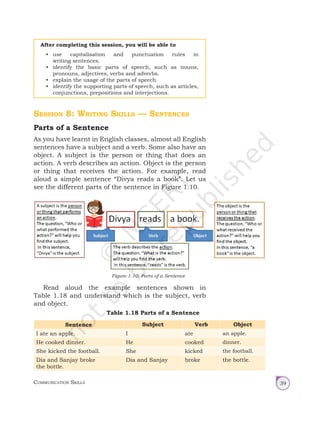
As you have learnt in English classes, almost all English
sentences have a subject and a verb. Some also have an
object. A subject is the person or thing that does an
action. A verb describes an action. Object is the person
or thing that receives the action. For example, read
aloud a simple sentence “Divya reads a book”. Let us
see the different parts of the sentence in Figure 1.10.
Figure 1.10: Parts of a Sentence
After completing this session, you will be able to
• use capitalisation and punctuation rules in
writing sentences.
• identify the basic parts of speech, such as nouns,
pronouns, adjectives, verbs and adverbs.
• explain the usage of the parts of speech.
• identify the supporting parts of speech, such as articles,
conjunctions, prepositions and interjections.
Read aloud the example sentences shown in
Table 1.18 and understand which is the subject, verb
and object.
Table 1.18 Parts of a Sentence
Sentence Subject Verb Object
I ate an apple. I ate an apple.
He cooked dinner. He cooked dinner.
She kicked the football. She kicked the football.
Dia and Sanjay broke
the bottle.
Dia and Sanjay broke the bottle.
Unit 1.indd 39 01-04-2019 16:40:18
Employability Skills – Class XI
40
Figure 1.12 Types of Sentences
Types of Objects
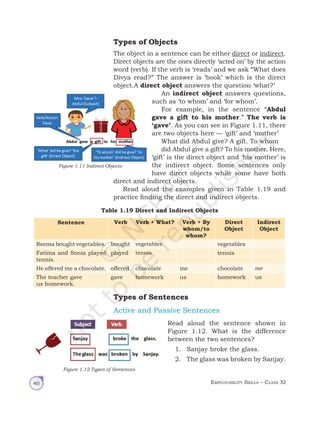
The object in a sentence can be either direct or indirect.
Direct objects are the ones directly ‘acted on’ by the action
word (verb). If the verb is ‘reads’ and we ask “What does
Divya read?” The answer is ‘book’ which is the direct
object.A direct object answers the question ‘what?’
An indirect object answers questions,
such as ‘to whom’ and ‘for whom’.
For example, in the sentence “Abdul
gave a gift to his mother.” The verb is
‘gave’. As you can see in Figure 1.11, there
are two objects here — ‘gift’ and ‘mother’
What did Abdul give? A gift. To whom
did Abdul give a gift? To his mother. Here,
‘gift’ is the direct object and ‘his mother’ is
the indirect object. Some sentences only
have direct objects while some have both
direct and indirect objects.
Read aloud the examples given in Table 1.19 and
practice finding the direct and indirect objects.
Figure 1.11 Indirect Objects
Table 1.19 Direct and Indirect Objects
Sentence Verb Verb + What? Verb + By
whom/to
whom?
Direct
Object
Indirect
Object
Reema bought vegetables. bought vegetables vegetables
Fatima and Sonia played
tennis.
played tennis tennis
He offered me a chocolate. offered chocolate me chocolate me
The teacher gave
us homework.
gave homework us homework us
Types of Sentences
Active and Passive Sentences
Read aloud the sentence shown in
Figure 1.12. What is the difference
between the two sentences?
1. Sanjay broke the glass.
2. The glass was broken by Sanjay.
Unit 1.indd 40 14-03-2019 10:37:52
Communication Skills 41
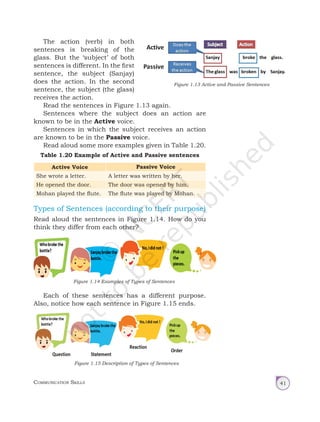
The action (verb) in both
sentences is breaking of the
glass. But the ‘subject’ of both
sentences is different. In the first
sentence, the subject (Sanjay)
does the action. In the second
sentence, the subject (the glass)
receives the action.
Read the sentences in Figure 1.13 again.
Sentences where the subject does an action are
known to be in the Active voice.
Sentences in which the subject receives an action
are known to be in the Passive voice.
Read aloud some more examples given in Table 1.20.
Table 1.20 Example of Active and Passive sentences
Active Voice Passive Voice
She wrote a letter. A letter was written by her.
He opened the door. The door was opened by him.
Mohan played the flute. The flute was played by Mohan.
Types of Sentences (according to their purpose)
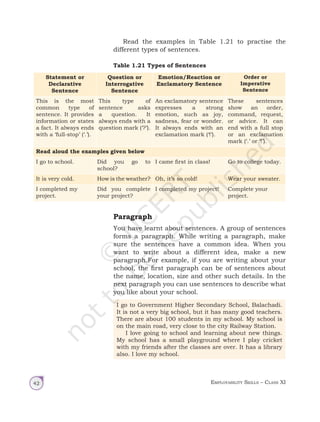
Read aloud the sentences in Figure 1.14. How do you
think they differ from each other?
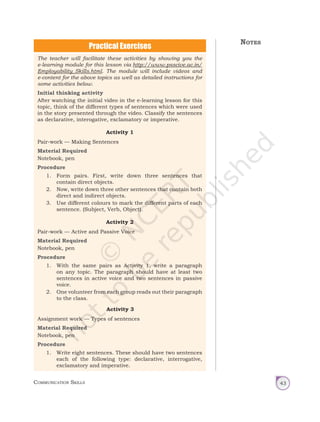
Each of these sentences has a different purpose.
Also, notice how each sentence in Figure 1.15 ends.
Figure 1.13 Active and Passive Sentences
Figure 1.15 Description of Types of Sentences
Figure 1.14 Examples of Types of Sentences
Unit 1.indd 41 14-03-2019 10:37:52
Employability Skills – Class XI
42
Table 1.21 Types of Sentences
Statement or
Declarative
Sentence
Question or
Interrogative
Sentence
Emotion/Reaction or
Exclamatory Sentence
Order or
Imperative
Sentence
This is the most
common type of
sentence. It provides
information or states
a fact. It always ends
with a ‘full-stop’ (‘.’).
This type of
sentence asks
a question. It
always ends with a
question mark (‘?’).
An exclamatory sentence
expresses a strong
emotion, such as joy,
sadness, fear or wonder.
It always ends with an
exclamation mark (‘!’).
These sentences
show an order,
command, request,
or advice. It can
end with a full stop
or an exclamation
mark (‘.’ or ‘!’).
Read aloud the examples given below
I go to school. Did you go to
school?
I came first in class! Go to college today.
It is very cold. How is the weather? Oh, it’s so cold! Wear your sweater.
I completed my
project.
Did you complete
your project?
I completed my project! Complete your
project.
Paragraph
You have learnt about sentences. A group of sentences
forms a paragraph. While writing a paragraph, make
sure the sentences have a common idea. When you
want to write about a different idea, make a new
paragraph.For example, if you are writing about your
school, the first paragraph can be of sentences about
the name, location, size and other such details. In the
next paragraph you can use sentences to describe what
you like about your school.
I go to Government Higher Secondary School, Balachadi.
It is not a very big school, but it has many good teachers.
There are about 100 students in my school. My school is
on the main road, very close to the city Railway Station.
I love going to school and learning about new things.
My school has a small playground where I play cricket
with my friends after the classes are over. It has a library
also. I love my school.
Read the examples in Table 1.21 to practise the
different types of sentences.
Unit 1.indd 42 01-04-2019 16:43:19
Communication Skills 43
The teacher will facilitate these activities by showing you the
e-learning module for this lesson via http://www.psscive.ac.in/
Employability_Skills.html. The module will include videos and
e-content for the above topics as well as detailed instructions for
some activities below.
Initial thinking activity
After watching the initial video in the e-learning lesson for this
topic, think of the different types of sentences which were used
in the story presented through the video. Classify the sentences
as declarative, interogative, exclamatory or imperative.
Activity 1
Pair-work — Making Sentences
Material Required
Notebook, pen
Procedure
1. Form pairs. First, write down three sentences that
contain direct objects.
2. Now, write down three other sentences that contain both
direct and indirect objects.
3. Use different colours to mark the different parts of each
sentence. (Subject, Verb, Object).
Activity 2
Pair-work — Active and Passive Voice
Material Required
Notebook, pen
Procedure
1. With the same pairs as Activity 1, write a paragraph
on any topic. The paragraph should have at least two
sentences in active voice and two sentences in passive
voice.
2. One volunteer from each group reads out their paragraph
to the class.
Activity 3
Assignment work — Types of sentences
Material Required
Notebook, pen
Procedure
1. Write eight sentences. These should have two sentences
each of the following type: declarative, interrogative,
exclamatory and imperative.
Notes
Unit 1.indd 43 14-03-2019 10:37:52
Employability Skills – Class XI
44
A. Multiple choice questions
Read carefully all the options given below the question
and choose the correct option(s).
1. Identify the subject in the sentence, “The children
played football.”
(a) The children
(b) Children played
(c) Played
(d) Football
2. Identify the object in the sentence, “The children
played football.”
(a) The children
(b) Children played
(c) Played
(d) Football
3. Which of these sentences has both indirect and
direct objects?
(a) I am watching TV.
(b) She bought a blue pen.
(c) The girls played cricket.
(d) He wrote his sister a letter.
4. Which of these sentences is in passive voice?
(a) They are watching a movie.
(b) The clock was repaired by Raju.
(c) He is sleeping in the room.
(d) My pet dog bit the postman.
B. Subjective question
1. Write one sentence of each type — statement, question,
exclamatory and order.
2. Which is your favourite festival? Write two paragraphs
about your favourite festival.
3. Each paragraph should have a minimum of four
sentences. Make sure you follow all the rules about
sentences and paragraphs you have learnt.
4. Practice work: Practice speaking correct sentences with
your classmates. Try and find the parts of sentences
which you use commonly.
Check Your Progress
Notes
After completing this session, you will be able to
• identify the different parts of a sentence.
• differentiate between active and passive voice.
• identify and compose different type of sentences.
What Have You Learnt?
Unit 1.indd 44 14-03-2019 10:37:52
Communication Skills 45
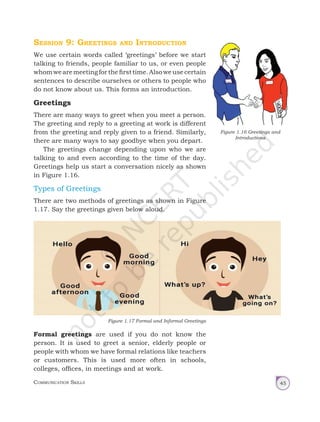
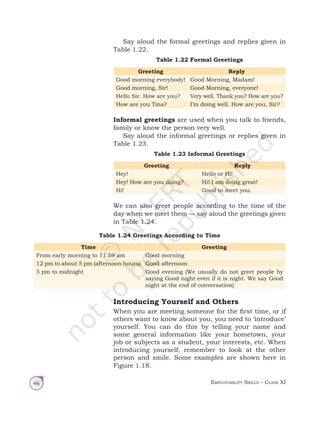
Session 9: Greetings and Introduction
We use certain words called ‘greetings’ before we start
talking to friends, people familiar to us, or even people
whomwearemeetingforthefirsttime.Alsoweusecertain
sentences to describe ourselves or others to people who
do not know about us. This forms an introduction.
Greetings
There are many ways to greet when you meet a person.
The greeting and reply to a greeting at work is different
from the greeting and reply given to a friend. Similarly,
there are many ways to say goodbye when you depart.
The greetings change depending upon who we are
talking to and even according to the time of the day.
Greetings help us start a conversation nicely as shown
in Figure 1.16.
Types of Greetings
There are two methods of greetings as shown in Figure
1.17. Say the greetings given below aloud.
Figure 1.16 Greetings and
Introductions
Figure 1.17 Formal and Informal Greetings
Formal greetings are used if you do not know the
person. It is used to greet a senior, elderly people or
people with whom we have formal relations like teachers
or customers. This is used more often in schools,
colleges, offices, in meetings and at work.
Unit 1.indd 45 14-03-2019 10:37:52
Employability Skills – Class XI
46
Say aloud the formal greetings and replies given in
Table 1.22.
Table 1.22 Formal Greetings
Greeting Reply
Good morning everybody! Good Morning, Madam!
Good morning, Sir! Good Morning, everyone!
Hello Sir. How are you? Very well. Thank you? How are you?
How are you Tina? I’m doing well. How are you, Sir?
Informal greetings are used when you talk to friends,
family or know the person very well.
Say aloud the informal greetings or replies given in
Table 1.23.
Table 1.23 Informal Greetings
Greeting Reply
Hey! Hello or Hi!
Hey! How are you doing? Hi! I am doing great!
Hi! Good to meet you.
We can also greet people according to the time of the
day when we meet them — say aloud the greetings given
in Table 1.24.
Table 1.24 Greetings According to Time
Time Greeting
From early morning to 11.59 am Good morning
12 pm to about 5 pm (afternoon hours) Good afternoon
5 pm to midnight Good evening (We usually do not greet people by
saying Good night even if it is night. We say Good
night at the end of conversation)
Introducing Yourself and Others
When you are meeting someone for the first time, or if
others want to know about you, you need to ‘introduce’
yourself. You can do this by telling your name and
some general information like your hometown, your
job or subjects as a student, your interests, etc. When
introducing yourself, remember to look at the other
person and smile. Some examples are shown here in
Figure 1.18.
Unit 1.indd 46 14-03-2019 10:37:52
Communication Skills 47
The teacher will facilitate these activities by showing you the
e-learning module for this lesson via http://www.psscive.ac.in/
Employability_Skills.html. The module will include videos and
e-content for the above topics as well as detailed instructions for
some activities below.
Initial thinking activity
Have you come across such a situation? Based on the initial
videos in the e-learning lesson for this topic, write down what do
you think about introducing yourself to neighbours? How will
you start a conversation politely?
Activity 1
Role-play — Formal and Informal Greetings
Material Required
Notebook, pen
Procedure
1. Form pairs of students.
2. Each pair should write about two conversations; one with
formal greetings and one with informal greetings.
3. One volunteer from each pair acts this out in front of
the class.
4. The class observes whether it is formal or informal greetings.
Activity 2
Role-play — Introducing Someone
Material Required
Notebook, pen
Figure 1.18 Introducing Yourself
We can introduce someone to others by telling their
name, what they do, how we know them, or even by
describing something interesting about them. One
example is shown in Figure 1.19.
Figure 1.19 Introducing Others
Unit 1.indd 47 14-03-2019 10:37:53
Employability Skills – Class XI
48
A. Multiple choice questions
Read carefully all the options given below the question
and choose the correct option(s).
1. Which of these are formal greetings?
(a) Good morning
(b) Good evening
(c) Good afternoon
(d) All of the above
2. In which of these situations can you say ‘Hi’?
(a) When you meet your teacher in class.
(b) When you meet a senior.
(c) When you meet your sister at home.
(d) When you meet your friends at a shop.
Check Your Progress
Procedure
1. Use same pairs of students as in Activity 1.
2. Write conversations that generally happen to introduce
someone to friends and family.
3. One volunteer from each pair demonstrates it for the
class. The class observes whether the introduction has
been made correctly or not.
Activity 3
Practice and Discussion — Greetings
Material Required
Notebook, pen
Procedure
1. Imagine that you are at home. The doorbell rings and
you open the door.
		 Write down
• What would you say when you see your uncle standing
at the door?
• What would you say when you see your friend standing
at the door?
2. One volunteer acts it out in front of the class. The class
in the presence of the teacher discusses:
• What is the difference in the way you greet your friends
and teachers?
• What are the different phrases used when
greeting friends?
• What are the phrases used when greeting elders?
• What are the phrases used when greeting your
superiors in the office?
Notes
Unit 1.indd 48 14-03-2019 10:37:53
Communication Skills 49
3. At which of these times can you say ‘Good evening’?
(a) 11am
(b) 9am
(c) 2pm
(d) 7pm
4. Which of these details can you say while introducing
a person?
(a) The person’s name
(b) How you know the person
(c) Something interesting about the person
(d) All of the above
B. Subjective question
1. Write two to three lines you would use to
introduce yourself.
After completing this session, you will be able to
• greet people formally and informally.
• introduce yourself to other people.
• introduce the other person to your friends.
Session 10: Talking about Self
You may need to talk about yourself on
many occasions especially when you
meet new people. You may also need
to fill forms with information about
yourself. In this lesson, you will learn
how to describe (or ‘introduce’) yourself
and write about yourself.
Talking About Yourself
When you meet someone for the first
time, they may want to know more
about you. You will need to ‘introduce’ yourself by telling
them about yourself as shown in Figure 1.20.
You usually start by telling your name. Then you can
talk about other things, such as what you do, your age,
where do you live, or even about the things or activities
that you like or dislike.For all these sentences, you will
use nouns and verbs.
What Have You Learnt?
Figure 1.20: Talking about Self
My
name is
Amit.
I like
History.
I don't
like
Maths.
I study
in
Class IX.
Unit 1.indd 49 14-03-2019 10:37:53
Employability Skills – Class XI
50
A noun is a ‘naming’ word that is used for a person,
place, thing, or idea. Some examples of nouns are Ali,
Delhi, football and music.
A verb is a ‘doing’ word that tells us what the noun
does. Some examples of verbs are play, like, eat and
write.Note that some verbs with an ‘ing’ ending can also
act as nouns. Swimming is an example. We can talk
about likes and dislikes using nouns as well as verbs
that end with ‘ing’. For example, cycling, swimming.
Table 1.25 shows how people talk about themselves.
Read aloud.
Table 1.25 Talking About Yourself
Name I am Harish Sethi. My name is Anu. I am Lucy Peter. My name is Ali.
What they
do
I am in high
school.
I am a student. I play cricket. I practice karate.
Age I am 15 years old. I am sixteen
years old.
I am nine. I will be 17 soon.
Hometown I stay in Agra. I live in Mumbai. I am from Goa. I am from Patna.
Likes I like playing
chess.
I like swimming. I like carpentry. I like music.
Dislikes I dislike summers. I do not like dolls. I dislike loud
noise.
I do not like playing
football.
Strengths I can write stories
very well.
I am a good
public speaker.
I can solve
crossword
puzzles quickly.
I am a good
team player.
Weaknesses I leave tasks
incomplete .
I get angry easily. I cannot
manage my time
properly.
I am nervous to
speak in front of a
large group.
Filling a Form
Sometimes, instead of talking, you will have to write
about yourself in a form. A form is a typed or printed
page with blank spaces for information.
Each form is different, so you should read it properly
before filling. Write neatly, while taking care to use the
correct spellings. A form usually has the following fields
for personal information as shown in Table 1.26.
Unit 1.indd 50 14-03-2019 10:37:53
Communication Skills 51
Table 1.26 Filling a Form
Name Here you enter your name. Sometimes you may need to
write the first, middle (if any) and surname.
Date of birth This is the date on which you were born. It is usually
written as the day, followed by the month, followed by
the year in numerals.
Address This is the postal address which includes your house
number and the details of the street, area and the city.
PIN code This is a group of numbers used by the post office to
identify a region. It is an important part of an address.
Signature (or Sign) This is your name or initials written by hand, in a
specific way (which is difficult for anyone else to copy).
Other information is to be filled according to the requirements of the form.
Example
Harish Sethi was born on 5 December 1999. He lives in
Agra, in a house named Sukh Nivas. His house number
is 13 in Raja Nagar. His postal code is 282001. Harish
filled a form asking for personal information like this.
First Name Harish
Last Name Sethi
Date of Birth 5 December 1999 (or 05-12-1999)
Address Sukh Nivas, No. 13, Raja Nagar, Agra
Pin Code 282001
The teacher will facilitate these activities by showing you the
e-learning module for this lesson via http://www.psscive.ac.in/
Employability_Skills.html. The module will include videos and
e-content for the above topics as well as detailed instructions for
some activities below.
Initial thinking activity
After watching the initial video in the e-learning lesson for this
topic think about yourself and write at least three sentences
about yourself?
Activity 1
Pair-work — Introducing Yourself and Filling Forms
Material Required
Notebook, pen
Unit 1.indd 51 14-03-2019 10:37:53
Employability Skills – Class XI
52
Notes
Procedure
1. Form pairs of students.
2. Introduce yourself to your partner, giving the details
necessary to fill a form. Your partner should fill in the
form with your details in his or her notebook. When
all the students have finished filling the form, read
the information given carefully and check whether the
details are correct.
3. Now, your partner should talk about him or her while
you fill the form in your notebook with his or her details.
4. After you finish, your partner should check information
given in the form.
Activity 2
Group Exercise — Talk About Yourself
Material Required
Notebook, pen
Procedure
1. Form groups of four students each.
2. Take turns and one by one, introduce yourself to the
others in the group.
3. Use the steps and expressions that you learnt in the
lesson. Remember to present your likes and dislikes as
well! Each person has one minute to talk about himself
or herself.
4. When one person talks, the others should correct and
guide him or her.
Practice work
Maintain a diary to show the assignments to your teacher. The
assignments may include the following:
• Introducing yourself to the new people you meet
• Telling your friends about your likes and dislikes
• Asking your family members to show you some forms
they have filled in.
• Creating a signature for yourself.
• Creating a simple form. Give copies to your friends and
ask them to fill in the form. Guide them if they do not
know how to fill it in.
Unit 1.indd 52 14-03-2019 10:37:53
Communication Skills 53
A. Fill in the blanks
1. Use the following words to complete the form given
below:
		 football and swimming, seven years old, Hassan,
Yasmin, in Bangalore.
(a) My first name is __________.
(b) My surname is ___________.
(c) I am ___________.
(d) I live ___________.
(e) I do not like ___________.
B. Multiple choice questions
Read carefully all the options given below the question
and choose the correct option(s).		
1. Select the correct answer for the following question:
		 A postal code is_______________
(a) a group of numbers or letters used to identify a
government building.
(b) a code used to indicate the door number of a house.
(c) a group of numbers or letters used by the post office
to identify a region.
(d) A code used to identify different post offices.
Check Your Progress
After completing this session, you wil be able to
• answer questions that others ask about you.
• talk about your likes and dislikes with your friends.
• fill out a form with some basic personal details.
Notes
What Have You Learnt?
Session 11: Asking Questions
A question is a sentence, phrase, or word that either
asks for information or is used to test someone’s
knowledge. We always use a question mark (?) at the
end of a question. In our day-to-day interactions with
others, we often have to ask and answer questions to
get information. Asking the correct questions can help
us get the information we want as shown in Figure 1.21.
What are the Two Main Types of Questions?
There are two basic types of questions: close-ended
questions and open-ended questions.
Figure 1.21 Questions and
Information
Unit 1.indd 53 14-03-2019 10:37:53
Employability Skills – Class XI
54
Questions that can be answered with a ‘yes’ or a ‘no’
are called close-ended questions. That is because the
answer options are limited or closed. For example, when
we ask: ‘Are you hungry?’, the answer could be either
‘Yes’ or ‘No’. (see Figure 1.22)
Sometimes, when we ask a question, we expect an
answer with more details. For example in Figure 1.22
when we ask: “What would you like to eat?”, the answer
could be: “I would like to eat an apple.” These are called
open-ended questions because their answer options
are not limited or closed. In this case, the person could
have said mango, orange or any other fruit.
How to Frame (or Form) Questions?
Forming Close-ended Questions
We can form close-ended questions by adding helping
verbs (called auxiliary verbs) like Be, Do and Have.
These convey additional information, such as time and
mood. Besides these, there are other auxiliary verbs
(called modal verbs), such as Can, May, Should which
show possibility or necessity. One method of forming
close-ended questions is to take a sentence without the
above words and place such words before the subject.
For example, the sentence “I like it” can be changed
into a close-ended question by adding the word ‘do’
before the subject ‘I’. This creates the close-ended
question: “Do I like it?”
Read aloud the other examples shown in Table 1.27.
Figure 1.22 Open-ended
Question
Figure 1.23 Close-ended
Question
Table 1.27 Close-ended Questions
Sentence Close-ended questions after adding helping verbs
They talk on the phone every day. Do they talk on the phone every day?
You share your lunch with
your friends.
Could you share your lunch with your friends?
Please Note: This helping verb changes based on
the subject, but the main verb remains unchanged.
For example, in the sentences and the questions
below, the main verb (cook) remains unchanged, but
the auxiliary verb (do) changes based on the subject.
Unit 1.indd 54 14-03-2019 10:37:53
Communication Skills 55
Read aloud the other examples given in Table 1.28.
Table 1.28: Close-ended Questions with Helping Verbs
Sentence Close-ended questions after adding helping verbs
I cook dinner. Do I cook dinner?
She can cook dinner. Can she cook dinner?
They cook dinner. Do they cook dinner?
In some cases, we exchange the positions of the
subject and the verb to create a close-ended question.
We can follow a similar method for sentences that
already have auxiliary verbs. Read aloud the other
examples shown here in Table 1.29.
Table 1.29 Close-ended Questions (Subject/Verb exchanged)
Sentence Close-ended questions after exchanging positions of
the subject and the verb
He is there. Is he there?
They were cleaning their room. Were they cleaning their room?
You can help me. Can you help me?
Forming Open-ended Questions — Using
Question Words
Some questions are called open-ended because their
answer options are not limited or closed. They have to
be answered with more information than just a ‘  yes’
or a ‘no’. We can form open-ended questions by using
question words, such as What, Why, Who, How, When
and Where. Read aloud the other examples shown here
in Table 1.30. Notice how these questions CANNOT be
answered with a ‘yes’ or a ‘no’.
Table 1.30 Open-ended Questions with Question Words
Open-ended questions Answer sentence
What did you do? I went to the park.
Why did you go there? I went to meet my friend.
How did you go? I cycled.
Unit 1.indd 55 14-03-2019 10:37:53
Employability Skills – Class XI
56
The teacher will facilitate these activities by showing you the
e-learning module for this lesson via http://www.psscive.ac.in/
Employability_Skills.html. The module will include videos and
e-content for the above topics as well as detailed instructions for
some activities below.
Activity 1
Pair-work — Open-ended and Closed-ended Questions
Material Required
Notebook, pen
Procedure
1. Form pairs of students.
2. Each pair writes 5 open-ended and 5 close-ended
questions along with the answers for all 10 questions.
3. When all pairs have completed the activity, one volunteer
pair reads out their questions and answers to the
whole class.
4. The class gives its feedback on whether the questions
are framed correctly or not.
Activity 2
Group Exercise — Forming Questions
Material Required
Notebook, pen
Procedure
1. Form groups of four students each.
2. Write a conversation between four people, with at least
6 questions (including close and open-ended questions).
3. One group volunteers to act it out in front of the class.
4. The other students give their observations on whether
the questions were framed correctly or not.
A. Multiple choice questions
Read carefully all the options given below the question
and choose the correct option(s).
1. What are close-ended questions?
(a) Questions that can have any answer
(b) Questions that do not have answers
(c) Questions with yes or no answers
(d) Questions that have many answers
Check Your Progress
Notes
Unit 1.indd 56 14-03-2019 10:37:53
Communication Skills 57
2. Which of these are open-ended questions?
(a) Where do you live?
(b) Are you hungry?
(c) How do you feel?
(d) Did you meet him?
3. Which is not a question word?
(a) What
(b) Want
(c) Which
(d) How
4. Which of these is the correct way to convert the sentence
“You are studying” into a question?
(a) You are studying?
(b) Studying you are?
(c) Are you studying?
(d) Studying are you?
B. Subjective question
1. Make a note of 10 questions your friends asked you.
How many were open-ended questions? Make a list of
10 close-ended questions you have asked.
What Have You Learnt?
After completing this session, you will be able to
• ask simple questions to solve your doubts.
• identify close-ended and open-ended questions.
• use the correct question words to ask open-ended and
close-ended questions.
Session 12: Talking about Family
Introduction
How big or small is your family?
What happens when someone
asks you about your family? What
do you say? Can you introduce all
your family members in English?
Let’s learn some words which
will help you introduce your family
members and describe how you
are related to them. Figure 1.24 Family
Unit 1.indd 57 14-03-2019 10:37:53
Employability Skills – Class XI
58
New Words — Names for Relatives
Do you know the English names for different members
of the family? Your mother and father are your parents.
You may have one or more brothers or sisters as in
Figure 1.24.
• In English, parents of both mother and father
are called Grandparents (Grandfather and
Grandmother).
• Sisters of both father and mother are called Aunts.
• Brothers of both father and mother are called
Uncles.
• Children of all aunts and uncles are called
Cousins.
• Family members of the husband or wife are known
as ‘in-laws’.
– For example, brothers and sisters of the
husband will be brothers-in-law and sisters-in-
law for the wife.
– Brothers and sisters of the wife will be brothers-
in-law and sisters-in-law for the husband.
– Parents of the wife will be father-in-law and
mother-in-law for the husband.
– Parents of the husband will be father-in-law
and mother-in-law for the wife.
Read and practice saying the words as shown in
Figure 1.25
Figure 1.25 Relatives
My Grandparents My Grandparents
Grandfather
Grandfather
My father’s sister
My Aunt My mother’s sister
My Aunt
My father’s brother
My Uncle
My mother’s brother
My Uncle
Sister-in-law
Brother-in-law
My Cousins
Father
My sister Myself
I am Tina.
Meet my
family
My Brother
Their children
My Parents
Mother
Her son
Grandmother Grandmother
Their children Their children
Their children
His daughter
Their children
M
y
father’s
parents
M
y
m
other’s
parents
Unit 1.indd 58 19-03-2019 16:18:35
Communication Skills 59
New Words — Words that Show Relations
Did you notice the words? (my, father’s, mother’s, their)
In ‘father’s sister’ the word ‘father’s’ describes
the relation with the noun ‘sister’. If you remember,
words which describe a noun or a pronoun are called
adjectives. The type of adjectives which describe
relations or ownership (possession) are known as
Possessive Adjectives.
Possessive adjectives can be used to show a relation
between people and owner of things.
The common relation words are given in Table 1.31.
Read and practice saying the words aloud.
Table 1.31 Words Showing Relations — Possessive Adjectives
Word Meaning Example Example
my Belongs to/related to me My mother is a teacher. This is my book.
your Belongs to/related to you Where is your sister? Is this your book?
his Belongs to/related to him His cousin plays cricket. That is his house.
her Belongs to/related to her She loves her father. I like her dress.
its Belongs to/related to it The baby is looking for
its mother.
Keep the ball in its place.
our Belongs to/related to us Our grandparents live
in Simla.
We love our school.
their Belongs to/related to them Parents take care of
their children.
We visited their house.
We also use the sign (’) with and ‘s’ to show the owner
or related person, as shown in Table 1.32.
Table 1.32 Words Showing Ownership or Relations
Word Meaning Example 1 Example 2
father’s Belongs to/related to father My father’s sister loves
us.
My father’s car is
red in colour.
mother’s Belongs to/related to
mother
My mother’s mother is
my grandmother.
My mother’s work
never ends.
Ravi’s Belongs to/related to Ravi Ravi’s sister is my
friend.
Ravi’s house is far
away.
Mr Sharma’s Belongs to/related to
Mr Sharma
Mr Sharma’s uncle is
very old.
Mr Sharma’s office
is well lit.
Unit 1.indd 59 14-03-2019 10:37:53
Employability Skills – Class XI
60
Read out these lines as Tina talks about her family.
Notice the relation words that have been underlined
and the relations which have been shaded.
• My name is Tina.
• My mother is a teacher.
• My father works in a hotel.
• My brother’s name is Raj and my sister’s name is
Anju.
• I have three aunts and two uncles.
• Our grandparents stay in Simla. I love going to
their house but it is far from our school.
How would you describe your family?
The teacher will facilitate these activities by showing you the
e-learning module for this lesson via http://www.psscive.ac.in/
Employability_Skills.html. The module will include videos and
e-content for the above topics as well as detailed instructions for
some activities below.
Activity 1
Pair-work — Talking about Family
Material Required
None
Procedure
1. Form pairs of students.
2. Ask your partner any five questions about his or her
family. The partner has to answer your questions by
talking about his or her family members.
3. Then the partner will ask you any five questions about
your family and you will need to talk about your family.
Activity 2
Role-play — Family Relations
Material Required
Pen and paper
Procedure
1. Form groups of five to eight students in each group.
2. Make chits with names of family members, such as
father, mother, uncle, brother, cousin, etc., on them.
Leave one chit blank.
Notes
Unit 1.indd 60 14-03-2019 10:37:53
Communication Skills 61
A. Multiple choice questions
Read carefully all the options given below the question
and choose the correct option(s).
1. Your mother’s or father’s sister is your _________ .
(a) parent
(b) sister
(c) uncle
(d) aunt
2. Your uncle’s children are your _________ .
(a) parents
(b) cousins
(c) brother
(d) sister
3. A father-in-law is my _________ .
(a) mother’s father
(b) cousin’s father
(c) uncle’s father
(d) husband or wife’s father
4. Your father’s or mother’s brother is your _________ .
(a) cousin
(b) uncle
(c) parent
(d) brother
B. Subjective question
1. Describe your family in 5–8 sentences.
3. Everyone should pick a chit and act according to
that role. The person who gets the blank chit will ask
questions to everyone else about their role in the family.
4. Everyone else will talk about their relations to each
other. For example, I am your father. This is your uncle.
5. Then the person with the blank chit will introduce the
‘family’ to the class.
What Have You Learnt?
After completing this session, you will be able to
• talk about your family and describe relationships.
• use ‘possessive adjectives’ to talk about things that
belong to you or others.
Check Your Progress
Notes
Unit 1.indd 61 14-03-2019 10:37:53
Employability Skills – Class XI
62
Session 13: Describing Habits
and Routines
A habit (Figure 1.26) is a practice that we
follow, especially one that is very hard to
stop or give up. For example, getting up at a
particular time is a habit.
A routine is a regular, ordered way of
doing activities at a fixed time. There are
some phrases that can be used to describe
your routine. Some words like every day,
usually (or generally), always, sometimes,
never, etc., can be used to describe our habits
and routines.
Concept of Habits and Routine — Priya’s Day
How would Priya describe her daily routine to a friend?
Read aloud the sentences given in Table 1.33.
Table 1.33 Priya’s Routine
My daily ROUTINE is this
Every day, I get up at 7 am.
I take a bath at 7.30 am.
I have my breakfast at 8.00 am.
I go to school at 8.30 am.
I come back home at 2.00 pm. Then I
iron and fold my clothes.
I have dinner with my family at 7.00 pm.
Then I help wash the utensils.
I watch TV at 8.00 pm.
I go to sleep at 9.00 pm.
All the above steps, done one after the other, form
Priya’s routine. She does them daily, in the same order!
Some are habits (like taking a bath, watching TV) and
some are work or chores (like washing utensils).
Let us see how Priya describes her habits (things
she usually does) to her friend Reena. Read aloud the
sentences given in Table 1.34 (first read Priya’s dialogue
and then read Reena’s dialogue).
Figure 1.26 Habits
Unit 1.indd 62 14-03-2019 10:37:54
Communication Skills 63
The words that are in bold — always, never,
sometimes — are used to describe when you do an
activity. They are called Adverbs of Frequency. They
describe how often something happens. They are useful
in describing habits. Other examples of such adverbs
are shown in Table 1.35.
Table 1.34 Priya’s Habits
Priya Reena
Hi Reena! Hi Priya, your hair looks so good.
Thank you Reena. I always oil and comb my hair. That’s a good habit. I never oil my hair.
You must do that Reena. Have you completed the
science homework?
Yes I have. I always finish my homework
on time.
That’s a great habit. I have not completed
the homework. I sometimes forget to finish
my homework.
Don’t worry, come I’ll help you with the
homework.
Table 1.35 Adverbs of Frequency
For regular activities weekly, daily, yearly, always I go to the temple weekly.
For irregular activities sometimes, often, rarely I sometimes go to the temple.
The teacher will facilitate these activities by showing you the
e-learning module for this lesson via http://www.psscive.ac.in/
Employability_Skills.html. The module will include videos and
e-content for the above topics as well as detailed instructions for
some activities below.
Activity 1
Pair-work — Discussing habits and routines
Material Required
Notebook, pen
Procedure
1. Form pairs of students.
2. Both partners make a table in this format (You can
change the details).
Time What do I do at this time?
6 am – 6.30 am I get up and get ready for the day.
6.30 am – 7.00 am I take a bath.
… and so on …
Unit 1.indd 63 14-03-2019 10:37:54
Employability Skills – Class XI
64
3. Take 5 minutes to fill in such a table about your daily
activities in your notebook. Ask your partner about their
routine. Listen carefully. Now your partner will ask you
about your routine. Read aloud your routine to them.
4. Make a table in your notebook and fill it with your
partner’s routine details.
5. Exchange your notebooks and each will check if the
partner has filled all details correctly.
Activity 2
Group-practice — Describing routines
Materials Required
Notebook, pen
Procedure
1. Form groups with five people in each group.
2. Choose a leader. The group leader will assign a role
to each student: movie star, sports player, politician,
teacher, doctor, etc. Then, think about the daily routine
of your character.
3. The leader will interview student 1. Student 1 will
interview student 2 and so on.
4. Finally, take some time to discuss about the routines of
the characters.
A. Fill in the blanks Using the Correct Option
1. Write the correct adverbs of frequency that can be
used in the following sentences against each sentence
(Options — Seldom, Sometimes, Usually, Always, Never)
(a) I eat breakfast every day._______________
(b) I don’t drink coffee at all. _______________
(c) Once in a while I walk to the beach. ___
(d) I generally play cricket after school. _____
(e) I rarely sleep in the afternoon. ______________
2. Which of the following are chores (or work) and which
are habits? Mark the chores as ‘C’ and habits as ‘H’.
(a) I wash my clothes every day. _______________
(b) After dinner, I wash the dishes. _______________
(c) On Sunday, I clean my house. _______________
(d) I go to sleep at 10 pm. _______________
(e) I brush my teeth every morning. ______________
B. Arrange in Correct Sequence
1. Arrange the following adverbs of frequency in order of
‘all the time’ to ‘not at all’.
Check Your Progress
Notes
Unit 1.indd 64 14-03-2019 10:37:54
Communication Skills 65
Sesssion 14: Asking for Directions
Introduction
Have you ever been lost and asked others for directions
as in Figure 1.27? Have you sometimes given directions
to others? In this lesson, you will learn to ask for and
give clear directions to a place.
How to Ask for or Give Directions
When you need to go to a new place what do you
do? You ask somebody or use a map. When you ask
someone, you ask politely. Start by saying ‘Excuse me’
or by greeting them.
Ask clearly for the place where you want to reach
(for example, Central School, Raja Nagar, Railway
Station, Kavi Nagar Post Office, Admission office inside
a building) as shown in Table 1.36.
Table 1.36 Asking for Directions
Excuse me, can you please tell me the way to the National Bank?
Excuse me, which way is the railway station?
Excuse me, do you know the way to the Gandhi National Museum?
Can you tell me the directions for reaching your home from the Town Hall?
The other person will usually tell you in which
direction you should go, how far, and where you need
2. Rarely (or seldom); Never; Often; Sometimes; Generally;
Always
C. Subjective questions
1. Write down the habits you want to create or the one’s
you want to drop.
2. Write down the routine you will follow over a month
before your final exams.
After completing this session, you will be able to
• describe your regular activities and tasks.
• describe, in the correct order, the activities that you and
other people do every day.
What Have You Learnt?
Figure 1.27 Directions
Unit 1.indd 65 01-04-2019 16:45:29
Employability Skills – Class XI
66
Table 1.37 Thanking Others
Phrase When to use
Thank You This is the polite way to answer when anyone helps you.
Thanks It means the same thing, but is more casual (should be used only with
friends or family).
I appreciate that This is one more polite way to answer when someone does something
for you.
I really
appreciate that
You can use this for someone who goes out of their way to help you.
When others thank you, you should accept by saying
‘welcome’, or ‘you’re welcome’.
More About Directions Using Landmarks
It is very helpful if you mention landmarks (places
which are well known or easy to locate) like a bus
stand, a lake, a bridge, big offices and schools, etc.
while giving directions.
To give directions using the location of well-
known places, we use location or position words
called ‘prepositions’. (Tip: prepositions show
position). There are some other prepositions which
are used to show time, but in this lesson we will
practice using the position words.
Some of these words are — on, near to, opposite,
in front of.
If someone asks you for directions, you should use
the same method. Repeat the directions to make sure
that you have understood correctly.
You must thank the person who helped you, before
leaving. Some words or phrases used for thanking
others are given in Table 1.37.
to take turns. Some terms for giving directions are
shown in Figure 1.28.
Figure 1.28 Terms for Giving Directions
Turn Left Turn Right U-Turn Go Straight Go Past Cross
A
A
A
Figure 1.29 Describing Position
Opposite
Between
Next to
At the corner
A
A
A B
B D
B
A
Unit 1.indd 66 19-03-2019 16:19:57
Communication Skills 67
Figure 1.30 Describe Locations Based on Landmarks
The teacher will facilitate these activities by showing you the
e-learning module for this lesson via http://www.psscive.ac.in/
Employability_Skills.html. The module will include videos and
e-content for the above topics as well as detailed instructions for
some activities below.
Activity 1
Group-exercise — Role-play
Materials Required
Notebook, pen
Procedure
1. Form groups with three students in each group.
2. Practise asking for and giving directions to different
places. Your teacher may suggest some places or you
can use places in your town as examples.
3. Discuss whether each person was able to give
correct directions.
4. Discuss what you learned from this activity.
Activity 1
Assignment — Write the direction shown by the symbols
given below.
_________ _________ _________ _________
Figure 1.30 shows examples of giving directions to a
place (Cosmos Mall). Different prepositions have been
used to give directions based on nearby landmarks.
Unit 1.indd 67 14-03-2019 10:37:56
Employability Skills – Class XI
68
What Have You Learnt?
After completing this session, you will be able to
• ask for directions, politely.
• thank a person in different ways using the correct
phrases.
• give directions using the correct prepositions.
Check Your Progress
A. Fill in the blanks using the given prepositions (across, of,
into, to) to complete the sentences.
1. Go _______ the bridge and on the other side you will see
a park.
2. Turn left ________ Acacia lane.
3. Go past the newspaper shop and carry on until you
come ______ a bridge.
4. Go out ______ the building and turn left.
B. Multiple choice questions
Read carefully all the options given below the question
and choose the correct option(s).
1. Which of the following is the correct way of thanking
someone?
(a) Thank you
(b) Thanks
(c) I really appreciate that
(d) All of the above
C. Subjective question
1. Your classmates are coming to your house. Write the
directions so that they can reach your home from
your school.
Notes
Unit 1.indd 68 14-03-2019 10:37:56

com-skills.pdf

  • 1.
    Session 1: Introductionto Communication You probably hear people talking about communication all the time. Everyone needs it and wants it, but what exactly is communication? Let us try to understand it. Unit Unit Communication Skills 1 Figure 1.1 Communication Process In Figure 1.1, you can see that communication is the ‘sharing’ of information between two or more individuals or within the group to reach a common understanding. The word ‘communication’ comes from the Latin word commūnicāre, meaning ‘to share’.
  • 2.
    Employability Skills –Class XI 2 Importance of Communication Your ability to communicate clearly and share thoughts, feelings and ideas will help you in all your relations with other people. As a student, you may study any language, but it is important that you are able to read, write, speak and listen well in order to communicate properly. Speaking more than one language can help you to communicate well with people around the world. Learning English can help you to communicate with people who understand English besides the language you have been exposed to in your family, for example, your mother tongue. Communication skills are needed to • Inform – for example, communicating the time of a meeting. • Influence – for example, negotiating with a shopkeeper to reduce the price. • Express feelings – for example, to say or show that you are excited about your success or about a given task. Elements of Communication Communication is a two-way process of sharing information as shown in Figure 1.2. Figure 1.2 Elements of Communication Unit 1.indd 2 14-03-2019 10:37:47
  • 3.
    Communication Skills 3 Asyou can see, communication is a two-way exchange of information, i.e., giving and receiving. Speaking and writing to someone are examples of giving information. Reading and listening to someone are examples of receiving information. Perspectives in Communication Perspectives are ideas, views, or fixed ways of thinking. These sometimes affect our communication. For example, if you have a fixed idea that your teacher or father is strict, even when they are being friendly, you may think they are scolding you. In the same way, others may also have fixed ideas about you, which affects whatever you say to them. Factors Affecting Perspectives in Communication Sometimes, we are not able to communicate clearly because of barriers that stop us from sharing and understanding messages. Some of these are summarised in Table 1.1. Table 1.1 Factors Affecting Perspectives in Communication Factor How the factor can become a barrier Language In case of use of incorrect words, unfamiliar language and lack of detail, language can act as a barrier to communicate what one wishes to convey. For example, language can act as a barrier when an Indian who only knows Hindi and a Chinese who only knows Mandarin want to interact with each other. Visual Perception Judging people or situations by how they look. For example, a man wearing torn clothes is poor. Past Experience Letting our earlier experience stop us from understanding or communicating clearly. For example, “This shopkeeper cheated me last time. Let me be careful.” Prejudice Fixed ideas, such as thinking “No one in my class listens to me” may stop a student from communicating openly in the class. Feelings Our feelings and emotions, such as lack of interest or not trusting the other person affect communication. For example, “I am sad. Let me not talk.” Environment Noise or disturbance in the surroundings may make communication difficult. For example, speaking while walking on road. Personal factors Your own feelings, habits and ways of thinking (for example, fear, low confidence) may make communication difficult. Culture Signs which have a different meaning in different cultures, such as showing a thumb may mean ‘good job’ for some people but may be insulting to others Unit 1.indd 3 14-03-2019 10:37:47
  • 4.
    Employability Skills –Class XI 4 Figure 1.3 7Cs of Effective Communication Effective Communication Effective communication can happen if we follow the basic principles of professional communication skills. These can be abbreviated as 7 Cs, i.e., clear, concise, concrete, correct, coherent, complete and courteous. These are further explained in Figure 1.3. There are different methods of communication — non-verbal, verbal and visual. We will learn more about them in the next sessions. The teacher will facilitate these activities by showing you the e-learning module for this lesson via http://www.psscive.ac.in/ Employability_Skills.html. The module will include videos and e-content for the above topics as well as detailed instructions for some activities below. Initial thinking activity After watching the initial video in the e-learning lesson for this topic, write the answer of the following question—Why is it important to communicate clearly? Activity 1 Group Exercise – Role-play on Communication Process Material Required None Procedure 1. Form groups of three students each. 2. The situation is that you need to sell some items to an old couple who has come to your shop. 3. One person can act as the salesperson and the other two as an old man and his wife. 4. Act out a conversation between the three people. 5. Discuss what you learned from this. Be clear about what you want to say and write Use simple words and say only what is needed Use exact words, phrases, Use facts and figures Use correct spellings, language and grammar Your words should make sense and should be related to the main topic Your message should have all the needed information Be respectful, friendly and honest Unit 1.indd 4 14-03-2019 10:37:47
  • 5.
    Communication Skills 5 Activity2 Group Exercise — Factors Affecting Perspectives in Communication Material Required None Procedure 1. Form groups of three students each. 2. Each group selects any one of the eight factors (from Table 1.1) which act as barriers to communication. 3. Discuss how it can affect or become a barrier to good communication with family, friends, in school or at a retail store. 4. Each group shares their experiences related to one of the eight factors which can act as a communication barrier. Activity 3 Classroom Discussion — on 7Cs of Effective Communication Material Required Paper and Pencil Procedure Each student writes down examples of the 7Cs of communication in his or her notebook. For each of the 7 Cs, a student volunteers to give his or her example of how to communicate well. The other students (with teacher guidance) say whether it is correct or wrong. Activity 4 Assignment — Chart Making on Elements of Communication Material Required Chart Paper, Colours and Pencil Procedure Make a chart showing the elements of communication in the communication cycle or communication process (can be done as homework, if there is less time during the class). Check Your Progress A. Multiple choice questions Read carefully all the options given below the question and choose the correct option(s). 1. What is the purpose of communication? (a) Inform (tell someone about something) (b) Influence (get someone to do something you want) (c) Share thoughts, ideas, feelings (d) All of the above Notes Unit 1.indd 5 14-03-2019 10:37:47
  • 6.
    Employability Skills –Class XI 6 Notes 2. Which of the following method is used to receive information from the sender? (a) Listening (b) Speaking (c) Telling (d) Writing 3. By which action can a sender send his or her messages? (a) Listening (b) Speaking (c) Sleeping (d) None of the above B. Match the Following Column A Column B Communication Barriers Examples 1. Language A. Taking an official call on your mobile where the mobile phone reception is poor 2. Emotional B. Hugging a person in a foreign country where such an act is rude and disrespectful 3. Environmental C. Talking in Hindi when others know only German 4. Cultural D. Teacher is too angry and is not willing to accept any reason from a student who is late for an examination C. Subjective question 1. Write down the seven factors affecting perspectives in communication. Provide examples, explaining how each factor affects communication. What Have You Learnt? After completing this session, you will be able to • identify the elements of communication. • draw a communication cycle showing all the elements of communication. • identify the factors affecting our perspectives in communication. Session 2: Verbal Communication Verbal communication is the sharing of information using words. It is what most people use as a method of communication. We will learn about non-verbal and visual communication in the next session. Verbal communication is important because if you do not Unit 1.indd 6 14-03-2019 10:37:47
  • 7.
    Communication Skills 7 usethe right words, you will cause confusion and you will not be able to communicate what you want. The important forms of verbal communication are given in Table 1.2. Table 1.2 Verbal Communication Type of Verbal Communication Examples Oral or Spoken Communication: Communication which involves talking Face-to-face conversation: When you can see the listener. For example, group discussion, talking to family members at home, public speeches, etc. Talking on a phone: This is for personal and official communication. Phone conversations should begin with a greeting (Hello), talking and listening to each other. The conversation can end with a ‘Thank you’ and ‘Bye’. Classroom teaching, business meeting and public speeches are other examples of oral communication, where one person talks to many others at once. Written Communication: Communication which involves written or typed words Writing on paper: letters, notes, etc. SMS (Short Message Service): These can be sent through a phone to a person or a group. Using email to share news, thoughts, documents and files (including photos, videos, music, etc.). e-mail can be used to send messages to a person or to a group. Printed books and newspapers Unit 1.indd 7 14-03-2019 10:37:48
  • 8.
    Employability Skills –Class XI 8 Advantages of Verbal Communication It is easy and quick. You can say what you want and get a quick response. It is an easier form of communication when you have to exchange ideas. You keep changing your communication as per the other person’s reply. Disadvantages of Verbal Communication Since verbal communication depends on words, sometimes the meanings become confusing and difficult to understand if the right words are not used. Public Speaking Speaking in front of a large group makes most people nervous. You can use the 3Ps (Prepare, Practice, Perform) method to get over your fears, and become a confident and effective speaker. These points are shown in Table 1.3. The teacher will facilitate these activities by showing you the e-learning module for this lesson via http://www.psscive.ac.in/ Employability_Skills.html. The module will include videos and e-content for the above topics as well as detailed instructions for some activities below. Initial thinking activity After watching the video in the e-Learning lesson for this topic write down why do you think Tina’s directions were not understood? How would you give directions on the phone? Table 1.3 3Ps of Public Speaking 3Ps of Public Speaking Prepare Think about your topic Think about what your listeners need to know about the topic Think about the best way to make your listeners understand your topic Write what you plan to say Practice Practice by yourself first. Talk in front of a mirror Talk in front of your family and friends and ask them what they think Speak clearly, loudly and at the right speed (not very fast nor very slow) Perform Take a few deep breaths if you are feeling nervous Think about what you have prepared and start speaking confidently Unit 1.indd 8 14-03-2019 10:37:48
  • 9.
    Communication Skills 9 Activity1 Group Exercise — Role-play of a Phone Conversation Material Required Notebook, pen Procedure 1. Form groups with three students in each group. Write a phone conversation based on a scene given by your teacher. Use proper sentences. 2. One student acts as caller and the other as receiver. Speak out the conversation aloud. The third student gives feedback. The students give feedback based on the 7 Cs of communication. Activity 2 Group Exercise — Public Speaking Material Required Notebook, pen Procedure 1. Choose a topic for a very short speech. 2. Write your thoughts on the topic in paragraphs. 3. Students to volunteer and give speech in front of the class. 4. Students listening to the speech will have to give suggestions to improve the delivery of speech. A. Multiple choice questions Read carefully all the options given below the question and choose the correct option(s). 1. Choose the correct example of oral communication. (a) Reports (b) Newspapers (c) Face-to-face interaction (d) Notes 2. What are the words we should use when we communicate verbally? (a) Use straight words (b) Use simple words (c) Use precise words (d) Use fixed words 3. Why do we send emails? (a) To communicate information (b) To share documents and files (c) To talk to each other (d) Both (a) and (b) B. Subjective question 1. Write down the different types of verbal communication with examples of each. Check Your Progress Notes Unit 1.indd 9 14-03-2019 10:37:48
  • 10.
    Employability Skills –Class XI 10 After completing this session, you will be able to • explain what the verbal method of communication is. • list the different types of verbal communication. • list the 7Cs of communication. • speak confidently in public using the 7Cs of communication. Figure1.4 Non-verbal Communication PARA- LANGUAGE EXPRESSIONS POSTURE EYE CONTACT GESTURES SPACE TOUCH NON- VERBAL Notes What Have You Learnt? Session 3: Non-verbal Communication Non-verbal communication is the message we send to others without using any words as shown in Figure 1.4. We send signals and messages to others through expressions, gestures and body postures. In this lesson, you will learn about non-verbal method of communication skills, its types and importance. You will learn to use correct body language, like gestures, eye contact, handshake, etc. Importance of Non-verbal Communication In our day-to-day communication, it is observed that most of the communication is done using body movements (face or arms movements, etc.) and voice control (voice, tone, pauses, etc.) and less than 10% is done using words. Unit 1.indd 10 14-03-2019 10:37:49
  • 11.
    Communication Skills 11 VoiceControl (Non-verbal) Expressions, Movements, Pictures (Non-verbal and Visual) Words (Verbal) Figure 1.5 Methods of Communication As we can see in Figure 1.5, maximum communication is non-verbal. We communicate using words, tone of voice and body language as given in Table 1.4. Table 1.4 Non-verbal Communication Non-Verbal Communication: Exchanging Information without Words Hand movements (gestures) and body language • Raising a hand to greet • Pointing your finger in anger Expressions • Smiling to show happiness • Making a sad face when you are upset Non-verbal communication makes our message stronger. • Using the right gestures and postures helps us to be professional at work. • Using the right gestures while speaking makes our message more effective. • Knowing non-verbal communication helps us understand our audience’s reaction and adjust our behaviour or communication accordingly. • If verbal messages are blocked by noise or distance, etc., we can use hand movements to exchange our message. Placing a finger on the Unit 1.indd 11 14-03-2019 10:37:49
  • 12.
    Employability Skills –Class XI 12 Table 1.5 Types of Non-verbal Communication Type What it implies How to use effectively? Facial Expression Our expressions show our feelings: Happiness, sadness, anger, surprise, fear, etc. • Smile when you meet someone • Keep your face relaxed • Match your expressions with what you are saying Posture Postures are positions of the body. They show our confidence and feelings. • Keep upper body relaxed and, shoulders straight • Sit straight, rest hands and feet in relaxed position • Keep hands by your sides while standing Gestures or Body Language Gestures describe movements of parts of the body, especially hands or head, to express an idea or meaning. This includes waving, pointing and using our hands when speaking. For example, raising a hand may mean asking a question. Biting nails show nervousness. • Avoid pointing at people with your finger • Bend your head a little while talking or listening to show that you are paying attention Touch We communicate a great deal through our touch, such as shaking hands and patting on the back. For example, a firm handshake shows confidence. Sports coaches give a pat on the back of players to encourage them. • Shake hands firmly • Avoid other touch gestures during formal communication lips to indicate need for silence and nodding the head up and saying ‘yes’. We communicate non-verbally in many ways. Let us learn about some of these as mentioned in Table 1.5. Unit 1.indd 12 14-03-2019 10:37:49
  • 13.
    Communication Skills 13 SpaceSpace is the physical distance maintained between two people. It is important to maintain a proper distance when speaking with someone. • Maintain proper space depending on the relationship, which could be formal or informal as the closeness with the person with whom you are talking. Eye Contact The way we look at someone can communicate things, such as interest or anger. Eye contact is when two people are looking directly into one another’s eyes. It shows that we are paying attention to the person. Looking away can make the other person feel ignored. • Look at the person who is speaking • Keep a relaxed, pleasant look. • Break the look every few seconds Paralanguage Paralanguage means how we speak. The tone of our voice, speed and volume can make a difference in the meaning we want to show. Speaking too fast may show happiness, excitement or nervousness. Speaking too slow may show seriousness or sadness. • Use a proper tone and volume while speaking • Maintain a moderate rate(speed) of talking Visual Communication Another important method of communication is visual communication, which involves sending and understanding messages only through images or pictures. The main advantage of this type of communication is that you do not need to know any particular language for understanding it. It is simple, easy to understand and remains same across different places. Table 1.6 shows some common types of visual communication. Unit 1.indd 13 14-03-2019 10:37:49
  • 14.
    Employability Skills –Class XI 14 The teacher will facilitate these activities by showing you the e-learning module for this lesson via http://www.psscive.ac.in/ Employability_Skills.html. The module will include videos and e-content for the above topics as well as detailed instructions for some activities below. Initial thinking activity After watching the initial video in the e-learning lesson for this topic write down how could Rohit understand something was wrong with Amar? Can you understand how your friends are feeling even when they do not tell you anything? Activity 1 Role-play — Non-verbal Communication Materials Required Notebook, pen Table 1.6 Examples of Visual Communication Visual Communication: Exchanging Information through Images Traffic symbol which communicates us not to blow horn Traffic Lights — Red for Stop; Yellow for Wait and Green for Go Sign for ladies and gents toilet Sign showing railway crossing Sign for flammable substances Sign for slippery surface Sign used to pause a video or audio file in smartphone or computer Sign which communicates that an area is a no smoking zone Unit 1.indd 14 14-03-2019 10:37:49
  • 15.
    Communication Skills 15 Procedure 1.Form groups of three students each. 2. Prepare the script for the role-play, based on the scenario given by your teacher. 3. Act it out in front of your group. 4. One of the groups volunteers to act before the whole class. 5. Discuss how students used non-verbal communication. Activity 2 Group Exercise — Dos and Don’ts to Avoid Body Language Mistakes Material Required Notebook, pen Procedure 1. With the same group of three students as in Activity 1, discuss what things you should do and what you should not do to avoid mistakes in communication. 2. Every student should write down a list of these Dos and Don’ts. Activity 3 Group Exercise — Comparing Methods of Communication Materials Required Notebook, pen Procedure 1. In the same group of three students as in Activity 2, discuss the three methods of communication (Verbal, Non-verbal and Visual). 2. Identify the different types of non-verbal gestures used in communication by the teacher and students (e.g. looking away while talking to others, tieing shoe laces while talking to a friend, etc.) Check Your Progress A. Multiple choice questions Read carefully all the options given below the question and choose the correct option(s). 1. Which of these is a positive (good) facial expression? (a) Staring hard (b) Nodding while listening (c) Wrinkled forehead (d) Looking away from the speaker Notes Unit 1.indd 15 14-03-2019 10:37:50
  • 16.
    Employability Skills –Class XI 16 2. What does an upright (straight) body posture convey or show? (a) Shyness (b) Fear (c) Confidence (d) Intelligence 3. Which of these is not an appropriate non-verbal communication at work? (a) Putting arm around a coworker’s shoulder (b) Shaking hands firmly (c) Looking at the speaker with a smile (d) Standing with an upright posture 4. When you are preparing for a presentation, you should (a) focus on the message (b) practice hand gestures (c) try different speaking techniques (d) All of the above B. Now let’s have a recap of what you have understood by non-verbal communication. Put a X mark against the actions below which are bad for non-verbal communication • Laughing during formal communication • Scratching head • Smiling while speaking to a friend • Nodding when you agree with something. • Standing straight • Yawning while listening • Sitting straight • Maintaining eye contact while speaking • Biting nails • Firm handshake • Clenching jaws • Looking away when someone is speaking to you • Intense stare C. Subjective question 1. Draw any two common signs used for visual communication. After completing this session, you will be able to • explain the importance of non-verbal and visual communication. • identify different types of non-verbal communication. • use the right non-verbal communication at work. • avoid common mistakes in non-verbal communication. What Have You Learnt? Notes Unit 1.indd 16 14-03-2019 10:37:50
  • 17.
    Communication Skills 17 Session4: Pronunciation Basics Pronunciation is the way you say a word or a language is spoken. If we do not say (or pronounce) words correctly, others cannot understand what we are saying (Figure 1.6). In this lesson you will learn about the common ‘sounds’ used while speaking in English. You will learn and practice how to say common words correctly. To communicate well when you speak, you need to know how to pronounce words correctly. Correct pronunciation will help you express yourself in a clear and confident manner. It will also help others to understand your words easily. Speaking Properly A common mistake that people make is when they are not able to pronounce words. Therefore, it is important to clearly and correctly pronounce the words. Say the following words aloud. Your World Chair Wear Also try saying these words aloud. Fall Fail Sail Sale Tail Tale What did you notice? Sometimes words, which have similar spellings are pronounced differently. Sometimes words, which have different spellings may be pronounced in the same way. The best way to learn correct pronunciation of words is to listen carefully. Phonetics How do we pronounce words? We use sounds to speak. Every word is made up of one or more sounds. We put these sounds together to pronounce words. Phonetics is the study of the sounds that we make when we speak. Figure 1.6 Importance of Pronunciation Unit 1.indd 17 01-04-2019 16:39:14
  • 18.
    Employability Skills –Class XI 18 For example, the word dog is made of three sounds put together: d-o-g. Speak the word aloud as shown in Hindi to help you pronounce it correctly: ड + ौ + ग = डौग The word cat is made of three other sounds: c-a-t. Speak the word aloud as shown in Hindi to help you pronounce it correctly: क + ै + ट = क ै ट The English alphabet has 26 letters, from A to Z. But each of these letters can be pronounced in different ways in different words. We use 26 letters to write in English. But, we use more than 26 sounds when we speak English. This is why a word’s spelling does not always match its pronunciation. Let us take the letter ‘a’ for example. Read out the words below aloud. ‘a’ is pronounced differently in different words as shown in Table 1.7. Table 1.7 Different Sounds of Letter ‘a’ Words Pronunciation of the letter ‘a’ Pronunciation in Hindi cat, apple and back ऐ क ै ट, ऐपल, बैक car, fast and park आ कार, फास्‍ट, पार ्क call, ball and saw ऑ कॉल, बॉल, सॉव ् Pay attention to the sound of each word while listening, you will be able to pronounce it clearly. Types of Sounds We have now seen how the letters of the alphabet are not enough to exactly match the many different sounds we make when we speak. Let us take a closer look at the sounds we use. All English words are made of three basic types of sounds as shown in Table 1.8. Notes Unit 1.indd 18 14-03-2019 10:37:50
  • 19.
    Communication Skills 19 Table1.8 Different Sounds in English Vowels Diphthongs (combination sound of two vowels) Consonants The English alphabet has 5 vowels (a, e, i, o and u) but 12 vowel sounds. This means most vowels can be pronounced in different ways. We make a vowel sound when we read a vowel in a word. We make a diphthong sound when we combine two vowels. Diphthongs start as one vowel sound and go to another. A consonant sound is any sound that is neither a vowel nor a diphthong sound. Example: We pronounce the letter ‘i’ in the word ‘bit’ by using a vowel sound. In Hindi it is: बिट Example: The sound ou in the word ‘house’ is a diphthong or a combination. In Hindi, it is: हाउस Example: We use consonant sounds to say the letters ‘p’ and ‘t’. Pot. In Hindi is: पौट Say the word ‘bit’ aloud and listen to how you are saying the vowel sound. Say the word ‘house’ aloud and listen to how you are saying the diphthong. Say the word ‘pot’ aloud and listen to how you are saying the consonant sounds. Some more examples are given in Table 1.9. Say these words aloud (also given in Hindi to assist pronunciation), listen carefully when others say these words and repeat what you hear. Table 1.9 Examples of Different Sounds Vowel sounds long ‘ee’ ( ी) sound short ‘i’ (ि ‍ ) sound short ‘u’ ( ु) sound long ‘oo’ ( ू ) sound Sleep स्लीप Slip स्लिप Book बुक‍ Boot बूट‍ Keep कीप Dip डिप Put पुट Group ‍ ग्रुप Feel फील Fill फिल Foot फ ु ट Two टू‍ Combination vowel (diphthong) sounds ‘ea’ sound (ि + ा) ‘ae’ sound ( े) ‘oa’ sound ( ो) ‘ou’ sound ( ा + ु) Near नियर Late लेट Boat बोट Mouth माउथ Dear डियर Cake क े क Loan लोन Cow काउ Hear हियर Game गेम Most मोस्‍ट Cloud क्‍लाउड Unit 1.indd 19 14-03-2019 10:37:50
  • 20.
    Employability Skills –Class XI 20 Consonant sounds ‘p प’ sound ‘t ट’ sound ‘k क’ sound ‘l ल’ sound Pen पेन Train ट्रेन Book बुक Look लुक Report रिपोर्ट Story स्‍टोरी Cold काेल्‍ड Place प्‍लेस Stop स्टाप Put पुट Music म्यूजिक School स्‍क‍ ू ल The teacher will facilitate these activities by showing you the e-learning module for this lesson via http://www.psscive.ac.in/ Employability_Skills.html. The module will include videos and e-content for the above topics as well as detailed instructions for some activities below. Activity 1 Group Exercise — Pronouncing Words Material Required Notebook, pen Procedure 1. Form groups of four students each. 2. Make a list of five things in the classroom (for example, desk, table, pen, garden, ground, water, floor, duster, etc.) 3. Each student speaks each word aloud and the teacher says if it is the right pronunciation. 4. One group volunteers to speak their list. The other students will give feedback on the pronunciation of the words. Activity 2 Pair work — Pronouncing Words Materials Required Notebook, pen Procedure 1. Form pairs of students. 2. Your teacher will now give you a list of words. 3. Practice saying these words aloud with your partner, who says if correct or not. 4. A volunteer reads out two words for the whole class which will give feedback on the correctness of the pronunciation. Unit 1.indd 20 14-03-2019 10:37:50
  • 21.
    Communication Skills 21 CheckYour Progress A. Multiple choice questions Read carefully all the options given below the question and choose the correct option(s). 1. What is phonetics? (a) It is the study of how we write words in English. (b) It is the study of how people understand sentences. (c) It is the study of how many words the English language has. (d) It is the study of the sounds we make when we speak. 2. What are the different types of sounds we use in English pronunciation? (a) Vowel sounds (b) Diphthong sounds (c) Consonant sounds (d) All of the above What Have You Learnt? After completing this session, you will be able to • explain the meaning of Phonetics. • differentiate between Vowel, Diphthong and Consonant. • pronounce simple words properly. Session 5: Communication Styles — Assertiveness You have learnt about the different types of communication. In this lesson we will learn about a new concept ‘communication styles’. A ‘style’ of communication includes verbal and non-verbal skills. Using the correct style of communication makes your communication more effective as others will be able to clearly understand what you say and respond to you in a better way. Important Communication Styles Have you ever wondered why you feel good after some conversations but some conversations make you feel angry? This may be due to the different communication styles used. Table 1.10 shows some of the most commonly used communication styles. Notes Unit 1.indd 21 14-03-2019 10:37:50
  • 22.
    Employability Skills –Class XI 22 Table 1.10 Communication Styles Aggressive Passive/ Submissive Passive-Aggressive Assertive What does it mean? • Winning at any cost • Not respecting others • Avoiding conflict • Giving others control • Losing self-respect • Trying to get your own way without taking responsibility • Hurting yourself and others • Respecting others and maintaining self-respect Examples • Not caring about other’s views or needs • Dismissing, ignoring or insulting others • Shouting, using strong language, and not listening to others • Keeping quiet and not expressing yourself • Accepting even wrong remarks from others • Saying sorry even when it is not your mistake • Indirect ways of showing anger, such as not doing a task and lying about it • Resentment • Talking ill about others in their absence • Expressing yourself while listening to others point • Understanding other’s views and problems • Disagreeing or saying ‘no’ without hurting others Results in • Ill-feeling, anger, breakdown of communication • Hurt-feelings, loss of confidence, misunderstandings • Not getting the results you want from the communication, bad feelings for everybody • Effective communication • You are able to understand others much better and they too can understand you As you can see, assertive communication is most effective. Let’s learn more about using this style. Assertive Communication Being assertive is a healthier communication style. It involves • expressing your views without disrespecting others or yourself, • respecting others, Unit 1.indd 22 14-03-2019 10:37:50
  • 23.
    Communication Skills 23 •communicating your opinion and wishes clearly, • being open to other’s points of view, and • finding a balance between your needs and other’s needs. Advantages of Assertive Communication Being assertive • builds self-confidence, • builds self-respect, • prevents you from saying words or doing actions that you may regret later, • makes you and others feel positive, • makes sure that everyone expresses their ideas and meets the needs of all, and • helps you to become a more confident worker and a better communicator. Practicing Assertive Communication Practice using the seven actions shown in Table 1.11 to become more assertive in your communication. Table 1.11 Practicing Assertive Communication 7 Actions for Assertive Communication Be confident When someone walks into a room smartly and with confidence, he or she gets the attention of others easily. Tips • Show confidence in the way you sit, stand or walk • Keep your shoulders straight and your chin up • Practise maintaining eye contact • Control signs of physical nervousness, such as biting nails Speak slowly and clearly Talking too fast will not give people the time to listen and understand you. If someone is accusing you wrongly or shouting and behaving aggressively, stay calm and reply slowly and firmly. Tips • Use a clear, calm voice • Be loud enough to be heard but don’t shout • If people aren’t noticing you, say ‘Excuse me’ • Don’t be apologetic when you haven’t done anything wrong • Make short and correct speeches Unit 1.indd 23 14-03-2019 10:37:50
  • 24.
    Employability Skills –Class XI 24 Dress correctly People make judgments based on how we look. Dress neatly, smartly and correctly according to the place and occasion Tips • Looking confident and attractive can change others’ minds • People may not listen to you seriously if you are not dressed properly • People respect you when you are dressed properly Be honest Being honest builds trust and results in open communication Tips • Express your thoughts clearly and honestly • Ask yourself what you actually want or what will work best for you before agreeing to something that is not convenient Don’t be aggressive Getting angry, shouting, using bad language and pushing is not assertive communication Tips • Don’t confuse assertiveness with aggression • When faced with an unfair situation, stay calm and try to understand the real problem • Insist on your rights by using logic and politeness Speak up Express your thoughts, ideas and opinions without worrying about other people’s reactions Tips • Don’t be silent if you have something to say • Share your feelings • Practise expressing your opinion Learn to say ‘NO’ If you do not feel right doing something, then do not do it. It is okay to refuse. Tips • Respect yourself • Don’t let others take advantage of you • Agreeing with things you know are not correct may harm everybody We will learn more about how to say ‘no’ while still maintaining good communication in the next lesson. The teacher will facilitate these activities by showing you the e-learning module for this lesson via http://www.psscive.ac.in/ Employability_Skills.html. The module will include videos and e-content for the above topics as well as detailed instructions for some activities below. Initial thinking activity After watching the initial video in the e-learning lesson on communication styles, write answer for the following question — Why is assertive communication important? Unit 1.indd 24 14-03-2019 10:37:50
  • 25.
    Communication Skills 25 Notes Activity1 Group Discussion — Communication Styles Material Required None Procedure 1. The teacher will ask some students to discuss their observations for the videos seen by them on communication styles. 2. The students will identify the type of communication style(s). 3. Students will explain why they liked or did not like a particular communication style. Activity 2 Group Exercise — Communication Styles Material Required None Procedure 1. Form groups with three students in each. 2. Select any example of assertive behaviour from the seven practice behaviours we discussed in this lesson. 3. Perform a role-play, to show assertive behaviour in front of the whole class. 4. Discuss, what you learned and explain why it is important to be assertive. Activity 3 Group Exercise — Observing and Sharing Communication Styles Material Required None Procedure 1. Use the same groups formed for Activity 2. 2. Each group will discuss and select some friends, teachers and family members who use different types of communication styles, as discussed in this lesson. 3. The group will discuss, amongst themselves, the most effective examples of the following: (i) Passive communication – Those who fail to speak for themselves and their rights. (ii) Aggressive communication – Those who express their feelings and opinions without respecting other’s rights and self-respect. (iii) Assertive communication – Those who advocate their feelings, opinions and rights without violating the rights of others. 4. The teacher will ask some groups to volunteer and discuss their observations. Unit 1.indd 25 14-03-2019 10:37:50
  • 26.
    Employability Skills –Class XI 26 A. Multiple choice questions Read carefully all the options given below the question and choose the correct option(s). 1. You have been standing in a queue for a long time to buy tickets for a movie. A man suddenly comes and stands in front of you, out of turn. What should you do? (a) Scream at the person so that he never repeats the mistake (b) Inform him politely that there is a queue and everyone is waiting for their turn (c) Stay quiet and let the person go ahead (d) Not say anything directly but complain about him to other people 2. A good friend of yours is very upset as her best friend has had a terrible accident. You are tired from the day’s work. The phone rings and the caller I.D. shows that it’s her. What should you do? (a) Ignore the call because you are tired (b) Answer the call and talk to her for as long as she wants to (c) Tell her that you are too tired and she should call someone else (d) Listen to her for some time and then tell her that you will talk again tomorrow 3. Your friend wants you to come play basketball with him but you haven’t finished your homework that is due tomorrow. He insists that if you don’t come they will not win and it will be your fault. He keeps insisting and even asks other people to convince you to play the match. What should you do? (a) Play the match because otherwise your friend will be upset (b) Play the match and make some excuse to your teacher about the homework (c) Make an excuse that you are sick and avoid playing the match (d) Explain clearly that you need to complete your homework so you cannot play B. Subjective question 1. List 3–4 examples of effective communication styles that you have seen your family, friends and teachers generally use. Check Your Progress Notes Unit 1.indd 26 14-03-2019 10:37:50
  • 27.
    Communication Skills 27 Aftercompleting this session, you will be able to • differentiate between assertive, aggressive, passive- aggressive and submissive styles of communication. • give examples of assertive communication. Session 6: Saying No — Refusal Skills You have learnt about assertive communication styles in the previous lesson. One of the important ways of being assertive is learning to say ‘no’ without upsetting others. Have you faced situations where you wanted to say ‘no’, but found it difficult to say so as you did not want to be rude or upset the other person. An example is shown in Figure 1.7. What Have You Learnt? Figure 1.7 Saying No It is often difficult to say ‘no’ to your family, friends, colleagues and seniors. You may find it difficult to say ‘no’ for various reasons — • You may not want to make the other person upset or angry • You may not want to start an argument or seem unhelpful • You may not want to be left out of a group or a team But it is important to say no in many situations. For example, when you cannot do what is being asked, or you do not want to do what is being asked, or it is against the rules or your own values. Let us learn how to say ‘no’ politely. Unit 1.indd 27 14-03-2019 10:37:50
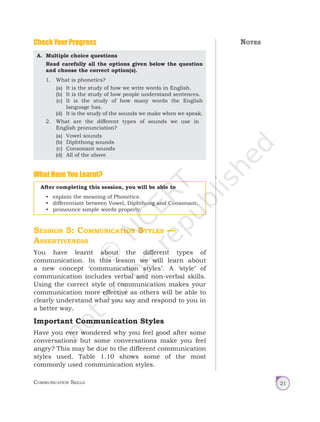
  • 28.
    Employability Skills –Class XI 28 How to Say ‘No’? Remember the vowels AEIOU? You can follow the steps for saying ‘No’ politely by using the AEIOU model. Table 1.12 explains these steps using two situations where you need to say ‘no’, with examples of possible responses. Table 1.12 Steps for Saying No — The AEIOU Model Situation 1 Someone asks you to leave school (or work) early so that you can go to a friend’s house together. You think it is wrong. Situation 2 A friend asks you to do his or her school assignment (or work) for him or her. A - Ask questions Ask questions to find how important a task is before saying no Why do we need to leave school or work early? Why can’t we go after school or work? Why aren’t you going to do it? Is it correct for me to do it? E- Engage by using polite statements If you are sure that you need to say ‘no’ to the request, you must refuse politely I would like to go with you to his or her house but… (give your reason) I would be glad to help you but … (give your reason) I- Include a reason for saying no Two points to remember when you are refusing someone’s request: Give an explanation of your feelings Give an explanation of your reasons I don’t like to ... I can’t come because …. I would like to go to your house but I feel it is not the right thing to do It doesn’t feel right to ... I can’t do it because I will not have the time…. O- Offer other options You may — • Suggest a different time • Suggest a different place • Direct them to someone else who can help immediately I would like to go to your house but I feel it is not the right thing to do. Can we go after school or work? I would be glad to help you with the assignment, but, I am still not done with mine. But, if you want, we can work on it together U- Thank the person Thank the people for understanding your situation Thank you for agreeing to my suggestion Thank you for understanding Unit 1.indd 28 14-03-2019 10:37:50
  • 29.
    Communication Skills 29 Somemore examples of different ways of saying ‘no’ politely are listed here: • I’m sorry I cannot come as I have other plans. • I’m sorry but I have a meeting to attend. • I have made other plans so I won’t be able to join you. • I have an important meeting to attend so I won’t be able to join you. • Thanks for asking, but I have to attend an important meeting. • I would love to come, but I cannot miss the meeting with my manager. Connecting Words (Conjunctions) Did you notice a few words, such as — ‘and’, ‘but’, ‘or’, ‘because’ and ‘so’ which have been used in the examples? Such words are called ‘conjunctions’ and are used to connect two sentences. Conjunctions are often used in sentences where you say no. Table 1.13 shows some examples. Table 1.13 Connecting Words (Conjunctions) AND ‘And’ is used to connect two words or sentences of equal importance ‘No, my brother won’t be able to come. No, I won’t be able to come’ can be written as ‘No, my brother and I won’t be able to come.’ BUT ‘But’ is used to join two sentences that suggest different ideas ‘I would love to come to your party. I can’t come because of other plans’ can be written as ‘I would love to come to your party, but I can’t come because of other plans.’ OR ‘Or’ is used when we need to show a choice between two words or sentences ‘No, you can go with Dia. No, you can go with Ali.’ can be written as ‘No, you can go with Dia or Ali.’ SO/ AS/ BECAUSE ‘So’, ‘As’, and ‘Because’ are used to join two sentences, when one sentence acts as a reason for the second sentence ‘I have a meeting. I can’t come.’ can be written as ‘I have a meeting, so I can’t come.’ Unit 1.indd 29 14-03-2019 10:37:50
  • 30.
    Employability Skills –Class XI 30 The teacher will facilitate these activities by showing you the e-learning module for this lesson via http://www.psscive.ac.in/ Employability_Skills.html. The module will include videos and e-content for the above topics as well as detailed instructions for some activities below. Initial thinking activity After watching the initial video in the e-learning lesson on ‘saying no’ think on the following and write your answer (i) Have you ever had to say no to your parents? (ii) If the answer to point no. 1 is yes, then what was the reason. Activity 1 Group Discussion — Communication Styles Material Required None Procedure 1. Form groups and based on the initial video of the lesson, discuss with each other — • Is it rude to say ‘no’? • How would you respond in a similar situation? 2. The teacher will ask some groups to volunteer and discuss their observations (for example, what did you learn from the lesson?). Activity 2 Group Exercise — Effective Communication — Saying No Material Required None Procedure 1. Form even number (2/4/6) of groups with five students in each group. 2. Two groups will perform the activity together. One person each from Group 1 and Group 2 should come forward one by one. 3. The members of Group 1 have to ask questions to Group 2 members. The person from the second group has to say ‘no’ to each question, politely. Use all the sentences and connectors you have learnt about. 4. After everyone has asked and answered a question, switch roles so that Group 2 asks questions and Group 1 gives answers. 5. At end of the activity, the teacher should share the best answers with the whole class. Notes Unit 1.indd 30 14-03-2019 10:37:51
  • 31.
    Communication Skills 31 A.Multiple choice questions Read carefully all the options given below the question and choose the correct option(s). 1. One of your friends is taking a leave and wants you to tell the teacher that he is sick. What should you tell your friend? (a) Yes, I can do that. (b) No, I cannot do that because I don’t want to lie to the teacher. (c) I understand that you want to take leave but why don’t you tell the correct reason? (d) No. I cannot help you. 2. Select the option which completes the sentence correctly — I have to go to the doctor____ I will not be coming to school on Monday. (a) and (b) but (c) so (d) because B. Match the requests with the correct responses Request Response 1. Can I borrow your notebook? A. No, I feel that is wrong. You should do it yourself but I can help if you have doubts. 2. Please come with us for the movie. B. I’m sorry but I didn’t get my Notebook today 3. Can I copy your homework? C. I can’t come because I need to complete my homework. 4. Come to my party on Tuesday. D. I would love to, but I will be going to Delhi. Notes Check Your Progress What Have You Learnt? After completing this session, you will be able to • demonstrate the knowledge of using refusal skills. • make use of appropriate sentences for saying no to requests that are not acceptable to you. Session 7: Writing Skills — Parts of Speech When we talk or write in English, we use sentences to express ourselves. Sentences are important because if you do not clearly write sentences then, the meaning of the same cannot be understood clearly. A sentence is a Unit 1.indd 31 14-03-2019 10:37:51
  • 32.
    Employability Skills –Class XI 32 Table 1.14 Capitalisation Rules Alphabet M I N T S What it shows: Months word ‘I’ Names Titles Starting letter of sentences Rule Capitalise the first letter in all the names of months Capitalise the letter ‘I’ when it is used as a word Capitalise the first letter in the names of people, places and days Capitalise the first letter in the titles used before people’s names Capitalise the first letter in every sentence Example I will go to college in June. Every day, I play tennis with him. This Tuesday, Vidya will be in Rajasthan. Dr Shah and Mr Patel work together. The cat ran out of the house. group of words that communicate a complete thought (for example, Raju goes to school). A group of words, which does not make complete sense, is known as a phrase (for example, Raju goes). A sentence always begins with a capital letter, and it always ends with a question mark, full stop or exclamation mark. Read aloud the examples given below. • Did you work on your project? • I completed it yesterday. • That is good! Using Capitals We know that all sentences begin with capital letters. Do you know at what other points in a sentence we should use capital letters? It is easy to know what to capitalise if you remember the word ‘MINTS’. MINTS is a set of simple rules that help you capitalise words correctly. Each letter in the word MINTS refers to one capitalisation rule as shown in Table 1.14. Punctuation Punctuation is a set of marks, such as the full stop and the comma, which help us separate parts of a sentence and explain its meaning. Like capitalisation, punctuation is also a very important part of sentences and has some rules. Some common punctuation marks are shown here in Table 1.15. Unit 1.indd 32 14-03-2019 10:37:51
  • 33.
    Communication Skills 33 Table1.15 Punctuation Punctuation name Sign Use Example Full stop . Shows the end of a sentence. Also used to show short form of long words, for example, ‘doctor’ can be shortened when we use it as a title before a name. This is a sentence. This is another sentence. Sanjay is a doctor. His patients call him Dr Sanjay. Comma , • Sometimes, we use a comma to indicate a pause in the sentence. After the waiter gave me a menu card, I ordered food. • We can also use a comma to separate items when we are listing out more than two items in a row. I bought apples, oranges and grapes. Question mark ? We use a question mark at the end of a question. What is your name? How old are you? Exclamation mark ! We use an exclamation mark at the end of a word or a sentence to indicate a strong feeling, such as surprise, shock or anger. What a pleasant surprise! You are late! Apostrophe (‘) We use an apostrophe followed by an ‘s’ to show that something belongs to someone. That is Divya’s pen. Are these Abdul’s books? We also use an apostrophe to indicate the shortened form of some words in informal speech. Let’s go. (Instead of Let us go.) He isn’t here. (Instead of He is not here.) Nouns Verbs Pronouns Adverbs Adjectives Figure 1.8 Parts of Speech Basic Parts of Speech Unit 1.indd 33 14-03-2019 10:37:51
  • 34.
    Employability Skills –Class XI 34 Let us now see how these words are used. Read aloud the sentence given below. Wow! Reema went to the studio and met a famous actor. We already know that Reema, studio and actor are nouns. Famous is an adjective here because it describes the noun ‘actor’ and the words ‘went’ and ‘met’ are verbs because they describe an action. The different types of words we use in sentences are called parts of speech. Some examples are nouns, pronouns, adjectives, verbs and adverbs as shown in Figure 1.8. Let us read more about them in Table 1.16. Table 1.16 Parts of Speech Parts of Speech What they do Example sentences Example words Noun Nouns are words that refer to a person, place, thing or idea. These are ‘naming words’ In the sentence, “Reema wrote a letter.” both Reema and letter are nouns. Dog Kindness India Sanjay Pronoun A pronoun is a word used in place of a noun In the second sentence, “Reema wrote a letter. She is tired.” ‘She’ is used in place of the noun Reema, and it is a pronoun I They He You Adjectives Adjectives are words that describe other words In the sentence: “Reema wrote a long letter.” ‘Long’ is an adjective that describes the noun ‘letter’. Small Blue Sharp Loud Verbs Verbs are words that show action In the sentence: “Reema wrote a letter.” ‘Wrote’ is the verb. It tells what action Reema did. Run Eat Think Sit Adverbs Adverbs are words that add meaning to verbs, adjectives, or other adverbs. They answer the questions — How? How often? When? and Where? In the sentence: “Reema quickly wrote a letter.” ‘Quickly’ is an adverb. It tells us how Reema did the action (writing) Easily Always Inside Before Unit 1.indd 34 14-03-2019 10:37:51
  • 35.
    Communication Skills 35 Whatabout the remaining words in this sentence: wow, to, the, and? What are these words called? We use such supporting words to join the main parts of speech together and to add information to the sentences we make. Let us now look at some types of these supporting words. Supporting Parts of Speech Types Along with the main ‘Parts of Speech’, there are some more words we need for making a sentence. These are shown in Figure 1.9. Let us learn more about them using Table 1.17. Table 1.17 Supporting Parts of Speech Supporting Parts of Speech Use Example Articles The words ‘a’, ‘an’ and ‘the’ are known as articles. Articles are generally used before nouns. An is used before words beginning with a vowel (a.e.i.o.u) sound A is used before nouns with a consonant (all other alphabets) sound The is used to refer to specific or particular words The car stopped suddenly because a cat ran in front of it. A book An apple An umbrella The sun Conjunctions Conjunctions are words that join two nouns, phrases or sentences. Some common conjunctions are ‘and’, ‘or’ and ‘but’. Instead of: Sheela went to the market. I went to the market. Sheela and I went to the market. Instead of: Do you want oranges? Do you want apples? Do you want oranges or apples? Figure 1.9 Supporting Parts of Speech Articles Conjunctions Prepositions Interjections Unit 1.indd 35 14-03-2019 10:37:51
  • 36.
    Employability Skills –Class XI 36 Prepositions Prepositions connect one word with another to show the relation between them. They usually answer the questions ‘where’, ‘when’ and ‘how’. Some common prepositions are ‘on’, ‘at’, ‘under’ and ‘in’. The cat is on the roof. The shop is at the end of the road. Rahul is standing under the tree. I live in Delhi. Interjections These words express strong emotions, such as happiness, surprise, anger or pain. They have an exclamation mark at the end. Wow! Oh! Oh no! Thanks! Help! The teacher will facilitate these activities by showing you the e-learning module for this lesson via http://www.psscive.ac.in/ Employability_Skills.html. The module will include videos and e-content for the above topics as well as detailed instructions for some activities below. Initial thinking activity After watching the initial video in the e-Learning lesson for this topic can you identify the parts of speech. Activity 1 Group Exercise — Identifying Parts of Speech Material Required Notebook, pen Procedure 1. Form groups of four students each. One by one, the students read aloud the paragraph given below. “on sunday, i have an appointment to meet dr.patel in delhi. my house is near mr patels shop i went to his shop on friday to buy vegetables I bought potatoes onions carrots and a cabbage mr patel is a friendly man have you met him” 2. This paragraph contains examples of the parts of speech you learnt about in this lesson. 3. Each group discusses and identifies as many of these parts of speech as they can and mark them. 4. They re-write the paragraph with proper punctuation. Unit 1.indd 36 14-03-2019 10:37:51
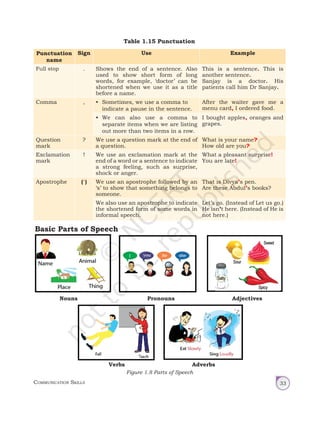
  • 37.
    Communication Skills 37 Activity2 Group Exercise — Constructing Sentences Material Required Notebook, pen Procedure 1. Form pairs of students. 2. List out five parts of speech that you learnt in the lesson. Select one of them and create two simple sentences which use these parts of speech. For example, if you have chosen adjectives, create two sentences that have adjectives. 3. For each part of speech, a volunteer reads out their sentences. The other students say if it is correct. Activity 3 Group Exercise — Identify Name, Place, Animal, Thing Material Required Notepad and pens Procedure 1. Number yourselves from 1 to 5. One set of 1–5 is in one group and so on. 2. Each member of a group has to say a word that is either a name, place, animal or thing; the fifth member has to do an action. 3. Each group gets 30 seconds to think what they are going to say and do. A. Multiple choice questions Read carefully all the options given below the question and choose the correct option(s). 1. What is a sentence? (a) A group of ideas that forms a complete paragraph. (b) A group of words that communicates a complete thought. (c) A set of rules that we must follow to write correctly. (d) A set of words that contains all the basic punctuation marks. 2. Which of these sentences is capitalised correctly? (a) I am Hungry. (b) Divya and sunil are reading. (c) The bucket is Full of water. (d) She lives in Delhi. Check Your Progress Notes Unit 1.indd 37 14-03-2019 10:37:51
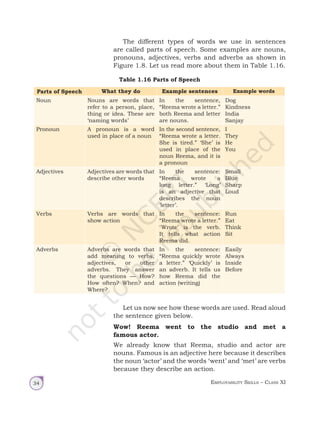
  • 38.
    Employability Skills –Class XI 38 3. Which of these sentences are punctuated correctly? (a) Where are you going. (b) I have a pen a notebook and a pencil. (c) I am so happy to see you! (d) This is Abdul’s house? B. Write the following sentences in your notebook and mark the nouns, pronouns, adjectives, verbs and adverbs in these sentences. (a) Sanjay plays football everyday. (b) Divya gave him new books. (c) I opened the red box carefully. C. Fill in the blanks 1. Fill correct nouns and verbs from the table to complete the sentence in the table given below. Nouns Verbs girl, girls, boy, milk, dog skipping, cycling, running, studying, drinking, barking a. The ____________ is _____________. b. The _____________ are _____________. c. The ____________ is _____________. d. Raju is __________. e. The ____________ is _____________. f. The _____________ is _____________. C. Subjective question 1. Identify the conjunctions and prepositions (Remember, conjunctions join two sentences while prepositions help answer the words ‘where’, ‘when’ and ‘how’.). Write the conjunctions and prepositions from the list given below in the correct box. • Under, And, In, At, Or, Up Conjunction Preposition Notes Unit 1.indd 38 14-03-2019 10:37:52
  • 39.
    Communication Skills 39 Session8: Writing Skills — Sentences Parts of a Sentence As you have learnt in English classes, almost all English sentences have a subject and a verb. Some also have an object. A subject is the person or thing that does an action. A verb describes an action. Object is the person or thing that receives the action. For example, read aloud a simple sentence “Divya reads a book”. Let us see the different parts of the sentence in Figure 1.10. Figure 1.10: Parts of a Sentence After completing this session, you will be able to • use capitalisation and punctuation rules in writing sentences. • identify the basic parts of speech, such as nouns, pronouns, adjectives, verbs and adverbs. • explain the usage of the parts of speech. • identify the supporting parts of speech, such as articles, conjunctions, prepositions and interjections. Read aloud the example sentences shown in Table 1.18 and understand which is the subject, verb and object. Table 1.18 Parts of a Sentence Sentence Subject Verb Object I ate an apple. I ate an apple. He cooked dinner. He cooked dinner. She kicked the football. She kicked the football. Dia and Sanjay broke the bottle. Dia and Sanjay broke the bottle. Unit 1.indd 39 01-04-2019 16:40:18
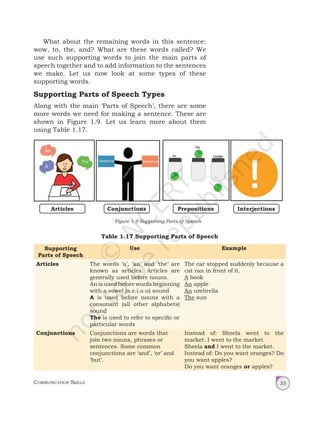
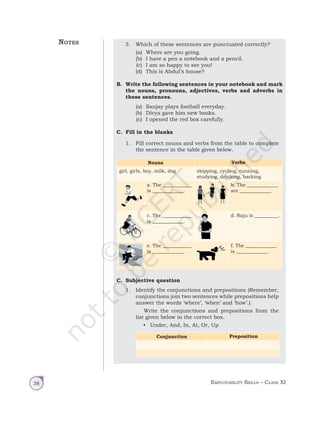
  • 40.
    Employability Skills –Class XI 40 Figure 1.12 Types of Sentences Types of Objects The object in a sentence can be either direct or indirect. Direct objects are the ones directly ‘acted on’ by the action word (verb). If the verb is ‘reads’ and we ask “What does Divya read?” The answer is ‘book’ which is the direct object.A direct object answers the question ‘what?’ An indirect object answers questions, such as ‘to whom’ and ‘for whom’. For example, in the sentence “Abdul gave a gift to his mother.” The verb is ‘gave’. As you can see in Figure 1.11, there are two objects here — ‘gift’ and ‘mother’ What did Abdul give? A gift. To whom did Abdul give a gift? To his mother. Here, ‘gift’ is the direct object and ‘his mother’ is the indirect object. Some sentences only have direct objects while some have both direct and indirect objects. Read aloud the examples given in Table 1.19 and practice finding the direct and indirect objects. Figure 1.11 Indirect Objects Table 1.19 Direct and Indirect Objects Sentence Verb Verb + What? Verb + By whom/to whom? Direct Object Indirect Object Reema bought vegetables. bought vegetables vegetables Fatima and Sonia played tennis. played tennis tennis He offered me a chocolate. offered chocolate me chocolate me The teacher gave us homework. gave homework us homework us Types of Sentences Active and Passive Sentences Read aloud the sentence shown in Figure 1.12. What is the difference between the two sentences? 1. Sanjay broke the glass. 2. The glass was broken by Sanjay. Unit 1.indd 40 14-03-2019 10:37:52
  • 41.
    Communication Skills 41 Theaction (verb) in both sentences is breaking of the glass. But the ‘subject’ of both sentences is different. In the first sentence, the subject (Sanjay) does the action. In the second sentence, the subject (the glass) receives the action. Read the sentences in Figure 1.13 again. Sentences where the subject does an action are known to be in the Active voice. Sentences in which the subject receives an action are known to be in the Passive voice. Read aloud some more examples given in Table 1.20. Table 1.20 Example of Active and Passive sentences Active Voice Passive Voice She wrote a letter. A letter was written by her. He opened the door. The door was opened by him. Mohan played the flute. The flute was played by Mohan. Types of Sentences (according to their purpose) Read aloud the sentences in Figure 1.14. How do you think they differ from each other? Each of these sentences has a different purpose. Also, notice how each sentence in Figure 1.15 ends. Figure 1.13 Active and Passive Sentences Figure 1.15 Description of Types of Sentences Figure 1.14 Examples of Types of Sentences Unit 1.indd 41 14-03-2019 10:37:52
  • 42.
    Employability Skills –Class XI 42 Table 1.21 Types of Sentences Statement or Declarative Sentence Question or Interrogative Sentence Emotion/Reaction or Exclamatory Sentence Order or Imperative Sentence This is the most common type of sentence. It provides information or states a fact. It always ends with a ‘full-stop’ (‘.’). This type of sentence asks a question. It always ends with a question mark (‘?’). An exclamatory sentence expresses a strong emotion, such as joy, sadness, fear or wonder. It always ends with an exclamation mark (‘!’). These sentences show an order, command, request, or advice. It can end with a full stop or an exclamation mark (‘.’ or ‘!’). Read aloud the examples given below I go to school. Did you go to school? I came first in class! Go to college today. It is very cold. How is the weather? Oh, it’s so cold! Wear your sweater. I completed my project. Did you complete your project? I completed my project! Complete your project. Paragraph You have learnt about sentences. A group of sentences forms a paragraph. While writing a paragraph, make sure the sentences have a common idea. When you want to write about a different idea, make a new paragraph.For example, if you are writing about your school, the first paragraph can be of sentences about the name, location, size and other such details. In the next paragraph you can use sentences to describe what you like about your school. I go to Government Higher Secondary School, Balachadi. It is not a very big school, but it has many good teachers. There are about 100 students in my school. My school is on the main road, very close to the city Railway Station. I love going to school and learning about new things. My school has a small playground where I play cricket with my friends after the classes are over. It has a library also. I love my school. Read the examples in Table 1.21 to practise the different types of sentences. Unit 1.indd 42 01-04-2019 16:43:19
  • 43.
    Communication Skills 43 Theteacher will facilitate these activities by showing you the e-learning module for this lesson via http://www.psscive.ac.in/ Employability_Skills.html. The module will include videos and e-content for the above topics as well as detailed instructions for some activities below. Initial thinking activity After watching the initial video in the e-learning lesson for this topic, think of the different types of sentences which were used in the story presented through the video. Classify the sentences as declarative, interogative, exclamatory or imperative. Activity 1 Pair-work — Making Sentences Material Required Notebook, pen Procedure 1. Form pairs. First, write down three sentences that contain direct objects. 2. Now, write down three other sentences that contain both direct and indirect objects. 3. Use different colours to mark the different parts of each sentence. (Subject, Verb, Object). Activity 2 Pair-work — Active and Passive Voice Material Required Notebook, pen Procedure 1. With the same pairs as Activity 1, write a paragraph on any topic. The paragraph should have at least two sentences in active voice and two sentences in passive voice. 2. One volunteer from each group reads out their paragraph to the class. Activity 3 Assignment work — Types of sentences Material Required Notebook, pen Procedure 1. Write eight sentences. These should have two sentences each of the following type: declarative, interrogative, exclamatory and imperative. Notes Unit 1.indd 43 14-03-2019 10:37:52
  • 44.
    Employability Skills –Class XI 44 A. Multiple choice questions Read carefully all the options given below the question and choose the correct option(s). 1. Identify the subject in the sentence, “The children played football.” (a) The children (b) Children played (c) Played (d) Football 2. Identify the object in the sentence, “The children played football.” (a) The children (b) Children played (c) Played (d) Football 3. Which of these sentences has both indirect and direct objects? (a) I am watching TV. (b) She bought a blue pen. (c) The girls played cricket. (d) He wrote his sister a letter. 4. Which of these sentences is in passive voice? (a) They are watching a movie. (b) The clock was repaired by Raju. (c) He is sleeping in the room. (d) My pet dog bit the postman. B. Subjective question 1. Write one sentence of each type — statement, question, exclamatory and order. 2. Which is your favourite festival? Write two paragraphs about your favourite festival. 3. Each paragraph should have a minimum of four sentences. Make sure you follow all the rules about sentences and paragraphs you have learnt. 4. Practice work: Practice speaking correct sentences with your classmates. Try and find the parts of sentences which you use commonly. Check Your Progress Notes After completing this session, you will be able to • identify the different parts of a sentence. • differentiate between active and passive voice. • identify and compose different type of sentences. What Have You Learnt? Unit 1.indd 44 14-03-2019 10:37:52
  • 45.
    Communication Skills 45 Session9: Greetings and Introduction We use certain words called ‘greetings’ before we start talking to friends, people familiar to us, or even people whomwearemeetingforthefirsttime.Alsoweusecertain sentences to describe ourselves or others to people who do not know about us. This forms an introduction. Greetings There are many ways to greet when you meet a person. The greeting and reply to a greeting at work is different from the greeting and reply given to a friend. Similarly, there are many ways to say goodbye when you depart. The greetings change depending upon who we are talking to and even according to the time of the day. Greetings help us start a conversation nicely as shown in Figure 1.16. Types of Greetings There are two methods of greetings as shown in Figure 1.17. Say the greetings given below aloud. Figure 1.16 Greetings and Introductions Figure 1.17 Formal and Informal Greetings Formal greetings are used if you do not know the person. It is used to greet a senior, elderly people or people with whom we have formal relations like teachers or customers. This is used more often in schools, colleges, offices, in meetings and at work. Unit 1.indd 45 14-03-2019 10:37:52
  • 46.
    Employability Skills –Class XI 46 Say aloud the formal greetings and replies given in Table 1.22. Table 1.22 Formal Greetings Greeting Reply Good morning everybody! Good Morning, Madam! Good morning, Sir! Good Morning, everyone! Hello Sir. How are you? Very well. Thank you? How are you? How are you Tina? I’m doing well. How are you, Sir? Informal greetings are used when you talk to friends, family or know the person very well. Say aloud the informal greetings or replies given in Table 1.23. Table 1.23 Informal Greetings Greeting Reply Hey! Hello or Hi! Hey! How are you doing? Hi! I am doing great! Hi! Good to meet you. We can also greet people according to the time of the day when we meet them — say aloud the greetings given in Table 1.24. Table 1.24 Greetings According to Time Time Greeting From early morning to 11.59 am Good morning 12 pm to about 5 pm (afternoon hours) Good afternoon 5 pm to midnight Good evening (We usually do not greet people by saying Good night even if it is night. We say Good night at the end of conversation) Introducing Yourself and Others When you are meeting someone for the first time, or if others want to know about you, you need to ‘introduce’ yourself. You can do this by telling your name and some general information like your hometown, your job or subjects as a student, your interests, etc. When introducing yourself, remember to look at the other person and smile. Some examples are shown here in Figure 1.18. Unit 1.indd 46 14-03-2019 10:37:52
  • 47.
    Communication Skills 47 Theteacher will facilitate these activities by showing you the e-learning module for this lesson via http://www.psscive.ac.in/ Employability_Skills.html. The module will include videos and e-content for the above topics as well as detailed instructions for some activities below. Initial thinking activity Have you come across such a situation? Based on the initial videos in the e-learning lesson for this topic, write down what do you think about introducing yourself to neighbours? How will you start a conversation politely? Activity 1 Role-play — Formal and Informal Greetings Material Required Notebook, pen Procedure 1. Form pairs of students. 2. Each pair should write about two conversations; one with formal greetings and one with informal greetings. 3. One volunteer from each pair acts this out in front of the class. 4. The class observes whether it is formal or informal greetings. Activity 2 Role-play — Introducing Someone Material Required Notebook, pen Figure 1.18 Introducing Yourself We can introduce someone to others by telling their name, what they do, how we know them, or even by describing something interesting about them. One example is shown in Figure 1.19. Figure 1.19 Introducing Others Unit 1.indd 47 14-03-2019 10:37:53
  • 48.
    Employability Skills –Class XI 48 A. Multiple choice questions Read carefully all the options given below the question and choose the correct option(s). 1. Which of these are formal greetings? (a) Good morning (b) Good evening (c) Good afternoon (d) All of the above 2. In which of these situations can you say ‘Hi’? (a) When you meet your teacher in class. (b) When you meet a senior. (c) When you meet your sister at home. (d) When you meet your friends at a shop. Check Your Progress Procedure 1. Use same pairs of students as in Activity 1. 2. Write conversations that generally happen to introduce someone to friends and family. 3. One volunteer from each pair demonstrates it for the class. The class observes whether the introduction has been made correctly or not. Activity 3 Practice and Discussion — Greetings Material Required Notebook, pen Procedure 1. Imagine that you are at home. The doorbell rings and you open the door. Write down • What would you say when you see your uncle standing at the door? • What would you say when you see your friend standing at the door? 2. One volunteer acts it out in front of the class. The class in the presence of the teacher discusses: • What is the difference in the way you greet your friends and teachers? • What are the different phrases used when greeting friends? • What are the phrases used when greeting elders? • What are the phrases used when greeting your superiors in the office? Notes Unit 1.indd 48 14-03-2019 10:37:53
  • 49.
    Communication Skills 49 3.At which of these times can you say ‘Good evening’? (a) 11am (b) 9am (c) 2pm (d) 7pm 4. Which of these details can you say while introducing a person? (a) The person’s name (b) How you know the person (c) Something interesting about the person (d) All of the above B. Subjective question 1. Write two to three lines you would use to introduce yourself. After completing this session, you will be able to • greet people formally and informally. • introduce yourself to other people. • introduce the other person to your friends. Session 10: Talking about Self You may need to talk about yourself on many occasions especially when you meet new people. You may also need to fill forms with information about yourself. In this lesson, you will learn how to describe (or ‘introduce’) yourself and write about yourself. Talking About Yourself When you meet someone for the first time, they may want to know more about you. You will need to ‘introduce’ yourself by telling them about yourself as shown in Figure 1.20. You usually start by telling your name. Then you can talk about other things, such as what you do, your age, where do you live, or even about the things or activities that you like or dislike.For all these sentences, you will use nouns and verbs. What Have You Learnt? Figure 1.20: Talking about Self My name is Amit. I like History. I don't like Maths. I study in Class IX. Unit 1.indd 49 14-03-2019 10:37:53
  • 50.
    Employability Skills –Class XI 50 A noun is a ‘naming’ word that is used for a person, place, thing, or idea. Some examples of nouns are Ali, Delhi, football and music. A verb is a ‘doing’ word that tells us what the noun does. Some examples of verbs are play, like, eat and write.Note that some verbs with an ‘ing’ ending can also act as nouns. Swimming is an example. We can talk about likes and dislikes using nouns as well as verbs that end with ‘ing’. For example, cycling, swimming. Table 1.25 shows how people talk about themselves. Read aloud. Table 1.25 Talking About Yourself Name I am Harish Sethi. My name is Anu. I am Lucy Peter. My name is Ali. What they do I am in high school. I am a student. I play cricket. I practice karate. Age I am 15 years old. I am sixteen years old. I am nine. I will be 17 soon. Hometown I stay in Agra. I live in Mumbai. I am from Goa. I am from Patna. Likes I like playing chess. I like swimming. I like carpentry. I like music. Dislikes I dislike summers. I do not like dolls. I dislike loud noise. I do not like playing football. Strengths I can write stories very well. I am a good public speaker. I can solve crossword puzzles quickly. I am a good team player. Weaknesses I leave tasks incomplete . I get angry easily. I cannot manage my time properly. I am nervous to speak in front of a large group. Filling a Form Sometimes, instead of talking, you will have to write about yourself in a form. A form is a typed or printed page with blank spaces for information. Each form is different, so you should read it properly before filling. Write neatly, while taking care to use the correct spellings. A form usually has the following fields for personal information as shown in Table 1.26. Unit 1.indd 50 14-03-2019 10:37:53
  • 51.
    Communication Skills 51 Table1.26 Filling a Form Name Here you enter your name. Sometimes you may need to write the first, middle (if any) and surname. Date of birth This is the date on which you were born. It is usually written as the day, followed by the month, followed by the year in numerals. Address This is the postal address which includes your house number and the details of the street, area and the city. PIN code This is a group of numbers used by the post office to identify a region. It is an important part of an address. Signature (or Sign) This is your name or initials written by hand, in a specific way (which is difficult for anyone else to copy). Other information is to be filled according to the requirements of the form. Example Harish Sethi was born on 5 December 1999. He lives in Agra, in a house named Sukh Nivas. His house number is 13 in Raja Nagar. His postal code is 282001. Harish filled a form asking for personal information like this. First Name Harish Last Name Sethi Date of Birth 5 December 1999 (or 05-12-1999) Address Sukh Nivas, No. 13, Raja Nagar, Agra Pin Code 282001 The teacher will facilitate these activities by showing you the e-learning module for this lesson via http://www.psscive.ac.in/ Employability_Skills.html. The module will include videos and e-content for the above topics as well as detailed instructions for some activities below. Initial thinking activity After watching the initial video in the e-learning lesson for this topic think about yourself and write at least three sentences about yourself? Activity 1 Pair-work — Introducing Yourself and Filling Forms Material Required Notebook, pen Unit 1.indd 51 14-03-2019 10:37:53
  • 52.
    Employability Skills –Class XI 52 Notes Procedure 1. Form pairs of students. 2. Introduce yourself to your partner, giving the details necessary to fill a form. Your partner should fill in the form with your details in his or her notebook. When all the students have finished filling the form, read the information given carefully and check whether the details are correct. 3. Now, your partner should talk about him or her while you fill the form in your notebook with his or her details. 4. After you finish, your partner should check information given in the form. Activity 2 Group Exercise — Talk About Yourself Material Required Notebook, pen Procedure 1. Form groups of four students each. 2. Take turns and one by one, introduce yourself to the others in the group. 3. Use the steps and expressions that you learnt in the lesson. Remember to present your likes and dislikes as well! Each person has one minute to talk about himself or herself. 4. When one person talks, the others should correct and guide him or her. Practice work Maintain a diary to show the assignments to your teacher. The assignments may include the following: • Introducing yourself to the new people you meet • Telling your friends about your likes and dislikes • Asking your family members to show you some forms they have filled in. • Creating a signature for yourself. • Creating a simple form. Give copies to your friends and ask them to fill in the form. Guide them if they do not know how to fill it in. Unit 1.indd 52 14-03-2019 10:37:53
  • 53.
    Communication Skills 53 A.Fill in the blanks 1. Use the following words to complete the form given below: football and swimming, seven years old, Hassan, Yasmin, in Bangalore. (a) My first name is __________. (b) My surname is ___________. (c) I am ___________. (d) I live ___________. (e) I do not like ___________. B. Multiple choice questions Read carefully all the options given below the question and choose the correct option(s). 1. Select the correct answer for the following question: A postal code is_______________ (a) a group of numbers or letters used to identify a government building. (b) a code used to indicate the door number of a house. (c) a group of numbers or letters used by the post office to identify a region. (d) A code used to identify different post offices. Check Your Progress After completing this session, you wil be able to • answer questions that others ask about you. • talk about your likes and dislikes with your friends. • fill out a form with some basic personal details. Notes What Have You Learnt? Session 11: Asking Questions A question is a sentence, phrase, or word that either asks for information or is used to test someone’s knowledge. We always use a question mark (?) at the end of a question. In our day-to-day interactions with others, we often have to ask and answer questions to get information. Asking the correct questions can help us get the information we want as shown in Figure 1.21. What are the Two Main Types of Questions? There are two basic types of questions: close-ended questions and open-ended questions. Figure 1.21 Questions and Information Unit 1.indd 53 14-03-2019 10:37:53
  • 54.
    Employability Skills –Class XI 54 Questions that can be answered with a ‘yes’ or a ‘no’ are called close-ended questions. That is because the answer options are limited or closed. For example, when we ask: ‘Are you hungry?’, the answer could be either ‘Yes’ or ‘No’. (see Figure 1.22) Sometimes, when we ask a question, we expect an answer with more details. For example in Figure 1.22 when we ask: “What would you like to eat?”, the answer could be: “I would like to eat an apple.” These are called open-ended questions because their answer options are not limited or closed. In this case, the person could have said mango, orange or any other fruit. How to Frame (or Form) Questions? Forming Close-ended Questions We can form close-ended questions by adding helping verbs (called auxiliary verbs) like Be, Do and Have. These convey additional information, such as time and mood. Besides these, there are other auxiliary verbs (called modal verbs), such as Can, May, Should which show possibility or necessity. One method of forming close-ended questions is to take a sentence without the above words and place such words before the subject. For example, the sentence “I like it” can be changed into a close-ended question by adding the word ‘do’ before the subject ‘I’. This creates the close-ended question: “Do I like it?” Read aloud the other examples shown in Table 1.27. Figure 1.22 Open-ended Question Figure 1.23 Close-ended Question Table 1.27 Close-ended Questions Sentence Close-ended questions after adding helping verbs They talk on the phone every day. Do they talk on the phone every day? You share your lunch with your friends. Could you share your lunch with your friends? Please Note: This helping verb changes based on the subject, but the main verb remains unchanged. For example, in the sentences and the questions below, the main verb (cook) remains unchanged, but the auxiliary verb (do) changes based on the subject. Unit 1.indd 54 14-03-2019 10:37:53
  • 55.
    Communication Skills 55 Readaloud the other examples given in Table 1.28. Table 1.28: Close-ended Questions with Helping Verbs Sentence Close-ended questions after adding helping verbs I cook dinner. Do I cook dinner? She can cook dinner. Can she cook dinner? They cook dinner. Do they cook dinner? In some cases, we exchange the positions of the subject and the verb to create a close-ended question. We can follow a similar method for sentences that already have auxiliary verbs. Read aloud the other examples shown here in Table 1.29. Table 1.29 Close-ended Questions (Subject/Verb exchanged) Sentence Close-ended questions after exchanging positions of the subject and the verb He is there. Is he there? They were cleaning their room. Were they cleaning their room? You can help me. Can you help me? Forming Open-ended Questions — Using Question Words Some questions are called open-ended because their answer options are not limited or closed. They have to be answered with more information than just a ‘  yes’ or a ‘no’. We can form open-ended questions by using question words, such as What, Why, Who, How, When and Where. Read aloud the other examples shown here in Table 1.30. Notice how these questions CANNOT be answered with a ‘yes’ or a ‘no’. Table 1.30 Open-ended Questions with Question Words Open-ended questions Answer sentence What did you do? I went to the park. Why did you go there? I went to meet my friend. How did you go? I cycled. Unit 1.indd 55 14-03-2019 10:37:53
  • 56.
    Employability Skills –Class XI 56 The teacher will facilitate these activities by showing you the e-learning module for this lesson via http://www.psscive.ac.in/ Employability_Skills.html. The module will include videos and e-content for the above topics as well as detailed instructions for some activities below. Activity 1 Pair-work — Open-ended and Closed-ended Questions Material Required Notebook, pen Procedure 1. Form pairs of students. 2. Each pair writes 5 open-ended and 5 close-ended questions along with the answers for all 10 questions. 3. When all pairs have completed the activity, one volunteer pair reads out their questions and answers to the whole class. 4. The class gives its feedback on whether the questions are framed correctly or not. Activity 2 Group Exercise — Forming Questions Material Required Notebook, pen Procedure 1. Form groups of four students each. 2. Write a conversation between four people, with at least 6 questions (including close and open-ended questions). 3. One group volunteers to act it out in front of the class. 4. The other students give their observations on whether the questions were framed correctly or not. A. Multiple choice questions Read carefully all the options given below the question and choose the correct option(s). 1. What are close-ended questions? (a) Questions that can have any answer (b) Questions that do not have answers (c) Questions with yes or no answers (d) Questions that have many answers Check Your Progress Notes Unit 1.indd 56 14-03-2019 10:37:53
  • 57.
    Communication Skills 57 2.Which of these are open-ended questions? (a) Where do you live? (b) Are you hungry? (c) How do you feel? (d) Did you meet him? 3. Which is not a question word? (a) What (b) Want (c) Which (d) How 4. Which of these is the correct way to convert the sentence “You are studying” into a question? (a) You are studying? (b) Studying you are? (c) Are you studying? (d) Studying are you? B. Subjective question 1. Make a note of 10 questions your friends asked you. How many were open-ended questions? Make a list of 10 close-ended questions you have asked. What Have You Learnt? After completing this session, you will be able to • ask simple questions to solve your doubts. • identify close-ended and open-ended questions. • use the correct question words to ask open-ended and close-ended questions. Session 12: Talking about Family Introduction How big or small is your family? What happens when someone asks you about your family? What do you say? Can you introduce all your family members in English? Let’s learn some words which will help you introduce your family members and describe how you are related to them. Figure 1.24 Family Unit 1.indd 57 14-03-2019 10:37:53
  • 58.
    Employability Skills –Class XI 58 New Words — Names for Relatives Do you know the English names for different members of the family? Your mother and father are your parents. You may have one or more brothers or sisters as in Figure 1.24. • In English, parents of both mother and father are called Grandparents (Grandfather and Grandmother). • Sisters of both father and mother are called Aunts. • Brothers of both father and mother are called Uncles. • Children of all aunts and uncles are called Cousins. • Family members of the husband or wife are known as ‘in-laws’. – For example, brothers and sisters of the husband will be brothers-in-law and sisters-in- law for the wife. – Brothers and sisters of the wife will be brothers- in-law and sisters-in-law for the husband. – Parents of the wife will be father-in-law and mother-in-law for the husband. – Parents of the husband will be father-in-law and mother-in-law for the wife. Read and practice saying the words as shown in Figure 1.25 Figure 1.25 Relatives My Grandparents My Grandparents Grandfather Grandfather My father’s sister My Aunt My mother’s sister My Aunt My father’s brother My Uncle My mother’s brother My Uncle Sister-in-law Brother-in-law My Cousins Father My sister Myself I am Tina. Meet my family My Brother Their children My Parents Mother Her son Grandmother Grandmother Their children Their children Their children His daughter Their children M y father’s parents M y m other’s parents Unit 1.indd 58 19-03-2019 16:18:35
  • 59.
    Communication Skills 59 NewWords — Words that Show Relations Did you notice the words? (my, father’s, mother’s, their) In ‘father’s sister’ the word ‘father’s’ describes the relation with the noun ‘sister’. If you remember, words which describe a noun or a pronoun are called adjectives. The type of adjectives which describe relations or ownership (possession) are known as Possessive Adjectives. Possessive adjectives can be used to show a relation between people and owner of things. The common relation words are given in Table 1.31. Read and practice saying the words aloud. Table 1.31 Words Showing Relations — Possessive Adjectives Word Meaning Example Example my Belongs to/related to me My mother is a teacher. This is my book. your Belongs to/related to you Where is your sister? Is this your book? his Belongs to/related to him His cousin plays cricket. That is his house. her Belongs to/related to her She loves her father. I like her dress. its Belongs to/related to it The baby is looking for its mother. Keep the ball in its place. our Belongs to/related to us Our grandparents live in Simla. We love our school. their Belongs to/related to them Parents take care of their children. We visited their house. We also use the sign (’) with and ‘s’ to show the owner or related person, as shown in Table 1.32. Table 1.32 Words Showing Ownership or Relations Word Meaning Example 1 Example 2 father’s Belongs to/related to father My father’s sister loves us. My father’s car is red in colour. mother’s Belongs to/related to mother My mother’s mother is my grandmother. My mother’s work never ends. Ravi’s Belongs to/related to Ravi Ravi’s sister is my friend. Ravi’s house is far away. Mr Sharma’s Belongs to/related to Mr Sharma Mr Sharma’s uncle is very old. Mr Sharma’s office is well lit. Unit 1.indd 59 14-03-2019 10:37:53
  • 60.
    Employability Skills –Class XI 60 Read out these lines as Tina talks about her family. Notice the relation words that have been underlined and the relations which have been shaded. • My name is Tina. • My mother is a teacher. • My father works in a hotel. • My brother’s name is Raj and my sister’s name is Anju. • I have three aunts and two uncles. • Our grandparents stay in Simla. I love going to their house but it is far from our school. How would you describe your family? The teacher will facilitate these activities by showing you the e-learning module for this lesson via http://www.psscive.ac.in/ Employability_Skills.html. The module will include videos and e-content for the above topics as well as detailed instructions for some activities below. Activity 1 Pair-work — Talking about Family Material Required None Procedure 1. Form pairs of students. 2. Ask your partner any five questions about his or her family. The partner has to answer your questions by talking about his or her family members. 3. Then the partner will ask you any five questions about your family and you will need to talk about your family. Activity 2 Role-play — Family Relations Material Required Pen and paper Procedure 1. Form groups of five to eight students in each group. 2. Make chits with names of family members, such as father, mother, uncle, brother, cousin, etc., on them. Leave one chit blank. Notes Unit 1.indd 60 14-03-2019 10:37:53
  • 61.
    Communication Skills 61 A.Multiple choice questions Read carefully all the options given below the question and choose the correct option(s). 1. Your mother’s or father’s sister is your _________ . (a) parent (b) sister (c) uncle (d) aunt 2. Your uncle’s children are your _________ . (a) parents (b) cousins (c) brother (d) sister 3. A father-in-law is my _________ . (a) mother’s father (b) cousin’s father (c) uncle’s father (d) husband or wife’s father 4. Your father’s or mother’s brother is your _________ . (a) cousin (b) uncle (c) parent (d) brother B. Subjective question 1. Describe your family in 5–8 sentences. 3. Everyone should pick a chit and act according to that role. The person who gets the blank chit will ask questions to everyone else about their role in the family. 4. Everyone else will talk about their relations to each other. For example, I am your father. This is your uncle. 5. Then the person with the blank chit will introduce the ‘family’ to the class. What Have You Learnt? After completing this session, you will be able to • talk about your family and describe relationships. • use ‘possessive adjectives’ to talk about things that belong to you or others. Check Your Progress Notes Unit 1.indd 61 14-03-2019 10:37:53
  • 62.
    Employability Skills –Class XI 62 Session 13: Describing Habits and Routines A habit (Figure 1.26) is a practice that we follow, especially one that is very hard to stop or give up. For example, getting up at a particular time is a habit. A routine is a regular, ordered way of doing activities at a fixed time. There are some phrases that can be used to describe your routine. Some words like every day, usually (or generally), always, sometimes, never, etc., can be used to describe our habits and routines. Concept of Habits and Routine — Priya’s Day How would Priya describe her daily routine to a friend? Read aloud the sentences given in Table 1.33. Table 1.33 Priya’s Routine My daily ROUTINE is this Every day, I get up at 7 am. I take a bath at 7.30 am. I have my breakfast at 8.00 am. I go to school at 8.30 am. I come back home at 2.00 pm. Then I iron and fold my clothes. I have dinner with my family at 7.00 pm. Then I help wash the utensils. I watch TV at 8.00 pm. I go to sleep at 9.00 pm. All the above steps, done one after the other, form Priya’s routine. She does them daily, in the same order! Some are habits (like taking a bath, watching TV) and some are work or chores (like washing utensils). Let us see how Priya describes her habits (things she usually does) to her friend Reena. Read aloud the sentences given in Table 1.34 (first read Priya’s dialogue and then read Reena’s dialogue). Figure 1.26 Habits Unit 1.indd 62 14-03-2019 10:37:54
  • 63.
    Communication Skills 63 Thewords that are in bold — always, never, sometimes — are used to describe when you do an activity. They are called Adverbs of Frequency. They describe how often something happens. They are useful in describing habits. Other examples of such adverbs are shown in Table 1.35. Table 1.34 Priya’s Habits Priya Reena Hi Reena! Hi Priya, your hair looks so good. Thank you Reena. I always oil and comb my hair. That’s a good habit. I never oil my hair. You must do that Reena. Have you completed the science homework? Yes I have. I always finish my homework on time. That’s a great habit. I have not completed the homework. I sometimes forget to finish my homework. Don’t worry, come I’ll help you with the homework. Table 1.35 Adverbs of Frequency For regular activities weekly, daily, yearly, always I go to the temple weekly. For irregular activities sometimes, often, rarely I sometimes go to the temple. The teacher will facilitate these activities by showing you the e-learning module for this lesson via http://www.psscive.ac.in/ Employability_Skills.html. The module will include videos and e-content for the above topics as well as detailed instructions for some activities below. Activity 1 Pair-work — Discussing habits and routines Material Required Notebook, pen Procedure 1. Form pairs of students. 2. Both partners make a table in this format (You can change the details). Time What do I do at this time? 6 am – 6.30 am I get up and get ready for the day. 6.30 am – 7.00 am I take a bath. … and so on … Unit 1.indd 63 14-03-2019 10:37:54
  • 64.
    Employability Skills –Class XI 64 3. Take 5 minutes to fill in such a table about your daily activities in your notebook. Ask your partner about their routine. Listen carefully. Now your partner will ask you about your routine. Read aloud your routine to them. 4. Make a table in your notebook and fill it with your partner’s routine details. 5. Exchange your notebooks and each will check if the partner has filled all details correctly. Activity 2 Group-practice — Describing routines Materials Required Notebook, pen Procedure 1. Form groups with five people in each group. 2. Choose a leader. The group leader will assign a role to each student: movie star, sports player, politician, teacher, doctor, etc. Then, think about the daily routine of your character. 3. The leader will interview student 1. Student 1 will interview student 2 and so on. 4. Finally, take some time to discuss about the routines of the characters. A. Fill in the blanks Using the Correct Option 1. Write the correct adverbs of frequency that can be used in the following sentences against each sentence (Options — Seldom, Sometimes, Usually, Always, Never) (a) I eat breakfast every day._______________ (b) I don’t drink coffee at all. _______________ (c) Once in a while I walk to the beach. ___ (d) I generally play cricket after school. _____ (e) I rarely sleep in the afternoon. ______________ 2. Which of the following are chores (or work) and which are habits? Mark the chores as ‘C’ and habits as ‘H’. (a) I wash my clothes every day. _______________ (b) After dinner, I wash the dishes. _______________ (c) On Sunday, I clean my house. _______________ (d) I go to sleep at 10 pm. _______________ (e) I brush my teeth every morning. ______________ B. Arrange in Correct Sequence 1. Arrange the following adverbs of frequency in order of ‘all the time’ to ‘not at all’. Check Your Progress Notes Unit 1.indd 64 14-03-2019 10:37:54
  • 65.
    Communication Skills 65 Sesssion14: Asking for Directions Introduction Have you ever been lost and asked others for directions as in Figure 1.27? Have you sometimes given directions to others? In this lesson, you will learn to ask for and give clear directions to a place. How to Ask for or Give Directions When you need to go to a new place what do you do? You ask somebody or use a map. When you ask someone, you ask politely. Start by saying ‘Excuse me’ or by greeting them. Ask clearly for the place where you want to reach (for example, Central School, Raja Nagar, Railway Station, Kavi Nagar Post Office, Admission office inside a building) as shown in Table 1.36. Table 1.36 Asking for Directions Excuse me, can you please tell me the way to the National Bank? Excuse me, which way is the railway station? Excuse me, do you know the way to the Gandhi National Museum? Can you tell me the directions for reaching your home from the Town Hall? The other person will usually tell you in which direction you should go, how far, and where you need 2. Rarely (or seldom); Never; Often; Sometimes; Generally; Always C. Subjective questions 1. Write down the habits you want to create or the one’s you want to drop. 2. Write down the routine you will follow over a month before your final exams. After completing this session, you will be able to • describe your regular activities and tasks. • describe, in the correct order, the activities that you and other people do every day. What Have You Learnt? Figure 1.27 Directions Unit 1.indd 65 01-04-2019 16:45:29
  • 66.
    Employability Skills –Class XI 66 Table 1.37 Thanking Others Phrase When to use Thank You This is the polite way to answer when anyone helps you. Thanks It means the same thing, but is more casual (should be used only with friends or family). I appreciate that This is one more polite way to answer when someone does something for you. I really appreciate that You can use this for someone who goes out of their way to help you. When others thank you, you should accept by saying ‘welcome’, or ‘you’re welcome’. More About Directions Using Landmarks It is very helpful if you mention landmarks (places which are well known or easy to locate) like a bus stand, a lake, a bridge, big offices and schools, etc. while giving directions. To give directions using the location of well- known places, we use location or position words called ‘prepositions’. (Tip: prepositions show position). There are some other prepositions which are used to show time, but in this lesson we will practice using the position words. Some of these words are — on, near to, opposite, in front of. If someone asks you for directions, you should use the same method. Repeat the directions to make sure that you have understood correctly. You must thank the person who helped you, before leaving. Some words or phrases used for thanking others are given in Table 1.37. to take turns. Some terms for giving directions are shown in Figure 1.28. Figure 1.28 Terms for Giving Directions Turn Left Turn Right U-Turn Go Straight Go Past Cross A A A Figure 1.29 Describing Position Opposite Between Next to At the corner A A A B B D B A Unit 1.indd 66 19-03-2019 16:19:57
  • 67.
    Communication Skills 67 Figure1.30 Describe Locations Based on Landmarks The teacher will facilitate these activities by showing you the e-learning module for this lesson via http://www.psscive.ac.in/ Employability_Skills.html. The module will include videos and e-content for the above topics as well as detailed instructions for some activities below. Activity 1 Group-exercise — Role-play Materials Required Notebook, pen Procedure 1. Form groups with three students in each group. 2. Practise asking for and giving directions to different places. Your teacher may suggest some places or you can use places in your town as examples. 3. Discuss whether each person was able to give correct directions. 4. Discuss what you learned from this activity. Activity 1 Assignment — Write the direction shown by the symbols given below. _________ _________ _________ _________ Figure 1.30 shows examples of giving directions to a place (Cosmos Mall). Different prepositions have been used to give directions based on nearby landmarks. Unit 1.indd 67 14-03-2019 10:37:56
  • 68.
    Employability Skills –Class XI 68 What Have You Learnt? After completing this session, you will be able to • ask for directions, politely. • thank a person in different ways using the correct phrases. • give directions using the correct prepositions. Check Your Progress A. Fill in the blanks using the given prepositions (across, of, into, to) to complete the sentences. 1. Go _______ the bridge and on the other side you will see a park. 2. Turn left ________ Acacia lane. 3. Go past the newspaper shop and carry on until you come ______ a bridge. 4. Go out ______ the building and turn left. B. Multiple choice questions Read carefully all the options given below the question and choose the correct option(s). 1. Which of the following is the correct way of thanking someone? (a) Thank you (b) Thanks (c) I really appreciate that (d) All of the above C. Subjective question 1. Your classmates are coming to your house. Write the directions so that they can reach your home from your school. Notes Unit 1.indd 68 14-03-2019 10:37:56