Communicatio
n
The word COMMUNICATIONcome
from Latin word communicare, means ‘to
share’
Communication means how we
communicate each other and share our
thoughts and views
Part of
Communication
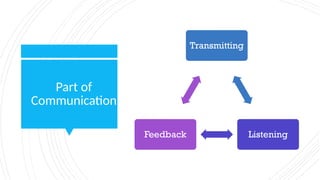
▪Transmitting:The sendertransmit the
message through one medium.
▪Listening:The receiver listen or
understands message.
▪Feedback:The receiver convey their
understanding of the message to the
sender in form of feedback to complete
the communication.
5.
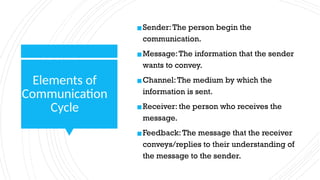
Elements of
Communication
Cycle
▪Sender:The personbegin the
communication.
▪Message:The information that the sender
wants to convey.
▪Channel:The medium by which the
information is sent.
▪Receiver: the person who receives the
message.
▪Feedback:The message that the receiver
conveys/replies to their understanding of
the message to the sender.
6.
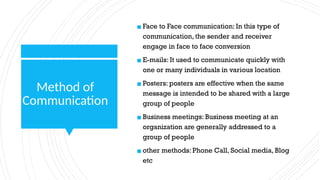
Method of
Communication
▪ Faceto Face communication: In this type of
communication, the sender and receiver
engage in face to face conversion
▪ E-mails: It used to communicate quickly with
one or many individuals in various location
▪ Posters: posters are effective when the same
message is intended to be shared with a large
group of people
▪ Business meetings: Business meeting at an
organization are generally addressed to a
group of people
▪ other methods: Phone Call, Social media, Blog
etc
7.
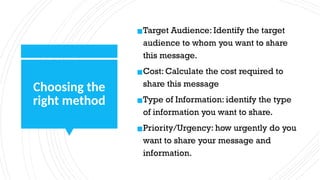
Choosing the
right method
▪TargetAudience: Identify the target
audience to whom you want to share
this message.
▪Cost: Calculate the cost required to
share this message
▪Type of Information: identify the type
of information you want to share.
▪Priority/Urgency: how urgently do you
want to share your message and
information.
Type of Verbal
Communicatio
ns
InterpersonalCommunication: It take place
between two individuals and is thus a one-on-
one conversation.
Written Communication:This form of
conversation involves writing word.
Small Group Communication:This type of
communication takes place when there are
more than two people involved.
4 Public Communication:This type of
communication take place when one individual
addresses a large meeting or gathering(Stage
Performance, Election Campaigns).
10.
Advantages of
Verbal
Communicatio
n
1. Inverbal communication, we can
share our ideas quickly and get a
quick response from the receiver
2. Verbal communication is very
interactive
3. we can modify our messages based
on the receiver’s response.
Non-verbal
Communication
Non-verbal Communication isthe
expression or exchange of information or
message without using any spoken or
writer word.
a. 55% communication is done using
body movements, face, arms etc.
b. 38% communication is done using
voice, tone, pauses, etc
c. only 7% communication is done using
word.
14.
Non-verbal
communicatio
n consists of:
1.Gestures:
a. Raising a hand to greet or say
goodbye.
b. Pointing your finger at someone.
2. Expressions:
c. Smiling when you are happy.
d. making a sad face when you are sad.
3. Body Language::
e. Postures by which attitudes and
feelings are communicated.
15.
Visual
Communication
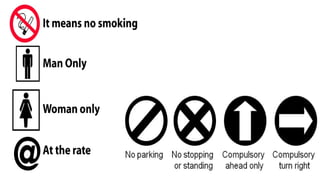
A.This type ofcommunication
proves to be effective since it
involves interchanging
messages only through
image or pictures.
B.Therefore, you don’t need to
know any particular language
for understanding it
Type of
Feedback
1. PositiveFeedback:Your friend looks at
your drawing and says,“wow, you are
really good at drawing!” this is positive
feedback.
2. Negative Feedback:Your presentation
was informative, but it could have been
more engaging. it is negative feedback,
but it is meant to help you improve and
be more careful in your next presentation.
3. No Feedback: It is also call negative
feedback with no improvement.
Advantages of
Descriptive
feedback
1. Understanding:It help the receiver
understand what the did right and
what they need to work on.
2. Motivation: It encourage them
because it shows they are doing well
in some areas.
3. Focused Improvement: it tells the
receivers exactly where to focus
their efforts to get better.
4. Two-way talk::the receiver can ask
questions.
5. Continuous Learning: It helps the
receiver keep learning.
21.
Effective
Communicatio
n
▪ Communication canonly be effective
when we follow basic professional
principle of Communication Skills(7Cs)
1. Clear: Be clear
2. Concise: Use simple words
3. Concrete: Use exact word and facts
4. Correct: Use correct grammar and spelling
5. Coherent:Words should make sense and
relate to the main topic.
6. Complete: Include all the needed
information.
7. Courteous: Be respectful, friendly and
honest
22.
Barriers to
effective
communicatio
n
Physical Barriers:Not being able to see
physical gestures, postures and general body
language can make communication less effective.
Linguistic Barriers:The inability to
communicate using a language is known as
language barrier to communication.
Emotional barriers: strong emotions like fear,
anger or stress can obstruct effective
communication.
Cultural Barriers: It occurs when people of
different cultures. for example, a gesture that is
acceptable in one culture may be offensive in
another culture.
23.
Way to overcome
barrierto
effective
communication
▪ Use simple Language
▪ Do not form assumptions on
culture, religion or geography
▪ Use Visuals
▪ Take help of a translator to
overcome differences in
language.
24.
Writing Skills-
Part ofSpeech
Writing speech is part of verbal
communication and include emails,
letter, notes, articles, SMS/chat,
blogs, etc.
1.Capitalization
a. Title
b. Word “I”
c. Names
d. Starting letter of sentences
25.
Writing Skills-
Part ofSpeech
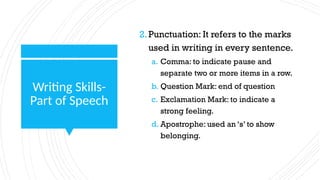
2.Punctuation: It refers to the marks
used in writing in every sentence.
a. Comma: to indicate pause and
separate two or more items in a row.
b. Question Mark: end of question
c. Exclamation Mark: to indicate a
strong feeling.
d. Apostrophe: used an ‘s’ to show
belonging.
26.
Basic Part of
Speech
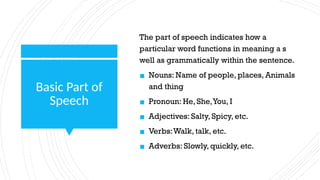
Thepart of speech indicates how a
particular word functions in meaning a s
well as grammatically within the sentence.
▪ Nouns: Name of people, places, Animals
and thing
▪ Pronoun: He, She,You, I
▪ Adjectives: Salty, Spicy, etc.
▪ Verbs:Walk, talk, etc.
▪ Adverbs: Slowly, quickly, etc.
27.
Writing Skills-
Sentences
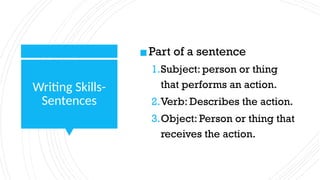
▪Part ofa sentence
1.Subject: person or thing
that performs an action.
2.Verb: Describes the action.
3.Object: Person or thing that
receives the action.