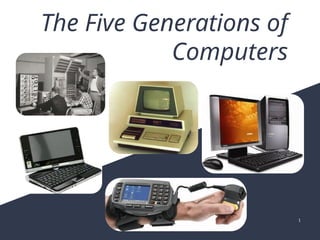
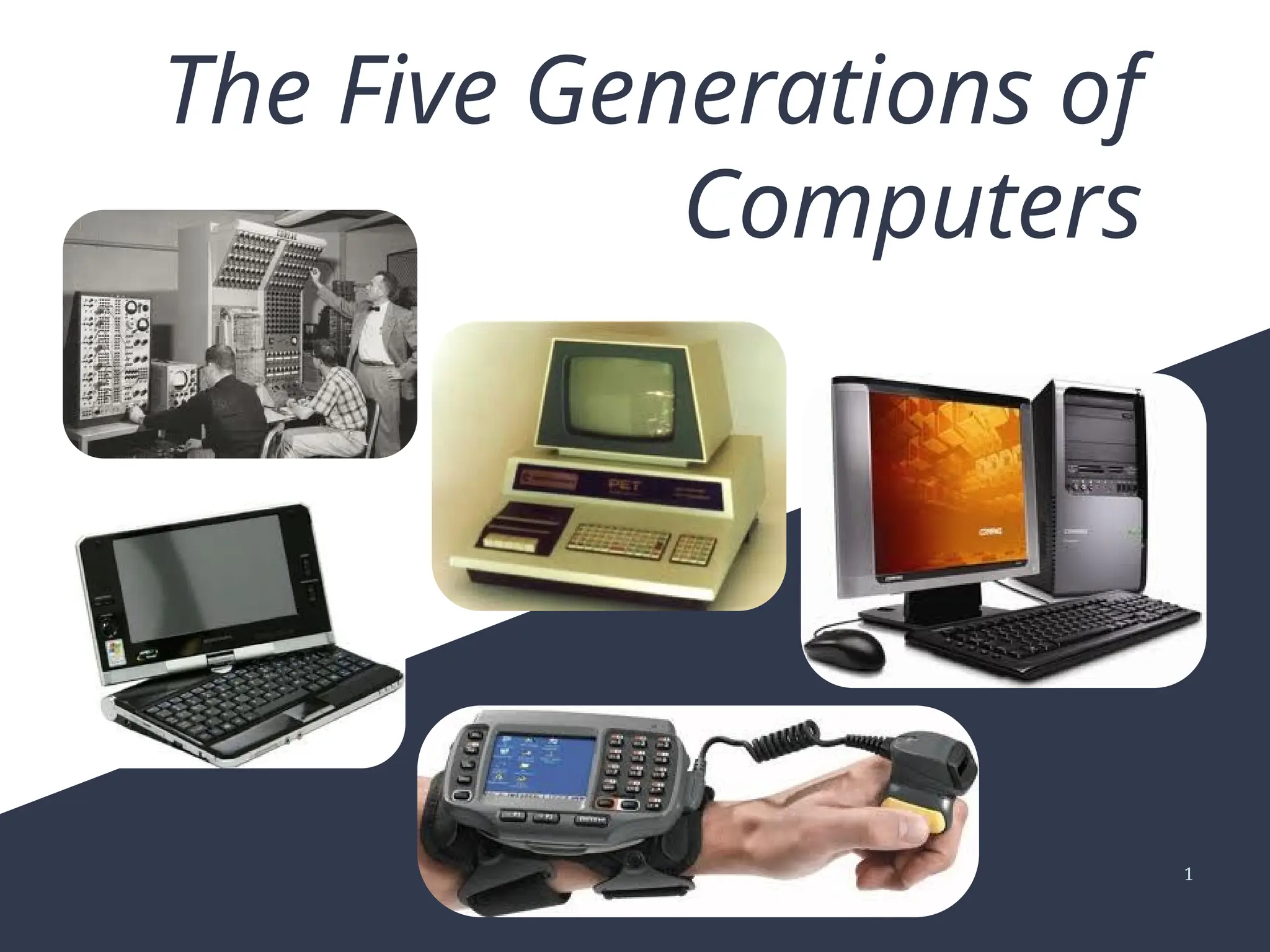
Generations of Computer
•Thecomputer has evolved from a large-sized
simple calculating machine to a smaller but much
more powerful machine.
•The evolution of computer to the current state is
defined in terms of the generations of computer.
•Each generation of computer is designed based
on a new technological development, resulting in
better, cheaper and smaller computers that are
more powerful, faster and efficient than their
predecessors.
2
3.
Generations of Computer
•Currently, there are five generations of computer.
In the following subsections, we will discuss the
generations of computer in terms of the
technology used by them (hardware and
software), computing characteristics (speed, i.e.,
number of instructions executed per second),
physical appearance, and their applications.
3
4.
First Generation Computers
(1940-1956)
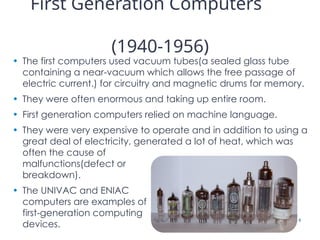
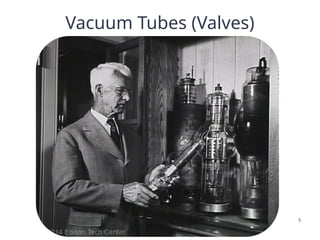
•The first computers used vacuum tubes(a sealed glass tube
containing a near-vacuum which allows the free passage of
electric current.) for circuitry and magnetic drums for memory.
• They were often enormous and taking up entire room.
• First generation computers relied on machine language.
• They were very expensive to operate and in addition to using a
great deal of electricity, generated a lot of heat, which was
often the cause of
malfunctions(defect or
breakdown).
• The UNIVAC and ENIAC
computers are examples of
first-generation computing
devices.
4
UNIVAC (Universal Automatic
Computer)
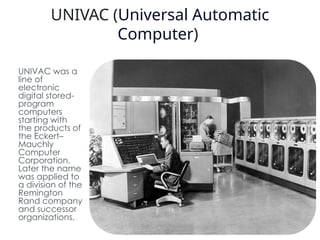
UNIVACwas a
line of
electronic
digital stored-
program
computers
starting with
the products of
the Eckert–
Mauchly
Computer
Corporation.
Later the name
was applied to
a division of the
Remington
Rand company
and successor
organizations. 6
7.
The ENIAC (Electronic
NumericalIntegrator and
Computer)
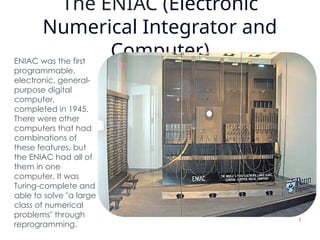
ENIAC was the first
programmable,
electronic, general-
purpose digital
computer,
completed in 1945.
There were other
computers that had
combinations of
these features, but
the ENIAC had all of
them in one
computer. It was
Turing-complete and
able to solve "a large
class of numerical
problems" through
reprogramming.
7
8.
First Generation Computers
Advantages:
•It was only electronic device
•First device to hold memory
Disadvantages :
•Too bulky i.e large in size
•Vacuum tubes burn frequently
•They were producing heat
•Maintenance problems 8
9.
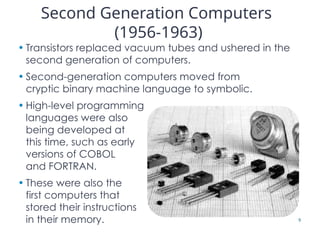
Second Generation Computers
(1956-1963)
•Transistors replaced vacuum tubes and ushered in the
second generation of computers.
• Second-generation computers moved from
cryptic binary machine language to symbolic.
• High-level programming
languages were also
being developed at
this time, such as early
versions of COBOL
and FORTRAN.
• These were also the
first computers that
stored their instructions
in their memory. 9
Second Generation Computers
Advantages:
•Size reduced considerably
•Very fast
•Very much reliable
Disadvantages :
•They overheated quickly
•Maintenance problems
11
12.
Third Generation Computers
(1964-1971)
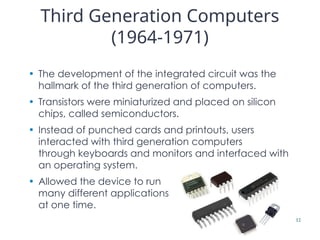
•The development of the integrated circuit was the
hallmark of the third generation of computers.
• Transistors were miniaturized and placed on silicon
chips, called semiconductors.
• Instead of punched cards and printouts, users
interacted with third generation computers
through keyboards and monitors and interfaced with
an operating system.
• Allowed the device to run
many different applications
at one time.
12
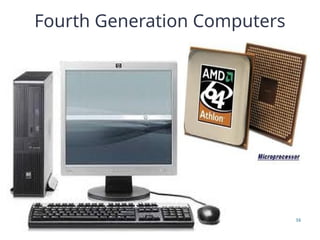
Fourth Generation Computers
(1971-present)
•The microprocessor brought the fourth generation
of computers, as thousands of integrated circuits
were built onto a single silicon chip.
• The Intel 4004 chip, developed in 1971, located all
the components of the computer.
• From the central processing unit and memory to
input/output controls—on a single chip.
• Fourth generation computers also saw the
development of GUIs, the mouse and
handheld devices.
15
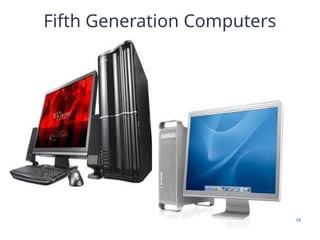
Fifth Generation Computers
(presentand beyond)
• Fifth generation computing devices, based
on artificial intelligence.
• Are still in development, though there are some
applications, such as voice recognition.
• The use of parallel processing and
superconductors is helping to make artificial
intelligence a reality.
• The goal of fifth-generation computing is to
develop devices that respond to natural
language input and are capable of learning and
self-organization.
17


![[ generation of computer ].pdf for BCA students](https://cdn.slidesharecdn.com/ss_thumbnails/generationofcomputer-250323073209-53bfd3d1-thumbnail.jpg?width=640&height=640&fit=bounds)


