Computer Networks
o Computer Networks
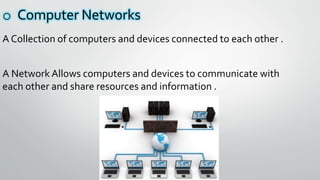
A Collection of computers and devices connected to each other .
A Network Allows computers and devices to communicate with
each other and share resources and information .
• Network Classification
1.Connection Method :
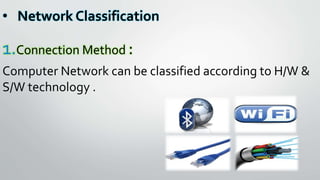
Computer Network can be classified according to H/W &
S/W technology .
Connection Method :
Connection method can be divided in to two methods :
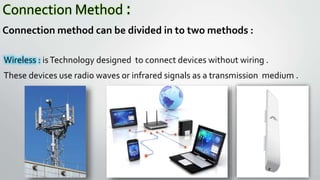
Wireless : isTechnology designed to connect devices without wiring .
These devices use radio waves or infrared signals as a transmission medium .
• Connection Method :
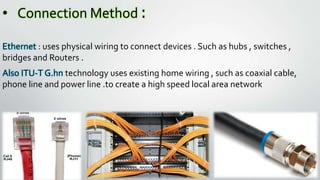
Ethernet : uses physical wiring to connect devices . Such as hubs , switches ,
bridges and Routers .
Also ITU-T G.hn technology uses existing home wiring , such as coaxial cable,
phone line and power line .to create a high speed local area network
• Network Classification
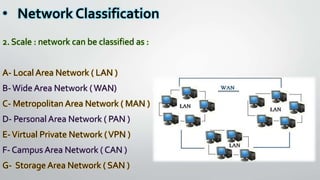
2. Scale : network can be classified as :
A- Local Area Network ( LAN )
B-Wide Area Network (WAN)
C- Metropolitan Area Network ( MAN )
D- Personal Area Network ( PAN )
E-Virtual Private Network (VPN )
F- Campus Area Network ( CAN )
G- Storage Area Network ( SAN )
• Network Classification
3- Functional relationship ( Network Architecture )
Computer Network Can be classified as :
Active Network
Client Server
Peer – to – Peer
• Network Classification
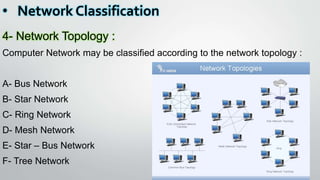
4- Network Topology :
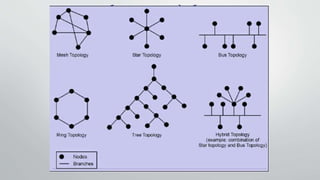
Computer Network may be classified according to the network topology :
A- Bus Network
B- Star Network
C- Ring Network
D- Mesh Network
E- Star – Bus Network
F- Tree Network
Types of Common Networks
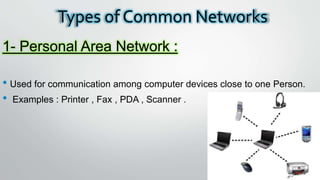
1- Personal Area Network :
• Used for communication among computer devices close to one Person.
• Examples : Printer , Fax , PDA , Scanner .
Types of Common Networks
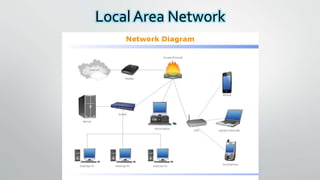
2- Local Area Network :
Is a computer Network Covering a small physical Area like a home , office , small group of buildings
such as a school or an airport .
Local Area Network May have wire or Wireless technology
The Characteristics of LANs :
Higher data transfer rates , smaller geographic range , and lack of a need for leased
telecommunication line .
Local Area Network
Types of Common Networks
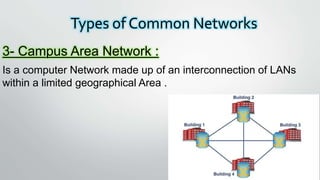
3- Campus Area Network :
Is a computer Network made up of an interconnection of LANs
within a limited geographical Area .
Campus Area Network
It can considered one form of a metropolitan area network ,specific
to an academic setting .
CAN Link variety of campus building including : academic
departments , the university library and student resident halls ,
CAN is larger than a local Area network but smaller than wide area
network ( WAN ) in some cases .
The main aim of CAN is to facilitate students accessing internet
and university resources .
Types of Common Networks
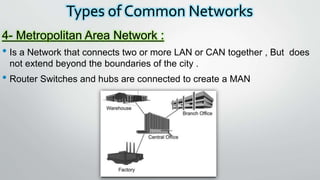
4- Metropolitan Area Network :
• Is a Network that connects two or more LAN or CAN together , But does
not extend beyond the boundaries of the city .
• Router Switches and hubs are connected to create a MAN
Types of Common Networks
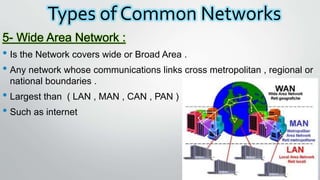
5- Wide Area Network :
• Is the Network covers wide or Broad Area .
• Any network whose communications links cross metropolitan , regional or
national boundaries .
• Largest than ( LAN , MAN , CAN , PAN )
• Such as internet
Types of Common Networks
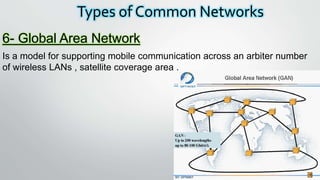
6- Global Area Network
Is a model for supporting mobile communication across an arbiter number
of wireless LANs , satellite coverage area .
Types of Common Networks
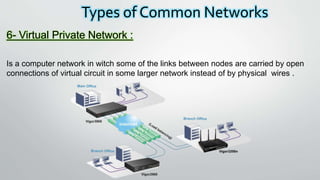
6- Virtual Private Network :
Is a computer network in witch some of the links between nodes are carried by open
connections of virtual circuit in some larger network instead of by physical wires .
• INTERNETWORK
•Internetworking involves connecting two or more , distinct
computer networks or network segments via a common routing
technology .
•Internetwork often shorted to internet.
•In modern practice , the interconnected networks use the
internet protocols .
•There are Three Internetworks :
1.Intranet
2.Extranet
3.Internet
INTERNETWORK
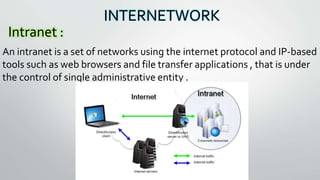
Intranet :
An intranet is a set of networks using the internet protocol and IP-based
tools such as web browsers and file transfer applications , that is under
the control of single administrative entity .
INTERNETWORK
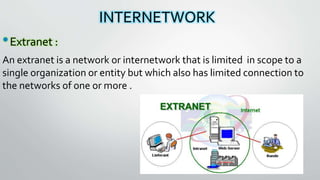
•Extranet :
An extranet is a network or internetwork that is limited in scope to a
single organization or entity but which also has limited connection to
the networks of one or more .
INTERNETWORK
•INTERNET
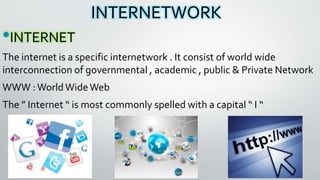
The internet is a specific internetwork . It consist of world wide
interconnection of governmental , academic , public & Private Network
WWW :WorldWideWeb
The ” Internet “ is most commonly spelled with a capital “ I “
Basic hardware components
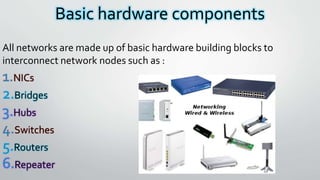
All networks are made up of basic hardware building blocks to
interconnect network nodes such as :
1.NICs
2.Bridges
3.Hubs
4.Switches
5.Routers
6.Repeater
Basic hardware components
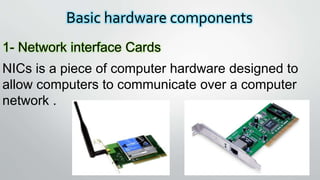
1- Network interface Cards
NICs is a piece of computer hardware designed to
allow computers to communicate over a computer
network .
Basic hardware components
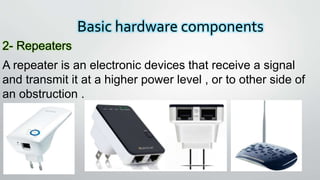
2- Repeaters
A repeater is an electronic devices that receive a signal
and transmit it at a higher power level , or to other side of
an obstruction .
Basic hardware components
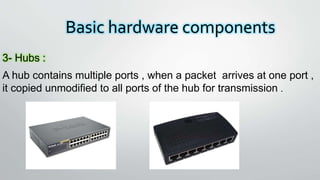
3- Hubs :
A hub contains multiple ports , when a packet arrives at one port ,
it copied unmodified to all ports of the hub for transmission .
Basic hardware components
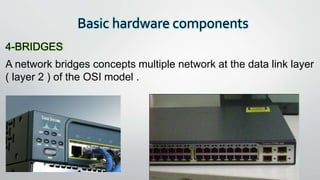
4-BRIDGES
A network bridges concepts multiple network at the data link layer
( layer 2 ) of the OSI model .
Bridges come inThree basic types :
1- Local Bridges : Directly connect local area network ( LANs )
2- Remote Bridges : Can be used to create a wide area network (
WAN ) link between LANs .
3- Wireless Bridges: Can be used to join LANs or connect remote
stations to LANs .
Basic hardware components
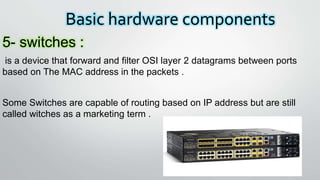
5- switches :
is a device that forward and filter OSI layer 2 datagrams between ports
based on The MAC address in the packets .
Some Switches are capable of routing based on IP address but are still
called witches as a marketing term .
Basic hardware components
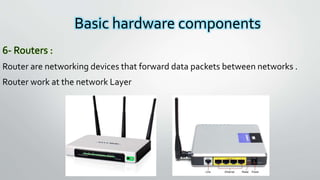
6- Routers :
Router are networking devices that forward data packets between networks .
Router work at the network Layer

Network

  • 1.
  • 2.
    o Computer Networks ACollection of computers and devices connected to each other . A Network Allows computers and devices to communicate with each other and share resources and information .
  • 3.
    • Network Classification 1.ConnectionMethod : Computer Network can be classified according to H/W & S/W technology .
  • 4.
    Connection Method : Connectionmethod can be divided in to two methods : Wireless : isTechnology designed to connect devices without wiring . These devices use radio waves or infrared signals as a transmission medium .
  • 5.
    • Connection Method: Ethernet : uses physical wiring to connect devices . Such as hubs , switches , bridges and Routers . Also ITU-T G.hn technology uses existing home wiring , such as coaxial cable, phone line and power line .to create a high speed local area network
  • 6.
    • Network Classification 2.Scale : network can be classified as : A- Local Area Network ( LAN ) B-Wide Area Network (WAN) C- Metropolitan Area Network ( MAN ) D- Personal Area Network ( PAN ) E-Virtual Private Network (VPN ) F- Campus Area Network ( CAN ) G- Storage Area Network ( SAN )
  • 7.
    • Network Classification 3-Functional relationship ( Network Architecture ) Computer Network Can be classified as : Active Network Client Server Peer – to – Peer
  • 8.
    • Network Classification 4-Network Topology : Computer Network may be classified according to the network topology : A- Bus Network B- Star Network C- Ring Network D- Mesh Network E- Star – Bus Network F- Tree Network
  • 10.
    Types of CommonNetworks 1- Personal Area Network : • Used for communication among computer devices close to one Person. • Examples : Printer , Fax , PDA , Scanner .
  • 11.
    Types of CommonNetworks 2- Local Area Network : Is a computer Network Covering a small physical Area like a home , office , small group of buildings such as a school or an airport . Local Area Network May have wire or Wireless technology The Characteristics of LANs : Higher data transfer rates , smaller geographic range , and lack of a need for leased telecommunication line .
  • 12.
  • 13.
    Types of CommonNetworks 3- Campus Area Network : Is a computer Network made up of an interconnection of LANs within a limited geographical Area .
  • 14.
    Campus Area Network Itcan considered one form of a metropolitan area network ,specific to an academic setting . CAN Link variety of campus building including : academic departments , the university library and student resident halls , CAN is larger than a local Area network but smaller than wide area network ( WAN ) in some cases . The main aim of CAN is to facilitate students accessing internet and university resources .
  • 15.
    Types of CommonNetworks 4- Metropolitan Area Network : • Is a Network that connects two or more LAN or CAN together , But does not extend beyond the boundaries of the city . • Router Switches and hubs are connected to create a MAN
  • 16.
    Types of CommonNetworks 5- Wide Area Network : • Is the Network covers wide or Broad Area . • Any network whose communications links cross metropolitan , regional or national boundaries . • Largest than ( LAN , MAN , CAN , PAN ) • Such as internet
  • 17.
    Types of CommonNetworks 6- Global Area Network Is a model for supporting mobile communication across an arbiter number of wireless LANs , satellite coverage area .
  • 18.
    Types of CommonNetworks 6- Virtual Private Network : Is a computer network in witch some of the links between nodes are carried by open connections of virtual circuit in some larger network instead of by physical wires .
  • 19.
    • INTERNETWORK •Internetworking involvesconnecting two or more , distinct computer networks or network segments via a common routing technology . •Internetwork often shorted to internet. •In modern practice , the interconnected networks use the internet protocols . •There are Three Internetworks : 1.Intranet 2.Extranet 3.Internet
  • 20.
    INTERNETWORK Intranet : An intranetis a set of networks using the internet protocol and IP-based tools such as web browsers and file transfer applications , that is under the control of single administrative entity .
  • 21.
    INTERNETWORK •Extranet : An extranetis a network or internetwork that is limited in scope to a single organization or entity but which also has limited connection to the networks of one or more .
  • 22.
    INTERNETWORK •INTERNET The internet isa specific internetwork . It consist of world wide interconnection of governmental , academic , public & Private Network WWW :WorldWideWeb The ” Internet “ is most commonly spelled with a capital “ I “
  • 23.
    Basic hardware components Allnetworks are made up of basic hardware building blocks to interconnect network nodes such as : 1.NICs 2.Bridges 3.Hubs 4.Switches 5.Routers 6.Repeater
  • 24.
    Basic hardware components 1-Network interface Cards NICs is a piece of computer hardware designed to allow computers to communicate over a computer network .
  • 25.
    Basic hardware components 2-Repeaters A repeater is an electronic devices that receive a signal and transmit it at a higher power level , or to other side of an obstruction .
  • 26.
    Basic hardware components 3-Hubs : A hub contains multiple ports , when a packet arrives at one port , it copied unmodified to all ports of the hub for transmission .
  • 27.
    Basic hardware components 4-BRIDGES Anetwork bridges concepts multiple network at the data link layer ( layer 2 ) of the OSI model .
  • 28.
    Bridges come inThreebasic types : 1- Local Bridges : Directly connect local area network ( LANs ) 2- Remote Bridges : Can be used to create a wide area network ( WAN ) link between LANs . 3- Wireless Bridges: Can be used to join LANs or connect remote stations to LANs .
  • 29.
    Basic hardware components 5-switches : is a device that forward and filter OSI layer 2 datagrams between ports based on The MAC address in the packets . Some Switches are capable of routing based on IP address but are still called witches as a marketing term .
  • 30.
    Basic hardware components 6-Routers : Router are networking devices that forward data packets between networks . Router work at the network Layer