Foundation and core

   Rick Szeliski &
  Andrew Zisserman
The Need ….

George Santayana:

   "Those who cannot remember the past are condemned to
     repeat it"


• We see in other communities their rediscovery of results and
  methods already well known in computer vision, e.g. in multi-
  media retrieval

• It is even worse if this happens in our own community
Outline


1. Some successes and areas where there has been
   significant progress


2. 20 things every CV researcher should know


3. Dissemination
Multiple View Geometry
One of the success stories of Computer Vision

•    1990
     estimate epipolar geometry of two images using a calibration rig

•    2000
     automatic estimation of cameras and structure from 1000s of frames of
     uncontrolled video footage


Two advances made this possible:
    1. Understanding the (projective) geometry of multiple views
       •    fundamental matrix, trifocal tensor …
    2. Automatic estimation of this geometry from images
       •    development of robust estimation algorithms
Computer vision in the movies
Match mover/camera tracking


 PhotoSynth/PhotoTourism
Kinect
What works reasonably well?
Significant progress and applications:
•   Face detection/recognition
•   OCR, (isolated) hand writing recognition
•   Industrial inspection
•   Affine covariant detectors
•   Gaze tracking
•   Multi-view stereo reconstruction
•   Tracking isolated people in video
•   Interactive segmentation, e.g. medical
•   Image denoising and correction
•   Image stitching, HDR
•   Fingerprint recognition
•    Duplicate image/video search
•    Instance recognition for weakly textured object
What works reasonably well continued?

• Active range finding
• Optical flow
• Autonomous driving with LIDAR
20 things everyone should know
• Data mining community. 2005/2006. Identified
   – 10 challenging problems, and
   – 10 most influential algorithms.


• The result was:
   – C4.5, k-Means, SVM, Apriori, EM, PageRank, AdaBoost, kNN, Naive
     Bayes, and CART
   – Top 10 algorithms in data mining, Wu et al., Knowl Inf Syst, 2008


• In Computer Vision??
   – There is so much: so many areas, so many disciplines, so many
     application areas
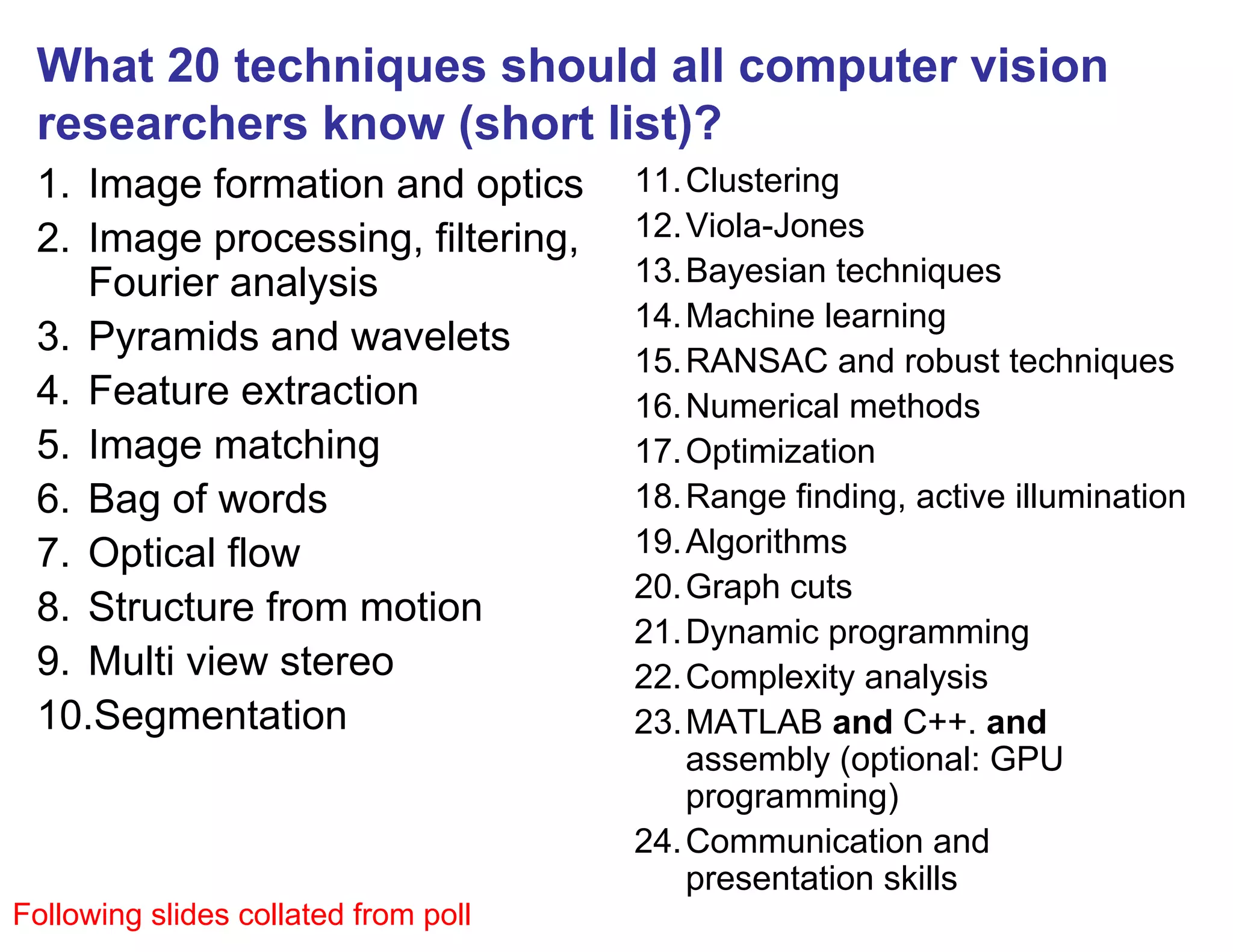
What 20 techniques should all computer vision
 researchers know (short list)?
 1. Image formation and optics        11. Clustering
 2. Image processing, filtering,      12. Viola-Jones
    Fourier analysis                  13. Bayesian techniques
                                      14. Machine learning
 3. Pyramids and wavelets
                                      15. RANSAC and robust techniques
 4. Feature extraction                16. Numerical methods
 5. Image matching                    17. Optimization
 6. Bag of words                      18. Range finding, active illumination
 7. Optical flow                      19. Algorithms
                                      20. Graph cuts
 8. Structure from motion
                                      21. Dynamic programming
 9. Multi view stereo                 22. Complexity analysis
 10.Segmentation                      23. MATLAB and C++. and
                                          assembly (optional: GPU
                                          programming)
                                      24. Communication and
                                          presentation skills
Following slides collated from poll
Image and features
•   NCC
•   Interest point operators
•   Scale invariant and affine invariant detectors & descriptors
•   Scale space
•   Image processing, filtering, Fourier analysis
•   Pyramids and wavelets
•   Edge detection
•   Restoration e.g. deblurring, super-resolution
    – Linear, e.g. Wiener filter
    – MRF
    – Non-local means/BM3D/bilateral filter
Segmentation, grouping and tracking

•   Segmentation
    – Normalized cuts


•   Grouping
    – Hough transforms


•   Clustering
    – K-means
    – Mean-shift
    – Pedro-clustering


•   Tracking
    – Kalman filter
    – Particle filter
Multi-view: stereo, SFM, flow
• RANSAC and other robust techniques
• Geometry:
   – epipolar geometry (projective and affine)
   – planar homographies
   – Affine camera
• Geometry estimators
   – 8 point algorithm for F
   – 4 point algorithm for H
• Factorization
• Bundle-adjustment
• Flow
   – Horn & Schunck L2
   – Lucas-Kanade
   – L1 regularized
Recognition

•   Bag of visual words
•   HOG, SIFT, GIST
•   Spatial pyramid
•   Spatial configurations/Pictorial structures
•   Sliding window/jumping window
•   Cascades
Others
Machine Learning
    –   Adaboost
    –   kNN
    –   SVM
    –   Random forest
    –   PCA, ICA, CCA
    –   EM
    –   MIL/Latent-SVM
    –   Regularization
    –   HMM
    –   Graphical & Bayesian models
Optimization
    –   Classical linear and non-linear
    –   Graph operations
    –   Dynamic programming/message passing for MAP, max-marginals
    –   Graph cuts for binary variable MAP

• Texture synthesis
Who can help?
Dissemination

• Accessible Wikipedia articles for generalists, with high-quality
  links
• Separate Wiki: CVOnline ???
• Summer schools (especially US), recorded
• Tutorial videos
• Online programming assignments (Ted procedures),
• Tutorial courses
• Industry panels @ conferences (will people attend?)
• Introductory video [Serge]
Courses that your computer vision students
do/should take
• Typically, they take computer vision directly (see core
  techniques), sometimes after graphics or image processing.

• Ideally, would like them to take (pre-requisites or co-requisites):
1.Linear algebra, numerical methods, optimization
2.Statistics, Bayesian and robust methods, machine learning
3.Computer graphics and image processing
4.Optics, image formation, sensor design
5.Visual perception
6.Programming: parallel languages (MATLAB), efficient
  languages (C++ and assembly)
7.Technical writing and presentation (all graduate students,
  possibly UGs as well)
Are current computer vision textbooks sufficient?
What is missing?


• No good up-to-date introductory book
• Need algorithm descriptions + pseudo code
• Video lectures, Khan academy (voice-over-pen/tablet
  drawing),
 http://www.ai-class.com/, http://robots.stanford.edu/cs221/
• (On-line) books supplemented by online tools, exercises,
  examples, resources, videos
• Social media + textbooks
• Ads to support free articles (??)

Fcv core szeliski_zisserman

  • 1.
    Foundation and core Rick Szeliski & Andrew Zisserman
  • 2.
    The Need …. GeorgeSantayana: "Those who cannot remember the past are condemned to repeat it" • We see in other communities their rediscovery of results and methods already well known in computer vision, e.g. in multi- media retrieval • It is even worse if this happens in our own community
  • 3.
    Outline 1. Some successesand areas where there has been significant progress 2. 20 things every CV researcher should know 3. Dissemination
  • 4.
    Multiple View Geometry Oneof the success stories of Computer Vision • 1990 estimate epipolar geometry of two images using a calibration rig • 2000 automatic estimation of cameras and structure from 1000s of frames of uncontrolled video footage Two advances made this possible: 1. Understanding the (projective) geometry of multiple views • fundamental matrix, trifocal tensor … 2. Automatic estimation of this geometry from images • development of robust estimation algorithms
  • 5.
    Computer vision inthe movies Match mover/camera tracking PhotoSynth/PhotoTourism
  • 6.
  • 7.
    What works reasonablywell? Significant progress and applications: • Face detection/recognition • OCR, (isolated) hand writing recognition • Industrial inspection • Affine covariant detectors • Gaze tracking • Multi-view stereo reconstruction • Tracking isolated people in video • Interactive segmentation, e.g. medical • Image denoising and correction • Image stitching, HDR • Fingerprint recognition • Duplicate image/video search • Instance recognition for weakly textured object
  • 8.
    What works reasonablywell continued? • Active range finding • Optical flow • Autonomous driving with LIDAR
  • 9.
    20 things everyoneshould know • Data mining community. 2005/2006. Identified – 10 challenging problems, and – 10 most influential algorithms. • The result was: – C4.5, k-Means, SVM, Apriori, EM, PageRank, AdaBoost, kNN, Naive Bayes, and CART – Top 10 algorithms in data mining, Wu et al., Knowl Inf Syst, 2008 • In Computer Vision?? – There is so much: so many areas, so many disciplines, so many application areas
  • 10.
    What 20 techniquesshould all computer vision researchers know (short list)? 1. Image formation and optics 11. Clustering 2. Image processing, filtering, 12. Viola-Jones Fourier analysis 13. Bayesian techniques 14. Machine learning 3. Pyramids and wavelets 15. RANSAC and robust techniques 4. Feature extraction 16. Numerical methods 5. Image matching 17. Optimization 6. Bag of words 18. Range finding, active illumination 7. Optical flow 19. Algorithms 20. Graph cuts 8. Structure from motion 21. Dynamic programming 9. Multi view stereo 22. Complexity analysis 10.Segmentation 23. MATLAB and C++. and assembly (optional: GPU programming) 24. Communication and presentation skills Following slides collated from poll
  • 11.
    Image and features • NCC • Interest point operators • Scale invariant and affine invariant detectors & descriptors • Scale space • Image processing, filtering, Fourier analysis • Pyramids and wavelets • Edge detection • Restoration e.g. deblurring, super-resolution – Linear, e.g. Wiener filter – MRF – Non-local means/BM3D/bilateral filter
  • 12.
    Segmentation, grouping andtracking • Segmentation – Normalized cuts • Grouping – Hough transforms • Clustering – K-means – Mean-shift – Pedro-clustering • Tracking – Kalman filter – Particle filter
  • 13.
    Multi-view: stereo, SFM,flow • RANSAC and other robust techniques • Geometry: – epipolar geometry (projective and affine) – planar homographies – Affine camera • Geometry estimators – 8 point algorithm for F – 4 point algorithm for H • Factorization • Bundle-adjustment • Flow – Horn & Schunck L2 – Lucas-Kanade – L1 regularized
  • 14.
    Recognition • Bag of visual words • HOG, SIFT, GIST • Spatial pyramid • Spatial configurations/Pictorial structures • Sliding window/jumping window • Cascades
  • 15.
    Others Machine Learning – Adaboost – kNN – SVM – Random forest – PCA, ICA, CCA – EM – MIL/Latent-SVM – Regularization – HMM – Graphical & Bayesian models Optimization – Classical linear and non-linear – Graph operations – Dynamic programming/message passing for MAP, max-marginals – Graph cuts for binary variable MAP • Texture synthesis
  • 16.
  • 17.
    Dissemination • Accessible Wikipediaarticles for generalists, with high-quality links • Separate Wiki: CVOnline ??? • Summer schools (especially US), recorded • Tutorial videos • Online programming assignments (Ted procedures), • Tutorial courses • Industry panels @ conferences (will people attend?) • Introductory video [Serge]
  • 18.
    Courses that yourcomputer vision students do/should take • Typically, they take computer vision directly (see core techniques), sometimes after graphics or image processing. • Ideally, would like them to take (pre-requisites or co-requisites): 1.Linear algebra, numerical methods, optimization 2.Statistics, Bayesian and robust methods, machine learning 3.Computer graphics and image processing 4.Optics, image formation, sensor design 5.Visual perception 6.Programming: parallel languages (MATLAB), efficient languages (C++ and assembly) 7.Technical writing and presentation (all graduate students, possibly UGs as well)
  • 19.
    Are current computervision textbooks sufficient? What is missing? • No good up-to-date introductory book • Need algorithm descriptions + pseudo code • Video lectures, Khan academy (voice-over-pen/tablet drawing), http://www.ai-class.com/, http://robots.stanford.edu/cs221/ • (On-line) books supplemented by online tools, exercises, examples, resources, videos • Social media + textbooks • Ads to support free articles (??)