OPEN SOURCE SOFTWARE DEVELOPMENT
CONTENTS
 What is Open Source?
 History
 Diff b/w open source and closed source
 Criteria for open source
 How open source works?
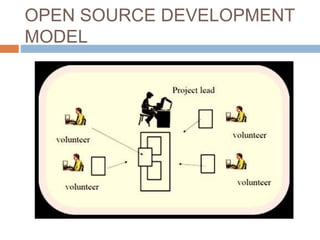
 Open source development model
 Advantages
 Disadvantages
 Examples
 Conclusion
What is open source?
o Open Source as the name implies is visible set of
instructions which is open to public or users to change
and customize as per their needs. It can be either be
paid or free one where the user can change the code as
per their needs.
 Open as in free
 Open as in access
 Open as in over time
 Open as in not closed
 Open as in reuse and change
 Open as in any place and for anyone
HISTORY OF OPEN SOURCE
In 1997, Eric S. Raymond wrote the Cathedral and the Bazaar. In this book,
Raymond makes the distinction between two kinds of software development.
The first is the conventional closed-source development. This kind of
development method is, according to Raymond, like the building of a
cathedral; central planning, tight organization and one process from start to
finish. The second is the progressive open-source development, which is more
like “a great babbling bazaar of differing agendas and approaches out of which
a coherent and stable system could seemingly emerge only by a succession of
miracles.” The latter analogy points to the discussion involved in an open-
source development process.
The term Open Source was adapted by a group of people held at Polo Alta,
Califomia.
Why Oss?
 Customizable.
 Improvable.
 Redistributable.
 Runs Everywhere, for everyone.
 Transparency.
 Free !!!
VS
 View/Modify the source code of an application
or software.
 Open source software is released to the
development Community but closed source
software is developed in isolation.
 Developers support and large community to
help.
 Open source is more secure and bugs and
vulnerabilities are fixed often.
CRITERIA FOR OPEN
SOURCE
 Source Code
 Derived works
 Free Redistribution
 Distribution of License
 Integrity of The Authors Source Code
 License Must Not Restrict Other Software
 No Discrimination Against Persons or Groups
 No Discrimination Against Fields of Endeavour
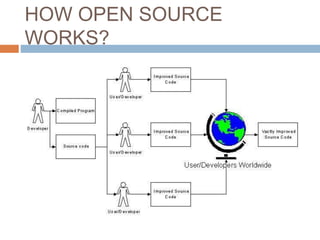
HOW OPEN SOURCE
WORKS?
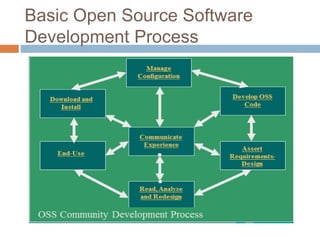
Basic Open Source Software
Development Process
OPEN SOURCE DEVELOPMENT
MODEL
ADVANATGES OF OPEN
SOURCE
 Availability of source code
 Source code to understand and learn from
 Do not have to re-invent the wheel
 Free as in “freedom”
 Does not depend on Vendor
 Can choose additional support
 Can fix bugs and adapt to change in requirements as
well as technology
 Quality and Customizability in open source is
better
 Costs much less than proprietary
DISADVANTAGES OF OPEN
SOURCE
 Not generally straightforward to use and
require a certain learning curve to use.
 Incompatibility issue with software and
hardware (3rd party drivers).
 Bad codes and some unqualified people who
uses it.
 Software quality assurance process is widely
not transparent.
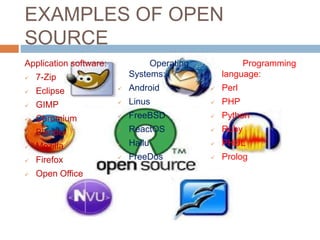
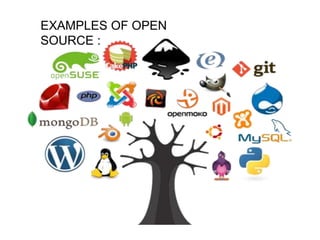
EXAMPLES OF OPEN
SOURCE
Application software:
 7-Zip
 Eclipse
 GIMP
 Chromium
 Blender
 Mozilla
 Firefox
 Open Office
Operating
Systems:
 Android
 Linus
 FreeBSD
 ReactOS
 Hailu
 FreeDos
Programming
language:
 Perl
 PHP
 Python
 Ruby
 PHDL
 Prolog
EXAMPLES OF OPEN
SOURCE :
CONCLUSION
 Common platform for sharing ideas and
putting them into action by developers or other
people who wishes to improve a
product/software.
 We are in the Open Source Revolution where
people collaborate to create, producing
software or technology.
 Based upon the advantages of open source
technology, we can finally conclude that Open
Source deserves the increasing popularity.
Open source software development

Open source software development

  • 1.
  • 2.
    CONTENTS  What isOpen Source?  History  Diff b/w open source and closed source  Criteria for open source  How open source works?  Open source development model  Advantages  Disadvantages  Examples  Conclusion
  • 3.
    What is opensource? o Open Source as the name implies is visible set of instructions which is open to public or users to change and customize as per their needs. It can be either be paid or free one where the user can change the code as per their needs.  Open as in free  Open as in access  Open as in over time  Open as in not closed  Open as in reuse and change  Open as in any place and for anyone
  • 4.
    HISTORY OF OPENSOURCE In 1997, Eric S. Raymond wrote the Cathedral and the Bazaar. In this book, Raymond makes the distinction between two kinds of software development. The first is the conventional closed-source development. This kind of development method is, according to Raymond, like the building of a cathedral; central planning, tight organization and one process from start to finish. The second is the progressive open-source development, which is more like “a great babbling bazaar of differing agendas and approaches out of which a coherent and stable system could seemingly emerge only by a succession of miracles.” The latter analogy points to the discussion involved in an open- source development process. The term Open Source was adapted by a group of people held at Polo Alta, Califomia.
  • 5.
    Why Oss?  Customizable. Improvable.  Redistributable.  Runs Everywhere, for everyone.  Transparency.  Free !!!
  • 6.
    VS  View/Modify thesource code of an application or software.  Open source software is released to the development Community but closed source software is developed in isolation.  Developers support and large community to help.  Open source is more secure and bugs and vulnerabilities are fixed often.
  • 7.
    CRITERIA FOR OPEN SOURCE Source Code  Derived works  Free Redistribution  Distribution of License  Integrity of The Authors Source Code  License Must Not Restrict Other Software  No Discrimination Against Persons or Groups  No Discrimination Against Fields of Endeavour
  • 8.
  • 9.
    Basic Open SourceSoftware Development Process
  • 10.
  • 11.
    ADVANATGES OF OPEN SOURCE Availability of source code  Source code to understand and learn from  Do not have to re-invent the wheel  Free as in “freedom”  Does not depend on Vendor  Can choose additional support  Can fix bugs and adapt to change in requirements as well as technology  Quality and Customizability in open source is better  Costs much less than proprietary
  • 12.
    DISADVANTAGES OF OPEN SOURCE Not generally straightforward to use and require a certain learning curve to use.  Incompatibility issue with software and hardware (3rd party drivers).  Bad codes and some unqualified people who uses it.  Software quality assurance process is widely not transparent.
  • 13.
    EXAMPLES OF OPEN SOURCE Applicationsoftware:  7-Zip  Eclipse  GIMP  Chromium  Blender  Mozilla  Firefox  Open Office Operating Systems:  Android  Linus  FreeBSD  ReactOS  Hailu  FreeDos Programming language:  Perl  PHP  Python  Ruby  PHDL  Prolog
  • 14.
  • 15.
    CONCLUSION  Common platformfor sharing ideas and putting them into action by developers or other people who wishes to improve a product/software.  We are in the Open Source Revolution where people collaborate to create, producing software or technology.  Based upon the advantages of open source technology, we can finally conclude that Open Source deserves the increasing popularity.