1

GPU Ray Tracing
with CUDA
BY TOM PITKIN

Bill Clark, PhD
Stu Steiner, MS, PhC
Objectives


Develop a sequential CPU and parallel GPU ray tracer



Illustrate the difference in rendering speed and design of a CPU and
GPU ray tracer

2
Outline


Introduction to Ray Tracing



CUDA



Parallelization with CUDA / Results



Future Work



Questions

3
What is Ray Tracing?


Rendering technique used in computer graphics



Simulates the behavior of light



Can produce advanced optical effects

4
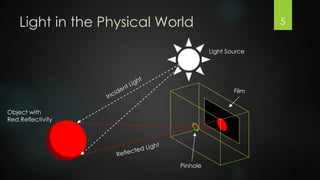
Light in the Physical World

5
Light Source

Film
Object with
Red Reflectivity

Pinhole
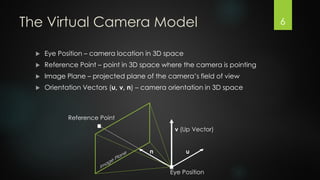
The Virtual Camera Model


Eye Position – camera location in 3D space



Reference Point – point in 3D space where the camera is pointing



Orientation Vectors (u, v, n) – camera orientation in 3D space



Image Plane – projected plane of the camera’s field of view

Reference Point
v (Up Vector)
n

u
Eye Position

6
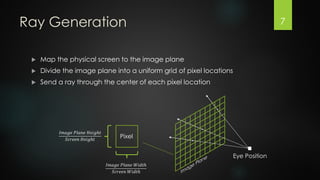
Ray Generation


Map the physical screen to the image plane



Divide the image plane into a uniform grid of pixel locations



7

Send a ray through the center of each pixel location

𝐼𝑚𝑎𝑔𝑒 𝑃𝑙𝑎𝑛𝑒 𝐻𝑒𝑖𝑔ℎ𝑡
𝑆𝑐𝑟𝑒𝑒𝑛 𝐻𝑒𝑖𝑔ℎ𝑡

Pixel
Eye Position
𝐼𝑚𝑎𝑔𝑒 𝑃𝑙𝑎𝑛𝑒 𝑊𝑖𝑑𝑡ℎ
𝑆𝑐𝑟𝑒𝑒𝑛 𝑊𝑖𝑑𝑡ℎ
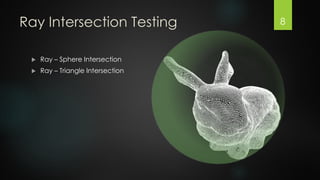
Ray Intersection Testing


Ray – Sphere Intersection



Ray – Triangle Intersection

8
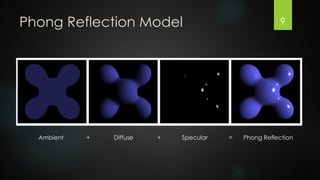
Phong Reflection Model

Ambient

+

Diffuse

+

Specular

9

=

Phong Reflection
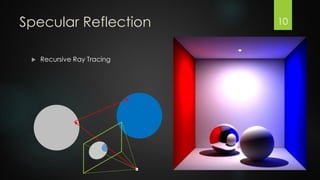
Specular Reflection


Recursive Ray Tracing

10
Outline


Introduction to Ray Tracing



CUDA



Parallelization with CUDA / Results



Future Work



Questions

11
What is CUDA?


Compute Unified Device Architecture (CUDA)



Parallel computing platform



Developed by Nvidia

12
Kernel Functions


Specifies the code to be executed in parallel



Single Program, Multiple Data (SPMD)

13
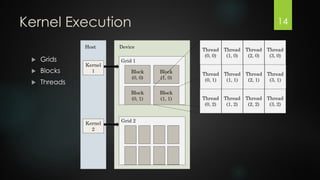
Kernel Execution


Grids



Blocks



Threads

14
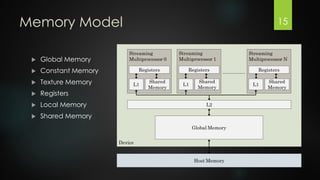
Memory Model


Global Memory



Constant Memory



Texture Memory



Registers



Local Memory



Shared Memory

15
Outline


Introduction to Ray Tracing



CUDA



Parallelization with CUDA / Results



Future Work



Questions

16
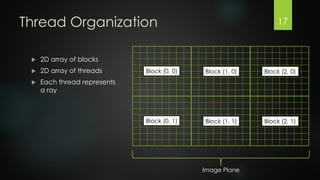
Thread Organization


2D array of blocks



2D array of threads



17

Each thread represents
a ray

Block (0, 0)

Block (1, 0)

Block (2, 0)

Block (0, 1)

Block (1, 1)

Block (2, 1)

Image Plane
Testing Environment


OS – Ubuntu Gnome Remix 13.04



CPU – Core i7-920




Core Clock – 2.66 GHz

GPU – Nvidia GTX 570


Core Clock - 742 MHz



CUDA Core - 480



Memory Clock - 3800 MHz



Video Memory - GDDR5 1280MB

18
Test Objects


Teapot






Surfaces: 1

Triangles: 992

Al





Surfaces: 174
Triangles: 7,124

Crocodile


Surfaces: 6



Triangles: 34,404

19
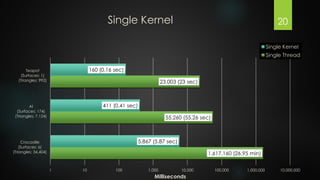
Single Kernel

20
Single Kernel
Single Thread

160 (0.16 sec)

Teapot
(Surfaces: 1)
(Triangles: 992)

23,003 (23 sec)

411 (0.41 sec)

Al
(Surfaces: 174)
(Triangles: 7,124)

55,260 (55.26 sec)

5,867 (5.87 sec)

Crocodile
(Surfaces: 6)
(Triangles: 34,404)

1,617,160 (26.95 min)
1

10

100

1,000

10,000

Milliseconds

100,000

1,000,000

10,000,000
Kernel Complexity and Size


Driver timeout



Register Spilling

21
Replacing Recursion


Iterative Loop



Layer based stack




Layers store color values returned from rays

Final image from convex combination of layers

22
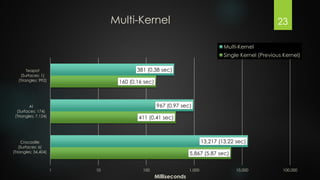
Multi-Kernel

23
Multi-Kernel
Single Kernel (Previous Kernel)

381 (0.38 sec)

Teapot
(Surfaces: 1)
(Triangles: 992)

160 (0.16 sec)

967 (0.97 sec)

Al
(Surfaces: 174)
(Triangles: 7,124)

411 (0.41 sec)

13,217 (13.22 sec)

Crocodile
(Surfaces: 6)
(Triangles: 34,404)

5,867 (5.87 sec)
1

10

100

1,000

Milliseconds

10,000

100,000
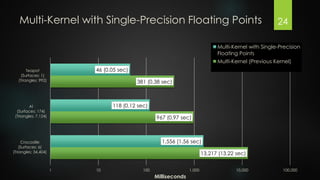
Multi-Kernel with Single-Precision Floating Points

24

Multi-Kernel with Single-Precision
Floating Points
Multi-Kernel (Previous Kernel)
46 (0.05 sec)

Teapot
(Surfaces: 1)
(Triangles: 992)

381 (0.38 sec)

118 (0.12 sec)

Al
(Surfaces: 174)
(Triangles: 7,124)

967 (0.97 sec)

1,556 (1.56 sec)

Crocodile
(Surfaces: 6)
(Triangles: 34,404)

13,217 (13.22 sec)
1

10

100

1,000

Milliseconds

10,000

100,000
Caching Surface Data


Object’s surface data stored on shared memory



All threads in same block have access to cached surface data



Removes duplicate memory requests



Data reuse

25
Multi-Kernel with Surface Caching

26

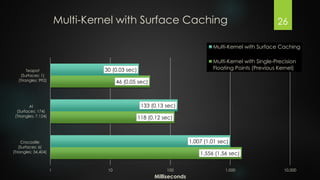
Multi-Kernel with Surface Caching
Multi-Kernel with Single-Precision
Floating Points (Previous Kernel)

30 (0.03 sec)

Teapot
(Surfaces: 1)
(Triangles: 992)

46 (0.05 sec)

133 (0.13 sec)

Al
(Surfaces: 174)
(Triangles: 7,124)

118 (0.12 sec)

1,007 (1.01 sec)

Crocodile
(Surfaces: 6)
(Triangles: 34,404)

1,556 (1.56 sec)
1

10

100

Milliseconds

1,000

10,000
Simplifying Mesh Data

27



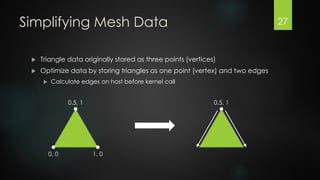
Triangle data originally stored as three points (vertices)



Optimize data by storing triangles as one point (vertex) and two edges


Calculate edges on host before kernel call

0.5, 1

0, 0

0.5, 1

1, 0
Multi-Kernel with Mesh Optimization

28

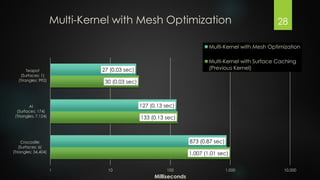
Multi-Kernel with Mesh Optimization
Multi-Kernel with Surface Caching
(Previous Kernel)

27 (0.03 sec)

Teapot
(Surfaces: 1)
(Triangles: 992)

30 (0.03 sec)

127 (0.13 sec)

Al
(Surfaces: 174)
(Triangles: 7,124)

133 (0.13 sec)

873 (0.87 sec)

Crocodile
(Surfaces: 6)
(Triangles: 34,404)

1,007 (1.01 sec)
1

10

100

Milliseconds

1,000

10,000
Final Results

29
Multi-Kernel with Intersection
Optimization
Single Thread

27 (0.03 sec)

Teapot
(Surfaces: 1)
(Triangles: 992)

23,003 (23 sec)

127 (0.13 sec)

Al
(Surfaces: 174)
(Triangles: 7,124)

55,260 (55.26 sec)

873 (0.87 sec)

Crocodile
(Surfaces: 6)
(Triangles: 34,404)

1,617,160 (26.95 min)
1

10

100

1,000

10,000

Milliseconds

100,000

1,000,000

10,000,000
Outline


Introduction to Ray Tracing



CUDA



Parallelization with CUDA / Results



Future Work



Questions

30
Future Work


Spatial partitioning



Multiple GPUs



Optimize code for different GPUs

31
Questions?

32

Computer Science Thesis Defense

  • 1.
    1 GPU Ray Tracing withCUDA BY TOM PITKIN Bill Clark, PhD Stu Steiner, MS, PhC
  • 2.
    Objectives  Develop a sequentialCPU and parallel GPU ray tracer  Illustrate the difference in rendering speed and design of a CPU and GPU ray tracer 2
  • 3.
    Outline  Introduction to RayTracing  CUDA  Parallelization with CUDA / Results  Future Work  Questions 3
  • 4.
    What is RayTracing?  Rendering technique used in computer graphics  Simulates the behavior of light  Can produce advanced optical effects 4
  • 5.
    Light in thePhysical World 5 Light Source Film Object with Red Reflectivity Pinhole
  • 6.
    The Virtual CameraModel  Eye Position – camera location in 3D space  Reference Point – point in 3D space where the camera is pointing  Orientation Vectors (u, v, n) – camera orientation in 3D space  Image Plane – projected plane of the camera’s field of view Reference Point v (Up Vector) n u Eye Position 6
  • 7.
    Ray Generation  Map thephysical screen to the image plane  Divide the image plane into a uniform grid of pixel locations  7 Send a ray through the center of each pixel location 𝐼𝑚𝑎𝑔𝑒 𝑃𝑙𝑎𝑛𝑒 𝐻𝑒𝑖𝑔ℎ𝑡 𝑆𝑐𝑟𝑒𝑒𝑛 𝐻𝑒𝑖𝑔ℎ𝑡 Pixel Eye Position 𝐼𝑚𝑎𝑔𝑒 𝑃𝑙𝑎𝑛𝑒 𝑊𝑖𝑑𝑡ℎ 𝑆𝑐𝑟𝑒𝑒𝑛 𝑊𝑖𝑑𝑡ℎ
  • 8.
    Ray Intersection Testing  Ray– Sphere Intersection  Ray – Triangle Intersection 8
  • 9.
  • 10.
  • 11.
    Outline  Introduction to RayTracing  CUDA  Parallelization with CUDA / Results  Future Work  Questions 11
  • 12.
    What is CUDA?  ComputeUnified Device Architecture (CUDA)  Parallel computing platform  Developed by Nvidia 12
  • 13.
    Kernel Functions  Specifies thecode to be executed in parallel  Single Program, Multiple Data (SPMD) 13
  • 14.
  • 15.
    Memory Model  Global Memory  ConstantMemory  Texture Memory  Registers  Local Memory  Shared Memory 15
  • 16.
    Outline  Introduction to RayTracing  CUDA  Parallelization with CUDA / Results  Future Work  Questions 16
  • 17.
    Thread Organization  2D arrayof blocks  2D array of threads  17 Each thread represents a ray Block (0, 0) Block (1, 0) Block (2, 0) Block (0, 1) Block (1, 1) Block (2, 1) Image Plane
  • 18.
    Testing Environment  OS –Ubuntu Gnome Remix 13.04  CPU – Core i7-920   Core Clock – 2.66 GHz GPU – Nvidia GTX 570  Core Clock - 742 MHz  CUDA Core - 480  Memory Clock - 3800 MHz  Video Memory - GDDR5 1280MB 18
  • 19.
    Test Objects  Teapot    Surfaces: 1 Triangles:992 Al    Surfaces: 174 Triangles: 7,124 Crocodile  Surfaces: 6  Triangles: 34,404 19
  • 20.
    Single Kernel 20 Single Kernel SingleThread 160 (0.16 sec) Teapot (Surfaces: 1) (Triangles: 992) 23,003 (23 sec) 411 (0.41 sec) Al (Surfaces: 174) (Triangles: 7,124) 55,260 (55.26 sec) 5,867 (5.87 sec) Crocodile (Surfaces: 6) (Triangles: 34,404) 1,617,160 (26.95 min) 1 10 100 1,000 10,000 Milliseconds 100,000 1,000,000 10,000,000
  • 21.
    Kernel Complexity andSize  Driver timeout  Register Spilling 21
  • 22.
    Replacing Recursion  Iterative Loop  Layerbased stack   Layers store color values returned from rays Final image from convex combination of layers 22
  • 23.
    Multi-Kernel 23 Multi-Kernel Single Kernel (PreviousKernel) 381 (0.38 sec) Teapot (Surfaces: 1) (Triangles: 992) 160 (0.16 sec) 967 (0.97 sec) Al (Surfaces: 174) (Triangles: 7,124) 411 (0.41 sec) 13,217 (13.22 sec) Crocodile (Surfaces: 6) (Triangles: 34,404) 5,867 (5.87 sec) 1 10 100 1,000 Milliseconds 10,000 100,000
  • 24.
    Multi-Kernel with Single-PrecisionFloating Points 24 Multi-Kernel with Single-Precision Floating Points Multi-Kernel (Previous Kernel) 46 (0.05 sec) Teapot (Surfaces: 1) (Triangles: 992) 381 (0.38 sec) 118 (0.12 sec) Al (Surfaces: 174) (Triangles: 7,124) 967 (0.97 sec) 1,556 (1.56 sec) Crocodile (Surfaces: 6) (Triangles: 34,404) 13,217 (13.22 sec) 1 10 100 1,000 Milliseconds 10,000 100,000
  • 25.
    Caching Surface Data  Object’ssurface data stored on shared memory  All threads in same block have access to cached surface data  Removes duplicate memory requests  Data reuse 25
  • 26.
    Multi-Kernel with SurfaceCaching 26 Multi-Kernel with Surface Caching Multi-Kernel with Single-Precision Floating Points (Previous Kernel) 30 (0.03 sec) Teapot (Surfaces: 1) (Triangles: 992) 46 (0.05 sec) 133 (0.13 sec) Al (Surfaces: 174) (Triangles: 7,124) 118 (0.12 sec) 1,007 (1.01 sec) Crocodile (Surfaces: 6) (Triangles: 34,404) 1,556 (1.56 sec) 1 10 100 Milliseconds 1,000 10,000
  • 27.
    Simplifying Mesh Data 27  Triangledata originally stored as three points (vertices)  Optimize data by storing triangles as one point (vertex) and two edges  Calculate edges on host before kernel call 0.5, 1 0, 0 0.5, 1 1, 0
  • 28.
    Multi-Kernel with MeshOptimization 28 Multi-Kernel with Mesh Optimization Multi-Kernel with Surface Caching (Previous Kernel) 27 (0.03 sec) Teapot (Surfaces: 1) (Triangles: 992) 30 (0.03 sec) 127 (0.13 sec) Al (Surfaces: 174) (Triangles: 7,124) 133 (0.13 sec) 873 (0.87 sec) Crocodile (Surfaces: 6) (Triangles: 34,404) 1,007 (1.01 sec) 1 10 100 Milliseconds 1,000 10,000
  • 29.
    Final Results 29 Multi-Kernel withIntersection Optimization Single Thread 27 (0.03 sec) Teapot (Surfaces: 1) (Triangles: 992) 23,003 (23 sec) 127 (0.13 sec) Al (Surfaces: 174) (Triangles: 7,124) 55,260 (55.26 sec) 873 (0.87 sec) Crocodile (Surfaces: 6) (Triangles: 34,404) 1,617,160 (26.95 min) 1 10 100 1,000 10,000 Milliseconds 100,000 1,000,000 10,000,000
  • 30.
    Outline  Introduction to RayTracing  CUDA  Parallelization with CUDA / Results  Future Work  Questions 30
  • 31.
    Future Work  Spatial partitioning  MultipleGPUs  Optimize code for different GPUs 31
  • 32.

Editor's Notes

  • #3 Used C++ and CUDA
  • #7 Forward Ray TracingBackward Ray Tracing
  • #8 Pixel – picture element that represents one point on an image. Consists of a single color
  • #9 Don’t forget to mention what happens if a ray misses completely
  • #10 Ambient Light – indirect light reflected off of other objects in the sceneDiffuse Light – direct light reflected off the surface in all directionsSpecular light – direct light reflected off the surface in a single direction
  • #15 Block and Threads have unique identifier
  • #16 Register Memory – 50x faster than Global MemoryL2 Cache – LRU (Least Recently Used)L1 Cache – Spatial Locality (Quickly access memory in nearby location of current memory reference), Caches per-thread stack and other local data structures
  • #21 Logarithmic ScaleSingle Pass, 640 x 480
  • #30 1852X speedup!